
(c) Briefly outline the corporation tax (CT) issues that Tay Limited should consider when deciding whether toacquire the shares or the assets of Tagus LDA. You are not required to discuss issues relating to transferpricing. (7 marks)
题目
(c) Briefly outline the corporation tax (CT) issues that Tay Limited should consider when deciding whether to
acquire the shares or the assets of Tagus LDA. You are not required to discuss issues relating to transfer
pricing. (7 marks)
相似考题
参考答案和解析
(c) (1) Acquisition of shares
Status
The acquisition of shares in Tagus LDA will add another associated company to the group. This may have an adverse
effect on the rates of corporation tax paid by the two existing group companies, particularly Tay Limited.
Taxation of profits
Profits will be taxed in Portugal. Any profits remitted to the UK as dividends will be taxable as Schedule D Case V income,
but will attract double tax relief. Double tax relief will be available against two types of tax suffered in Portugal. Credit
will be given for any tax withheld on payments from Tagus LDA to Tay Limited and relief will also be available for the
underlying tax as Tay Limited owns at least 10% of the voting power of Tagus LDA. The underlying tax is the tax
attributable to the relevant profits from which the dividend was paid. Double tax relief is given at the lower rate of the
UK tax and the foreign tax (withholding and underlying taxes) suffered.
Losses
As Tagus LDA is a non-UK resident company, losses arising in Tagus LDA cannot be group relieved against profits of the
two UK companies. Similarly, any UK trading losses cannot be used against profits generated by Tagus LDA.
(2) Acquisition of assets
Status
The business of Tagus will be treated as a branch of Tay Limited i.e. an extension of the UK company’s activities. The
number of associated companies will be unaffected.
Taxation of profits
Tay Limited will be treated as having a permanent establishment in Portugal. Profits attributable to the Tagus business
will thus still be taxed in Portugal. In addition, the profits will be taxed in the UK as trading income. Double tax relief
will be available for the tax already suffered in Portugal at the lower of the two rates.
Capital allowances will be available. As the assets in question will not previously have been subject to a claim for UK
capital allowances, there will be no cost restriction and the consideration attributable to each asset will form. the basis
for the capital allowance claim.
Losses
The Tagus trade is part of Tay Limited’s trade, so any losses incurred by the Portuguese trade will automatically be offset
against the trading profits of the UK trade, and vice versa.
更多“(c) Briefly outline the corporation tax (CT) issues that Tay Limited should consider when deciding whether toacquire the shares or the assets of Tagus LDA. You are not required to discuss issues relating to transferpricing. (7 marks)”相关问题
-
第1题:
Assume that the corporation tax rates for the financial year 2004 apply throughout.
(b) Explain the corporation tax (CT) and value added tax (VAT) issues that Irroy should be aware of, if she
proceeds with her proposal for the Irish subsidiary, Green Limited. Your answer should clearly identify those
factors which will determine whether or not Green Limited is considered UK resident or Irish resident and
the tax implications of each alternative situation.
You need not repeat points that are common to each situation. (16 marks)
正确答案:
(b) There are several matters that Irroy will need to be aware of in relation to value added tax and corporation tax. These are set
out below.
Residence of subsidiary
Irroy will want to ensure that the subsidiary is treated as being resident in the Republic of Ireland. It will then pay corporation
tax on its profits at lower rates than in the UK. The country of incorporation usually claims taxing rights, but this is not by
itself sufficient. Irroy needs to be aware that a company can be treated as UK resident by virtue of the location of its central
management and control. This is usually defined as being where the board of directors meets to make strategic decisions. As
a result, Irroy needs to ensure that board meetings are conducted outside the UK.
If Green Limited is treated as being UK resident, it will be taxed in the UK on its worldwide income, including that arising in
the Republic of Ireland. However, as it will be conducting trading activities in the Republic of Ireland, Green Limited will also
be treated as being Irish resident as its activities in that country are likely to constitute a permanent establishment. Thus it
may also suffer tax in the Republic of Ireland as a consequence, although double tax relief will be available (see later).
A permanent establishment is broadly defined as a fixed place of business through which a business is wholly or partly carried
on. Examples of a permanent establishment include an office, factory or workshop, although certain activities (such as storage
or ancillary activities) can be excluded from the definition.
If Green Limited is treated as being an Irish resident company, any dividends paid to Aqua Limited will be taxed under
Schedule D Case V in the UK. Despite being non resident, Green Limited will still count as an associate of the existing UK
companies, and may affect the rates of tax paid by Aqua Limited and Aria Limited in the UK. However, as a non UK resident
company, Green Limited will not be able to claim losses from the UK companies by way of group relief.
Double tax relief
If Green Limited is treated as UK resident, corporation tax at UK rates will be payable on all profits earned. However, income
arising in the Republic of Ireland is likely to have been taxed in that country also by virtue of having a permanent
establishment located there. As the same profits have been taxed twice, double tax relief is available, either by reference to
the tax treaty between the UK and the Republic of Ireland, or on a unilateral basis, where the UK will give relief for the foreign
tax suffered.
If Green Limited is treated as an Irish resident company, it will pay tax in the Republic of Ireland, based on its worldwide
taxable profits. However, any repatriation of profits to the UK by dividend will be taxed on a receipts basis in the UK. Again,
double tax relief will be available as set out above.
Double tax relief is available against two types of tax. For payments made by Green Limited to Aqua Limited on which
withholding tax has been levied, credit will be given for the tax withheld. In addition, relief is available for the underlying tax
where a dividend is received from a foreign company in which Aqua Limited owns at least 10% of the voting power. The
underlying tax is the tax attributable to the relevant profits from which the dividend was paid.
Double tax relief is given at the lower rate of the UK tax and the foreign tax (withholding and underlying taxes) suffered.
Transfer pricing
Where groups have subsidiaries in other countries, they may be tempted to divert profits to subsidiaries which pay tax at lower
rates. This can be achieved by artificially changing the prices charged (known as the transfer price) between the group
companies. While they can do this commercially through common control, anti avoidance legislation seeks to correct this by
ensuring that for taxation purposes, profits on such intra-group transactions are calculated as if the transactions were carried
out on an arms length basis. Since 1 April 2004, this legislation can also be applied to transactions between UK group
companies.
If Green Limited is treated as a UK resident company, the group’s status as a small or medium sized enterprise means that
transfer pricing issues will not apply to transactions between Green Limited and the other UK group companies.
If Green Limited is an Irish resident company, transfer pricing issues will not apply to transactions between Green Ltd and the
UK resident companies because of the group’s status as a small or medium-sized enterprise and the existence of a double
tax treaty, based on the OECD model, between the UK and the Republic of Ireland.
Controlled foreign companies
Tax legislation exists to stop a UK company accumulating profits in a foreign subsidiary which is subject to a low tax rate.
Such a subsidiary is referred to as a controlled foreign company (CFC), and exists where:
(1) the company is resident outside the UK, and
(2) is controlled by a UK resident entity or persons, and
(3) pays a ‘lower level of tax’ in its country of residence.
A lower level of tax is taken to be less than 75% of the tax that would have been payable had the company been UK resident.
If Green Limited is an Irish resident company, it will be paying corporation tax at 12·5% so would appear to be caught by
the above rules and is therefore likely to be treated as a CFC.
Where a company is treated as a CFC, its profits are apportioned to UK resident companies entitled to at least 25% of its
profits. For Aqua Limited, which would own 100% of the shares in Green Limited, any profits made by Green Limited would
be apportioned to Aqua Limited as a deemed distribution. Aqua Limited would be required to self-assess this apportionment
on its tax return and pay UK tax on the deemed distribution (with credit being given for the Irish tax suffered).
There are some exemptions which if applicable the CFC legislation does not apply and no apportionments of profits will be
made. These include where chargeable profits of the CFC do not exceed £50,000 in an accounting period, or where the CFC
follows an acceptable distribution policy (distributing at least 90% of its chargeable profits within 18 months of the relevant
period).
Value added tax (VAT)
Green Limited will be making taxable supplies in the Republic of Ireland and thus (subject to exceeding the Irish registration
limit) liable to register for VAT there. If Green Limited is registered for VAT in the Republic of Ireland, then supplies of goods
made from the UK will be zero rated. VAT on the goods will be levied in the Republic of Ireland at a rate of 21%. Aqua Limited
will need to have proof of supply in order to apply the zero rate, and will have to issue an invoice showing Green Limited’s
Irish VAT registration number as well as its own. In the absence of such evidence/registration, Aqua Limited will have to treat
its transactions with Green Limited as domestic sales and levy VAT at the UK standard rate of 17·5%.
In addition to making its normal VAT returns, Aqua Limited will also be required to complete an EU Sales List (ESL) statement
each quarter. This provides details of the sales made to customers in the return period – in this case, Green Limited. Penalties
can be applied for inaccuracies or non-compliance. -
第2题:
(c) Outline the ways in which Arthur and Cindy can reduce their income tax liability by investing in unquoted
shares and recommend, with reasons, which form. of investment best suits their circumstances. You are not
required to discuss the qualifying conditions applicable to the investment vehicle recommended. (5 marks)
You should assume that the income tax rates and allowances for the tax year 2005/06 apply throughout this
question
正确答案:
(c) Reduction of income tax liability by investing in unquoted shares
The two forms of investment
Income tax relief is available for investments in venture capital trusts (VCTs) and enterprise investment scheme (EIS) shares.
A VCT is a quoted company that invests in shares in a number of unquoted trading companies. EIS shares are shares in
qualifying unquoted trading companies.
Recommendation
The most suitable investment for Arthur and Cindy is a VCT for the following reasons.
– An investment in a VCT is likely to be less risky than investing directly in EIS companies as the risk will be spread over
a greater number of companies.
– The tax deduction is 40% of the amount invested as opposed to 20% for EIS shares.
– Dividends from a VCT are not taxable whereas dividends on EIS shares are taxed in the normal way. -
第3题:
(c) Explain the capital gains tax (CGT) and income tax (IT) issues Paul and Sharon should consider in deciding
which form. of trust to set up for Gisella and Gavin. You are not required to consider inheritance tax (IHT) or
stamp duty land tax (SDLT) issues. (10 marks)
You should assume that the tax rates and allowances for the tax year 2005/06 apply throughout this question.
正确答案:
(c) As the trust is created in the settlors’ (Paul and Sharon’s) lifetime its creation will constitute a chargeable disposal for capital
gains tax. Also, as the settlors and trustees are connected persons, the disposal will be deemed to be at market value, resulting
in a chargeable gain of £80,000 (160,000 – 80,000). No taper relief will be available as the property is a non-business
asset, and has been held for less than three years, but annual exemptions of £17,000 (2 x £8,500) will be available.
However, in the case of a discretionary trust, gift hold over relief will be available. This is because the gift will constitute a
chargeable lifetime transfer and because there is an immediate charge to inheritance tax (even though no tax is payable due
to the nil rate band) relief is available if a specific accumulation and maintenance trust is used, as in this case the gift will
qualify as a potentially exempt transfer and so gift relief would only be available in respect of business assets. The use of a
basic discretionary trust will thus facilitate the deferral of an immediate capital gains tax charge of £25,200 (63,000 x 40%).
If/when the property is disposed of, however, the trustees will pay capital gains tax on the deferred gain at the trust income
tax rate of 40%, and have an annual exemption of only £4,250 (50% of the normal individual rate) available to them. The
40% rate of tax and lower annual exemption rate also apply to chargeable gains arising in a specific accumulation and
maintenance trust, as well as a basic discretionary trust.
A chargeable disposal between connected persons will also arise for the purposes of capital gains tax if/when the property
vests in a beneficiary, i.e. one or more of the beneficiaries becomes absolutely entitled to all or part of the income or capital
of the trust. Gift hold over relief will again be available on all assets in the case of a discretionary trust, but only on business
assets in the case of an accumulation and maintenance trust, except where a beneficiary becomes entitled to both income
and capital at the same time.
The trust will have taxable property income in the form. of net rents from its creation and in future years is also likely to have
other investment income, probably in the form. of interest, to the extent that monies are retained in the trust. Whichever form
of trust is used, the trustees will pay tax at the standard trust rate of 40% on income other than dividend income (32·5%),
except to the extent of (1) the first £500 of taxable income, which is taxed at the rate that would otherwise apply to such
income (i.e. 22% for non-savings (rental) income, 20% for savings income (interest) and 10% for dividends) but, only to the
extent that it is not distributed; and (2) the legitimate trust management expenses, which are offsettable for the purposes of
the higher trust tax rates against the income with the lowest rate(s) of normal tax and so bear tax only at that rate. The higher
trust tax rate always applies to income that is distributed, other than to the extent that it has been treated as the settlor’s
income, and taxed at that settlor’s marginal tax rate.
As Paul and Sharon intend to create a trust for their unmarried minor (under 18) children, then even if the trust specifically
excludes them from any benefit under the trust, the trust income will be treated as theirs for income tax purposes to the extent
that it constitutes income paid for on behalf (including maintenance payments) of Gisella and Gavin; except where (1) the
total income arising does not exceed £100 gross per annum, and (2) income is held for the benefit of a child under an
accumulation and maintenance settlement, to the extent that it is not paid out. -
第4题:
(c) For commercial reasons, Damian believes that it would be sensible to place a new holding company, Bold plc,
over the existing company, Linden Limited. Bold plc would also be unquoted and would acquire the existing
Linden Limited shares in exchange for the issue of its own shares.
If the new structure is implemented, Bold plc will provide management services to Linden Limited, but the
amount that will be charged for these services is yet to be determined.
Required:
(i) State the capital gains tax (CGT) issues that Damian should be aware of before disposing of his shares
in Linden Limited to Bold plc. Your answer should include details of any conditions that will need to be
satisfied if an immediate charge to tax is to be avoided. (4 marks)
正确答案:
(c) (i) The proposed transaction broadly falls under the ‘paper for paper’ rules. Where this is the case, chargeable gains do not
arise. Instead, the new holding stands in the shoes (and inherits the base cost) of the original holding.
The company issuing the new shares must:
(i) end up with more than 25% of the ordinary share capital or a majority of the voting power of the old company,
OR
(ii) make a general offer to shareholders in the old company with a condition which would give the acquiring company
control of the company if accepted.
The exchange must be for bona fide commercial reasons and not have as its main purpose (or one of its main purposes)
the avoidance of capital gains tax or corporation tax.
The issue of shares by Bold plc satisfies these conditions, thus Damian, as a shareholder of Linden Limited, will not be
taxed on the exchange of shares. -
第5题:
(ii) Calculate the corporation tax (CT) payable by Tay Limited for the year ended 31 March 2006, taking
advantage of all available reliefs. (3 marks)
正确答案:
-
第6题:
(iii) The effect of the restructuring on the group’s ability to recover directly and non-directly attributable input
tax. (6 marks)
You are required to prepare calculations in respect of part (ii) only of this part of this question.
Note: – You should assume that the corporation tax rates and allowances for the financial year 2006 apply
throughout this question.
正确答案:(iii) The effect of the restructuring on the group’s ability to recover its input tax
Prior to the restructuring
Rapier Ltd and Switch Ltd make wholly standard rated supplies and are in a position to recover all of their input tax
other than that which is specifically blocked. Dirk Ltd and Flick Ltd are unable to register for VAT as they do not make
taxable supplies. Accordingly, they cannot recover any of their input tax.
Following the restructuring
Rapier Ltd will be carrying on four separate trades, two of which involve the making of exempt supplies such that it will
be a partially exempt trader. Its recoverable input tax will be calculated as follows.
– Input tax in respect of inputs wholly attributable to taxable supplies is recoverable.
– Input tax in respect of inputs wholly attributable to exempt supplies cannot be recovered (subject to the de minimis
limits below).
– A proportion of the company’s residual input tax, i.e. input tax in respect of inputs which cannot be directly
attributed to particular supplies, is recoverable. The proportion is taxable supplies (VAT exclusive) divided by total
supplies (VAT exclusive). This proportion is rounded up to the nearest whole percentage where total residual input
tax is no more than £400,000 per quarter.
The balance of the residual input tax cannot be recovered (subject to the de minimis limits below).
– If the de minimis limits are satisfied, Rapier Ltd will be able to recover all of its input tax (other than that which is
specifically blocked) including that which relates to exempt supplies. The de minimis limits are satisfied where the
irrecoverable input tax:
– is less than or equal to £625 per month on average; and
– is less than or equal to 50% of total input tax.
The impact of the restructuring on the group’s ability to recover its input tax will depend on the level of supplies made
by the different businesses and the amounts of input tax involved. The restructuring could result in the group being able
to recover all of its input tax (if the de minimis limits are satisfied). Alternatively the amount of irrecoverable input tax
may be more or less than the amounts which cannot be recovered by Dirk Ltd and Flick Ltd under the existing group
structure.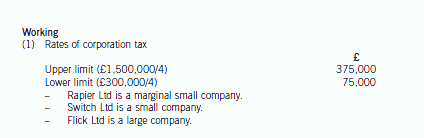
-
第7题:
(ii) Explain why Galileo is able to pay the inheritance tax due in instalments, state when the instalments are
due and identify any further issues relevant to Galileo relating to the payments. (3 marks)
正确答案:
(ii) Payment by instalments
The inheritance tax can be paid by instalments because Messier Ltd is an unquoted company controlled by Kepler at
the time of the gift and is still unquoted at the time of his death.
The tax is due in ten equal annual instalments starting on 30 November 2008.
Interest will be charged on any instalments paid late; otherwise the instalments will be interest free because Messier is
a trading company that does not deal in property or financial assets.
All of the outstanding inheritance tax will become payable if Galileo sells the shares in Messier Ltd.
Tutorial note
Candidates were also given credit for stating that payment by instalments is available because the shares represent at
least 10% of the company’s share capital and are valued at £20,000 or more. -
第8题:
5 You are an audit manager in Dedza, a firm of Chartered Certified Accountants. Recently, you have been assigned
specific responsibility for undertaking annual reviews of existing clients. The following situations have arisen in
connection with three client companies:
(a) Dedza was appointed auditor and tax advisor to Kora Co, a limited liability company, last year and has recently
issued an unmodified opinion on the financial statements for the year ended 30 June 2005. To your surprise,
the tax authority has just launched an investigation into the affairs of Kora on suspicion of underdeclaring income.
(7 marks)
Required:
Identify and comment on the ethical and other professional issues raised by each of these matters and state what
action, if any, Dedza should now take.
NOTE: The mark allocation is shown against each of the three situations.
正确答案:
5 DEDZA CO
(a) Tax investigation
■ Kora is a relatively new client. Before accepting the assignment(s) Dedza should have carried out customer due
diligence (CDD). Dedza should therefore have a sufficient knowledge and understanding of Kora to be aware of any
suspicions that the tax authority might have.
■ As the investigation has come as a surprise it is possible that, for example:
– the tax authority’s suspicions are unfounded;
– Dedza has failed to recognise suspicious circumstances.
Tutorial note: In either case, Dedza should seek clarification on the period of suspicion and review relevant procedures.
■ Dedza should review any communication from the predecessor auditor obtained in response to its ‘professional inquiry’
(for any professional reasons why the appointment should not have been accepted).
■ A quality control for new audits is that the audit opinion should be subject to a second partner review before it is issued.
It should be considered now whether or not such a review took place. If it did, then it should be sufficiently well
documented to evidence that the review was thorough and not a mere formality.
■ Criminal property includes the proceeds of tax evasion. If Kora is found to be guilty of under-declaring income that is a
money laundering offence.
■ Dedza’s reputational risk will be increased if implicated because it knew (or ought to have known) about Kora’s activities.
(Dedza may also be liable if found to have been negligent in failing to detect any material misstatement arising in the
2004/05 financial statements as a result.)
■ Kora’s audit working paper files and tax returns should be reviewed for any suspicion of fraud being committed by Kora
or error overlooked by Dedza. Tax advisory work should have been undertaken and/or reviewed by a manager/partner
not involved in the audit work.
■ As tax advisor, Dedza could soon be making disclosures of misstatements to the tax authority on behalf of Kora. Dedza
should encourage Kora to make necessary disclosure voluntarily.
■ Dedza will not be in breach of its duty of confidentiality to Kora if Kora gives Dedza permission to disclose information
to the tax authority (or Dedza is legally required to do so).
■ If Dedza finds reasonable grounds to know or suspect that potential disclosures to the tax authority relate to criminal
conduct, then a suspicious transaction report (STR) should be made to the financial intelligence unit (FIU) also.
Tutorial note: Though not the main issue credit will be awarded for other ethical issues such as the potential selfinterest/
self-review threat arising from the provision of other services. -
第9题:
(b) A sale of industrial equipment to Deakin Co in May 2005 resulted in a loss on disposal of $0·3 million that has
been separately disclosed on the face of the income statement. The equipment cost $1·2 million when it was
purchased in April 1996 and was being depreciated on a straight-line basis over 20 years. (6 marks)
Required:
For each of the above issues:
(i) comment on the matters that you should consider; and
(ii) state the audit evidence that you should expect to find,
in undertaking your review of the audit working papers and financial statements of Keffler Co for the year ended
31 March 2006.
NOTE: The mark allocation is shown against each of the three issues.
正确答案:
(b) Sale of industrial equipment
(i) Matters
■ The industrial equipment was in use for nine years (from April 1996) and would have had a carrying value of
$660,000 at 31 March 2005 (11/20 × $1·2m – assuming nil residual value and a full year’s depreciation charge
in the year of acquisition and none in the year of disposal). Disposal proceeds were therefore only $360,000.
■ The $0·3m loss represents 15% of PBT (for the year to 31 March 2006) and is therefore material. The equipment
was material to the balance sheet at 31 March 2005 representing 2·6% of total assets ($0·66/$25·7 × 100).
■ Separate disclosure, of a material loss on disposal, on the face of the income statement is in accordance with
IAS 16 ‘Property, Plant and Equipment’. However, in accordance with IAS 1 ‘Presentation of Financial Statements’,
it should not be captioned in any way that might suggest that it is not part of normal operating activities (i.e. not
‘extraordinary’, ‘exceptional’, etc).
Tutorial note: However, note that if there is a prior period error to be accounted for (see later), there would be
no impact on the current period income statement requiring consideration of any disclosure.
■ The reason for the sale. For example, whether the equipment was:
– surplus to operating requirements (i.e. not being replaced); or
– being replaced with newer equipment (thereby contributing to the $8·1m increase (33·8 – 25·7) in total
assets).
■ The reason for the loss on sale. For example, whether:
– the sale was at an under-value (e.g. to a related party);
– the equipment had a bad maintenance history (or was otherwise impaired);
– the useful life of the equipment is less than 20 years;
– there is any deferred consideration not yet recorded;
– any non-cash disposal proceeds have been overlooked (e.g. if another asset was acquired in a part-exchange).
■ If the useful life was less than 20 years, tangible non-current assets may be materially overstated in respect of other
items of equipment that are still in use and being depreciated on the same basis.
■ If the sale was to a related party then additional disclosure should be required in a note to the financial statements
for the year to 31 March 2006 (IAS 24 ‘Related Party Disclosures’).
Tutorial note: Since there are no specific pointers to a related party transaction (RPT), this point is not expanded
on.
■ Whether the sale was identified in the prior year audit’s post balance sheet event review. If so:
– the disclosure made in the prior year’s financial statements (IAS 10 ‘Events After the Balance Sheet Date’);
– whether an impairment loss was recognised at 31 March 2005.
■ If not, and the equipment was impaired at 31 March 2005, a prior period error should be accounted for (IAS 8
‘Accounting Policies, Changes in Accounting Estimates and Errors’). An impairment loss of $0·3m would have
been material to prior year profit (12·5%).
Tutorial note: Unless this was a RPT or the impairment arose after 31 March 2005 a prior period adjustment
should be made.
■ Failure to account for a prior period error (if any) would result in modification of the audit opinion ‘except for’ noncompliance
with IAS 8 (in the current year) and IAS 36 (in the prior period).
(ii) Audit evidence
■ Carrying amount ($0·66m as above) agreed to the non-current asset register balances at 31 March 2005 and
recalculation of the loss on disposal.
■ Cost and accumulated depreciation removed from the asset register in the year to 31 March 2006.
■ Receipt of proceeds per cash book agreed to bank statement.
■ Sales invoice transferring title to Deakin.
■ A review of maintenance expenses and records (e.g. to confirm reason for loss on sale).
■ Post balance sheet event review on prior year audit working papers file.
■ Management representation confirming that Deakin is not a related party (provided that there is no evidence to
suggest otherwise). -
第10题:
(c) In November 2006 Seymour announced the recall and discontinuation of a range of petcare products. The
product recall was prompted by the high level of customer returns due to claims of poor quality. For the year to
30 September 2006, the product range represented $8·9 million of consolidated revenue (2005 – $9·6 million)
and $1·3 million loss before tax (2005 – $0·4 million profit before tax). The results of the ‘petcare’ operations
are disclosed separately on the face of the income statement. (6 marks)
Required:
For each of the above issues:
(i) comment on the matters that you should consider; and
(ii) state the audit evidence that you should expect to find,
in undertaking your review of the audit working papers and financial statements of Seymour Co for the year ended
30 September 2006.
NOTE: The mark allocation is shown against each of the three issues.
正确答案:
■ The discontinuation of the product line after the balance sheet date provides additional evidence that, as at the
balance sheet date, it was of poor quality. Therefore, as at the balance sheet date:
– an allowance (‘provision’) may be required for credit notes for returns of products after the year end that were
sold before the year end;
– goods returned to inventory should be written down to net realisable value (may be nil);
– any plant and equipment used exclusively in the production of the petcare range of products should be tested
for impairment;
– any material contingent liabilities arising from legal claims should be disclosed.
(ii) Audit evidence
■ A copy of Seymour’s announcement (external ‘press release’ and any internal memorandum).
■ Credit notes raised/refunds paid after the year end for faulty products returned.
■ Condition of products returned as inspected during physical attendance of inventory count.
■ Correspondence from customers claiming reimbursement/compensation for poor quality.
■ Direct confirmation from legal adviser (solicitor) regarding any claims for customers including estimates of possible
payouts. -
第11题:
(b) (i) Explain the matters you should consider to determine whether capitalised development costs are
appropriately recognised; and (5 marks)
正确答案:
(b) (i) Materiality
The net book value of capitalised development costs represent 7% of total assets in 2007 (2006 – 7·7%), and is
therefore material. The net book value has increased by 13%, a significant trend.
The costs capitalised during the year amount to $750,000. If it was found that the development cost had been
inappropriately capitalised, the cost should instead have been expensed. This would reduce profit before tax by
$750,000, representing 42% of the year’s profit. This is highly material. It is therefore essential to gather sufficient
evidence to support the assertion that development costs should be recognised as an asset.
In 2007, $750,000 capitalised development costs have been incurred, when added to $160,000 research costs
expensed, total research and development costs are $910,000 which represents 20·2% of total revenue, again
indicating a high level of materiality for this class of transaction.
Relevant accounting standard
Development costs should only be capitalised as an intangible asset if the recognition criteria of IAS 38 Intangible Assets
have been demonstrated in full:
– Intention to complete the intangible asset and use or sell it
– Technical feasibility and ability to use or sell
– Ability to generate future economic benefit
– Availability of technical, financial and other resources to complete
– Ability to measure the expenditure attributable to the intangible asset.
Research costs must be expensed, as should development costs which do not comply with the above criteria. The
auditors must consider how Sci-Tech Co differentiates between research and development costs.
There is risk that not all of the criteria have been demonstrated, especially due to the subjective nature of the
development itself:
– Pharmaceutical development is highly regulated. If the government does not license the product then the product
cannot be sold, and economic benefits will therefore not be received.
– Market research should justify the commercial viability of the product. The launch of a rival product to Flortex
means that market share is likely to be much lower than anticipated, and the ability to sell Flortex is reduced. This
could mean that Flortex will not generate an overall economic benefit if future sales will not recover the research
and development costs already suffered, and yet to be suffered, prior to launch. The existence of the rival product
could indicate that Flortex is no longer commercially viable, in which case the capitalised development costs
relating to Flortex should be immediately expensed.
– The funding on which development is dependent may be withdrawn, indicating that there are not adequate
resources to complete the development of the products. Sci-Tech has failed to meet one of its required key
performance indicators (KPI) in the year ended 30 November 2007, as products valued at 0·8% revenue have
been donated to charity, whereas the required KPI is 1% revenue.
Given that there is currently a breach of the target KPIs, this is likely to result in funding equivalent to 25% of
research and development expenditure being withdrawn. If Sci-Tech Co is unable to source alternative means of
finance, then it would seem that adequate resources may not be available to complete the development of new
products. -
第12题:
(c) Discuss the quality control issues raised by the audit senior’s comments. (3 marks)
正确答案:
(c) Quality control issues raised from the senior’s comments
There are several issues raised, all of which indicate that quality control procedures have not functioned adequately. The
planned audit procedures appear to be inadequate, further tests should have been performed to confirm the completeness,
existence and valuation of the balance.
In last year’s audit, the management representation was accepted as sufficient evidence in relation to the receivable. Possibly
the item was not identified as a related party transaction, or it was not considered to be material enough to warrant further
investigation.
At the planning stage, it is standard procedure to identify key related parties of an entity, and to plan procedures specific to
them. Inadequate planning may lead to a lack of prioritisation of this as an area of relatively high audit risk.
Work on receivables is often carried out by a relatively inexperienced member of the audit team. Audit juniors may not
appreciate the potential breach of IAS 24, or the complexities regarding materiality assessment for this type of transaction.
Insufficient review by the audit manager has been performed on completed working papers, which then failed to spot the
weakness of the management representation as a source of evidence. This year the audit senior has highlighted the matter,
which can now be resolved through additional audit procedures. -
第13题:
(ii) Briefly outline the tax consequences for Henry if the types of protection identified in (i) were to be
provided for him by Happy Home Ltd compared to providing them for himself. You are not required to
discuss the corporation tax (CT) consequences for Happy Home Ltd. (4 marks)
正确答案:
(ii) Provision of protection: company or individual
If any of the policies are taken out and paid for by Henry personally, then there will be no tax relief on the premiums,
but neither will there normally be any tax payable on the proceeds or benefits received.
If Happy Home Ltd were to pay the premiums on a policy taken out by Henry, and of which he was the direct beneficiary,
then this will constitute a benefit, on the grounds that the company will have satisfied a personal liability of Henry’s.
Accordingly, income tax and Class 1A national insurance contributions will be payable on the benefit.
If, however, Happy Home Ltd were to decide to offer protection benefits to their employees on a group basis (and not
just to Henry), then it would be possible to avoid a charge under the benefits rules and/or obtain a lower rate of premium
under a collective policy. For example:
– A death in service benefit of up to four times remuneration can be provided as part of an approved pension scheme.
No benefit charge arises on Henry and any lump sum will be paid tax free. This could be considered a substitute
for a term assurance policy.
– If a group permanent health insurance policy were taken out, no benefit charge would arise on Henry, but any
benefits payable under the policy would be paid to Happy Home Ltd in the first instance. When subsequently paid
on to Henry, such payments would be treated as arising from his employment and subject to PAYE and national
insurance as for normal salary payments.
– If a group critical illness policy were taken out, again no benefit charge would arise on Henry, but in this case also,
any benefits received by Henry directly from Happy Home Ltd as a result of the payments under the policy would
be considered as derived from his employment and subject to income tax and national insurance. Such a charge
to tax and national insurance would however be avoided if these payments were made in terms of a trust. -
第14题:
(d) Explain how Gloria would be taxed in the UK on the dividends paid by Bubble Inc and the capital gains tax
and inheritance tax implications of a future disposal of the shares. Clearly state, giving reasons, whether or
not the payment made to Eric is allowable for capital gains tax purposes. (9 marks)
You should assume that the rates and allowances for the tax year 2005/06 apply throughout this question.
正确答案:
(d) UK tax implications of shares in Bubble Inc
Income tax
Gloria is UK resident and is therefore subject to income tax on her worldwide income. However, because she is non-UK
domiciled, she will only be taxed on the foreign dividends she brings into the UK.
Dividends brought into the UK will be grossed up for any tax paid in Oceania. The gross amount is taxed at 10% if it falls
into the starting or basic rate band and at 321/2% if it falls into the higher rate band. The tax suffered in Oceania is available
for offset against the UK tax liability. The offset is restricted to a maximum of the UK tax on the dividend income.
Capital gains tax
Individuals are subject to capital gains tax on worldwide assets if they are resident or ordinarily resident in the UK. However,
because Gloria is non-UK domiciled and the shares are situated abroad, the gain is only taxable to the extent that the sales
proceeds are brought into the UK. Any tax suffered in Oceania in respect of the gain is available for offset against the UK
capital gains tax liability arising on the shares.
Any loss arising on the disposal of the shares would not be available for relief in the UK.
In computing a capital gain or allowable loss, a deduction is available for the incidental costs of acquisition. However, to be
allowable, such costs must be incurred wholly and exclusively for the purposes of acquiring the asset. The fee paid to Eric
related to general investment advice and not to the acquisition of the shares and therefore, would not be deductible in
computing the gain.
Taper relief will be at non-business asset rates as Bubble Inc is an investment company.
Inheritance tax
Assets situated abroad owned by non-UK domiciled individuals are excluded property for the purposes of inheritance tax.
However, Gloria will be deemed to be UK domiciled (for the purposes of inheritance tax only) if she has been resident in the
UK for 17 out of the 20 tax years ending with the year in which the disposal occurs.
Gloria has been running a business in the UK since June 1992 and would therefore, appear to have been resident for at least
15 tax years (1992/93 to 2006/07 inclusive).
If Gloria is deemed to be UK domiciled such that the shares in Bubble Inc are not excluded property, business property relief
will not be available because Bubble Inc is an investment company. -
第15题:
(b) Peter, one of Linden Limited’s non-executive directors, having lived and worked in the UK for most of his adult
life, sold his home near London on 22 March 2006 and, together with his wife (a French citizen), moved to live
in a villa which she owns in the south of France. Peter is now demanding that the tax deducted from his director’s
fees, for the board meetings held on 18 April and 16 May 2006, be refunded, on the grounds that, as he is no
longer resident in the UK, he is no longer liable to UK income tax. All of the company’s board meetings are held
at its offices in Cambridge.
Despite Peter’s assurance that none of the other companies of which he is a director has disputed his change of
tax status, Damian is uncertain whether he should make the refunds requested. However, as Peter is a friend of
the company’s founder, Linden Limited’s managing director is urging him to do so, stating that if the tax does
have to be paid, then Linden Limited could always bear the cost.
Required:
Advise Damian whether Peter is correct in his assertion regarding his tax position and in the case that there
is a UK tax liability the implications of the managing director’s suggestion. You are not required to consider
national insurance (NIC) issues. (4 marks)
正确答案:
(b) Peter will have been resident and ordinarily resident in the UK. When such individuals leave the UK for a purpose other than
to take up full time employment abroad, they normally continue to still be so regarded unless their absence spans a complete
tax year. But, where someone intends to live permanently abroad or to do so for a period of at least three tax years, they may
be treated as non-resident and non-ordinarily resident from the day after the date of their departure, if they can provide
evidence to HMRC of that intention. Selling a residence in the UK and setting up home abroad will normally constitute such
evidence. However to retain non-resident status the intention must actually be fulfilled, and visits to the UK must not exceed
182 days in any tax year or average more than 90 days per year over a period of four tax years. Given that Peter would appear
to have several company directorships in the UK, it is possible that he might fail to satisfy the 90 day average ‘substantial
visits’ rule.
Even if Peter is classed as non-resident, any remuneration earned in the UK will still be liable to UK income tax, and subject
to PAYE, unless it is for duties incidental to an overseas employment, which is unlikely to be the case for fees paid to a nonexecutive
director for attending board meetings. Thus, income tax should still be deducted from the fees under PAYE. Where
PAYE should have been deducted from a director’s emoluments and it has not been, but the tax is nevertheless accounted
for by the company to HMRC, then to the extent that the tax is not reimbursed by the director, he will be treated as receiving
a benefit equivalent to the amount of tax. -
第16题:
(iii) State the value added tax (VAT) and stamp duty (SD) issues arising as a result of inserting Bold plc as
a holding company and identify any planning actions that can be taken to defer or minimise these tax
costs. (4 marks)
You should assume that the corporation tax rates for the financial year 2005 and the income tax rates
and allowances for the tax year 2005/06 apply throughout this question.
正确答案:
(iii) Bold plc will be making a taxable supply of services, likely to exceed the VAT threshold. It should therefore consider
registering for VAT – either immediately on a voluntary basis, or when its cumulative taxable supplies in the previous
twelve months exceed £60,000.
As an alternative, the new group can apply for a group VAT registration. This will simplify its VAT administration as intragroup
transactions are broadly disregarded for VAT purposes, and only one VAT return is required for the group as a
whole.
Stamp duty normally applies at 0·5% on the consideration payable in respect of transactions in shares. However, an
exemption is available in the case of a takeover, reconstruction or amalgamation where there is no real change in
ownership, i.e. the new shareholdings mirror the old shareholdings, and the transaction is for commercial purposes. The
insertion of a new holding company over an existing company, as proposed here, would qualify for this exemption.
There is no VAT on transactions in shares. -
第17题:
(iii) Explain the potential corporation tax (CT) implications of Tay Limited transferring work to Trent Limited,
and suggest how these can be minimised or eliminated. (3 marks)
正确答案:
(iii) Trading losses may not be carried forward where, within a period of three years there is both a change in the ownership
of a company and a major change in the nature or conduct of its trade. The transfer of work from Tay Limited to Trent
Limited is likely to constitute a major change in the nature or conduct of the latter’s trade. As a consequence, any tax
losses at the date of acquisition will be forfeited. Assuming losses were incurred uniformly in 2005, the tax losses at the
date of acquisition were £380,000 (300,000 + 2/3 x 120,000)). This is worth £114,000 assuming a corporation tax
rate of 30%.
Thus, Tay Limited should not consider transferring any trade to Trent Limited until after the third anniversary of the date
of the change of ownership i.e. not before 1 September 2008. As the trades are similar, there should be little problem
in transferring work from that date onwards. -
第18题:
(c) On the assumption that the administrators of Noland’s estate will sell quoted shares in order to fund the
inheritance tax due as a result of his death, calculate the value of the quoted shares that will be available to
transfer to Avril. You should include brief notes of your treatment of the house and the shares in Kurb Ltd.
(9 marks)
Note: you should assume that the tax rates and allowances for the tax year 2006/07 apply throughout this
question.
正确答案:(c) Value of quoted shares that can be transferred to Avril
The value of shares to be transferred to Avril will be equal to £370,000 less the inheritance tax due by the estate.
IHT is payable on transfers in the seven years prior to Noland’s death and on the death estate.
The only chargeable gift in the seven years prior to Noland’s death is the transfer to the discretionary trust. No tax is due in
respect of this gift as it is covered by the nil rate band.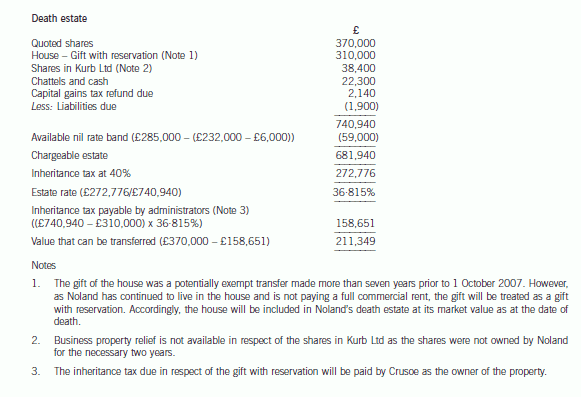
-
第19题:
(c) During the year Albreda paid $0·1 million (2004 – $0·3 million) in fines and penalties relating to breaches of
health and safety regulations. These amounts have not been separately disclosed but included in cost of sales.
(5 marks)
Required:
For each of the above issues:
(i) comment on the matters that you should consider; and
(ii) state the audit evidence that you should expect to find,
in undertaking your review of the audit working papers and financial statements of Albreda Co for the year ended
30 September 2005.
NOTE: The mark allocation is shown against each of the three issues.
正确答案:
(c) Fines and penalties
(i) Matters
■ $0·1 million represents 5·6% of profit before tax and is therefore material. However, profit has fallen, and
compared with prior year profit it is less than 5%. So ‘borderline’ material in quantitative terms.
■ Prior year amount was three times as much and represented 13·6% of profit before tax.
■ Even though the payments may be regarded as material ‘by nature’ separate disclosure may not be necessary if,
for example, there are no external shareholders.
■ Treatment (inclusion in cost of sales) should be consistent with prior year (‘The Framework’/IAS 1 ‘Presentation of
Financial Statements’).
■ The reason for the fall in expense. For example, whether due to an improvement in meeting health and safety
regulations and/or incomplete recording of liabilities (understatement).
■ The reason(s) for the breaches. For example, Albreda may have had difficulty implementing new guidelines in
response to stricter regulations.
■ Whether expenditure has been adjusted for in the income tax computation (as disallowed for tax purposes).
■ Management’s attitude to health and safety issues (e.g. if it regards breaches as an acceptable operational practice
or cheaper than compliance).
■ Any references to health and safety issues in other information in documents containing audited financial
statements that might conflict with Albreda incurring these costs.
■ Any cost savings resulting from breaches of health and safety regulations would result in Albreda possessing
proceeds of its own crime which may be a money laundering offence.
(ii) Audit evidence
■ A schedule of amounts paid totalling $0·1 million with larger amounts being agreed to the cash book/bank
statements.
■ Review/comparison of current year schedule against prior year for any apparent omissions.
■ Review of after-date cash book payments and correspondence with relevant health and safety regulators (e.g. local
authorities) for liabilities incurred before 30 September 2005.
■ Notes in the prior year financial statements confirming consistency, or otherwise, of the lack of separate disclosure.
■ A ‘signed off’ review of ‘other information’ (i.e. directors’ report, chairman’s statement, etc).
■ Written management representation that there are no fines/penalties other than those which have been reflected in
the financial statements. -
第20题:
3 You are the manager responsible for the audit of Keffler Co, a private limited company engaged in the manufacture of
plastic products. The draft financial statements for the year ended 31 March 2006 show revenue of $47·4 million
(2005 – $43·9 million), profit before taxation of $2 million (2005 – $2·4 million) and total assets of $33·8 million
(2005 – $25·7 million).
The following issues arising during the final audit have been noted on a schedule of points for your attention:
(a) In April 2005, Keffler bought the right to use a landfill site for a period of 15 years for $1·1 million. Keffler
expects that the amount of waste that it will need to dump will increase annually and that the site will be
completely filled after just ten years. Keffler has charged the following amounts to the income statement for the
year to 31 March 2006:
– $20,000 licence amortisation calculated on a sum-of-digits basis to increase the charge over the useful life
of the site; and
– $100,000 annual provision for restoring the land in 15 years’ time. (9 marks)
Required:
For each of the above issues:
(i) comment on the matters that you should consider; and
(ii) state the audit evidence that you should expect to find,
in undertaking your review of the audit working papers and financial statements of Keffler Co for the year ended
31 March 2006.
NOTE: The mark allocation is shown against each of the three issues.
正确答案:
3 KEFFLER CO
Tutorial note: None of the issues have any bearing on revenue. Therefore any materiality calculations assessed on revenue are
inappropriate and will not be awarded marks.
(a) Landfill site
(i) Matters
■ $1·1m cost of the right represents 3·3% of total assets and is therefore material.
■ The right should be amortised over its useful life, that is just 10 years, rather than the 15-year period for which
the right has been granted.
Tutorial note: Recalculation on the stated basis (see audit evidence) shows that a 10-year amortisation has been
correctly used.
■ The amortisation charge represents 1% of profit before tax (PBT) and is not material.
■ The amortisation method used should reflect the pattern in which the future economic benefits of the right are
expected to be consumed by Keffler. If that pattern cannot be determined reliably, the straight-line method must
be used (IAS 38 ‘Intangible Assets’).
■ Using an increasing sum-of-digits will ‘end-load’ the amortisation charge (i.e. least charge in the first year, highest
charge in the last year). However, according to IAS 38 there is rarely, if ever, persuasive evidence to support an
amortisation method that results in accumulated amortisation lower than that under the straight-line method.
Tutorial note: Over the first half of the asset’s life, depreciation will be lower than under the straight-line basis
(and higher over the second half of the asset’s life).
■ On a straight line basis the annual amortisation charge would be $0·11m, an increase of $90,000. Although this
difference is just below materiality (4·5% PBT) the cumulative effect (of undercharging amortisation) will become
material.
■ Also, when account is taken of the understatement of cost (see below), the undercharging of amortisation will be
material.
■ The sum-of-digits method might be suitable as an approximation to the unit-of-production method if Keffler has
evidence to show that use of the landfill site will increase annually.
■ However, in the absence of such evidence, the audit opinion should be qualified ‘except for’ disagreement with the
amortisation method (resulting in intangible asset overstatement/amortisation expense understatement).
■ The annual restoration provision represents 5% of PBT and 0·3% of total assets. Although this is only borderline
material (in terms of profit), there will be a cumulative impact.
■ Annual provisioning is contrary to IAS 37 ‘Provisions, Contingent Liabilities and Contingent Assets’.
■ The estimate of the future restoration cost is (presumably) $1·5m (i.e. $0·1 × 15). The present value of this
amount should have been provided in full in the current year and included in the cost of the right.
■ Thus the amortisation being charged on the cost of the right (including the restoration cost) is currently understated
(on any basis).
Tutorial note: A 15-year discount factor at 10% (say) is 0·239. $1·5m × 0·239 is approximately $0·36m. The
resulting present value (of the future cost) would be added to the cost of the right. Amortisation over 10 years
on a straight-line basis would then be increased by $36,000, increasing the difference between amortisation
charged and that which should be charged. The lower the discount rate, the greater the understatement of
amortisation expense.
Total amount expensed ($120k) is less than what should have been expensed (say $146k amortisation + $36k
unwinding of discount). However, this is not material.
■ Whether Keffler will wait until the right is about to expire before restoring the land or might restore earlier (if the
site is completely filled in 10 years).
(ii) Audit evidence
■ Written agreement for purchase of right and contractual terms therein (e.g. to make restoration in 15 years’ time).
■ Cash book/bank statement entries in April 2005 for $1·1m payment.
■ Physical inspection of the landfill site to confirm Keffler’s use of it.
■ Annual dump budget/projection over next 10 years and comparison with sum-of-digits proportions.
■ Amount actually dumped in the year (per dump records) compared with budget and as a percentage/proportion of
the total available.
■ Recalculation of current year’s amortisation based on sum-of-digits. That is, $1·1m ÷ 55 = $20,000.
Tutorial note: The sum-of-digits from 1 to 10 may be calculated long-hand or using the formula n(n+1)/2 i.e.
(10 × 11)/2 = 55.
■ The basis of the calculation of the estimated restoration costs and principal assumptions made.
■ If estimated by a quantity surveyor/other expert then a copy of the expert’s report.
■ Written management representation confirming the planned timing of the restoration in 15 years (or sooner). -
第21题:
(c) In April 2006, Keffler was banned by the local government from emptying waste water into a river because the
water did not meet minimum standards of cleanliness. Keffler has made a provision of $0·9 million for the
technological upgrading of its water purifying process and included $45,000 for the penalties imposed in ‘other
provisions’. (5 marks)
Required:
For each of the above issues:
(i) comment on the matters that you should consider; and
(ii) state the audit evidence that you should expect to find,
in undertaking your review of the audit working papers and financial statements of Keffler Co for the year ended
31 March 2006.
NOTE: The mark allocation is shown against each of the three issues.
正确答案:
(c) Ban on emptying waste water
(i) Matter
■ $0·9m provision for upgrading the process represents 45% PBT and is very material. This provision is also
material to the balance sheet (2·7% of total assets).
■ The provision for penalties is immaterial (2·2% PBT and 0·1% total assets).
■ The ban is an adjusting post balance sheet event in respect of the penalties (IAS 10). It provides evidence that at
the balance sheet date Keffler was in contravention of local government standards. Therefore it is correct (in
accordance with IAS 37) that a provision has been made for the penalties. As the matter is not material inclusion
in ‘other provisions’ is appropriate.
■ However, even if Keffler has a legal obligation to meet minimum standards, there is no obligation for upgrading the
purifying process at 31 March 2006 and the $0·9m provision should be written back.
■ If the provision for upgrading is not written back the audit opinion should be qualified ‘except for’ (disagreement).
■ Keffler does not even have a contingent liability for upgrading the process because there is no present obligation to
do so. The obligation is to stop emptying unclean water into the river. Nor is there a possible obligation whose
existence will be confirmed by an uncertain future event not wholly within Keffler’s control.
Tutorial note: Consider that Keffler has alternatives wholly within its control. For example, it could ignore the ban
and incur fines, or relocate/close this particular plant/operation or perhaps dispose of the water by alternative
means.
■ The need for a technological upgrade may be an indicator of impairment. Management should have carried out
an impairment test on the carrying value of the water purifying process and recognised any impairment loss in the
profit for the year to 31 March 2006.
■ Management’s intention to upgrade the process is more appropriate to an environmental responsibility report (if
any).
■ Whether there is any other information in documents containing financial statements.
(ii) Audit evidence
■ Penalty notices of fines received to confirm amounts and period/dates covered.
■ After-date payment of fines agreed to the cash book.
■ A copy of the ban and any supporting report on the local government’s findings.
■ Minutes of board meetings at which the ban was discussed confirming management’s intentions (e.g. to upgrade
the process).
Tutorial note: This may be disclosed in the directors’ report and/or as a non-adjusting post balance sheet event.
■ Any tenders received/costings for upgrading.
Tutorial note: This will be relevant if, for example, capital commitment authorised (by the board) but not
contracted for at the year end are disclosed in the notes to the financial statements.
■ Physical inspection of the emptying point at the river to confirm that Keffler is not still emptying waste water into
it (unless the upgrading has taken place).
Tutorial note: Thereby incurring further penalties. -
第22题:
(c) Lamont owns a residential apartment above its head office. Until 31 December 2006 it was let for $3,000 a
month. Since 1 January 2007 it has been occupied rent-free by the senior sales executive. (6 marks)
Required:
For each of the above issues:
(i) comment on the matters that you should consider; and
(ii) state the audit evidence that you should expect to find,
in undertaking your review of the audit working papers and financial statements of Lamont Co for the year ended
31 March 2007.
NOTE: The mark allocation is shown against each of the three issues.
正确答案:
(c) Rent-free accommodation
(i) Matters
■ The senior sales executive is a member of Lamont’s key management personnel and is therefore a related party.
■ The occupation of Lamont’s residential apartment by the senior sales executive is therefore a related party
transaction, even though no price is charged (IAS 24 Related Party Disclosures).
■ Related party transactions are material by nature and information about them should be disclosed so that users of
financial statements understand the potential effect of related party relationships on the financial statements.
■ The provision of ‘housing’ is a non-monetary benefit that should be included in the disclosure of key management
personnel compensation (within the category of short-term employee benefits).
■ The financial statements for the year ended 31 March 2007 should disclose the arrangement for providing the
senior sales executive with rent-free accommodation and its fair value (i.e. $3,000 per month).
Tutorial note: Since no price is charged for the transaction, rote-learned disclosures such as ‘the amount of outstanding
balances’ and ‘expense recognised in respect of bad debts’ are irrelevant.
(ii) Audit evidence
■ Physical inspection of the apartment to confirm that it is occupied.
■ Written representation from the senior sales executive that he is occupying the apartment free of charge.
■ Written representation from the management board confirming that there are no related party transactions requiring
disclosure other than those that have been disclosed.
■ Inspection of the lease agreement with (or payments received from) the previous tenant to confirm the $3,000
monthly rental value. -
第23题:
(c) Prepare briefing notes, to be used by an audit partner in your firm, assessing the professional, ethical and
other issues to be considered in deciding whether to proceed with the appointment as auditor of Medix Co.
Note: requirement (c) includes 2 professional marks. (12 marks)
正确答案:
(c) Briefing notes
To: Audit partner
From: Audit manager
Subject: Issues to consider regarding appointment as auditor of Medix Co
Introduction
Medix Co has recently invited our firm to become appointed as auditor. These briefing notes summarise the main issues we
should consider in deciding whether to take the appointment a stage further. My comments are based on a discussion held
with Ricardo Feller, finance director of Medix Co, a discussion with the current audit partner, and information provided in the
local newspaper.
Legal actions and investigations
There are several indications that Medix Co has a history of non compliance with law and regulations. The former finance
director is claiming unfair dismissal, and in the past the local authority has successfully taken legal action against the
company and has a current case pending. In addition, there have been two tax investigations in recent years hinting at noncompliance
with relevant tax regulations.
There are two problems for us in taking on a client with a propensity for legal actions and investigations. Firstly, the reputation
of the company must be considered. If we become associated with the company through being appointed as auditor, we could
be ‘tarred with the same brush’ and our own reputation also tarnished.
Secondly, we could become quickly exposed to an advocacy independence threat, which clearly should be avoided. Our
ethical status should not be compromised for the sake of gaining a new audit client. Mick Evans only ‘believes’ that the tax
matter has been resolved by the directors, and we should avoid taking on a new client which is involved in an on-going
investigation.
Public interest
The problems noted above are compounded by the bad publicity which the company is currently receiving. The local press
contained a recent article discussing Medix Co’s past and current breach of planning regulations. Given the current level of
public interest in environmental issues, and emphasis on corporate responsibility, it would seem that Medix Co has a poor
public perception, which we would not want to be associated with.
Potential liability to lender
The company is currently negotiating a significant bank loan, and the lender will be using the audited financial statements to
make a decision on whether to advance a loan, and the terms of any finance that might be advanced to Medix Co. This means
that our audit opinion for the forthcoming year end will be scrutinised by the lender, and our firm is exposed to a relatively
high risk of liability to a third party. Given that this will be our first audit, and the limited time we have available (discussed
below) our firm may feel that the risk of this audit engagement is too high. Should the appointment be accepted, disclaimers
should be put in place to ensure that we could not be sued in the event of the bank suffering a financial loss as a result of
their lending decision.
Timeframe. and resources
It is currently the last month of the financial year. If we are appointed as auditor we need to work quickly to develop a thorough
understanding of the business, and to begin to plan the assignment. We need to consider whether our firm has sufficient
resources to put together an audit team so quickly without detracting from other client work currently being conducted.
To make this matter worse, Mick Evans states that Medix Co likes ‘a quick audit’, and we need to consider how to manage
this expectation, as first year audit procedures such as systems documentation, and developing business understanding tend
to take a long time. We must be careful that the client does not pressure us into a ‘quick audit’, which could compromise
quality.
Medix Co operates in a reasonably specialist and highly regulated industry, so our firm should take care to ensure we have
expertise in this industry.
Potentially aggressive management style
There are several indicators that the management may take a confrontational approach, such as the unfair dismissal claim
brought against the company by the ex-finance director. In addition, the auditors prior to Mick Evans resigned following a
disagreement with management. This history shows that we may find it difficult to establish a good working relationship with
the management. As the company is owner managed the presence of a dominant managing director exacerbates this problem.
Management bias
There is incentive for the financial statements to be manipulated in order to secure bank finance. There is considerable risk
of material misstatement which our firm may consider to be unacceptably high.
Internal systems and controls
The current auditors have found systems and controls to be poor, and management has not acted upon recommendations
made by the auditors. Of course this does not mean that we should not take on the assignment – many companies have
weak controls. However, if we did take on the appointment, we would not be able to rely on controls or use a controls based
approach for the audit. We would need to take a substantive approach to the audit. One practical issue here is availability of
staff to conduct the audit testing, as substantive procedures tend to be more time consuming than if we could have taken a
systems based approach.
Opening balances
In all new audit assignments, work must be conducted to verify the opening balances. Given the possible fraud and poor
controls described above, we would need to perform. detailed testing on the opening balances as there is a high risk of fraud
and/or error in previous accounting periods. We may also wish to consider the competence of the previous auditors, who
appeared to disregard potential fraud indicator (two cash books) and had only one audit client.
Fees
Mick Evans has made it clear that Medix Co’s management likes to keep a tight control on costs, and it may put pressure on
us to charge a low audit fee. We need to bear in mind the risks associated with this engagement, as discussed above, and
only take on this high risk audit if the audit fee is high enough to compensate.
We should also consider the cash flow problems being experienced by the company. As a business we need to ensure that
we only take on clients with a good credit rating, and it seems that Medix Co, operating with an overdraft, may not be able
to pay our invoices.
Indication of fraud or money laundering
Surely the most serious issue to consider is that Jon Tate, the managing director, has kept two cash books. We need further
detail on this, but it clearly could indicate a fraud being perpetrated at the highest level of management. The fact that he has
maintained two cash books could indicate money laundering activites taking place, especially when considered in the context
of an owner-managed business with overseas operations. If this were the ONLY problem discovered it could be deemed
serious enough to bring to an end our appointment process. It would be reckless for our firm to take on a client where the
managing director is a fraudster.
Conclusion
Further information is needed in many areas before a final decision is made. However, from the information we have gathered
so far, it appears that Medix Co would represent a high risk client, and our firm must therefore be very careful to assess each
problem noted above before deciding whether to proceed with the appointment.