
(e) Briefly discuss FOUR initiatives that management might consider in order to further enhance profitability.(4 marks)
题目
(e) Briefly discuss FOUR initiatives that management might consider in order to further enhance profitability.
(4 marks)
相似考题
更多“(e) Briefly discuss FOUR initiatives that management might consider in order to further enhance profitability.(4 marks)”相关问题
-
第1题:
(b) Discuss how management’s judgement and the financial reporting infrastructure of a country can have a
significant impact on financial statements prepared under IFRS. (6 marks)
Appropriateness and quality of discussion. (2 marks)
正确答案:
(b) Management judgement may have a greater impact under IFRS than generally was the case under national GAAP. IFRS
utilises fair values extensively. Management have to use their judgement in selecting valuation methods and formulating
assumptions when dealing with such areas as onerous contracts, share-based payments, pensions, intangible assets acquired
in business combinations and impairment of assets. Differences in methods or assumptions can have a major impact on
amounts recognised in financial statements. IAS1 expects companies to disclose the sensitivity of carrying amounts to the
methods, assumptions and estimates underpinning their calculation where there is a significant risk of material adjustment
to their carrying amounts within the next financial year. Often management’s judgement is that there is no ‘significant risk’
and they often fail to disclose the degree of estimation or uncertainty and thus comparability is affected.
In addition to the IFRSs themselves, a sound financial reporting infrastructure is required. This implies effective corporate
governance practices, high quality auditing standards and practices, and an effective enforcement or oversight mechanism.
Therefore, consistency and comparability of IFRS financial statements will also depend on the robust nature of the other
elements of the financial reporting infrastructure.
Many preparers of financial statements will have been trained in national GAAP and may not have been trained in the
principles underlying IFRS and this can lead to unintended inconsistencies when implementing IFRS especially where the
accounting profession does not have a CPD requirement. Additionally where the regulatory system of a country is not well
developed, there may not be sufficient market information to utilise fair value measurements and thus this could lead to
hypothetical markets being created or the use of mathematical modelling which again can lead to inconsistencies because of
lack of experience in those countries of utilising these techniques. This problem applies to other assessments or estimates
relating to such things as actuarial valuations, investment property valuations, impairment testing, etc.
The transition to IFRS can bring significant improvement to the quality of financial performance and improve comparability
worldwide. However, there are issues still remaining which can lead to inconsistency and lack of comparability with those
financial statements. -
第2题:
(ii) Explain THREE strategies that might be adopted in order to improve the future prospects of Diverse
Holdings Plc. (6 marks)
正确答案:
(ii) The forecast situation of Diverse Holdings Plc is not without its problems. KAL and OPL require the immediate attention
of management. The position of KAL is precarious to say the least. There is a choice of strategies for it:
(i) Outsource the manufacture of appliances
(ii) Set up a manufacturing operation overseas
(ii) Withdraw from the market.
Each alternative must be assessed. Whatever decision is taken it is unlikely to affect the other four subsidiaries.
PSL is also independent of the other subsidiaries. A strategic decision to widen its range of products and outlets must
surely help. Hence management should endeavour to find new markets for its products, which are separate and distinct
from those markets served by its appointed distributors.
21
In order to improve the prospects of OPL management need to adopt appropriate strategies since at the present time the
company appears to be in a high growth market but is unable to capture a reasonable market share. Perhaps the answer
lies in increased or more effective advertising of the endorsement of the product range by health and safety experts.
Management should endeavour to develop a strategy to integrate further its subsidiaries so that they can benefit from
each other and also derive as much synergy as possible from the acquisition of HTL.
It is of paramount importance that management ensure that sufficient funds are channelled into growing OFL and HTL,
which are both showing a rising trend in profitability. The group has depleted cash reserves which must to some extent
be attributable to the purchase of HTL. It is possible that the divestment of KAL would provide some much needed
funding. -
第3题:
(d) Discuss the main benefits that might accrue from the successful implementation of a Total Quality
Management programme by the management of the combined entity. (5 marks)
正确答案:
(d) The benefits that might accrue from the successful implementation of a Total quality management programme by the
management of the combined entity include the following:
– There will be an increased awareness of all personnel within Quicklink Ltd of the need to establish a ‘quality culture’
within the company which will provide a basis of improved performance throughout the organisation.
– The successful adoption of a TQM philosophy would ensure that there is a real commitment to ‘continuous improvement’
in all processes.
– It would place a greater focus on customer satisfaction since at the heart of any TQM programme is a deep-seated
commitment to the satisfaction of every customer.
– There would be a greater emphasis upon teamwork which would be used in a number of forms e.g. quality circles which
could be established with a view to improving performance within every area of the business. The fostering of team spirit
will also improve communication within Quicklink Ltd.
– A major characteristic of a TQM programme is process-redesign which is used to simplify processes, systems,
procedures and the organisation itself. In this respect the adoption of a TQM philosophy will be invaluable since the
integration of the Quicklink Ltd and Celer Transport businesses will require, of necessity, a detailed review of those
processes currently employed.
– The adoption of a TQM philosophy will necessitate the monitoring of quality costs in order to measure whether the
objective of continuous improvement is being achieved. In this respect the aim will be to eliminate internal failure costs
such as late deliveries and lost items which are clearly detrimental to a business which operates in the transport and
haulage industry. -
第4题:
(ii) Briefly discuss FOUR non-financial factors which might influence the above decision. (4 marks)
正确答案:
(ii) Four factors that could be considered are as follows:
(i) The quality of the service provided by NSC as evidenced by, for example, the comfort of the ferries, on-board
facilities, friendliness and responsiveness of staff.
(ii) The health and safety track record of NSC – passenger safety is a ‘must’ in such operations.
(iii) The reliability, timeliness and dependability of NSC as a service provider.
(iv) The potential loss of image due to redundancies within Wonderland plc. -
第5题:
(ii) Briefly discuss TWO factors which could reduce the rate of return earned by the investment as per the
results in part (a). (4 marks)
正确答案:
(ii) Two factors which might reduce the return earned by the investment are as follows:
(i) Poor product quality
The very nature of the product requires that it is of the highest quality i.e. the cakes are made for human
consumption. Bad publicity via a ‘product recall’ could potentially have a catastrophic effect on the total sales to
Superstores plc over the eighteen month period.
(ii) The popularity of the Mighty Ben character
There is always the risk that the popularity of the character upon which the product is based will diminish with a
resultant impact on sales volumes achieved. In this regard it would be advisable to attempt to negotiate with
Superstores plc in order to minimise potential future losses. -
第6题:
(b) Advise the management of SCC Ltd of THREE strategies that should be considered in order to improve the
future performance of SCC Ltd. (6 marks)
正确答案:
(b) The four quadrants of the Boston-growth share matrix summarise expected profits and resultant cash flows and recommends
an outline strategy to follow which rather simplistically may be summarised as invest in stars, scrutinise the problem children,
milk the cows and divest the dogs.
Value Chain Analysis
It is vital that the management of SCC Ltd undertake a value chain analysis of each of its divisions in order to identify and
eliminate all non-value added activities, thereby improving profitability and cash flow without necessarily increasing turnover
or market share.
Divestment of the Footwear division
Serious consideration should be given to the divestment of the Footwear division. This will enable resources to be redirected
to divisions categorised as problem children i.e. the Industrial and Children’s divisions.
Support the Stars
As far as the Fashion division is concerned, it is obviously in a growth market and currently performing well. It is vital, given
the forecast performance of the other subsidiaries that the management of SCC Ltd do not concentrate on the poor performers
to the detriment of its only star. -
第7题:
(b) Briefly discuss how stakeholder groups (other than management and employees) may be rewarded for ‘good’
performance. (4 marks)
正确答案:
(b) Good performance should result in improved profitability and therefore other stakeholder groups may be rewarded for ‘good
performance’ as follows:
– Shareholders may receive increased returns on equity in the form. of increased dividends and /or capital growth.
– Customers may benefit from improved quality of products and services, and possibly lower prices.
– Suppliers may benefit from increased volumes of purchases.
– Government will benefit from increased amounts of taxation. -
第8题:
(c) Briefly discuss why the directors of HFL might choose contract D irrespective of whether or not contract D
would have been selected using expected values as per part (a). (2 marks)
正确答案:
(c) The directors might select Contract D under which 360,000 kilograms of organic mushrooms would be supplied to HFL for
each outlet. This is the entire capacity of HFL which would ensure that competitors would not be able to supply the same
product and hence the competitive advantage held by HFL might be preserved. -
第9题:
(c) Discuss the practical problems that may be encountered in the implementation of an activity-based system
of product cost management. (5 marks)
正确答案:
(c) The benefits of an activity-based system as the basis for product cost/profit estimation may not be straightforward. A number
of problems may be identified.
The selection of relevant activities and cost drivers may be complicated where there are many activities and cost drivers in
complex business situations.
There may be difficulty in the collection of data to enable accurate cost driver rates to be calculated. This is also likely to
require an extensive data collection and analysis system.
The problem of ‘cost driver denominator level’ may also prove difficult. This is similar to the problem in a traditional volume
related system. This is linked to the problem of fixed/variable cost analysis. For example the cost per batch may be fixed. Its
impact may be reduced, however, where the batch size can be increased without a proportionate increase in cost.
The achievement of the required level of management skill and commitment to change may also detract from the
implementation of the new system. Management may feel that the activity based approach contains too many assumptions
and estimates about activities and cost drivers. There may be doubt as to the degree of increased accuracy which it provides.
(alternative relevant examples and discussion would be acceptable) -
第10题:
(b) Discuss the statements of the operational manager of Bonlandia and assess their implications for SSH.
(4 marks)
正确答案:
(b) In a market place such as that in which SSH competes, product and service quality assumes critical significance. Quality is
a key determinant of the financial results and the level of competitiveness achieved by SSH. This will always be the case and
therefore quality may be viewed as a strategic necessity if SSH is to prosper in the future. Therefore, the statements of the
manager of Bonlandia operations are myopic at best and unethical at worst! Businesses use software in a variety of different
ways but poor quality software can do serious harm to businesses. Much will depend on the extent to which a business uses
its information for strategic reasons as opposed to meeting operational needs. The more a business uses its information
systems for strategic reasons then the greater the potential damage suffered as a consequence of poor quality software. It is
wrong for the manager of Bonlandia operations to knowingly promote the installation of poor quality business software in
clients’ businesses. The effects can be costly to clients in terms of poor planning, control and decision-making with potential
losses of client goodwill and reputation. -
第11题:
(c) Critically discuss the adoption of activity-based management (ABM) in companies such as TOC. (6 marks)
正确答案:
(c) Activity-based management (ABM) is a method of identifying and evaluating activities that a business performs using
activity-based costing to carry out a value chain analysis or a re-engineering initiative to improve strategic and operational
decisions in an organisation. Activity-based costing establishes relationships between overhead costs and activities so that
overhead costs can be more precisely allocated to products, services, or customer segments. Activity-based management
focuses on managing activities to reduce costs and improve customer value.
Kaplan and Cooper (1998) divide ABM into operational ABM and strategic ABM:
Operational ABM is about ‘doing things right’, using ABC information to improve efficiency. Those activities which add value
to the product can be identified and improved. Activities that don’t add value are the ones that need to be reduced to cut costs
without reducing product value.
Strategic ABM is about ‘doing the right things’, using ABC information to decide which products to develop and which
activities to use. This can also be used for customer profitability analysis, identifying which customers are the most profitable
and focusing on them more.
A risk with ABM is that some activities have an implicit value, not necessarily reflected in a financial value added to any
product. For instance a particularly pleasant workplace can help attract and retain the best staff, but may not be identified as
adding value in operational ABM. A customer that represents a loss based on committed activities, but that opens up leads
in a new market, may be identified as a low value customer by a strategic ABM process.
ABM can give middle managers an understanding of costs to other teams to help them make decisions that benefit the whole
organisation, not just their activities’ bottom line.
-
第12题:
(d) Discuss the professional accountant’s liability for reporting on prospective financial information and the
measures that the professional accountant might take to reduce that liability. (6 marks)
正确答案:
(d) Professional accountant’s liability
Liability for reporting on PFI
Independent accountants may be required to report on PFI for many reasons (e.g. to help secure a bank loan). Such forecasts
and projections are inherently unreliable. If the forecast or projection does not materialise, and the client or lenders (or
investors) consequently sustain financial loss, the accountant may face lawsuits claiming financial loss.
Courts in different jurisdictions use various criteria to define the group of persons to whom independent accountants may be
held liable for providing a report on an inaccurate forecast or projection. The most common of these are that an accountant
is liable to persons with whom there is proximity:
(i) only (i.e. the client who engaged the independent accountant);
(ii) or whose relationship with the accountant sufficiently approaches privity;
(iii) and to persons or members of a limited group of persons for whose benefit and guidance the accountant supplied the
information or knew that the recipient of the information intended to supply it;
(iv) and to persons who reasonably can be foreseen to rely on the information.
Measures to reduce liability
As significant assumptions will be essential to a reader’s understanding of a financial forecast, the independent accountant
should ensure that they are adequately disclosed and clearly stated to be the management’s responsibility. Hypothetical
assumptions should be clearly distinguished from best estimates.
The introduction to any forecast (and/or report thereon) should include a caveat that the prospective results may not be
attained. Specific and extensive warnings (‘the actual results … will vary’) and disclaimers (‘we do not express an opinion’)
may be effective in protecting an independent accountant sued for inaccuracies in forecasts or projections that they have
reported on.
Any report to a third party should state:
■ for whom it is prepared, who is entitled to rely on it (if anyone) and for what purpose;
■ that the engagement was undertaken in accordance with the engagement terms;
■ the work performed and the findings.
An independent accountant’s report should avoid inappropriate and open-ended wording, for example, ‘we certify …’ and ‘we
obtained all the explanations we considered necessary’.
Engagement terms to report on PFI should include an appropriate liability cap that is reasonable given the specific
circumstances of the engagement.
The independent accountant may be able to obtain indemnity from a client in respect of claims from third parties. Such ‘hold
harmless’ clauses obligate the client to indemnify the independent accountant from third party claims. -
第13题:
2 Chen Products produces four manufactured products: Products 1, 2, 3 and 4. The company’s risk committee recently
met to discuss how the company might respond to a number of problems that have arisen with Product 2. After a
number of incidents in which Product 2 had failed whilst being used by customers, Chen Products had been presented
with compensation claims from customers injured and inconvenienced by the product failure. It was decided that the
risk committee should meet to discuss the options.
When the discussion of Product 2 began, committee chairman Anne Ricardo reminded her colleagues that, apart from
the compensation claims, Product 2 was a highly profitable product.
Chen’s risk management committee comprised four non-executive directors who each had different backgrounds and
areas of expertise. None of them had direct experience of Chen’s industry or products. It was noted that it was
common for them to disagree among themselves as to how risks should be managed and that in some situations,
each member proposed a quite different strategy to manage a given risk. This was the case when they discussed
which risk management strategy to adopt with regard to Product 2.
Required:
(a) Describe the typical roles of a risk management committee. (6 marks)
正确答案:
(a) Typical roles of a risk management committee
The typical roles of a risk management committee are as follows:
To agree and approve the risk management strategy and policies. The design of risk policy will take into account the
environment, the strategic posture towards risk, the product type and a range of other relevant factors.
Receiving and reviewing risk reports from affected departments. Some departments will file regular reports on key risks (such
as liquidity assessments from the accounting department, legal risks from the company secretariat or product risks from the
sales manager).
Monitoring overall exposure and specific risks. If the risk policy places limits on the total risk exposure for a given risk then
this role ensures that limits are adhered to. In the case of certain strategic risks, monitoring could occur on a very frequent
basis whereas for more operational risks, monitoring will more typically occur to coincide with risk management committee
meetings.
Assessing the effectiveness of risk management systems. This involves getting feedback from departments and the internal
audit function on the workings of current management and risk mitigation systems.
Providing general and explicit guidance to the main board on emerging risks and to report on existing risks. This will involve
preparing reports on apparent risks and assessing their probability of being realised and their potential impact if they do.
To work with the audit committee on designing and monitoring internal controls for the management and mitigation of risks.
If the risk committee is part of the executive structure, it will likely have an advisory role in respect of its input into the audit
committee. If it is non-executive, its input may be more directly influential.
[Tutorial note: other roles may be suggested that, if relevant, will be rewarded] -
第14题:
(c) Comment on four reasons why the Managing Director of Quicklink Ltd might consider the acquisition of the
Celer Transport business to be a ‘good strategic move’ insofar as may be determined from the information
provided. (5 marks)
正确答案: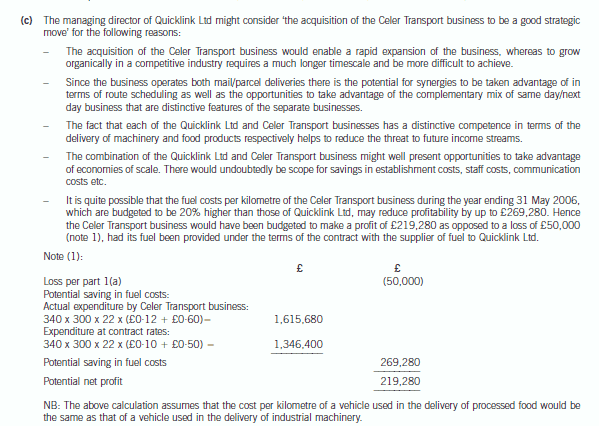
-
第15题:
(b) Discuss FOUR factors that distinguish service from manufacturing organisations and explain how each of
these factors relates to the services provided by the Dental Health Partnership. (5 marks)
正确答案:
(b) The major characteristics of services which distinguish services from manufacturing are as follows:
– Intangibility.
When a dentist provides a service to a client there are many intangible factors involved such as for example the
appearance of the surgery, the personality of the dentist, the manner and efficiency of the dental assistant. The output
of the service is ‘performance’ by the dentist as opposed to tangible goods.
– Simultaneity.
The service provided by the dentist to the patient is created by the dentist at the same time as the patient consumed it
thus preventing any advance verification of quality.
– Heterogeneity.
Many service organisations face the problem of achieving consistency in the quality of its output. Whilst each of the
dentists within the Dental Health Partnership will have similar professional qualifications there will be differences in the
manner they provide services to clients.
– Perishability.
Many services are perishable. The services of a dentist are purchased only for the duration of an appointment. -
第16题:
(ii) Comment briefly on how divisional managers might respond to the results achieved and ONE potential
problem that might be experienced by Our Timbers Ltd. (2 marks)
正确答案: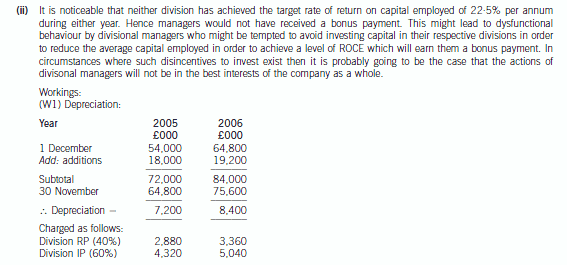
-
第17题:
(c) Explain the term ‘target costing’ and how it may be applied by GWCC. Briefly discuss any potential
limitations in its application. (8 marks)
正确答案:
(c) Target costing should be viewed as an integral part of a strategic profit management system. The initial consideration in target
costing is the determination of an estimate of the selling price for a new product which will enable a firm to capture its required
share of the market. In this particular example, Superstores plc, which on the face of it looks a powerful commercial
organisation, wishes to apply a 35% mark-up on the purchase price of each cake from GWCC. Since Superstores plc has
already decided on a launch price of £20·25 then it follows that the maximum selling price that can be charged by GWCC
is (100/135) x £20·25 which is £15·00.
This is clearly a situation which lends itself to the application of target costing/pricing techniques as in essence GWCC can
see the extent to which they fall short of the required level of return with regard to a contract with Superstores plc which ends
after twelve months. Thus it is necessary to reduce the total costs by £556,029 to this figure in order to achieve the desired
level of profit, having regard to the rate of return required on new capital investment. The deduction of required profit from
the proposed selling price will produce a target price that must be met in order to ensure that the desired rate of return is
obtained. Thus the main theme that underpins target costing can be seen to be ‘what should a product cost in order to achieve
the desired level of return’.
Target costing will necessitate comparison of current estimated cost levels against the target level which must be achieved if
the desired levels of profitability, and hence return on investment, are to be achieved. Thus where a gap exists between the
current estimated cost levels and the target cost, it is essential that this gap be closed.
The Directors of GWCC plc should be aware of the fact that it is far easier to ‘design out’ cost during the pre-production phase
than to ‘control out’ cost during the production phase. Thus cost reduction at this stage of a product’s life cycle is of critical
significance to business success.
A number of techniques may be employed in order to help in the achievement and maintenance of the desired level of target
cost. Attention should be focussed upon the identification of value added and non-value added activities with the aim of the
elimination of the latter. The product should be developed in an atmosphere of ‘continuous improvement’. In this regard, total
quality techniques such as the use of Quality circles may be used in attempting to find ways of achieving reductions in product
cost.
Value engineering techniques can be used to evaluate necessary product features such as the quality of materials used. It is
essential that a collaborative approach is taken by the management of GWCC and that all interested parties such as suppliers
and customers are closely involved in order to engineer product enhancements at reduced cost.
The degree of success that will be achieved by GWCC via the application of target costing principles will be very much
dependent on the extent of ‘flexibility’ in variable costs. Also the accuracy of information gathered by GWCC will assume
critical importance because the use of inaccurate information will produce calculated ‘cost gaps’ which are meaningless and
render the application of target costing principles of little value. -
第18题:
(ii) Briefly explain the extent to which the application of sensitivity analysis might be useful in deciding
which refrigeration system to purchase and discuss the limitations inherent in its use. (3 marks)
正确答案:
(ii) Sensitivity analysis could be used to assess how responsive the NPV calculated in part (a) in respect of each decision
option change is to changes in the variables used to calculate it. The application of sensitivity analysis requires that the
net present values are calculated under alternative assumptions in order to determine how sensitive they are to changing
conditions. In this particular example then a relatively small change in the forecast cash flows might lead to a change
in the investment decision. The application of sensitivity analysis can indicate those variables to which the NPV is most
sensitive and the extent to which these variables may change before an investment results in a negative NPV. Thus the
application of sensitivity analysis may provide management with an indication of why a particular project might fail. The
directors of Stay Cool Ltd should give consideration to the potential variations in the independent variables which feature
in the decision-making process such as:
– estimated revenues
– estimated operating costs
– estimated working lives
– estimated repair costs
– the estimated discount rate i.e. cost of capital of each alternative investment.
Sensitivity analysis has some serious limitations. The use of the method requires changes in each variable under
consideration are isolated. However management may be focused on what happens if changes occur in two or more
critical variables. Another problem relating to the use of sensitivity analysis to forecast outcomes lies in the fact that it
provides no indication of the likelihood of the occurrence of changes in critical variables. -
第19题:
(b) Explain how growth may be assessed, and critically discuss the advantages and issues that might arise as a
result of a decision by the directors of CSG to pursue the objective of growth. (8 marks)
正确答案:
(b) Growth may be measured in a number of ways which are as follows:
Cash flow
This is a very important measure of growth as it ultimately determines the amount of funds available for re-investment by any
business.
Sales revenue
Growth in sales revenues generated is only of real value to investors if it precipitates growth in profits.
Profitability
There are many measures relating to profit which include sales margin, earnings before interest, taxation, depreciation and
amortisation (EBITDA) and earnings per share. More sophisticated measures such as return on capital employed and residual
income consider the size of the investment relative to the level of profits earned. In general terms, measures of profitability
are only meaningful if they are used as a basis for comparisons over time or in conjunction with other measures of
performance. Growth rate in profitability are useful when compared with other companies and also with other industries.
Return on investment
A growing return upon invested capital suggests that capital is being used more and more productively. Indicators of a growing
return would be measured by reference to dividend payment and capital growth.
Market share
Growth in market share is generally seen as positive as it can generate economies of scale.
Number of products/service offerings
Growth is only regarded as useful if products and services are profitable.
Number of employees
Measures of productivity such as value added per employee and profit per employee are often used by shareholders in
assessing growth. Very often an increased headcount is a measure of success in circumstances where more people are
needed in order to deliver a service to a required standard. However it is incumbent on management to ensure that all
employees are utilised in an effective manner.
It is a widely held belief that growth requires profits and that growth produces profits. Profits are essential in order to prevent
a company which has achieved growth from becoming a target for a take-over or in a worse case scenario goes into
liquidation. Hence it is fundamental that a business is profitable throughout its existence. Growth accompanied by growth in
profits is also likely to aid the long-term survival of an organisation. CSG operates in Swingland which experiences fluctuations
in its economic climate and in this respect the exploitation of profitable growth opportunities will help CSG to survive at the
expense of its competitors who do not exploit such opportunities.
Note: Alternative relevant discussion and examples would be accepted. -
第20题:
(ii) Briefly discuss THREE disadvantages of using EVA? in the measurement of financial performance.
(3 marks)
正确答案:
(ii) Disadvantages of an EVA approach to the measurement of financial performance include:
(i) The calculation of EVA may be complicated due to the number of adjustments required.
(ii) It is difficult to use EVA for inter-firm and inter-divisional comparisons because it is not a ratio measure.
(iii) Economic depreciation is difficult to estimate and conflicts with generally accepted accounting principles.
Note: Other relevant discussion would be acceptable. -
第21题:
JOL Co was the market leader with a share of 30% three years ago. The managing director of JOL Co stated at a
recent meeting of the board of directors that: ‘our loss of market share during the last three years might lead to the
end of JOL Co as an organisation and therefore we must address this issue immediately’.
Required:
(b) Discuss the statement of the managing director of JOL Co and discuss six performance indicators, other than
decreasing market share, which might indicate that JOL Co might fail as a corporate entity. (10 marks)
正确答案:
(b) It would appear that JOL’s market share has declined from 30% to (80 – 26)/3 = 18% during the last three years. A 12%
fall in market share is probably very significant with a knock-on effect on profits and resultant cash flows. Obviously such a
declining trend needs to be arrested immediately and this will require a detailed investigation to be undertaken by the directors
of JOL. Consequently loss of market share can be seen to be an indicator of potential corporate failure. Other indicators of
corporate failure are as follows:
Six performance indicators that an organisation might fail are as follows:
Poor cash flow
Poor cash flow might render an organisation unable to pay its debts as and when they fall due for payment. This might mean,
for example, that providers of finance might be able to invoke the terms of a loan covenant and commence legal action against
an organisation which might eventually lead to its winding-up.
Lack of new production/service introduction
Innovation can often be seen to be the difference between ‘life and death’ as new products and services provide continuity
of income streams in an ever-changing business environment. A lack of new product/service introduction may arise from a
shortage of funds available for re-investment. This can lead to organisations attempting to compete with their competitors with
an out of date range of products and services, the consequences of which will invariably turn out to be disastrous.
General economic conditions
Falling demand and increasing interest rates can precipitate the demise of organisations. Highly geared organisations will
suffer as demand falls and the weight of the interest burden increases. Organisations can find themselves in a vicious circle
as increasing amounts of interest payable are paid from diminishing gross margins leading to falling profits/increasing losses
and negative cash flows. This leads to the need for further loan finance and even higher interest burden, further diminution
in margins and so on.
Lack of financial controls
The absence of sound financial controls has proven costly to many organisations. In extreme circumstances it can lead to
outright fraud (e.g. Enron and WorldCom).
Internal rivalry
The extent of internal rivalry that exists within an organisation can prove to be of critical significance to an organisation as
managerial effort is effectively channeled into increasing the amount of internal conflict that exists to the detriment of the
organisation as a whole. Unfortunately the adverse consequences of internal rivalry remain latent until it is too late to redress
them.
Loss of key personnel
In certain types of organisation the loss of key personnel can ‘spell the beginning of the end’ for an organisation. This is
particularly the case when individuals possess knowledge which can be exploited by direct competitors, e.g. sales contacts,
product specifications, product recipes, etc.
-
第22题:
(b) The management of Division C has identified the need to achieve cost savings in order to become more
competitive. They have decided that an analysis and investigation of quality costs into four sub-categories will
provide a focus for performance measurement and improvement.
Required:
Identify the FOUR sub-categories into which quality costs can be analysed and provide examples (which
must relate to Division C) of each of the four sub-categories of quality cost that can be investigated in order
that overall cost savings might be achieved and hence the performance improved. (8 marks)
正确答案:
(b) Quality costs may be monitored by measuring costs of non-conformance and costs of conformance.
Costs of non-conformance occur when the product fails to reach the design quality standards. Such costs may be subdivided
into internal failure costs and external failure costs.
Internal failure costs occur when the failure is detected before the transfer of the product to the customer.
External failure costs occur when the failure to reach the required standards is not detected until after the product has been
transferred to the customer.
Costs of conformance are those incurred in reducing or eliminating the costs of non-conformance. Such costs may be
subdivided into appraisal costs and prevention costs.
Appraisal costs are those associated with the evaluation of items such as purchased material and services in order to ensure
that they conform. to the agreed specification.
Prevention costs are those associated with the implementation of a quality improvement programme. Such costs are planned
in advance and their implementation should lead to continuous improvement.
Examples of quality costs relevant to Division C may include:
Internal failure costs: cost of materials scrapped due to poor receipt and storage procedures or losses of CC output due to poor
processing routines.
External failure costs: cost of quality problems with batch of CC not detected until it has reached Division B. This may require
free replacement of the batch and compensation for loss of output by Division B.
Appraisal costs: evaluation of purchased material and services in relation to the manufacture of CC to ensure that it conforms
to the agreed specification; e.g. inspection and testing before use.
Prevention costs: the cost of implementation of staff training and the costs of equipment testing to ensure that it conforms to
the specification standards required for the production of CC.
(Alternative relevant examples would be accepted) -
第23题:
(c) Briefly outline the corporation tax (CT) issues that Tay Limited should consider when deciding whether to
acquire the shares or the assets of Tagus LDA. You are not required to discuss issues relating to transfer
pricing. (7 marks)
正确答案:
(c) (1) Acquisition of shares
Status
The acquisition of shares in Tagus LDA will add another associated company to the group. This may have an adverse
effect on the rates of corporation tax paid by the two existing group companies, particularly Tay Limited.
Taxation of profits
Profits will be taxed in Portugal. Any profits remitted to the UK as dividends will be taxable as Schedule D Case V income,
but will attract double tax relief. Double tax relief will be available against two types of tax suffered in Portugal. Credit
will be given for any tax withheld on payments from Tagus LDA to Tay Limited and relief will also be available for the
underlying tax as Tay Limited owns at least 10% of the voting power of Tagus LDA. The underlying tax is the tax
attributable to the relevant profits from which the dividend was paid. Double tax relief is given at the lower rate of the
UK tax and the foreign tax (withholding and underlying taxes) suffered.
Losses
As Tagus LDA is a non-UK resident company, losses arising in Tagus LDA cannot be group relieved against profits of the
two UK companies. Similarly, any UK trading losses cannot be used against profits generated by Tagus LDA.
(2) Acquisition of assets
Status
The business of Tagus will be treated as a branch of Tay Limited i.e. an extension of the UK company’s activities. The
number of associated companies will be unaffected.
Taxation of profits
Tay Limited will be treated as having a permanent establishment in Portugal. Profits attributable to the Tagus business
will thus still be taxed in Portugal. In addition, the profits will be taxed in the UK as trading income. Double tax relief
will be available for the tax already suffered in Portugal at the lower of the two rates.
Capital allowances will be available. As the assets in question will not previously have been subject to a claim for UK
capital allowances, there will be no cost restriction and the consideration attributable to each asset will form. the basis
for the capital allowance claim.
Losses
The Tagus trade is part of Tay Limited’s trade, so any losses incurred by the Portuguese trade will automatically be offset
against the trading profits of the UK trade, and vice versa.