
6 Proposed ISA 600 (Revised and Redrafted) The Audit of Group Financial Statements is likely to substantially increasethe formal requirements in the area of group audits.Required:(a) Outline the significant issues that are being addressed in the IAASB’s p
题目
6 Proposed ISA 600 (Revised and Redrafted) The Audit of Group Financial Statements is likely to substantially increase
the formal requirements in the area of group audits.
Required:
(a) Outline the significant issues that are being addressed in the IAASB’s project on group audits. (5 marks)
相似考题
更多“6 Proposed ISA 600 (Revised and Redrafted) The Audit of Group Financial Statements is likely to substantially increasethe formal requirements in the area of group audits.Required:(a) Outline the significant issues that are being addressed in the IAASB’s p”相关问题
-
第1题:
(b) On 1 April 2004 Volcan introduced a ‘reward scheme’ for its customers. The main elements of the reward
scheme include the awarding of a ‘store point’ to customers’ loyalty cards for every $1 spent, with extra points
being given for the purchase of each week’s special offers. Customers who hold a loyalty card can convert their
points into cash discounts against future purchases on the basis of $1 per 100 points. (6 marks)
Required:
For each of the above issues:
(i) comment on the matters that you should consider; and
(ii) state the audit evidence that you should expect to find,
in undertaking your review of the audit working papers and financial statements of Volcan for the year ended
31 March 2005.
NOTE: The mark allocation is shown against each of the three issues.
正确答案:
(b) Reward scheme
(i) Matters
■ If the entire year’s revenue ($303m) attracted store points then the cost of the reward scheme in the year is at
most $3·03m. This represents 1% of revenue, which is material to the income statement and very material
(31·9%) to profit before tax (PBT).
■ The proportion of customers who register for loyalty cards and the percentage of revenue (and profit) which they
represent (which may vary from store to store depending on customer profile).
■ In accordance with the assumption of accruals, which underlies the preparation and presentation of financial
statements (The Framework/IAS 1 ‘Presentation of Financial Statements’), the expense and liability should be
recognised as revenue is earned. (It is of the nature of a discount.)
■ Any restrictions on the terms for converting points (e.g. whether they expire if not used within a specified time).
■ To the extent that points have been awarded but not redeemed at 31 March 2005, Volcan will have a liability at
the balance sheet date.
■ Agree the total balance due to customers at the year end under the reward scheme to the sum of the points on
individual customer reward cards.
■ The proportion of reward points awarded which are not expected to be claimed (e.g. the ‘take up’ of points awarded
may be only 80%, say).
■ Whether reward points are valued at selling price or cost. For example, if the average gross profit margin is 20%,
one point is equivalent to 0·8 cents of goods at cost.
(ii) Audit evidence
■ New/updated systems documentation explaining how:
– loyalty cards (and numbers) are issued to customers;
– points earned are recorded at the point of sale; and
– points are later redeemed on subsequent purchases.
■ Walk-through tests (e.g. on registering customer applications and issuing loyalty cards, awarding of points on
special offer items).
■ Tests of controls supporting the extent to which audit reliance is placed on the accounting and internal control
system. In particular, how points are extracted from the electronic tills (cash registers) and summarised into the
weekly/monthly financial data for each store which underlies the financial statements.
■ Analytical procedures on the value of points awarded by store per month with explanations of variations (‘variation
analysis’). For example, similar proportions (not exceeding 1% of revenue) of points in each month might be
expected by store – possibly increasing following any promotion of the ‘loyalty’ scheme.
Tutorial note: Within a close community, for example, a high proportion of customers might be expected to sign
up for the reward scheme. However, in big cities, where a large proportion of the customers might be transitory
(e.g. tourists or other visitors) the proportion may be much lower.
■ Tests of detail on a sample of transactions with customers undertaken at store visits. For example, for a sample of
copy till receipts:
– check the arithmetic accuracy of points awarded (1 per $1 spent + special offers);
– agree points awarded for special offers to that week’s special offers;
– for cash discounts taken confirm the conversion of points is against the opening balance of points awarded
(not against purchases just made). -
第2题:
3 You are the manager responsible for the audit of Seymour Co. The company offers information, proprietary foods and
medical innovations designed to improve the quality of life. (Proprietary foods are marketed under and protected by
registered names.) The draft consolidated financial statements for the year ended 30 September 2006 show revenue
of $74·4 million (2005 – $69·2 million), profit before taxation of $13·2 million (2005 – $15·8 million) and total
assets of $53·3 million (2005 – $40·5 million).
The following issues arising during the final audit have been noted on a schedule of points for your attention:
(a) In 2001, Seymour had been awarded a 20-year patent on a new drug, Tournose, that was also approved for
food use. The drug had been developed at a cost of $4 million which is being amortised over the life of the
patent. The patent cost $11,600. In September 2006 a competitor announced the successful completion of
preliminary trials on an alternative drug with the same beneficial properties as Tournose. The alternative drug is
expected to be readily available in two years time. (7 marks)
Required:
For each of the above issues:
(i) comment on the matters that you should consider; and
(ii) state the audit evidence that you should expect to find,
in undertaking your review of the audit working papers and financial statements of Seymour Co for the year ended
30 September 2006.
NOTE: The mark allocation is shown against each of the three issues.
正确答案: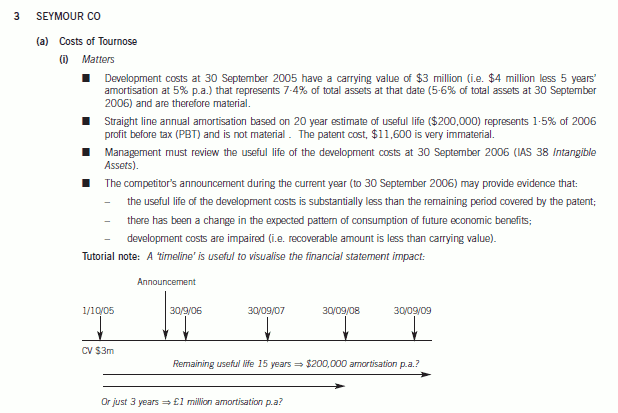
■ A change in the estimated useful life should be accounted for as a change in accounting estimate in accordance
with IAS 8 Accounting Policies, Changes in Accounting Estimates and Errors. For example, if the development
costs have little, if any, useful life after the introduction of the alternative drug (‘worst case’ scenario), the carrying
value ($3 million) should be written off over the current and remaining years, i.e. $1 million p.a. The increase in
amortisation/decrease in carrying value ($800,000) is material to PBT (6%) and total assets (1·5%).
■ Similarly a change in the expected pattern of consumption of the future economic benefits should be accounted for
as a change in accounting estimate (IAS 8). For example, it may be that the useful life is still to 2020 but that
the economic benefits may reduce significantly in two years time.
■ After adjusting the carrying amount to take account of the change in accounting estimate(s) management should
have tested it for impairment and any impairment loss recognised in profit or loss.
(ii) Audit evidence
■ $3 million carrying amount of development costs brought forward agreed to prior year working papers and financial
statements.
■ A copy of the press release announcing the competitor’s alternative drug.
■ Management’s projections of future cashflows from Tournose-related sales as evidence of the useful life of the
development costs and pattern of consumption.
■ Reperformance of management’s impairment test on the development costs: Recalculation of management’s
calculation of the carrying amount after revising estimates of useful life and/or consumption of benefits compared
with management’s calculation of value in use.
■ Sensitivity analysis on management’s key assumptions (e.g. estimates of useful life, discount rate).
■ Written management representation on the key assumptions concerning the future that have a significant risk of
causing material adjustment to the carrying amount of the development costs. (These assumptions should be
disclosed in accordance with IAS 1 Presentation of Financial Statements.) -
第3题:
4 (a) The purpose of ISA 250 Consideration of Laws and Regulations in an Audit of Financial Statements is to
establish standards and provide guidance on the auditor’s responsibility to consider laws and regulations in an
audit of financial statements.
Explain the auditor’s responsibilities for reporting non-compliance that comes to the auditor’s attention
during the conduct of an audit. (5 marks)
正确答案:
4 CLEEVES CO
(a) Reporting non-compliance
Non-compliance refers to acts of omission or commission by the entity being audited, either intentional or unintentional, that
are contrary to the prevailing laws or regulations.
To management
Regarding non-compliance that comes to the auditor’s attention the auditor should, as soon as practicable, either:
■ communicate with those charged with governance; or
■ obtain audit evidence that they are appropriately informed.
However, the auditor need not do so for matters that are clearly inconsequential or trivial and may reach agreement1 in
advance on the nature of such matters to be communicated.
If in the auditor’s judgment the non-compliance is believed to be intentional and material, the auditor should communicate
the finding without delay.
If the auditor suspects that members of senior management are involved in non-compliance, the auditor should report the
matter to the next higher level of authority at the entity, if it exists (e.g. an audit committee or a supervisory board). Where
no higher authority exists, or if the auditor believes that the report may not be acted upon or is unsure as to the person to
whom to report, the auditor would consider seeking legal advice.
To the users of the auditor’s report on the financial statements
If the auditor concludes that the non-compliance has a material effect on the financial statements, and has not been properly
reflected in the financial statements, the auditor expresses a qualified (i.e. ‘except for disagreement’) or an adverse opinion.
If the auditor is precluded by the entity from obtaining sufficient appropriate audit evidence to evaluate whether or not noncompliance
that may be material to the financial statements has (or is likely to have) occurred, the auditor should express a
qualified opinion or a disclaimer of opinion on the financial statements on the basis of a limitation on the scope of the audit.
Tutorial note: For example, if management denies the auditor access to information from which he would be able to assess
whether or not illegal dumping had taken place (and, if so, the extent of it).
If the auditor is unable to determine whether non-compliance has occurred because of limitations imposed by circumstances
rather than by the entity, the auditor should consider the effect on the auditor’s report.
Tutorial note: For example, if new legal requirements have been announced as effective but the detailed regulations are not
yet published.
To regulatory and enforcement authorities
The auditor’s duty of confidentiality ordinarily precludes reporting non-compliance to a third party. However, in certain
circumstances, that duty of confidentiality is overridden by statute, law or by courts of law (e.g. in some countries the auditor
is required to report non-compliance by financial institutions to the supervisory authorities). The auditor may need to seek
legal advice in such circumstances, giving due consideration to the auditor’s responsibility to the public interest. -
第4题:
(b) While the refrigeration units were undergoing modernisation Lamont outsourced all its cold storage requirements
to Hogg Warehousing Services. At 31 March 2007 it was not possible to physically inspect Lamont’s inventory
held by Hogg due to health and safety requirements preventing unauthorised access to cold storage areas.
Lamont’s management has provided written representation that inventory held at 31 March 2007 was
$10·1 million (2006 – $6·7 million). This amount has been agreed to a costing of Hogg’s monthly return of
quantities held at 31 March 2007. (7 marks)
Required:
For each of the above issues:
(i) comment on the matters that you should consider; and
(ii) state the audit evidence that you should expect to find,
in undertaking your review of the audit working papers and financial statements of Lamont Co for the year ended
31 March 2007.
NOTE: The mark allocation is shown against each of the three issues.
正确答案:
(b) Outsourced cold storage
(i) Matters
■ Inventory at 31 March 2007 represents 21% of total assets (10·1/48·0) and is therefore a very material item in the
balance sheet.
■ The value of inventory has increased by 50% though revenue has increased by only 7·5%. Inventory may be
overvalued if no allowance has been made for slow-moving/perished items in accordance with IAS 2 Inventories.
■ Inventory turnover has fallen to 6·6 times per annum (2006 – 9·3 times). This may indicate a build up of
unsaleable items.
Tutorial note: In the absence of cost of sales information, this is calculated on revenue. It may also be expressed
as the number of days sales in inventory, having increased from 39 to 55 days.
■ Inability to inspect inventory may amount to a limitation in scope if the auditor cannot obtain sufficient audit
evidence regarding quantity and its condition. This would result in an ‘except for’ opinion.
■ Although Hogg’s monthly return provides third party documentary evidence concerning the quantity of inventory it
does not provide sufficient evidence with regard to its valuation. Inventory will need to be written down if, for
example, it was contaminated by the leakage (before being moved to Hogg’s cold storage) or defrosted during
transfer.
■ Lamont’s written representation does not provide sufficient evidence regarding the valuation of inventory as
presumably Lamont’s management did not have access to physically inspect it either. If this is the case this may
call into question the value of any other representations made by management.
■ Whether, since the balance sheet date, inventory has been moved back from Hogg’s cold storage to Lamont’s
refrigeration units. If so, a physical inspection and roll-back of the most significant fish lines should have been
undertaken.
Tutorial note: Credit will be awarded for other relevant accounting issues. For example a candidate may question
whether, for example, cold storage costs have been capitalised into the cost of inventory. Or whether inventory moves
on a FIFO basis in deep storage (rather than LIFO).
(ii) Audit evidence
■ A copy of the health and safety regulation preventing the auditor from gaining access to Hogg’s cold storage to
inspect Lamont’s inventory.
■ Analysis of Hogg’s monthly returns and agreement of significant movements to purchase/sales invoices.
■ Analytical procedures such as month-on-month comparison of gross profit percentage and inventory turnover to
identify any trend that may account for the increase in inventory valuation (e.g. if Lamont has purchased
replacement inventory but spoiled items have not been written off).
■ Physical inspection of any inventory in Lamont’s refrigeration units after the balance sheet date to confirm its
condition.
■ An aged-inventory analysis and recalculation of any allowance for slow-moving items.
■ A review of after-date sales invoices for large quantities of fish to confirm that fair value (less costs to sell) exceed
carrying amount.
■ A review of after-date credit notes for any returns of contaminated/perished or otherwise substandard fish. -
第5题:
5 You are the audit manager for three clients of Bertie & Co, a firm of Chartered Certified Accountants. The financial
year end for each client is 30 September 2007.
You are reviewing the audit senior’s proposed audit reports for two clients, Alpha Co and Deema Co.
Alpha Co, a listed company, permanently closed several factories in May 2007, with all costs of closure finalised and
paid in August 2007. The factories all produced the same item, which contributed 10% of Alpha Co’s total revenue
for the year ended 30 September 2007 (2006 – 23%). The closure has been discussed accurately and fully in the
chairman’s statement and Directors’ Report. However, the closure is not mentioned in the notes to the financial
statements, nor separately disclosed on the financial statements.
The audit senior has proposed an unmodified audit opinion for Alpha Co as the matter has been fully addressed in
the chairman’s statement and Directors’ Report.
In October 2007 a legal claim was filed against Deema Co, a retailer of toys. The claim is from a customer who slipped
on a greasy step outside one of the retail outlets. The matter has been fully disclosed as a material contingent liability
in the notes to the financial statements, and audit working papers provide sufficient evidence that no provision is
necessary as Deema Co’s lawyers have stated in writing that the likelihood of the claim succeeding is only possible.
The amount of the claim is fixed and is adequately covered by cash resources.
The audit senior proposes that the audit opinion for Deema Co should not be qualified, but that an emphasis of matter
paragraph should be included after the audit opinion to highlight the situation.
Hugh Co was incorporated in October 2006, using a bank loan for finance. Revenue for the first year of trading is
$750,000, and there are hopes of rapid growth in the next few years. The business retails luxury hand made wooden
toys, currently in a single retail outlet. The two directors (who also own all of the shares in Hugh Co) are aware that
due to the small size of the company, the financial statements do not have to be subject to annual external audit, but
they are unsure whether there would be any benefit in a voluntary audit of the first year financial statements. The
directors are also aware that a review of the financial statements could be performed as an alternative to a full audit.
Hugh Co currently employs a part-time, part-qualified accountant, Monty Parkes, who has prepared a year end
balance sheet and income statement, and who produces summary management accounts every three months.
Required:
(a) Evaluate whether the audit senior’s proposed audit report is appropriate, and where you disagree with the
proposed report, recommend the amendment necessary to the audit report of:
(i) Alpha Co; (6 marks)
正确答案:
5 BERTIE & CO
(a) (i) Alpha Co
The factory closures constitute a discontinued operation per IFRS 5 Non-Current Assets Held for Sale and Discontinued
Operations, due to the discontinuance of a separate major component of the business. It is a major component due to
the 10% contribution to revenue in the year to 30 September 2007 and 23% contribution in 2006. It is a separate
business component of the company due to the factories having made only one item, indicating a separate income
generating unit.
Under IFRS 5 there must be separate disclosure on the face of the income statement of the post tax results of the
discontinued operation, and of any profit or loss resulting from the closures. The revenue and costs of the discontinued
operation should be separately disclosed either on the face of the income statement or in the notes to the financial
statements. Cash flows relating to the discontinued operation should also be separately disclosed per IAS 7 Cash Flow
Statements.
In addition, as Alpha Co is a listed company, IFRS 8 Operating Segments requires separate segmental disclosure of
discontinued operations.
Failure to disclose the above information in the financial statements is a material breach of International Accounting
Standards. The audit opinion should therefore be qualified on the grounds of disagreement on disclosure (IFRS 5,
IAS 7 and IFRS 8). The matter is material, but not pervasive, and therefore an ‘except for’ opinion should be issued.
The opinion paragraph should clearly state the reason for the disagreement, and an indication of the financial
significance of the matter.
The audit opinion relates only to the financial statements which have been audited, and the contents of the other
information (chairman’s statement and Directors’ Report) are irrelevant when deciding if the financial statements show
a true and fair view, or are fairly presented.
Tutorial note: there is no indication in the question scenario that Alpha Co is in financial or operational difficulty
therefore no marks are awarded for irrelevant discussion of going concern issues and the resultant impact on the audit
opinion. -
第6题:
You are the manager responsible for performing hot reviews on audit files where there is a potential disagreement
between your firm and the client regarding a material issue. You are reviewing the going concern section of the audit
file of Dexter Co, a client with considerable cash flow difficulties, and other, less significant operational indicators of
going concern problems. The working papers indicate that Dexter Co is currently trying to raise finance to fund
operating cash flows, and state that if the finance is not received, there is significant doubt over the going concern
status of the company. The working papers conclude that the going concern assumption is appropriate, but it is
recommended that the financial statements should contain a note explaining the cash flow problems faced by the
company, along with a description of the finance being sought, and an evaluation of the going concern status of the
company. The directors do not wish to include the note in the financial statements.
Required:
(b) Consider and comment on the possible reasons why the directors of Dexter Co are reluctant to provide the
note to the financial statements. (5 marks)
正确答案:
(b) Directors reluctance to disclose
The directors are likely to have several reasons behind their reluctance to disclose the note as recommended by the audit
manager. The first is that the disclosure of Dexter Co’s poor cash flow position and perilous going concern status may reflect
badly on the directors themselves. The company’s shareholders and other stakeholders will be displeased to see the company
in such a poor position, and the directors will be held accountable for the problems. Of course it may not be the case that
the directors have exercised poor management of the company – the problems could be caused by external influences outside
the control of the directors. However, it is natural that the directors will not want to highlight the situation in order to protect
their own position.
Secondly, the note could itself trigger further financial distress for the company. Dexter Co is trying to raise finance, and it is
probable that the availability of further finance will be detrimentally affected by the disclosure of the company’s financial
problems. In particular, if the cash flow difficulties are highlighted, providers of finance will consider the company too risky
an investment, and are not likely to make funds available for fear of non-repayment. Existing lenders may seek repayment of
their funds in fear that the company may be unable in the future to meet repayments.
In addition, the disclosures could cause operational problems, for example, suppliers may curtail trading relationships as they
become concerned that they will not be paid, or customers may be deterred from purchasing from the company if they feel
that there is no long-term future for the business. Unfortunately the mere disclosure of financial problems can be self-fulfilling,
and cause such further problems for the company that it is pushed into non-going concern status.
The directors may also be concerned that if staff were to hear of this they may worry about the future of the company and
seek alternative employment, which could lead in turn to the loss of key members of staff. This would be detrimental to the
business and trigger further operational problems.
Finally, the reluctance to disclose may be caused by an entirely different reason. The directors could genuinely feel that the
cash flow and operational problems faced by the company do not constitute factors affecting the going concern status. They
may be confident that although a final decision has not been made regarding financing, the finance is likely to be forthcoming,
and therefore there is no long-term material uncertainty over the future of the company. However audit working papers
conclude that there is a significant level of doubt over the going concern status of Dexter Co, and therefore it seems that the
directors may be over optimistic if they feel that there is no significant doubt to be disclosed in the financial statements. -
第7题:
The finance director of Blod Co, Uma Thorton, has requested that your firm type the financial statements in the form
to be presented to shareholders at the forthcoming company general meeting. Uma has also commented that the
previous auditors did not use a liability disclaimer in their audit report, and would like more information about the use
of liability disclaimer paragraphs.
Required:
(b) Discuss the ethical issues raised by the request for your firm to type the financial statements of Blod Co.
(3 marks)
正确答案:
(b) It is not uncommon for audit firms to word process and typeset the financial statements of their clients, especially where the
client is a relatively small entity, which may lack the resources and skills to perform. this task. It is not prohibited by ethical
standards.
However, there could be a perceived threat to independence, with risk magnified in the case of Blod Co, which is a listed
company. The auditors could be perceived to be involved with the preparation of the financial statements of a listed client
company, which is prohibited by ethical standards. IFAC’s Code of Ethics for Professional Accountants states that for a listed
client, the audit firm should not be involved with the preparation of financial statements, which would create a self-review
threat so severe that safeguards could not reduce the threat to an acceptable level. Although the typing of financial statements
itself is not prohibited by ethical guidance, the risk is that providing such a service could be perceived to be an element of
the preparation of the financial statements.
It is possible that during the process of typing the financial statements, decisions and judgments would be made. This could
be perceived as making management decisions in relation to the financial statements, a clear breach of independence.
Therefore to eliminate any risk exposure, the prudent decision would be not to type the financial statements, ensuring that
Blod Co appreciates the ethical problems that this would cause.
Tutorial note: This is an area not specifically covered by ethical guides, where different audit firms may have different views
on whether it is acceptable to provide a typing service for the financial statements of their clients. Credit will be awarded for
sensible discussion of the issues raised bearing in mind other options for the audit firm, for example, it could be argued that
it is acceptable to offer the typing service provided that it is performed by people independent of the audit team, and that
the matter has been discussed with the audit committee/those charged with governance -
第8题:
You are an audit manager at Rockwell & Co, a firm of Chartered Certified Accountants. You are responsible for the audit of the Hopper Group, a listed audit client which supplies ingredients to the food and beverage industry worldwide.
The audit work for the year ended 30 June 2015 is nearly complete, and you are reviewing the draft audit report which has been prepared by the audit senior. During the year the Hopper Group purchased a new subsidiary company, Seurat Sweeteners Co, which has expertise in the research and design of sugar alternatives. The draft financial statements of the Hopper Group for the year ended 30 June 2015 recognise profit before tax of $495 million (2014 – $462 million) and total assets of $4,617 million (2014: $4,751 million). An extract from the draft audit report is shown below:
Basis of modified opinion (extract)
In their calculation of goodwill on the acquisition of the new subsidiary, the directors have failed to recognise consideration which is contingent upon meeting certain development targets. The directors believe that it is unlikely that these targets will be met by the subsidiary company and, therefore, have not recorded the contingent consideration in the cost of the acquisition. They have disclosed this contingent liability fully in the notes to the financial statements. We do not feel that the directors’ treatment of the contingent consideration is correct and, therefore, do not believe that the criteria of the relevant standard have been met. If this is the case, it would be appropriate to adjust the goodwill balance in the statement of financial position.
We believe that any required adjustment may materially affect the goodwill balance in the statement of financial position. Therefore, in our opinion, the financial statements do not give a true and fair view of the financial position of the Hopper Group and of the Hopper Group’s financial performance and cash flows for the year then ended in accordance with International Financial Reporting Standards.
Emphasis of Matter Paragraph
We draw attention to the note to the financial statements which describes the uncertainty relating to the contingent consideration described above. The note provides further information necessary to understand the potential implications of the contingency.
Required:
(a) Critically appraise the draft audit report of the Hopper Group for the year ended 30 June 2015, prepared by the audit senior.
Note: You are NOT required to re-draft the extracts from the audit report. (10 marks)
(b) The audit of the new subsidiary, Seurat Sweeteners Co, was performed by a different firm of auditors, Fish Associates. During your review of the communication from Fish Associates, you note that they were unable to obtain sufficient appropriate evidence with regard to the breakdown of research expenses. The total of research costs expensed by Seurat Sweeteners Co during the year was $1·2 million. Fish Associates has issued a qualified audit opinion on the financial statements of Seurat Sweeteners Co due to this inability to obtain sufficient appropriate evidence.
Required:
Comment on the actions which Rockwell & Co should take as the auditor of the Hopper Group, and the implications for the auditor’s report on the Hopper Group financial statements. (6 marks)
(c) Discuss the quality control procedures which should be carried out by Rockwell & Co prior to the audit report on the Hopper Group being issued. (4 marks)
正确答案:(a) Critical appraisal of the draft audit report
Type of opinion
When an auditor issues an opinion expressing that the financial statements ‘do not give a true and fair view’, this represents an adverse opinion. The paragraph explaining the modification should, therefore, be titled ‘Basis of Adverse Opinion’ rather than simply ‘Basis of Modified Opinion’.
An adverse opinion means that the auditor considers the misstatement to be material and pervasive to the financial statements of the Hopper Group. According to ISA 705 Modifications to Opinions in the Independent Auditor’s Report, pervasive matters are those which affect a substantial proportion of the financial statements or fundamentally affect the users’ understanding of the financial statements. It is unlikely that the failure to recognise contingent consideration is pervasive; the main effect would be to understate goodwill and liabilities. This would not be considered a substantial proportion of the financial statements, neither would it be fundamental to understanding the Hopper Group’s performance and position.
However, there is also some uncertainty as to whether the matter is even material. If the matter is determined to be material but not pervasive, then a qualified opinion would be appropriate on the basis of a material misstatement. If the matter is not material, then no modification would be necessary to the audit opinion.
Wording of opinion/report
The auditor’s reference to ‘the acquisition of the new subsidiary’ is too vague; the Hopper Group may have purchased a number of subsidiaries which this phrase could relate to. It is important that the auditor provides adequate description of the event and in these circumstances it would be appropriate to name the subsidiary referred to.
The auditor has not quantified the amount of the contingent element of the consideration. For the users to understand the potential implications of any necessary adjustments, they need to know how much the contingent consideration will be if it becomes payable. It is a requirement of ISA 705 that the auditor quantifies the financial effects of any misstatements, unless it is impracticable to do so.
In addition to the above point, the auditor should provide more description of the financial effects of the misstatement, including full quantification of the effect of the required adjustment to the assets, liabilities, incomes, revenues and equity of the Hopper Group.
The auditor should identify the note to the financial statements relevant to the contingent liability disclosure rather than just stating ‘in the note’. This will improve the understandability and usefulness of the contents of the audit report.
The use of the term ‘we do not feel that the treatment is correct’ is too vague and not professional. While there may be some interpretation necessary when trying to apply financial reporting standards to unique circumstances, the expression used is ambiguous and may be interpreted as some form. of disclaimer by the auditor with regard to the correct accounting treatment. The auditor should clearly explain how the treatment applied in the financial statements has departed from the requirements of the relevant standard.
Tutorial note: As an illustration to the above point, an appropriate wording would be: ‘Management has not recognised the acquisition-date fair value of contingent consideration as part of the consideration transferred in exchange for the acquiree, which constitutes a departure from International Financial Reporting Standards.’
The ambiguity is compounded by the use of the phrase ‘if this is the case, it would be appropriate to adjust the goodwill’. This once again suggests that the correct treatment is uncertain and perhaps open to interpretation.
If the auditor wishes to refer to a specific accounting standard they should refer to its full title. Therefore instead of referring to ‘the relevant standard’ they should refer to International Financial Reporting Standard 3 Business Combinations.
The opinion paragraph requires an appropriate heading. In this case the auditors have issued an adverse opinion and the paragraph should be headed ‘Adverse Opinion’.
As with the basis paragraph, the opinion paragraph lacks authority; suggesting that the required adjustments ‘may’ materially affect the financial statements implies that there is a degree of uncertainty. This is not the case; the amount of the contingent consideration will be disclosed in the relevant purchase agreement, so the auditor should be able to determine whether the required adjustments are material or not. Regardless, the sentence discussing whether the balance is material or not is not required in the audit report as to warrant inclusion in the report the matter must be considered material. The disclosure of the nature and financial effect of the misstatement in the basis paragraph is sufficient.
Finally, the emphasis of matter paragraph should not be included in the audit report. An emphasis of matter paragraph is only used to draw attention to an uncertainty/matter of fundamental importance which is correctly accounted for and disclosed in the financial statements. An emphasis of matter is not required in this case for the following reasons:
– Emphasis of matter is only required to highlight matters which the auditor believes are fundamental to the users’ understanding of the business. An example may be where a contingent liability exists which is so significant it could lead to the closure of the reporting entity. That is not the case with the Hopper Group; the contingent liability does not appear to be fundamental.
– Emphasis of matter is only used for matters where the auditor has obtained sufficient appropriate evidence that the matter is not materially misstated in the financial statements. If the financial statements are materially misstated, in this regard the matter would be fully disclosed by the auditor in the basis of qualified/adverse opinion paragraph and no emphasis of matter is necessary.
(b) Communication from the component auditor
The qualified opinion due to insufficient evidence may be a significant matter for the Hopper Group audit. While the possible adjustments relating to the current year may not be material to the Hopper Group, the inability to obtain sufficient appropriate evidence with regard to a material matter in Seurat Sweeteners Co’s financial statements may indicate a control deficiency which the auditor was not aware of at the planning stage and it could indicate potential problems with regard to the integrity of management, which could also indicate a potential fraud. It could also indicate an unwillingness of management to provide information, which could create problems for future audits, particularly if research and development costs increase in future years. If the group auditor suspects that any of these possibilities are true, they may need to reconsider their risk assessment and whether the audit procedures performed are still appropriate.
If the detail provided in the communication from the component auditor is insufficient, the group auditor should first discuss the matter with the component auditor to see whether any further information can be provided. The group auditor can request further working papers from the component auditor if this is necessary. However, if Seurat Sweeteners has not been able to provide sufficient appropriate evidence, it is unlikely that this will be effective.
If the discussions with the component auditor do not provide satisfactory responses to evaluate the potential impact on the Hopper Group, the group auditor may need to communicate with either the management of Seurat Sweeteners or the Hopper Group to obtain necessary clarification with regard to the matter.
Following these procedures, the group auditor needs to determine whether they have sufficient appropriate evidence to draw reasonable conclusions on the Hopper Group’s financial statements. If they believe the lack of information presents a risk of material misstatement in the group financial statements, they can request that further audit procedures be performed, either by the component auditor or by themselves.
Ultimately the group engagement partner has to evaluate the effect of the inability to obtain sufficient appropriate evidence on the audit opinion of the Hopper Group. The matter relates to research expenses totalling $1·2 million, which represents 0·2% of the profit for the year and 0·03% of the total assets of the Hopper Group. It is therefore not material to the Hopper Group’s financial statements. For this reason no modification to the audit report of the Hopper Group would be required as this does not represent a lack of sufficient appropriate evidence with regard to a matter which is material to the Group financial statements.
Although this may not have an impact on the Hopper Group audit opinion, this may be something the group auditor wishes to bring to the attention of those charged with governance. This would be particularly likely if the group auditor believed that this could indicate some form. of fraud in Seurat Sweeteners Co, a serious deficiency in financial reporting controls or if this could create problems for accepting future audits due to management’s unwillingness to provide access to accounting records.
(c) Quality control procedures prior to issuing the audit report
ISA 220 Quality Control for an Audit of Financial Statements and ISQC 1 Quality Control for Firms that Perform. Audits and Reviews of Historical Financial Information, and Other Assurance and Related Services Agreements require that an engagement quality control reviewer shall be appointed for audits of financial statements of listed entities. The audit engagement partner then discusses significant matters arising during the audit engagement with the engagement quality control reviewer.
The engagement quality control reviewer and the engagement partner should discuss the failure to recognise the contingent consideration and its impact on the auditor’s report. The engagement quality control reviewer must review the financial statements and the proposed auditor’s report, in particular focusing on the conclusions reached in formulating the auditor’s report and consideration of whether the proposed auditor’s opinion is appropriate. The audit documentation relating to the acquisition of Seurat Sweeteners Co will be carefully reviewed, and the reviewer is likely to consider whether procedures performed in relation to these balances were appropriate.
Given the listed status of the Hopper Group, any modification to the auditor’s report will be scrutinised, and the firm must be sure of any decision to modify the report, and the type of modification made. Once the engagement quality control reviewer has considered the necessity of a modification, they should consider whether a qualified or an adverse opinion is appropriate in the circumstances. This is an important issue, given that it requires judgement as to whether the matters would be material or pervasive to the financial statements.
The engagement quality control reviewer should ensure that there is adequate documentation regarding the judgements used in forming the final audit opinion, and that all necessary matters have been brought to the attention of those charged with governance.
The auditor’s report must not be signed and dated until the completion of the engagement quality control review.
Tutorial note: In the case of the Hopper Group’s audit, the lack of evidence in respect of research costs is unlikely to be discussed unless the audit engagement partner believes that the matter could be significant, for example, if they suspected the lack of evidence is being used to cover up a financial statements fraud.
-
第9题:
You are the audit manager of Chestnut & Co and are reviewing the key issues identified in the files of two audit clients.
Palm Industries Co (Palm)
Palm’s year end was 31 March 2015 and the draft financial statements show revenue of $28·2 million, receivables of $5·6 million and profit before tax of $4·8 million. The fieldwork stage for this audit has been completed.
A customer of Palm owed an amount of $350,000 at the year end. Testing of receivables in April highlighted that no amounts had been paid to Palm from this customer as they were disputing the quality of certain goods received from Palm. The finance director is confident the issue will be resolved and no allowance for receivables was made with regards to this balance.
Ash Trading Co (Ash)
Ash is a new client of Chestnut & Co, its year end was 31 January 2015 and the firm was only appointed auditors in February 2015, as the previous auditors were suddenly unable to undertake the audit. The fieldwork stage for this audit is currently ongoing.
The inventory count at Ash’s warehouse was undertaken on 31 January 2015 and was overseen by the company’s internal audit department. Neither Chestnut & Co nor the previous auditors attended the count. Detailed inventory records were maintained but it was not possible to undertake another full inventory count subsequent to the year end.
The draft financial statements show a profit before tax of $2·4 million, revenue of $10·1 million and inventory of $510,000.
Required:
For each of the two issues:
(i) Discuss the issue, including an assessment of whether it is material;
(ii) Recommend ONE procedure the audit team should undertake to try to resolve the issue; and
(iii) Describe the impact on the audit report if the issue remains UNRESOLVED.
Notes:
1 The total marks will be split equally between each of the two issues.
2 Audit report extracts are NOT required.
正确答案:Audit reports
Palm Industries Co (Palm)
(i) A customer of Palm’s owing $350,000 at the year end has not made any post year-end payments as they are disputing the quality of goods received. No allowance for receivables has been made against this balance. As the balance is being disputed, there is a risk of incorrect valuation as some or all of the receivable balance is overstated, as it may not be paid.
This $350,000 receivables balance represents 1·2% (0·35/28·2m) of revenue, 6·3% (0·35/5·6m) of receivables and 7·3% (0·35/4·8m) of profit before tax; hence this is a material issue.
(ii) A procedure to adopt includes:
– Review whether any payments have subsequently been made by this customer since the audit fieldwork was completed.
– Discuss with management whether the issue of quality of goods sold to the customer has been resolved, or whether it is still in dispute.
– Review the latest customer correspondence with regards to an assessment of the likelihood of the customer making payment.
(iii) If management refuses to provide against this receivable, the audit report will need to be modified. As receivables are overstated and the error is material but not pervasive a qualified opinion would be necessary.
A basis for qualified opinion paragraph would be needed and would include an explanation of the material misstatement in relation to the valuation of receivables and the effect on the financial statements. The opinion paragraph would be qualified ‘except for’.
Ash Trading Co (Ash)
(i) Chestnut & Co was only appointed as auditors subsequent to Ash’s year end and hence did not attend the year-end inventory count. Therefore, they have not been able to gather sufficient and appropriate audit evidence with regards to the completeness and existence of inventory.
Inventory is a material amount as it represents 21·3% (0·51/2·4m) of profit before tax and 5% (0·51/10·1m) of revenue; hence this is a material issue.
(ii) A procedure to adopt includes:
– Review the internal audit reports of the inventory count to identify the level of adjustments to the records to assess the reasonableness of relying on the inventory records.
– Undertake a sample check of inventory in the warehouse and compare to the inventory records and then from inventory records to the warehouse, to assess the reasonableness of the inventory records maintained by Ash.
(iii) The auditors will need to modify the audit report as they are unable to obtain sufficient appropriate evidence in relation to inventory which is a material but not pervasive balance. Therefore a qualified opinion will be required.
A basis for qualified opinion paragraph will be required to explain the limitation in relation to the lack of evidence over inventory. The opinion paragraph will be qualified ‘except for’.
-
第10题:
A requirements specification is ( ).A.a rough list of things that the proposed software ought to do
B.a precise list of things that the proposed software ought to do
C.a formal list of things that the proposed software must do
D.an estimate of the resources (time, money, personnel, etc.) which will be required to construct the proposed software
答案:C解析:解析:翻译:需求规格说明书是( )。A.软件需要完成的工作的一个粗略的文档B.软件需要完成的工作的一个精确的文档C.软件需要完成的工作的一个正式的文档D.用于估算(时间、成本、人员等)资源的文档,这种资源的估算用于指导软件的开发 -
第11题:
Which one of the statements below correctly describes the Virtual Router Redundancy Protocol (VRRP), which is being used in the Company network to provide redundancy?()
- A、 A VRRP group has one active and one or more standby virtual routers.
- B、 A VRRP group has one master and one or more backup virtual routers.
- C、 A VRRP group has one master and one redundant virtual router.
- D、 None of the other alternatives apply
正确答案:B -
第12题:
单选题What does the underlined word “outnumber” mean?ATo be smaller in size than another group.
BTo be more in number than another group.
CTo be bigger in area than another group.
DTo be smaller in area than another group.
正确答案: D解析:
词义猜测题。根据上下文语境可知,此处“outnumber”表示“数目超过,多于”。 -
第13题:
(b) A sale of industrial equipment to Deakin Co in May 2005 resulted in a loss on disposal of $0·3 million that has
been separately disclosed on the face of the income statement. The equipment cost $1·2 million when it was
purchased in April 1996 and was being depreciated on a straight-line basis over 20 years. (6 marks)
Required:
For each of the above issues:
(i) comment on the matters that you should consider; and
(ii) state the audit evidence that you should expect to find,
in undertaking your review of the audit working papers and financial statements of Keffler Co for the year ended
31 March 2006.
NOTE: The mark allocation is shown against each of the three issues.
正确答案:
(b) Sale of industrial equipment
(i) Matters
■ The industrial equipment was in use for nine years (from April 1996) and would have had a carrying value of
$660,000 at 31 March 2005 (11/20 × $1·2m – assuming nil residual value and a full year’s depreciation charge
in the year of acquisition and none in the year of disposal). Disposal proceeds were therefore only $360,000.
■ The $0·3m loss represents 15% of PBT (for the year to 31 March 2006) and is therefore material. The equipment
was material to the balance sheet at 31 March 2005 representing 2·6% of total assets ($0·66/$25·7 × 100).
■ Separate disclosure, of a material loss on disposal, on the face of the income statement is in accordance with
IAS 16 ‘Property, Plant and Equipment’. However, in accordance with IAS 1 ‘Presentation of Financial Statements’,
it should not be captioned in any way that might suggest that it is not part of normal operating activities (i.e. not
‘extraordinary’, ‘exceptional’, etc).
Tutorial note: However, note that if there is a prior period error to be accounted for (see later), there would be
no impact on the current period income statement requiring consideration of any disclosure.
■ The reason for the sale. For example, whether the equipment was:
– surplus to operating requirements (i.e. not being replaced); or
– being replaced with newer equipment (thereby contributing to the $8·1m increase (33·8 – 25·7) in total
assets).
■ The reason for the loss on sale. For example, whether:
– the sale was at an under-value (e.g. to a related party);
– the equipment had a bad maintenance history (or was otherwise impaired);
– the useful life of the equipment is less than 20 years;
– there is any deferred consideration not yet recorded;
– any non-cash disposal proceeds have been overlooked (e.g. if another asset was acquired in a part-exchange).
■ If the useful life was less than 20 years, tangible non-current assets may be materially overstated in respect of other
items of equipment that are still in use and being depreciated on the same basis.
■ If the sale was to a related party then additional disclosure should be required in a note to the financial statements
for the year to 31 March 2006 (IAS 24 ‘Related Party Disclosures’).
Tutorial note: Since there are no specific pointers to a related party transaction (RPT), this point is not expanded
on.
■ Whether the sale was identified in the prior year audit’s post balance sheet event review. If so:
– the disclosure made in the prior year’s financial statements (IAS 10 ‘Events After the Balance Sheet Date’);
– whether an impairment loss was recognised at 31 March 2005.
■ If not, and the equipment was impaired at 31 March 2005, a prior period error should be accounted for (IAS 8
‘Accounting Policies, Changes in Accounting Estimates and Errors’). An impairment loss of $0·3m would have
been material to prior year profit (12·5%).
Tutorial note: Unless this was a RPT or the impairment arose after 31 March 2005 a prior period adjustment
should be made.
■ Failure to account for a prior period error (if any) would result in modification of the audit opinion ‘except for’ noncompliance
with IAS 8 (in the current year) and IAS 36 (in the prior period).
(ii) Audit evidence
■ Carrying amount ($0·66m as above) agreed to the non-current asset register balances at 31 March 2005 and
recalculation of the loss on disposal.
■ Cost and accumulated depreciation removed from the asset register in the year to 31 March 2006.
■ Receipt of proceeds per cash book agreed to bank statement.
■ Sales invoice transferring title to Deakin.
■ A review of maintenance expenses and records (e.g. to confirm reason for loss on sale).
■ Post balance sheet event review on prior year audit working papers file.
■ Management representation confirming that Deakin is not a related party (provided that there is no evidence to
suggest otherwise). -
第14题:
(b) Seymour offers health-related information services through a wholly-owned subsidiary, Aragon Co. Goodwill of
$1·8 million recognised on the purchase of Aragon in October 2004 is not amortised but included at cost in the
consolidated balance sheet. At 30 September 2006 Seymour’s investment in Aragon is shown at cost,
$4·5 million, in its separate financial statements.
Aragon’s draft financial statements for the year ended 30 September 2006 show a loss before taxation of
$0·6 million (2005 – $0·5 million loss) and total assets of $4·9 million (2005 – $5·7 million). The notes to
Aragon’s financial statements disclose that they have been prepared on a going concern basis that assumes that
Seymour will continue to provide financial support. (7 marks)
Required:
For each of the above issues:
(i) comment on the matters that you should consider; and
(ii) state the audit evidence that you should expect to find,
in undertaking your review of the audit working papers and financial statements of Seymour Co for the year ended
30 September 2006.
NOTE: The mark allocation is shown against each of the three issues.
正确答案:
(b) Goodwill
(i) Matters
■ Cost of goodwill, $1·8 million, represents 3·4% consolidated total assets and is therefore material.
Tutorial note: Any assessments of materiality of goodwill against amounts in Aragon’s financial statements are
meaningless since goodwill only exists in the consolidated financial statements of Seymour.
■ It is correct that the goodwill is not being amortised (IFRS 3 Business Combinations). However, it should be tested
at least annually for impairment, by management.
■ Aragon has incurred losses amounting to $1·1 million since it was acquired (two years ago). The write-off of this
amount against goodwill in the consolidated financial statements would be material (being 61% cost of goodwill,
8·3% PBT and 2·1% total assets).
■ The cost of the investment ($4·5 million) in Seymour’s separate financial statements will also be material and
should be tested for impairment.
■ The fair value of net assets acquired was only $2·7 million ($4·5 million less $1·8 million). Therefore the fair
value less costs to sell of Aragon on other than a going concern basis will be less than the carrying amount of the
investment (i.e. the investment is impaired by at least the amount of goodwill recognised on acquisition).
■ In assessing recoverable amount, value in use (rather than fair value less costs to sell) is only relevant if the going
concern assumption is appropriate for Aragon.
■ Supporting Aragon financially may result in Seymour being exposed to actual and/or contingent liabilities that
should be provided for/disclosed in Seymour’s financial statements in accordance with IAS 37 Provisions,
Contingent Liabilities and Contingent Assets.
(ii) Audit evidence
■ Carrying values of cost of investment and goodwill arising on acquisition to prior year audit working papers and
financial statements.
■ A copy of Aragon’s draft financial statements for the year ended 30 September 2006 showing loss for year.
■ Management’s impairment test of Seymour’s investment in Aragon and of the goodwill arising on consolidation at
30 September 2006. That is a comparison of the present value of the future cash flows expected to be generated
by Aragon (a cash-generating unit) compared with the cost of the investment (in Seymour’s separate financial
statements).
■ Results of any impairment tests on Aragon’s assets extracted from Aragon’s working paper files.
■ Analytical procedures on future cash flows to confirm their reasonableness (e.g. by comparison with cash flows for
the last two years).
■ Bank report for audit purposes for any guarantees supporting Aragon’s loan facilities.
■ A copy of Seymour’s ‘comfort letter’ confirming continuing financial support of Aragon for the foreseeable future. -
第15题:
3 You are the manager responsible for the audit of Lamont Co. The company’s principal activity is wholesaling frozen
fish. The draft consolidated financial statements for the year ended 31 March 2007 show revenue of $67·0 million
(2006 – $62·3 million), profit before taxation of $11·9 million (2006 – $14·2 million) and total assets of
$48·0 million (2006 – $36·4 million).
The following issues arising during the final audit have been noted on a schedule of points for your attention:
(a) In early 2007 a chemical leakage from refrigeration units owned by Lamont caused contamination of some of its
property. Lamont has incurred $0·3 million in clean up costs, $0·6 million in modernisation of the units to
prevent future leakage and a $30,000 fine to a regulatory agency. Apart from the fine, which has been expensed,
these costs have been capitalised as improvements. (7 marks)
Required:
For each of the above issues:
(i) comment on the matters that you should consider; and
(ii) state the audit evidence that you should expect to find,
in undertaking your review of the audit working papers and financial statements of Lamont Co for the year ended
31 March 2007.
NOTE: The mark allocation is shown against each of the three issues.
正确答案:
3 LAMONT CO
(a) Chemical leakage
(i) Matters
■ $30,000 fine is very immaterial (just 1/4% profit before tax). This is revenue expenditure and it is correct that it
has been expensed to the income statement.
■ $0·3 million represents 0·6% total assets and 2·5% profit before tax and is not material on its own. $0·6 million
represents 1·2% total assets and 5% profit before tax and is therefore material to the financial statements.
■ The $0·3 million clean-up costs should not have been capitalised as the condition of the property is not improved
as compared with its condition before the leakage occurred. Although not material in isolation this amount should
be adjusted for and expensed, thereby reducing the aggregate of uncorrected misstatements.
■ It may be correct that $0·6 million incurred in modernising the refrigeration units should be capitalised as a major
overhaul (IAS 16 Property, Plant and Equipment). However, any parts scrapped as a result of the modernisation
should be treated as disposals (i.e. written off to the income statement).
■ The carrying amount of the refrigeration units at 31 March 2007, including the $0·6 million for modernisation,
should not exceed recoverable amount (i.e. the higher of value in use and fair value less costs to sell). If it does,
an allowance for the impairment loss arising must be recognised in accordance with IAS 36 Impairment of Assets.
(ii) Audit evidence
■ A breakdown/analysis of costs incurred on the clean-up and modernisation amounting to $0·3 million and
$0·6 million respectively.
■ Agreement of largest amounts to invoices from suppliers/consultants/sub-contractors, etc and settlement thereof
traced from the cash book to the bank statement.
■ Physical inspection of the refrigeration units to confirm their modernisation and that they are in working order. (Do
they contain frozen fish?)
■ Sample of components selected from the non-current asset register traced to the refrigeration units and inspected
to ensure continuing existence.
■ $30,000 penalty notice from the regulatory agency and corresponding cash book payment/payment per the bank
statement.
■ Written management representation that there are no further penalties that should be provided for or disclosed other
than the $30,000 that has been accounted for. -
第16题:
(c) Lamont owns a residential apartment above its head office. Until 31 December 2006 it was let for $3,000 a
month. Since 1 January 2007 it has been occupied rent-free by the senior sales executive. (6 marks)
Required:
For each of the above issues:
(i) comment on the matters that you should consider; and
(ii) state the audit evidence that you should expect to find,
in undertaking your review of the audit working papers and financial statements of Lamont Co for the year ended
31 March 2007.
NOTE: The mark allocation is shown against each of the three issues.
正确答案:
(c) Rent-free accommodation
(i) Matters
■ The senior sales executive is a member of Lamont’s key management personnel and is therefore a related party.
■ The occupation of Lamont’s residential apartment by the senior sales executive is therefore a related party
transaction, even though no price is charged (IAS 24 Related Party Disclosures).
■ Related party transactions are material by nature and information about them should be disclosed so that users of
financial statements understand the potential effect of related party relationships on the financial statements.
■ The provision of ‘housing’ is a non-monetary benefit that should be included in the disclosure of key management
personnel compensation (within the category of short-term employee benefits).
■ The financial statements for the year ended 31 March 2007 should disclose the arrangement for providing the
senior sales executive with rent-free accommodation and its fair value (i.e. $3,000 per month).
Tutorial note: Since no price is charged for the transaction, rote-learned disclosures such as ‘the amount of outstanding
balances’ and ‘expense recognised in respect of bad debts’ are irrelevant.
(ii) Audit evidence
■ Physical inspection of the apartment to confirm that it is occupied.
■ Written representation from the senior sales executive that he is occupying the apartment free of charge.
■ Written representation from the management board confirming that there are no related party transactions requiring
disclosure other than those that have been disclosed.
■ Inspection of the lease agreement with (or payments received from) the previous tenant to confirm the $3,000
monthly rental value. -
第17题:
(c) With specific reference to Hugh Co, discuss the objective of a review engagement and contrast the level of
assurance provided with that provided in an audit of financial statements. (6 marks)
正确答案:
(c) The objective of a review engagement is to enable the auditor to obtain moderate assurance as to whether the financial
statements have been prepared in accordance with an identified financial reporting framework. This is defined in ISRE 2400
Engagements to Review Financial Statements.
In order to obtain this assurance, it is necessary to gather evidence using analytical procedures and enquiries with
management. Detailed substantive procedures will not be performed unless the auditor has reason to believe that the
information may be materially misstated.
The auditor should approach the engagement with a high degree of professional scepticism, looking for circumstances that
may cause the financial statements to be misstated. For example, in Hugh Co, the fact that the preparer of the financial
statements is part-qualified may lead the auditor to believe that there is a high inherent risk that the figures are misstated.
As a result of procedures performed, the auditor’s objective is to provide a clear written expression of negative assurance on
the financial statements. In a review engagement the auditor would state that ‘we are not aware of any material modifications
that should be made to the financial statements….’
This is normally referred to as an opinion of ‘negative assurance’.
Negative assurance means that the auditor has performed limited procedures and has concluded that the financial statements
appear reasonable. The user of the financial statements gains some comfort that the figures have been subject to review, but
only a moderate level of assurance is provided. The user may need to carry out additional procedures of their own if they
want to rely on the financial statements. For example, if Hugh Co were to use the financial statements as a means to raise
further bank finance, the bank would presumably perform, or require Hugh Co to perform, additional procedures to provide
a higher level of assurance as to the validity of the figures contained in the financial statements.
In comparison, in an audit, a high level of assurance is provided. The auditors provide an opinion of positive, but not absolute
assurance. The user is assured that the figures are free from material misstatement and that the auditor has based the opinion
on detailed procedures. -
第18题:
(c) Maxwell Co is audited by Lead & Co, a firm of Chartered Certified Accountants. Leo Sabat has enquired as to
whether your firm would be prepared to conduct a joint audit in cooperation with Lead & Co, on the future
financial statements of Maxwell Co if the acquisition goes ahead. Leo Sabat thinks that this would enable your
firm to improve group audit efficiency, without losing the cumulative experience that Lead & Co has built up while
acting as auditor to Maxwell Co.
Required:
Define ‘joint audit’, and assess the advantages and disadvantages of the audit of Maxwell Co being conducted
on a ‘joint basis’. (7 marks)
正确答案:
(c) A joint audit is when two or more audit firms are jointly responsible for giving the audit opinion. This is very common in a
group situation where the principal auditor is appointed jointly with the auditor of a subsidiary to provide a joint opinion on
the subsidiary’s financial statements. There are several advantages and disadvantages in a joint audit being performed.
Advantages
It can be beneficial in terms of audit efficiency for a joint audit to be conducted, especially in the case of a new subsidiary.
In this case, Lead & Co will have built up an understanding of Maxwell Co’s business, systems and controls, and financial
statement issues. It will be time efficient for the two firms of auditors to work together in order for Chien & Co to build up
knowledge of the new subsidiary. This is a key issue, as Chien & Co need to acquire a thorough understanding of the
subsidiary in order to assess any risks inherent in the company which could impact on the overall assessment of risk within
the group. Lead & Co will be able to provide a good insight into the company, and advise Chien & Co of the key risk areas
they have previously identified.
On the practical side, it seems that Maxwell Co is a significant addition to the group, as it is expected to increase operating
facilities by 40%. If Chien & Co were appointed as sole auditors to Maxwell Co it may be difficult for the audit firm to provide
adequate resources to conduct the audit at the same time as auditing the other group companies. A joint audit will allow
sufficient resources to be allocated to the audit of Maxwell Co, assuring the quality of the opinion provided.
If there is a tight deadline, as is common with the audit of subsidiaries, which should be completed before the group audit
commences, then having access to two firms’ resources should enable the audit to be completed in good time.
The audit should also benefit from an improvement in quality. The two audit firms may have different points of view, and
would be able to discuss contentious issues throughout the audit process. In particular, the newly appointed audit team will
have a ‘fresh pair of eyes’ and be able to offer new insight to matters identified. It should be easier to challenge management
and therefore ensure that the auditors’ position is taken seriously.
Tutorial note: Candidates may have referred to the recent debate over whether joint audits increase competition in the
profession. In particular, joint audits have been proposed as a way for ‘mid tier’ audit firms to break into the market of
auditing large companies and groups, which at the moment is monopolised by the ‘Big 4’. Although this does not answer
the specific question set, credit will be awarded for demonstration of awareness of this topical issue.
Disadvantages
For the client, it is likely to be more expensive to engage two audit firms than to have the audit opinion provided by one firm.
From a cost/benefit point of view there is clearly no point in paying twice for one opinion to be provided. Despite the audit
workload being shared, both firms will have a high cost for being involved in the audit in terms of senior manager and partner
time. These costs will be passed on to the client within the audit fee.
The two audit firms may use very different audit approaches and terminology. This could make it difficult for the audit firms
to work closely together, negating some of the efficiency and cost benefits discussed above. Problems could arise in deciding
which firm’s method to use, for example, to calculate materiality, design and pick samples for audit procedures, or evaluate
controls within the accounting system. It may be impossible to reconcile two different methods and one firm’s methods may
end up dominating the audit process, which then eliminates the benefit of a joint audit being conducted. It could be time
consuming to develop a ‘joint’ audit approach, based on elements of each of the two firms’ methodologies, time which
obviously would not have been spent if a single firm was providing the audit.
There may be problems for the two audit firms to work together harmoniously. Lead & Co may feel that ultimately they will
be replaced by Chien & Co as audit provider, and therefore could be unwilling to offer assistance and help.
Potentially, problems could arise in terms of liability. In the event of litigation, because both firms have provided the audit
opinion, it follows that the firms would be jointly liable. The firms could blame each other for any negligence which was
discovered, making the litigation process more complex than if a single audit firm had provided the opinion. However, it could
be argued that joint liability is not necessarily a drawback, as the firms should both be covered by professional indemnity
insurance. -
第19题:
(a) List and explain FOUR methods of selecting a sample of items to test from a population in accordance with ISA 530 (Redrafted) Audit Sampling and Other Means of Testing. (4 marks)
(b) List and explain FOUR assertions from ISA 500 Audit Evidence that relate to the recording of classes of
transactions. (4 marks)
(c) In terms of audit reports, explain the term ‘modified’. (2 marks)
正确答案:
(a)SamplingmethodsMethodsofsamplinginaccordancewithISA530AuditSamplingandOtherMeansofTesting:Randomselection.Ensureseachiteminapopulationhasanequalchanceofselection,forexamplebyusingrandomnumbertables.Systematicselection.Inwhichanumberofsamplingunitsinthepopulationisdividedbythesamplesizetogiveasamplinginterval.Haphazardselection.Theauditorselectsthesamplewithoutfollowingastructuredtechnique–theauditorwouldavoidanyconsciousbiasorpredictability.Sequenceorblock.Involvesselectingablock(s)ofcontinguousitemsfromwithinapopulation.Tutorialnote:Othermethodsofsamplingareasfollows:MonetaryUnitSampling.Thisselectionmethodensuresthateachindividual$1inthepopulationhasanequalchanceofbeingselected.Judgementalsampling.Selectingitemsbasedontheskillandjudgementoftheauditor.(b)Assertions–classesoftransactionsOccurrence.Thetransactionsandeventsthathavebeenrecordedhaveactuallyoccurredandpertaintotheentity.Completeness.Alltransactionsandeventsthatshouldhavebeenrecordedhavebeenrecorded.Accuracy.Theamountsandotherdatarelatingtorecordedtransactionsandeventshavebeenrecordedappropriately.Cut-off.Transactionsandeventshavebeenrecordedinthecorrectaccountingperiod.Classification.Transactionsandeventshavebeenrecordedintheproperaccounts.(c)AuditreporttermModified.Anauditormodifiesanauditreportinanysituationwhereitisinappropriatetoprovideanunmodifiedreport.Forexample,theauditormayprovideadditionalinformationinanemphasisofmatter(whichdoesnotaffecttheauditor’sopinion)orqualifytheauditreportforlimitationofscopeordisagreement. -
第20题:
Under certain circumstances, profits made on transactions between members of a group need to be eliminated from the consolidated financial statements under IFRS.
Which of the following statements about intra-group profits in consolidated financial statements is/are correct?
(i) The profit made by a parent on the sale of goods to a subsidiary is only realised when the subsidiary sells the goods to a third party
(ii) Eliminating intra-group unrealised profits never affects non-controlling interests
(iii) The profit element of goods supplied by the parent to an associate and held in year-end inventory must be eliminated in full
A.(i) only
B.(i) and (ii)
C.(ii) and (iii)
D.(iii) only
正确答案:A(i) is the only correct elimination required by IFRS.
-
第21题:
A requirements specification is( ).
A.a rough list of things that the proposed software ought to do
B.a precise list of things that the proposed software ought to do
C.a formal list of things that the proposed software must do
D.an estimate of the resources (time,money,personnel,etc)which will be required to construct the proposed software .
正确答案:C
-
第22题:
Which three statements about bidirectional PIM are true?()
- A、Traffic for a bidirectional group flows along the one shared tree and simultaneously utilizes multiple paths in a redundant network topology
- B、It does not require any traffic signaling in the protocol
- C、Membership to a bidirectional group is signaled using explicit Join messages
- D、It maintains source-specific forwarding state
- E、It reduces memory, bandwidth, and CPU requirements
正确答案:B,C,E -
第23题:
You upgrade five computers in the Finance organizational unit (OU) from Windows NT Workstation 4.0 to Windows 2000 Professional. The computers are used by members of the Finance OU to run financial Applications. All five computers are configured to have the default security settings. A user named Helene reports that she can no longer log run the financial applications on her Windows 2000 Professional computer. Prior to the upgrade, Helene was able to run the financial applications on her computer. Helene is a member of the local Users group. You want the financial applications to run on her computer. What should you do?()
- A、 Use Computer Management to configure separate memory space for each financial application on Helene’s computer.
- B、 Use Security Templates to edit the Security Policy to include the financial application onHelene’s computer. Then add Helene’s user account to the Power Users group on Helene’s computer.
- C、 Use Security Configuration and Analysis to reconfigure the default security policy .inf to allow financial applications to run on Helene’s computer.
- D、 Use Secedit.exe to apply the Compatws.inf security template on Helene’s Security Policy toloosen the permissions for the local Users group on Helene’s computer.
正确答案:D