
(b) Describe with suitable calculations how the goodwill arising on the acquisition of Briars will be dealt with inthe group financial statements and how the loan to Briars should be treated in the financial statements ofBriars for the year ended 31 May 2
题目
(b) Describe with suitable calculations how the goodwill arising on the acquisition of Briars will be dealt with in
the group financial statements and how the loan to Briars should be treated in the financial statements of
Briars for the year ended 31 May 2006. (9 marks)
相似考题
更多“(b) Describe with suitable calculations how the goodwill arising on the acquisition of Briars will be dealt with inthe group financial statements and how the loan to Briars should be treated in the financial statements ofBriars for the year ended 31 May 2”相关问题
-
第1题:
(d) Player trading
Another proposal is for the club to sell its two valuable players, Aldo and Steel. It is thought that it will receive a
total of $16 million for both players. The players are to be offered for sale at the end of the current football season
on 1 May 2007. (5 marks)
Required:
Discuss how the above proposals would be dealt with in the financial statements of Seejoy for the year ending
31 December 2007, setting out their accounting treatment and appropriateness in helping the football club’s
cash flow problems.
(Candidates do not need knowledge of the football finance sector to answer this question.)
正确答案: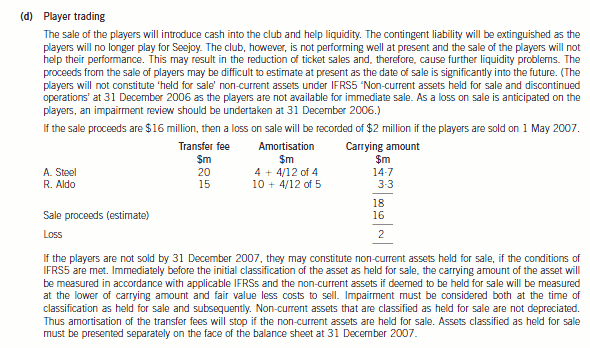
-
第2题:
(iv) Tyre recently undertook a sales campaign whereby customers can obtain free car accessories, by presenting a
coupon, which has been included in an advertisement in a national newspaper, on the purchase of a vehicle.
The offer is valid for a limited time period from 1 January 2006 until 31 July 2006. The management are unsure
as to how to treat this offer in the financial statements for the year ended 31 May 2006.
(5 marks)
Required:
Advise the directors of Tyre on how to treat the above items in the financial statements for the year ended
31 May 2006.
(The mark allocation is shown against each of the above items)
正确答案:
(iv) Car accessories
An obligation should not be recognised for the coupons and no provision created under IAS37 ‘Provisions, Contingent
Liabilities and Contingent Assets’. A provision should only be recognised where there is an obligating event. There has to be
a present obligation (legal or constructive), the probability of an outflow of resources and the ability to make a reliable estimate
of the amount of the obligation. These conditions do not seem to have been met. Until the vehicle is purchased the
accessories cannot be obtained. That is the point at which the present obligation arises, the outflow of resources occurs and
an estimate of the amount of the obligation can be made. When the car is purchased, the accessories become part of the
cost of the sale. The revenue recognised will be the amount received from the customer (the sales price). The revenue will
not be grossed up to include the value of the accessories. -
第3题:
(c) Wader is reviewing the accounting treatment of its buildings. The company uses the ‘revaluation model’ for its
buildings. The buildings had originally cost $10 million on 1 June 2005 and had a useful economic life of
20 years. They are being depreciated on a straight line basis to a nil residual value. The buildings were revalued
downwards on 31 May 2006 to $8 million which was the buildings’ recoverable amount. At 31 May 2007 the
value of the buildings had risen to $11 million which is to be included in the financial statements. The company
is unsure how to treat the above events. (7 marks)
Required:
Discuss the accounting treatments of the above items in the financial statements for the year ended 31 May
2007.
Note: a discount rate of 5% should be used where necessary. Candidates should show suitable calculations where
necessary.
正确答案: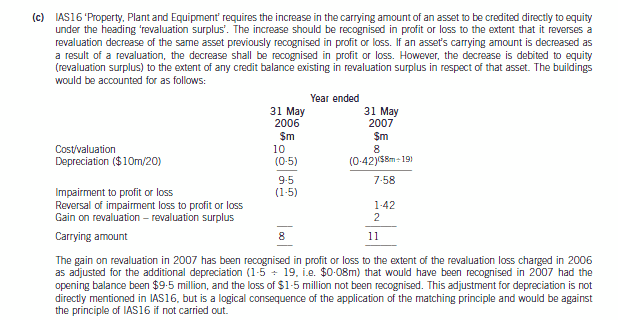
-
第4题:
(b) Router has a number of film studios and office buildings. The office buildings are in prestigious areas whereas
the film studios are located in ‘out of town’ locations. The management of Router wish to apply the ‘revaluation
model’ to the office buildings and the ‘cost model’ to the film studios in the year ended 31 May 2007. At present
both types of buildings are valued using the ‘revaluation model’. One of the film studios has been converted to a
theme park. In this case only, the land and buildings on the park are leased on a single lease from a third party.
The lease term was 30 years in 1990. The lease of the land and buildings was classified as a finance lease even
though the financial statements purport to comply with IAS 17 ‘Leases’.
The terms of the lease were changed on 31 May 2007. Router is now going to terminate the lease early in 2015
in exchange for a payment of $10 million on 31 May 2007 and a reduction in the monthly lease payments.
Router intends to move from the site in 2015. The revised lease terms have not resulted in a change of
classification of the lease in the financial statements of Router. (10 marks)
Required:
Discuss how the above items should be dealt with in the group financial statements of Router for the year ended
31 May 2007.
正确答案:
(b) IAS16 ‘Property, Plant and Equipment’ permits assets to be revalued on a class by class basis. The different characteristics
of the buildings allow them to be classified separately. Different measurement models can, therefore, be used for the office
buildings and the film studios. However, IAS8 ‘Accounting policies, changes in accounting estimates and errors’ says that
once an entity has decided on its accounting policies, it should apply them consistently from period to period and across all
relevant transactions. An entity can change its accounting policies but only in specific circumstances. These circumstances
are:
(a) where there is a new accounting standard or interpretation or changes to an accounting standard
(b) where the change results in the financial statements providing reliable and more relevant information about the effects
of transactions, other events or conditions on the entity’s financial position, financial performance, or cash flows
Voluntary changes in accounting policies are quite uncommon but may occur when an accounting policy is no longer
appropriate. Router will have to ensure that the change in accounting policy meets the criteria in IAS8. Additionally,
depreciated historical cost will have to be calculated for the film studios at the commencement of the period and the opening
balance on the revaluation reserve and any other affected component of equity adjusted. The comparative amounts for each
prior period should be presented as if the new accounting policy had always been applied. There are limits on retrospective
application on the grounds of impracticability.
It is surprising that the lease of the land is considered to be a finance lease under IAS17 ‘Leases’. Land is considered to have
an indefinite life and should, therefore normally be classified as an operating lease unless ownership passes to the lessee
during the lease term. The lease of the land should be separated out from the lease and treated individually. The value of the
land so determined would be taken off the balance sheet in terms of the liability and asset and the lease payments treated
as rentals in the income statement. A prior period adjustment should also be made. The buildings would continue to be
treated as property, plant and equipment (PPE) and the carrying amount not adjusted. However, the remaining useful life of
the building should be revised to reflect the shorter lease term. This will result in the carrying amount being depreciated over
the shorter period. This change to the depreciation policy is applied prospectively not retrospectively.
The lease liability must be assessed for derecognition under IAS39 ‘Financial Instruments: Recognition and Measurement’,
because of the revision of the lease terms, in order to determine whether the new terms are substantially different from the
old. The purpose of this is to determine whether the change in terms is a modification or an extinguishment. The change
seems to constitute a ‘modification’ because there is little change to the terms. The lease liability is, therefore, amended by
deducting the one off payment ($10 million) from the carrying amount (after adjustment for the lease of land) together with
any transaction costs. The lease liability is then remeasured to the present value of the revised future cash flows, discounted
using the original effective interest rate. Any adjustment made in remeasuring the lease liability will be taken to the income
statement.
-
第5题:
(d) Additionally Router purchased 60% of the ordinary shares of a radio station, Playtime, a public limited company,
on 31 May 2007. The remaining 40% of the ordinary shares are owned by a competitor company who owns a
substantial number of warrants issued by Playtime which are currently exercisable. If these warrants are
exercised, they will result in Router only owning 35% of the voting shares of Playtime. (4 marks)
Required:
Discuss how the above items should be dealt with in the group financial statements of Router for the year ended
31 May 2007.
正确答案:(d) IAS27 paragraph 14, ‘Consolidated and Separate Financial Statements’, states that warrants that have the potential to give
the holder voting power or reduce another party’s voting power over the financial and operating policies of the issuer should
be considered when existence of control is assessed. The warrants held by the competitor company, if exercised, would grant
that company control over Playtime. One party only can control Playtime and, therefore, the competitor company should
consolidate Playtime. In coming to this decision all the facts and circumstances that affect potential voting rights (except the
intention of management and the financial ability to exercise or convert) should be considered. It seems, however, that there
is a prima facie case for not consolidating Playtime but accounting for it under IAS28 or IAS39.
-
第6题:
(b) Discuss how management’s judgement and the financial reporting infrastructure of a country can have a
significant impact on financial statements prepared under IFRS. (6 marks)
Appropriateness and quality of discussion. (2 marks)
正确答案:
(b) Management judgement may have a greater impact under IFRS than generally was the case under national GAAP. IFRS
utilises fair values extensively. Management have to use their judgement in selecting valuation methods and formulating
assumptions when dealing with such areas as onerous contracts, share-based payments, pensions, intangible assets acquired
in business combinations and impairment of assets. Differences in methods or assumptions can have a major impact on
amounts recognised in financial statements. IAS1 expects companies to disclose the sensitivity of carrying amounts to the
methods, assumptions and estimates underpinning their calculation where there is a significant risk of material adjustment
to their carrying amounts within the next financial year. Often management’s judgement is that there is no ‘significant risk’
and they often fail to disclose the degree of estimation or uncertainty and thus comparability is affected.
In addition to the IFRSs themselves, a sound financial reporting infrastructure is required. This implies effective corporate
governance practices, high quality auditing standards and practices, and an effective enforcement or oversight mechanism.
Therefore, consistency and comparability of IFRS financial statements will also depend on the robust nature of the other
elements of the financial reporting infrastructure.
Many preparers of financial statements will have been trained in national GAAP and may not have been trained in the
principles underlying IFRS and this can lead to unintended inconsistencies when implementing IFRS especially where the
accounting profession does not have a CPD requirement. Additionally where the regulatory system of a country is not well
developed, there may not be sufficient market information to utilise fair value measurements and thus this could lead to
hypothetical markets being created or the use of mathematical modelling which again can lead to inconsistencies because of
lack of experience in those countries of utilising these techniques. This problem applies to other assessments or estimates
relating to such things as actuarial valuations, investment property valuations, impairment testing, etc.
The transition to IFRS can bring significant improvement to the quality of financial performance and improve comparability
worldwide. However, there are issues still remaining which can lead to inconsistency and lack of comparability with those
financial statements. -
第7题:
(ii) Explain how the inclusion of rental income in Coral’s UK income tax computation could affect the
income tax due on her dividend income. (2 marks)
You are not required to prepare calculations for part (b) of this question.
Note: you should assume that the tax rates and allowances for the tax year 2006/07 and for the financial year to
31 March 2007 will continue to apply for the foreseeable future.
正确答案:
(ii) The effect of taxable rental income on the tax due on Coral’s dividend income
Remitting rental income to the UK may cause some of Coral’s dividend income currently falling within the basic rate
band to fall within the higher rate band. The effect of this would be to increase the tax on the gross dividend income
from 0% (10% less the 10% tax credit) to 221/2% (321/2% less 10%).
Tutorial note
It would be equally acceptable to state that the effective rate of tax on the dividend income would increase from 0%
to 25%. -
第8题:
(b) You are an audit manager with specific responsibility for reviewing other information in documents containing
audited financial statements before your firm’s auditor’s report is signed. The financial statements of Hegas, a
privately-owned civil engineering company, show total assets of $120 million, revenue of $261 million, and profit
before tax of $9·2 million for the year ended 31 March 2005. Your review of the Annual Report has revealed
the following:
(i) The statement of changes in equity includes $4·5 million under a separate heading of ‘miscellaneous item’
which is described as ‘other difference not recognized in income’. There is no further reference to this
amount or ‘other difference’ elsewhere in the financial statements. However, the Management Report, which
is required by statute, is not audited. It discloses that ‘changes in shareholders’ equity not recognized in
income includes $4·5 million arising on the revaluation of investment properties’.
The notes to the financial statements state that the company has implemented IAS 40 ‘Investment Property’
for the first time in the year to 31 March 2005 and also that ‘the adoption of this standard did not have a
significant impact on Hegas’s financial position or its results of operations during 2005’.
(ii) The chairman’s statement asserts ‘Hegas has now achieved a position as one of the world’s largest
generators of hydro-electricity, with a dedicated commitment to accountable ethical professionalism’. Audit
working papers show that 14% of revenue was derived from hydro-electricity (2004: 12%). Publicly
available information shows that there are seven international suppliers of hydro-electricity in Africa alone,
which are all at least three times the size of Hegas in terms of both annual turnover and population supplied.
Required:
Identify and comment on the implications of the above matters for the auditor’s report on the financial
statements of Hegas for the year ended 31 March 2005. (10 marks)
正确答案:
(b) Implications for the auditor’s report
(i) Management Report
■ $4·5 million represents 3·75% of total assets, 1·7% of revenue and 48·9% profit before tax. As this is material
by any criteria (exceeding all of 2% of total assets, 1/2% revenue and 5% PBT), the specific disclosure requirements
of IASs need to be met (IAS 1 ‘Presentation of Financial Statements’).
■ The Management Report discloses the amount and the reason for a material change in equity whereas the financial
statements do not show the reason for the change and suggest that it is immaterial. As the increase in equity
attributable to this adjustment is nearly half as much as that attributable to PBT there is a material inconsistency
between the Management Report and the audited financial statements.
■ Amendment to the Management Report is not required.
Tutorial note: Marks will be awarded for arguing, alternatively, that the Management Report disclosure needs to
be amended to clarify that the revaluation arises from the first time implementation.
■ Amendment to the financial statements is required because the disclosure is:
– incorrect – as, on first adoption of IAS 40, the fair value adjustment should be against the opening balance
of retained earnings; and
– inadequate – because it is being ‘supplemented’ by additional disclosure in a document which is not within
the scope of the audit of financial statements.
■ Whilst it is true that the adoption of IAS 40 did not have a significant impact on results of operations, Hegas’s
financial position has increased by nearly 4% in respect of the revaluation (to fair value) of just one asset category
(investment properties). As this is significant, the statement in the notes should be redrafted.
■ If the financial statements are not amended, the auditor’s report should be qualified ‘except for’ on grounds of
disagreement (non-compliance with IAS 40) as the matter is material but not pervasive. Additional disclosure
should also be given (e.g. that the ‘other difference’ is a fair value adjustment).
■ However, it is likely that when faced with the prospect of a qualified auditor’s report Hegas’s management will
rectify the financial statements so that an unmodified auditor’s report can be issued.
Tutorial note: Marks will be awarded for other relevant points e.g. citing IAS 8 ‘Accounting Policies, Changes in
Accounting Estimates and Errors’.
(ii) Chairman’s statement
Tutorial note: Hegas is privately-owned therefore IAS 14 ‘Segment Reporting’ does not apply and the proportion of
revenue attributable to hydro-electricity will not be required to be disclosed in the financial statements. However, credit
will be awarded for discussing the implications for the auditor’s report if it is regarded as a material inconsistency on
the assumption that segment revenue (or similar) is reported in the financial statements.
■ The assertion in the chairman’s statement, which does not fall within the scope of the audit of the financial
statements, claims two things, namely that the company:
(1) is ‘one of the world’s largest generators of hydro-electricity’; and
(2) has ‘a dedicated commitment to accountable ethical professionalism’.
■ To the extent that this information does not relate to matters disclosed in the financial statements it may give rise
to a material misstatement of fact. In particular, the first statement presents a misleading impression of the
company’s size. In misleading a user of the financial statements with this statement, the second statement is not
true (as it is not ethical or professional to mislead the reader and potentially undermine the credibility of the
financial statements).
■ The first statement is a material misstatement of fact because, for example:
– the company is privately-owned, and publicly-owned international/multi-nationals are larger;
– the company’s main activity is civil engineering not electricity generation (only 14% of revenue is derived from
HEP);
– as the company ranks at best eighth against African companies alone it ranks much lower globally.
■ Hegas should be asked to reconsider the wording of the chairman’s statement (i.e. removing these assertions) and
consult, as necessary, the company’s legal advisor.
■ If the statement is not changed there will be no grounds for qualification of the opinion on the audited financial
statements. The audit firm should therefore take legal advice on how the matter should be reported.
■ However, an emphasis of matter paragraph may be used to report on matters other than those affecting the audited
financial statements. For example, to explain the misstatement of fact if management refuses to make the
amendment.
Tutorial note: Marks will also be awarded for relevant comments about the chairman’s statement being perceived by
many readers to be subject to audit and therefore that the unfounded statement might undermine the credibility of the
financial statements. Shareholders tend to rely on the chairman’s statement, even though it is not regulated or audited,
because modern financial statements are so complex. -
第9题:
(b) Seymour offers health-related information services through a wholly-owned subsidiary, Aragon Co. Goodwill of
$1·8 million recognised on the purchase of Aragon in October 2004 is not amortised but included at cost in the
consolidated balance sheet. At 30 September 2006 Seymour’s investment in Aragon is shown at cost,
$4·5 million, in its separate financial statements.
Aragon’s draft financial statements for the year ended 30 September 2006 show a loss before taxation of
$0·6 million (2005 – $0·5 million loss) and total assets of $4·9 million (2005 – $5·7 million). The notes to
Aragon’s financial statements disclose that they have been prepared on a going concern basis that assumes that
Seymour will continue to provide financial support. (7 marks)
Required:
For each of the above issues:
(i) comment on the matters that you should consider; and
(ii) state the audit evidence that you should expect to find,
in undertaking your review of the audit working papers and financial statements of Seymour Co for the year ended
30 September 2006.
NOTE: The mark allocation is shown against each of the three issues.
正确答案:
(b) Goodwill
(i) Matters
■ Cost of goodwill, $1·8 million, represents 3·4% consolidated total assets and is therefore material.
Tutorial note: Any assessments of materiality of goodwill against amounts in Aragon’s financial statements are
meaningless since goodwill only exists in the consolidated financial statements of Seymour.
■ It is correct that the goodwill is not being amortised (IFRS 3 Business Combinations). However, it should be tested
at least annually for impairment, by management.
■ Aragon has incurred losses amounting to $1·1 million since it was acquired (two years ago). The write-off of this
amount against goodwill in the consolidated financial statements would be material (being 61% cost of goodwill,
8·3% PBT and 2·1% total assets).
■ The cost of the investment ($4·5 million) in Seymour’s separate financial statements will also be material and
should be tested for impairment.
■ The fair value of net assets acquired was only $2·7 million ($4·5 million less $1·8 million). Therefore the fair
value less costs to sell of Aragon on other than a going concern basis will be less than the carrying amount of the
investment (i.e. the investment is impaired by at least the amount of goodwill recognised on acquisition).
■ In assessing recoverable amount, value in use (rather than fair value less costs to sell) is only relevant if the going
concern assumption is appropriate for Aragon.
■ Supporting Aragon financially may result in Seymour being exposed to actual and/or contingent liabilities that
should be provided for/disclosed in Seymour’s financial statements in accordance with IAS 37 Provisions,
Contingent Liabilities and Contingent Assets.
(ii) Audit evidence
■ Carrying values of cost of investment and goodwill arising on acquisition to prior year audit working papers and
financial statements.
■ A copy of Aragon’s draft financial statements for the year ended 30 September 2006 showing loss for year.
■ Management’s impairment test of Seymour’s investment in Aragon and of the goodwill arising on consolidation at
30 September 2006. That is a comparison of the present value of the future cash flows expected to be generated
by Aragon (a cash-generating unit) compared with the cost of the investment (in Seymour’s separate financial
statements).
■ Results of any impairment tests on Aragon’s assets extracted from Aragon’s working paper files.
■ Analytical procedures on future cash flows to confirm their reasonableness (e.g. by comparison with cash flows for
the last two years).
■ Bank report for audit purposes for any guarantees supporting Aragon’s loan facilities.
■ A copy of Seymour’s ‘comfort letter’ confirming continuing financial support of Aragon for the foreseeable future. -
第10题:
(d) Wader has decided to close one of its overseas branches. A board meeting was held on 30 April 2007 when a
detailed formal plan was presented to the board. The plan was formalised and accepted at that meeting. Letters
were sent out to customers, suppliers and workers on 15 May 2007 and meetings were held prior to the year
end to determine the issues involved in the closure. The plan is to be implemented in June 2007. The company
wish to provide $8 million for the restructuring but are unsure as to whether this is permissible. Additionally there
was an issue raised at one of the meetings. The operations of the branch are to be moved to another country
from June 2007 but the operating lease on the present buildings of the branch is non-cancellable and runs for
another two years, until 31 May 2009. The annual rent of the buildings is $150,000 payable in arrears on
31 May and the lessor has offered to take a single payment of $270,000 on 31 May 2008 to settle the
outstanding amount owing and terminate the lease on that date. Wader has additionally obtained permission to
sublet the building at a rental of $100,000 per year, payable in advance on 1 June. The company needs advice
on how to treat the above under IAS37 ‘Provisions, Contingent Liabilities and Contingent Assets’. (7 marks)
Required:
Discuss the accounting treatments of the above items in the financial statements for the year ended 31 May
2007.
Note: a discount rate of 5% should be used where necessary. Candidates should show suitable calculations where
necessary.
正确答案:(d) A provision under IAS37 ‘Provisions, Contingent Liabilities and Contingent assets’ can only be made in relation to the entity’s
restructuring plans where there is both a detailed formal plan in place and the plans have been announced to those affected.
The plan should identify areas of the business affected, the impact on employees and the likely cost of the restructuring and
the timescale for implementation. There should be a short timescale between communicating the plan and starting to
implement it. A provision should not be recognised until a plan is formalised.
A decision to restructure before the balance sheet date is not sufficient in itself for a provision to be recognised. A formal plan
should be announced prior to the balance sheet date. A constructive obligation should have arisen. It arises where there has
been a detailed formal plan and this has raised a valid expectation in the minds of those affected. The provision should only
include direct expenditure arising from the restructuring. Such amounts do not include costs associated with ongoing business
operations. Costs of retraining staff or relocating continuing staff or marketing or investment in new systems and distribution
networks, are excluded. It seems as though in this case a constructive obligation has arisen as there have been detailed formal
plans approved and communicated thus raising valid expectations. The provision can be allowed subject to the exclusion of
the costs outlined above.
Although executory contracts are outside IAS37, it is permissible to recognise a provision that is onerous. Onerous contracts
can result from restructuring plans or on a stand alone basis. A provision should be made for the best estimate of the excess
unavoidable costs under the onerous contract. This estimate should assess any likely level of future income from new sources.
Thus in this case, the rental income from sub-letting the building should be taken into account. The provision should be
-
第11题:
Financial statements should be understandable to everyone.()
正确答案:错
-
第12题:
You are an audit manager at Rockwell & Co, a firm of Chartered Certified Accountants. You are responsible for the audit of the Hopper Group, a listed audit client which supplies ingredients to the food and beverage industry worldwide.
The audit work for the year ended 30 June 2015 is nearly complete, and you are reviewing the draft audit report which has been prepared by the audit senior. During the year the Hopper Group purchased a new subsidiary company, Seurat Sweeteners Co, which has expertise in the research and design of sugar alternatives. The draft financial statements of the Hopper Group for the year ended 30 June 2015 recognise profit before tax of $495 million (2014 – $462 million) and total assets of $4,617 million (2014: $4,751 million). An extract from the draft audit report is shown below:
Basis of modified opinion (extract)
In their calculation of goodwill on the acquisition of the new subsidiary, the directors have failed to recognise consideration which is contingent upon meeting certain development targets. The directors believe that it is unlikely that these targets will be met by the subsidiary company and, therefore, have not recorded the contingent consideration in the cost of the acquisition. They have disclosed this contingent liability fully in the notes to the financial statements. We do not feel that the directors’ treatment of the contingent consideration is correct and, therefore, do not believe that the criteria of the relevant standard have been met. If this is the case, it would be appropriate to adjust the goodwill balance in the statement of financial position.
We believe that any required adjustment may materially affect the goodwill balance in the statement of financial position. Therefore, in our opinion, the financial statements do not give a true and fair view of the financial position of the Hopper Group and of the Hopper Group’s financial performance and cash flows for the year then ended in accordance with International Financial Reporting Standards.
Emphasis of Matter Paragraph
We draw attention to the note to the financial statements which describes the uncertainty relating to the contingent consideration described above. The note provides further information necessary to understand the potential implications of the contingency.
Required:
(a) Critically appraise the draft audit report of the Hopper Group for the year ended 30 June 2015, prepared by the audit senior.
Note: You are NOT required to re-draft the extracts from the audit report. (10 marks)
(b) The audit of the new subsidiary, Seurat Sweeteners Co, was performed by a different firm of auditors, Fish Associates. During your review of the communication from Fish Associates, you note that they were unable to obtain sufficient appropriate evidence with regard to the breakdown of research expenses. The total of research costs expensed by Seurat Sweeteners Co during the year was $1·2 million. Fish Associates has issued a qualified audit opinion on the financial statements of Seurat Sweeteners Co due to this inability to obtain sufficient appropriate evidence.
Required:
Comment on the actions which Rockwell & Co should take as the auditor of the Hopper Group, and the implications for the auditor’s report on the Hopper Group financial statements. (6 marks)
(c) Discuss the quality control procedures which should be carried out by Rockwell & Co prior to the audit report on the Hopper Group being issued. (4 marks)
正确答案:(a) Critical appraisal of the draft audit report
Type of opinion
When an auditor issues an opinion expressing that the financial statements ‘do not give a true and fair view’, this represents an adverse opinion. The paragraph explaining the modification should, therefore, be titled ‘Basis of Adverse Opinion’ rather than simply ‘Basis of Modified Opinion’.
An adverse opinion means that the auditor considers the misstatement to be material and pervasive to the financial statements of the Hopper Group. According to ISA 705 Modifications to Opinions in the Independent Auditor’s Report, pervasive matters are those which affect a substantial proportion of the financial statements or fundamentally affect the users’ understanding of the financial statements. It is unlikely that the failure to recognise contingent consideration is pervasive; the main effect would be to understate goodwill and liabilities. This would not be considered a substantial proportion of the financial statements, neither would it be fundamental to understanding the Hopper Group’s performance and position.
However, there is also some uncertainty as to whether the matter is even material. If the matter is determined to be material but not pervasive, then a qualified opinion would be appropriate on the basis of a material misstatement. If the matter is not material, then no modification would be necessary to the audit opinion.
Wording of opinion/report
The auditor’s reference to ‘the acquisition of the new subsidiary’ is too vague; the Hopper Group may have purchased a number of subsidiaries which this phrase could relate to. It is important that the auditor provides adequate description of the event and in these circumstances it would be appropriate to name the subsidiary referred to.
The auditor has not quantified the amount of the contingent element of the consideration. For the users to understand the potential implications of any necessary adjustments, they need to know how much the contingent consideration will be if it becomes payable. It is a requirement of ISA 705 that the auditor quantifies the financial effects of any misstatements, unless it is impracticable to do so.
In addition to the above point, the auditor should provide more description of the financial effects of the misstatement, including full quantification of the effect of the required adjustment to the assets, liabilities, incomes, revenues and equity of the Hopper Group.
The auditor should identify the note to the financial statements relevant to the contingent liability disclosure rather than just stating ‘in the note’. This will improve the understandability and usefulness of the contents of the audit report.
The use of the term ‘we do not feel that the treatment is correct’ is too vague and not professional. While there may be some interpretation necessary when trying to apply financial reporting standards to unique circumstances, the expression used is ambiguous and may be interpreted as some form. of disclaimer by the auditor with regard to the correct accounting treatment. The auditor should clearly explain how the treatment applied in the financial statements has departed from the requirements of the relevant standard.
Tutorial note: As an illustration to the above point, an appropriate wording would be: ‘Management has not recognised the acquisition-date fair value of contingent consideration as part of the consideration transferred in exchange for the acquiree, which constitutes a departure from International Financial Reporting Standards.’
The ambiguity is compounded by the use of the phrase ‘if this is the case, it would be appropriate to adjust the goodwill’. This once again suggests that the correct treatment is uncertain and perhaps open to interpretation.
If the auditor wishes to refer to a specific accounting standard they should refer to its full title. Therefore instead of referring to ‘the relevant standard’ they should refer to International Financial Reporting Standard 3 Business Combinations.
The opinion paragraph requires an appropriate heading. In this case the auditors have issued an adverse opinion and the paragraph should be headed ‘Adverse Opinion’.
As with the basis paragraph, the opinion paragraph lacks authority; suggesting that the required adjustments ‘may’ materially affect the financial statements implies that there is a degree of uncertainty. This is not the case; the amount of the contingent consideration will be disclosed in the relevant purchase agreement, so the auditor should be able to determine whether the required adjustments are material or not. Regardless, the sentence discussing whether the balance is material or not is not required in the audit report as to warrant inclusion in the report the matter must be considered material. The disclosure of the nature and financial effect of the misstatement in the basis paragraph is sufficient.
Finally, the emphasis of matter paragraph should not be included in the audit report. An emphasis of matter paragraph is only used to draw attention to an uncertainty/matter of fundamental importance which is correctly accounted for and disclosed in the financial statements. An emphasis of matter is not required in this case for the following reasons:
– Emphasis of matter is only required to highlight matters which the auditor believes are fundamental to the users’ understanding of the business. An example may be where a contingent liability exists which is so significant it could lead to the closure of the reporting entity. That is not the case with the Hopper Group; the contingent liability does not appear to be fundamental.
– Emphasis of matter is only used for matters where the auditor has obtained sufficient appropriate evidence that the matter is not materially misstated in the financial statements. If the financial statements are materially misstated, in this regard the matter would be fully disclosed by the auditor in the basis of qualified/adverse opinion paragraph and no emphasis of matter is necessary.
(b) Communication from the component auditor
The qualified opinion due to insufficient evidence may be a significant matter for the Hopper Group audit. While the possible adjustments relating to the current year may not be material to the Hopper Group, the inability to obtain sufficient appropriate evidence with regard to a material matter in Seurat Sweeteners Co’s financial statements may indicate a control deficiency which the auditor was not aware of at the planning stage and it could indicate potential problems with regard to the integrity of management, which could also indicate a potential fraud. It could also indicate an unwillingness of management to provide information, which could create problems for future audits, particularly if research and development costs increase in future years. If the group auditor suspects that any of these possibilities are true, they may need to reconsider their risk assessment and whether the audit procedures performed are still appropriate.
If the detail provided in the communication from the component auditor is insufficient, the group auditor should first discuss the matter with the component auditor to see whether any further information can be provided. The group auditor can request further working papers from the component auditor if this is necessary. However, if Seurat Sweeteners has not been able to provide sufficient appropriate evidence, it is unlikely that this will be effective.
If the discussions with the component auditor do not provide satisfactory responses to evaluate the potential impact on the Hopper Group, the group auditor may need to communicate with either the management of Seurat Sweeteners or the Hopper Group to obtain necessary clarification with regard to the matter.
Following these procedures, the group auditor needs to determine whether they have sufficient appropriate evidence to draw reasonable conclusions on the Hopper Group’s financial statements. If they believe the lack of information presents a risk of material misstatement in the group financial statements, they can request that further audit procedures be performed, either by the component auditor or by themselves.
Ultimately the group engagement partner has to evaluate the effect of the inability to obtain sufficient appropriate evidence on the audit opinion of the Hopper Group. The matter relates to research expenses totalling $1·2 million, which represents 0·2% of the profit for the year and 0·03% of the total assets of the Hopper Group. It is therefore not material to the Hopper Group’s financial statements. For this reason no modification to the audit report of the Hopper Group would be required as this does not represent a lack of sufficient appropriate evidence with regard to a matter which is material to the Group financial statements.
Although this may not have an impact on the Hopper Group audit opinion, this may be something the group auditor wishes to bring to the attention of those charged with governance. This would be particularly likely if the group auditor believed that this could indicate some form. of fraud in Seurat Sweeteners Co, a serious deficiency in financial reporting controls or if this could create problems for accepting future audits due to management’s unwillingness to provide access to accounting records.
(c) Quality control procedures prior to issuing the audit report
ISA 220 Quality Control for an Audit of Financial Statements and ISQC 1 Quality Control for Firms that Perform. Audits and Reviews of Historical Financial Information, and Other Assurance and Related Services Agreements require that an engagement quality control reviewer shall be appointed for audits of financial statements of listed entities. The audit engagement partner then discusses significant matters arising during the audit engagement with the engagement quality control reviewer.
The engagement quality control reviewer and the engagement partner should discuss the failure to recognise the contingent consideration and its impact on the auditor’s report. The engagement quality control reviewer must review the financial statements and the proposed auditor’s report, in particular focusing on the conclusions reached in formulating the auditor’s report and consideration of whether the proposed auditor’s opinion is appropriate. The audit documentation relating to the acquisition of Seurat Sweeteners Co will be carefully reviewed, and the reviewer is likely to consider whether procedures performed in relation to these balances were appropriate.
Given the listed status of the Hopper Group, any modification to the auditor’s report will be scrutinised, and the firm must be sure of any decision to modify the report, and the type of modification made. Once the engagement quality control reviewer has considered the necessity of a modification, they should consider whether a qualified or an adverse opinion is appropriate in the circumstances. This is an important issue, given that it requires judgement as to whether the matters would be material or pervasive to the financial statements.
The engagement quality control reviewer should ensure that there is adequate documentation regarding the judgements used in forming the final audit opinion, and that all necessary matters have been brought to the attention of those charged with governance.
The auditor’s report must not be signed and dated until the completion of the engagement quality control review.
Tutorial note: In the case of the Hopper Group’s audit, the lack of evidence in respect of research costs is unlikely to be discussed unless the audit engagement partner believes that the matter could be significant, for example, if they suspected the lack of evidence is being used to cover up a financial statements fraud.
-
第13题:
(iii) Tyre has entered into two new long lease property agreements for two major retail outlets. Annual rentals are paid
under these agreements. Tyre has had to pay a premium to enter into these agreements because of the outlets’
location. Tyre feels that the premiums paid are justifiable because of the increase in revenue that will occur
because of the outlets’ location. Tyre has analysed the leases and has decided that one is a finance lease and
one is an operating lease but the company is unsure as to how to treat this premium. (5 marks)
Required:
Advise the directors of Tyre on how to treat the above items in the financial statements for the year ended
31 May 2006.
(The mark allocation is shown against each of the above items)
正确答案:
(iii) Retail outlets
The two new long lease agreements have been separately classified as an operating lease and a finance lease. The lease
premium paid for a finance lease should be capitalised and recognised as an asset under the lease. IAS17 ‘Leases’ says that
costs identified as directly attributable to a finance lease are added to the amount recognised as an asset. It will be included
in the present value calculation of the minimum lease payments. The finance lease will be recognised at its fair value or if
lower the present value of the minimum lease payments. The premium will be depreciated as part of the asset’s value over
the shorter of the lease term and the asset’s useful life. Initially, a finance lease liability will be set up which is equal to the
value of the leased asset.
The operating lease premium will be spread over the lease term on a straight line basis unless some other method is more
representative. The premium will be effectively treated as a prepayment of rent and is amortised over the life of the agreement. -
第14题:
(iii) How items not dealt with by an IFRS for SMEs should be treated. (5 marks)
正确答案:
(iii) The treatment of items not dealt with by an IFRS for SMEs
IFRSs for SMEs would not necessarily deal with all the recognition and measurement issues facing an entity but the key
issues should revolve around the nature of the recognition, measurement and disclosure of the transactions of SMEs. In
the case where the item is not dealt with by the standards there are three alternatives:
(a) the entity can look to the full IFRS to resolve the issue
(b) management’s judgement can be used with reference to the Framework and consistency with other IFRSs for SMEs
(c) existing practice could be used.
The first approach is more likely to result in greater consistency and comparability. However, this approach may also
increase the burden on SMEs as it can be argued that they are subject to two sets of standards.
An SME may wish to make a disclosure required by a full IFRS which is not required by the SME standard, or a
measurement principle is simplified or exempted in the SME standard, or the IFRS may give a choice between two
measurement options and the SME standard does not allow choice. Thus the issue arises as to whether SMEs should
be able to choose to comply with a full IFRS for some items and SME standards for other items, allowing an SME to
revert to IFRS on a principle by principle basis. The problem which will arise will be a lack of consistency and
comparability of SME financial statements.
-
第15题:
4 (a) Router, a public limited company operates in the entertainment industry. It recently agreed with a television
company to make a film which will be broadcast on the television company’s network. The fee agreed for the
film was $5 million with a further $100,000 to be paid every time the film is shown on the television company’s
channels. It is hoped that it will be shown on four occasions. The film was completed at a cost of $4 million and
delivered to the television company on 1 April 2007. The television company paid the fee of $5 million on
30 April 2007 but indicated that the film needed substantial editing before they were prepared to broadcast it,
the costs of which would be deducted from any future payments to Router. The directors of Router wish to
recognise the anticipated future income of $400,000 in the financial statements for the year ended 31 May
2007. (5 marks)
Required:
Discuss how the above items should be dealt with in the group financial statements of Router for the year ended
31 May 2007.
正确答案:
(a) Under IAS18 ‘Revenue’, revenue on a service contract is recognised when the outcome of the transaction can be measured
reliably. For revenue arising from the rendering of services, provided that all of the following criteria are met, revenue should
be recognised by reference to the stage of completion of the transaction at the balance sheet date (the percentage-ofcompletion
method) (IAS18 para 20):
(a) the amount of revenue can be measured reliably;
(b) it is probable that the economic benefits will flow to the seller;
(c) the stage of completion at the balance sheet date can be measured reliably; and
(d) the costs incurred, or to be incurred, in respect of the transaction can be measured reliably.
When the above criteria are not met, revenue arising from the rendering of services should be recognised only to the extent
of the expenses recognised that are recoverable. Because the only revenue which can be measured reliably is the fee for
making the film ($5 million), this should therefore be recognised as revenue in the year to 31 May 2007 and matched against
the cost of the film of $4 million. Only when the television company shows the film should any further amounts of $100,000
be recognised as there is an outstanding ‘performance’ condition in the form. of the editing that needs to take place before the
television company will broadcast the film. The costs of the film should not be carried forward and matched against
anticipated future income unless they can be deemed to be an intangible asset under IAS 38 ‘Intangible Assets’. Additionally,
when assessing revenue to be recognised in future years, the costs of the editing and Router’s liability for these costs should
be assessed.
-
第16题:
(c) At 1 June 2006, Router held a 25% shareholding in a film distribution company, Wireless, a public limited
company. On 1 January 2007, Router sold a 15% holding in Wireless thus reducing its investment to a 10%
holding. Router no longer exercises significant influence over Wireless. Before the sale of the shares the net asset
value of Wireless on 1 January 2007 was $200 million and goodwill relating to the acquisition of Wireless was
$5 million. Router received $40 million for its sale of the 15% holding in Wireless. At 1 January 2007, the fair
value of the remaining investment in Wireless was $23 million and at 31 May 2007 the fair value was
$26 million. (6 marks)
Required:
Discuss how the above items should be dealt with in the group financial statements of Router for the year ended
31 May 2007.Required:
Discuss how the above items should be dealt with in the group financial statements of Router for the year ended
31 May 2007.
正确答案:
(c) The investment in Wireless is currently accounted for using the equity method of accounting under IAS28 ‘Investments in
Associates’. On the sale of a 15% holding, the investment in Wireless will be accounted for in accordance with IAS39. Router
should recognise a gain on the sale of the holding in Wireless of $7 million (Working 1). The gain comprises the following:
(i) the difference between the sale proceeds and the proportion of the net assets sold and
(ii) the goodwill disposed of.
The total gain is shown in the income statement.
The remaining 10 per cent investment will be classified as an ‘available for sale’ financial asset or at ‘fair value through profit
or loss’ financial asset. Changes in fair value for these categories are reported in equity or in the income statement respectively.
At 1 January 2007, the investment will be recorded at fair value and a gain of $1 million $(23 – 22) recorded. At 31 May
2007 a further gain of $(26 – 23) million, i.e. $3 million will be recorded. In order for the investment to be categorised as
at fair value through profit or loss, certain conditions have to be fulfilled. An entity may use this designation when doing so
results in more relevant information by eliminating or significantly reducing a measurement or recognition inconsistency (an
‘accounting mismatch’) or where a group of financial assets and/or financial liabilities is managed and its performance is
evaluated on a fair value basis, in accordance with a documented risk management or investment strategy, and information
about the assets and/ or liabilities is provided internally to the entity’s key management personnel.
-
第17题:
(b) One of the hotels owned by Norman is a hotel complex which includes a theme park, a casino and a golf course,
as well as a hotel. The theme park, casino, and hotel were sold in the year ended 31 May 2008 to Conquest, a
public limited company, for $200 million but the sale agreement stated that Norman would continue to operate
and manage the three businesses for their remaining useful life of 15 years. The residual interest in the business
reverts back to Norman after the 15 year period. Norman would receive 75% of the net profit of the businesses
as operator fees and Conquest would receive the remaining 25%. Norman has guaranteed to Conquest that the
net minimum profit paid to Conquest would not be less than $15 million. (4 marks)
Norman has recently started issuing vouchers to customers when they stay in its hotels. The vouchers entitle the
customers to a $30 discount on a subsequent room booking within three months of their stay. Historical
experience has shown that only one in five vouchers are redeemed by the customer. At the company’s year end
of 31 May 2008, it is estimated that there are vouchers worth $20 million which are eligible for discount. The
income from room sales for the year is $300 million and Norman is unsure how to report the income from room
sales in the financial statements. (4 marks)
Norman has obtained a significant amount of grant income for the development of hotels in Europe. The grants
have been received from government bodies and relate to the size of the hotel which has been built by the grant
assistance. The intention of the grant income was to create jobs in areas where there was significant
unemployment. The grants received of $70 million will have to be repaid if the cost of building the hotels is less
than $500 million. (4 marks)
Appropriateness and quality of discussion (2 marks)
Required:
Discuss how the above income would be treated in the financial statements of Norman for the year ended
31 May 2008.
正确答案:
(b) Property is sometimes sold with a degree of continuing involvement by the seller so that the risks and rewards of ownership
have not been transferred. The nature and extent of the buyer’s involvement will determine how the transaction is accounted
for. The substance of the transaction is determined by looking at the transaction as a whole and IAS18 ‘Revenue’ requires
this by stating that where two or more transactions are linked, they should be treated as a single transaction in order to
understand the commercial effect (IAS18 paragraph 13). In the case of the sale of the hotel, theme park and casino, Norman
should not recognise a sale as the company continues to enjoy substantially all of the risks and rewards of the businesses,
and still operates and manages them. Additionally the residual interest in the business reverts back to Norman. Also Norman
has guaranteed the income level for the purchaser as the minimum payment to Conquest will be $15 million a year. The
transaction is in substance a financing arrangement and the proceeds should be treated as a loan and the payment of profits
as interest.
The principles of IAS18 and IFRIC13 ‘Customer Loyalty Programmes’ require that revenue in respect of each separate
component of a transaction is measured at its fair value. Where vouchers are issued as part of a sales transaction and are
redeemable against future purchases, revenue should be reported at the amount of the consideration received/receivable less
the voucher’s fair value. In substance, the customer is purchasing both goods or services and a voucher. The fair value of the
voucher is determined by reference to the value to the holder and not the cost to the issuer. Factors to be taken into account
when estimating the fair value, would be the discount the customer obtains, the percentage of vouchers that would be
redeemed, and the time value of money. As only one in five vouchers are redeemed, then effectively the hotel has sold goods
worth ($300 + $4) million, i.e. $304 million for a consideration of $300 million. Thus allocating the discount between the
two elements would mean that (300 ÷ 304 x $300m) i.e. $296·1 million will be allocated to the room sales and the balance
of $3·9 million to the vouchers. The deferred portion of the proceeds is only recognised when the obligations are fulfilled.
The recognition of government grants is covered by IAS20 ‘Accounting for government grants and disclosure of government
assistance’. The accruals concept is used by the standard to match the grant received with the related costs. The relationship
between the grant and the related expenditure is the key to establishing the accounting treatment. Grants should not be
recognised until there is reasonable assurance that the company can comply with the conditions relating to their receipt and
the grant will be received. Provision should be made if it appears that the grant may have to be repaid.
There may be difficulties of matching costs and revenues when the terms of the grant do not specify precisely the expense
towards which the grant contributes. In this case the grant appears to relate to both the building of hotels and the creation of
employment. However, if the grant was related to revenue expenditure, then the terms would have been related to payroll or
a fixed amount per job created. Hence it would appear that the grant is capital based and should be matched against the
depreciation of the hotels by using a deferred income approach or deducting the grant from the carrying value of the asset
(IAS20). Additionally the grant is only to be repaid if the cost of the hotel is less than $500 million which itself would seem
to indicate that the grant is capital based. If the company feels that the cost will not reach $500 million, a provision should
be made for the estimated liability if the grant has been recognised. -
第18题:
19 Which of the following statements about intangible assets in company financial statements are correct according
to international accounting standards?
1 Internally generated goodwill should not be capitalised.
2 Purchased goodwill should normally be amortised through the income statement.
3 Development expenditure must be capitalised if certain conditions are met.
A 1 and 3 only
B 1 and 2 only
C 2 and 3 only
D All three statements are correct
正确答案:A
-
第19题:
3 You are the manager responsible for the audit of Volcan, a long-established limited liability company. Volcan operates
a national supermarket chain of 23 stores, five of which are in the capital city, Urvina. All the stores are managed in
the same way with purchases being made through Volcan’s central buying department and product pricing, marketing,
advertising and human resources policies being decided centrally. The draft financial statements for the year ended
31 March 2005 show revenue of $303 million (2004 – $282 million), profit before taxation of $9·5 million (2004
– $7·3 million) and total assets of $178 million (2004 – $173 million).
The following issues arising during the final audit have been noted on a schedule of points for your attention:
(a) On 1 May 2005, Volcan announced its intention to downsize one of the stores in Urvina from a supermarket to
a ‘City Metro’ in response to a significant decline in the demand for supermarket-style. shopping in the capital.
The store will be closed throughout June, re-opening on 1 July 2005. Goodwill of $5·5 million was recognised
three years ago when this store, together with two others, was bought from a national competitor. It is Volcan’s
policy to write off goodwill over five years. (7 marks)
Required:
For each of the above issues:
(i) comment on the matters that you should consider; and
(ii) state the audit evidence that you should expect to find,
in undertaking your review of the audit working papers and financial statements of Volcan for the year ended
31 March 2005.
NOTE: The mark allocation is shown against each of the three issues.
正确答案:
3 VOLCAN
(a) Store impairment
(i) Matters
■ Materiality
? The cost of goodwill represents 3·1% of total assets and is therefore material.
? However, after three years the carrying amount of goodwill ($2·2m) represents only 1·2% of total assets –
and is therefore immaterial in the context of the balance sheet.
? The annual amortisation charge ($1·1m) represents 11·6% profit before tax (PBT) and is therefore also
material (to the income statement).
? The impact of writing off the whole of the carrying amount would be material to PBT (23%).
Tutorial note: The temporary closure of the supermarket does not constitute a discontinued operation under IFRS 5
‘Non-Current Assets Held for Sale and Discontinued Operations’.
■ Under IFRS 3 ‘Business Combinations’ Volcan should no longer be writing goodwill off over five years but
subjecting it to an annual impairment test.
■ The announcement is after the balance sheet date and is therefore a non-adjusting event (IAS 10 ‘Events After the
Balance Sheet Date’) insofar as no provision for restructuring (for example) can be made.
■ However, the event provides evidence of a possible impairment of the cash-generating unit which is this store and,
in particular, the value of goodwill assigned to it.
■ If the carrying amount of goodwill ($2·2m) can be allocated on a reasonable and consistent basis to this and the
other two stores (purchased at the same time) Volcan’s management should have applied an impairment test to
the goodwill of the downsized store (this is likely to show impairment).
■ If more than 22% of goodwill is attributable to the City Metro store – then its write-off would be material to PBT
(22% × $2·2m ÷ $9·5m = 5%).
■ If the carrying amount of goodwill cannot be so allocated; the impairment test should be applied to the
cash-generating unit that is the three stores (this may not necessarily show impairment).
■ Management should have considered whether the other four stores in Urvina (and elsewhere) are similarly
impaired.
■ Going concern is unlikely to be an issue unless all the supermarkets are located in cities facing a downward trend
in demand.
Tutorial note: Marks will be awarded for stating the rules for recognition of an impairment loss for a cash-generating
unit. However, as it is expected that the majority of candidates will not deal with this matter, the rules of IAS 36 are
not reproduced here.
(ii) Audit evidence
■ Board minutes approving the store’s ‘facelift’ and documenting the need to address the fall in demand for it as a
supermarket.
■ Recomputation of the carrying amount of goodwill (2/5 × $5·5m = $2·2m).
■ A schedule identifying all the assets that relate to the store under review and the carrying amounts thereof agreed
to the underlying accounting records (e.g. non-current asset register).
■ Recalculation of value in use and/or fair value less costs to sell of the cash-generating unit (i.e. the store that is to
become the City Metro, or the three stores bought together) as at 31 March 2005.
Tutorial note: If just one of these amounts exceeds carrying amount there will be no impairment loss. Also, as
there is a plan NOT to sell the store it is most likely that value in use should be used.
■ Agreement of cash flow projections (e.g. to approved budgets/forecast revenues and costs for a maximum of five
years, unless a longer period can be justified).
■ Written management representation relating to the assumptions used in the preparation of financial budgets.
■ Agreement that the pre-tax discount rate used reflects current market assessments of the time value of money (and
the risks specific to the store) and is reasonable. For example, by comparison with Volcan’s weighted average cost
of capital.
■ Inspection of the store (if this month it should be closed for refurbishment).
■ Revenue budgets and cash flow projections for:
– the two stores purchased at the same time;
– the other stores in Urvina; and
– the stores elsewhere.
Also actual after-date sales by store compared with budget. -
第20题:
(b) You are the audit manager of Johnston Co, a private company. The draft consolidated financial statements for
the year ended 31 March 2006 show profit before taxation of $10·5 million (2005 – $9·4 million) and total
assets of $55·2 million (2005 – $50·7 million).
Your firm was appointed auditor of Tiltman Co when Johnston Co acquired all the shares of Tiltman Co in March
2006. Tiltman’s draft financial statements for the year ended 31 March 2006 show profit before taxation of
$0·7 million (2005 – $1·7 million) and total assets of $16·1 million (2005 – $16·6 million). The auditor’s
report on the financial statements for the year ended 31 March 2005 was unmodified.
You are currently reviewing two matters that have been left for your attention on the audit working paper files for
the year ended 31 March 2006:
(i) In December 2004 Tiltman installed a new computer system that properly quantified an overvaluation of
inventory amounting to $2·7 million. This is being written off over three years.
(ii) In May 2006, Tiltman’s head office was relocated to Johnston’s premises as part of a restructuring.
Provisions for the resulting redundancies and non-cancellable lease payments amounting to $2·3 million
have been made in the financial statements of Tiltman for the year ended 31 March 2006.
Required:
Identify and comment on the implications of these two matters for your auditor’s reports on the financial
statements of Johnston Co and Tiltman Co for the year ended 31 March 2006. (10 marks)
正确答案:
(b) Tiltman Co
Tiltman’s total assets at 31 March 2006 represent 29% (16·1/55·2 × 100) of Johnston’s total assets. The subsidiary is
therefore material to Johnston’s consolidated financial statements.
Tutorial note: Tiltman’s profit for the year is not relevant as the acquisition took place just before the year end and will
therefore have no impact on the consolidated income statement. Calculations of the effect on consolidated profit before
taxation are therefore inappropriate and will not be awarded marks.
(i) Inventory overvaluation
This should have been written off to the income statement in the year to 31 March 2005 and not spread over three
years (contrary to IAS 2 ‘Inventories’).
At 31 March 2006 inventory is overvalued by $0·9m. This represents all Tiltmans’s profit for the year and 5·6% of
total assets and is material. At 31 March 2005 inventory was materially overvalued by $1·8m ($1·7m reported profit
should have been a $0·1m loss).
Tutorial note: 1/3 of the overvaluation was written off in the prior period (i.e. year to 31 March 2005) instead of $2·7m.
That the prior period’s auditor’s report was unmodified means that the previous auditor concurred with an incorrect
accounting treatment (or otherwise gave an inappropriate audit opinion).
As the matter is material a prior period adjustment is required (IAS 8 ‘Accounting Policies, Changes in Accounting
Estimates and Errors’). $1·8m should be written off against opening reserves (i.e. restated as at 1 April 2005).
(ii) Restructuring provision
$2·3m expense has been charged to Tiltman’s profit and loss in arriving at a draft profit of $0·7m. This is very material.
(The provision represents 14·3% of Tiltman’s total assets and is material to the balance sheet date also.)
The provision for redundancies and onerous contracts should not have been made for the year ended 31 March 2006
unless there was a constructive obligation at the balance sheet date (IAS 37 ‘Provisions, Contingent Liabilities and
Contingent Assets’). So, unless the main features of the restructuring plan had been announced to those affected (i.e.
redundancy notifications issued to employees), the provision should be reversed. However, it should then be disclosed
as a non-adjusting post balance sheet event (IAS 10 ‘Events After the Balance Sheet Date’).
Given the short time (less than one month) between acquisition and the balance sheet it is very possible that a
constructive obligation does not arise at the balance sheet date. The relocation in May was only part of a restructuring
(and could be the first evidence that Johnston’s management has started to implement a restructuring plan).
There is a risk that goodwill on consolidation of Tiltman may be overstated in Johnston’s consolidated financial
statements. To avoid the $2·3 expense having a significant effect on post-acquisition profit (which may be negligible
due to the short time between acquisition and year end), Johnston may have recognised it as a liability in the
determination of goodwill on acquisition.
However, the execution of Tiltman’s restructuring plan, though made for the year ended 31 March 2006, was conditional
upon its acquisition by Johnston. It does not therefore represent, immediately before the business combination, a
present obligation of Johnston. Nor is it a contingent liability of Johnston immediately before the combination. Therefore
Johnston cannot recognise a liability for Tiltman’s restructuring plans as part of allocating the cost of the combination
(IFRS 3 ‘Business Combinations’).
Tiltman’s auditor’s report
The following adjustments are required to the financial statements:
■ restructuring provision, $2·3m, eliminated;
■ adequate disclosure of relocation as a non-adjusting post balance sheet event;
■ current period inventory written down by $0·9m;
■ prior period inventory (and reserves) written down by $1·8m.
Profit for the year to 31 March 2006 should be $3·9m ($0·7 + $0·9 + $2·3).
If all these adjustments are made the auditor’s report should be unmodified. Otherwise, the auditor’s report should be
qualified ‘except for’ on grounds of disagreement. If none of the adjustments are made, the qualification should still be
‘except for’ as the matters are not pervasive.
Johnston’s auditor’s report
If Tiltman’s auditor’s report is unmodified (because the required adjustments are made) the auditor’s report of Johnston
should be similarly unmodified. As Tiltman is wholly-owned by Johnston there should be no problem getting the
adjustments made.
If no adjustments were made in Tiltman’s financial statements, adjustments could be made on consolidation, if
necessary, to avoid modification of the auditor’s report on Johnston’s financial statements.
The effect of these adjustments on Tiltman’s net assets is an increase of $1·4m. Goodwill arising on consolidation (if
any) would be reduced by $1·4m. The reduction in consolidated total assets required ($0·9m + $1·4m) is therefore
the same as the reduction in consolidated total liabilities (i.e. $2·3m). $2·3m is material (4·2% consolidated total
assets). If Tiltman’s financial statements are not adjusted and no adjustments are made on consolidation, the
consolidated financial position (balance sheet) should be qualified ‘except for’. The results of operations (i.e. profit for
the period) should be unqualified (if permitted in the jurisdiction in which Johnston reports).
Adjustment in respect of the inventory valuation may not be required as Johnston should have consolidated inventory
at fair value on acquisition. In this case, consolidated total liabilities should be reduced by $2·3m and goodwill arising
on consolidation (if any) reduced by $2·3m.
Tutorial note: The effect of any possible goodwill impairment has been ignored as the subsidiary has only just been
acquired and the balance sheet date is very close to the date of acquisition. -
第21题:
(ii) On 1 July 2006 Petrie introduced a 10-year warranty on all sales of its entire range of stainless steel
cookware. Sales of stainless steel cookware for the year ended 31 March 2007 totalled $18·2 million. The
notes to the financial statements disclose the following:
‘Since 1 July 2006, the company’s stainless steel cookware is guaranteed to be free from defects in
materials and workmanship under normal household use within a 10-year guarantee period. No provision
has been recognised as the amount of the obligation cannot be measured with sufficient reliability.’
(4 marks)
Your auditor’s report on the financial statements for the year ended 31 March 2006 was unmodified.
Required:
Identify and comment on the implications of these two matters for your auditor’s report on the financial
statements of Petrie Co for the year ended 31 March 2007.
NOTE: The mark allocation is shown against each of the matters above.
正确答案:
(ii) 10-year guarantee
$18·2 million stainless steel cookware sales amount to 43·1% of revenue and are therefore material. However, the
guarantee was only introduced three months into the year, say in respect of $13·6 million (3/4 × 18·2 million) i.e.
approximately 32% of revenue.
The draft note disclosure could indicate that Petrie’s management believes that Petrie has a legal obligation in respect
of the guarantee, that is not remote and likely to be material (otherwise no disclosure would have been required).
A best estimate of the obligation amounting to 5% profit before tax (or more) is likely to be considered material, i.e.
$90,000 (or more). Therefore, if it is probable that 0·66% of sales made under guarantee will be returned for refund,
this would require a warranty provision that would be material.
Tutorial note: The return of 2/3% of sales over a 10-year period may well be probable.
Clearly there is a present obligation as a result of a past obligating event for sales made during the nine months to
31 March 2007. Although the likelihood of outflow under the guarantee is likely to be insignificant (even remote) it is
probable that some outflow will be needed to settle the class of such obligations.
The note in the financial statements is disclosing this matter as a contingent liability. This term encompasses liabilities
that do not meet the recognition criteria (e.g. of reliable measurement in accordance with IAS 37 Provisions, Contingent
Liabilities and Contingent Assets).
However, it is extremely rare that no reliable estimate can be made (IAS 37) – the use of estimates being essential to
the preparation of financial statements. Petrie’s management must make a best estimate of the cost of refunds/repairs
under guarantee taking into account, for example:
■ the proportion of sales during the nine months to 31 March 2007 that have been returned under guarantee at the
balance sheet date (and in the post balance sheet event period);
■ the average age of cookware showing a defect;
■ the expected cost of a replacement item (as a refund of replacement is more likely than a repair, say).
If management do not make a provision for the best estimate of the obligation the audit opinion should be qualified
‘except for’ non-compliance with IAS 37 (no provision made). The disclosure made in the note to the financial
statements, however detailed, is not a substitute for making the provision.
Tutorial note: No marks will be awarded for suggesting that an emphasis of matter of paragraph would be appropriate
(drawing attention to the matter more fully explained in the note).
Management’s claim that the obligation cannot be measured with sufficient reliability does not give rise to a limitation
on scope on the audit. The auditor has sufficient evidence of the non-compliance with IAS 37 and disagrees with it. -
第22题:
听力原文:M: There are several reasons why careful analysis of financial statements is necessary. What are they?
W: First, financial statements are general-purpose statements. Secondly, the relationships between amounts on successive financial statements are not obvious without analysis. And thirdly, users of financial statements may be interested in seeing how well a company is performing.
Q: What are they talking about?
(17)
A.The methods of financial statements.
B.The necessity of careful analysis of financial statements
C.The relationship among financial statements.
D.The purpose of financial statements.
正确答案:B
解析:男士问的是仔细分析财务报表的必要性的理由,故B选项符合。D项说的是财务报表的目的,并非分析财务报表的目的。 -
第23题:
On 1 April 2009 Pandar purchased 80% of the equity shares in Salva. The acquisition was through a share exchange of three shares in Pandar for every five shares in Salva. The market prices of Pandar’s and Salva’s shares at 1 April
2009 were $6 per share and $3.20 respectively.
On the same date Pandar acquired 40% of the equity shares in Ambra paying $2 per share.
The summarised income statements for the three companies for the year ended 30 September 2009 are:
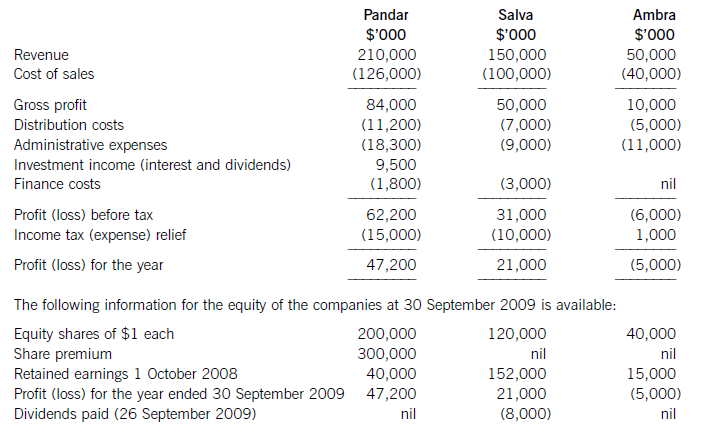
The following information is relevant:
(i) The fair values of the net assets of Salva at the date of acquisition were equal to their carrying amounts with the exception of an item of plant which had a carrying amount of $12 million and a fair value of $17 million. This plant had a remaining life of five years (straight-line depreciation) at the date of acquisition of Salva. All depreciation is charged to cost of sales.
In addition Salva owns the registration of a popular internet domain name. The registration, which had a
negligible cost, has a five year remaining life (at the date of acquisition); however, it is renewable indefinitely at a nominal cost. At the date of acquisition the domain name was valued by a specialist company at $20 million.
The fair values of the plant and the domain name have not been reflected in Salva’s financial statements.
No fair value adjustments were required on the acquisition of the investment in Ambra.
(ii) Immediately after its acquisition of Salva, Pandar invested $50 million in an 8% loan note from Salva. All interest accruing to 30 September 2009 had been accounted for by both companies. Salva also has other loans in issue at 30 September 2009.
(iii) Pandar has credited the whole of the dividend it received from Salva to investment income.
(iv) After the acquisition, Pandar sold goods to Salva for $15 million on which Pandar made a gross profit of 20%. Salva had one third of these goods still in its inventory at 30 September 2009. There are no intra-group current account balances at 30 September 2009.
(v) The non-controlling interest in Salva is to be valued at its (full) fair value at the date of acquisition. For this
purpose Salva’s share price at that date can be taken to be indicative of the fair value of the shareholding of the non-controlling interest.
(vi) The goodwill of Salva has not suffered any impairment; however, due to its losses, the value of Pandar’s
investment in Ambra has been impaired by $3 million at 30 September 2009.
(vii) All items in the above income statements are deemed to accrue evenly over the year unless otherwise indicated.
Required:
(a) (i) Calculate the goodwill arising on the acquisition of Salva at 1 April 2009; (6 marks)
(ii) Calculate the carrying amount of the investment in Ambra to be included within the consolidated
statement of financial position as at 30 September 2009. (3 marks)
(b) Prepare the consolidated income statement for the Pandar Group for the year ended 30 September 2009.(16 marks)
正确答案: