
(iii) Can audit teams cross sell services to their clients? (4 marks)Required:For EACH of the three FAQs, explain the threats to objectivity that may arise and the safeguards that shouldbe available to manage them to an acceptable level.NOTE: The mark all
题目
(iii) Can audit teams cross sell services to their clients? (4 marks)
Required:
For EACH of the three FAQs, explain the threats to objectivity that may arise and the safeguards that should
be available to manage them to an acceptable level.
NOTE: The mark allocation is shown against each of the three questions.
相似考题
更多“(iii) Can audit teams cross sell services to their clients? (4 marks)Required:For EACH of the three FAQs, explain the threats to objectivity that may arise and the safeguards that shouldbe available to manage them to an acceptable level.NOTE: The mark all”相关问题
-
第1题:
(c) Identify TWO QUALITATIVE benefits that might arise as a consequence of the investment in a new IT system
and explain how you would attempt to assess them. (4 marks)
正确答案:
(c) One of the main qualitative benefits that may arise from an investment in a new IT system by Moffat Ltd is the improved level
of service to its customers in the form. of reduced waiting times which may arise as a consequence of better scheduling of
appointments, inventory management etc. This could be assessed via the introduction of a questionnaire requiring customers
to rate the service that they have received from their recent visit to a location within Moffat Ltd according to specific criteria
such as adherence to appointment times, time taken to service the vehicle, cleanliness of the vehicle, attitude of staff etc.
Alternatively a follow-up telephone call from a centralised customer services department may be made by Moffat Ltd
personnel in order to gather such information.
Another qualitative benefit of the proposed investment may arise in the form. of competitive advantage. Improvements in
customer specific information and service levels may give Moffat Ltd a competitive advantage. Likewise, improved inventory
management may enable costs to be reduced thereby enabling a ‘win-win’ relationship to be enjoyed with its customers. -
第2题:
(b) Explain how growth may be assessed, and critically discuss the advantages and issues that might arise as a
result of a decision by the directors of CSG to pursue the objective of growth. (8 marks)
正确答案:
(b) Growth may be measured in a number of ways which are as follows:
Cash flow
This is a very important measure of growth as it ultimately determines the amount of funds available for re-investment by any
business.
Sales revenue
Growth in sales revenues generated is only of real value to investors if it precipitates growth in profits.
Profitability
There are many measures relating to profit which include sales margin, earnings before interest, taxation, depreciation and
amortisation (EBITDA) and earnings per share. More sophisticated measures such as return on capital employed and residual
income consider the size of the investment relative to the level of profits earned. In general terms, measures of profitability
are only meaningful if they are used as a basis for comparisons over time or in conjunction with other measures of
performance. Growth rate in profitability are useful when compared with other companies and also with other industries.
Return on investment
A growing return upon invested capital suggests that capital is being used more and more productively. Indicators of a growing
return would be measured by reference to dividend payment and capital growth.
Market share
Growth in market share is generally seen as positive as it can generate economies of scale.
Number of products/service offerings
Growth is only regarded as useful if products and services are profitable.
Number of employees
Measures of productivity such as value added per employee and profit per employee are often used by shareholders in
assessing growth. Very often an increased headcount is a measure of success in circumstances where more people are
needed in order to deliver a service to a required standard. However it is incumbent on management to ensure that all
employees are utilised in an effective manner.
It is a widely held belief that growth requires profits and that growth produces profits. Profits are essential in order to prevent
a company which has achieved growth from becoming a target for a take-over or in a worse case scenario goes into
liquidation. Hence it is fundamental that a business is profitable throughout its existence. Growth accompanied by growth in
profits is also likely to aid the long-term survival of an organisation. CSG operates in Swingland which experiences fluctuations
in its economic climate and in this respect the exploitation of profitable growth opportunities will help CSG to survive at the
expense of its competitors who do not exploit such opportunities.
Note: Alternative relevant discussion and examples would be accepted. -
第3题:
(ii) Explain, with reasons, the relief available in respect of the fall in value of the shares in All Over plc,
identify the years in which it can be claimed and state the time limit for submitting the claim.
(3 marks)
正确答案: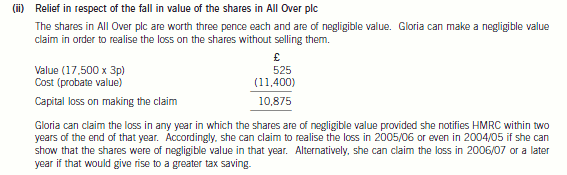
-
第4题:
4 (a) Explain the auditor’s responsibilities in respect of subsequent events. (5 marks)
Required:
Identify and comment on the implications of the above matters for the auditor’s report on the financial
statements of Jinack Co for the year ended 30 September 2005 and, where appropriate, the year ending
30 September 2006.
NOTE: The mark allocation is shown against each of the matters.
正确答案:
4 JINACK CO
(a) Auditor’s responsibilities for subsequent events
■ Auditors must consider the effect of subsequent events on:
– the financial statements;
– the auditor’s report.
■ Subsequent events are all events occurring after a period end (i.e. reporting date) i.e.:
– events after the balance sheet date (as defined in IAS 10); and
– events after the financial statements have been authorised for issue.
Events occurring up to date of auditor’s report
■ The auditor is responsible for carrying out procedures designed to obtain sufficient appropriate audit evidence that all
events up to the date of the auditor’s report that may require adjustment of, or disclosure in, the financial statements
have been identified.
■ These procedures are in addition to those applied to specific transactions occurring after the period end that provide
audit evidence of period-end account balances (e.g. inventory cut-off and receipts from trade receivables). Such
procedures should ordinarily include:
– reviewing minutes of board/audit committee meetings;
– scrutinising latest interim financial statements/budgets/cash flows, etc;
– making/extending inquiries to legal advisors on litigation matters;
– inquiring of management whether any subsequent events have occurred that might affect the financial statements
(e.g. commitments entered into).
■ When the auditor becomes aware of events that materially affect the financial statements, the auditor must consider
whether they have been properly accounted for and adequately disclosed in the financial statements.
Facts discovered after the date of the auditor’s report but before financial statements are issued
Tutorial note: After the date of the auditor’s report it is management’s responsibility to inform. the auditor of facts which
may affect the financial statements.
■ If the auditor becomes aware of such facts which may materially affect the financial statements, the auditor:
– considers whether the financial statements need amendment;
– discusses the matter with management; and
– takes appropriate action (e.g. audit any amendments to the financial statements and issue a new auditor’s report).
■ If management does not amend the financial statements (where the auditor believes they need to be amended) and the
auditor’s report has not been released to the entity, the auditor should express a qualified opinion or an adverse opinion
(as appropriate).
■ If the auditor’s report has been released to the entity, the auditor must notify those charged with governance not to issue
the financial statements (and the auditor’s report thereon) to third parties.
Tutorial note: The auditor would seek legal advice if the financial statements and auditor’s report were subsequently issued.
Facts discovered after the financial statements have been issued
■ The auditor has no obligation to make any inquiry regarding financial statements that have been issued.
■ However, if the auditor becomes aware of a fact which existed at the date of the auditor’s report and which, if known
at that date, may have caused the auditor’s report to be modified, the auditor should:
– consider whether the financial statements need revision;
– discuss the matter with management; and
– take appropriate action (e.g. issuing a new report on revised financial statements). -
第5题:
(b) The chief executive of Xalam Co, an exporter of specialist equipment, has asked for advice on the accounting
treatment and disclosure of payments made for security consultancy services. The payments, which aim to
ensure that consignments are not impounded in the destination country of a major customer, may be material to
the financial statements for the year ending 30 June 2006. Xalam does not treat these payments as tax
deductible. (4 marks)
Required:
Identify and comment on the ethical and other professional issues raised by each of these matters and state what
action, if any, Dedza should now take.
NOTE: The mark allocation is shown against each of the three situations.
正确答案:
(b) Advice on payments
■ As compared with (a) there is no obvious tax issue. Xalam is not overstating expenditure for tax purposes.
■ The payments being made for security consultancy services amount to a bribe. Corruption and bribery (and extortion)
are designated categories of money laundering offence under ‘The Forty Recommendations’ of the Financial Action Task
Force on Money Laundering (FATF).
■ Xalam clearly benefits from the payments as it receives income from the contract with the major customer. This is
criminal property and possession of it is a money laundering offence.
■ Dedza should consider the seriousness of the disclosure made by the chief executive in the context of domestic law.
■ Dedza should consider its knowledge of import duties etc in the destination country before recommending a course of
action to Xalam.
■ Dedza may be guilty of a money laundering offence if the matter is not reported. If a report to the FIU is considered
necessary then Dedza should encourage Xalam to make voluntary disclosure. If Xalam does not, Dedza will not be in
breach of client confidentiality for reporting knowledge of a suspicious transaction.
Tutorial note: Making a report takes precedence over client confidentiality. -
第6题:
5 You are an audit manager in Bartolome, a firm of Chartered Certified Accountants. You have specific responsibility
for undertaking annual reviews of existing clients and advising whether an engagement can be properly continued.
The following matters have arisen in connection with recent assignments:
(a) Leon Dormido is the senior in charge of the audit of the financial statements of Moreno, a limited liability
company, for the year ending 30 June 2005. Moreno’s Chief Executive Officer, James Bay, has just sent you an
e-mail to advise you that Leon has been short-listed for the position of Finance Director. You were not previously
aware that Leon had applied for the position. (5 marks)
Required:
Comment on the ethical and other professional issues raised by each of the above matters and their implications,
if any, for the continuation of each assignment.
NOTE: The mark allocation is shown against each of the three issues.
正确答案:
5 BARTOLOME
(a) Senior audit staff leaving for employment with client
Ethical and professional issues
■ Leon’s independence is in doubt as he is threatened by self-interest. Leon’s objectivity in relation to the audit may be
influenced by a desire to please and impress Moreno, as a prospective employer.
■ There appears to be a lack of integrity on the part of James and/or Leon:
? Leon should have confided in an appropriately senior manager/partner of Bartolome. In not doing so he has
compromised the firm by having applied for a position with a client whilst assigned to the client.
? James may lack integrity in having advised Bartolome of the short-listing if he gave an undertaking to Leon not to
do so. (Conversely, James may be acting with integrity in advising Bartolome and as a matter of professional
courtesy.)
■ Leon should be removed from the audit assignment immediately regardless of whether or not he is finally appointed by
Moreno.
■ Leon should be given an oral warning (assuming this to be a first offence) for failing to adhere to Bartolome’s quality
control policies and procedures (requiring disclosure to the firm of any threat of involvement with an audit client).
■ The working papers for all interim audit work relating to Moreno performed under the supervision of Leon should be
reviewed as soon as possible, before the balance sheet date (at the end of the month).
Implications for continuation with assignment
The assignment can be properly continued with a new senior in charge of the audit of the financial statements for the year
ending 30 June 2005. Any planning of the year end and final audit work by Leon should be reviewed, amended as necessary
and approved before any further work is undertaken. -
第7题:
(b) A sale of industrial equipment to Deakin Co in May 2005 resulted in a loss on disposal of $0·3 million that has
been separately disclosed on the face of the income statement. The equipment cost $1·2 million when it was
purchased in April 1996 and was being depreciated on a straight-line basis over 20 years. (6 marks)
Required:
For each of the above issues:
(i) comment on the matters that you should consider; and
(ii) state the audit evidence that you should expect to find,
in undertaking your review of the audit working papers and financial statements of Keffler Co for the year ended
31 March 2006.
NOTE: The mark allocation is shown against each of the three issues.
正确答案:
(b) Sale of industrial equipment
(i) Matters
■ The industrial equipment was in use for nine years (from April 1996) and would have had a carrying value of
$660,000 at 31 March 2005 (11/20 × $1·2m – assuming nil residual value and a full year’s depreciation charge
in the year of acquisition and none in the year of disposal). Disposal proceeds were therefore only $360,000.
■ The $0·3m loss represents 15% of PBT (for the year to 31 March 2006) and is therefore material. The equipment
was material to the balance sheet at 31 March 2005 representing 2·6% of total assets ($0·66/$25·7 × 100).
■ Separate disclosure, of a material loss on disposal, on the face of the income statement is in accordance with
IAS 16 ‘Property, Plant and Equipment’. However, in accordance with IAS 1 ‘Presentation of Financial Statements’,
it should not be captioned in any way that might suggest that it is not part of normal operating activities (i.e. not
‘extraordinary’, ‘exceptional’, etc).
Tutorial note: However, note that if there is a prior period error to be accounted for (see later), there would be
no impact on the current period income statement requiring consideration of any disclosure.
■ The reason for the sale. For example, whether the equipment was:
– surplus to operating requirements (i.e. not being replaced); or
– being replaced with newer equipment (thereby contributing to the $8·1m increase (33·8 – 25·7) in total
assets).
■ The reason for the loss on sale. For example, whether:
– the sale was at an under-value (e.g. to a related party);
– the equipment had a bad maintenance history (or was otherwise impaired);
– the useful life of the equipment is less than 20 years;
– there is any deferred consideration not yet recorded;
– any non-cash disposal proceeds have been overlooked (e.g. if another asset was acquired in a part-exchange).
■ If the useful life was less than 20 years, tangible non-current assets may be materially overstated in respect of other
items of equipment that are still in use and being depreciated on the same basis.
■ If the sale was to a related party then additional disclosure should be required in a note to the financial statements
for the year to 31 March 2006 (IAS 24 ‘Related Party Disclosures’).
Tutorial note: Since there are no specific pointers to a related party transaction (RPT), this point is not expanded
on.
■ Whether the sale was identified in the prior year audit’s post balance sheet event review. If so:
– the disclosure made in the prior year’s financial statements (IAS 10 ‘Events After the Balance Sheet Date’);
– whether an impairment loss was recognised at 31 March 2005.
■ If not, and the equipment was impaired at 31 March 2005, a prior period error should be accounted for (IAS 8
‘Accounting Policies, Changes in Accounting Estimates and Errors’). An impairment loss of $0·3m would have
been material to prior year profit (12·5%).
Tutorial note: Unless this was a RPT or the impairment arose after 31 March 2005 a prior period adjustment
should be made.
■ Failure to account for a prior period error (if any) would result in modification of the audit opinion ‘except for’ noncompliance
with IAS 8 (in the current year) and IAS 36 (in the prior period).
(ii) Audit evidence
■ Carrying amount ($0·66m as above) agreed to the non-current asset register balances at 31 March 2005 and
recalculation of the loss on disposal.
■ Cost and accumulated depreciation removed from the asset register in the year to 31 March 2006.
■ Receipt of proceeds per cash book agreed to bank statement.
■ Sales invoice transferring title to Deakin.
■ A review of maintenance expenses and records (e.g. to confirm reason for loss on sale).
■ Post balance sheet event review on prior year audit working papers file.
■ Management representation confirming that Deakin is not a related party (provided that there is no evidence to
suggest otherwise). -
第8题:
(b) As a newly-qualified Chartered Certified Accountant in Boleyn & Co, you have been assigned to assist the ethics
partner in developing ethical guidance for the firm. In particular, you have been asked to draft guidance on the
following frequently asked questions (‘FAQs’) that will be circulated to all staff through Boleyn & Co’s intranet:
(i) What Information Technology services can we offer to audit clients? (5 marks)
Required:
For EACH of the three FAQs, explain the threats to objectivity that may arise and the safeguards that should
be available to manage them to an acceptable level.
NOTE: The mark allocation is shown against each of the three questions.
正确答案:
(b) FAQs
(i) Information Technology (IT) services
The greatest threats to independence arise from the provision of any service which involves auditors in:
■ auditing their own work;
■ the decision-making process;
■ undertaking management functions of the client.
IT services potentially pose all these threats:
■ self-interest threat – on-going services that provide a large proportion of Boleyn’s annual fees will contribute to a
threat to objectivity;
■ self-review threat – e.g. when IT services provided involve (i) the supervision of the audit client’s employees in the
performance of their normal duties; or (ii) the origination of electronic data evidencing the occurrence of
transactions;
■ management threat – e.g. when the IT services involve making judgments and taking decisions that are properly
the responsibility of management.
Thus, services that involve the design and implementation of financial IT systems that are used to generate information
forming a significant part of a client’s accounting system or financial statements is likely to create significant ethical
threats.
Possible safeguards include:
■ disclosing and discussing fees with the client’s audit committees (or others charged with corporate governance);
■ the audit client providing a written acknowledgment (e.g. in an engagement letter) of its responsibility for:
– establishing and monitoring a system of internal controls;
– the operation of the system (hardware or software); and
– the data used or generated by the system;
■ the designation by the audit client of a competent employee (preferably within senior management) with
responsibility to make all management decisions regarding the design and implementation of the hardware or
software system;
■ evaluation of the adequacy and results of the design and implementation of the system by the audit client;
■ suitable allocation of work within the firm (i.e. staff providing the IT services not being involved in the audit
engagement and having different reporting lines); and
■ review of the audit opinion by an audit partner who is not involved in the audit engagement.
Services in connection with the assessment, design and implementation of internal accounting controls and risk
management controls are not considered to create a threat to independence provided that the firm’s personnel do not
perform. management functions.
It would be acceptable to provide IT services to an audit client where the systems are not important to any significant
part of the accounting system or the production of financial statements and do not have significant reliance placed on
them by the auditors, provided that:
■ a member of the client’s management has been designated to receive and take responsibility for the results of the
IT work undertaken; and
■ appropriate safeguards are put in place (e.g. using separate partners and staff for each role and review by a partner
not involved in the audit engagement).
It would also generally be acceptable to provide and install off-the-shelf accounting packages to an audit client. -
第9题:
(b) While the refrigeration units were undergoing modernisation Lamont outsourced all its cold storage requirements
to Hogg Warehousing Services. At 31 March 2007 it was not possible to physically inspect Lamont’s inventory
held by Hogg due to health and safety requirements preventing unauthorised access to cold storage areas.
Lamont’s management has provided written representation that inventory held at 31 March 2007 was
$10·1 million (2006 – $6·7 million). This amount has been agreed to a costing of Hogg’s monthly return of
quantities held at 31 March 2007. (7 marks)
Required:
For each of the above issues:
(i) comment on the matters that you should consider; and
(ii) state the audit evidence that you should expect to find,
in undertaking your review of the audit working papers and financial statements of Lamont Co for the year ended
31 March 2007.
NOTE: The mark allocation is shown against each of the three issues.
正确答案:
(b) Outsourced cold storage
(i) Matters
■ Inventory at 31 March 2007 represents 21% of total assets (10·1/48·0) and is therefore a very material item in the
balance sheet.
■ The value of inventory has increased by 50% though revenue has increased by only 7·5%. Inventory may be
overvalued if no allowance has been made for slow-moving/perished items in accordance with IAS 2 Inventories.
■ Inventory turnover has fallen to 6·6 times per annum (2006 – 9·3 times). This may indicate a build up of
unsaleable items.
Tutorial note: In the absence of cost of sales information, this is calculated on revenue. It may also be expressed
as the number of days sales in inventory, having increased from 39 to 55 days.
■ Inability to inspect inventory may amount to a limitation in scope if the auditor cannot obtain sufficient audit
evidence regarding quantity and its condition. This would result in an ‘except for’ opinion.
■ Although Hogg’s monthly return provides third party documentary evidence concerning the quantity of inventory it
does not provide sufficient evidence with regard to its valuation. Inventory will need to be written down if, for
example, it was contaminated by the leakage (before being moved to Hogg’s cold storage) or defrosted during
transfer.
■ Lamont’s written representation does not provide sufficient evidence regarding the valuation of inventory as
presumably Lamont’s management did not have access to physically inspect it either. If this is the case this may
call into question the value of any other representations made by management.
■ Whether, since the balance sheet date, inventory has been moved back from Hogg’s cold storage to Lamont’s
refrigeration units. If so, a physical inspection and roll-back of the most significant fish lines should have been
undertaken.
Tutorial note: Credit will be awarded for other relevant accounting issues. For example a candidate may question
whether, for example, cold storage costs have been capitalised into the cost of inventory. Or whether inventory moves
on a FIFO basis in deep storage (rather than LIFO).
(ii) Audit evidence
■ A copy of the health and safety regulation preventing the auditor from gaining access to Hogg’s cold storage to
inspect Lamont’s inventory.
■ Analysis of Hogg’s monthly returns and agreement of significant movements to purchase/sales invoices.
■ Analytical procedures such as month-on-month comparison of gross profit percentage and inventory turnover to
identify any trend that may account for the increase in inventory valuation (e.g. if Lamont has purchased
replacement inventory but spoiled items have not been written off).
■ Physical inspection of any inventory in Lamont’s refrigeration units after the balance sheet date to confirm its
condition.
■ An aged-inventory analysis and recalculation of any allowance for slow-moving items.
■ A review of after-date sales invoices for large quantities of fish to confirm that fair value (less costs to sell) exceed
carrying amount.
■ A review of after-date credit notes for any returns of contaminated/perished or otherwise substandard fish. -
第10题:
(b) As a newly-qualified Chartered Certified Accountant, you have been asked to write an ‘ethics column’ for a trainee
accountant magazine. In particular, you have been asked to draft guidance on the following questions addressed
to the magazine’s helpline:
(i) What gifts or hospitality are acceptable and when do they become an inducement? (5 marks)
Required:
For each of the three questions, explain the threats to objectivity that may arise and the safeguards that
should be available to manage them to an acceptable level.
NOTE: The mark allocation is shown against each of the three questions above.
正确答案:
(b) Draft guidance
(i) Gifts and hospitality
Gifts and hospitality may be offered as an inducement i.e. to unduly influence actions or decisions, encourage illegal or
dishonest behaviour or to obtain confidential information. An offer of gifts and/or hospitality from a client ordinarily gives
rise to threats to compliance with the fundamental principles, for example:
■ self-interest threats to objectivity and/or confidentiality may be created if a gift from a client is accepted;
■ intimidation threats to objectivity and/or confidentiality may arise through the possibility of such offers being made
public and damaging the reputation of the professional accountant (or close family member).
The significance of such threats will depend on the nature, value and intent behind the offer. There may be no significant
threat to compliance with the fundamental principles if a reasonable and informed third party would consider gifts and
hospitality to be clearly insignificant. For example, if the offer of gifts or hospitality is made in the normal course of
business without the specific intent to influence decision making or to obtain information.
If evaluated threats are other than clearly insignificant, safeguards should be considered and applied as necessary to
eliminate them or reduce them to an acceptable level.
Offers of gifts and hospitality should not be accepted if the threats cannot be eliminated or reduced to an acceptable
level through the application of safeguards.
As the real or apparent threats to compliance with the fundamental principles do not merely arise from acceptance of
an inducement but, sometimes, merely from the fact of the offer having been made, additional safeguards should be
adopted. For example:
■ immediately informing higher levels of management or those charged with governance that an inducement has
been offered;
■ informing third parties (e.g. a professional body) of the offer (after seeking legal advice);
■ advising immediate or close family members of relevant threats and safeguards where they are potentially in
positions that might result in offers of inducements (e.g. as a result of their employment situation); and
■ informing higher levels of management or those charged with governance where immediate or close family
members are employed by competitors or potential suppliers of that organisation. -
第11题:
(iii) Can internal audit services be undertaken for an audit client? (4 marks)
Required:
For each of the three questions, explain the threats to objectivity that may arise and the safeguards that
should be available to manage them to an acceptable level.
NOTE: The mark allocation is shown against each of the three questions above.
正确答案:(iii) Internal audit services
A self-review threat may be created when a firm, or network firm, provides internal audit services to a financial statement
audit client. Internal audit services may comprise:
■ an extension of the firm’s audit service beyond requirements of International Standards on Auditing (ISAs);
■ assistance in the performance of a client’s internal audit activities; or
■ outsourcing of the activities.
The nature of the service must be considered in evaluating any threats to independence. (For this purpose, internal audit
services do not include operational internal audit services unrelated to the internal accounting controls, financial systems
or financial statements.)
Services involving an extension of the procedures required to conduct a financial statement audit in accordance with
ISAs would not be considered to impair independence with respect to the audit client provided that the firm’s or network
firm’s personnel do not act or appear to act in a capacity equivalent to a member of audit client management.When the firm, or a network firm, provides an audit client with assistance in the performance of internal audit activities
or undertakes the outsourcing, any self-review threat created may be reduced to an acceptable level by a clear separation
of:
■ the management and control of the internal audit by client management;
■ the internal audit activities.
Performing a significant portion of an audit client’s internal audit activities may create a self-review threat. Appropriate
safeguards should include the audit client’s acknowledgement of its responsibilities for establishing, maintaining and
monitoring the system of internal controls.
Other safeguards include:
■ the audit client designating a competent employee, preferably within senior management, to be responsible for
internal audit activities;
■ the audit client, audit committee or supervisory body approving the scope, risk and frequency of internal audit
work;
■ the audit client being responsible for evaluating and determining which recommendations of the firm should be
implemented;
■ the audit client evaluating the adequacy of the internal audit procedures performed and the resultant findings by
obtaining and acting on reports from the firm; and
■ appropriate reporting of findings and recommendations resulting from the internal audit activities to the audit
committee or supervisory body.
Consideration should also be given to whether such non-assurance services should be provided only by personnel not
involved in the financial statement audit engagement and with different reporting lines within the firm. -
第12题:
Following a competitive tender, your audit firm Cal & Co has just gained a new audit client Tirrol Co. You are the manager in charge of planning the audit work. Tirrol Co’s year end is 30 June 2009 with a scheduled date to complete the audit of 15 August 2009. The date now is 3 June 2009.
Tirrol Co provides repair services to motor vehicles from 25 different locations. All inventory, sales and purchasing systems are computerised, with each location maintaining its own computer system. The software in each location is
the same because the programs were written specifically for Tirrol Co by a reputable software house. Data from each location is amalgamated on a monthly basis at Tirrol Co’s head office to produce management and financial accounts.
You are currently planning your audit approach for Tirrol Co. One option being considered is to re-write Cal & Co’s audit software to interrogate the computerised inventory systems in each location of Tirrol Co (except for head office)
as part of inventory valuation testing. However, you have also been informed that any computer testing will have to be on a live basis and you are aware that July is a major holiday period for your audit firm.
Required:
(a) (i) Explain the benefits of using audit software in the audit of Tirrol Co; (4 marks)
(ii) Explain the problems that may be encountered in the audit of Tirrol Co and for each problem, explain
how that problem could be overcome. (10 marks)
(b) Following a discussion with the management at Tirrol Co you now understand that the internal audit department are prepared to assist with the statutory audit. Specifically, the chief internal auditor is prepared to provide you with documentation on the computerised inventory systems at Tirrol Co. The documentation provides details of the software and shows diagrammatically how transactions are processed through the inventory system. This documentation can be used to significantly decrease the time needed to understand the computer systems and enable audit software to be written for this year’s audit.
Required:
Explain how you will evaluate the computer systems documentation produced by the internal audit
department in order to place reliance on it during your audit. (6 marks)
正确答案:
(a)(i)BenefitsofusingauditsoftwareStandardsystemsatclientThesamecomputerisedsystemsandprogramsasusedinall25branchesofTirrolCo.Thismeansthatthesameauditsoftwarecanbeusedineachlocationprovidingsignificanttimesavingscomparedtothesituationwhereclientsystemsaredifferentineachlocation.UseactualcomputerfilesnotcopiesorprintoutsUseofauditsoftwaremeansthattheTirrolCo’sactualinventoryfilescanbetestedratherthanhavingtorelyonprintoutsorscreenimages.Thelattercouldbeincorrect,byaccidentorbydeliberatemistake.Theauditfirmwillhavemoreconfidencethatthe‘real’fileshavebeentested.TestmoreitemsUseofsoftwarewillmeanthatmoreinventoryrecordscanbetested–itispossiblethatallproductlinescouldbetestedforobsolescenceratherthanasampleusingmanualtechniques.Theauditorwillthereforegainmoreevidenceandhavegreaterconfidencethatinventoryisvaluedcorrectly.CostTherelativecostofusingauditsoftwaredecreasesthemoreyearsthatsoftwareisused.Anycostoverrunsthisyearcouldbeoffsetagainsttheauditfeesinfutureyearswhentheactualexpensewillbeless.(ii)ProblemsontheauditofTirrolTimescale–sixweekreportingdeadline–auditplanningTheauditreportisduetobesignedsixweeksaftertheyearend.Thismeansthattherewillbeconsiderablepressureontheauditortocompleteauditworkwithoutcompromisingstandardsbyrushingprocedures.Thisproblemcanbeovercomebycarefulplanningoftheaudit,useofexperiencedstaffandensuringotherstaffsuchassecondpartnerreviewsarebookedwellinadvance.Timescale–sixweekreportingdeadline–softwareissuesTheauditreportisduetobesignedaboutsixweeksaftertheyearend.Thismeansthatthereislittletimetowriteandtestauditsoftware,letaloneusethesoftwareandevaluatetheresultsoftesting.Thisproblemcanbealleviatedbycarefulplanning.AccesstoTirrolCo’ssoftwareanddatafilesmustbeobtainedassoonaspossibleandworkcommencedontailoringCal&Co’ssoftwarefollowingthis.Specialistcomputerauditstaffshouldbebookedassoonaspossibletoperform.thiswork.FirstyearauditcostsTherelativecostsofanauditinthefirstyearataclienttendtobegreaterduetotheadditionalworkofascertainingclientsystems.ThismeansthatCal&Comayhavealimitedbudgettodocumentsystemsincludingcomputersystems.Thisproblemcanbealleviatedtosomeextentagainbygoodauditplanning.Themanagermustalsomonitortheauditprocesscarefully,ensuringthatanyadditionalworkcausedbytheclientnotprovidingaccesstosystemsinformationincludingcomputersystemsisidentifiedandaddedtothetotalbillingcostoftheaudit.StaffholidaysMostoftheauditworkwillbecarriedoutinJuly,whichisalsothemonthwhenmanyofCal&Costafftaketheirannualholiday.Thismeansthattherewillbeashortageofauditstaff,particularlyasauditworkforTirrolCoisbeingbookedwithlittlenotice.Theproblemcanbealleviatedbybookingstaffassoonaspossibleandthenidentifyinganyshortages.Wherenecessary,staffmaybeborrowedfromotherofficesorevendifferentcountriesonasecondmentbasiswhereshortagesareacute.Non-standardsystemsTirrolCo’scomputersoftwareisnon-standard,havingbeenwrittenspecificallyfortheorganisation.Thismeansthatmoretimewillbenecessarytounderstandthesystemthanifstandardsystemswereused.Thisproblemcanbealleviatedeitherbyobtainingdocumentationfromtheclientorbyapproachingthesoftwarehouse(withTirrolCo’spermission)toseeiftheycanassistwithprovisionofinformationondatastructuresfortheinventorysystems.ProvisionofthisinformationwilldecreasethetimetakentotailorauditsoftwareforuseinTirrolCo.IssuesoflivetestingCal&Cohasbeeninformedthatinventorysystemsmustbetestedonalivebasis.Thisincreasestheriskofaccidentalamendmentordeletionofclientdatasystemscomparedtotestingcopyfiles.Tolimitthepossibilityofdamagetoclientsystems,Cal&CocanconsiderperforminginventorytestingondayswhenTirrolCoisnotoperatinge.g.weekends.Attheworst,backupsofdatafilestakenfromthepreviousdaycanbere-installedwhenCal&Co’stestingiscomplete.ComputersystemsTheclienthas25locations,witheachlocationmaintainingitsowncomputersystem.Itispossiblethatcomputersystemsarenotcommonacrosstheclientduetoamendmentsmadeatthebranchlevel.Thisproblemcanbeovercometosomeextentbyaskingstaffateachbranchwhethersystemshavebeenamendedandfocusingauditworkonmaterialbranches.UsefulnessofauditsoftwareTheuseofauditsoftwareatTirrolCodoesappeartohavesignificantproblemsthisyear.Thismeansthateveniftheauditsoftwareisready,theremaystillbesomeriskofincorrectconclusionsbeingderivedduetolackoftesting,etc.Thisproblemcanbealleviatedbyseriouslyconsideringthepossibilityofusingamanualauditthisyear.Themanagermayneedtoinvestigatewhetheramanualauditisfeasibleandifsowhetheritcouldbecompletedwithinthenecessarytimescalewithminimalauditrisk.(b)RelianceoninternalauditdocumentationTherearetwoissuestoconsider;theabilityofinternalaudittoproducethedocumentationandtheactualaccuracyofthedocumentationitself.Theabilityoftheinternalauditdepartmenttoproducethedocumentationcanbedeterminedby:–Ensuringthatthedepartmenthasstaffwhohaveappropriatequalifications.Provisionofarelevantqualificatione.g.membershipofacomputerrelatedinstitutewouldbeappropriate.–Ensuringthatthisandsimilardocumentationisproducedusingarecognisedplanandthatthedocumentationistestedpriortouse.Theuseofdifferentstaffintheinternalauditdepartmenttoproduceandtestdocumentationwillincreaseconfidenceinitsaccuracy.–Ensuringthatthedocumentationisactuallyusedduringinternalauditworkandthatproblemswithdocumentationarenotedandinvestigatedaspartofthatwork.Beinggivenaccesstointernalauditreportsontheinventorysoftwarewillprovideappropriateevidence.Regardingtheactualdocumentation:–Reviewingthedocumentationtoensurethatitappearslogicalandthattermsandsymbolsareusedconsistentlythroughout.Thiswillprovideevidencethattheflowcharts,etcshouldbeaccurate.–Comparingthedocumentationagainstthe‘live’inventorysystemtoensureitcorrectlyreflectstheinventorysystem.Thiscomparisonwillincludetracingindividualtransactionsthroughtheinventorysystems.–UsingpartofthedocumentationtoamendCal&Co’sauditsoftware,andthenensuringthatthesoftwareprocessesinventorysystemdataaccurately.However,thisstagemaybelimitedduetotheneedtouselivefilesatTirrolCo. -
第13题:
2 The Information Technology division (IT) of the RJ Business Consulting Group provides consulting services to its
clients as well as to other divisions within the group. Consultants always work in teams of two on every consulting
day. Each consulting day is charged to external clients at £750 which represents cost plus 150% profit mark up. The
total cost per consulting day has been estimated as being 80% variable and 20% fixed.
The director of the Human Resources (HR) division of RJ Business Consulting Group has requested the services of
two teams of consultants from the IT division on five days per week for a period of 48 weeks, and has suggested that
she meets with the director of the IT division in order to negotiate a transfer price. The director of the IT division has
responded by stating that he is aware of the limitations of using negotiated transfer prices and intends to charge the
HR division £750 per consulting day.
The IT division always uses ‘state of the art’ video-conferencing equipment on all internal consultations which would
reduce the variable costs by £50 per consulting day. Note: this equipment can only be used when providing internal
consultations.
Required:
(a) Calculate and discuss the transfer prices per consulting day at which the IT division should provide
consulting services to the HR division in order to ensure that the profit of the RJ Business Consulting Group
is maximised in each of the following situations:
(i) Every pair of consultants in the IT division is 100% utilised during the required 48-week period in
providing consulting services to external clients, i.e. there is no spare capacity.
(ii) There is one team of consultants who, being free from other commitments, would be available to
undertake the provision of services to the HR division during the required 48-week period. All other
teams of consultants would be 100% utilised in providing consulting services to external clients.
(iii) A major client has offered to pay the IT division £264,000 for the services of two teams of consultants
during the required 48-week period.
(12 marks)
正确答案:
(a) (i) The transfer price of £750 proposed by the IT division is based on cost plus 150% from which it can be deduced that
the total cost of a consulting day is (100/250) x £750 = £300. This comprises £240 (80%) variable cost and £60
(20%) fixed cost. In this instance the transfer price should be set at marginal costs plus opportunity cost. It is assumed
in this situation that transferring internally would result in the IT division having a lost contribution of £750 – £240 =
£510 per consulting day. The marginal cost of the transfer of services to the HR division is £190 (£240 external variable
costs less £50 saving due to use of internal video-conferencing equipment). Adding the opportunity cost of £510 gives
a transfer price of £700 per consulting day. This is equivalent to using market price as a basis for transfer pricing where
the transfer price is set at the external market price (£750) less any costs avoided (£50) by transferring internally.
(ii) There is in effect no external market available for one of the required pairs of consultants within the IT division and
therefore opportunity cost will not apply and transfers should be made at the variable cost per consulting day of £190.
The other pair of consultants, who would otherwise be 100% utilised in providing consulting services to external clients,
should be charged at a rate of £700 per day which represents marginal cost plus opportunity cost.
(iii) The lost contribution from the major client amounts to £264,000/(2 x 240) = £550 less variable costs of £240 =
£310 per consulting day. Thus, in this instance the transfer price should be the contribution foregone of £310 plus
internal variable costs of £190 making a total of £500 per consulting day.
-
第14题:
(iii) Identify and discuss an alternative strategy that may assist in improving the performance of CTC with
effect from 1 May 2009 (where only the products in (a) and (b) above are available for manufacture).
(4 marks)
正确答案:
(iii) If no new products are available then CTC must look to boost revenues obtained from its existing product portolio whilst
seeking to reduce product specific fixed overheads and the company’s other fixed overheads. In order to do this attention
should be focused on the marketing activities currently undertaken.
CTC should consider selling all of its products in ‘multi product’ packages as it might well be the case that the increased
contribution achieved from increased sales volumes would outweigh the diminution in contribution arising from
reductions in the selling price per unit of each product.
CTC could also apply target costing principles in order to reduce costs and thereby increase the margins on each of its
products. Value analysis should be undertaken in order to evaluate the value-added features of each product. For
example, the use of non-combustible materials in manufacture would be a valued added feature of such products
whereas the use of pins and metal fastenings which are potentially harmful to children would obviously not comprise
value added features. CTC should focus on delivering ‘value’ to the customer and in attempting to do so should seek to
identify all non-value activities in order that they may be eliminated and hence margins improved. -
第15题:
(c) During the year Albreda paid $0·1 million (2004 – $0·3 million) in fines and penalties relating to breaches of
health and safety regulations. These amounts have not been separately disclosed but included in cost of sales.
(5 marks)
Required:
For each of the above issues:
(i) comment on the matters that you should consider; and
(ii) state the audit evidence that you should expect to find,
in undertaking your review of the audit working papers and financial statements of Albreda Co for the year ended
30 September 2005.
NOTE: The mark allocation is shown against each of the three issues.
正确答案:
(c) Fines and penalties
(i) Matters
■ $0·1 million represents 5·6% of profit before tax and is therefore material. However, profit has fallen, and
compared with prior year profit it is less than 5%. So ‘borderline’ material in quantitative terms.
■ Prior year amount was three times as much and represented 13·6% of profit before tax.
■ Even though the payments may be regarded as material ‘by nature’ separate disclosure may not be necessary if,
for example, there are no external shareholders.
■ Treatment (inclusion in cost of sales) should be consistent with prior year (‘The Framework’/IAS 1 ‘Presentation of
Financial Statements’).
■ The reason for the fall in expense. For example, whether due to an improvement in meeting health and safety
regulations and/or incomplete recording of liabilities (understatement).
■ The reason(s) for the breaches. For example, Albreda may have had difficulty implementing new guidelines in
response to stricter regulations.
■ Whether expenditure has been adjusted for in the income tax computation (as disallowed for tax purposes).
■ Management’s attitude to health and safety issues (e.g. if it regards breaches as an acceptable operational practice
or cheaper than compliance).
■ Any references to health and safety issues in other information in documents containing audited financial
statements that might conflict with Albreda incurring these costs.
■ Any cost savings resulting from breaches of health and safety regulations would result in Albreda possessing
proceeds of its own crime which may be a money laundering offence.
(ii) Audit evidence
■ A schedule of amounts paid totalling $0·1 million with larger amounts being agreed to the cash book/bank
statements.
■ Review/comparison of current year schedule against prior year for any apparent omissions.
■ Review of after-date cash book payments and correspondence with relevant health and safety regulators (e.g. local
authorities) for liabilities incurred before 30 September 2005.
■ Notes in the prior year financial statements confirming consistency, or otherwise, of the lack of separate disclosure.
■ A ‘signed off’ review of ‘other information’ (i.e. directors’ report, chairman’s statement, etc).
■ Written management representation that there are no fines/penalties other than those which have been reflected in
the financial statements. -
第16题:
5 You are an audit manager in Dedza, a firm of Chartered Certified Accountants. Recently, you have been assigned
specific responsibility for undertaking annual reviews of existing clients. The following situations have arisen in
connection with three client companies:
(a) Dedza was appointed auditor and tax advisor to Kora Co, a limited liability company, last year and has recently
issued an unmodified opinion on the financial statements for the year ended 30 June 2005. To your surprise,
the tax authority has just launched an investigation into the affairs of Kora on suspicion of underdeclaring income.
(7 marks)
Required:
Identify and comment on the ethical and other professional issues raised by each of these matters and state what
action, if any, Dedza should now take.
NOTE: The mark allocation is shown against each of the three situations.
正确答案:
5 DEDZA CO
(a) Tax investigation
■ Kora is a relatively new client. Before accepting the assignment(s) Dedza should have carried out customer due
diligence (CDD). Dedza should therefore have a sufficient knowledge and understanding of Kora to be aware of any
suspicions that the tax authority might have.
■ As the investigation has come as a surprise it is possible that, for example:
– the tax authority’s suspicions are unfounded;
– Dedza has failed to recognise suspicious circumstances.
Tutorial note: In either case, Dedza should seek clarification on the period of suspicion and review relevant procedures.
■ Dedza should review any communication from the predecessor auditor obtained in response to its ‘professional inquiry’
(for any professional reasons why the appointment should not have been accepted).
■ A quality control for new audits is that the audit opinion should be subject to a second partner review before it is issued.
It should be considered now whether or not such a review took place. If it did, then it should be sufficiently well
documented to evidence that the review was thorough and not a mere formality.
■ Criminal property includes the proceeds of tax evasion. If Kora is found to be guilty of under-declaring income that is a
money laundering offence.
■ Dedza’s reputational risk will be increased if implicated because it knew (or ought to have known) about Kora’s activities.
(Dedza may also be liable if found to have been negligent in failing to detect any material misstatement arising in the
2004/05 financial statements as a result.)
■ Kora’s audit working paper files and tax returns should be reviewed for any suspicion of fraud being committed by Kora
or error overlooked by Dedza. Tax advisory work should have been undertaken and/or reviewed by a manager/partner
not involved in the audit work.
■ As tax advisor, Dedza could soon be making disclosures of misstatements to the tax authority on behalf of Kora. Dedza
should encourage Kora to make necessary disclosure voluntarily.
■ Dedza will not be in breach of its duty of confidentiality to Kora if Kora gives Dedza permission to disclose information
to the tax authority (or Dedza is legally required to do so).
■ If Dedza finds reasonable grounds to know or suspect that potential disclosures to the tax authority relate to criminal
conduct, then a suspicious transaction report (STR) should be made to the financial intelligence unit (FIU) also.
Tutorial note: Though not the main issue credit will be awarded for other ethical issues such as the potential selfinterest/
self-review threat arising from the provision of other services. -
第17题:
(b) On 1 April 2004 Volcan introduced a ‘reward scheme’ for its customers. The main elements of the reward
scheme include the awarding of a ‘store point’ to customers’ loyalty cards for every $1 spent, with extra points
being given for the purchase of each week’s special offers. Customers who hold a loyalty card can convert their
points into cash discounts against future purchases on the basis of $1 per 100 points. (6 marks)
Required:
For each of the above issues:
(i) comment on the matters that you should consider; and
(ii) state the audit evidence that you should expect to find,
in undertaking your review of the audit working papers and financial statements of Volcan for the year ended
31 March 2005.
NOTE: The mark allocation is shown against each of the three issues.
正确答案:
(b) Reward scheme
(i) Matters
■ If the entire year’s revenue ($303m) attracted store points then the cost of the reward scheme in the year is at
most $3·03m. This represents 1% of revenue, which is material to the income statement and very material
(31·9%) to profit before tax (PBT).
■ The proportion of customers who register for loyalty cards and the percentage of revenue (and profit) which they
represent (which may vary from store to store depending on customer profile).
■ In accordance with the assumption of accruals, which underlies the preparation and presentation of financial
statements (The Framework/IAS 1 ‘Presentation of Financial Statements’), the expense and liability should be
recognised as revenue is earned. (It is of the nature of a discount.)
■ Any restrictions on the terms for converting points (e.g. whether they expire if not used within a specified time).
■ To the extent that points have been awarded but not redeemed at 31 March 2005, Volcan will have a liability at
the balance sheet date.
■ Agree the total balance due to customers at the year end under the reward scheme to the sum of the points on
individual customer reward cards.
■ The proportion of reward points awarded which are not expected to be claimed (e.g. the ‘take up’ of points awarded
may be only 80%, say).
■ Whether reward points are valued at selling price or cost. For example, if the average gross profit margin is 20%,
one point is equivalent to 0·8 cents of goods at cost.
(ii) Audit evidence
■ New/updated systems documentation explaining how:
– loyalty cards (and numbers) are issued to customers;
– points earned are recorded at the point of sale; and
– points are later redeemed on subsequent purchases.
■ Walk-through tests (e.g. on registering customer applications and issuing loyalty cards, awarding of points on
special offer items).
■ Tests of controls supporting the extent to which audit reliance is placed on the accounting and internal control
system. In particular, how points are extracted from the electronic tills (cash registers) and summarised into the
weekly/monthly financial data for each store which underlies the financial statements.
■ Analytical procedures on the value of points awarded by store per month with explanations of variations (‘variation
analysis’). For example, similar proportions (not exceeding 1% of revenue) of points in each month might be
expected by store – possibly increasing following any promotion of the ‘loyalty’ scheme.
Tutorial note: Within a close community, for example, a high proportion of customers might be expected to sign
up for the reward scheme. However, in big cities, where a large proportion of the customers might be transitory
(e.g. tourists or other visitors) the proportion may be much lower.
■ Tests of detail on a sample of transactions with customers undertaken at store visits. For example, for a sample of
copy till receipts:
– check the arithmetic accuracy of points awarded (1 per $1 spent + special offers);
– agree points awarded for special offers to that week’s special offers;
– for cash discounts taken confirm the conversion of points is against the opening balance of points awarded
(not against purchases just made). -
第18题:
(c) Pinzon, a limited liability company and audit client, is threatening to sue your firm in respect of audit fees charged
for the year ended 31 December 2004. Pinzon is alleging that Bartolome billed the full rate on air fares for audit
staff when substantial discounts had been obtained by Bartolome. (4 marks)
Required:
Comment on the ethical and other professional issues raised by each of the above matters and their implications,
if any, for the continuation of each assignment.
NOTE: The mark allocation is shown against each of the three issues.
正确答案:
(c) Threatened legal action
Ethical and professional issues
■ An advocacy threat has arisen as Bartolome and Pinzon are in opposition concerning the fee note for the 2004 audit.
■ If Pinzon’s allegations are true this may cast serious doubt on the integrity of Bartolome. Pinzon should be advised to
take their claims first to ACCA’s Disciplinary Committee.
■ If Bartolome has indeed charged full air fares when substantial discounts had been obtained this could be due to:
– Bartolome incorrectly believing this to be an acceptable industry practice; or
– a billing error/oversight.
In either case Bartolome should issue a credit note, although this may be insufficient to make amends and salvage the
auditor-client relationship.
■ Bartolome may have legitimately claimed for full airfares if this was agreed in its contract (i.e. the terms of engagement)
with Pinzon.
Implications for continuation with assignment
Unless the threat of legal action is amicably resolved very quickly (which is perhaps unlikely) Pinzon and Bartolome are in
conflict. Bartolome cannot therefore be seen to be independent and so should tender their resignation as auditor for the year
ending 31 December 2005 (assuming they were re-appointed and have not already been removed from office). -
第19题:
(c) Explain the possible impact of RBG outsourcing its internal audit services on the audit of the financial
statements by Grey & Co. (4 marks)
正确答案:
(c) Impact on the audit of the financial statements
Tutorial note: The answer to this part should reflect that it is not the external auditor who is providing the internal audit
services. Thus comments regarding objectivity impairment are not relevant.
■ As Grey & Co is likely to be placing some reliance on RBG’s internal audit department in accordance with ISA 610
Considering the Work of Internal Auditing the degree of reliance should be reassessed.
■ The appointment will include an evaluation of organisational risk. The results of this will provide Grey with evidence,
for example:
– supporting the appropriateness of the going concern assumption;
– of indicators of obsolescence of goods or impairment of other assets.
■ As the quality of internal audit services should be higher than previously, providing a stronger control environment, the
extent to which Grey may rely on internal audit work could be increased. This would increase the efficiency of the
external audit of the financial statements as the need for substantive procedures should be reduced.
■ However, if internal audit services are performed on a part-time basis (e.g. fitting into the provider’s less busy months)
Grey must evaluate the impact of this on the prevention, detection and control of fraud and error.
■ The internal auditors will provide a body of expertise within RBG with whom Grey can consult on contentious matters.
Tutorial note: Appropriate credit will be given for arguing that less reliance may be placed on internal audit in this year of
change of provider. -
第20题:
(ii) Can we entertain our clients as a gesture of goodwill or is corporate hospitality ruled out? (3 marks)
Required:
For EACH of the three FAQs, explain the threats to objectivity that may arise and the safeguards that should
be available to manage them to an acceptable level.
NOTE: The mark allocation is shown against each of the three questions.
正确答案:
(ii) Corporate hospitality
A partner in an audit firm is obviously in a position to influence the conduct and outcome of an audit. Therefore a
partner being on ‘too friendly’ terms with an audit client creates a familiarity threat. Other members of the audit team
may not exert as much influence on the audit.
A self-interest threat may also be perceived (e.g. if corporate hospitality is provided to keep a prestigious client).
There is no absolute prohibition against corporate hospitality provided:
■ the value attached to such hospitality is ‘insignificant’; and
■ the ‘frequency, nature and cost’ of the hospitality is reasonable.
Thus, flying the directors of an audit client for weekends away could be seen as significant. Similarly, entertaining an
audit client on a regular basis could be seen as unacceptable.
Partners and staff of Boleyn will need to be objective in their assessments of the significance or reasonableness of the
hospitality offered. (Would ‘a reasonable and informed third party’ conclude that the hospitality will or is likely to be
seen to impair your objectivity?)
If they have any doubts they should discuss the matter in the first instance with the audit engagement partner, who
should refer the matter to the ethics partner if in doubt. -
第21题:
4 (a) ISA 701 Modifications to The Independent Auditor’s Report includes ‘suggested wording of modifying phrases
for use when issuing modified reports’.
Required:
Explain and distinguish between each of the following terms:
(i) ‘qualified opinion’;
(ii) ‘disclaimer of opinion’;
(iii) ‘emphasis of matter paragraph’. (6 marks)
正确答案:
4 PETRIE CO
(a) Independent auditor’s report terms
(i) Qualified opinion – A qualified opinion is expressed when the auditor concludes that an unqualified opinion cannot be
expressed but that the effect of any disagreement with management, or limitation on scope is not so material and
pervasive as to require an adverse opinion or a disclaimer of opinion.
(ii) Disclaimer of opinion – A disclaimer of opinion is expressed when the possible effect of a limitation on scope is so
material and pervasive that the auditor has not been able to obtain sufficient appropriate audit evidence and accordingly
is unable to express an opinion on the financial statements.
(iii) Emphasis of matter paragraph – An auditor’s report may be modified by adding an emphasis of matter paragraph to
highlight a matter affecting the financial statements that is included in a note to the financial statements that more
extensively discusses the matter. Such an emphasis of matter paragraph does not affect the auditor’s opinion. An
emphasis of matter paragraph may also be used to report matters other than those affecting the financial statements
(e.g. if there is a misstatement of fact in other information included in documents containing audited financial
statements).
(iii) is clearly distinguishable from (i) and (ii) because (i) and (ii) affect the opinion paragraph, whereas (iii) does not.
(i) and (ii) are distinguishable by the degree of their impact on the financial statements. In (i) the effects of any disagreement
or limitation on scope can be identified with an ‘except for …’ opinion. In (ii) the matter is pervasive, that is, affecting the
financial statements as a whole.
(ii) can only arise in respect of a limitation in scope (i.e. insufficient evidence) that has a pervasive effect. (i) is not pervasive
and may also arise from disagreement (i.e. where there is sufficient evidence). -
第22题:
(ii) If a partner, who is an actuary, provides valuation services to an audit client, can we continue with the audit?
(3 marks)
Required:
For each of the three questions, explain the threats to objectivity that may arise and the safeguards that
should be available to manage them to an acceptable level.
NOTE: The mark allocation is shown against each of the three questions above.
正确答案:
(ii) Actuarial services to an audit client
IFAC’s ‘Code of Ethics for Professional Accountants’ does not deal specifically with actuarial valuation services but with
valuation services in general.
A valuation comprises:
■ making assumptions about the future;
■ applying certain methodologies and techniques;
■ computing a value (or range of values) for an asset, a liability or for a business as a whole.
A self-review threat may be created when a firm or network firm2 performs a valuation for a financial statement audit
client that is to be incorporated into the client’s financial statements.
As an actuarial valuation service is likely to involve the valuation of matters material to the financial statements (e.g. the
present value of obligations) and the valuation involves a significant degree of subjectivity (e.g. length of service), the
self-review threat created cannot be reduced to an acceptable level of the application of any safeguard. Accordingly:
■ such valuation services should not be provided; or
■ the firm should withdraw from the financial statement audit engagement.
If the net liability was not material to the financial statements the self-review threat may be reduced to an acceptable
level by the application of safeguards such as:
■ involving an additional professional accountant who was not a member of the audit team to review the work done
by the actuary;
■ confirming with the audit client their understanding of the underlying assumptions of the valuation and the
methodology to be used and obtaining approval for their use;
■ obtaining the audit client‘s acknowledgement of responsibility for the results of the work performed by the firm; and
■ making arrangements so that the partner providing the actuarial services does not participate in the audit
engagement. -
第23题:
(a) List and explain FOUR methods of selecting a sample of items to test from a population in accordance with ISA 530 (Redrafted) Audit Sampling and Other Means of Testing. (4 marks)
(b) List and explain FOUR assertions from ISA 500 Audit Evidence that relate to the recording of classes of
transactions. (4 marks)
(c) In terms of audit reports, explain the term ‘modified’. (2 marks)
正确答案:
(a)SamplingmethodsMethodsofsamplinginaccordancewithISA530AuditSamplingandOtherMeansofTesting:Randomselection.Ensureseachiteminapopulationhasanequalchanceofselection,forexamplebyusingrandomnumbertables.Systematicselection.Inwhichanumberofsamplingunitsinthepopulationisdividedbythesamplesizetogiveasamplinginterval.Haphazardselection.Theauditorselectsthesamplewithoutfollowingastructuredtechnique–theauditorwouldavoidanyconsciousbiasorpredictability.Sequenceorblock.Involvesselectingablock(s)ofcontinguousitemsfromwithinapopulation.Tutorialnote:Othermethodsofsamplingareasfollows:MonetaryUnitSampling.Thisselectionmethodensuresthateachindividual$1inthepopulationhasanequalchanceofbeingselected.Judgementalsampling.Selectingitemsbasedontheskillandjudgementoftheauditor.(b)Assertions–classesoftransactionsOccurrence.Thetransactionsandeventsthathavebeenrecordedhaveactuallyoccurredandpertaintotheentity.Completeness.Alltransactionsandeventsthatshouldhavebeenrecordedhavebeenrecorded.Accuracy.Theamountsandotherdatarelatingtorecordedtransactionsandeventshavebeenrecordedappropriately.Cut-off.Transactionsandeventshavebeenrecordedinthecorrectaccountingperiod.Classification.Transactionsandeventshavebeenrecordedintheproperaccounts.(c)AuditreporttermModified.Anauditormodifiesanauditreportinanysituationwhereitisinappropriatetoprovideanunmodifiedreport.Forexample,theauditormayprovideadditionalinformationinanemphasisofmatter(whichdoesnotaffecttheauditor’sopinion)orqualifytheauditreportforlimitationofscopeordisagreement.