
(c) In August 2004 it was discovered that the inventory at 31 December 2003 had been overstated by $100,000.(4 marks)Required:Advise the directors on the correct treatment of these matters, stating the relevant accounting standard whichjustifies your answ
题目
(c) In August 2004 it was discovered that the inventory at 31 December 2003 had been overstated by $100,000.
(4 marks)
Required:
Advise the directors on the correct treatment of these matters, stating the relevant accounting standard which
justifies your answer in each case.
NOTE: The mark allocation is shown against each of the three matters.
相似考题
更多“(c) In August 2004 it was discovered that the inventory at 31 December 2003 had been overstated by $100,000.(4 marks)Required:Advise the directors on the correct treatment of these matters, stating the relevant accounting standard whichjustifies your answ”相关问题
-
第1题:
(ii) Explain the accounting treatment under IAS39 of the loan to Bromwich in the financial statements of
Ambush for the year ended 30 November 2005. (4 marks)
正确答案:
(ii) There is objective evidence of impairment because of the financial difficulties and reorganisation of Bromwich. The
impairment loss on the loan will be calculated by discounting the estimated future cash flows. The future cash flows
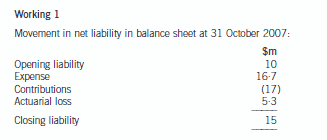
will be $100,000 on 30 November 2007. This will be discounted at an effective interest rate of 8% to give a present
value of $85,733. The loan will, therefore, be impaired by ($200,000 – $85,733) i.e. $114,267.
(Note: IAS 39 requires accrual of interest on impaired loans at the original effective interest rate. In the year to
30 November 2006 interest of 8% of $85,733 i.e. $6,859 would be accrued.)
-
第2题:
(b) Misson has purchased goods from a foreign supplier for 8 million euros on 31 July 2006. At 31 October 2006,
the trade payable was still outstanding and the goods were still held by Misson. Similarly Misson has sold goods
to a foreign customer for 4 million euros on 31 July 2006 and it received payment for the goods in euros on
31 October 2006. Additionally Misson had purchased an investment property on 1 November 2005 for
28 million euros. At 31 October 2006, the investment property had a fair value of 24 million euros. The company
uses the fair value model in accounting for investment properties.
Misson would like advice on how to treat these transactions in the financial statements for the year ended 31
October 2006. (7 marks)
Required:
Discuss the accounting treatment of the above transactions in accordance with the advice required by the
directors.
(Candidates should show detailed workings as well as a discussion of the accounting treatment used.)
正确答案:
(b) Inventory, Goods sold and Investment property
The inventory and trade payable initially would be recorded at 8 million euros ÷ 1·6, i.e. $5 million. At the year end, the
amount payable is still outstanding and is retranslated at 1 dollar = 1·3 euros, i.e. $6·2 million. An exchange loss of
$(6·2 – 5) million, i.e. $1·2 million would be reported in profit or loss. The inventory would be recorded at $5 million at the
year end unless it is impaired in value.
The sale of goods would be recorded at 4 million euros ÷ 1·6, i.e. $2·5 million as a sale and as a trade receivable. Payment
is received on 31 October 2006 in euros and the actual value of euros received will be 4 million euros ÷ 1·3,
i.e. $3·1 million.
Thus a gain on exchange of $0·6 million will be reported in profit or loss.
The investment property should be recognised on 1 November 2005 at 28 million euros ÷ 1·4, i.e. $20 million. At
31 October 2006, the property should be recognised at 24 million euros ÷ 1·3, i.e. $18·5 million. The decrease in fair value
should be recognised in profit and loss as a loss on investment property. The property is a non-monetary asset and any foreign
currency element is not recognised separately. When a gain or loss on a non-monetary item is recognised in profit or loss,
any exchange component of that gain or loss is also recognised in profit or loss. If any gain or loss is recognised in equity ona non-monetary asset, any exchange gain is also recognised in equity. -
第3题:
(d) Player trading
Another proposal is for the club to sell its two valuable players, Aldo and Steel. It is thought that it will receive a
total of $16 million for both players. The players are to be offered for sale at the end of the current football season
on 1 May 2007. (5 marks)
Required:
Discuss how the above proposals would be dealt with in the financial statements of Seejoy for the year ending
31 December 2007, setting out their accounting treatment and appropriateness in helping the football club’s
cash flow problems.
(Candidates do not need knowledge of the football finance sector to answer this question.)
正确答案: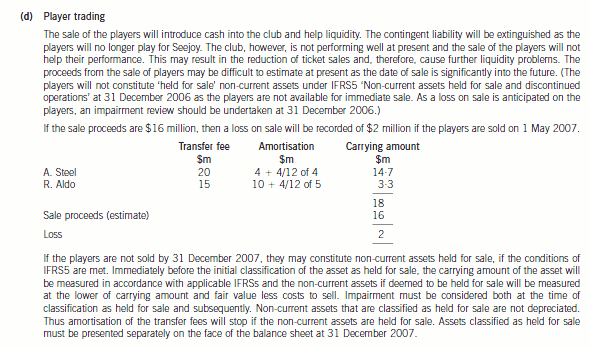
-
第4题:
(iv) Tyre recently undertook a sales campaign whereby customers can obtain free car accessories, by presenting a
coupon, which has been included in an advertisement in a national newspaper, on the purchase of a vehicle.
The offer is valid for a limited time period from 1 January 2006 until 31 July 2006. The management are unsure
as to how to treat this offer in the financial statements for the year ended 31 May 2006.
(5 marks)
Required:
Advise the directors of Tyre on how to treat the above items in the financial statements for the year ended
31 May 2006.
(The mark allocation is shown against each of the above items)
正确答案:
(iv) Car accessories
An obligation should not be recognised for the coupons and no provision created under IAS37 ‘Provisions, Contingent
Liabilities and Contingent Assets’. A provision should only be recognised where there is an obligating event. There has to be
a present obligation (legal or constructive), the probability of an outflow of resources and the ability to make a reliable estimate
of the amount of the obligation. These conditions do not seem to have been met. Until the vehicle is purchased the
accessories cannot be obtained. That is the point at which the present obligation arises, the outflow of resources occurs and
an estimate of the amount of the obligation can be made. When the car is purchased, the accessories become part of the
cost of the sale. The revenue recognised will be the amount received from the customer (the sales price). The revenue will
not be grossed up to include the value of the accessories. -
第5题:
5 Financial statements have seen an increasing move towards the use of fair values in accounting. Advocates of ‘fair
value accounting’ believe that fair value is the most relevant measure for financial reporting whilst others believe that
historical cost provides a more useful measure.
Issues have been raised over the reliability and measurement of fair values, and over the nature of the current level
of disclosure in financial statements in this area.
Required:
(a) Discuss the problems associated with the reliability and measurement of fair values and the nature of any
additional disclosures which may be required if fair value accounting is to be used exclusively in corporate
reporting. (13 marks)
正确答案:
(a) Reliability and Measurement
Fair value can be defined as the price that would be received to sell an asset or paid to transfer a liability. The fair value can
be thought of as an ‘exit price’. A fair value measurement assumes that the transaction to sell the asset or transfer the liability
occurs in the principal market for the asset or liability or, in the absence of a principal market, the most advantageous market
for the asset or liability which is the market in which the reporting entity would sell the asset or transfer the liability with the
price that maximises the amount that would be received or minimises the amount that would be paid. IAS39 ‘Financial
Instruments: Recognition and Measurement’ requires an entity to use the most advantageous active market in measuring the
fair value of a financial asset or liability when multiple markets exist whereas IAS41 ‘Agriculture’ requires an entity to use the
most relevant market. Thus there can be different approaches for estimating exit prices. Additionally valuation techniques and
current replacement cost could be used.
A hierarchy of fair value measurements would have to be developed in order to convey information about the nature of the
information used in creating the fair values. For example quoted prices (unadjusted) in active markets would provide better
quality information than quoted prices for similar assets and liabilities in active markets which would provide better quality
information than prices which reflect the reporting entity’s own thinking about the assumptions that market participants would
use in pricing the asset or liability. Enron made extensive use of what it called ‘mark-to-market’ accounting which was based
on valuation techniques and estimates. IFRSs currently do not have a single hierarchy that applies to all fair value measures.
Instead individual standards indicate preferences for certain inputs and measures of fair value over others, but this guidance
is not consistent among all IFRSs.
Some companies, in order to effectively manage their businesses, have already developed models for determining fair values.
Businesses manage their operations by managing risks. A risk management process often requires measurement of fair values
of contracts, financial instruments, and risk positions.
If markets were liquid and transparent for all assets and liabilities, fair value accounting clearly would give reliable information
which is useful in the decision making process. However, because many assets and liabilities do not have an active market,
the inputs and methods for estimating their fair value are more subjective and, therefore, the valuations are less reliable. Fair
value estimates can vary greatly, depending on the valuation inputs and methodology used. Where management uses
significant judgment in selecting market inputs when market prices are not available, reliability will continue to be an issue.
Management can use significant judgment in the valuation process. Management bias, whether intentional or unintentional,
may result in inappropriate fair value measurements and consequently misstatements of earnings and equity capital. Without
reliable fair value estimates, the potential for misstatements in financial statements prepared using fair value measurements
will be even greater.
Consideration must be given to revenue recognition issues in a fair value system. It must be ensured that unearned revenue
is not recognised early as it recently was by certain high-tech companies.
As the variety and complexity of financial instruments increases, so does the need for independent verification of fair value
estimates. However, verification of valuations that are not based on observable market prices is very challenging. Users of
financial statements will need to place greater emphasis on understanding how assets and liabilities are measured and how
reliable these valuations are when making decisions based on them.
Disclosure
Fair values reflect point estimates and do not result in transparent financial statements. Additional disclosures are necessary
to bring meaning to these fair value estimates. These disclosures might include key drivers affecting valuations, fair-valuerange
estimates, and confidence levels. Another important disclosure consideration relates to changes in fair value amounts.
For example, changes in fair values on securities can arise from movements in interest rates, foreign-currency rates, and credit
quality, as well as purchases and sales from the portfolio. For users to understand fair value estimates, they must be given
adequate disclosures about what factors caused the changes in fair value. It could be argued that the costs involved in
determining fair values may exceed the benefits derived therefrom. When considering how fair value information should be
presented in the financial statements, it is important to consider what type of financial information investors want. There are
indications that some investors desire both fair value information and historical cost information. One of the issues affecting
the credibility of fair value disclosures currently is that a number of companies include ‘health warnings’ with their disclosures
indicating that the information is not used by management. This language may contribute to users believing that the fair value
disclosures lack credibility.
-
第6题:
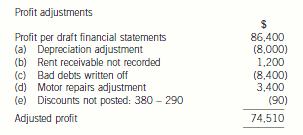
2 The draft financial statements of Choctaw, a limited liability company, for the year ended 31 December 2004 showed
a profit of $86,400. The trial balance did not balance, and a suspense account with a credit balance of $3,310 was
included in the balance sheet.
In subsequent checking the following errors were found:
(a) Depreciation of motor vehicles at 25 per cent was calculated for the year ended 31 December 2004 on the
reducing balance basis, and should have been calculated on the straight-line basis at 25 per cent.
Relevant figures:
Cost of motor vehicles $120,000, net book value at 1 January 2004, $88,000
(b) Rent received from subletting part of the office accommodation $1,200 had been put into the petty cash box.
No receivable balance had been recognised when the rent fell due and no entries had been made in the petty
cash book or elsewhere for it. The petty cash float in the trial balance is the amount according to the records,
which is $1,200 less than the actual balance in the box.
(c) Bad debts totalling $8,400 are to be written off.
(d) The opening accrual on the motor repairs account of $3,400, representing repair bills due but not paid at
31 December 2003, had not been brought down at 1 January 2004.
(e) The cash discount totals for December 2004 had not been posted to the discount accounts in the nominal ledger.
The figures were:
$
Discount allowed 380
Discount received 290
After the necessary entries, the suspense account balanced.
Required:
Prepare journal entries, with narratives, to correct the errors found, and prepare a statement showing the
necessary adjustments to the profit.
(10 marks)
正确答案: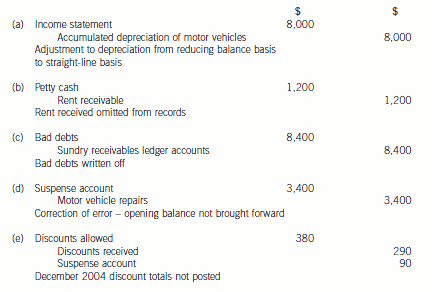
-
第7题:
(b) During the inventory count on 31 December, some goods which had cost $80,000 were found to be damaged.
In February 2005 the damaged goods were sold for $85,000 by an agent who received a 10% commission out
of the sale proceeds. (2 marks)
Required:
Advise the directors on the correct treatment of these matters, stating the relevant accounting standard which
justifies your answer in each case.
NOTE: The mark allocation is shown against each of the three matters.
正确答案:
(b) The inventories should be valued at the lower of cost and net realisable value. Cost is $80,000, net realisable value is
$85,000 less 10%, or $76,500. The net realisable value of $76,500 should therefore be taken (IAS2 Inventories) -
第8题:
(b) Advise on the capital gains implications should Trent Limited’s old building be sold as proposed. Support your
advice with relevant calculations. (4 marks)
正确答案:
This gives a higher post-entry loss of £50,000 (150,000 – 100,000) and so it is advisable for Trent Limited to make
this election.
The £100,000 of pre-entry losses are still available, but can only be set against gains on assets which:
(i) Trent Limited sold prior to being acquired (subject to the normal carry back restrictions), or
(ii) Trent Limited already owned when it was acquired, or
(iii) Trent Limited acquired from outside the group and used in its trade after being bought by Tay Limited. -
第9题:
(c) Lamont owns a residential apartment above its head office. Until 31 December 2006 it was let for $3,000 a
month. Since 1 January 2007 it has been occupied rent-free by the senior sales executive. (6 marks)
Required:
For each of the above issues:
(i) comment on the matters that you should consider; and
(ii) state the audit evidence that you should expect to find,
in undertaking your review of the audit working papers and financial statements of Lamont Co for the year ended
31 March 2007.
NOTE: The mark allocation is shown against each of the three issues.
正确答案:
(c) Rent-free accommodation
(i) Matters
■ The senior sales executive is a member of Lamont’s key management personnel and is therefore a related party.
■ The occupation of Lamont’s residential apartment by the senior sales executive is therefore a related party
transaction, even though no price is charged (IAS 24 Related Party Disclosures).
■ Related party transactions are material by nature and information about them should be disclosed so that users of
financial statements understand the potential effect of related party relationships on the financial statements.
■ The provision of ‘housing’ is a non-monetary benefit that should be included in the disclosure of key management
personnel compensation (within the category of short-term employee benefits).
■ The financial statements for the year ended 31 March 2007 should disclose the arrangement for providing the
senior sales executive with rent-free accommodation and its fair value (i.e. $3,000 per month).
Tutorial note: Since no price is charged for the transaction, rote-learned disclosures such as ‘the amount of outstanding
balances’ and ‘expense recognised in respect of bad debts’ are irrelevant.
(ii) Audit evidence
■ Physical inspection of the apartment to confirm that it is occupied.
■ Written representation from the senior sales executive that he is occupying the apartment free of charge.
■ Written representation from the management board confirming that there are no related party transactions requiring
disclosure other than those that have been disclosed.
■ Inspection of the lease agreement with (or payments received from) the previous tenant to confirm the $3,000
monthly rental value. -
第10题:
During the year the internal auditor of Mulligan Co discovered several discrepancies in the inventory records. In a
statement made to the board of directors, the internal auditor said:
‘I think that someone is taking items from the warehouse. A physical inventory count is performed every three months,
and it has become apparent that about 200 boxes of flat-packed chairs and tables are disappearing from the
warehouse every month. We should get someone to investigate what has happened and quantify the value of the
loss.’
Required:
(c) Define ‘forensic accounting’ and explain its relevance to the statement made by the internal auditor.
(5 marks)
正确答案:
(c) Forensic accounting is where an assurance provider investigates a specific issue, often with a legal consequence, such as a
suspected fraud. Specifically it is the process of gathering, analysing and reporting on data for the purpose of finding facts
and/or evidence in the context of financial/legal disputes and/or irregularities. The forensic accountant will also give
preventative advice based on evidence gathered. This advice is based usually on recommendations to improve the internal
control systems to prevent and detect fraud.
The relevance here is that Webb & Co are likely to be asked to provide a forensic accounting service to Mulligan Co.
The investigation will consider two issues – firstly whether the fraud actually happened, and secondly, if a fraud has taken
place, the financial value of the fraud. The investigation should determine who has perpetrated the fraud, and collect evidence
to help prosecute those involved in the deception.
In this case the suspicion that inventory is being stolen should be investigated, as there could be other reasons for the
discrepancy found in the inventory records. For example, the discrepancy could be caused by:
– Obsolete or damaged inventory thrown away but not eliminated from the inventory records
– Despatches from the warehouse not recorded in the inventory management system
– Incoming inventory being recorded incorrectly (e.g. recorded twice in the inventory management system)
– Inventory being held at a separate location and therefore not included in the count.
If it is found that thefts have taken place, then the forensic accountant should gather evidence to:
– Prove the identity of the persons involved
– Quantify the value of inventory taken.
The evidence gathered could be used to start criminal proceedings against those found to have been involved in the fraud. -
第11题:
The goods ()shipped already if your L/C had arrived by the end of December last.
A、would be
B、must have been
C、had been
D、would have been
参考答案:D
-
第12题:
There has been significant divergence in practice over recognition of revenue mainly because International Financial Reporting Standards (IFRS) have contained limited guidance in certain areas. The International Accounting Standards Board (IASB) as a result of the joint project with the US Financial Accounting Standards Board (FASB) has issued IFRS 15 Revenue from Contracts with Customers. IFRS 15 sets out a five-step model, which applies to revenue earned from a contract with a customer with limited exceptions, regardless of the type of revenue transaction or the industry. Step one in the five-step model requires the identification of the contract with the customer and is critical for the purpose of applying the standard. The remaining four steps in the standard’s revenue recognition model are irrelevant if the contract does not fall within the scope of IFRS 15.
Required:
(a) (i) Discuss the criteria which must be met for a contract with a customer to fall within the scope of IFRS 15. (5 marks)
(ii) Discuss the four remaining steps which lead to revenue recognition after a contract has been identified as falling within the scope of IFRS 15. (8 marks)
(b) (i) Tang enters into a contract with a customer to sell an existing printing machine such that control of the printing machine vests with the customer in two years’ time. The contract has two payment options. The customer can pay $240,000 when the contract is signed or $300,000 in two years’ time when the customer gains control of the printing machine. The interest rate implicit in the contract is 11·8% in order to adjust for the risk involved in the delay in payment. However, Tang’s incremental borrowing rate is 5%. The customer paid $240,000 on 1 December 2014 when the contract was signed. (4 marks)
(ii) Tang enters into a contract on 1 December 2014 to construct a printing machine on a customer’s premises for a promised consideration of $1,500,000 with a bonus of $100,000 if the machine is completed within 24 months. At the inception of the contract, Tang correctly accounts for the promised bundle of goods and services as a single performance obligation in accordance with IFRS 15. At the inception of the contract, Tang expects the costs to be $800,000 and concludes that it is highly probable that a significant reversal in the amount of cumulative revenue recognised will occur. Completion of the printing machine is highly susceptible to factors outside of Tang’s influence, mainly issues with the supply of components.
At 30 November 2015, Tang has satisfied 65% of its performance obligation on the basis of costs incurred to date and concludes that the variable consideration is still constrained in accordance with IFRS 15. However, on 4 December 2015, the contract is modified with the result that the fixed consideration and expected costs increase by $110,000 and $60,000 respectively. The time allowable for achieving the bonus is extended by six months with the result that Tang concludes that it is highly probable that the bonus will be achieved and that the contract still remains a single performance obligation. Tang has an accounting year end of 30 November. (6 marks)
Required:
Discuss how the above two contracts should be accounted for under IFRS 15. (In the case of (b)(i), the discussion should include the accounting treatment up to 30 November 2016 and in the case of (b)(ii), the accounting treatment up to 4 December 2015.)
Note: The mark allocation is shown against each of the items above.
Professional marks will be awarded in question 4 for clarity and quality of presentation. (2 marks)
正确答案:(a) (i) The definition of what constitutes a contract for the purpose of applying the standard is critical. The definition of contract is based on the definition of a contract in the USA and is similar to that in IAS 32 Financial Instruments: Presentation. A contract exists when an agreement between two or more parties creates enforceable rights and obligations between those parties. The agreement does not need to be in writing to be a contract but the decision as to whether a contractual right or obligation is enforceable is considered within the context of the relevant legal framework of a jurisdiction. Thus, whether a contract is enforceable will vary across jurisdictions. The performance obligation could include promises which result in a valid expectation that the entity will transfer goods or services to the customer even though those promises are not legally enforceable.
The first criteria set out in IFRS 15 is that the parties should have approved the contract and are committed to perform. their respective obligations. It would be questionable whether that contract is enforceable if this were not the case. In the case of oral or implied contracts, this may be difficult but all relevant facts and circumstances should be considered in assessing the parties’ commitment. The parties need not always be committed to fulfilling all of the obligations under a contract. IFRS 15 gives the example where a customer is required to purchase a minimum quantity of goods but past experience shows that the customer does not always do this and the other party does not enforce their contract rights. However, there needs to be evidence that the parties are substantially committed to the contract.
It is essential that each party’s rights and the payment terms can be identified regarding the goods or services to be transferred. This latter requirement is the key to determining the transaction price.
The contract must have commercial substance before revenue can be recognised, as without this requirement, entities might artificially inflate their revenue and it would be questionable whether the transaction has economic consequences. Further, it should be probable that the entity will collect the consideration due under the contract. An assessment of a customer’s credit risk is an important element in deciding whether a contract has validity but customer credit risk does not affect the measurement or presentation of revenue. The consideration may be different to the contract price because of discounts and bonus offerings. The entity should assess the ability of the customer to pay and the customer’s intention to pay the consideration. If a contract with a customer does not meet these criteria, the entity can continually re-assess the contract to determine whether it subsequently meets the criteria.
Two or more contracts which are entered into around the same time with the same customer may be combined and accounted for as a single contract, if they meet the specified criteria. The standard provides detailed requirements for contract modifications. A modification may be accounted for as a separate contract or a modification of the original contract, depending upon the circumstances of the case.
(ii) Step one in the five-step model requires the identification of the contract with the customer. After a contract has been determined to fall under IFRS 15, the following steps are required before revenue can be recognised.
Step two requires the identification of the separate performance obligations in the contract. This is often referred to as ’unbundling’, and is done at the beginning of a contract. The key factor in identifying a separate performance obligation is the distinctiveness of the good or service, or a bundle of goods or services. A good or service is distinct if the customer can benefit from the good or service on its own or together with other readily available resources and is separately identifiable from other elements of the contract. IFRS 15 requires a series of distinct goods or services which are substantially the same with the same pattern of transfer, to be regarded as a single performance obligation. A good or service, which has been delivered, may not be distinct if it cannot be used without another good or service which has not yet been delivered. Similarly, goods or services which are not distinct should be combined with other goods or services until the entity identifies a bundle of goods or services which is distinct. IFRS 15 provides indicators rather than criteria to determine when a good or service is distinct within the context of the contract. This allows management to apply judgement to determine the separate performance obligations which best reflect the economic substance of a transaction.
Step three requires the entity to determine the transaction price, which is the amount of consideration which an entity expects to be entitled to in exchange for the promised goods or services. This amount excludes amounts collected on behalf of a third party, for example, government taxes. An entity must determine the amount of consideration to which it expects to be entitled in order to recognise revenue.
The transaction price might include variable or contingent consideration. Variable consideration should be estimated as either the expected value or the most likely amount. Management should use the approach which it expects will best predict the amount of consideration and should be applied consistently throughout the contract. An entity can only include variable consideration in the transaction price to the extent that it is highly probable that a subsequent change in the estimated variable consideration will not result in a significant revenue reversal. If it is not appropriate to include all of the variable consideration in the transaction price, the entity should assess whether it should include part of the variable consideration. However, this latter amount still has to pass the ’revenue reversal’ test.
Additionally, an entity should estimate the transaction price taking into account non-cash consideration, consideration payable to the customer and the time value of money if a significant financing component is present. The latter is not required if the time period between the transfer of goods or services and payment is less than one year. If an entity anticipates that it may ultimately accept an amount lower than that initially promised in the contract due to, for example, past experience of discounts given, then revenue would be estimated at the lower amount with the collectability of that lower amount being assessed. Subsequently, if revenue already recognised is not collectable, impairment losses should be taken to profit or loss.
Step four requires the allocation of the transaction price to the separate performance obligations. The allocation is based on the relative standalone selling prices of the goods or services promised and is made at inception of the contract. It is not adjusted to reflect subsequent changes in the standalone selling prices of those goods or services. The best evidence of standalone selling price is the observable price of a good or service when the entity sells that good or service separately. If that is not available, an estimate is made by using an approach which maximises the use of observable inputs. For example, expected cost plus an appropriate margin or the assessment of market prices for similar goods or services adjusted for entity-specific costs and margins or in limited circumstances a residual approach. When a contract contains more than one distinct performance obligation, an entity allocates the transaction price to each distinct performance obligation on the basis of the standalone selling price.
Where the transaction price includes a variable amount and discounts, consideration needs to be given as to whether these amounts relate to all or only some of the performance obligations in the contract. Discounts and variable consideration will typically be allocated proportionately to all of the performance obligations in the contract. However, if certain conditions are met, they can be allocated to one or more separate performance obligations.
Step five requires revenue to be recognised as each performance obligation is satisfied. An entity satisfies a performance obligation by transferring control of a promised good or service to the customer, which could occur over time or at a point in time. The definition of control includes the ability to prevent others from directing the use of and obtaining the benefits from the asset. A performance obligation is satisfied at a point in time unless it meets one of three criteria set out in IFRS 15. Revenue is recognised in line with the pattern of transfer.
If an entity does not satisfy its performance obligation over time, it satisfies it at a point in time and revenue will be recognised when control is passed at that point in time. Factors which may indicate the passing of control include the present right to payment for the asset or the customer has legal title to the asset or the entity has transferred physical possession of the asset.
(b) (i) The contract contains a significant financing component because of the length of time between when the customer pays for the asset and when Tang transfers the asset to the customer, as well as the prevailing interest rates in the market. A contract with a customer which has a significant financing component should be separated into a revenue component (for the notional cash sales price) and a loan component. Consequently, the accounting for a sale arising from a contract which has a significant financing component should be comparable to the accounting for a loan with the same features. An entity should use the discount rate which would be reflected in a separate financing transaction between the entity and its customer at contract inception. The interest rate implicit in the transaction may be different from the rate to be used to discount the cash flows, which should be the entity’s incremental borrowing rate. IFRS 15 would therefore dictate that the rate which should be used in adjusting the promised consideration is 5%, which is the entity’s incremental borrowing rate, and not 11·8%.
Tang would account for the significant financing component as follows:
Recognise a contract liability for the $240,000 payment received on 1 December 2014 at the contract inception:
Dr Cash $240,000
Cr Contract liability $240,000During the two years from contract inception (1 December 2014) until the transfer of the printing machine, Tang adjusts the amount of consideration and accretes the contract liability by recognising interest on $240,000 at 5% for two years.
Year to 30 November 2015
Dr Interest expense $12,000
Cr Contract liability $12,000Contract liability would stand at $252,000 at 30 November 2015.
Year to 30 November 2016
Dr Interest expense $12,600
Cr Contract liability $12,600Recognition of contract revenue on transfer of printing machine at 30 November 2016 of $264,600 by debiting contract liability and crediting revenue with this amount.
(ii) Tang accounts for the promised bundle of goods and services as a single performance obligation satisfied over time in accordance with IFRS 15. At the inception of the contract, Tang expects the following:
Transaction price $1,500,000
Expected costs $800,000
Expected profit (46·7%) $700,000At contract inception, Tang excludes the $100,000 bonus from the transaction price because it cannot conclude that it is highly probable that a significant reversal in the amount of cumulative revenue recognised will not occur. Completion of the printing machine is highly susceptible to factors outside the entity’s influence. By the end of the first year, the entity has satisfied 65% of its performance obligation on the basis of costs incurred to date. Costs incurred to date are therefore $520,000 and Tang reassesses the variable consideration and concludes that the amount is still constrained. Therefore at 30 November 2015, the following would be recognised:
Revenue $975,000
Costs $520,000
Gross profit $455,000However, on 4 December 2015, the contract is modified. As a result, the fixed consideration and expected costs increase by $110,000 and $60,000, respectively. The total potential consideration after the modification is $1,710,000 which is $1,610,000 fixed consideration + $100,000 completion bonus. In addition, the allowable time for achieving the bonus is extended by six months with the result that Tang concludes that it is highly probable that including the bonus in the transaction price will not result in a significant reversal in the amount of cumulative revenue recognised in accordance with IFRS 15. Therefore the bonus of $100,000 can be included in the transaction price. Tang also concludes that the contract remains a single performance obligation. Thus,Tang accounts for the contract modification as if it were part of the original contract. Therefore, Tang updates its estimates of costs and revenue as follows:
Tang has satisfied 60·5% of its performance obligation ($520,000 actual costs incurred compared to $860,000 total expected costs). The entity recognises additional revenue of $59,550 [(60·5% of $1,710,000) – $975,000 revenue recognised to date] at the date of the modification as a cumulative catch-up adjustment. As the contract amendment took place after the year end, the additional revenue would not be treated as an adjusting event.
-
第13题:
2 Misson, a public limited company, has carried out transactions denominated in foreign currency during the financial
year ended 31 October 2006 and has conducted foreign operations through a foreign entity. Its functional and
presentation currency is the dollar. A summary of the foreign currency activities is set out below:
(a) Misson has a 100% owned foreign subsidiary, Chong, which was formed on 1 November 2004 with a share
capital of 100 million euros which has been taken as the cost of the investment. The total shareholders’ equity
of the subsidiary as at 31 October 2005 and 31 October 2006 was 140 million euros and 160 million euros
respectively. Chong has not paid any dividends to Misson and has no other reserves than retained earnings in its
financial statements. The subsidiary was sold on 31 October 2006 for 195 million euros.
Misson would like to know how to treat the sale of the subsidiary in the parent and group accounts for the year
ended 31 October 2006. (8 marks)
Required:
Discuss the accounting treatment of the above transactions in accordance with the advice required by the
directors.
(Candidates should show detailed workings as well as a discussion of the accounting treatment used.)
正确答案: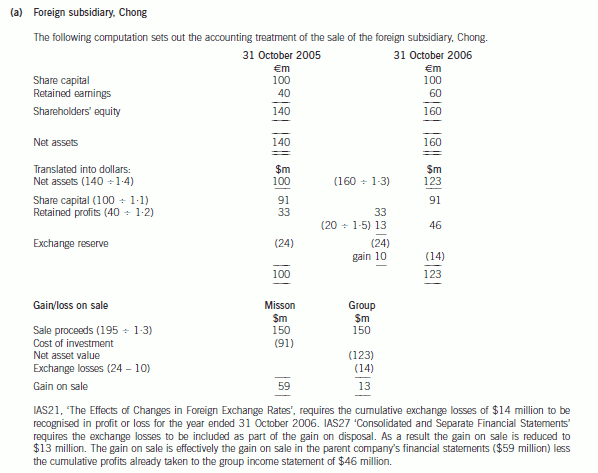
-
第14题:
3 Seejoy is a famous football club but has significant cash flow problems. The directors and shareholders wish to take
steps to improve the club’s financial position. The following proposals had been drafted in an attempt to improve the
cash flow of the club. However, the directors need advice upon their implications.
(a) Sale and leaseback of football stadium (excluding the land element)
The football stadium is currently accounted for using the cost model in IAS16, ‘Property, Plant, and Equipment’.
The carrying value of the stadium will be $12 million at 31 December 2006. The stadium will have a remaining
life of 20 years at 31 December 2006, and the club uses straight line depreciation. It is proposed to sell the
stadium to a third party institution on 1 January 2007 and lease it back under a 20 year finance lease. The sale
price and fair value are $15 million which is the present value of the minimum lease payments. The agreement
transfers the title of the stadium back to the football club at the end of the lease at nil cost. The rental is
$1·2 million per annum in advance commencing on 1 January 2007. The directors do not wish to treat this
transaction as the raising of a secured loan. The implicit interest rate on the finance in the lease is 5·6%.
(9 marks)
Required:
Discuss how the above proposals would be dealt with in the financial statements of Seejoy for the year ending
31 December 2007, setting out their accounting treatment and appropriateness in helping the football club’s
cash flow problems.
(Candidates do not need knowledge of the football finance sector to answer this question.)
正确答案:

-
第15题:
(ii) The property of the former administrative centre of Tyre is owned by the company. Tyre had decided in the year
that the property was surplus to requirements and demolished the building on 10 June 2006. After demolition,
the company will have to carry out remedial environmental work, which is a legal requirement resulting from the
demolition. It was intended that the land would be sold after the remedial work had been carried out. However,
land prices are currently increasing in value and, therefore, the company has decided that it will not sell the land
immediately. Tyres uses the ‘cost model’ in IAS16 ‘Property, plant and equipment’ and has owned the property
for many years. (7 marks)
Required:
Advise the directors of Tyre on how to treat the above items in the financial statements for the year ended
31 May 2006.
(The mark allocation is shown against each of the above items)
正确答案:
(ii) Former administrative building
The land and buildings of the former administrative centre are accounted for as separate elements. The demolition of the
building is an indicator of the impairment of the property under IAS36. The building will not generate any future cash flows
and its recoverable amount is zero. Therefore, the carrying value of the building will be written down to zero and the loss
charged to profit or loss in the year to 31 May 2006 when the decision to demolish the building was made. The land value
will be in excess of its carrying amount as the company uses the cost model and land prices are rising. Thus no impairment
charge is recognised in respect of the land.
The demolition costs will be expensed when incurred and a provision for environmental costs recognised when an obligation
arises, i.e. in the financial year to 31 May 2007. It may be that some of these costs could be recognised as site preparation
costs and be capitalised under IAS16.
The land will not meet the criteria set out in IFRS5 ‘Non-current Assets Held for Sale and Discontinued Operations’ as a noncurrent
asset which is held for sale. IFRS5 says that a non-current asset should be classified as ‘held for sale’ if its carrying
amount will be recovered principally through a sale transaction rather than through continuing use. However, the non-current
asset must be available for immediate sale and must be actively marketed at its current fair value (amongst other criteria) and
these criteria have not been met in this case.
When the building has been demolished and the site prepared, the land could be considered to be an investment property
and accounted for under IAS40 ‘Investment Property’ where the fair value model allows gains (or losses) to be recognised inprofit or loss for the period. -
第16题:
(c) Wader is reviewing the accounting treatment of its buildings. The company uses the ‘revaluation model’ for its
buildings. The buildings had originally cost $10 million on 1 June 2005 and had a useful economic life of
20 years. They are being depreciated on a straight line basis to a nil residual value. The buildings were revalued
downwards on 31 May 2006 to $8 million which was the buildings’ recoverable amount. At 31 May 2007 the
value of the buildings had risen to $11 million which is to be included in the financial statements. The company
is unsure how to treat the above events. (7 marks)
Required:
Discuss the accounting treatments of the above items in the financial statements for the year ended 31 May
2007.
Note: a discount rate of 5% should be used where necessary. Candidates should show suitable calculations where
necessary.
正确答案: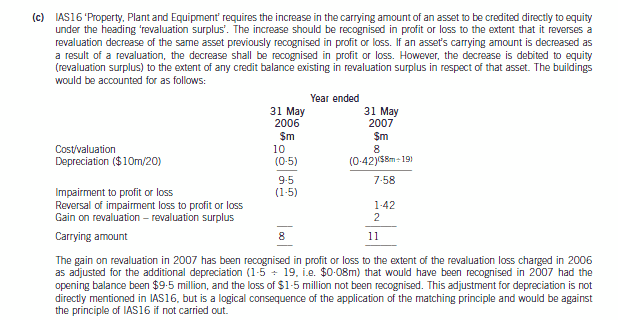
-
第17题:
(b) (i) Discusses the principles involved in accounting for claims made under the above warranty provision.
(6 marks)
(ii) Shows the accounting treatment for the above warranty provision under IAS37 ‘Provisions, Contingent
Liabilities and Contingent Assets’ for the year ended 31 October 2007. (3 marks)
Appropriateness of the format and presentation of the report and communication of advice. (2 marks)
正确答案:(b) Provisions – IAS37
An entity must recognise a provision under IAS37 if, and only if:
(a) a present obligation (legal or constructive) has arisen as a result of a past event (the obligating event)
(b) it is probable (‘more likely than not’), that an outflow of resources embodying economic benefits will be required to settle
the obligation
(c) the amount can be estimated reliably
An obligating event is an event that creates a legal or constructive obligation and, therefore, results in an enterprise having
no realistic alternative but to settle the obligation. A constructive obligation arises if past practice creates a valid expectation
on the part of a third party. If it is more likely than not that no present obligation exists, the enterprise should disclose a
contingent liability, unless the possibility of an outflow of resources is remote.
The amount recognised as a provision should be the best estimate of the expenditure required to settle the present obligation
at the balance sheet date, that is, the amount that an enterprise would rationally pay to settle the obligation at the balance
sheet date or to transfer it to a third party. This means provisions for large populations of events such as warranties, are
measured at a probability weighted expected value. In reaching its best estimate, the entity should take into account the risks
and uncertainties that surround the underlying events.
Expected cash outflows should be discounted to their present values, where the effect of the time value of money is material
using a risk adjusted rate (it should not reflect risks for which future cash flows have been adjusted). If some or all of the
expenditure required to settle a provision is expected to be reimbursed by another party, the reimbursement should be
recognised as a separate asset when, and only when, it is virtually certain that reimbursement will be received if the entity
settles the obligation. The amount recognised should not exceed the amount of the provision. In measuring a provision future
events should be considered. The provision for the warranty claim will be determined by using the expected value method.
The past event which causes the obligation is the initial sale of the product with the warranty given at that time. It would be
appropriate for the company to make a provision for the Year 1 warranty of $280,000 and Year 2 warranty of $350,000,
which represents the best estimate of the obligation (see Appendix 2). Only if the insurance company have validated the
counter claim will Macaljoy be able to recognise the asset and income. Recovery has to be virtually certain. If it is virtually
certain, then Macaljoy may be able to recognise the asset. Generally contingent assets are never recognised, but disclosed
where an inflow of economic benefits is probable.
The company could discount the provision if it was considered that the time value of money was material. The majority of
provisions will reverse in the short term (within two years) and, therefore, the effects of discounting are likely to be immaterial.
In this case, using the risk adjusted rate (IAS37), the provision would be reduced to $269,000 in Year 1 and $323,000 in
Year 2. The company will have to determine whether this is material.
Appendix 1
The accounting for the defined benefit plan is as follows:

-
第18题:
5 The directors of Quapaw, a limited liability company, are reviewing the company’s draft financial statements for the
year ended 31 December 2004.
The following material matters are under discussion:
(a) During the year the company has begun selling a product with a one-year warranty under which manufacturing
defects are remedied without charge. Some claims have already arisen under the warranty. (2 marks)
Required:
Advise the directors on the correct treatment of these matters, stating the relevant accounting standard which
justifies your answer in each case.
NOTE: The mark allocation is shown against each of the three matters
正确答案:
(a) The correct treatment is to provide for the best estimate of the costs likely to be incurred under the warranty, as required by
IAS37 Provisions, contingent liabilities and contingent assets. -
第19题:
2 The draft financial statements of Rampion, a limited liability company, for the year ended 31 December 2005
included the following figures:
$
Profit 684,000
Closing inventory 116,800
Trade receivables 248,000
Allowance for receivables 10,000
No adjustments have yet been made for the following matters:
(1) The company’s inventory count was carried out on 3 January 2006 leading to the figure shown above. Sales
between the close of business on 31 December 2005 and the inventory count totalled $36,000. There were no
deliveries from suppliers in that period. The company fixes selling prices to produce a 40% gross profit on sales.
The $36,000 sales were included in the sales records in January 2006.
(2) $10,000 of goods supplied on sale or return terms in December 2005 have been included as sales and
receivables. They had cost $6,000. On 10 January 2006 the customer returned the goods in good condition.
(3) Goods included in inventory at cost $18,000 were sold in January 2006 for $13,500. Selling expenses were
$500.
(4) $8,000 of trade receivables are to be written off.
(5) The allowance for receivables is to be adjusted to the equivalent of 5% of the trade receivables after allowing for
the above matters, based on past experience.
Required:
(a) Prepare a statement showing the effect of the adjustments on the company’s net profit for the year ended
31 December 2005. (5 marks)
正确答案: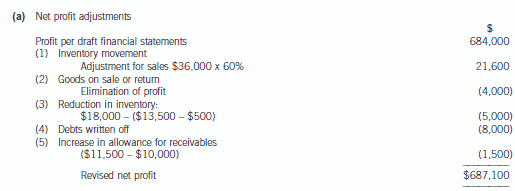
-
第20题:
(c) Pinzon, a limited liability company and audit client, is threatening to sue your firm in respect of audit fees charged
for the year ended 31 December 2004. Pinzon is alleging that Bartolome billed the full rate on air fares for audit
staff when substantial discounts had been obtained by Bartolome. (4 marks)
Required:
Comment on the ethical and other professional issues raised by each of the above matters and their implications,
if any, for the continuation of each assignment.
NOTE: The mark allocation is shown against each of the three issues.
正确答案:
(c) Threatened legal action
Ethical and professional issues
■ An advocacy threat has arisen as Bartolome and Pinzon are in opposition concerning the fee note for the 2004 audit.
■ If Pinzon’s allegations are true this may cast serious doubt on the integrity of Bartolome. Pinzon should be advised to
take their claims first to ACCA’s Disciplinary Committee.
■ If Bartolome has indeed charged full air fares when substantial discounts had been obtained this could be due to:
– Bartolome incorrectly believing this to be an acceptable industry practice; or
– a billing error/oversight.
In either case Bartolome should issue a credit note, although this may be insufficient to make amends and salvage the
auditor-client relationship.
■ Bartolome may have legitimately claimed for full airfares if this was agreed in its contract (i.e. the terms of engagement)
with Pinzon.
Implications for continuation with assignment
Unless the threat of legal action is amicably resolved very quickly (which is perhaps unlikely) Pinzon and Bartolome are in
conflict. Bartolome cannot therefore be seen to be independent and so should tender their resignation as auditor for the year
ending 31 December 2005 (assuming they were re-appointed and have not already been removed from office). -
第21题:
(b) You are the audit manager of Petrie Co, a private company, that retails kitchen utensils. The draft financial
statements for the year ended 31 March 2007 show revenue $42·2 million (2006 – $41·8 million), profit before
taxation of $1·8 million (2006 – $2·2 million) and total assets of $30·7 million (2006 – $23·4 million).
You are currently reviewing two matters that have been left for your attention on Petrie’s audit working paper file
for the year ended 31 March 2007:
(i) Petrie’s management board decided to revalue properties for the year ended 31 March 2007 that had
previously all been measured at depreciated cost. At the balance sheet date three properties had been
revalued by a total of $1·7 million. Another nine properties have since been revalued by $5·4 million. The
remaining three properties are expected to be revalued later in 2007. (5 marks)
Required:
Identify and comment on the implications of these two matters for your auditor’s report on the financial
statements of Petrie Co for the year ended 31 March 2007.
NOTE: The mark allocation is shown against each of the matters above.
正确答案:
(b) Implications for auditor’s report
(i) Selective revaluation of premises
The revaluations are clearly material to the balance sheet as $1·7 million and $5·4 million represent 5·5% and 17·6%
of total assets, respectively (and 23·1% in total). As the effects of the revaluation on line items in the financial statements
are clearly identified (e.g. revalued amount, depreciation, surplus in statement of changes in equity) the matter is not
pervasive.
The valuations of the nine properties after the year end provide additional evidence of conditions existing at the year end
and are therefore adjusting events per IAS 10 Events After the Balance Sheet Date.
Tutorial note: It is ‘now’ still less than three months after the year end so these valuations can reasonably be expected
to reflect year end values.
However, IAS 16 Property, Plant and Equipment does not permit the selective revaluation of assets thus the whole class
of premises would need to have been revalued for the year to 31 March 2007 to change the measurement basis for this
reporting period.
The revaluation exercise is incomplete. Unless the remaining three properties are revalued before the auditor’s report on
the financial statements for the year ended 31 March 2007 is signed off:
(1) the $7·1 revaluation made so far must be reversed to show all premises at depreciated cost as in previous years;
OR
(2) the auditor’s report would be qualified ‘except for’ disagreement regarding non-compliance with IAS 16.
When it is appropriate to adopt the revaluation model (e.g. next year) the change in accounting policy (from a cost model
to a revaluation model) should be accounted for in accordance with IAS 16 (i.e. as a revaluation).
Tutorial note: IAS 8 Accounting Policies, Changes in Accounting Estimates and Errors does not apply to the initial
application of a policy to revalue assets in accordance with IAS 16.
Assuming the revaluation is written back, before giving an unmodified opinion, the auditor should consider why the three
properties were not revalued. In particular if there are any indicators of impairment (e.g. physical dilapidation) there
should be sufficient evidence on the working paper file to show that the carrying amount of these properties is not
materially greater than their recoverable amount (i.e. the higher of value in use and fair value less costs to sell).
If there is insufficient evidence to confirm that the three properties are not impaired (e.g. if the auditor was prevented
from inspecting the properties) the auditor’s report would be qualified ‘except for’ on grounds of limitation on scope.
If there is evidence of material impairment but management fail to write down the carrying amount to recoverable
amount the auditor’s report would be qualified ‘except for’ disagreement regarding non-compliance with IAS 36
Impairment of Assets.
-
第22题:
(c) Identify and discuss the ethical and professional matters raised at the inventory count of LA Shots Co.
(6 marks)
正确答案:
(c) There are several ethical and professional issues raised in relation to the inventory count of LA Shots Co.
Firstly, it was inappropriate of Brenda Mangle to offer the incentive to the audit juniors. As she is a new manager, it may be
that she didn’t realise how the incentive would be perceived. Brenda should be informed that her actions could have serious
implications.
The offer could be viewed as a bribe of the audit juniors, and could be perceived as a self-interest independence threat as
there is a financial benefit offered to members of the audit team.
The value of the ten bottles of ‘Super Juice’ should be considered, as it is only appropriate for a member of the audit team to
accept any goods or hospitality from the audit client if the value is ‘clearly insignificant’. Ultimately it would be the decision
of the audit partner as to whether the value is clearly insignificant. It is likely that this does not constitute a significant threat
to independence, however the offer should still be referred to the audit partner.
Also, if the juniors took ten bottles of ‘Super Juice’, this could interfere with the physical count of goods and/or with cut off
details obtained at the count. The juniors should therefore have declined the offer and informed a senior member of the audit
team of the situation.
There may be a need to adequately train new members of staff on ethical matters if the juniors were unsure of how to react
to the offer.
The work performed by the juniors at the inventory count must be reviewed. The audit procedures were performed very
quickly compared to last year and therefore sufficient evidence may not have been gathered. In an extreme situation the whole
inventory count may have to be reperformed if it is found that the procedures performed cannot be relied upon.
In addition, the juniors should not have attended the audit client’s office party without the permission of the audit manager.
The party appears to have taken place during work time, when the juniors should have been completing the inventory count
procedures. The two juniors have not acted with due professional consideration, and could be considered to lack integrity.
The actions of the juniors should be discussed with them, possibly with a view to disciplinary action.
There may also be questions over whether the direction and supervision of the juniors was adequate. As the two juniors are
both recent recruits, this is likely to be the first inventory count that they have attended. It appears that they may not have
been adequately briefed as to the importance of the inventory count as a source of audit evidence, or that they have
disregarded any such briefing that was provided to them. In either case possibly a more senior auditor should have
accompanied them to the inventory count and supervised their actions. -
第23题:
One of your audit clients is Tye Co a company providing petrol, aviation fuel and similar oil based products to the government of the country it is based in. Although the company is not listed on any stock exchange, it does follow best practice regarding corporate governance regulations. The audit work for this year is complete, apart from the matter referred to below.
As part of Tye Co’s service contract with the government, it is required to hold an emergency inventory reserve of 6,000 barrels of aviation fuel. The inventory is to be used if the supply of aviation fuel is interrupted due to unforeseen events such as natural disaster or terrorist activity.
This fuel has in the past been valued at its cost price of $15 a barrel. The current value of aviation fuel is $120 a barrel. Although the audit work is complete, as noted above, the directors of Tye Co have now decided to show the ‘real’ value of this closing inventory in the financial statements by valuing closing inventory of fuel at market value, which does not comply with relevant accounting standards. The draft financial statements of Tye Co currently show a profit of approximately $500,000 with net assets of $170 million.
Required:
(a) List the audit procedures and actions that you should now take in respect of the above matter. (6 marks)
(b) For the purposes of this section assume from part (a) that the directors have agreed to value inventory at
$15/barrel.
Having investigated the matter in part (a) above, the directors present you with an amended set of financial
statements showing the emergency reserve stated not at 6,000 barrels, but reported as 60,000 barrels. The final financial statements now show a profit following the inclusion of another 54,000 barrels of oil in inventory. When queried about the change from 6,000 to 60,000 barrels of inventory, the finance director stated that this change was made to meet expected amendments to emergency reserve requirements to be published in about six months time. The inventory will be purchased this year, and no liability will be shown in the financial statements for this future purchase. The finance director also pointed out that part of Tye Co’s contract with the government requires Tye Co to disclose an annual profit and that a review of bank loans is due in three months. Finally the finance director stated that if your audit firm qualifies the financial statements in respect of the increase in inventory, they will not be recommended for re-appointment at the annual general meeting. The finance director refuses to amend the financial statements to remove this ‘fictitious’ inventory.
Required:
(i) State the external auditor’s responsibilities regarding the detection of fraud; (4 marks)
(ii) Discuss to which groups the auditors of Tye Co could report the ‘fictitious’ aviation fuel inventory;
(6 marks)
(iii) Discuss the safeguards that the auditors of Tye Co can use in an attempt to overcome the intimidation
threat from the directors of Tye Co. (4 marks)
正确答案:
(a)Valuationofaviationinventory–ReviewGAAPtoensurethattherearenoexceptionsforaviationfuelorinventoryheldforemergencypurposeswhichwouldsuggestamarketvaluationshouldbeused.–Calculatethedifferenceinvaluation.Theerrorininventoryvaluationis$105*6,000barrelsor$630k,whichisamaterialamountcomparedtoprofit.–Reviewprioryearworkingpaperstodeterminewhetherasimilarsituationoccurredlastyearandascertaintheoutcomeatthatstage.–Discussthematterwiththedirectorstoobtainreasonswhytheybelievethatmarketvalueshouldbeusedfortheinventorythisyear.–Warnthedirectorsthatinyouropinion,aviationfuelshouldbevaluedatthelowerofcostornetrealisablevalue(thatis$15/barrel)andthatusingmarketvaluewillresultinamodificationtotheauditreport.–Ifthedirectorsnowamendthefinancialstatementstoshowinventoryvaluedatcost,thenconsidermentioningtheissueintheweaknessletteranddonotmodifytheauditreportinrespectofthismatter.–Ifthedirectorswillnotamendthefinancialstatements,quantifytheeffectofthedisagreementinthevaluationmethod–thesumof$630,000ismaterialtothefinancialstatementsasTyeCo’sincomestatementfigureisdecreasedfromasmalllosstoalossof$130,000althoughnetassetsdecreasebyonlyabout0·3%.–ObtainamanagementrepresentationletterfromthedirectorsofTyeCoconfirmingthatmarketvalueistobeusedfortheemergencyinventoryofaviationfuel.–Ifthedirectorswillnotamendthefinancialstatements,drafttherelevantsectionsoftheauditreport,showingaqualificationonthegroundsofdisagreementwiththeaccountingpolicyforvaluationofinventory.(b)(i)ExternalauditorresponsibilitiesregardingdetectionoffraudOverallresponsibilityofauditorTheexternalauditorisprimarilyresponsiblefortheauditopiniononthefinancialstatementsfollowingtheinternationalauditingstandards(ISAs).ISA240(Redrafted)TheAuditor’sResponsibilitiesRelatingtoFraudinanAuditofFinancialStatementsisrelevanttoauditworkregardingfraud.Themainfocusofauditworkisthereforetoensurethatthefinancialstatementsshowatrueandfairview.Thedetectionoffraudisthereforenotthemainfocusoftheexternalauditor’swork.Anauditorisresponsibleforobtainingreasonableassurancethatthefinancialstatementsasawholearefreefrommaterialmisstatement,whethercausedbyfraudorerror.Theauditorisresponsibleformaintaininganattitudeofprofessionalscepticismthroughouttheaudit,consideringthepotentialformanagementoverrideofcontrolsandrecognisingthefactthatauditproceduresthatareeffectivefordetectingerrormaynotbeeffectivefordetectingfraud.MaterialityISA240statesthattheauditorshouldreduceauditrisktoanacceptablylowlevel.Therefore,inreachingtheauditopinionandperformingauditwork,theexternalauditortakesintoaccounttheconceptofmateriality.Inotherwords,theexternalauditorisnotresponsibleforcheckingallthetransactions.Auditproceduresareplannedtohaveareasonablelikelihoodofidentifyingmaterialfraud.DiscussionamongtheauditteamAdiscussionisrequiredamongtheengagementteamplacingparticularemphasisonhowandwheretheentity’sfinancialstatementsmaybesusceptibletomaterialmisstatementduetofaud,includinghowfraudmightoccur.IdentificationoffraudInsituationswheretheexternalauditordoesdetectfraud,thentheauditorwillneedtoconsidertheimplicationsfortheentireaudit.Inotherwords,theexternalauditorhasaresponsibilitytoextendtestingintootherareasbecausetheriskofprovidinganincorrectauditopinionwillhaveincreased.(ii)GroupstoreportfraudtoReporttoauditcommitteeDisclosethesituationtotheauditcommitteeastheyarechargedwithmaintainingahighstandardofgovernanceinthecompany.Thecommitteeshouldbeabletodiscussthesituationwiththedirectorsandrecommendthattheytakeappropriateactione.g.amendthefinancialstatements.ReporttogovernmentAsTyeCoisactingunderagovernmentcontract,andtheover-statementofinventorywillmeanTyeCobreachesthatcontract(thereportedprofitbecomingaloss),thentheauditormayhavetoreportthesituationdirectlytothegovernment.TheauditorofTyeConeedstoreviewthecontracttoconfirmthereportingrequiredunderthatcontract.ReporttomembersIfthefinancialstatementsdonotshowatrueandfairviewthentheauditorneedstoreportthisfacttothemembersofTyeCo.Theauditreportwillbequalifiedwithanexceptfororadverseopinion(dependingonmateriality)andinformationconcerningthereasonforthedisagreementgiven.Inthiscasetheauditorislikelytostatefactuallytheproblemofinventoryquantitiesbeingincorrect,ratherthanstatingorimplyingthatthedirectorsareinvolvedinfraud.ReporttoprofessionalbodyIftheauditorisuncertainastothecorrectcourseofaction,advicemaybeobtainedfromtheauditor’sprofessionalbody.Dependingontheadvicereceived,theauditormaysimplyreporttothemembersintheauditreport,althoughresignationandtheconveningofageneralmeetingisanotherreportingoption.(iii)Intimidationthreat–safeguardsInresponsetotheimpliedthreatofdismissaliftheauditreportismodifiedregardingthepotentialfraud/error,thefollowingsafeguardsareavailabletotheauditor.DiscusswithauditcommitteeThesituationcanbediscussedwiththeauditcommittee.Astheauditcommitteeshouldcomprisenon-executivedirectors,theywillbeabletodiscussthesituationwiththefinancedirectorandpointoutclearlytheauditor’sopinion.Theycanalsoremindthedirectorsasawholethattheappointmentoftheauditorrestswiththemembersontherecommendationoftheauditcommittee.Iftherecommendationoftheauditcommitteeisrejectedbytheboard,goodcorporategovernancerequiresdisclosureofthereasonforrejection.ObtainsecondpartnerreviewTheengagementpartnercanaskasecondpartnertoreviewtheworkingpapersandotherevidencerelatingtotheissueofpossiblefraud.Whilethisactiondoesnotresolvetheissue,itdoesprovideadditionalassurancethatthefindingsandactionsoftheengagementpartnerarevalid.ResignationIfthematterisserious,thentheauditorcanconsiderresignationratherthannotbeingre-appointed.Resignationhastheadditionalsafeguardthattheauditorcannormallyrequirethedirectorstoconveneageneralmeetingtoconsiderthecircumstancesoftheresignation.