
1 Your client, Island Co, is a manufacturer of machinery used in the coal extraction industry. You are currently planningthe audit of the financial statements for the year ended 30 November 2007. The draft financial statements showrevenue of $125 million
题目
1 Your client, Island Co, is a manufacturer of machinery used in the coal extraction industry. You are currently planning
the audit of the financial statements for the year ended 30 November 2007. The draft financial statements show
revenue of $125 million (2006 – $103 million), profit before tax of $5·6 million (2006 – $5·1 million) and total
assets of $95 million (2006 – $90 million). Your firm was appointed as auditor to Island Co for the first time in June
2007.
Island Co designs, constructs and installs machinery for five key customers. Payment is due in three instalments: 50%
is due when the order is confirmed (stage one), 25% on delivery of the machinery (stage two), and 25% on successful
installation in the customer’s coal mine (stage three). Generally it takes six months from the order being finalised until
the final installation.
At 30 November, there is an amount outstanding of $2·85 million from Jacks Mine Co. The amount is a disputed
stage three payment. Jacks Mine Co is refusing to pay until the machinery, which was installed in August 2007, is
running at 100% efficiency.
One customer, Sawyer Co, communicated in November 2007, via its lawyers with Island Co, claiming damages for
injuries suffered by a drilling machine operator whose arm was severely injured when a machine malfunctioned. Kate
Shannon, the chief executive officer of Island Co, has told you that the claim is being ignored as it is generally known
that Sawyer Co has a poor health and safety record, and thus the accident was their fault. Two orders which were
placed by Sawyer Co in October 2007 have been cancelled.
Work in progress is valued at $8·5 million at 30 November 2007. A physical inventory count was held on
17 November 2007. The chief engineer estimated the stage of completion of each machine at that date. One of the
major components included in the coal extracting machinery is now being sourced from overseas. The new supplier,
Locke Co, is located in Spain and invoices Island Co in euros. There is a trade payable of $1·5 million owing to Locke
Co recorded within current liabilities.
All machines are supplied carrying a one year warranty. A warranty provision is recognised on the balance sheet at
$2·5 million (2006 – $2·4 million). Kate Shannon estimates the cost of repairing defective machinery reported by
customers, and this estimate forms the basis of the provision.
Kate Shannon owns 60% of the shares in Island Co. She also owns 55% of Pacific Co, which leases a head office to
Island Co. Kate is considering selling some of her shares in Island Co in late January 2008, and would like the audit
to be finished by that time.
Required:
(a) Using the information provided, identify and explain the principal audit risks, and any other matters to be
considered when planning the final audit for Island Co for the year ended 30 November 2007.
Note: your answer should be presented in the format of briefing notes to be used at a planning meeting.
Requirement (a) includes 2 professional marks. (13 marks)
相似考题
更多“1 Your client, Island Co, is a manufacturer of machinery used in the coal extraction industry. You are currently planningthe audit of the financial statements for the year ended 30 November 2007. The draft financial statements showrevenue of $125 million ”相关问题
-
第1题:
3 You are the manager responsible for the audit of Albreda Co, a limited liability company, and its subsidiaries. The
group mainly operates a chain of national restaurants and provides vending and other catering services to corporate
clients. All restaurants offer ‘eat-in’, ‘take-away’ and ‘home delivery’ services. The draft consolidated financial
statements for the year ended 30 September 2005 show revenue of $42·2 million (2004 – $41·8 million), profit
before taxation of $1·8 million (2004 – $2·2 million) and total assets of $30·7 million (2004 – $23·4 million).
The following issues arising during the final audit have been noted on a schedule of points for your attention:
(a) In September 2005 the management board announced plans to cease offering ‘home delivery’ services from the
end of the month. These sales amounted to $0·6 million for the year to 30 September 2005 (2004 – $0·8
million). A provision of $0·2 million has been made as at 30 September 2005 for the compensation of redundant
employees (mainly drivers). Delivery vehicles have been classified as non-current assets held for sale as at 30
September 2005 and measured at fair value less costs to sell, $0·8 million (carrying amount,
$0·5 million). (8 marks)
Required:
For each of the above issues:
(i) comment on the matters that you should consider; and
(ii) state the audit evidence that you should expect to find,
in undertaking your review of the audit working papers and financial statements of Albreda Co for the year ended
30 September 2005.
NOTE: The mark allocation is shown against each of the three issues.
正确答案:3 ALBREDA CO
(a) Cessation of ‘home delivery’ service
(i) Matters
■ $0·6 million represents 1·4% of reported revenue (prior year 1·9%) and is therefore material.
Tutorial note: However, it is clearly not of such significance that it should raise any doubts whatsoever regarding
the going concern assumption. (On the contrary, as revenue from this service has declined since last year.)
■ The home delivery service is not a component of Albreda and its cessation does not classify as a discontinued
operation (IFRS 5 ‘Non-current Assets Held for Sale and Discontinued Operations’).
? It is not a cash-generating unit because home delivery revenues are not independent of other revenues
generated by the restaurant kitchens.
? 1·4% of revenue is not a ‘major line of business’.
? Home delivery does not cover a separate geographical area (but many areas around the numerous
restaurants).
■ The redundancy provision of $0·2 million represents 11·1% of profit before tax (10% before allowing for the
provision) and is therefore material. However, it represents only 0·6% of total assets and is therefore immaterial
to the balance sheet.
■ As the provision is a liability it should have been tested primarily for understatement (completeness).
■ The delivery vehicles should be classified as held for sale if their carrying amount will be recovered principally
through a sale transaction rather than through continuing use. For this to be the case the following IFRS 5 criteria
must be met:
? the vehicles must be available for immediate sale in their present condition; and
? their sale must be highly probable.
Tutorial note: Highly probable = management commitment to a plan + initiation of plan to locate buyer(s) +
active marketing + completion expected in a year.
■ However, even if the classification as held for sale is appropriate the measurement basis is incorrect.
■ Non-current assets classified as held for sale should be carried at the lower of carrying amount and fair value less
costs to sell.
■ It is incorrect that the vehicles are being measured at fair value less costs to sell which is $0·3 million in excess
of the carrying amount. This amounts to a revaluation. Wherever the credit entry is (equity or income statement)
it should be reversed. $0·3 million represents just less than 1% of assets (16·7% of profit if the credit is to the
income statement).
■ Comparison of fair value less costs to sell against carrying amount should have been made on an item by item
basis (and not on their totals).
(ii) Audit evidence
■ Copy of board minute documenting management’s decision to cease home deliveries (and any press
releases/internal memoranda to staff).
■ An analysis of revenue (e.g. extracted from management accounts) showing the amount attributed to home delivery
sales.
■ Redundancy terms for drivers as set out in their contracts of employment.
■ A ‘proof in total’ for the reasonableness/completeness of the redundancy provision (e.g. number of drivers × sum
of years employed × payment per year of service).
■ A schedule of depreciated cost of delivery vehicles extracted from the non-current asset register.
■ Checking of fair values on a sample basis to second hand market prices (as published/advertised in used vehicle
guides).
■ After-date net sale proceeds from sale of vehicles and comparison of proceeds against estimated fair values.
■ Physical inspection of condition of unsold vehicles.
■ Separate disclosure of the held for sale assets on the face of the balance sheet or in the notes.
■ Assets classified as held for sale (and other disposals) shown in the reconciliation of carrying amount at the
beginning and end of the period.
■ Additional descriptions in the notes of:
? the non-current assets; and
? the facts and circumstances leading to the sale/disposal (i.e. cessation of home delivery service). -
第2题:
(c) During the year Albreda paid $0·1 million (2004 – $0·3 million) in fines and penalties relating to breaches of
health and safety regulations. These amounts have not been separately disclosed but included in cost of sales.
(5 marks)
Required:
For each of the above issues:
(i) comment on the matters that you should consider; and
(ii) state the audit evidence that you should expect to find,
in undertaking your review of the audit working papers and financial statements of Albreda Co for the year ended
30 September 2005.
NOTE: The mark allocation is shown against each of the three issues.
正确答案:
(c) Fines and penalties
(i) Matters
■ $0·1 million represents 5·6% of profit before tax and is therefore material. However, profit has fallen, and
compared with prior year profit it is less than 5%. So ‘borderline’ material in quantitative terms.
■ Prior year amount was three times as much and represented 13·6% of profit before tax.
■ Even though the payments may be regarded as material ‘by nature’ separate disclosure may not be necessary if,
for example, there are no external shareholders.
■ Treatment (inclusion in cost of sales) should be consistent with prior year (‘The Framework’/IAS 1 ‘Presentation of
Financial Statements’).
■ The reason for the fall in expense. For example, whether due to an improvement in meeting health and safety
regulations and/or incomplete recording of liabilities (understatement).
■ The reason(s) for the breaches. For example, Albreda may have had difficulty implementing new guidelines in
response to stricter regulations.
■ Whether expenditure has been adjusted for in the income tax computation (as disallowed for tax purposes).
■ Management’s attitude to health and safety issues (e.g. if it regards breaches as an acceptable operational practice
or cheaper than compliance).
■ Any references to health and safety issues in other information in documents containing audited financial
statements that might conflict with Albreda incurring these costs.
■ Any cost savings resulting from breaches of health and safety regulations would result in Albreda possessing
proceeds of its own crime which may be a money laundering offence.
(ii) Audit evidence
■ A schedule of amounts paid totalling $0·1 million with larger amounts being agreed to the cash book/bank
statements.
■ Review/comparison of current year schedule against prior year for any apparent omissions.
■ Review of after-date cash book payments and correspondence with relevant health and safety regulators (e.g. local
authorities) for liabilities incurred before 30 September 2005.
■ Notes in the prior year financial statements confirming consistency, or otherwise, of the lack of separate disclosure.
■ A ‘signed off’ review of ‘other information’ (i.e. directors’ report, chairman’s statement, etc).
■ Written management representation that there are no fines/penalties other than those which have been reflected in
the financial statements. -
第3题:
3 You are the manager responsible for the audit of Keffler Co, a private limited company engaged in the manufacture of
plastic products. The draft financial statements for the year ended 31 March 2006 show revenue of $47·4 million
(2005 – $43·9 million), profit before taxation of $2 million (2005 – $2·4 million) and total assets of $33·8 million
(2005 – $25·7 million).
The following issues arising during the final audit have been noted on a schedule of points for your attention:
(a) In April 2005, Keffler bought the right to use a landfill site for a period of 15 years for $1·1 million. Keffler
expects that the amount of waste that it will need to dump will increase annually and that the site will be
completely filled after just ten years. Keffler has charged the following amounts to the income statement for the
year to 31 March 2006:
– $20,000 licence amortisation calculated on a sum-of-digits basis to increase the charge over the useful life
of the site; and
– $100,000 annual provision for restoring the land in 15 years’ time. (9 marks)
Required:
For each of the above issues:
(i) comment on the matters that you should consider; and
(ii) state the audit evidence that you should expect to find,
in undertaking your review of the audit working papers and financial statements of Keffler Co for the year ended
31 March 2006.
NOTE: The mark allocation is shown against each of the three issues.
正确答案:
3 KEFFLER CO
Tutorial note: None of the issues have any bearing on revenue. Therefore any materiality calculations assessed on revenue are
inappropriate and will not be awarded marks.
(a) Landfill site
(i) Matters
■ $1·1m cost of the right represents 3·3% of total assets and is therefore material.
■ The right should be amortised over its useful life, that is just 10 years, rather than the 15-year period for which
the right has been granted.
Tutorial note: Recalculation on the stated basis (see audit evidence) shows that a 10-year amortisation has been
correctly used.
■ The amortisation charge represents 1% of profit before tax (PBT) and is not material.
■ The amortisation method used should reflect the pattern in which the future economic benefits of the right are
expected to be consumed by Keffler. If that pattern cannot be determined reliably, the straight-line method must
be used (IAS 38 ‘Intangible Assets’).
■ Using an increasing sum-of-digits will ‘end-load’ the amortisation charge (i.e. least charge in the first year, highest
charge in the last year). However, according to IAS 38 there is rarely, if ever, persuasive evidence to support an
amortisation method that results in accumulated amortisation lower than that under the straight-line method.
Tutorial note: Over the first half of the asset’s life, depreciation will be lower than under the straight-line basis
(and higher over the second half of the asset’s life).
■ On a straight line basis the annual amortisation charge would be $0·11m, an increase of $90,000. Although this
difference is just below materiality (4·5% PBT) the cumulative effect (of undercharging amortisation) will become
material.
■ Also, when account is taken of the understatement of cost (see below), the undercharging of amortisation will be
material.
■ The sum-of-digits method might be suitable as an approximation to the unit-of-production method if Keffler has
evidence to show that use of the landfill site will increase annually.
■ However, in the absence of such evidence, the audit opinion should be qualified ‘except for’ disagreement with the
amortisation method (resulting in intangible asset overstatement/amortisation expense understatement).
■ The annual restoration provision represents 5% of PBT and 0·3% of total assets. Although this is only borderline
material (in terms of profit), there will be a cumulative impact.
■ Annual provisioning is contrary to IAS 37 ‘Provisions, Contingent Liabilities and Contingent Assets’.
■ The estimate of the future restoration cost is (presumably) $1·5m (i.e. $0·1 × 15). The present value of this
amount should have been provided in full in the current year and included in the cost of the right.
■ Thus the amortisation being charged on the cost of the right (including the restoration cost) is currently understated
(on any basis).
Tutorial note: A 15-year discount factor at 10% (say) is 0·239. $1·5m × 0·239 is approximately $0·36m. The
resulting present value (of the future cost) would be added to the cost of the right. Amortisation over 10 years
on a straight-line basis would then be increased by $36,000, increasing the difference between amortisation
charged and that which should be charged. The lower the discount rate, the greater the understatement of
amortisation expense.
Total amount expensed ($120k) is less than what should have been expensed (say $146k amortisation + $36k
unwinding of discount). However, this is not material.
■ Whether Keffler will wait until the right is about to expire before restoring the land or might restore earlier (if the
site is completely filled in 10 years).
(ii) Audit evidence
■ Written agreement for purchase of right and contractual terms therein (e.g. to make restoration in 15 years’ time).
■ Cash book/bank statement entries in April 2005 for $1·1m payment.
■ Physical inspection of the landfill site to confirm Keffler’s use of it.
■ Annual dump budget/projection over next 10 years and comparison with sum-of-digits proportions.
■ Amount actually dumped in the year (per dump records) compared with budget and as a percentage/proportion of
the total available.
■ Recalculation of current year’s amortisation based on sum-of-digits. That is, $1·1m ÷ 55 = $20,000.
Tutorial note: The sum-of-digits from 1 to 10 may be calculated long-hand or using the formula n(n+1)/2 i.e.
(10 × 11)/2 = 55.
■ The basis of the calculation of the estimated restoration costs and principal assumptions made.
■ If estimated by a quantity surveyor/other expert then a copy of the expert’s report.
■ Written management representation confirming the planned timing of the restoration in 15 years (or sooner). -
第4题:
(b) You are the audit manager of Johnston Co, a private company. The draft consolidated financial statements for
the year ended 31 March 2006 show profit before taxation of $10·5 million (2005 – $9·4 million) and total
assets of $55·2 million (2005 – $50·7 million).
Your firm was appointed auditor of Tiltman Co when Johnston Co acquired all the shares of Tiltman Co in March
2006. Tiltman’s draft financial statements for the year ended 31 March 2006 show profit before taxation of
$0·7 million (2005 – $1·7 million) and total assets of $16·1 million (2005 – $16·6 million). The auditor’s
report on the financial statements for the year ended 31 March 2005 was unmodified.
You are currently reviewing two matters that have been left for your attention on the audit working paper files for
the year ended 31 March 2006:
(i) In December 2004 Tiltman installed a new computer system that properly quantified an overvaluation of
inventory amounting to $2·7 million. This is being written off over three years.
(ii) In May 2006, Tiltman’s head office was relocated to Johnston’s premises as part of a restructuring.
Provisions for the resulting redundancies and non-cancellable lease payments amounting to $2·3 million
have been made in the financial statements of Tiltman for the year ended 31 March 2006.
Required:
Identify and comment on the implications of these two matters for your auditor’s reports on the financial
statements of Johnston Co and Tiltman Co for the year ended 31 March 2006. (10 marks)
正确答案:
(b) Tiltman Co
Tiltman’s total assets at 31 March 2006 represent 29% (16·1/55·2 × 100) of Johnston’s total assets. The subsidiary is
therefore material to Johnston’s consolidated financial statements.
Tutorial note: Tiltman’s profit for the year is not relevant as the acquisition took place just before the year end and will
therefore have no impact on the consolidated income statement. Calculations of the effect on consolidated profit before
taxation are therefore inappropriate and will not be awarded marks.
(i) Inventory overvaluation
This should have been written off to the income statement in the year to 31 March 2005 and not spread over three
years (contrary to IAS 2 ‘Inventories’).
At 31 March 2006 inventory is overvalued by $0·9m. This represents all Tiltmans’s profit for the year and 5·6% of
total assets and is material. At 31 March 2005 inventory was materially overvalued by $1·8m ($1·7m reported profit
should have been a $0·1m loss).
Tutorial note: 1/3 of the overvaluation was written off in the prior period (i.e. year to 31 March 2005) instead of $2·7m.
That the prior period’s auditor’s report was unmodified means that the previous auditor concurred with an incorrect
accounting treatment (or otherwise gave an inappropriate audit opinion).
As the matter is material a prior period adjustment is required (IAS 8 ‘Accounting Policies, Changes in Accounting
Estimates and Errors’). $1·8m should be written off against opening reserves (i.e. restated as at 1 April 2005).
(ii) Restructuring provision
$2·3m expense has been charged to Tiltman’s profit and loss in arriving at a draft profit of $0·7m. This is very material.
(The provision represents 14·3% of Tiltman’s total assets and is material to the balance sheet date also.)
The provision for redundancies and onerous contracts should not have been made for the year ended 31 March 2006
unless there was a constructive obligation at the balance sheet date (IAS 37 ‘Provisions, Contingent Liabilities and
Contingent Assets’). So, unless the main features of the restructuring plan had been announced to those affected (i.e.
redundancy notifications issued to employees), the provision should be reversed. However, it should then be disclosed
as a non-adjusting post balance sheet event (IAS 10 ‘Events After the Balance Sheet Date’).
Given the short time (less than one month) between acquisition and the balance sheet it is very possible that a
constructive obligation does not arise at the balance sheet date. The relocation in May was only part of a restructuring
(and could be the first evidence that Johnston’s management has started to implement a restructuring plan).
There is a risk that goodwill on consolidation of Tiltman may be overstated in Johnston’s consolidated financial
statements. To avoid the $2·3 expense having a significant effect on post-acquisition profit (which may be negligible
due to the short time between acquisition and year end), Johnston may have recognised it as a liability in the
determination of goodwill on acquisition.
However, the execution of Tiltman’s restructuring plan, though made for the year ended 31 March 2006, was conditional
upon its acquisition by Johnston. It does not therefore represent, immediately before the business combination, a
present obligation of Johnston. Nor is it a contingent liability of Johnston immediately before the combination. Therefore
Johnston cannot recognise a liability for Tiltman’s restructuring plans as part of allocating the cost of the combination
(IFRS 3 ‘Business Combinations’).
Tiltman’s auditor’s report
The following adjustments are required to the financial statements:
■ restructuring provision, $2·3m, eliminated;
■ adequate disclosure of relocation as a non-adjusting post balance sheet event;
■ current period inventory written down by $0·9m;
■ prior period inventory (and reserves) written down by $1·8m.
Profit for the year to 31 March 2006 should be $3·9m ($0·7 + $0·9 + $2·3).
If all these adjustments are made the auditor’s report should be unmodified. Otherwise, the auditor’s report should be
qualified ‘except for’ on grounds of disagreement. If none of the adjustments are made, the qualification should still be
‘except for’ as the matters are not pervasive.
Johnston’s auditor’s report
If Tiltman’s auditor’s report is unmodified (because the required adjustments are made) the auditor’s report of Johnston
should be similarly unmodified. As Tiltman is wholly-owned by Johnston there should be no problem getting the
adjustments made.
If no adjustments were made in Tiltman’s financial statements, adjustments could be made on consolidation, if
necessary, to avoid modification of the auditor’s report on Johnston’s financial statements.
The effect of these adjustments on Tiltman’s net assets is an increase of $1·4m. Goodwill arising on consolidation (if
any) would be reduced by $1·4m. The reduction in consolidated total assets required ($0·9m + $1·4m) is therefore
the same as the reduction in consolidated total liabilities (i.e. $2·3m). $2·3m is material (4·2% consolidated total
assets). If Tiltman’s financial statements are not adjusted and no adjustments are made on consolidation, the
consolidated financial position (balance sheet) should be qualified ‘except for’. The results of operations (i.e. profit for
the period) should be unqualified (if permitted in the jurisdiction in which Johnston reports).
Adjustment in respect of the inventory valuation may not be required as Johnston should have consolidated inventory
at fair value on acquisition. In this case, consolidated total liabilities should be reduced by $2·3m and goodwill arising
on consolidation (if any) reduced by $2·3m.
Tutorial note: The effect of any possible goodwill impairment has been ignored as the subsidiary has only just been
acquired and the balance sheet date is very close to the date of acquisition. -
第5题:
3 You are the manager responsible for the audit of Seymour Co. The company offers information, proprietary foods and
medical innovations designed to improve the quality of life. (Proprietary foods are marketed under and protected by
registered names.) The draft consolidated financial statements for the year ended 30 September 2006 show revenue
of $74·4 million (2005 – $69·2 million), profit before taxation of $13·2 million (2005 – $15·8 million) and total
assets of $53·3 million (2005 – $40·5 million).
The following issues arising during the final audit have been noted on a schedule of points for your attention:
(a) In 2001, Seymour had been awarded a 20-year patent on a new drug, Tournose, that was also approved for
food use. The drug had been developed at a cost of $4 million which is being amortised over the life of the
patent. The patent cost $11,600. In September 2006 a competitor announced the successful completion of
preliminary trials on an alternative drug with the same beneficial properties as Tournose. The alternative drug is
expected to be readily available in two years time. (7 marks)
Required:
For each of the above issues:
(i) comment on the matters that you should consider; and
(ii) state the audit evidence that you should expect to find,
in undertaking your review of the audit working papers and financial statements of Seymour Co for the year ended
30 September 2006.
NOTE: The mark allocation is shown against each of the three issues.
正确答案: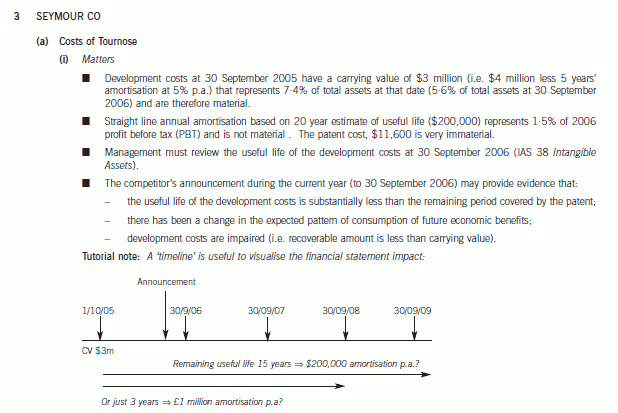
■ A change in the estimated useful life should be accounted for as a change in accounting estimate in accordance
with IAS 8 Accounting Policies, Changes in Accounting Estimates and Errors. For example, if the development
costs have little, if any, useful life after the introduction of the alternative drug (‘worst case’ scenario), the carrying
value ($3 million) should be written off over the current and remaining years, i.e. $1 million p.a. The increase in
amortisation/decrease in carrying value ($800,000) is material to PBT (6%) and total assets (1·5%).
■ Similarly a change in the expected pattern of consumption of the future economic benefits should be accounted for
as a change in accounting estimate (IAS 8). For example, it may be that the useful life is still to 2020 but that
the economic benefits may reduce significantly in two years time.
■ After adjusting the carrying amount to take account of the change in accounting estimate(s) management should
have tested it for impairment and any impairment loss recognised in profit or loss.
(ii) Audit evidence
■ $3 million carrying amount of development costs brought forward agreed to prior year working papers and financial
statements.
■ A copy of the press release announcing the competitor’s alternative drug.
■ Management’s projections of future cashflows from Tournose-related sales as evidence of the useful life of the
development costs and pattern of consumption.
■ Reperformance of management’s impairment test on the development costs: Recalculation of management’s
calculation of the carrying amount after revising estimates of useful life and/or consumption of benefits compared
with management’s calculation of value in use.
■ Sensitivity analysis on management’s key assumptions (e.g. estimates of useful life, discount rate).
■ Written management representation on the key assumptions concerning the future that have a significant risk of
causing material adjustment to the carrying amount of the development costs. (These assumptions should be
disclosed in accordance with IAS 1 Presentation of Financial Statements.) -
第6题:
(c) In November 2006 Seymour announced the recall and discontinuation of a range of petcare products. The
product recall was prompted by the high level of customer returns due to claims of poor quality. For the year to
30 September 2006, the product range represented $8·9 million of consolidated revenue (2005 – $9·6 million)
and $1·3 million loss before tax (2005 – $0·4 million profit before tax). The results of the ‘petcare’ operations
are disclosed separately on the face of the income statement. (6 marks)
Required:
For each of the above issues:
(i) comment on the matters that you should consider; and
(ii) state the audit evidence that you should expect to find,
in undertaking your review of the audit working papers and financial statements of Seymour Co for the year ended
30 September 2006.
NOTE: The mark allocation is shown against each of the three issues.
正确答案:
■ The discontinuation of the product line after the balance sheet date provides additional evidence that, as at the
balance sheet date, it was of poor quality. Therefore, as at the balance sheet date:
– an allowance (‘provision’) may be required for credit notes for returns of products after the year end that were
sold before the year end;
– goods returned to inventory should be written down to net realisable value (may be nil);
– any plant and equipment used exclusively in the production of the petcare range of products should be tested
for impairment;
– any material contingent liabilities arising from legal claims should be disclosed.
(ii) Audit evidence
■ A copy of Seymour’s announcement (external ‘press release’ and any internal memorandum).
■ Credit notes raised/refunds paid after the year end for faulty products returned.
■ Condition of products returned as inspected during physical attendance of inventory count.
■ Correspondence from customers claiming reimbursement/compensation for poor quality.
■ Direct confirmation from legal adviser (solicitor) regarding any claims for customers including estimates of possible
payouts. -
第7题:
(ii) Briefly explain the implications of Parr & Co’s audit opinion for your audit opinion on the consolidated
financial statements of Cleeves Co for the year ended 30 September 2006. (3 marks)
正确答案:
(ii) Implications for audit opinion on consolidated financial statements of Cleeves
■ If the potential adjustments to non-current asset carrying amounts and loss are not material to the consolidated
financial statements there will be no implication. However, as Howard is material to Cleeves and the modification
appears to be ‘so material’ (giving rise to adverse opinion) this seems unlikely.
Tutorial note: The question clearly states that Howard is material to Cleeves, thus there is no call for speculation
on this.
■ As Howard is wholly-owned the management of Cleeves must be able to request that Howard’s financial statements
are adjusted to reflect the impairment of the assets. The auditor’s report on Cleeves will then be unmodified
(assuming that any impairment of the investment in Howard is properly accounted for in the separate financial
statements of Cleeves).
■ If the impairment losses are not recognised in Howard’s financial statements they can nevertheless be adjusted on
consolidation of Cleeves and its subsidiaries (by writing down assets to recoverable amounts). The audit opinion
on Cleeves should then be unmodified in this respect.
■ If there is no adjustment of Howard’s asset values (either in Howard’s financial statements or on consolidation) it
is most likely that the audit opinion on Cleeves’s consolidated financial statements would be ‘except for’. (It should
not be adverse as it is doubtful whether even the opinion on Howard’s financial statements should be adverse.)
Tutorial note: There is currently no requirement in ISA 600 to disclose that components have been audited by another
auditor unless the principal auditor is permitted to base their opinion solely upon the report of another auditor. -
第8题:
(b) While the refrigeration units were undergoing modernisation Lamont outsourced all its cold storage requirements
to Hogg Warehousing Services. At 31 March 2007 it was not possible to physically inspect Lamont’s inventory
held by Hogg due to health and safety requirements preventing unauthorised access to cold storage areas.
Lamont’s management has provided written representation that inventory held at 31 March 2007 was
$10·1 million (2006 – $6·7 million). This amount has been agreed to a costing of Hogg’s monthly return of
quantities held at 31 March 2007. (7 marks)
Required:
For each of the above issues:
(i) comment on the matters that you should consider; and
(ii) state the audit evidence that you should expect to find,
in undertaking your review of the audit working papers and financial statements of Lamont Co for the year ended
31 March 2007.
NOTE: The mark allocation is shown against each of the three issues.
正确答案:
(b) Outsourced cold storage
(i) Matters
■ Inventory at 31 March 2007 represents 21% of total assets (10·1/48·0) and is therefore a very material item in the
balance sheet.
■ The value of inventory has increased by 50% though revenue has increased by only 7·5%. Inventory may be
overvalued if no allowance has been made for slow-moving/perished items in accordance with IAS 2 Inventories.
■ Inventory turnover has fallen to 6·6 times per annum (2006 – 9·3 times). This may indicate a build up of
unsaleable items.
Tutorial note: In the absence of cost of sales information, this is calculated on revenue. It may also be expressed
as the number of days sales in inventory, having increased from 39 to 55 days.
■ Inability to inspect inventory may amount to a limitation in scope if the auditor cannot obtain sufficient audit
evidence regarding quantity and its condition. This would result in an ‘except for’ opinion.
■ Although Hogg’s monthly return provides third party documentary evidence concerning the quantity of inventory it
does not provide sufficient evidence with regard to its valuation. Inventory will need to be written down if, for
example, it was contaminated by the leakage (before being moved to Hogg’s cold storage) or defrosted during
transfer.
■ Lamont’s written representation does not provide sufficient evidence regarding the valuation of inventory as
presumably Lamont’s management did not have access to physically inspect it either. If this is the case this may
call into question the value of any other representations made by management.
■ Whether, since the balance sheet date, inventory has been moved back from Hogg’s cold storage to Lamont’s
refrigeration units. If so, a physical inspection and roll-back of the most significant fish lines should have been
undertaken.
Tutorial note: Credit will be awarded for other relevant accounting issues. For example a candidate may question
whether, for example, cold storage costs have been capitalised into the cost of inventory. Or whether inventory moves
on a FIFO basis in deep storage (rather than LIFO).
(ii) Audit evidence
■ A copy of the health and safety regulation preventing the auditor from gaining access to Hogg’s cold storage to
inspect Lamont’s inventory.
■ Analysis of Hogg’s monthly returns and agreement of significant movements to purchase/sales invoices.
■ Analytical procedures such as month-on-month comparison of gross profit percentage and inventory turnover to
identify any trend that may account for the increase in inventory valuation (e.g. if Lamont has purchased
replacement inventory but spoiled items have not been written off).
■ Physical inspection of any inventory in Lamont’s refrigeration units after the balance sheet date to confirm its
condition.
■ An aged-inventory analysis and recalculation of any allowance for slow-moving items.
■ A review of after-date sales invoices for large quantities of fish to confirm that fair value (less costs to sell) exceed
carrying amount.
■ A review of after-date credit notes for any returns of contaminated/perished or otherwise substandard fish. -
第9题:
(ii) On 1 July 2006 Petrie introduced a 10-year warranty on all sales of its entire range of stainless steel
cookware. Sales of stainless steel cookware for the year ended 31 March 2007 totalled $18·2 million. The
notes to the financial statements disclose the following:
‘Since 1 July 2006, the company’s stainless steel cookware is guaranteed to be free from defects in
materials and workmanship under normal household use within a 10-year guarantee period. No provision
has been recognised as the amount of the obligation cannot be measured with sufficient reliability.’
(4 marks)
Your auditor’s report on the financial statements for the year ended 31 March 2006 was unmodified.
Required:
Identify and comment on the implications of these two matters for your auditor’s report on the financial
statements of Petrie Co for the year ended 31 March 2007.
NOTE: The mark allocation is shown against each of the matters above.
正确答案:
(ii) 10-year guarantee
$18·2 million stainless steel cookware sales amount to 43·1% of revenue and are therefore material. However, the
guarantee was only introduced three months into the year, say in respect of $13·6 million (3/4 × 18·2 million) i.e.
approximately 32% of revenue.
The draft note disclosure could indicate that Petrie’s management believes that Petrie has a legal obligation in respect
of the guarantee, that is not remote and likely to be material (otherwise no disclosure would have been required).
A best estimate of the obligation amounting to 5% profit before tax (or more) is likely to be considered material, i.e.
$90,000 (or more). Therefore, if it is probable that 0·66% of sales made under guarantee will be returned for refund,
this would require a warranty provision that would be material.
Tutorial note: The return of 2/3% of sales over a 10-year period may well be probable.
Clearly there is a present obligation as a result of a past obligating event for sales made during the nine months to
31 March 2007. Although the likelihood of outflow under the guarantee is likely to be insignificant (even remote) it is
probable that some outflow will be needed to settle the class of such obligations.
The note in the financial statements is disclosing this matter as a contingent liability. This term encompasses liabilities
that do not meet the recognition criteria (e.g. of reliable measurement in accordance with IAS 37 Provisions, Contingent
Liabilities and Contingent Assets).
However, it is extremely rare that no reliable estimate can be made (IAS 37) – the use of estimates being essential to
the preparation of financial statements. Petrie’s management must make a best estimate of the cost of refunds/repairs
under guarantee taking into account, for example:
■ the proportion of sales during the nine months to 31 March 2007 that have been returned under guarantee at the
balance sheet date (and in the post balance sheet event period);
■ the average age of cookware showing a defect;
■ the expected cost of a replacement item (as a refund of replacement is more likely than a repair, say).
If management do not make a provision for the best estimate of the obligation the audit opinion should be qualified
‘except for’ non-compliance with IAS 37 (no provision made). The disclosure made in the note to the financial
statements, however detailed, is not a substitute for making the provision.
Tutorial note: No marks will be awarded for suggesting that an emphasis of matter of paragraph would be appropriate
(drawing attention to the matter more fully explained in the note).
Management’s claim that the obligation cannot be measured with sufficient reliability does not give rise to a limitation
on scope on the audit. The auditor has sufficient evidence of the non-compliance with IAS 37 and disagrees with it. -
第10题:
You are the manager responsible for performing hot reviews on audit files where there is a potential disagreement
between your firm and the client regarding a material issue. You are reviewing the going concern section of the audit
file of Dexter Co, a client with considerable cash flow difficulties, and other, less significant operational indicators of
going concern problems. The working papers indicate that Dexter Co is currently trying to raise finance to fund
operating cash flows, and state that if the finance is not received, there is significant doubt over the going concern
status of the company. The working papers conclude that the going concern assumption is appropriate, but it is
recommended that the financial statements should contain a note explaining the cash flow problems faced by the
company, along with a description of the finance being sought, and an evaluation of the going concern status of the
company. The directors do not wish to include the note in the financial statements.
Required:
(b) Consider and comment on the possible reasons why the directors of Dexter Co are reluctant to provide the
note to the financial statements. (5 marks)
正确答案:
(b) Directors reluctance to disclose
The directors are likely to have several reasons behind their reluctance to disclose the note as recommended by the audit
manager. The first is that the disclosure of Dexter Co’s poor cash flow position and perilous going concern status may reflect
badly on the directors themselves. The company’s shareholders and other stakeholders will be displeased to see the company
in such a poor position, and the directors will be held accountable for the problems. Of course it may not be the case that
the directors have exercised poor management of the company – the problems could be caused by external influences outside
the control of the directors. However, it is natural that the directors will not want to highlight the situation in order to protect
their own position.
Secondly, the note could itself trigger further financial distress for the company. Dexter Co is trying to raise finance, and it is
probable that the availability of further finance will be detrimentally affected by the disclosure of the company’s financial
problems. In particular, if the cash flow difficulties are highlighted, providers of finance will consider the company too risky
an investment, and are not likely to make funds available for fear of non-repayment. Existing lenders may seek repayment of
their funds in fear that the company may be unable in the future to meet repayments.
In addition, the disclosures could cause operational problems, for example, suppliers may curtail trading relationships as they
become concerned that they will not be paid, or customers may be deterred from purchasing from the company if they feel
that there is no long-term future for the business. Unfortunately the mere disclosure of financial problems can be self-fulfilling,
and cause such further problems for the company that it is pushed into non-going concern status.
The directors may also be concerned that if staff were to hear of this they may worry about the future of the company and
seek alternative employment, which could lead in turn to the loss of key members of staff. This would be detrimental to the
business and trigger further operational problems.
Finally, the reluctance to disclose may be caused by an entirely different reason. The directors could genuinely feel that the
cash flow and operational problems faced by the company do not constitute factors affecting the going concern status. They
may be confident that although a final decision has not been made regarding financing, the finance is likely to be forthcoming,
and therefore there is no long-term material uncertainty over the future of the company. However audit working papers
conclude that there is a significant level of doubt over the going concern status of Dexter Co, and therefore it seems that the
directors may be over optimistic if they feel that there is no significant doubt to be disclosed in the financial statements. -
第11题:
5 You are the manager responsible for the audit of Blod Co, a listed company, for the year ended 31 March 2008. Your
firm was appointed as auditors of Blod Co in September 2007. The audit work has been completed, and you are
reviewing the working papers in order to draft a report to those charged with governance. The statement of financial
position (balance sheet) shows total assets of $78 million (2007 – $66 million). The main business activity of Blod
Co is the manufacture of farm machinery.
During the audit of property, plant and equipment it was discovered that controls over capital expenditure transactions
had deteriorated during the year. Authorisation had not been gained for the purchase of office equipment with a cost
of $225,000. No material errors in the financial statements were revealed by audit procedures performed on property,
plant and equipment.
An internally generated brand name has been included in the statement of financial position (balance sheet) at a fair
value of $10 million. Audit working papers show that the matter was discussed with the financial controller, who
stated that the $10 million represents the present value of future cash flows estimated to be generated by the brand
name. The member of the audit team who completed the work programme on intangible assets has noted that this
treatment appears to be in breach of IAS 38 Intangible Assets, and that the management refuses to derecognise the
asset.
Problems were experienced in the audit of inventories. Due to an oversight by the internal auditors of Blod Co, the
external audit team did not receive a copy of inventory counting procedures prior to attending the count. This caused
a delay at the beginning of the inventory count, when the audit team had to quickly familiarise themselves with the
procedures. In addition, on the final audit, when the audit senior requested documentation to support the final
inventory valuation, it took two weeks for the information to be received because the accountant who had prepared
the schedules had mislaid them.
Required:
(a) (i) Identify the main purpose of including ‘findings from the audit’ (management letter points) in a report
to those charged with governance. (2 marks)
正确答案:
5 Blod Co
(a) (i) A report to those charged with governance is produced to communicate matters relating to the external audit to those
who are ultimately responsible for the financial statements. ISA 260 Communication of Audit Matters With Those
Charged With Governance requires the auditor to communicate many matters, including independence and other ethical
issues, the audit approach and scope, the details of management representations, and the findings of the audit. The
findings of the audit are commonly referred to as management letter points. By communicating these matters, the auditor
is confident that there is written documentation outlining all significant matters raised during the audit process, and that
such matters have been formally notified to the highest level of management of the client. For the management, the
report should ensure that they fully understand the scope and results of the audit service which has been provided, and
is likely to provide constructive comments to help them to fulfil their duties in relation to the financial statements and
accounting systems and controls more effectively. The report should also include, where relevant, any actions that
management has indicated they will take in relation to recommendations made by the auditors. -
第12题:
You are the audit manager of Chestnut & Co and are reviewing the key issues identified in the files of two audit clients.
Palm Industries Co (Palm)
Palm’s year end was 31 March 2015 and the draft financial statements show revenue of $28·2 million, receivables of $5·6 million and profit before tax of $4·8 million. The fieldwork stage for this audit has been completed.
A customer of Palm owed an amount of $350,000 at the year end. Testing of receivables in April highlighted that no amounts had been paid to Palm from this customer as they were disputing the quality of certain goods received from Palm. The finance director is confident the issue will be resolved and no allowance for receivables was made with regards to this balance.
Ash Trading Co (Ash)
Ash is a new client of Chestnut & Co, its year end was 31 January 2015 and the firm was only appointed auditors in February 2015, as the previous auditors were suddenly unable to undertake the audit. The fieldwork stage for this audit is currently ongoing.
The inventory count at Ash’s warehouse was undertaken on 31 January 2015 and was overseen by the company’s internal audit department. Neither Chestnut & Co nor the previous auditors attended the count. Detailed inventory records were maintained but it was not possible to undertake another full inventory count subsequent to the year end.
The draft financial statements show a profit before tax of $2·4 million, revenue of $10·1 million and inventory of $510,000.
Required:
For each of the two issues:
(i) Discuss the issue, including an assessment of whether it is material;
(ii) Recommend ONE procedure the audit team should undertake to try to resolve the issue; and
(iii) Describe the impact on the audit report if the issue remains UNRESOLVED.
Notes:
1 The total marks will be split equally between each of the two issues.
2 Audit report extracts are NOT required.
正确答案:Audit reports
Palm Industries Co (Palm)
(i) A customer of Palm’s owing $350,000 at the year end has not made any post year-end payments as they are disputing the quality of goods received. No allowance for receivables has been made against this balance. As the balance is being disputed, there is a risk of incorrect valuation as some or all of the receivable balance is overstated, as it may not be paid.
This $350,000 receivables balance represents 1·2% (0·35/28·2m) of revenue, 6·3% (0·35/5·6m) of receivables and 7·3% (0·35/4·8m) of profit before tax; hence this is a material issue.
(ii) A procedure to adopt includes:
– Review whether any payments have subsequently been made by this customer since the audit fieldwork was completed.
– Discuss with management whether the issue of quality of goods sold to the customer has been resolved, or whether it is still in dispute.
– Review the latest customer correspondence with regards to an assessment of the likelihood of the customer making payment.
(iii) If management refuses to provide against this receivable, the audit report will need to be modified. As receivables are overstated and the error is material but not pervasive a qualified opinion would be necessary.
A basis for qualified opinion paragraph would be needed and would include an explanation of the material misstatement in relation to the valuation of receivables and the effect on the financial statements. The opinion paragraph would be qualified ‘except for’.
Ash Trading Co (Ash)
(i) Chestnut & Co was only appointed as auditors subsequent to Ash’s year end and hence did not attend the year-end inventory count. Therefore, they have not been able to gather sufficient and appropriate audit evidence with regards to the completeness and existence of inventory.
Inventory is a material amount as it represents 21·3% (0·51/2·4m) of profit before tax and 5% (0·51/10·1m) of revenue; hence this is a material issue.
(ii) A procedure to adopt includes:
– Review the internal audit reports of the inventory count to identify the level of adjustments to the records to assess the reasonableness of relying on the inventory records.
– Undertake a sample check of inventory in the warehouse and compare to the inventory records and then from inventory records to the warehouse, to assess the reasonableness of the inventory records maintained by Ash.
(iii) The auditors will need to modify the audit report as they are unable to obtain sufficient appropriate evidence in relation to inventory which is a material but not pervasive balance. Therefore a qualified opinion will be required.
A basis for qualified opinion paragraph will be required to explain the limitation in relation to the lack of evidence over inventory. The opinion paragraph will be qualified ‘except for’.
-
第13题:
(b) Historically, all owned premises have been measured at cost depreciated over 10 to 50 years. The management
board has decided to revalue these premises for the year ended 30 September 2005. At the balance sheet date
two properties had been revalued by a total of $1·7 million. Another 15 properties have since been revalued by
$5·4 million and there remain a further three properties which are expected to be revalued during 2006. A
revaluation surplus of $7·1 million has been credited to equity. (7 marks)
Required:
For each of the above issues:
(i) comment on the matters that you should consider; and
(ii) state the audit evidence that you should expect to find,
in undertaking your review of the audit working papers and financial statements of Albreda Co for the year ended
30 September 2005.
NOTE: The mark allocation is shown against each of the three issues.
正确答案:
(b) Revaluation of owned premises
(i) Matters
■ The revaluations are clearly material as $1·7 million, $5·4 million and $7·1 million represent 5·5% , 17·6% and
23·1% of total assets, respectively.
■ The change in accounting policy, from a cost model to a revaluation model, should be accounted for in accordance
with IAS 16 ‘Property, Plant and Equipment’ (i.e. as a revaluation).
Tutorial note: IAS 8 ‘Accounting Policies, Changes in Accounting Estimates and Errors’ does not apply to the initial
application of a policy to revalue assets in accordance with IAS 16.
■ The basis on which the valuations have been carried out, for example, market-based fair value (IAS 16).
■ Independence, qualifications and expertise of valuer(s).
■ IAS 16 does not permit the selective revaluation of assets thus the whole class of premises should have been
revalued.
■ The valuations of properties after the year end are adjusting events (i.e. providing additional evidence of conditions
existing at the year end) per IAS 10 ‘Events After the Balance Sheet Date’.
Tutorial note: It is ‘now’ still less than three months after the year end so these valuations can reasonably be
expected to reflect year-end values.
■ If $5·4 million is a net amount of surpluses and deficits it should be grossed up so that the credit to equity reflects
the sum of the surpluses with any deficits being expensed through profit and loss (IAS 36 ‘Impairment of Assets’).
■ The revaluation exercise is incomplete. If the revaluations on the remaining three properties are expected to be
material and cannot be reasonably estimated for inclusion in the financial statements for the year ended
30 September 2005 perhaps the change in policy should be deferred for a year.
■ Depreciation for the year should have been calculated on cost as usual to establish carrying amount before
revaluation.
■ Any premises held under finance leases should be similarly revalued.
(ii) Audit evidence
■ A schedule of depreciated cost of owned premises extracted from the non-current asset register.
■ Calculation of difference between valuation and depreciated cost by property. Separate summation of surpluses
and deficits.
■ Copy of valuation certificate for each property.
■ Physical inspection of properties with largest surpluses (including the two valued before the year end) to confirm
condition.
■ Extracts from local property guides/magazines indicating a range of values of similarly styled/sized properties.
■ Separate presentation of the revaluation surpluses (gross) in:
– the statement of changes in equity; and
– reconciliation of carrying amount at the beginning and end of the period.
■ IAS 16 disclosures in the notes to the financial statements including:
– the effective date of revaluation;
– whether an independent valuer was involved;
– the methods and significant assumptions applied in estimating fair values; and
– the carrying amount that would have been recognised under the cost model. -
第14题:
3 You are the manager responsible for the audit of Volcan, a long-established limited liability company. Volcan operates
a national supermarket chain of 23 stores, five of which are in the capital city, Urvina. All the stores are managed in
the same way with purchases being made through Volcan’s central buying department and product pricing, marketing,
advertising and human resources policies being decided centrally. The draft financial statements for the year ended
31 March 2005 show revenue of $303 million (2004 – $282 million), profit before taxation of $9·5 million (2004
– $7·3 million) and total assets of $178 million (2004 – $173 million).
The following issues arising during the final audit have been noted on a schedule of points for your attention:
(a) On 1 May 2005, Volcan announced its intention to downsize one of the stores in Urvina from a supermarket to
a ‘City Metro’ in response to a significant decline in the demand for supermarket-style. shopping in the capital.
The store will be closed throughout June, re-opening on 1 July 2005. Goodwill of $5·5 million was recognised
three years ago when this store, together with two others, was bought from a national competitor. It is Volcan’s
policy to write off goodwill over five years. (7 marks)
Required:
For each of the above issues:
(i) comment on the matters that you should consider; and
(ii) state the audit evidence that you should expect to find,
in undertaking your review of the audit working papers and financial statements of Volcan for the year ended
31 March 2005.
NOTE: The mark allocation is shown against each of the three issues.
正确答案:
3 VOLCAN
(a) Store impairment
(i) Matters
■ Materiality
? The cost of goodwill represents 3·1% of total assets and is therefore material.
? However, after three years the carrying amount of goodwill ($2·2m) represents only 1·2% of total assets –
and is therefore immaterial in the context of the balance sheet.
? The annual amortisation charge ($1·1m) represents 11·6% profit before tax (PBT) and is therefore also
material (to the income statement).
? The impact of writing off the whole of the carrying amount would be material to PBT (23%).
Tutorial note: The temporary closure of the supermarket does not constitute a discontinued operation under IFRS 5
‘Non-Current Assets Held for Sale and Discontinued Operations’.
■ Under IFRS 3 ‘Business Combinations’ Volcan should no longer be writing goodwill off over five years but
subjecting it to an annual impairment test.
■ The announcement is after the balance sheet date and is therefore a non-adjusting event (IAS 10 ‘Events After the
Balance Sheet Date’) insofar as no provision for restructuring (for example) can be made.
■ However, the event provides evidence of a possible impairment of the cash-generating unit which is this store and,
in particular, the value of goodwill assigned to it.
■ If the carrying amount of goodwill ($2·2m) can be allocated on a reasonable and consistent basis to this and the
other two stores (purchased at the same time) Volcan’s management should have applied an impairment test to
the goodwill of the downsized store (this is likely to show impairment).
■ If more than 22% of goodwill is attributable to the City Metro store – then its write-off would be material to PBT
(22% × $2·2m ÷ $9·5m = 5%).
■ If the carrying amount of goodwill cannot be so allocated; the impairment test should be applied to the
cash-generating unit that is the three stores (this may not necessarily show impairment).
■ Management should have considered whether the other four stores in Urvina (and elsewhere) are similarly
impaired.
■ Going concern is unlikely to be an issue unless all the supermarkets are located in cities facing a downward trend
in demand.
Tutorial note: Marks will be awarded for stating the rules for recognition of an impairment loss for a cash-generating
unit. However, as it is expected that the majority of candidates will not deal with this matter, the rules of IAS 36 are
not reproduced here.
(ii) Audit evidence
■ Board minutes approving the store’s ‘facelift’ and documenting the need to address the fall in demand for it as a
supermarket.
■ Recomputation of the carrying amount of goodwill (2/5 × $5·5m = $2·2m).
■ A schedule identifying all the assets that relate to the store under review and the carrying amounts thereof agreed
to the underlying accounting records (e.g. non-current asset register).
■ Recalculation of value in use and/or fair value less costs to sell of the cash-generating unit (i.e. the store that is to
become the City Metro, or the three stores bought together) as at 31 March 2005.
Tutorial note: If just one of these amounts exceeds carrying amount there will be no impairment loss. Also, as
there is a plan NOT to sell the store it is most likely that value in use should be used.
■ Agreement of cash flow projections (e.g. to approved budgets/forecast revenues and costs for a maximum of five
years, unless a longer period can be justified).
■ Written management representation relating to the assumptions used in the preparation of financial budgets.
■ Agreement that the pre-tax discount rate used reflects current market assessments of the time value of money (and
the risks specific to the store) and is reasonable. For example, by comparison with Volcan’s weighted average cost
of capital.
■ Inspection of the store (if this month it should be closed for refurbishment).
■ Revenue budgets and cash flow projections for:
– the two stores purchased at the same time;
– the other stores in Urvina; and
– the stores elsewhere.
Also actual after-date sales by store compared with budget. -
第15题:
(b) A sale of industrial equipment to Deakin Co in May 2005 resulted in a loss on disposal of $0·3 million that has
been separately disclosed on the face of the income statement. The equipment cost $1·2 million when it was
purchased in April 1996 and was being depreciated on a straight-line basis over 20 years. (6 marks)
Required:
For each of the above issues:
(i) comment on the matters that you should consider; and
(ii) state the audit evidence that you should expect to find,
in undertaking your review of the audit working papers and financial statements of Keffler Co for the year ended
31 March 2006.
NOTE: The mark allocation is shown against each of the three issues.
正确答案:
(b) Sale of industrial equipment
(i) Matters
■ The industrial equipment was in use for nine years (from April 1996) and would have had a carrying value of
$660,000 at 31 March 2005 (11/20 × $1·2m – assuming nil residual value and a full year’s depreciation charge
in the year of acquisition and none in the year of disposal). Disposal proceeds were therefore only $360,000.
■ The $0·3m loss represents 15% of PBT (for the year to 31 March 2006) and is therefore material. The equipment
was material to the balance sheet at 31 March 2005 representing 2·6% of total assets ($0·66/$25·7 × 100).
■ Separate disclosure, of a material loss on disposal, on the face of the income statement is in accordance with
IAS 16 ‘Property, Plant and Equipment’. However, in accordance with IAS 1 ‘Presentation of Financial Statements’,
it should not be captioned in any way that might suggest that it is not part of normal operating activities (i.e. not
‘extraordinary’, ‘exceptional’, etc).
Tutorial note: However, note that if there is a prior period error to be accounted for (see later), there would be
no impact on the current period income statement requiring consideration of any disclosure.
■ The reason for the sale. For example, whether the equipment was:
– surplus to operating requirements (i.e. not being replaced); or
– being replaced with newer equipment (thereby contributing to the $8·1m increase (33·8 – 25·7) in total
assets).
■ The reason for the loss on sale. For example, whether:
– the sale was at an under-value (e.g. to a related party);
– the equipment had a bad maintenance history (or was otherwise impaired);
– the useful life of the equipment is less than 20 years;
– there is any deferred consideration not yet recorded;
– any non-cash disposal proceeds have been overlooked (e.g. if another asset was acquired in a part-exchange).
■ If the useful life was less than 20 years, tangible non-current assets may be materially overstated in respect of other
items of equipment that are still in use and being depreciated on the same basis.
■ If the sale was to a related party then additional disclosure should be required in a note to the financial statements
for the year to 31 March 2006 (IAS 24 ‘Related Party Disclosures’).
Tutorial note: Since there are no specific pointers to a related party transaction (RPT), this point is not expanded
on.
■ Whether the sale was identified in the prior year audit’s post balance sheet event review. If so:
– the disclosure made in the prior year’s financial statements (IAS 10 ‘Events After the Balance Sheet Date’);
– whether an impairment loss was recognised at 31 March 2005.
■ If not, and the equipment was impaired at 31 March 2005, a prior period error should be accounted for (IAS 8
‘Accounting Policies, Changes in Accounting Estimates and Errors’). An impairment loss of $0·3m would have
been material to prior year profit (12·5%).
Tutorial note: Unless this was a RPT or the impairment arose after 31 March 2005 a prior period adjustment
should be made.
■ Failure to account for a prior period error (if any) would result in modification of the audit opinion ‘except for’ noncompliance
with IAS 8 (in the current year) and IAS 36 (in the prior period).
(ii) Audit evidence
■ Carrying amount ($0·66m as above) agreed to the non-current asset register balances at 31 March 2005 and
recalculation of the loss on disposal.
■ Cost and accumulated depreciation removed from the asset register in the year to 31 March 2006.
■ Receipt of proceeds per cash book agreed to bank statement.
■ Sales invoice transferring title to Deakin.
■ A review of maintenance expenses and records (e.g. to confirm reason for loss on sale).
■ Post balance sheet event review on prior year audit working papers file.
■ Management representation confirming that Deakin is not a related party (provided that there is no evidence to
suggest otherwise). -
第16题:
5 You are an audit manager in Fox & Steeple, a firm of Chartered Certified Accountants, responsible for allocating staff
to the following three audits of financial statements for the year ending 31 December 2006:
(a) Blythe Co is a new audit client. This private company is a local manufacturer and distributor of sportswear. The
company’s finance director, Peter, sees little value in the audit and put it out to tender last year as a cost-cutting
exercise. In accordance with the requirements of the invitation to tender your firm indicated that there would not
be an interim audit.
(b) Huggins Co, a long-standing client, operates a national supermarket chain. Your firm provided Huggins Co with
corporate financial advice on obtaining a listing on a recognised stock exchange in 2005. Senior management
expects a thorough examination of the company’s computerised systems, and are also seeking assurance that
the annual report will not attract adverse criticism.
(c) Gray Co has been an audit client since 1999 after your firm advised management on a successful buyout. Gray
provides communication services and software solutions. Your firm provides Gray with technical advice on
financial reporting and tax services. Most recently you have been asked to conduct due diligence reviews on
potential acquisitions.
Required:
For these assignments, compare and contrast:
(i) the threats to independence;
(ii) the other professional and practical matters that arise; and
(iii) the implications for allocating staff.
(15 marks)
正确答案:
5 FOX & STEEPLE – THREE AUDIT ASSIGNMENTS
(i) Threats to independence
Self-interest
Tutorial note: This threat arises when a firm or a member of the audit team could benefit from a financial interest in, or
other self-interest conflict with, an assurance client.
■ A self-interest threat could potentially arise in respect of any (or all) of these assignments as, regardless of any fee
restrictions (e.g. per IFAC’s ‘Code of Ethics for Professional Accountants’), the auditor is remunerated by clients for
services provided.
■ This threat is likely to be greater for Huggins Co (larger/listed) and Gray Co (requires other services) than for Blythe Co
(audit a statutory necessity).
■ The self-interest threat may be greatest for Huggins Co. As a company listed on a recognised stock exchange it may
give prestige and credibility to Fox & Steeple (though this may be reciprocated). Fox & Steeple could be pressurised into
taking evasive action to avoid the loss of a listed client (e.g. concurring with an inappropriate accounting treatment).
Self-review
Tutorial note: This arises when, for example, any product or judgment of a previous engagement needs to be re-evaluated
in reaching conclusions on the audit engagement.
■ This threat is also likely to be greater for Huggins and Gray where Fox & Steeple is providing other (non-audit) services.
■ A self-review threat may be created by Fox & Steeple providing Huggins with a ‘thorough examination’ of its computerised
systems if it involves an extension of the procedures required to conduct an audit in accordance with International
Standards on Auditing (ISAs).
■ Appropriate safeguards must be put in place if Fox & Steeple assists Huggins in the performance of internal audit
activities. In particular, Fox & Steeple’s personnel must not act (or appear to act) in a capacity equivalent to a member
of Huggins’ management (e.g. reporting, in a management role, to those charged with governance).
■ Fox & Steeple may provide Gray with accounting and bookkeeping services, as Gray is not a listed entity, provided that
any self-review threat created is reduced to an acceptable level. In particular, in giving technical advice on financial
reporting, Fox & Steeple must take care not to make managerial decisions such as determining or changing journal
entries without obtaining Gray’s approval.
■ Taxation services comprise a broad range of services, including compliance, planning, provision of formal taxation
opinions and assistance in the resolution of tax disputes. Such assignments are generally not seen to create threats to
independence.
Tutorial note: It is assumed that the provision of tax services is permitted in the jurisdiction (i.e. that Fox and Steeple
are not providing such services if prohibited).
■ The due diligence reviews for Gray may create a self-review threat (e.g. on the fair valuation of net assets acquired).
However, safeguards may be available to reduce these threats to an acceptable level.
■ If staff involved in providing other services are also assigned to the audit, their work should be reviewed by more senior
staff not involved in the provision of the other services (to the extent that the other service is relevant to the audit).
■ The reporting lines of any staff involved in the audit of Huggins and the provision of other services for Huggins should
be different. (Similarly for Gray.)
Familiarity
Tutorial note: This arises when, by virtue of a close relationship with an audit client (or its management or employees) an
audit firm (or a member of the audit team) becomes too sympathetic to the client’s interests.
■ Long association of a senior member of an audit team with an audit client may create a familiarity threat. This threat
is likely to be greatest for Huggins, a long-standing client. It may also be significant for Gray as Fox & Steeple have had
dealings with this client for seven years now.
■ As Blythe is a new audit client this particular threat does not appear to be relevant.
■ Senior personnel should be rotated off the Huggins and Gray audit teams. If this is not possible (for either client), an
additional professional accountant who was not a member of the audit team should be required to independently review
the work done by the senior personnel.
■ The familiarity threat of using the same lead engagement partner on an audit over a prolonged period is particularly
relevant to Huggins, which is now a listed entity. IFAC’s ‘Code of Ethics for Professional Accountants’ requires that the
lead engagement partner should be rotated after a pre-defined period, normally no more than seven years. Although it
might be time for the lead engagement partner of Huggins to be changed, the current lead engagement partner may
continue to serve for the 2006 audit.
Tutorial note: Two additional years are permitted when an existing client becomes listed, since it may not be in the
client’s best interests to have an immediate rotation of engagement partner.
Intimidation
Tutorial note: This arises when a member of the audit team may be deterred from acting objectively and exercising
professional skepticism by threat (actual or perceived), from the audit client.
■ This threat is most likely to come from Blythe as auditors are threatened with a tendering process to keep fees down.
■ Peter may have already applied pressure to reduce inappropriately the extent of audit work performed in order to reduce
fees, by stipulating that there should not be an interim audit.
■ The audit senior allocated to Blythe will need to be experienced in standing up to client management personnel such as
Peter.
Tutorial note: ‘Correct’ classification under ‘ethical’, ‘other professional’, ‘practical’ or ‘staff implications’ is not as important
as identifying the matters.
(ii) Other professional and practical matters
Tutorial note: ‘Other professional’ includes quality control.
■ The experience of staff allocated to each assignment should be commensurate with the assessment of associated risk.
For example, there may be a risk that insufficient audit evidence is obtained within the budget for the audit of Blythe.
Huggins, as a listed client, carries a high reputational risk.
■ Sufficient appropriate staff should be allocated to each audit to ensure adequate quality control (in particular in the
direction, supervision, review of each assignment). It may be appropriate for a second partner to be assigned to carry
out a ‘hot review’ (before the auditor’s report is signed) of:
– Blythe, because it is the first audit of a new client; and
– Huggins, as it is listed.
■ Existing clients (Huggins and Gray) may already have some expectation regarding who should be assigned to their
audits. There is no reason why there should not be some continuity of staff providing appropriate safeguards are put in
place (e.g. to overcome any familiarity threat).
■ Senior staff assigned to Blythe should be alerted to the need to exercise a high degree of professional skepticism (in the
light of Peter’s attitude towards the audit).
■ New staff assigned to Huggins and Gray would perhaps be less likely to assume unquestioned honesty than staff
previously involved with these audits.
Logistics (practical)
■ All three assignments have the same financial year end, therefore there will be an element of ‘competition’ for the staff
to be assigned to the year-end visits and final audit assignments. As a listed company, Huggins is likely to have the
tightest reporting deadline and so have a ‘priority’ for staff.
■ Blythe is a local and private company. Staff involved in the year-end visit (e.g. to attend the physical inventory count)
should also be involved in the final audit. As this is a new client, staff assigned to this audit should get involved at every
stage to increase their knowledge and understanding of the business.
■ Huggins is a national operation and may require numerous staff to attend year-end procedures. It would not be expected
that all staff assigned to year-end visits should all be involved in the final audit.
Time/fee/staff budgets
■ Time budgets will need to be prepared for each assignment to determine manpower requirements (and to schedule audit
work).
(iii) Implications for allocating staff
■ Fox & Steeple should allocate staff so that those providing other services to Huggins and Gray (that may create a selfreview
threat) do not participate in the audit engagement.
Competence and due care (Qualifications/Specialisation)
■ All audit assignments will require competent staff.
■ Huggins will require staff with an in-depth knowledge of their computerised system.
■ Gray will require senior audit staff to be experienced in financial reporting matters specific to communications and
software solutions (e.g. in revenue recognition issues and accounting for internally-generated intangible assets).
■ Specialists providing tax services and undertaking the due diligence reviews for Gray may not be required to have any
involvement in the audit assignment. -
第17题:
(b) Seymour offers health-related information services through a wholly-owned subsidiary, Aragon Co. Goodwill of
$1·8 million recognised on the purchase of Aragon in October 2004 is not amortised but included at cost in the
consolidated balance sheet. At 30 September 2006 Seymour’s investment in Aragon is shown at cost,
$4·5 million, in its separate financial statements.
Aragon’s draft financial statements for the year ended 30 September 2006 show a loss before taxation of
$0·6 million (2005 – $0·5 million loss) and total assets of $4·9 million (2005 – $5·7 million). The notes to
Aragon’s financial statements disclose that they have been prepared on a going concern basis that assumes that
Seymour will continue to provide financial support. (7 marks)
Required:
For each of the above issues:
(i) comment on the matters that you should consider; and
(ii) state the audit evidence that you should expect to find,
in undertaking your review of the audit working papers and financial statements of Seymour Co for the year ended
30 September 2006.
NOTE: The mark allocation is shown against each of the three issues.
正确答案:
(b) Goodwill
(i) Matters
■ Cost of goodwill, $1·8 million, represents 3·4% consolidated total assets and is therefore material.
Tutorial note: Any assessments of materiality of goodwill against amounts in Aragon’s financial statements are
meaningless since goodwill only exists in the consolidated financial statements of Seymour.
■ It is correct that the goodwill is not being amortised (IFRS 3 Business Combinations). However, it should be tested
at least annually for impairment, by management.
■ Aragon has incurred losses amounting to $1·1 million since it was acquired (two years ago). The write-off of this
amount against goodwill in the consolidated financial statements would be material (being 61% cost of goodwill,
8·3% PBT and 2·1% total assets).
■ The cost of the investment ($4·5 million) in Seymour’s separate financial statements will also be material and
should be tested for impairment.
■ The fair value of net assets acquired was only $2·7 million ($4·5 million less $1·8 million). Therefore the fair
value less costs to sell of Aragon on other than a going concern basis will be less than the carrying amount of the
investment (i.e. the investment is impaired by at least the amount of goodwill recognised on acquisition).
■ In assessing recoverable amount, value in use (rather than fair value less costs to sell) is only relevant if the going
concern assumption is appropriate for Aragon.
■ Supporting Aragon financially may result in Seymour being exposed to actual and/or contingent liabilities that
should be provided for/disclosed in Seymour’s financial statements in accordance with IAS 37 Provisions,
Contingent Liabilities and Contingent Assets.
(ii) Audit evidence
■ Carrying values of cost of investment and goodwill arising on acquisition to prior year audit working papers and
financial statements.
■ A copy of Aragon’s draft financial statements for the year ended 30 September 2006 showing loss for year.
■ Management’s impairment test of Seymour’s investment in Aragon and of the goodwill arising on consolidation at
30 September 2006. That is a comparison of the present value of the future cash flows expected to be generated
by Aragon (a cash-generating unit) compared with the cost of the investment (in Seymour’s separate financial
statements).
■ Results of any impairment tests on Aragon’s assets extracted from Aragon’s working paper files.
■ Analytical procedures on future cash flows to confirm their reasonableness (e.g. by comparison with cash flows for
the last two years).
■ Bank report for audit purposes for any guarantees supporting Aragon’s loan facilities.
■ A copy of Seymour’s ‘comfort letter’ confirming continuing financial support of Aragon for the foreseeable future. -
第18题:
(b) You are an audit manager in a firm of Chartered Certified Accountants currently assigned to the audit of Cleeves
Co for the year ended 30 September 2006. During the year Cleeves acquired a 100% interest in Howard Co.
Howard is material to Cleeves and audited by another firm, Parr & Co. You have just received Parr’s draft
auditor’s report for the year ended 30 September 2006. The wording is that of an unmodified report except for
the opinion paragraph which is as follows:
Audit opinion
As more fully explained in notes 11 and 15 impairment losses on non-current assets have not been
recognised in profit or loss as the directors are unable to quantify the amounts.
In our opinion, provision should be made for these as required by International Accounting Standard 36
(Impairment). If the provision had been so recognised the effect would have been to increase the loss before
and after tax for the year and to reduce the value of tangible and intangible non-current assets. However,
as the directors are unable to quantify the amounts we are unable to indicate the financial effect of such
omissions.
In view of the failure to provide for the impairments referred to above, in our opinion the financial statements
do not present fairly in all material respects the financial position of Howard Co as of 30 September 2006
and of its loss and its cash flows for the year then ended in accordance with International Financial Reporting
Standards.
Your review of the prior year auditor’s report shows that the 2005 audit opinion was worded identically.
Required:
(i) Critically appraise the appropriateness of the audit opinion given by Parr & Co on the financial
statements of Howard Co, for the years ended 30 September 2006 and 2005. (7 marks)
正确答案:(b) (i) Appropriateness of audit opinion given
Tutorial note: The answer points suggested by the marking scheme are listed in roughly the order in which they might
be extracted from the information presented in the question. The suggested answer groups together some of these
points under headings to give the analysis of the situation a possible structure.
Heading
■ The opinion paragraph is not properly headed. It does not state the form. of the opinion that has been given nor
the grounds for qualification.
■ The opinion ‘the financial statements do not give a true and fair view’ is an ‘adverse’ opinion.
■ That ‘provision should be made’, but has not, is a matter of disagreement that should be clearly stated as noncompliance
with IAS 36. The title of IAS 36 Impairment of Assets should be given in full.
■ The opinion should be headed ‘Disagreement on Accounting Policies – Inappropriate Accounting Method – Adverse
Opinion’.
1 ISA 250 does not specify with whom agreement should be reached but presumably with those charged with corporate governance (e.g audit committee or
2 other supervisory board).
20
6D–INTBA
Paper 3.1INT
Content
■ It is appropriate that the opinion paragraph should refer to the note(s) in the financial statements where the matter
giving rise to the modification is more fully explained. However, this is not an excuse for the audit opinion being
‘light’ on detail. For example, the reason for impairment could be summarised in the auditor’s report.
■ The effects have not been quantified, but they should be quantifiable. The maximum possible loss would be the
carrying amount of the non-current assets identified as impaired.
■ It is not clear why the directors have been ‘unable to quantify the amounts’. Since impairments should be
quantifiable any ‘inability’ suggest a limitation in scope of the audit, in which case the opinion should be disclaimed
(or ‘except for’) on grounds of lack of evidence rather than disagreement.
■ The wording is confusing. ‘Failure to provide’ suggests disagreement. However, there must be sufficient evidence
to support any disagreement. Although the directors cannot quantify the amounts it seems the auditors must have
been able to (estimate at least) in order to form. an opinion that the amounts involved are sufficiently material to
warrant a qualification.
■ The first paragraph refers to ‘non-current assets’. The second paragraph specifies ‘tangible and intangible assets’.
There is no explanation why or how both tangible and intangible assets are impaired.
■ The first paragraph refers to ‘profit or loss’ and the second and third paragraphs to ‘loss’. It may be clearer if the
first paragraph were to refer to recognition in the income statement.
■ It is not clear why the failure to recognise impairment warrants an adverse opinion rather than ‘except for’. The
effects of non-compliance with IAS 36 are to overstate the carrying amount(s) of non-current assets (that can be
specified) and to understate the loss. The matter does not appear to be pervasive and so an adverse opinion looks
unsuitable as the financial statements as a whole are not incomplete or misleading. A loss is already being reported
so it is not that a reported profit would be turned into a loss (which is sometimes judged to be ‘pervasive’).
Prior year
■ As the 2005 auditor’s report, as previously issued, included an adverse opinion and the matter that gave rise to
the modification:
– is unresolved; and
– results in a modification of the 2006 auditor’s report,
the 2006 auditor’s report should also be modified regarding the corresponding figures (ISA 710 Comparatives).
■ The 2006 auditor’s report does not refer to the prior period modification nor highlight that the matter resulting in
the current period modification is not new. For example, the report could say ‘As previously reported and as more
fully explained in notes ….’ and state ‘increase the loss by $x (2005 – $y)’. -
第19题:
3 You are the manager responsible for the audit of Lamont Co. The company’s principal activity is wholesaling frozen
fish. The draft consolidated financial statements for the year ended 31 March 2007 show revenue of $67·0 million
(2006 – $62·3 million), profit before taxation of $11·9 million (2006 – $14·2 million) and total assets of
$48·0 million (2006 – $36·4 million).
The following issues arising during the final audit have been noted on a schedule of points for your attention:
(a) In early 2007 a chemical leakage from refrigeration units owned by Lamont caused contamination of some of its
property. Lamont has incurred $0·3 million in clean up costs, $0·6 million in modernisation of the units to
prevent future leakage and a $30,000 fine to a regulatory agency. Apart from the fine, which has been expensed,
these costs have been capitalised as improvements. (7 marks)
Required:
For each of the above issues:
(i) comment on the matters that you should consider; and
(ii) state the audit evidence that you should expect to find,
in undertaking your review of the audit working papers and financial statements of Lamont Co for the year ended
31 March 2007.
NOTE: The mark allocation is shown against each of the three issues.
正确答案:
3 LAMONT CO
(a) Chemical leakage
(i) Matters
■ $30,000 fine is very immaterial (just 1/4% profit before tax). This is revenue expenditure and it is correct that it
has been expensed to the income statement.
■ $0·3 million represents 0·6% total assets and 2·5% profit before tax and is not material on its own. $0·6 million
represents 1·2% total assets and 5% profit before tax and is therefore material to the financial statements.
■ The $0·3 million clean-up costs should not have been capitalised as the condition of the property is not improved
as compared with its condition before the leakage occurred. Although not material in isolation this amount should
be adjusted for and expensed, thereby reducing the aggregate of uncorrected misstatements.
■ It may be correct that $0·6 million incurred in modernising the refrigeration units should be capitalised as a major
overhaul (IAS 16 Property, Plant and Equipment). However, any parts scrapped as a result of the modernisation
should be treated as disposals (i.e. written off to the income statement).
■ The carrying amount of the refrigeration units at 31 March 2007, including the $0·6 million for modernisation,
should not exceed recoverable amount (i.e. the higher of value in use and fair value less costs to sell). If it does,
an allowance for the impairment loss arising must be recognised in accordance with IAS 36 Impairment of Assets.
(ii) Audit evidence
■ A breakdown/analysis of costs incurred on the clean-up and modernisation amounting to $0·3 million and
$0·6 million respectively.
■ Agreement of largest amounts to invoices from suppliers/consultants/sub-contractors, etc and settlement thereof
traced from the cash book to the bank statement.
■ Physical inspection of the refrigeration units to confirm their modernisation and that they are in working order. (Do
they contain frozen fish?)
■ Sample of components selected from the non-current asset register traced to the refrigeration units and inspected
to ensure continuing existence.
■ $30,000 penalty notice from the regulatory agency and corresponding cash book payment/payment per the bank
statement.
■ Written management representation that there are no further penalties that should be provided for or disclosed other
than the $30,000 that has been accounted for. -
第20题:
(b) You are the audit manager of Petrie Co, a private company, that retails kitchen utensils. The draft financial
statements for the year ended 31 March 2007 show revenue $42·2 million (2006 – $41·8 million), profit before
taxation of $1·8 million (2006 – $2·2 million) and total assets of $30·7 million (2006 – $23·4 million).
You are currently reviewing two matters that have been left for your attention on Petrie’s audit working paper file
for the year ended 31 March 2007:
(i) Petrie’s management board decided to revalue properties for the year ended 31 March 2007 that had
previously all been measured at depreciated cost. At the balance sheet date three properties had been
revalued by a total of $1·7 million. Another nine properties have since been revalued by $5·4 million. The
remaining three properties are expected to be revalued later in 2007. (5 marks)
Required:
Identify and comment on the implications of these two matters for your auditor’s report on the financial
statements of Petrie Co for the year ended 31 March 2007.
NOTE: The mark allocation is shown against each of the matters above.
正确答案:
(b) Implications for auditor’s report
(i) Selective revaluation of premises
The revaluations are clearly material to the balance sheet as $1·7 million and $5·4 million represent 5·5% and 17·6%
of total assets, respectively (and 23·1% in total). As the effects of the revaluation on line items in the financial statements
are clearly identified (e.g. revalued amount, depreciation, surplus in statement of changes in equity) the matter is not
pervasive.
The valuations of the nine properties after the year end provide additional evidence of conditions existing at the year end
and are therefore adjusting events per IAS 10 Events After the Balance Sheet Date.
Tutorial note: It is ‘now’ still less than three months after the year end so these valuations can reasonably be expected
to reflect year end values.
However, IAS 16 Property, Plant and Equipment does not permit the selective revaluation of assets thus the whole class
of premises would need to have been revalued for the year to 31 March 2007 to change the measurement basis for this
reporting period.
The revaluation exercise is incomplete. Unless the remaining three properties are revalued before the auditor’s report on
the financial statements for the year ended 31 March 2007 is signed off:
(1) the $7·1 revaluation made so far must be reversed to show all premises at depreciated cost as in previous years;
OR
(2) the auditor’s report would be qualified ‘except for’ disagreement regarding non-compliance with IAS 16.
When it is appropriate to adopt the revaluation model (e.g. next year) the change in accounting policy (from a cost model
to a revaluation model) should be accounted for in accordance with IAS 16 (i.e. as a revaluation).
Tutorial note: IAS 8 Accounting Policies, Changes in Accounting Estimates and Errors does not apply to the initial
application of a policy to revalue assets in accordance with IAS 16.
Assuming the revaluation is written back, before giving an unmodified opinion, the auditor should consider why the three
properties were not revalued. In particular if there are any indicators of impairment (e.g. physical dilapidation) there
should be sufficient evidence on the working paper file to show that the carrying amount of these properties is not
materially greater than their recoverable amount (i.e. the higher of value in use and fair value less costs to sell).
If there is insufficient evidence to confirm that the three properties are not impaired (e.g. if the auditor was prevented
from inspecting the properties) the auditor’s report would be qualified ‘except for’ on grounds of limitation on scope.
If there is evidence of material impairment but management fail to write down the carrying amount to recoverable
amount the auditor’s report would be qualified ‘except for’ disagreement regarding non-compliance with IAS 36
Impairment of Assets.
-
第21题:
5 You are the audit manager for three clients of Bertie & Co, a firm of Chartered Certified Accountants. The financial
year end for each client is 30 September 2007.
You are reviewing the audit senior’s proposed audit reports for two clients, Alpha Co and Deema Co.
Alpha Co, a listed company, permanently closed several factories in May 2007, with all costs of closure finalised and
paid in August 2007. The factories all produced the same item, which contributed 10% of Alpha Co’s total revenue
for the year ended 30 September 2007 (2006 – 23%). The closure has been discussed accurately and fully in the
chairman’s statement and Directors’ Report. However, the closure is not mentioned in the notes to the financial
statements, nor separately disclosed on the financial statements.
The audit senior has proposed an unmodified audit opinion for Alpha Co as the matter has been fully addressed in
the chairman’s statement and Directors’ Report.
In October 2007 a legal claim was filed against Deema Co, a retailer of toys. The claim is from a customer who slipped
on a greasy step outside one of the retail outlets. The matter has been fully disclosed as a material contingent liability
in the notes to the financial statements, and audit working papers provide sufficient evidence that no provision is
necessary as Deema Co’s lawyers have stated in writing that the likelihood of the claim succeeding is only possible.
The amount of the claim is fixed and is adequately covered by cash resources.
The audit senior proposes that the audit opinion for Deema Co should not be qualified, but that an emphasis of matter
paragraph should be included after the audit opinion to highlight the situation.
Hugh Co was incorporated in October 2006, using a bank loan for finance. Revenue for the first year of trading is
$750,000, and there are hopes of rapid growth in the next few years. The business retails luxury hand made wooden
toys, currently in a single retail outlet. The two directors (who also own all of the shares in Hugh Co) are aware that
due to the small size of the company, the financial statements do not have to be subject to annual external audit, but
they are unsure whether there would be any benefit in a voluntary audit of the first year financial statements. The
directors are also aware that a review of the financial statements could be performed as an alternative to a full audit.
Hugh Co currently employs a part-time, part-qualified accountant, Monty Parkes, who has prepared a year end
balance sheet and income statement, and who produces summary management accounts every three months.
Required:
(a) Evaluate whether the audit senior’s proposed audit report is appropriate, and where you disagree with the
proposed report, recommend the amendment necessary to the audit report of:
(i) Alpha Co; (6 marks)
正确答案:
5 BERTIE & CO
(a) (i) Alpha Co
The factory closures constitute a discontinued operation per IFRS 5 Non-Current Assets Held for Sale and Discontinued
Operations, due to the discontinuance of a separate major component of the business. It is a major component due to
the 10% contribution to revenue in the year to 30 September 2007 and 23% contribution in 2006. It is a separate
business component of the company due to the factories having made only one item, indicating a separate income
generating unit.
Under IFRS 5 there must be separate disclosure on the face of the income statement of the post tax results of the
discontinued operation, and of any profit or loss resulting from the closures. The revenue and costs of the discontinued
operation should be separately disclosed either on the face of the income statement or in the notes to the financial
statements. Cash flows relating to the discontinued operation should also be separately disclosed per IAS 7 Cash Flow
Statements.
In addition, as Alpha Co is a listed company, IFRS 8 Operating Segments requires separate segmental disclosure of
discontinued operations.
Failure to disclose the above information in the financial statements is a material breach of International Accounting
Standards. The audit opinion should therefore be qualified on the grounds of disagreement on disclosure (IFRS 5,
IAS 7 and IFRS 8). The matter is material, but not pervasive, and therefore an ‘except for’ opinion should be issued.
The opinion paragraph should clearly state the reason for the disagreement, and an indication of the financial
significance of the matter.
The audit opinion relates only to the financial statements which have been audited, and the contents of the other
information (chairman’s statement and Directors’ Report) are irrelevant when deciding if the financial statements show
a true and fair view, or are fairly presented.
Tutorial note: there is no indication in the question scenario that Alpha Co is in financial or operational difficulty
therefore no marks are awarded for irrelevant discussion of going concern issues and the resultant impact on the audit
opinion. -
第22题:
You are an audit manager responsible for providing hot reviews on selected audit clients within your firm of Chartered
Certified Accountants. You are currently reviewing the audit working papers for Pulp Co, a long standing audit client,
for the year ended 31 January 2008. The draft statement of financial position (balance sheet) of Pulp Co shows total
assets of $12 million (2007 – $11·5 million).The audit senior has made the following comment in a summary of
issues for your review:
‘Pulp Co’s statement of financial position (balance sheet) shows a receivable classified as a current asset with a value
of $25,000. The only audit evidence we have requested and obtained is a management representation stating the
following:
(1) that the amount is owed to Pulp Co from Jarvis Co,
(2) that Jarvis Co is controlled by Pulp Co’s chairman, Peter Sheffield, and
(3) that the balance is likely to be received six months after Pulp Co’s year end.
The receivable was also outstanding at the last year end when an identical management representation was provided,
and our working papers noted that because the balance was immaterial no further work was considered necessary.
No disclosure has been made in the financial statements regarding the balance. Jarvis Co is not audited by our firm
and we have verified that Pulp Co does not own any shares in Jarvis Co.’
Required:
(b) In relation to the receivable recognised on the statement of financial position (balance sheet) of Pulp Co as
at 31 January 2008:
(i) Comment on the matters you should consider. (5 marks)
正确答案:
(b) (i) Matters to consider
Materiality
The receivable represents only 0·2% (25,000/12 million x 100) of total assets so is immaterial in monetary terms.
However, the details of the transaction could make it material by nature.
The amount is outstanding from a company under the control of Pulp Co’s chairman. Readers of the financial statements
would be interested to know the details of this transaction, which currently is not disclosed. Elements of the transaction
could be subject to bias, specifically the repayment terms, which appear to be beyond normal commercial credit terms.
Paul Sheffield may have used his influence over the two companies to ‘engineer’ the transaction. Disclosure is necessary
due to the nature of the transaction, the monetary value is irrelevant.
A further matter to consider is whether this is a one-off transaction, or indicative of further transactions between the two
companies.
Relevant accounting standard
The definitions in IAS 24 must be carefully considered to establish whether this actually constitutes a related party
transaction. The standard specifically states that two entities are not necessarily related parties just because they have
a director or other member of key management in common. The audit senior states that Jarvis Co is controlled by Peter
Sheffield, who is also the chairman of Pulp Co. It seems that Peter Sheffield is in a position of control/significant influence
over the two companies (though this would have to be clarified through further audit procedures), and thus the two
companies are likely to be perceived as related.
IAS 24 requires full disclosure of the following in respect of related party transactions:
– the nature of the related party relationship,
– the amount of the transaction,
– the amount of any balances outstanding including terms and conditions, details of security offered, and the nature
of consideration to be provided in settlement,
– any allowances for receivables and associated expense.
There is currently a breach of IAS 24 as no disclosure has been made in the notes to the financial statements. If not
amended, the audit opinion on the financial statements should be qualified with an ‘except for’ disagreement. In
addition, if practicable, the auditor’s report should include the information that would have been included in the financial
statements had the requirements of IAS 24 been adhered to.
Valuation and classification of the receivable
A receivable should only be recognised if it will give rise to future economic benefit, i.e. a future cash inflow. It appears
that the receivable is long outstanding – if the amount is unlikely to be recovered then it should be written off as a bad
debt and the associated expense recognised. It is possible that assets and profits are overstated.
Although a representation has been received indicating that the amount will be paid to Pulp Co, the auditor should be
sceptical of this claim given that the same representation was given last year, and the amount was not subsequently
recovered. The $25,000 could be recoverable in the long term, in which case the receivable should be reclassified as
a non-current asset. The amount advanced to Jarvis Co could effectively be an investment rather than a short term
receivable. Correct classification on the statement of financial position (balance sheet) is crucial for the financial
statements to properly show the liquidity position of the company at the year end.
Tutorial note: Digressions into management imposing a limitation in scope by withholding evidence are irrelevant in this
case, as the scenario states that the only evidence that the auditors have asked for is a management representation.
There is no indication in the scenario that the auditors have asked for, and been refused any evidence. -
第23题:
You are an audit manager at Rockwell & Co, a firm of Chartered Certified Accountants. You are responsible for the audit of the Hopper Group, a listed audit client which supplies ingredients to the food and beverage industry worldwide.
The audit work for the year ended 30 June 2015 is nearly complete, and you are reviewing the draft audit report which has been prepared by the audit senior. During the year the Hopper Group purchased a new subsidiary company, Seurat Sweeteners Co, which has expertise in the research and design of sugar alternatives. The draft financial statements of the Hopper Group for the year ended 30 June 2015 recognise profit before tax of $495 million (2014 – $462 million) and total assets of $4,617 million (2014: $4,751 million). An extract from the draft audit report is shown below:
Basis of modified opinion (extract)
In their calculation of goodwill on the acquisition of the new subsidiary, the directors have failed to recognise consideration which is contingent upon meeting certain development targets. The directors believe that it is unlikely that these targets will be met by the subsidiary company and, therefore, have not recorded the contingent consideration in the cost of the acquisition. They have disclosed this contingent liability fully in the notes to the financial statements. We do not feel that the directors’ treatment of the contingent consideration is correct and, therefore, do not believe that the criteria of the relevant standard have been met. If this is the case, it would be appropriate to adjust the goodwill balance in the statement of financial position.
We believe that any required adjustment may materially affect the goodwill balance in the statement of financial position. Therefore, in our opinion, the financial statements do not give a true and fair view of the financial position of the Hopper Group and of the Hopper Group’s financial performance and cash flows for the year then ended in accordance with International Financial Reporting Standards.
Emphasis of Matter Paragraph
We draw attention to the note to the financial statements which describes the uncertainty relating to the contingent consideration described above. The note provides further information necessary to understand the potential implications of the contingency.
Required:
(a) Critically appraise the draft audit report of the Hopper Group for the year ended 30 June 2015, prepared by the audit senior.
Note: You are NOT required to re-draft the extracts from the audit report. (10 marks)
(b) The audit of the new subsidiary, Seurat Sweeteners Co, was performed by a different firm of auditors, Fish Associates. During your review of the communication from Fish Associates, you note that they were unable to obtain sufficient appropriate evidence with regard to the breakdown of research expenses. The total of research costs expensed by Seurat Sweeteners Co during the year was $1·2 million. Fish Associates has issued a qualified audit opinion on the financial statements of Seurat Sweeteners Co due to this inability to obtain sufficient appropriate evidence.
Required:
Comment on the actions which Rockwell & Co should take as the auditor of the Hopper Group, and the implications for the auditor’s report on the Hopper Group financial statements. (6 marks)
(c) Discuss the quality control procedures which should be carried out by Rockwell & Co prior to the audit report on the Hopper Group being issued. (4 marks)
正确答案:(a) Critical appraisal of the draft audit report
Type of opinion
When an auditor issues an opinion expressing that the financial statements ‘do not give a true and fair view’, this represents an adverse opinion. The paragraph explaining the modification should, therefore, be titled ‘Basis of Adverse Opinion’ rather than simply ‘Basis of Modified Opinion’.
An adverse opinion means that the auditor considers the misstatement to be material and pervasive to the financial statements of the Hopper Group. According to ISA 705 Modifications to Opinions in the Independent Auditor’s Report, pervasive matters are those which affect a substantial proportion of the financial statements or fundamentally affect the users’ understanding of the financial statements. It is unlikely that the failure to recognise contingent consideration is pervasive; the main effect would be to understate goodwill and liabilities. This would not be considered a substantial proportion of the financial statements, neither would it be fundamental to understanding the Hopper Group’s performance and position.
However, there is also some uncertainty as to whether the matter is even material. If the matter is determined to be material but not pervasive, then a qualified opinion would be appropriate on the basis of a material misstatement. If the matter is not material, then no modification would be necessary to the audit opinion.
Wording of opinion/report
The auditor’s reference to ‘the acquisition of the new subsidiary’ is too vague; the Hopper Group may have purchased a number of subsidiaries which this phrase could relate to. It is important that the auditor provides adequate description of the event and in these circumstances it would be appropriate to name the subsidiary referred to.
The auditor has not quantified the amount of the contingent element of the consideration. For the users to understand the potential implications of any necessary adjustments, they need to know how much the contingent consideration will be if it becomes payable. It is a requirement of ISA 705 that the auditor quantifies the financial effects of any misstatements, unless it is impracticable to do so.
In addition to the above point, the auditor should provide more description of the financial effects of the misstatement, including full quantification of the effect of the required adjustment to the assets, liabilities, incomes, revenues and equity of the Hopper Group.
The auditor should identify the note to the financial statements relevant to the contingent liability disclosure rather than just stating ‘in the note’. This will improve the understandability and usefulness of the contents of the audit report.
The use of the term ‘we do not feel that the treatment is correct’ is too vague and not professional. While there may be some interpretation necessary when trying to apply financial reporting standards to unique circumstances, the expression used is ambiguous and may be interpreted as some form. of disclaimer by the auditor with regard to the correct accounting treatment. The auditor should clearly explain how the treatment applied in the financial statements has departed from the requirements of the relevant standard.
Tutorial note: As an illustration to the above point, an appropriate wording would be: ‘Management has not recognised the acquisition-date fair value of contingent consideration as part of the consideration transferred in exchange for the acquiree, which constitutes a departure from International Financial Reporting Standards.’
The ambiguity is compounded by the use of the phrase ‘if this is the case, it would be appropriate to adjust the goodwill’. This once again suggests that the correct treatment is uncertain and perhaps open to interpretation.
If the auditor wishes to refer to a specific accounting standard they should refer to its full title. Therefore instead of referring to ‘the relevant standard’ they should refer to International Financial Reporting Standard 3 Business Combinations.
The opinion paragraph requires an appropriate heading. In this case the auditors have issued an adverse opinion and the paragraph should be headed ‘Adverse Opinion’.
As with the basis paragraph, the opinion paragraph lacks authority; suggesting that the required adjustments ‘may’ materially affect the financial statements implies that there is a degree of uncertainty. This is not the case; the amount of the contingent consideration will be disclosed in the relevant purchase agreement, so the auditor should be able to determine whether the required adjustments are material or not. Regardless, the sentence discussing whether the balance is material or not is not required in the audit report as to warrant inclusion in the report the matter must be considered material. The disclosure of the nature and financial effect of the misstatement in the basis paragraph is sufficient.
Finally, the emphasis of matter paragraph should not be included in the audit report. An emphasis of matter paragraph is only used to draw attention to an uncertainty/matter of fundamental importance which is correctly accounted for and disclosed in the financial statements. An emphasis of matter is not required in this case for the following reasons:
– Emphasis of matter is only required to highlight matters which the auditor believes are fundamental to the users’ understanding of the business. An example may be where a contingent liability exists which is so significant it could lead to the closure of the reporting entity. That is not the case with the Hopper Group; the contingent liability does not appear to be fundamental.
– Emphasis of matter is only used for matters where the auditor has obtained sufficient appropriate evidence that the matter is not materially misstated in the financial statements. If the financial statements are materially misstated, in this regard the matter would be fully disclosed by the auditor in the basis of qualified/adverse opinion paragraph and no emphasis of matter is necessary.
(b) Communication from the component auditor
The qualified opinion due to insufficient evidence may be a significant matter for the Hopper Group audit. While the possible adjustments relating to the current year may not be material to the Hopper Group, the inability to obtain sufficient appropriate evidence with regard to a material matter in Seurat Sweeteners Co’s financial statements may indicate a control deficiency which the auditor was not aware of at the planning stage and it could indicate potential problems with regard to the integrity of management, which could also indicate a potential fraud. It could also indicate an unwillingness of management to provide information, which could create problems for future audits, particularly if research and development costs increase in future years. If the group auditor suspects that any of these possibilities are true, they may need to reconsider their risk assessment and whether the audit procedures performed are still appropriate.
If the detail provided in the communication from the component auditor is insufficient, the group auditor should first discuss the matter with the component auditor to see whether any further information can be provided. The group auditor can request further working papers from the component auditor if this is necessary. However, if Seurat Sweeteners has not been able to provide sufficient appropriate evidence, it is unlikely that this will be effective.
If the discussions with the component auditor do not provide satisfactory responses to evaluate the potential impact on the Hopper Group, the group auditor may need to communicate with either the management of Seurat Sweeteners or the Hopper Group to obtain necessary clarification with regard to the matter.
Following these procedures, the group auditor needs to determine whether they have sufficient appropriate evidence to draw reasonable conclusions on the Hopper Group’s financial statements. If they believe the lack of information presents a risk of material misstatement in the group financial statements, they can request that further audit procedures be performed, either by the component auditor or by themselves.
Ultimately the group engagement partner has to evaluate the effect of the inability to obtain sufficient appropriate evidence on the audit opinion of the Hopper Group. The matter relates to research expenses totalling $1·2 million, which represents 0·2% of the profit for the year and 0·03% of the total assets of the Hopper Group. It is therefore not material to the Hopper Group’s financial statements. For this reason no modification to the audit report of the Hopper Group would be required as this does not represent a lack of sufficient appropriate evidence with regard to a matter which is material to the Group financial statements.
Although this may not have an impact on the Hopper Group audit opinion, this may be something the group auditor wishes to bring to the attention of those charged with governance. This would be particularly likely if the group auditor believed that this could indicate some form. of fraud in Seurat Sweeteners Co, a serious deficiency in financial reporting controls or if this could create problems for accepting future audits due to management’s unwillingness to provide access to accounting records.
(c) Quality control procedures prior to issuing the audit report
ISA 220 Quality Control for an Audit of Financial Statements and ISQC 1 Quality Control for Firms that Perform. Audits and Reviews of Historical Financial Information, and Other Assurance and Related Services Agreements require that an engagement quality control reviewer shall be appointed for audits of financial statements of listed entities. The audit engagement partner then discusses significant matters arising during the audit engagement with the engagement quality control reviewer.
The engagement quality control reviewer and the engagement partner should discuss the failure to recognise the contingent consideration and its impact on the auditor’s report. The engagement quality control reviewer must review the financial statements and the proposed auditor’s report, in particular focusing on the conclusions reached in formulating the auditor’s report and consideration of whether the proposed auditor’s opinion is appropriate. The audit documentation relating to the acquisition of Seurat Sweeteners Co will be carefully reviewed, and the reviewer is likely to consider whether procedures performed in relation to these balances were appropriate.
Given the listed status of the Hopper Group, any modification to the auditor’s report will be scrutinised, and the firm must be sure of any decision to modify the report, and the type of modification made. Once the engagement quality control reviewer has considered the necessity of a modification, they should consider whether a qualified or an adverse opinion is appropriate in the circumstances. This is an important issue, given that it requires judgement as to whether the matters would be material or pervasive to the financial statements.
The engagement quality control reviewer should ensure that there is adequate documentation regarding the judgements used in forming the final audit opinion, and that all necessary matters have been brought to the attention of those charged with governance.
The auditor’s report must not be signed and dated until the completion of the engagement quality control review.
Tutorial note: In the case of the Hopper Group’s audit, the lack of evidence in respect of research costs is unlikely to be discussed unless the audit engagement partner believes that the matter could be significant, for example, if they suspected the lack of evidence is being used to cover up a financial statements fraud.