
(b) Describe five major barriers to good communication. (10 marks)
题目
(b) Describe five major barriers to good communication. (10 marks)
相似考题
参考答案和解析
Part (b):
Barriers to communication include the personal background of the people communicating, including language differences between
staff, management and customers. The use of jargon, especially by professional and technical staff, differences in education levels
can be a substantial barrier throughout the organisation. Communication ‘noise’ is a barrier not always recognised. This is where
the message is confused by extraneous matters not relevant to that particular communication. Different levels of education and
experience can lead to different perception of individuals, leading to conflict within the organisation, between individuals and
between departments. Similarly, another barrier often not recognised is communication overload; too much information being
communicated at one time leading to confusion. Distances involved and the subsequent use of different communication facilities
is a barrier, leading to misunderstandings based on problems noted above. Finally, and perhaps most importantly, distortion of the
information transmitted.
更多“(b) Describe five major barriers to good communication. (10 marks)”相关问题
-
第1题:
(b) Describe the content of a reference. (5 marks)
正确答案:
Part (b)
A simple standard form. to be completed by the referee is acceptable to provide all the required details. A standard form. should
ask about the existing job title, the main duties and responsibilities of the current job, period of employment, present pay or salary
and the attendance record. -
第2题:
(b) Explain Mintzberg’s five organisational components. (10 marks)
正确答案:
(b) The strategic apex is the highest level of the organisation and is therefore the highest level of management. This part ensures that the organisation’s mission is followed and manages the relationship with the environment.
The operating core is the part that represents the productive activity of the organisation, gathering inputs and, through conversion, turns them into outputs.
The middle line represents that part of the organisation where the middle managers operate. The role of this part is to turn the instructions of the strategic apex into activities for the operating core.
The technostructure includes the staff who provide a technical or supportive activity but which are not a part of the core activities. This part of the organisation includes the engineering, accounting and human resource departments.
The support staff carry out the ancillary activities that are neither part of the core nor the technostructure. Support staff have no role in the direct activities of the organisation: these activities include catering and public relations.(Students may draw the appropriate diagram)
-
第3题:
(b) Describe the advantages of external recruitment. (5 marks)
正确答案:
(b) External recruitment describes the situation where the organisation decides to fill a staff vacancy and recruit from outside the organisation.
It may be essential if particular skills or expertise are not already available within the organisation and is necessary to restore depleted staffing levels or when for some reason the organisation urgently needs new employees. New staff members bring new ideas and novel approaches to the organisation and to the specific task, often providing experience and work methods from other employers.
-
第4题:
(b) Describe five main barriers to an effective appraisal interview. (10 marks)
正确答案:
(b) The appraisal system should be well constructed and fair to both the individual and the organisation. However, there are a number of barriers, often because employees see the appraisal as one or more of the following:
Confrontation due to lack of agreement on performance, badly explained or subjective feedback, performance based on recent events or disagreement on longer term activities.
Judgement, the appraisal is seen as a one sided process based entirely on the manager’s perspective.
Chat is the worst of all worlds. The appraisal interview is seen as an informal, loosely constructed and badly managed conversation without purpose.
Unfinished business is when the appraisal is not seen as part of a continuing process of performance management.
An annual event when the appraisal is seen as largely irrelevant and simply an event to set annual targets that quickly become out of date.
A system of bureaucracy based on forms devised solely to satisfy the organisation’s human resources department so that its main purpose, that of identifying individual and organisation performance and improvement, is forgotten.
-
第5题:
(b) Using the TARA framework, construct four possible strategies for managing the risk presented by Product 2.
Your answer should describe each strategy and explain how each might be applied in the case.
(10 marks)
正确答案:
(b) Risk management strategies and Chen Products
Risk transference strategy
This would involve the company accepting a portion of the risk and seeking to transfer a part to a third party. Although an
unlikely possibility given the state of existing claims, insurance against future claims would serve to limit Chen’s potential
losses and place a limit on its losses. Outsourcing manufacture may be a way of transferring risk if the ourtsourcee can be
persuaded to accept some of the product liability.
Risk avoidance strategy
An avoidance strategy involves discontinuing the activity that is exposing the company to risk. In the case of Chen this would
involve ceasing production of Product 2. This would be pursued if the impact (hazard) and probability of incurring an
acceptable level of liability were both considered to be unacceptably high and there were no options for transference or
reduction.
Risk reduction strategy
A risk reduction strategy involves seeking to retain a component of the risk (in order to enjoy the return assumed to be
associated with that risk) but to reduce it and thereby limit its ability to create liability. Chen produces four products and it
could reconfigure its production capacity to produce proportionately more of Products 1, 3 and 4 and proportionately less of
Product 2. This would reduce Product 2 in the overall portfolio and therefore Chen’s exposure to its risks. This would need
to be associated with instructions to other departments (e.g. sales and marketing) to similarly reconfigure activities to sell
more of the other products and less of Product 2.
Risk acceptance strategy
A risk acceptance strategy involves taking limited or no action to reduce the exposure to risk and would be taken if the returns
expected from bearing the risk were expected to be greater than the potential liabilities. The case mentions that Product 2 is
highly profitable and it may be that the returns attainable by maintaining and even increasing Product 2’s sales are worth the
liabilities incurred by compensation claims. This is a risk acceptance strategy. -
第6题:
(b) Describe a framework to assess the risks to the progress of the Giant Dam Project. Your answer should
include a diagram to represent the framework. (6 marks)
正确答案:(b) Framework for assessing risk
Risk is assessed by considering each identified risk in terms of two variables:
– its hazard (or consequences or impact) and,
– its probability of happening (or being realised or ‘crystallising’).
The most material risks are those identified as having high impact/hazard and the highest probability of happening. Risks
with low hazard and low probability will have low priority whilst between these two extremes are situations where judgement
is required on how to manage the risk.
In practice, it is difficult to measure both variables with any degree of certainty and so if is often sufficient to consider each
in terms of relative crude metrics such as ‘high/medium/low’ or even ‘high/low’. The framework can be represented as a ‘map’
of two intersecting continuums with each variable being plotted along a continuum.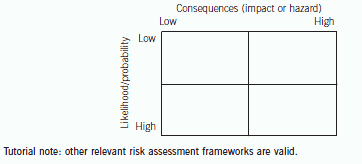
-
第7题:
(b) Explain FIVE critical success factors to the performance of HSC on which the directors must focus if HSC is
to achieve success in its marketplace. (10 marks)
正确答案:
(b) Critical success factors are as follows:
Product quality
The fact that the production staff have no previous experience in a food production environment is likely to prove problematic.
It is vital that a comprehensive training programme is put in place at the earliest opportunity. HSC need to reach and maintain
the highest level of product quality as soon as possible.
Supply quality
The quality of delivery into SFG supermarkets assumes critical significance. Time literally will be of the essence since 90%
of all sandwiches are sold in SFG’s supermarkets before 2 pm each day. Hence supply chain management must be extremely
robust as there is very little scope for error.
Technical quality
Compliance with existing regulations regarding food production including all relevant factory health and safety requirements
is vital in order to establish and maintain the reputation of HSC as a supplier of quality products. The ability to store products
at the correct temperature is critical because sandwiches are produced for human consumption and in extreme circumstance
could cause fatalities.
External credibility
Accreditation by relevant trade associations/regulators will be essential if nationwide acceptance of HSC as a major producer
of sandwiches is to be established.
New product development
Whilst HSC have developed a range of healthy eating sandwiches it must be recognised that consumer tastes change and
that in the face of competition there will always be a need for a continuous focus on new product development.
Margin
Whilst HSC need to recognise all other critical success factors they should always be mindful that the need to obtain the
desired levels of gross and net margin remain of the utmost importance.
Notes: (i) Only five critical success factors were required.
(ii) Alternative relevant discussion and examples would be acceptable. -
第8题:
(b) Describe the audit work to be performed in respect of the carrying amount of the following items in the
balance sheet of GVF as at 30 September 2005:
(i) goat herd; (4 marks)
正确答案:
(b) Audit work on carrying amounts
Tutorial note: This part concerns audit work to be undertaken in respect of non-current tangible assets (the production
animals in the goat herd and certain equipment) and inventories (the for-sale animals and cheese). One of the ‘tests’ for
assessing whether or not a point is worthy of a mark will be whether or not the asset to which it relates is apparent. Points
which are so vague that they could apply to ANY non-current asset for ANY entity, rather than those of GVF are unlikely to
attract many marks, if any, at this level.
(i) Goat herd
■ Physical inspection of the number and condition of animals in the herd and confirming, on a test basis, that they
are tagged (or otherwise ‘branded’ as being owned by GVF).
■ Tests of controls on management’s system of identifying and distinguishing held-for-sale animals (inventory) from
the production herd (depreciable non-current assets).
■ Comparison of GVF’s depreciation policies (including useful lives, depreciation methods and residual values) with
those used by other farming entities.
■ ‘Proof in total’, or other reasonableness check, of the depreciation charge for the herd for the year.
■ Observing test counts or total counts of animals held for sale.
■ Comparing carrying amounts of the kids, according to their weight and age, as at 30 September 2005 with their
market values. (These may approximate to actual invoiced selling prices obtained by GVF.)
Tutorial note: Market value of the production herd could also be compared with its carrying amount to assess possible
impairment. However, if value in use appears to be less than market value the herd should be sold rather than used
for production. -
第9题:
(b) Describe the principal matters that should be included in your firm’s submission to provide internal audit
services to RBG. (10 marks)
正确答案:
(b) Principal matters to be included in submission to provide internal audit services
■ Introduction/background – details about York including its organisation (of functions), offices (locations) and number of
internal auditors working within each office. The office that would be responsible for managing the contract should be
stated.
■ A description of York’s services most relevant to RBG’s needs (e.g. in the areas of risk management, IT audits, value for
money (VFM) and corporate governance).
■ Client-specific issues identified. For example, revenue audits will be required routinely for control purposes and to
substantiate the contingent rents due. Other areas of expertise that RBG may be interested in taking advantage of, for
example, special projects such as acquisitions and mergers.
■ York’s approach to assessing audit needs including the key stages and who will be involved. For example:
(1) Preliminary – review of business, industry and the entity’s operating characteristics
(2) Planning – including needs analysis and co-ordination with external audit plan
(3) Post-Audit – assurance that activities were effectively and efficiently executed
(4) Review – of services provided, reports issued and management’s responses.
■ A description of internal audit tools used and methodologies/approach to audit fieldwork including use of embedded
audit software and programs developed by York.
■ A description of York’s systems-based audit, the IT issues to be addressed and the technological support that can be
provided.
■ Any training that will be offered to RBG’s managers and staff, for example, in a risk management approach.
■ A description and quantity of resources, in particular the number of full-time staff, to be deployed in providing services
to RBG. An outline of RBG’s track record in human resource retention and development.
■ Relevant experience – e.g. in internal and external audit in the retail industry. The relative qualifications and skills of
each grade of audit staff and the contract manager in particular.
■ Insurance certifications covering, for example, public liability and professional indemnity insurance.
■ Work ethic policies relating to health and safety, equal opportunities’ and race relations.
■ How York ensures quality throughout the internal audit process including standards to be followed (e.g. Institute of
Internal Auditors’ standards).
■ Sample report templates – e.g. for reporting the results of risk analysis, audit plans and quarterly reporting of findings
to the Audit and Risk Management Committee.
■ Current clients to whom internal audit services are provided from whom RBG will be able to take up references, by
arrangement, if York is short-listed.
■ Any work currently carried out/competed for that could cause a conflict of interest (and the measures to avoid such
conflicts).
■ Fees (daily rates) for each grade of staff and travel and other expenses to be reimbursed. An indication of price increases,
if any, over the three-year contract period. Invoicing terms (e.g. on presentation of reports) and payment terms (e.g. the
end of the month following receipt of the invoice).
■ Performance targets to be met such as deadlines for completing work and submitting and issuing reports. -
第10题:
(c) (i) Identify and describe FOUR quality control procedures that are applicable to the individual audit
engagement; and (8 marks)
正确答案:
(c) (i) ISQC 1 Quality Control for Firms That Perform. Audits and Reviews of Historical Financial Information and Other
Assurance and Related Services Engagements provides guidance on the overall quality control systems that should be
implemented by an audit firm. ISA 220 Quality Control for Audits of Historical Financial Information specifies the quality
control procedures that should be applied by the engagement team in individual audit assignments.
Procedures include the following:
Client acceptance procedures
There should be full documentation, and conclusion on, ethical and client acceptance issues in each audit assignment.
The engagement partner should consider whether members of the audit team have complied with ethical requirements,
for example, whether all members of the team are independent of the client. Additionally, the engagement partner should
conclude whether all acceptance procedures have been followed, for example, that the audit firm has considered the
integrity of the principal owners and key management of the client. Other procedures on client acceptance should
include:
– Obtaining professional clearance from previous auditors
– Consideration of any conflict of interest
– Money laundering (client identification) procedures.
Engagement team
Procedures should be followed to ensure that the engagement team collectively has the skills, competence and time to
perform. the audit engagement. The engagement partner should assess that the audit team, for example:
– Has the appropriate level of technical knowledge
– Has experience of audit engagements of a similar nature and complexity
– Has the ability to apply professional judgement
– Understands professional standards, and regulatory and legal requirements.
Direction
The engagement team should be directed by the engagement partner. Procedures such as an engagement planning
meeting should be undertaken to ensure that the team understands:
– Their responsibilities
– The objectives of the work they are to perform
– The nature of the client’s business
– Risk related issues
– How to deal with any problems that may arise; and
– The detailed approach to the performance of the audit.
The planning meeting should be led by the partner and should include all people involved with the audit. There should
be a discussion of the key issues identified at the planning stage.
Supervision
Supervision should be continuous during the engagement. Any problems that arise during the audit should be rectified
as soon as possible. Attention should be focused on ensuring that members of the audit team are carrying out their work
in accordance with the planned approach to the engagement. Significant matters should be brought to the attention of
senior members of the audit team. Documentation should be made of key decisions made during the audit engagement.
Review
The review process is one of the key quality control procedures. All work performed must be reviewed by a more senior
member of the audit team. Reviewers should consider for example whether:
– Work has been performed in accordance with professional standards
– The objectives of the procedures performed have been achieved
– Work supports conclusions drawn and is appropriately documented.
The review process itself must be evidenced.
Consultation
Finally the engagement partner should arrange consultation on difficult or contentious matters. This is a procedure
whereby the matter is discussed with a professional outside the engagement team, and sometimes outside the audit
firm. Consultations must be documented to show:
– The issue on which the consultation was sought; and
– The results of the consultation. -
第11题:
(ii) Describe the procedures to verify the number of serious accidents in the year ended 30 November 2007.
(4 marks)
正确答案:
(ii) Procedures to verify the number of serious accidents during 2007 could include the following:
Tutorial note: procedures should focus on the completeness of the disclosure as it is in the interest of Sci-Tech Co to
understate the number of serious accidents.
– Review the accident log book and count the total number of accidents during the year
– Discuss the definition of ‘serious accident’ with the directors and clarify exactly what criteria need to be met to
satisfy the definition
– For serious accidents identified:
? review HR records to determine the amount of time taken off work
? review payroll records to determine the financial amount of sick pay awarded to the employee
? review correspondence with the employee regarding the accident.
Tutorial note: the above will help to clarify that the accident was indeed serious.
– Review board minutes where the increase in the number of serious accidents has been discussed
– Review correspondence with Sci-Tech Co’s legal advisors to ascertain any legal claims made against the company
due to accidents at work
– Enquire as to whether any health and safety visits have been conducted during the year by regulatory bodies, and
review any documentation or correspondence issued to Sci-Tech Co after such visits.
Tutorial note: it is highly likely that in a regulated industry such as pharmaceutical research, any serious accident
would trigger a health and safety inspection from the appropriate regulatory body.
– Discuss the level of accidents with representatives of Sci-Tech Co’s employees to reach an understanding as to
whether accidents sometimes go unreported in the accident log book. -
第12题:
单选题The company has()some major changes in the last five years.Astood
Bsuffered
Cundergone
Dtolerated
正确答案: A解析: 暂无解析 -
第13题:
6 The accountant communicates information to others in reports and statements. Understanding the nature and
importance of communication is therefore an important part of the accountant’s role.
Required:
(a) Explain the importance of good communication. (5 marks)
正确答案:
6 Overview:
The need for clear and concise communication and the consequences of poor communication must be understood by a profession
which exists to provide information to others. Poor communication leads to ineffective control, poor co-ordination and management
failure.
Part (a):
Good communication ensures that individuals know what is expected of them. Co-ordination takes place within the organisation
and there is control of the organisation’s plans, procedures and staff. Instructions of management need to be clearly understood in
assisting group and team cohesiveness and reducing stress from misunderstood instructions. Bias, distortion and omission is
removed with clear communication, as is secrecy, innuendo and rumour. Good communication ensures that the right information
is received by the correct person and thus acted upon, reducing conflict within and between different parts of the organisation. -
第14题:
(b) Describe the skills that a counsellor should possess. (14 marks)
正确答案:
(b) It is clear that many of the problems at Bailey’s that have led to the unhappy atmosphere lend themselves to resolution through the neutral and non-judgemental approach offered by the appointment of external counsellors. The counsellor must be in a position to help the individual employee to identify problems, issues and possible solutions to the kind of problems that have manifested themselves at Bailey’s: poor production, unrest, low morale and significantly, the long tradition of poor pay that is leading to employee family problems outside the factory. There is always the danger of leading the employee, so the counsellor must adopt a passive role, show interest and encourage reflection whilst allowing the employee to lead and talk around the issues. Open questions must be used to help the employee explore ideas and feelings. The counsellor must be an active listener, speaking only to clarify issues and elicit answers when appropriate. Above all, the counsellor must be impartial and this is why Bailey’s has appointed outside counsellors.
Counselling skills require the ability to establish rapport with the employee, to clarify and summarise as appropriate, to ask non-specific questions, use a non-directive approach, to listen and be able to discern what is meant by what the employee says. In addition, the counsellor must allow the employee to be silent if he or she wishes to be, to allow any meeting to take place at the speed of the employee and anticipate the employee’s views on the causes, which at Bailey’s are many, and to allow solutions to the problems.
-
第15题:
(c) Briefly describe five factors to be taken into account when deciding whether to use recruitment consultants.(5 marks)
正确答案:
(c) An organisation considering the use of external recruitment consultants would make its decision upon the availability, level and appropriateness of expertise available within the host organisation and its likely effectiveness, together with the cost of using consultants set against the cost of using the organisation’s own staff. The organisation should consider the level of expertise required of potential employees and therefore the appropriate knowledge required of the consultants and the need for impartiality or security which may be of particular importance for some organisations. In addition, the views of internal staff as to the likely effect of using outside consultants must be considered, as is the effect the use of consultants might have on the need to develop expertise within the organisation.
-
第16题:
(ii) Describe the basis for the calculation of the provision for deferred taxation on first time adoption of IFRS
including the provision in the opening IFRS balance sheet. (4 marks)
正确答案:
(ii) A company has to apply IAS12 to the temporary differences between the carrying amount of the assets and liabilities in
its opening IFRS balance sheet (1 November 2003) and their tax bases (IFRS1 ‘First time adoption of IFRS’). The
deferred tax provision will be calculated using tax rates that have been enacted or substantially enacted by the balance
sheet date. The carrying values of the assets and liabilities at the opening balance sheet date will be determined by
reference to IFRS1 and will use the applicable IFRS in the first IFRS financial statements. Any adjustments required to
the deferred tax balance will be recognised directly in retained earnings.
Subsequent balance sheets (at 31 October 2004 and 31 October 2005) will be drawn up using the IFRS used in the
financial statements to 31 October 2005. The deferred tax provision will be adjusted as at 31 October 2004 and thenas at 31 October 2005 to reflect the temporary differences arising at those dates. -
第17题:
(ii) Describe the claim of each of the four identified stakeholders. (4 marks)
正确答案:
(ii) Stakeholder claims
Four external stakeholders in the case and their claims are as follows.
The client, i.e. the government of the East Asian country. This stakeholder wants the project completed to budget and
on time. It may also be concerned to minimise negative publicity in respect of the construction of the dam and the
possible negative environmental consequences.
Stop-the-dam, the vocal and well organised pressure group. This stakeholder wants the project stopped completely,
seemingly and slightly paradoxically, for environmental and social footprint reasons.
First Nation, the indigenous people group currently resident on the land behind the dam that would be flooded after its
construction. This stakeholder also wants the project stopped so they can continue to live on and farm the land.
The banks (identified as a single group). These seem happy to lend to the project and will want it to proceed so they
make a return on their loans commensurate with the risk of the loan. They do not want to be publicly identified as being
associated with the Giant Dam Project.
Shareholders. The shareholders have the right to have their investment in the company managed in such a way as to
maximise the value of their shareholding. The shareholders seek projects providing positive NPVs within the normal
constraints of sound risk management.
Tutorial note: only four stakeholders need to be identified. Marks will be given for up to four relevant stakeholders
only. -
第18题:
(b) Explain the major benefits of pursuing a policy of internal development. (4 marks)
正确答案:
(b) The major benefits of pursuing a policy of internal development that may accrue to Taliesin Ltd are as follows:
– By confining their activities to its internal environment the company avoids the need to manage the integration of
businesses which is necessitated by an acquisition. Management teams, when considering the acquisition of another
organisation, very often underestimate the costs of integration.
– There is no need for the board of directors of Taliesin Ltd to familiarise itself with different organisational and national
cultures, values etc, thereby avoiding many potential problems.
– The board of directors of Taliesin Ltd is better able to control the activities of the business and the need for more complex
supply chains and strategic alliances with foreign organisations is rendered unnecessary.
– All investments are made at market price whereas if the board of directors was to attempt to grow the business
acquisition then significant outlays would probably be made in respect of purchased goodwill.
– As the organisation develops and expands, staff are provided with development and learning activities that may
precipitate an increase in the level of their commitment to the organisation. -
第19题:
(b) Describe the principal audit work to be performed in respect of the useful lives of Shire Oil Co’s rig platforms.
(6 marks)
正确答案:
(b) Principal audit work – useful life of rig platforms
Tutorial notes: The platforms are just one item of each rig. Candidates should not be awarded marks here for the matters
to be considered in the assessment of useful lives (since this is illustrated in the scenario). No marks will be awarded for
criticising management for estimating useful lives on a per platform. basis or for audit work on depreciation charges/carrying
amounts unrelated to the determination of useful lives.
■ Review of management’s annual assessment of the useful life of each rig at 31 December 2005 and corroboration of
any information that has led to a change in previous estimates. For example, for the abandoned rig, where useful life
has been assessed to be at an end, obtain:
? weather reports;
? incident report supported by photographs;
? insurance claim, etc.
■ Consider management’s past experience and expertise in estimating useful lives. For example, if all lives initially
assessed as short (c. 15 years) are subsequently lengthened (or long lives consistently shortened) this would suggest
that management is being over (under) prudent in its initial estimates.
■ Review of industry comparatives as published in the annual reports of other oil producers.
■ Comparison of actual maintenance costs against budgeted to confirm that the investment needed in maintenance, to
achieve expected life expectancy, is being made.
■ Comparison of actual output (oil extracted) against budgeted. If actual output is less than budgeted the economic life
of the platform. may be:
? shorter (e.g. because there is less oil to be extracted than originally surveyed); or
? longer (e.g. because the rate of extraction is less than budgeted).
Tutorial note: An increase in actual output can be explained conversely.
■ A review of the results of management’s impairment testing of each rig (i.e. the cash-generating unit of which each
platform. is a part).
■ Recalculations of cash flow projections (based on reasonable and supportable assumptions) discounted at a suitable
pre-tax rate.
Tutorial note: As the rigs will not have readily determinable net selling prices (each one being unique and not available
for sale) any impairment will be assessed by a comparison of value in use against carrying amount.
■ Review of working papers of geologist/quantity surveyor(s) employed by Shire supporting estimations of reserves used
in the determination of useful lives of rigs. -
第20题:
(d) Briefly describe the principal audit work to be performed in respect of the carrying amount of the following
items in the balance sheet:
(i) trade receivables; and (3 marks)
正确答案:
(d) Principal audit work
(i) Trade receivables
■ Review of agreements to determine the volume rebates terms. For example,
– the % discounts;
– the volumes to which they apply;
– the period over which they accumulate;
– settlement method (e.g. by credit note or other off-set or repayment).
■ Direct positive confirmation of a value-weighted sample of balances (i.e. larger amounts) to identify potential
overstatement (e.g. due to discounts earned not being awarded).
■ Monitoring of after-date cash receipts and matching against amounts due as shortfalls may indicate disputed
amounts.
■ Review of after-date credit notes to ensure adequate allowance (accrual) is made for discounts earned in the year
to 30 June 2006.
■ Credit risk analysis of individually significant balances and assessment of impairment losses (where carrying value
is less than the present value of the estimated cash flows discounted at the effective interest rate). -
第21题:
(c) Describe the examination procedures you should use to verify Cusiter Co’s prospective financial information.
(9 marks)
正确答案:
(c) Examination procedures
■ The arithmetic accuracy of the PFI should be confirmed, i.e. subtotals and totals should be recast and agreed.
■ The actual information for the year to 31 December 2006 that is shown as comparative information should be agreed
to the audited financial statements for that year to ensure consistency.
■ Balances and transaction totals for the quarter to 31 March 2007 should be agreed to general ledger account balances
at that date. The net book value of property, plant and equipment should be agreed to the non-current asset register;
accounts receivable/payable to control accounts and cash at bank to a bank reconciliation statement.
■ Tenders for the new equipment should be inspected to confirm the additional cost included in property, plant and
equipment included in the forecast for the year to 31 December 2008 and that it can be purchased with the funds being
lent by the bank.
■ The reasonableness of all new assumptions should be considered. For example, the expected useful life of the new
equipment, the capacity at which it will be operating, the volume of new product that can be sold, and at what price.
■ The forecast income statement should be reviewed for completeness of costs associated with the expansion. For
example, operating expenses should include salaries of additional equipment operatives or supervisors.
■ The consistency of accounting practices reflected in the forecast with International Financial Reporting Standards (IFRS)
should be considered. For example, the intangible asset might be expected to be less than $10,000 at 31 December
2008 as it should be carried at amortised cost.
■ The cost of property, plant and equipment at 31 December 2008 is $280,000 more than as at 31 December 2007.
Consideration should be given to the adequacy of borrowing $250,000 if the actual investment is $30,000 more.
■ The terms of existing borrowings (both non-current and short-term) should be reviewed to ensure that the forecast takes
full account of existing repayment schedules. For example, to confirm that only $23,000 of term borrowings will become
current by the end of 2007.
Trends should be reviewed and fluctuations explained, for example:
■ Revenue for the first quarter of 2007 is only 22% of revenue for 2006 and so may appear to be understated. However,
revenue may not be understated if sales are seasonal and the first quarter is traditionally ‘quieter’.
■ Forecast revenue for 2007 is 18% up on 2006. However, forecast revenue for 2008 is only 19% up on 2007. As the
growth in 2007 is before the investment in new plant and equipment it does not look as though the new investment
will be contributing significantly to increased growth in the first year.
■ The gross profit % is maintained at around 29% for the three years. However, the earnings before interest and tax (EBIT)
% is forecast to fall by 2% for 2008. Earnings after interest might be worrying to the potential lender as this is forecast
to rise from 12·2% in 2006 to 13·7% in 2007 but then fall to 7·6% in 2008.
The reasonableness of relationships between income statement and balance sheet items should be considered. For example:
■ The average collection period at each of the balance sheet dates presented is 66, 69, 66 and 66 days respectively (e.g.
71/394 × 365 = 66 days). Although it may be realistic to assume that the current average collection period may be
maintained in future it is possible that it could deteriorate if, for example, new customers taken on to launch the new
product are not as credit worthy as the existing customer base.
■ The number of days sales in inventory at each balance sheet date is 66, 88, 66 and 65 days respectively (e.g. 50/278
× 365 = 66 days). The reason for the increase to 88 at the end of the first quarter must be established and
management’s assertion that 66 days will be re-established as the ‘norm’ corroborated.
■ As the $42,000 movement on retained earnings from 2007 to 2008 is the earnings before income tax for 2008 it may
be that there is no tax in 2008 or that tax effects have not been forecast. (However, some deferred tax effect might be
expected if the investment in new plant and equipment is likely to attract accelerated capital allowances.) -
第22题:
(ii) Describe the evidence you would seek to support the assertion that development costs are technically
feasible. (3 marks)
正确答案:
(ii) Evidence supporting the assertion that development costs are technically feasible would include the following:
– Review the results of scientific tests performed on the products, for example, the results of animal or human testing
of the products.
– Discuss any detrimental results of these tests, e.g. harmful side effects, with the scientists working on the project
to determine what corrective action is being taken.
– Enquire whether any licences necessary for continued development and/or commercial production have been
granted by the appropriate regulatory body.
– Compare expected to actual development costs incurred per product being developed. Where actual costs are in
excess of expected costs investigate whether the extra costs have been incurred in order to make good any problems
identified in the development process.
– Review board minutes for relevant discussion of the product development taking place during the year. -
第23题:
(b) Describe the potential benefits for Hugh Co in choosing to have a financial statement audit. (4 marks)
正确答案:
(b) There are several benefits for Hugh Co in choosing a voluntary financial statement audit.
An annual audit will ensure that any material mistakes made by the part-qualified accountant in preparing the year end
financial statements will be detected. This is important as the directors will be using the year end accounts to review their
progress in the first year of trading and will need reliable figures to assess performance. An audit will give the directors comfort
that the financial statements are a sound basis for making business decisions.
Accurate first year figures will also enable more effective budgeting and forecasting, which will be crucial if rapid growth is to
be achieved.
The auditors are likely to use the quarterly management accounts as part of normal audit procedures. The auditors will be
able to advise Monty Parkes of any improvements that could be made to the management accounts, for example, increased
level of detail, more frequent reporting. Better quality management accounts will help the day-to-day running of the business
and enable a speedier response to any problems arising during the year.
As a by-product of the audit, a management letter (report to those charged with governance) will be produced, identifying
weaknesses and making recommendations on areas such as systems and controls which will improve the smooth running of
the business.
It is likely that Hugh Co will require more bank funding in order to expand, and it is likely that the bank would like to see
audited figures for review, before deciding on further finance. It will be easier and potentially cheaper to raise finance from
other providers with an audited set of financial statements.
As the business deals in cash sales, and retails small, luxury items there is a high risk of theft of assets. The external audit
can act as both a deterrent and a detective control, thus reducing the risk of fraud and resultant detrimental impact on the
financial statements.
Accurate financial statements will be the best basis for tax assessment and tax planning. An audit opinion will enhance the
credibility of the figures.
If the business grows rapidly, then it is likely that at some point in the future, the audit exemption limit will be exceeded and
thus an audit will become mandatory.
Choosing to have an audit from the first year of incorporation will reduce potential errors carried down to subsequent periods
and thus avoid qualifications of opening balances.