
(c) Describe the main stages of a formal grievance procedure that Oliver should now pursue. (10 marks)
题目
(c) Describe the main stages of a formal grievance procedure that Oliver should now pursue. (10 marks)
相似考题
参考答案和解析
Part (c):
Grievance procedures must be accessible to all employees of Hoopers and Henderson at any level of the organisation and
regardless of their status. Managers must have suitable training in procedures and be provided with background as to how
grievances can occur in the first place. Grievance procedures must be regarded as beneficial and not threatening.
If an employee has a grievance, he or she should be able to pursue it and have the problem which has led to the grievance resolved.
A formal grievance procedure must be available, set out in writing and accessible to all employees. The procedure should consist
of five formal stages.
The first stage states the grade of employee or employees and their rights for each type of grievance.
The second stage details the actual procedures for pursuing a grievance, and is in four parts:
– The employee must discuss the grievance with his or her immediate supervisor or line manager.
– If the grievance can not be resolved at the first level, then the employee’s manager must become involved.
– The interview between the employee and manager takes place with the employee being allowed a representative if desired.
– If the grievance remains unresolved then the matter must be referred to a higher manager.
The third stage (referral to a higher manager) requires that the Human Resources Department or, in the case of Hoopers and
Henderson the partner responsible, must be informed.
The fourth stage is that written records must be kept and be available to all employees.
Finally, the procedure must be time limited.
Allowance must be made for the involvement of a trade union, staff association or individual support (if desired) at an appropriate
stage in the procedure.
At Hoopers and Henderson, Oliver has attempted to discuss the issue with his immediate manager (David Morgan) but without
success. He has therefore followed the procedure, but to continue correctly, Oliver must have taken up his grievance with the
manager next in seniority to David Morgan, who in this case is the partner responsible for human resources.
更多“(c) Describe the main stages of a formal grievance procedure that Oliver should now pursue. (10 marks)”相关问题
-
第1题:
(b) Describe the content of a reference. (5 marks)
正确答案:
Part (b)
A simple standard form. to be completed by the referee is acceptable to provide all the required details. A standard form. should
ask about the existing job title, the main duties and responsibilities of the current job, period of employment, present pay or salary
and the attendance record. -
第2题:
(b) Describe the skills that a counsellor should possess. (14 marks)
正确答案:
(b) It is clear that many of the problems at Bailey’s that have led to the unhappy atmosphere lend themselves to resolution through the neutral and non-judgemental approach offered by the appointment of external counsellors. The counsellor must be in a position to help the individual employee to identify problems, issues and possible solutions to the kind of problems that have manifested themselves at Bailey’s: poor production, unrest, low morale and significantly, the long tradition of poor pay that is leading to employee family problems outside the factory. There is always the danger of leading the employee, so the counsellor must adopt a passive role, show interest and encourage reflection whilst allowing the employee to lead and talk around the issues. Open questions must be used to help the employee explore ideas and feelings. The counsellor must be an active listener, speaking only to clarify issues and elicit answers when appropriate. Above all, the counsellor must be impartial and this is why Bailey’s has appointed outside counsellors.
Counselling skills require the ability to establish rapport with the employee, to clarify and summarise as appropriate, to ask non-specific questions, use a non-directive approach, to listen and be able to discern what is meant by what the employee says. In addition, the counsellor must allow the employee to be silent if he or she wishes to be, to allow any meeting to take place at the speed of the employee and anticipate the employee’s views on the causes, which at Bailey’s are many, and to allow solutions to the problems.
-
第3题:
(b) Describe five main barriers to an effective appraisal interview. (10 marks)
正确答案:
(b) The appraisal system should be well constructed and fair to both the individual and the organisation. However, there are a number of barriers, often because employees see the appraisal as one or more of the following:
Confrontation due to lack of agreement on performance, badly explained or subjective feedback, performance based on recent events or disagreement on longer term activities.
Judgement, the appraisal is seen as a one sided process based entirely on the manager’s perspective.
Chat is the worst of all worlds. The appraisal interview is seen as an informal, loosely constructed and badly managed conversation without purpose.
Unfinished business is when the appraisal is not seen as part of a continuing process of performance management.
An annual event when the appraisal is seen as largely irrelevant and simply an event to set annual targets that quickly become out of date.
A system of bureaucracy based on forms devised solely to satisfy the organisation’s human resources department so that its main purpose, that of identifying individual and organisation performance and improvement, is forgotten.
-
第4题:
Bonar Paint to date has had no formal strategic planning process.
(d) What are the advantages and disadvantages of developing a formal mission statement to guide Bonar Paint’s
future direction after the buyout? (10 marks)
正确答案:
(d) The change in ownership represents a major change in the life of any organisation and the opportunity to convince the various
stakeholders of the strategic direction the firm is going in should not be missed. Mission statements are not something that
can be created at five minutes notice and once created need to be revisited to ensure they are still relevant and engaging.
Some experts argue that the mission can only be developed once the firm’s competitive strategy has been developed. Others
argue that it is the starting point for the whole strategic planning process.
A mission statement expresses the purpose of the business and great care will need to be taken to clarify the new role and
status of the buyout directors. Two other critical stakeholders are the workforce and the customers – alienation of either group
will have serious consequences for the firm. Customers need to be convinced that they should stay with the firm and staff
that there is a future for them in the new set up. Bonar Paint needs to ensure that its reputation for customer care is part of
the statement.
The strategy of the firm in terms of where and how it is going to compete again should create confidence in the key
stakeholders. Developing this clear sense of where Bonar Paint is going and how it is going to get there will be of particular
interest to its financial backers. Expressing the mission of the business will be a key part of any business plan. Bonar Paint
may also choose to emphasise the standards of behaviour that will underpin the way it does business. This may include an
explicit commitment to innovative products and customer service. Once again the impact and relevance to both internal and
external stakeholders is important.
Finally, the buyout managers have to convince stakeholders that the culture and values associated with that culture will be
retained after the change in ownership. Bonar Paint, under the Bonar brothers’ ownership and direction, did not feel that
strategic planning was a necessary activity. A succinct and meaningful mission statement may be an excellent way to
communicate the new ownership and sense of purpose in Bonar Paint.
Creating mission statements that convey a sense of purpose may not be easy for the buyout team. The time spent creating
the statement has to have positive outcomes or it will be time wasted. Creating such a statement with no previous experience
increases the difficulties. Seeing it as an integral part of a strategic planning process is important. Care must be taken to
involve other stakeholders in the process or statements may be made with little meaning for them. The degree of involvement
is also significant; most stakeholders are more likely to be useful as ‘sounding boards’ for testing and refining the statement.
The danger is that a statement is produced that few stakeholders buy into and does not affect attitudes or behaviours towardBonar Paint. -
第5题:
(b) (i) Discuss the main factors that should be taken into account when determining how to treat gains and
losses arising on tangible non-current assets in a single statement of financial performance. (8 marks)
正确答案:
(b) (i) Currently there are many rules on how gains and losses on tangible non current assets should be reported and these
have traditionally varied from country to country. The main issues revolve around the reporting of depreciation,
disposal/revaluation gains and losses, and impairment losses. The reporting of such elements should take into account
whether the tangible non current assets have been revalued or held at historical cost. The problem facing standard
setters is where to report such gains and losses.The question is whether they should be reported as part of operating
activities or as ‘other gains and losses’.
Holding gains arising on the sale of tangible non current assets could be reported separately from operating results so
that the latter is not obscured by an asset realisation that reflects more a change in market prices than any increase in
the operating activity of the entity. Other changes in the carrying amounts of tangible non current assets will be reported
as part of the operating results. For example, the depreciation charge tries to reflect the consumption of the asset by the
entity and as such is not a holding loss. There may be cases where the depreciation charge does not reflect the
consumption of economic benefits. For example, the pattern and rate of depreciation could have been misjudged
because the asset’s useful life has been assessed incorrectly. In this case, when an asset is sold any excess or shortfall
of depreciation may need to be dealt with in the operating result.
Impairment is another factor to consider in reporting gains and losses on tangible non current assets. Impairment is
effectively accelerated depreciation. Impairment arises when the carrying amount of the asset is above its recoverable
amount. It follows therefore that any impairment loss should be reported as part of the operating result. Any losses on
disposal, to the extent that they represent impairment, could therefore be reported as part of the operating results. Any
losses which represent holding losses could be reported in ‘other gains and losses’. The difficulty will be differentiating
between holding losses and impairment losses. There will have to be clear and concise definitions of these terms or it
could lead to abuse by companies in their quest to maximise operating profits.
A distinction should be made between gains and losses arising on tangible non current assets as a result of revaluations
and those arising on disposal. The nature of the gain or loss is essentially the same although the timing and certainty
of the gain/loss is different. Therefore revaluation gains/losses may be reported in the ‘other gains and losses’ section.
Where an asset has been revalued, any loss on disposal that represents an impairment would be charged to operating
results and any remaining loss reported in ‘other gains and losses’.
Essentially, gains and losses should be reported on the basis of the characteristics of the gains and losses themselves.
Gains and losses with similar characteristics should be reported together thus helping the comparability of financial
performance nationally and internationally. -
第6题:
(b) Using the TARA framework, construct four possible strategies for managing the risk presented by Product 2.
Your answer should describe each strategy and explain how each might be applied in the case.
(10 marks)
正确答案:
(b) Risk management strategies and Chen Products
Risk transference strategy
This would involve the company accepting a portion of the risk and seeking to transfer a part to a third party. Although an
unlikely possibility given the state of existing claims, insurance against future claims would serve to limit Chen’s potential
losses and place a limit on its losses. Outsourcing manufacture may be a way of transferring risk if the ourtsourcee can be
persuaded to accept some of the product liability.
Risk avoidance strategy
An avoidance strategy involves discontinuing the activity that is exposing the company to risk. In the case of Chen this would
involve ceasing production of Product 2. This would be pursued if the impact (hazard) and probability of incurring an
acceptable level of liability were both considered to be unacceptably high and there were no options for transference or
reduction.
Risk reduction strategy
A risk reduction strategy involves seeking to retain a component of the risk (in order to enjoy the return assumed to be
associated with that risk) but to reduce it and thereby limit its ability to create liability. Chen produces four products and it
could reconfigure its production capacity to produce proportionately more of Products 1, 3 and 4 and proportionately less of
Product 2. This would reduce Product 2 in the overall portfolio and therefore Chen’s exposure to its risks. This would need
to be associated with instructions to other departments (e.g. sales and marketing) to similarly reconfigure activities to sell
more of the other products and less of Product 2.
Risk acceptance strategy
A risk acceptance strategy involves taking limited or no action to reduce the exposure to risk and would be taken if the returns
expected from bearing the risk were expected to be greater than the potential liabilities. The case mentions that Product 2 is
highly profitable and it may be that the returns attainable by maintaining and even increasing Product 2’s sales are worth the
liabilities incurred by compensation claims. This is a risk acceptance strategy. -
第7题:
(c) Describe the examination procedures you should use to verify Cusiter Co’s prospective financial information.
(9 marks)
正确答案:
(c) Examination procedures
■ The arithmetic accuracy of the PFI should be confirmed, i.e. subtotals and totals should be recast and agreed.
■ The actual information for the year to 31 December 2006 that is shown as comparative information should be agreed
to the audited financial statements for that year to ensure consistency.
■ Balances and transaction totals for the quarter to 31 March 2007 should be agreed to general ledger account balances
at that date. The net book value of property, plant and equipment should be agreed to the non-current asset register;
accounts receivable/payable to control accounts and cash at bank to a bank reconciliation statement.
■ Tenders for the new equipment should be inspected to confirm the additional cost included in property, plant and
equipment included in the forecast for the year to 31 December 2008 and that it can be purchased with the funds being
lent by the bank.
■ The reasonableness of all new assumptions should be considered. For example, the expected useful life of the new
equipment, the capacity at which it will be operating, the volume of new product that can be sold, and at what price.
■ The forecast income statement should be reviewed for completeness of costs associated with the expansion. For
example, operating expenses should include salaries of additional equipment operatives or supervisors.
■ The consistency of accounting practices reflected in the forecast with International Financial Reporting Standards (IFRS)
should be considered. For example, the intangible asset might be expected to be less than $10,000 at 31 December
2008 as it should be carried at amortised cost.
■ The cost of property, plant and equipment at 31 December 2008 is $280,000 more than as at 31 December 2007.
Consideration should be given to the adequacy of borrowing $250,000 if the actual investment is $30,000 more.
■ The terms of existing borrowings (both non-current and short-term) should be reviewed to ensure that the forecast takes
full account of existing repayment schedules. For example, to confirm that only $23,000 of term borrowings will become
current by the end of 2007.
Trends should be reviewed and fluctuations explained, for example:
■ Revenue for the first quarter of 2007 is only 22% of revenue for 2006 and so may appear to be understated. However,
revenue may not be understated if sales are seasonal and the first quarter is traditionally ‘quieter’.
■ Forecast revenue for 2007 is 18% up on 2006. However, forecast revenue for 2008 is only 19% up on 2007. As the
growth in 2007 is before the investment in new plant and equipment it does not look as though the new investment
will be contributing significantly to increased growth in the first year.
■ The gross profit % is maintained at around 29% for the three years. However, the earnings before interest and tax (EBIT)
% is forecast to fall by 2% for 2008. Earnings after interest might be worrying to the potential lender as this is forecast
to rise from 12·2% in 2006 to 13·7% in 2007 but then fall to 7·6% in 2008.
The reasonableness of relationships between income statement and balance sheet items should be considered. For example:
■ The average collection period at each of the balance sheet dates presented is 66, 69, 66 and 66 days respectively (e.g.
71/394 × 365 = 66 days). Although it may be realistic to assume that the current average collection period may be
maintained in future it is possible that it could deteriorate if, for example, new customers taken on to launch the new
product are not as credit worthy as the existing customer base.
■ The number of days sales in inventory at each balance sheet date is 66, 88, 66 and 65 days respectively (e.g. 50/278
× 365 = 66 days). The reason for the increase to 88 at the end of the first quarter must be established and
management’s assertion that 66 days will be re-established as the ‘norm’ corroborated.
■ As the $42,000 movement on retained earnings from 2007 to 2008 is the earnings before income tax for 2008 it may
be that there is no tax in 2008 or that tax effects have not been forecast. (However, some deferred tax effect might be
expected if the investment in new plant and equipment is likely to attract accelerated capital allowances.) -
第8题:
(c) In the context of a standard unmodified audit report, describe the content of a liability disclaimer paragraph,
and discuss the main arguments for and against the use of a liability disclaimer paragraph. (5 marks)
正确答案:
(c) It has become increasingly common for audit firms to include a disclaimer paragraph within the audit report. However, it is
not a requirement of auditing standards and individual audit firms need to assess the advantages and disadvantages of the
use of a disclaimer paragraph.
The wording is used to state the fact that the auditor’s report is intended solely for the use of the company’s members as a
body, and that no responsibility is accepted or assumed to anyone other than the company and the company’s members as
a body.
The main perceived advantage is that the disclaimer should help to reduce the exposure of the audit firm to liability claims
from anyone other than the company or the company’s body of shareholders. The disclaimer makes it clear that the audit
firm reports only to those who appointed the firm, i.e. the members of the company, and this may make it more difficult for
the audit firm to be sued by a third party.
It is also argued that the use of a disclaimer could help to bridge the ‘expectation gap’ by providing a clearer indication of the
responsibility of the auditor.
In this way the audit firm can manage its risk exposure in an increasingly litigious environment. Recent high profile legal cases
against audit firms, such as the Bannerman case in Scotland, illustrate that an audit firm’s duty of care can extend beyond
the company and its shareholders, and that audit firms should consider how to protect themselves against liability claims.
Tutorial note: It is appropriate here to quote recent cases such as the Bannerman case to illustrate the reason why audit
firms face increased potential exposure to claims from third parties. However, knowledge of specific legal cases is not
required to gain full marks for this requirement.
However, it can be argued that a disclaimer does not necessarily work to protect an audit firm. Each legal case has individual
circumstances, and while a disclaimer might protect the audit firm in one situation, equally it may not offer any protection
where the facts of the case are different.
In addition, it is often argued that if an audit firm conducts an audit using full due care and diligence, there is no need for a
disclaimer, as a high quality audit would be very unlikely to lead to any claims against the audit firm. Consequently, it could
be argued that the use of disclaimers as a means to limit liability could permit low quality audits to be performed, the auditors
being confident that legal cases against them are restricted due to the presence of a disclaimer within the audit report. -
第9题:
A normal lesson should have the all the stages discussed in this unit and the stages should be in fixed order.()
A对
B错
错
略 -
第10题:
A normal lesson should have the all the stages discussed in this unit and the stages should be in fixed order.()
正确答案:错误 -
第11题:
判断题A normal lesson should have the all the stages discussed in this unit and the stages should be in fixed order.()A对
B错
正确答案: 错解析: 暂无解析 -
第12题:
单选题Which of the following statements can not be used to describe universities in Britain?AAll universities are private institutions.
BAll students have got high marks in “A” Level.
CThey have their own governing councils
DThey now derive nearly all of their funds from state grants.
正确答案: D解析:
英国大学是一个独立自治的机构,不属于任何政府部门的管辖和控制,它们主要的经费是由英格兰高等教育拨款委员资助。但英国大学课程很严格,并不是所有人都能得A,故B项错误。 -
第13题:
(b) Describe five major barriers to good communication. (10 marks)
正确答案:
Part (b):
Barriers to communication include the personal background of the people communicating, including language differences between
staff, management and customers. The use of jargon, especially by professional and technical staff, differences in education levels
can be a substantial barrier throughout the organisation. Communication ‘noise’ is a barrier not always recognised. This is where
the message is confused by extraneous matters not relevant to that particular communication. Different levels of education and
experience can lead to different perception of individuals, leading to conflict within the organisation, between individuals and
between departments. Similarly, another barrier often not recognised is communication overload; too much information being
communicated at one time leading to confusion. Distances involved and the subsequent use of different communication facilities
is a barrier, leading to misunderstandings based on problems noted above. Finally, and perhaps most importantly, distortion of the
information transmitted. -
第14题:
(b) Describe the advantages of external recruitment. (5 marks)
正确答案:
(b) External recruitment describes the situation where the organisation decides to fill a staff vacancy and recruit from outside the organisation.
It may be essential if particular skills or expertise are not already available within the organisation and is necessary to restore depleted staffing levels or when for some reason the organisation urgently needs new employees. New staff members bring new ideas and novel approaches to the organisation and to the specific task, often providing experience and work methods from other employers.
-
第15题:
6 Communication is important for all organisations and requires an understanding of communication flows and channels.
Required:
(a) Briefly explain the main purposes of the three main formal communication channels in an organisation:
(i) Downwards; (3 marks)
正确答案:
6 There are many forms of communication within an organisation, both formal and informal. Formally communicated information often flows in one of three main directions: downwards, upwards and lateral. However, all organisations also have informal communication channels and management must understand their importance.
(a) Formal communicated information flows in three main directions.
(i) Downwards. This form. of communication is often the one most easily recognised and understood. The purpose of downward communication is to give specific directives, to provide information about procedures and practices and to provide information about work practices. It also serves to tell employees about their performance and provides information on organisational and departmental objectives.
-
第16题:
The group have now decided to convert their business idea into reality.
(b) What elements should a marketing plan contain to achieve a successful launch of their restaurant?
(8 marks)
正确答案:
(b) The launch of any new business is a critical event and a marketing plan a vital ingredient in achieving launch success. Most
companies will associate a marketing plan with the ever-popular 4 Ps. However, the marketing mix can only be decided once
some fundamental marketing decisions have been taken. Firstly, the group need to clearly identify which segments of the
market they are seeking to attract. Segments are made up of groups of customers with similar needs and expectations. If they
are identifying the student market as an important segment they should recognise that there are very different segments within
this group. They are most likely to want to target those students willing and able to pay for a high quality meal and experience.
They are not in the market for low priced/fast food. This requires them to recognise how they are trying to position their
restaurant – high quality and moderate prices looks to be a combination, which will deliver an attractive service and added
value to the customer. The relationship between the customers’ perception of added value and the price charged is, in terms
of Bowman’s strategy clock, likely to be that of a focused differentiator.
For the Casa del Mediterraneo getting the product or service right will involve a complex co-ordination of many different
activities – from buying the right food through to delivering the orders efficiently. As a service, there may be many more things
that potentially can go wrong and it really does come down to the people delivering the service. This involves one of the
additional ‘P’s, involved in delivering services, namely processes, which together with the physical evidence in the shape of
the restaurant, will have a major say in the success or otherwise of the launch. Clearly, the place and the physical evidence
are one and the same thing and the right location will also affect the success of both the launch and the whole venture.
Pricing in a competitive market will be important and many upmarket restaurants price on the basis of what the market will
bear. There needs to be a clear relationship between the price and the value offered. Finally, promotion is perhaps the key
element in the effective launch of the new restaurant. There will need to be a correct choice of media to reach the targetaudience including the use of web-based advertising to get the restaurant known. -
第17题:
(b) Describe with suitable calculations how the goodwill arising on the acquisition of Briars will be dealt with in
the group financial statements and how the loan to Briars should be treated in the financial statements of
Briars for the year ended 31 May 2006. (9 marks)
正确答案:(b) IAS21 ‘The Effects of Changes in Foreign Exchange Rates’ requires goodwill arising on the acquisition of a foreign operation
and fair value adjustments to acquired assets and liabilities to be treated as belonging to the foreign operation. They should
be expressed in the functional currency of the foreign operation and translated at the closing rate at each balance sheet date.
Effectively goodwill is treated as a foreign currency asset which is retranslated at the closing rate. In this case the goodwillarising on the acquisition of Briars would be treated as follows: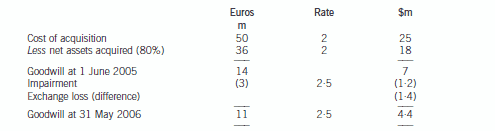
At 31 May 2006, the goodwill will be retranslated at 2·5 euros to the dollar to give a figure of $4·4 million. Therefore this
will be the figure for goodwill in the balance sheet and an exchange loss of $1·4 million recorded in equity (translation
reserve). The impairment of goodwill will be expensed in profit or loss to the value of $1·2 million. (The closing rate has been
used to translate the impairment; however, there may be an argument for using the average rate.)
The loan to Briars will effectively be classed as a financial liability measured at amortised cost. It is the default category for
financial liabilities that do not meet the definition of financial liabilities at fair value through profit or loss. For most entities,
most financial liabilities will fall into this category. When a financial liability is recognised initially in the balance sheet, the
liability is measured at fair value. Fair value is the amount for which a liability can be settled, between knowledgeable, willing
parties in an arm’s length transaction. In other words, fair value is an actual or estimated transaction price on the reporting
date for a transaction taking place between unrelated parties that have adequate information about the asset or liability being
measured.
Since fair value is a market transaction price, on initial recognition fair value generally is assumed to equal the amount of
consideration paid or received for the financial asset or financial liability. Accordingly, IAS39 specifies that the best evidence
of the fair value of a financial instrument at initial recognition generally is the transaction price. However for longer-term
receivables or payables that do not pay interest or pay a below-market interest, IAS39 does require measurement initially at
the present value of the cash flows to be received or paid.
Thus in Briars financial statements the following entries will be made: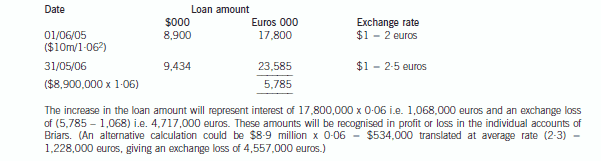
-
第18题:
(b) Describe the principal matters that should be included in your firm’s submission to provide internal audit
services to RBG. (10 marks)
正确答案:
(b) Principal matters to be included in submission to provide internal audit services
■ Introduction/background – details about York including its organisation (of functions), offices (locations) and number of
internal auditors working within each office. The office that would be responsible for managing the contract should be
stated.
■ A description of York’s services most relevant to RBG’s needs (e.g. in the areas of risk management, IT audits, value for
money (VFM) and corporate governance).
■ Client-specific issues identified. For example, revenue audits will be required routinely for control purposes and to
substantiate the contingent rents due. Other areas of expertise that RBG may be interested in taking advantage of, for
example, special projects such as acquisitions and mergers.
■ York’s approach to assessing audit needs including the key stages and who will be involved. For example:
(1) Preliminary – review of business, industry and the entity’s operating characteristics
(2) Planning – including needs analysis and co-ordination with external audit plan
(3) Post-Audit – assurance that activities were effectively and efficiently executed
(4) Review – of services provided, reports issued and management’s responses.
■ A description of internal audit tools used and methodologies/approach to audit fieldwork including use of embedded
audit software and programs developed by York.
■ A description of York’s systems-based audit, the IT issues to be addressed and the technological support that can be
provided.
■ Any training that will be offered to RBG’s managers and staff, for example, in a risk management approach.
■ A description and quantity of resources, in particular the number of full-time staff, to be deployed in providing services
to RBG. An outline of RBG’s track record in human resource retention and development.
■ Relevant experience – e.g. in internal and external audit in the retail industry. The relative qualifications and skills of
each grade of audit staff and the contract manager in particular.
■ Insurance certifications covering, for example, public liability and professional indemnity insurance.
■ Work ethic policies relating to health and safety, equal opportunities’ and race relations.
■ How York ensures quality throughout the internal audit process including standards to be followed (e.g. Institute of
Internal Auditors’ standards).
■ Sample report templates – e.g. for reporting the results of risk analysis, audit plans and quarterly reporting of findings
to the Audit and Risk Management Committee.
■ Current clients to whom internal audit services are provided from whom RBG will be able to take up references, by
arrangement, if York is short-listed.
■ Any work currently carried out/competed for that could cause a conflict of interest (and the measures to avoid such
conflicts).
■ Fees (daily rates) for each grade of staff and travel and other expenses to be reimbursed. An indication of price increases,
if any, over the three-year contract period. Invoicing terms (e.g. on presentation of reports) and payment terms (e.g. the
end of the month following receipt of the invoice).
■ Performance targets to be met such as deadlines for completing work and submitting and issuing reports. -
第19题:
(c) Describe the audit procedures you should perform. to determine the validity of the amortisation rate of five
years being applied to development costs in relation to Plummet. (5 marks)
正确答案:
(c) Audit procedures to determine the validity of the amortisation rate of five years being applied to development costs in relation
to the product Plummet would include the following:
– Obtain the papers documenting market research carried out on Plummet. Review and ascertain that the market research
supports a product life span of five years.
– Review actual sales patterns since the launch of Plummet and compare to the predicted sales per the market research
document.
Tutorial note: this will help to demonstrate the accuracy of the predicted sales forecast of Plummet.
– Read the assumptions underpinning the market research sales projections, and consider whether these assumptions
agree with the auditors’ understanding of the business.
– Discuss sales trends with the sales/marketing directors and ascertain whether sales are in line with management’s
expectations.
– Read correspondence with retail outlets to ensure there is continued support for selling Plummet.
– Obtain marketing/advertising budgets and ascertain enough expenditure is continuing on Plummet to support continued
sales. -
第20题:
describe the procedure to start an emergency generator ?
正确答案:1) to check the lube oil level in the crankcance and fuel oil level in the tank . 2) to see whether there is any leakage . 3) to check the air pressure if the generator is air started model ; and to check the battery voltage to see whether it is normal if the generator is the battery started model 4)also to make sure there are no obstacles around the machine .
-
第21题:
What are some of the main stages of a lesson?
1. Presentation: The teacher presents new words or structures, gives examples, writes them on the board, etc.
2. Practice: Students practice using words or structures in a controlled way. Practice can be oral or written.
3. Production: Students use language they have learnt to express themselves more freely. Like practice, production can be oral or written.
4. Reading: Students read a text and answer questions or do a simple task.
5. Listening: The teacher reads a text or dialogue while the students listen and answer questions, or the students listen to the tape.
6. Revision: The teacher reviews language learnt in an earlier lesson, to refresh the students’ memories, or as a preparation for a new presentation.
略 -
第22题:
You work in a company which uses SQL Server 2008. You are the administrator of the company database. Now you are in charge of a SQL Server 2008 instance. There is a stored procedure. The stored procedure implements a database maintenance process. A SQL Server Agent job should be created to that runs the stored procedure. Besides this, you must make sure that after it is completed successfully, the job is removed. What should you do? ()
- A、You should create a job which is assigned to the Database Maintenance category
- B、You should create an Alert which will run another to delete the maintenance job.
- C、You should create a job. You schedule the job to run only once.
- D、You should create a job. The job uses the Automatically delete job option
正确答案:D -
第23题:
单选题You work in a company which uses SQL Server 2008. You are the administrator of the company database. Now you are in charge of a SQL Server 2008 instance. There are user-defined stored procedures. Now you have to make sure two things, first, the names of all user-defined stored procedures must contain the prefix usp_ on all instances; second, stored procedures that do not contain this prefix cannot be created by you. So what should you do to ensure this two?()AYou should create a policy that targets the name of the stored procedure that is evaluated on change.
BYou should create a policy that targets the name of the stored procedure that is evaluated on demand.
CYou should create a condition that targets the name of stored procedure that is evaluated on demand.
DYou should create a condition that targets the name of the stored procedure that isevaluated on change.
正确答案: C解析: 暂无解析