
(b) Explain and give examples of assertive behaviour. (7 marks)
题目
(b) Explain and give examples of assertive behaviour. (7 marks)
相似考题
更多“(b) Explain and give examples of assertive behaviour. (7 marks)”相关问题
-
第1题:
6 An important part of managing people in a professional organisation is to be able to distinguish between aggressiveness and assertiveness in an employee.
Required:
(a) Explain and give examples of aggressive behaviour. (8 marks)
正确答案:
6 To get the best out of people, managers need to have effective communication skills. Professional accountants as managers need to understand the difference between aggressive and assertive behaviour. Often an exchange of communication can be interpreted as a belligerent response from an employee. However, a slight difference in approach can communicate different feelings and achieve a more positive result.
(a) Aggressive behaviour is competitive and directed at defeating someone else. It is standing up for oneself at the expense of other people. It is defending one’s rights but doing so in such a way that violates the rights of other people. Aggressive behaviour ignores or dismisses the needs, wants, opinions, feelings or beliefs of others.
Characteristics of aggressive behaviour include excessive ‘I’ statements, boastfulness, and the individual’s opinions expressed as fact, threatening questions or postures from the individual, sarcasm and other throw-away remarks and a constant blaming of others.
Aggressive behaviour can be self defeating. It may cause such antagonism in the others in the organisation that they will refuse to co-operate or work with the person showing aggressive behaviour.
-
第2题:
4 (a) Explain the meaning of the term ‘working capital cycle’ for a trading company. (4 marks)
正确答案:
(a) The working capital cycle illustrates the changing make-up of working capital in the course of the trading operations of a
business:
1 Purchases are made on credit and the goods go into inventory.
2 Inventory is sold and converted into receivables
3 Credit customers pay their accounts
4 Cash is used to pay suppliers. -
第3题:
(b) Distinguish between strategic and operational risks, and explain why the secrecy option would be a source
of strategic risk. (10 marks)
正确答案:
(b) Strategic and operational risks
Strategic risks
These arise from the overall strategic positioning of the company in its environment. Some strategic positions give rise to
greater risk exposures than others. Because strategic issues typically affect the whole of an organisation and not just one or
more of its parts, strategic risks can potentially concern very high stakes – they can have very high hazards and high returns.
Because of this, they are managed at board level in an organisation and form. a key part of strategic management.
Operational risks
Operational risks refer to potential losses arising from the normal business operations. Accordingly, they affect the day-to-day
running of operations and business systems in contrast to strategic risks that arise from the organisation’s strategic positioning.
Operational risks are managed at risk management level (not necessarily board level) and can be managed and mitigated by
internal control systems.
The secrecy option would be a strategic risk for the following reasons.
It would radically change the environment that SHC is in by reducing competition. This would radically change SHC’s strategic
fit with its competitive environment. In particular, it would change its ‘five forces’ positioning which would change its risk
profile.
It would involve the largest investment programme in the company’s history with new debt substantially changing the
company’s financial structure and making it more vulnerable to short term liquidity problems and monetary pressure (interest
rates).
It would change the way that stakeholders view SHC, for better or worse. It is a ‘crisis issue’, certain to polarise opinion either
way.
It will change the economics of the industry thereby radically affecting future cost, revenue and profit forecasts.
There may be retaliatory behaviour by SHC’s close competitor on 25% of the market.
[Tutorial note: similar reasons if relevant and well argued will attract marks] -
第4题:
(c) Define ‘retirement by rotation’ and explain its importance in the context of Rosh and Company.
(5 marks)
正确答案:
(c) Retirement by rotation.
Definition
Retirement by rotation is an arrangement in a director’s contract that specifies his or her contract to be limited to a specific
period (typically three years) after which he or she must retire from the board or offer himself (being eligible) for re-election.
The director must be actively re-elected back onto the board to serve another term. The default is that the director retires
unless re-elected.
Importance of
Retirement by rotation reduces the cost of contract termination for underperforming directors. They can simply not be
re-elected after their term of office expires and they will be required to leave the service of the board as a retiree (depending
on contract terms).
It encourages directors’ performance (they know they are assessed by shareholders and reconsidered every three years) and
focuses their minds upon the importance of meeting objectives in line with shareholders’ aims.
It is an opportunity, over time, to replace the board membership whilst maintaining medium term stability of membership
(one or two at a time).
Applied to Rosh
Retirement by rotation would enable the board of Rosh to be changed over time. There is evidence that some directors may
have stayed longer than is ideal because of links with other board members going back many years. -
第5题:
(ii) Explain THREE strategies that might be adopted in order to improve the future prospects of Diverse
Holdings Plc. (6 marks)
正确答案:
(ii) The forecast situation of Diverse Holdings Plc is not without its problems. KAL and OPL require the immediate attention
of management. The position of KAL is precarious to say the least. There is a choice of strategies for it:
(i) Outsource the manufacture of appliances
(ii) Set up a manufacturing operation overseas
(ii) Withdraw from the market.
Each alternative must be assessed. Whatever decision is taken it is unlikely to affect the other four subsidiaries.
PSL is also independent of the other subsidiaries. A strategic decision to widen its range of products and outlets must
surely help. Hence management should endeavour to find new markets for its products, which are separate and distinct
from those markets served by its appointed distributors.
21
In order to improve the prospects of OPL management need to adopt appropriate strategies since at the present time the
company appears to be in a high growth market but is unable to capture a reasonable market share. Perhaps the answer
lies in increased or more effective advertising of the endorsement of the product range by health and safety experts.
Management should endeavour to develop a strategy to integrate further its subsidiaries so that they can benefit from
each other and also derive as much synergy as possible from the acquisition of HTL.
It is of paramount importance that management ensure that sufficient funds are channelled into growing OFL and HTL,
which are both showing a rising trend in profitability. The group has depleted cash reserves which must to some extent
be attributable to the purchase of HTL. It is possible that the divestment of KAL would provide some much needed
funding. -
第6题:
(b) Explain THREE problems in undertaking a performance comparison of GBC and TTC and also explain THREE
items of additional information that would be of assistance in assessing the operating and financial
performance of GBC and TTC. (6 marks)
正确答案:
(b) The relative performance of GBC and TTC is difficult to assess due to the following:
(i) They would appear to have differing objectives. GBC provides free transport for senior citizens and charges lower fares
than TTC. GBC also uses environmentally friendly fuel. Each of these factors inhibits a direct comparison of the two
organisations.
(ii) The organisations are funded differently. It is evident that TTC uses loan finance to fund operations which gives rise to
interest charges which are not incurred by GBC. On the other hand GBC is funded by the government.
(iii) TTC has higher fixed asset values which precipitate much higher depreciation charges.
(iv) There is also a lack of non-financial performance indicators such as the number of on-time arrivals, number of accidents,
complaints re passenger dissatisfaction, staff turnover, adherence to relevant legislation, convenience of pick-up/drop-off
points etc.
The following items of additional information would assist in assessing the financial and operating performance of the two
companies:
(1) The number of staff employed by each organisation would assist in the assessment of the financial and operating
performance. Ratios such as revenue generated per employee and operating costs per employee might provide useful
comparators of financial and operating efficiency.
(2) Safety and accident records of each organisation would give an indication of the reliability and safety afforded to
passengers by each organisation. Passenger safety is of paramount importance to all passenger transport businesses.
(3) Records of late/cancelled buses together with the number of complaints received from the passengers would provide an
indication of the efficiency of the service provided by each organisation.
(4) The accessibility of the services, location of pick-up/drop-off points would provide an indication of the flexibility of service
delivery provided by each organisation.
(5) The comfort, cleanliness and age of the respective bus fleets would provide a further indication of the level of service
quality provided by each organisation.
(6) The fuel emission levels of the buses operated by each organisation would provide an indication of the extent of their
‘social responsibility’.
Notes: (i) Only three items of additional information were required.
(ii) Alternative relevant discussion and examples would be acceptable. -
第7题:
6 (a) Explain the term ‘money laundering’. (3 marks)
正确答案:
6 MONEY LAUNDERING
Tutorial note: The answer which follows is indicative of the range of points which might be made. Other relevant material will
be given suitable credit.
(a) Meaning of the term
■ Money laundering is the process by which criminals attempt to conceal the true origin and ownership of the proceeds
of their criminal activity (‘dirty’ money) allowing them to maintain control over the proceeds and, ultimately, providing a
legitimate cover for their sources of income.
■ The term is widely defined to include:
– possessing; or
– in any way dealing with; or
– concealing
the proceeds of any crime (‘criminal property’).
■ It also includes:
– an attempt or conspiracy or incitement to commit such an offence; or
– aiding, abetting, counselling or procuring the commission of such an offence.
■ Further, it includes failure by an individual in a regulated sector to inform. the financial intelligence unit (FIU), as soon
as practicable, of knowledge or suspicion that another person is engaged in money laundering.
Tutorial note: The FIU serves as a national centre for receiving (and, as permitted, requesting), analysing and
disseminating suspicious transaction reports (STRs). -
第8题:
In relation to the courts’ powers to interpret legislation, explain and differentiate between:
(a) the literal approach, including the golden rule; and (5 marks)
(b) the purposive approach, including the mischief rule. (5 marks)
正确答案:Tutorial note:
In order to apply any piece of legislation, judges have to determine its meaning. In other words they are required to interpret the
statute before them in order to give it meaning. The diffi culty, however, is that the words in statutes do not speak for themselves and
interpretation is an active process, and at least potentially a subjective one depending on the situation of the person who is doing
the interpreting.
Judges have considerable power in deciding the actual meaning of statutes, especially when they are able to deploy a number of
competing, not to say contradictory, mechanisms for deciding the meaning of the statute before them. There are, essentially, two
contrasting views as to how judges should go about determining the meaning of a statute – the restrictive, literal approach and the
more permissive, purposive approach.
(a) The literal approach
The literal approach is dominant in the English legal system, although it is not without critics, and devices do exist for
circumventing it when it is seen as too restrictive. This view of judicial interpretation holds that the judge should look primarily
to the words of the legislation in order to construe its meaning and, except in the very limited circumstances considered below,
should not look outside of, or behind, the legislation in an attempt to fi nd its meaning.
Within the context of the literal approach there are two distinct rules:
(i) The literal rule
Under this rule, the judge is required to consider what the legislation actually says rather than considering what it might
mean. In order to achieve this end, the judge should give words in legislation their literal meaning, that is, their plain,
ordinary, everyday meaning, even if the effect of this is to produce what might be considered an otherwise unjust or
undesirable outcome (Fisher v Bell (1961)) in which the court chose to follow the contract law literal interpretation of
the meaning of offer in the Act in question and declined to consider the usual non-legal literal interpretation of the word
(offer).(ii) The golden rule
This rule is applied in circumstances where the application of the literal rule is likely to result in what appears to the court
to be an obviously absurd result. It should be emphasised, however, that the court is not at liberty to ignore, or replace,
legislative provisions simply on the basis that it considers them absurd; it must fi nd genuine diffi culties before it declines
to use the literal rule in favour of the golden one. As examples, there may be two apparently contradictory meanings to a
particular word used in the statute, or the provision may simply be ambiguous in its effect. In such situations, the golden
rule operates to ensure that preference is given to the meaning that does not result in the provision being an absurdity.
Thus in Adler v George (1964) the defendant was found guilty, under the Offi cial Secrets Act 1920, with obstruction
‘in the vicinity’ of a prohibited area, although she had actually carried out the obstruction ‘inside’ the area.
(b) The purposive approach
The purposive approach rejects the limitation of the judges’ search for meaning to a literal construction of the words of
legislation itself. It suggests that the interpretative role of the judge should include, where necessary, the power to look beyond
the words of statute in pursuit of the reason for its enactment, and that meaning should be construed in the light of that purpose
and so as to give it effect. This purposive approach is typical of civil law systems. In these jurisdictions, legislation tends to set
out general principles and leaves the fi ne details to be fi lled in later by the judges who are expected to make decisions in the
furtherance of those general principles.
European Community (EC) legislation tends to be drafted in the continental manner. Its detailed effect, therefore, can only be
determined on the basis of a purposive approach to its interpretation. This requirement, however, runs counter to the literal
approach that is the dominant approach in the English system. The need to interpret such legislation, however, has forced
a change in that approach in relation to Community legislation and even with respect to domestic legislation designed to
implement Community legislation. Thus, in Pickstone v Freemans plc (1988), the House of Lords held that it was permissible,
and indeed necessary, for the court to read words into inadequate domestic legislation in order to give effect to Community
law in relation to provisions relating to equal pay for work of equal value. (For a similar approach, see also the House of Lords’
decision in Litster v Forth Dry Dock (1989) and the decision in Three Rivers DC v Bank of England (No 2) (1996).) However,
it has to recognise that the purposive rule is not particularly modern and has its precursor in a long established rule of statutory
interpretation, namely the mischief rule.The mischief rule
This rule permits the court to go behind the actual wording of a statute in order to consider the problem that the statute is
supposed to remedy.
In its traditional expression it is limited by being restricted to using previous common law rules in order to decide the operation
of contemporary legislation. Thus in Heydon’s case (1584) it was stated that in making use of the mischief rule the court
should consider what the mischief in the law was which the common law did not adequately deal with and which statute law
had intervened to remedy. Use of the mischief rule may be seen in Corkery v Carpenter (1950), in which a man was found
guilty of being drunk in charge of a carriage although he was in fact only in charge of a bicycle. -
第9题:
In relation to company law, explain:
(a) the limitations on the use of company names; (4 marks)
(b) the tort of ‘passing off’; (4 marks)
(c) the role of the company names adjudicators under the Companies Act 2006. (2 marks)
正确答案:(a) Except in relation to specifically exempted companies, such as those involved in charitable work, companies are required to indicate that they are operating on the basis of limited liability. Thus private companies are required to end their names, either with the word ‘limited’ or the abbreviation ‘ltd’, and public companies must end their names with the words ‘public limited company’ or the abbreviation ‘plc’. Welsh companies may use the Welsh language equivalents (Companies Act (CA)2006 ss.58, 59 & 60).
Companies Registry maintains a register of business names, and will refuse to register any company with a name that is the same as one already on that index (CA 2006 s.66).
Certain categories of names are, subject to the decision of the Secretary of State, unacceptable per se, as follows:
(i) names which in the opinion of the Secretary of State constitute a criminal offence or are offensive (CA 2006 s.53)
(ii) names which are likely to give the impression that the company is connected with either government or local government authorities (s.54).
(iii) names which include a word or expression specified under the Company and Business Names Regulations 1981 (s.26(2)(b)). This category requires the express approval of the Secretary of State for the use of any of the names or expressions contained on the list, and relates to areas which raise a matter of public concern in relation to their use.
Under s.67 of the Companies Act 2006 the Secretary of State has power to require a company to alter its name under the following circumstances:
(i) where it is the same as a name already on the Registrar’s index of company names.
(ii) where it is ‘too like’ a name that is on that index.
The name of a company can always be changed by a special resolution of the company so long as it continues to comply with the above requirements (s.77).(b) The tort of passing off was developed to prevent one person from using any name which is likely to divert business their way by suggesting that the business is actually that of some other person or is connected in any way with that other business. It thus enables people to protect the goodwill they have built up in relation to their business activity. In Ewing v Buttercup
Margarine Co Ltd (1917) the plaintiff successfully prevented the defendants from using a name that suggested a link with
his existing dairy company. It cannot be used, however, if there is no likelihood of the public being confused, where for example the companies are conducting different businesses (Dunlop Pneumatic Tyre Co Ltd v Dunlop Motor Co Ltd (1907)
and Stringfellow v McCain Foods GB Ltd (1984). Nor can it be used where the name consists of a word in general use (Aerators Ltd v Tollitt (1902)).
Part 41 of the Companies Act (CA) 2006, which repeals and replaces the Business Names Act 1985, still does not prevent one business from using the same, or a very similar, name as another business so the tort of passing off will still have an application in the wider business sector. However the Act introduced a new procedure to deal specifically with company names. As previously under the CA 1985, a company cannot register with a name that was the same as any already registered (s.665 Companies Act (CA) 2006) and under CA s.67 the Secretary of State may direct a company to change its name if it has been registered in a name that is the same as, or too like a name appearing on the registrar’s index of company names. In addition, however, a completely new system of complaint has been introduced.(c) Under ss.69–74 of CA 2006 a new procedure has been introduced to cover situations where a company has been registered with a name
(i) that it is the same as a name associated with the applicant in which he has goodwill, or
(ii) that it is sufficiently similar to such a name that its use in the United Kingdom would be likely to mislead by suggesting a connection between the company and the applicant (s.69).
Section 69 can be used not just by other companies but by any person to object to a company names adjudicator if a company’s name is similar to a name in which the applicant has goodwill. There is list of circumstances raising a presumption that a name was adopted legitimately, however even then, if the objector can show that the name was registered either, to obtain money from them, or to prevent them from using the name, then they will be entitled to an order to require the company to change its name.
Under s.70 the Secretary of State is given the power to appoint company names adjudicators and their staff and to finance their activities, with one person being appointed Chief Adjudicator.
Section 71 provides the Secretary of State with power to make rules for the proceedings before a company names adjudicator.
Section 72 provides that the decision of an adjudicator and the reasons for it, are to be published within 90 days of the decision.
Section 73 provides that if an objection is upheld, then the adjudicator is to direct the company with the offending name to change its name to one that does not similarly offend. A deadline must be set for the change. If the offending name is not changed, then the adjudicator will decide a new name for the company.
Under s.74 either party may appeal to a court against the decision of the company names adjudicator. The court can either uphold or reverse the adjudicator’s decision, and may make any order that the adjudicator might have made. -
第10题:
(b) (i) Explain the matters you should consider, and the evidence you would expect to find in respect of the
carrying value of the cost of investment of Dylan Co in the financial statements of Rosie Co; and
(7 marks)
正确答案:
(b) (i) Cost of investment on acquisition of Dylan Co
Matters to consider
According to the schedule provided by the client, the cost of investment comprises three elements. One matter to
consider is whether the cost of investment is complete.
It appears that no legal or professional fees have been included in the cost of investment (unless included within the
heading ‘cash consideration’). Directly attributable costs should be included per IFRS 3 Business Combinations, and
there is a risk that these costs may be expensed in error, leading to understatement of the investment.
The cash consideration of $2·5 million is the least problematical component. The only matter to consider is whether the
cash has actually been paid. Given that Dylan Co was acquired in the last month of the financial year it is possible that
the amount had not been paid before the year end, in which case the amount should be recognised as a current liability
on the statement of financial position (balance sheet). However, this seems unlikely given that normally control of an
acquired company only passes to the acquirer on cash payment.
IFRS 3 states that the cost of investment should be recognised at fair value, which means that deferred consideration
should be discounted to present value at the date of acquisition. If the consideration payable on 31 January 2009 has
not been discounted, the cost of investment, and the corresponding liability, will be overstated. It is possible that the
impact of discounting the $1·5 million payable one year after acquisition would be immaterial to the financial
statements, in which case it would be acceptable to leave the consideration at face value within the cost of investment.
Contingent consideration should be accrued if it is probable to be paid. Here the amount is payable if revenue growth
targets are achieved over the next four years. The auditor must therefore assess the probability of the targets being
achieved, using forecasts and projections of Maxwell Co’s revenue. Such information is inherently subjective, and could
have been manipulated, if prepared by the vendor of Maxwell Co, in order to secure the deal and maximise
consideration. Here it will be crucial to be sceptical when reviewing the forecasts, and the assumptions underlying the
data. The management of Rosie Co should have reached their own opinion on the probability of paying the contingent
consideration, but they may have relied heavily on information provided at the time of the acquisition.
Audit evidence
– Agreement of the monetary value and payment dates of the consideration per the client schedule to legal
documentation signed by vendor and acquirer.
– Agreement of $2·5 million paid to Rosie Co’s bank statement and cash book prior to year end. If payment occurs
after year end confirm that a current liability is recognised on the individual company and consolidated statement
of financial position (balance sheet).
– Board minutes approving the payment.
– Recomputation of discounting calculations applied to deferred and contingent consideration.
– Agreement that the discount rate used is pre-tax, and reflects current market assessment of the time value of money
(e.g. by comparison to Rosie Co’s weighted average cost of capital).
– Revenue and profit projections for the period until January 2012, checked for arithmetic accuracy.
– A review of assumptions used in the projections, and agreement that the assumptions are comparable with the
auditor’s understanding of Dylan Co’s business.
Tutorial note: As the scenario states that Chien & Co has audited Dylan Co for several years, it is reasonable to rely on
their cumulative knowledge and understanding of the business in auditing the revenue projections. -
第11题:
(a) List and explain FOUR methods of selecting a sample of items to test from a population in accordance with ISA 530 (Redrafted) Audit Sampling and Other Means of Testing. (4 marks)
(b) List and explain FOUR assertions from ISA 500 Audit Evidence that relate to the recording of classes of
transactions. (4 marks)
(c) In terms of audit reports, explain the term ‘modified’. (2 marks)
正确答案:
(a)SamplingmethodsMethodsofsamplinginaccordancewithISA530AuditSamplingandOtherMeansofTesting:Randomselection.Ensureseachiteminapopulationhasanequalchanceofselection,forexamplebyusingrandomnumbertables.Systematicselection.Inwhichanumberofsamplingunitsinthepopulationisdividedbythesamplesizetogiveasamplinginterval.Haphazardselection.Theauditorselectsthesamplewithoutfollowingastructuredtechnique–theauditorwouldavoidanyconsciousbiasorpredictability.Sequenceorblock.Involvesselectingablock(s)ofcontinguousitemsfromwithinapopulation.Tutorialnote:Othermethodsofsamplingareasfollows:MonetaryUnitSampling.Thisselectionmethodensuresthateachindividual$1inthepopulationhasanequalchanceofbeingselected.Judgementalsampling.Selectingitemsbasedontheskillandjudgementoftheauditor.(b)Assertions–classesoftransactionsOccurrence.Thetransactionsandeventsthathavebeenrecordedhaveactuallyoccurredandpertaintotheentity.Completeness.Alltransactionsandeventsthatshouldhavebeenrecordedhavebeenrecorded.Accuracy.Theamountsandotherdatarelatingtorecordedtransactionsandeventshavebeenrecordedappropriately.Cut-off.Transactionsandeventshavebeenrecordedinthecorrectaccountingperiod.Classification.Transactionsandeventshavebeenrecordedintheproperaccounts.(c)AuditreporttermModified.Anauditormodifiesanauditreportinanysituationwhereitisinappropriatetoprovideanunmodifiedreport.Forexample,theauditormayprovideadditionalinformationinanemphasisofmatter(whichdoesnotaffecttheauditor’sopinion)orqualifytheauditreportforlimitationofscopeordisagreement. -
第12题:
Which of the following may better check students' ability of using a grammatical struc-ture?A.Having them work out the rule.
B.Having them give some examples.
C.Having them explain the meaning.
D.Having them explain the structure.答案:B解析:考查语法教学技能。此题是问:下列哪一项可以更好地检测学生运用语法结构的能力 A项意为“让他们找出规律”.B项意为“让他们给出一些例子”,C项意为“让他们解释含义”,D项意为“让他们说明结构”。通过让学生给出一些相同语法结构的例句,可以更准确地判断出他们对于该句法结构的把握。故选B。 -
第13题:
(b) Explain what is meant by McGregor’s
(i) Theory X; (5 marks)
正确答案:
(b) Douglas McGregor has suggested that the managers’ view of the individuals’ attitude to work can be divided into two categories, which he called Theory X and Theory Y. The style. of management adopted will stem from the view taken as to how subordinates behave. However, these two typologies are not distinct; they do in fact represent the two ends of a continuum.
(i) Theory X is based on traditional organisational thinking. It assumes that the average person is basically indolent and has an inherent dislike of work which should be avoided at all costs. The individual lacks ambition, shuns responsibility, has no ambition and is resistant to change. This theory holds that the individual seeks only security and is driven solely by self-interest. It follows that because of this dislike of work, most have to be directed, controlled, organised or coerced. Management is based on fear and punishment and will have an exploitative or authoritarian style. This reflects the thinking of the classical school of management, based on a scientific approach, specialisation, standardisation and obedience to superiors.
-
第14题:
(c) Explain what ‘fiduciary responsibility’ means and construct the case for broadening the football club board’s
fiduciary responsibility in this case. (7 marks)
正确答案:
(c) Fiduciary responsibility
Definition of ‘fiduciary responsibility’
A fiduciary responsibility is a duty of trust and care towards one or more constituencies. It describes direction of accountability
in that one party has a fiduciary duty to another. In terms of the case, the question refers to whose interests the directors of
the football club should act in. Traditionally, the fiduciary duty of directors in public companies is to act in the economic
interests of shareholders who invest in the company but are unable to manage the company directly. The case raises a number
of issues concerning broadening the fiduciary duties of the directors of the football club with regard to the building of the new
stadium, to other stakeholder groups.
The case for extending fiduciary responsibility
Although the primary fiduciary duty of directors in large public companies will be to shareholders, directors in businesses such
as the football club described in the case may have good reason to broaden their views on fiduciary responsibility. This would
involve taking into account, and acting in the interests of, the local wildlife centre, the residents, the school, the local
government authority and the fans. The stakeholders in the case are not in agreement on the outcome for the new stadium
and the club will need to privilege some stakeholders over others, which is a common situation whenever a proposal involving
multiple impacts is considered. The specific arguments for broadening the fiduciary duties in this case include the following:
Such an acceptance of claims made on the football club would clearly demonstrate that the club values the community of
which it considers itself a part.
It would help to maintain and manage its local reputation, which is important in progressing the stadium project.
To broaden the fiduciary responsibility in this case would be to an important part of the risk management strategy, especially
with regard to risks that could arise from the actions of local stakeholders.
It could be argued that there is a moral case for all organisations to include other stakeholders’ claims in their strategies as it
enfranchises and captures the views of those affected by an organisation’s policies and actions. -
第15题:
(b) Explain the roles of a nominations committee and assess the potential usefulness of a nominations committee
to the board of Rosh and Company. (8 marks)
正确答案:
(b) Nominations committees
General roles of a nominations committee.
It advises on the balance between executives and independent non-executive directors and establishes the appropriate
number and type of NEDs on the board. The nominations committee is usually made up of NEDs.
It establishes the skills, knowledge and experience possessed by current board and notes any gaps that will need to be filled.
It acts to meet the needs for continuity and succession planning, especially among the most senior members of the board.
It establishes the desirable and optimal size of the board, bearing in mind the current size and complexity of existing and
planned activities and strategies.
It seeks to ensure that the board is balanced in terms of it having board members from a diversity of backgrounds so as to
reflect its main constituencies and ensure a flow of new ideas and the scrutiny of existing strategies.
In the case of Rosh, the needs that a nominations committee could address are:
To recommend how many directors would be needed to run the business and plan for recruitment accordingly. The perceived
similarity of skills and interests of existing directors is also likely to be an issue.
To resolve the issues over numbers of NEDs. It seems likely that the current number is inadequate and would put Rosh in a
position of non-compliance with many of the corporate governance guidelines pertaining to NEDs.
To resolve the issues over the independence of NEDs. The closeness that the NEDs have to existing executive board members
potentially undermines their independence and a nominations committee should be able to identify this as an issue and make
recommendations to rectify it.
To make recommendations over the succession of the chairmanship. It may not be in the interests of Rosh for family members
to always occupy senior positions in the business. -
第16题:
(b) Explain how the use of SWOT analysis may be of assistance to the management of Diverse Holdings Plc.
(3 marks)
正确答案:
(b) The use of SWOT analysis will focus management attention on current strengths and weaknesses of each subsidiary company
which will be of assistance in the formulating of the business strategy of Diverse Holdings Plc. It will also enable management
to monitor trends and developments in the constantly changing environments of their subsidiaries. Each trend or development
may be classified as an opportunity or a threat that will provide a stimulus for an appropriate management response.
Management can make an assessment of the feasibility of required actions in order that the company may capitalise upon
opportunities whilst considering how best to negate or minimise the effect of any threats.
A SWOT analysis should assist the management of Diverse Holdings Plc as they must identify their strengths, weaknesses,
opportunities and threats. These may be classified as follows:
Strengths which appear to include both OFL and HTL.
Weaknesses which must include PSL and its limited outlets, which generate little growth and could collapse overnight. KAL
is also a weakness due to its declining profitability.
Opportunities where OFT, HTL and OPL are operating in growth markets.
Threats from which KAL is suffering.
If these four categories are identified and analysed then the group should be strengthened. -
第17题:
(ii) Explain how the existing product range and the actions per Note (3) would feature in Ansoff’s
product-market matrix. (7 marks)
正确答案:
(ii) Market Penetration
With regard to existing products it would appear that a strategy of market penetration is being followed, whereby attempts
are made to sell existing products into existing markets. This is a low risk strategy which is most unlikely to lead to high
rates of growth, reflected in the forecast increase of 2% per annum in the years ending 30 November 2008 and 2009.
Management seeks here to increase its market share with the current product range. In pursuing a penetration strategy
the management of Vision plc may to some extent be able to exploit opportunities including the following:
– Encouraging existing customers to buy more of their brand
– Encouraging customers who are buying a competitor’s brand to switch to their brand
– Encouraging non-users within the segment to buy their brand
‘Strengths’ within the current portfolio will need to be consolidated and any areas of weakness addressed with remedial
action.
Market Development
The purchase of the retail outlets will enable management to sell existing products via new channels of distribution. The
products of both the Astronomy and Outdoor Pursuits divisions could be sold via the retail outlets. Very often new
markets can be established in geographical terms. Management could, for example, look to promote the sale of
microscopes and associated equipment to overseas hospitals.
Product Development
The launch of the Birdcam-V is an example of a product development strategy whereby new products are targeted at
existing markets. Very often, existing products can be improved, or if an organisation possesses adequate resources,
completely new products can be developed to meet existing market needs. Some of the main risks here lie in the ‘time
to market’ and product development costs which frequently go well beyond initial estimates.
Diversification
The purchase of Racquets Ltd is an example of diversification on the part of Vision plc since the products and markets
of Racquets Ltd bear no relationship to the existing products and markets of the company. In this regard the
diversification is said to be unrelated.
The establishment of the Oceanic division could be regarded as a related diversification since existing technology will be
used to develop new products for new markets. The success of this strategy will very much depend on the strength of
the Vision brand. -
第18题:
(c) Advise Alan on the proposed disposal of the shares in Mobile Ltd. Your answer should include calculations
of the potential capital gain, and explain any options available to Alan to reduce this tax liability. (7 marks)
正确答案: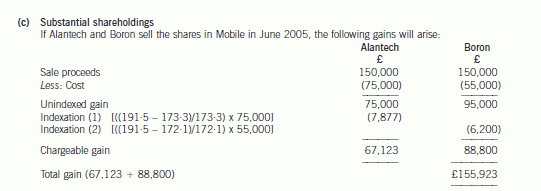
However, an exemption from corporation tax exists for any gain arising when a trading company (or member of a trading
group) sells the whole or any part of a substantial shareholding in another trading company.
A substantial shareholding is one where the investing company holds 10% of the ordinary share capital and is beneficially
entitled to at least 10% of the
(i) profits available for distribution to equity holders and
(ii) assets of the company available for distribution to equity holders on a winding up.
In meeting the 10% test, shares owned by a chargeable gains group may be amalgamated. The 10% test must have been
met for a continuous 12 month period during the 2 years preceding the disposal.
The companies making the disposals must have been trading companies (or members of a trading group) throughout the
12 month period, as well as at the date of disposal. In addition, they must also be trading companies (or members of a trading
group) immediately after the disposal.
The exemption is given automatically, and acts to deny losses as well as eliminate gains.
While Alantech Ltd has owned its holding in Mobile Ltd for 33 months, its ownership of the Boron holding has only lasted
for 10 months (at 1 June 2005) since Boron was acquired on 1 July 2004. Selling the shares in June 2005 will fail the
12 month test, and the gain will become chargeable.
It would be better for the companies to wait for a further month until July 2005 before selling the amalgamated shareholding.
By doing so, they will both be able to take advantage of the substantial shareholdings relief, thereby saving tax of £29,625
assuming a corporation tax rate of 19%. -
第19题:
(b) Identify and explain the financial statement risks to be taken into account in planning the final audit.
(12 marks)
正确答案:
(b) Financial statement risks
Tutorial note: Note the timeframe. Financial statements for the year to 30 June 2006 are draft. Certain misstatements
may therefore exist due to year-end procedures not yet having taken place.
Revenue/(Receivables)
■ Revenue has increased by 11·8% ((161·5 – 144·4)/144·4 × 100). Overstatement could arise if rebates due to customers
have not yet been accounted for in full (as they are calculated in arrears). If rebates have still to be accounted for trade
receivables will be similarly overstated.
Materials expense
■ Materials expense has increased by 17·8% ((88.0 – 74·7)/74·7 × 100). This is more than the increase in revenue. This
could be legitimate (e.g. if fuel costs have increased significantly). However, the increase could indicate misclassification
of:
– revenue expenditure (see fall in other expenses below);
– capital expenditure (e.g. on overhauls or major refurbishment) as revenue;
– finance lease payments as operating lease.
Depreciation/amortisation
■ This has fallen by 10·5% ((8·5 – 9·5)/9·5 × 100). This could be valid (e.g. if Yates has significant assets already fully
depreciated or the asset base is lower since last year’s restructuring). However, there is a risk of understatement if, for
example:
– not all assets have been depreciated (or depreciated at the wrong rates, or only for 11 months of the year);
– cost of non-current assets is understated (e.g. due to failure to recognise capital expenditure)1;
– impairment losses have not been recognised (as compared with the prior year).
Tutorial note: Depreciation on vehicles and transport equipment represents only 7% of cost. If all items were being
depreciated on a straight-line basis over eight years this should be 12·5%. The depreciation on other equipment looks more
reasonable as it amounts to 14% which would be consistent with an average age of vehicles of seven years (i.e. in the middle
of the range 3 – 13 years).
Other expenses
■ These have fallen by 15·5% ((19·6 – 23·2)/23·2 × 100). They may have fallen (e.g. following the restructuring) or may be
understated due to:
– expenses being misclassified as materials expense;
– underestimation of accrued expenses (especially as the financial reporting period has not yet expired).
Intangibles
■ Intangible assets have increased by $1m (16% on the prior year). Although this may only just be material to the
financial statements as a whole (see (a)) this is the net movement, therefore additions could be material.
■ Internally-generated intangibles will be overstated if:
– any of the IAS 38 recognition criteria cannot be demonstrated;
– any impairment in the year has not yet been written off in accordance with IAS 36 ‘Impairment of Assets’.
Tangible assets
■ The net book value of property (at cost) has fallen by 5%, vehicles are virtually unchanged (increased by just 2·5%)
and other equipment (though the least material category) has fallen by 20·4%.
■ Vehicles and equipment may be overstated if:
– disposals have not been recorded;
– depreciation has been undercharged (e.g. not for a whole year);
– impairments have not yet been accounted for.
■ Understatement will arise if finance leases are treated as operating leases.
Receivables
■ Trade receivables have increased by just 2·2% (although sales increased by 11·8%) and may be understated due to a
cutoff error resulting in overstatement of cash receipts.
■ There is a risk of overstatement if sufficient allowances have not been made for the impairment of individually significant
balances and for the remainder assessed on a portfolio or group basis.
Restructuring provision
■ The restructuring provision that was made last year has fallen/been utilised by 10·2%. There is a risk of overstatement
if the provision is underutilised/not needed for the purpose for which it was established.
Finance lease liabilities
■ Although finance lease liabilities have increased (by $1m) there is a greater risk of understatement than overstatement
if leased assets are not recognised on the balance sheet (i.e. capitalised).
■ Disclosure risk arises if the requirements of IAS 17 ‘Leases’ (e.g. in respect of minimum lease payments) are not met.
Trade payables
■ These have increased by only 5·3% compared with the 17·8% increase in materials expense. There is a risk of
understatement as notifications (e.g. suppliers’ invoices) of liabilities outstanding at 30 June 2006 may have still to be
received (the month of June being an unexpired period).
Other (employee) liabilities
■ These may be understated as they have increased by only 7·5% although staff costs have increased by 14%. For
example, balances owing in respect of outstanding holiday entitlements at the year end may not yet be accurately
estimated.
Tutorial note: Credit will be given to other financial statements risks specific to the scenario. For example, ‘time-sensitive
delivery schedules’ might give rise to penalties or claims, that could result in understated provisions or undisclosed
contingent liabilities. Also, given that this is a new audit and the result has changed significantly (from loss to profit) might
suggest a risk of misstatement in the opening balances (and hence comparative information).
1 Tutorial note: This may be unlikely as other expenses have fallen also. -
第20题:
In relation to the law of contract, distinguish between and explain the effect of:
(a) a term and a mere representation; (3 marks)
(b) express and implied terms, paying particular regard to the circumstances under which terms may be implied in contracts. (7 marks)
正确答案:This question requires candidates to consider the law relating to terms in contracts. It specifically requires the candidates to distinguish between terms and mere representations and then to establish the difference between express and implied terms in contracts.
(a) As the parties to a contract will be bound to perform. any promise they have contracted to undertake, it is important to distinguish between such statements that will be considered part of the contract, i.e. terms, and those other pre-contractual statements which are not considered to be part of the contract, i.e. mere representations. The reason for distinguishing between them is that there are different legal remedies available if either statement turns out to be incorrect.
A representation is a statement that induces a contract but does not become a term of the contract. In practice it is sometimes difficult to distinguish between the two, but in attempting to do so the courts will focus on when the statement was made in relation to the eventual contract, the importance of the statement in relation to the contract and whether or not the party making the statement had specialist knowledge on which the other party relied (Oscar Chess v Williams (1957) and Dick
Bentley v Arnold Smith Motors (1965)).
(b) Express terms are statements actually made by one of the parties with the intention that they become part of the contract and
thus binding and enforceable through court action if necessary. It is this intention that distinguishes the contractual term from
the mere representation, which, although it may induce the contractual agreement, does not become a term of the contract.
Failure to comply with the former gives rise to an action for breach of contract, whilst failure to comply with the latter only gives rise to an action for misrepresentation.Such express statements may be made by word of mouth or in writing as long as they are sufficiently clear for them to be enforceable. Thus in Scammel v Ouston (1941) Ouston had ordered a van from the claimant on the understanding that the balance of the purchase price was to be paid ‘on hire purchase terms over two years’. When Scammel failed to deliver the van Ouston sued for breach of contract without success, the court holding that the supposed terms of the contract were too
uncertain to be enforceable. There was no doubt that Ouston wanted the van on hire purchase but his difficulty was that
Scammel operated a range of hire purchase terms and the precise conditions of his proposed hire purchase agreement were
never sufficiently determined.
Implied terms, however, are not actually stated or expressly included in the contract, but are introduced into the contract by implication. In other words the exact meaning and thus the terms of the contract are inferred from its context. Implied terms can be divided into three types.
Terms implied by statute
In this instance a particular piece of legislation states that certain terms have to be taken as constituting part of an agreement, even where the contractual agreement between the parties is itself silent as to that particular provision. For example, under s.5 of the Partnership Act 1890, every member of an ordinary partnership has the implied power to bind the partnership in a contract within its usual sphere of business. That particular implied power can be removed or reduced by the partnership agreement and any such removal or reduction of authority would be effective as long as the other party was aware of it. Some implied terms, however, are completely prescriptive and cannot be removed.
Terms implied by custom or usage
An agreement may be subject to terms that are customarily found in such contracts within a particular market, trade or locality. Once again this is the case even where it is not actually specified by the parties. For example, in Hutton v Warren (1836), it was held that customary usage permitted a farm tenant to claim an allowance for seed and labour on quitting his tenancy. It should be noted, however, that custom cannot override the express terms of an agreement (Les Affreteurs Reunnis SA v Walford (1919)).
Terms implied by the courts Generally, it is a matter for the parties concerned to decide the terms of a contract, but on occasion the court will presume that the parties intended to include a term which is not expressly stated. They will do so where it is necessary to give business efficacy to the contract.Whether a term may be implied can be decided on the basis of the officious bystander test. Imagine two parties, A and B, negotiating a contract, when a third party, C, interrupts to suggest a particular provision. A and B reply that that particular term is understood. In just such a way, the court will decide that a term should be implied into a contract.
In The Moorcock (1889), the appellants, owners of a wharf, contracted with the respondents to permit them to discharge their ship at the wharf. It was apparent to both parties that when the tide was out the ship would rest on the riverbed. When the tide was out, the ship sustained damage by settling on a ridge. It was held that there was an implied warranty in the contract that the place of anchorage should be safe for the ship. As a consequence, the ship owner was entitled to damages for breach of that term.
Alternatively the courts will imply certain terms into unspecific contracts where the parties have not reduced the general agreement into specific details. Thus in contracts of employment the courts have asserted the existence of implied terms to impose duties on both employers and employees, although such implied terms can be overridden by express contractual provision to the contrary. -
第21题:
(b) Explain the matters that should be considered when planning the nature and scope of the examination of
Cusiter Co’s forecast balance sheet and income statement as prepared for the bank. (7 marks)
正确答案:
(b) Matters to be considered
Tutorial note: Candidates at this level must appreciate that the matters to be considered when planning the nature and
scope of the examination are not the same matters to be considered when deciding whether or not to accept an
engagement. The scenario clearly indicates that the assignment is being undertaken by the current auditor rendering any
‘pre-engagement’/‘professional etiquette’ considerations irrelevant to answering this question.
This PFI has been prepared to show an external user, the bank, the financial consequences of Cusiter’s plans to help the bank
in making an investment decision. If Cusiter is successful in its loan application the PFI provides a management tool against
which the results of investing in the plant and equipment can be measured.
The PFI is unpublished rather than published. That is, it is prepared at the specific request of a third party, the bank. It will
not be published to users of financial information in general.
The auditor’s report on the PFI will provide only negative assurance as to whether the assumptions provide a reasonable basis
for the PFI and an opinion whether the PFI is:
■ properly prepared on the basis of the assumptions; and
■ presented in accordance with the relevant financial reporting framework.
The nature of the engagement is an examination to obtain evidence concerning:
■ the reasonableness and consistency of assumptions made;
■ proper preparation (on the basis of stated assumptions); and
■ consistent presentation (with historical financial statements, using appropriate accounting principles).
Such an examination is likely to take the form. of inquiry, analytical procedures and corroboration.
The period of time covered by the prospective financial information is two years. The assumptions for 2008 are likely to be
more speculative than for 2007, particularly in relation to the impact on earnings, etc of the investment in new plant and
equipment.
The forecast for the year to 31 December 2007 includes an element of historical financial information (because only part of
this period is in the future) hence actual evidence should be available to verify the first three months of the forecast (possibly
more since another three-month period will expire at the end of the month).
Cusiter management’s previous experience in preparing PFI will be relevant. For example, in making accounting estimates
(e.g. for provisions, impairment losses, etc) or preparing cash flow forecasts (e.g. in support of the going concern assertion).
The basis of preparation of the forecast. For example, the extent to which it comprises:
■ proforma financial information (i.e. historical financial information adjusted for the effects of the planned loan and capital
expenditure transaction);
■ new information and assumptions about future performance (e.g. the operating capacity of the new equipment, sales
generated, etc).
The nature and scope of any standards/guidelines under which the PFI has been prepared is likely to assist the auditor in
discharging their responsibilities to report on it. Also, ISAE 3400 The Examination of Prospective Financial Information,
establishes standards and provides guidance on engagements to examine and report on PFI including examination
procedures.
The planned nature and scope of the examination is likely to take into account the time and fee budgets for the assignments
as adjusted for any ‘overlap’ with audit work. For example, the examination of the PFI is likely to draw on the auditor’s
knowledge of the business obtained in auditing the financial statements to 31 December 2006. Analytical procedures carried
out in respect of the PFI may provide evidence relevant to the 31 December 2007 audit. -
第22题:
(ii) From the information provided above, recommend the matters which should be included as ‘findings
from the audit’ in your report to those charged with governance, and explain the reason for their
inclusion. (7 marks)
正确答案:
(ii) Control weakness
ISA 260 contains guidance on the type of issues that should be communicated. One of the matters identified is a control
weakness in the capital expenditure transaction cycle. The assets for which no authorisation was obtained amount to
0·3% of total assets (225,000/78 million x 100%), which is clearly immaterial. However, regardless of materiality, the
auditor should ensure that the weakness is brought to the attention of the management, with a clear indication of the
implication of the weakness, and recommendations as to how the control weakness should be eliminated.
The auditor is providing information to help those charged with governance improve the internal systems and controls
and ultimately reduce business risk. In this case there is a high risk of fraud, as the lack of authorisation for purchase
of office equipment could allow expenditure on assets not used for bona fide business purposes.
Disagreement with accounting treatment of brand
Audit procedures have revealed a breach of IAS 38 Intangible Assets, in which internally generated brand names are
specifically prohibited from being recognised. Blod Co has recognised an internally generated brand name which is
material to the statement of financial position (balance sheet) as it represents 12·8% of total assets (10/78 x 100%).
The statement of financial position (balance sheet) therefore contains a material misstatement.
The report to those charged with governance should clearly explain the rules on recognition of internally generated brand
names, to ensure that the management has all relevant technical facts available. In the report the auditors should
request that the financial statements be corrected, and clarify that if the brand is not derecognised, then the audit opinion
will be qualified on the grounds of a material disagreement – an ‘except for’ opinion would be provided. Once the breach
of IAS 38 is made clear to the management in the report, they then have the opportunity to discuss the matter and
decide whether to amend the financial statements, thereby avoiding a qualified audit opinion.
Audit inefficiencies
Documentation relating to inventories was not always made readily available to the auditors. This seems to be due to
poor administration by the client rather than a deliberate attempt to conceal information. The report should contain a
brief description of the problems encountered by the audit team. The management should be made aware that
significant delay to the receipt of necessary paperwork can cause inefficiencies in the audit process. This may seem a
relatively trivial issue, but it could lead to an increase in audit fee. Management should react to these comments by
ensuring as far as possible that all requested documentation is made available to the auditors in a timely fashion. -
第23题:
Which of the following may better check students′ ability of using a grammatical structure
A.Having them work out the rule.
B.Having them give some examples.
C.Having them explain the meaning.
D.Having them explain the structure.答案:B解析:考查语法教学技能。此题是问:下列哪一项可以更好地检测学生运用语法结构的能力A项意为“让他们找出规律”,B项意为“让他们给出一些例子”,C项意为“让他们解释含义”,D项意为“让他们说明结构”。通过让学生给出一些相同语法结构的例句,可以更准确地判断出他们对于该句法结构的把握。故选B。