
(b) Explain Mintzberg’s five organisational components. (10 marks)
题目
(b) Explain Mintzberg’s five organisational components. (10 marks)
相似考题
更多“(b) Explain Mintzberg’s five organisational components. (10 marks)”相关问题
-
第1题:
5 Your manager has heard of Maslow’s hierarchy of needs theory and how it has some relevance to motivational techniques.
Required:
(a) Explain Maslow’s hierarchy of needs theory. (10 marks)
正确答案:5 The way in which managers’ duties are undertaken can significantly influence the satisfaction that employees derive from their work. Abraham Maslow suggested that individuals have a hierarchy of personal needs which are identifiable, universally applicable and can be satisfied in the workplace. Understanding this concept provides guidance to management as to the appropriateness of
motivational techniques.
(a) Maslow’s theory of motivation is a content theory. Its basic idea is that each individual has a set of needs which have to be
satisfied in a set order of priority.
Maslow suggested that individuals have five needs:
Self-actualisation
(or self fulfilment)
Esteem needs
(or ego)
Social needs
Safety needs
Physiological needs
These needs are arranged in a hierarchy of importance and movement is upwards, from physiological needs to selfactualisation.Any individual will always want more; each need must be satisfied before the next is sought. However – andcritically so far as motivation in the workplace is concerned – a satisfied need is no longer a motivator.
The theory is usually presented in the shape of a triangle, with physiological needs at its base and self-actualisation at itsapex. The triangle shape has a clear significance. As an individual moves up toward the apex, the needs thin out, that isphysiological needs are far greater than self-actualisation needs. For many individuals, reaching social needs is often thehighest need to be satisfied. The theory is sometimes presented as a staircase; again with self-actualisation at the top. Thissecond diagrammatic form. reflects the application of the theory to more modern situations, where it can reasonably beassumed that those within the organisation have already achieved physiological and safety needs. For such individuals, socialand esteem needs may well be greater.
Physiological needs are the basic survival needs which, although part of the theory, probably have less relevance today. Theseneeds are usually seen as food, shelter (which is sometimes noted as a safety need), warmth and clothing.
Safety needs are the desire for security, order, certainty and predictability in life and freedom from threat. The above two so-called ‘lower order needs’ dominate until satisfied.
Social needs are the gregarious needs of mankind, the need for friendship, relationships and affection. This is often seen as the desire to be part of a family.
Esteem needs are the desire for recognition and respect, often associated with status, especially in the modern world.
Self-actualisation (self fulfilment) is the ultimate goal. Once this state is achieved the individual has fulfilled personal potential.
However, later work by Maslow has suggested that there are two additional needs; freedom of enquiry (free speech and justice) and knowledge (the need to explore and learn). These additional needs are a further development of social needs and recognise the changing nature of modern life. -
第2题:
(d) Explain to the management of Bailey’s why consideration should be given to resolving the problems through:
(i) job rotation; (5 marks)
正确答案:
(d) (i) Job rotation is the planned rotation of staff between jobs and tasks to reduce monotony and boredom and provide fresh opportunities and challenges. This could be a useful way of encouraging employees at Bailey’s alongside enrichment and enlargement. Rotation would encourage better understanding between employees at Bailey’s. It takes two forms,the transfer to another job after some time in an existing job and the introduction of another individual to the job being vacated, or as a form. of training where individuals are moved through different jobs to learn new skills.
-
第3题:
(b) Describe five main barriers to an effective appraisal interview. (10 marks)
正确答案:
(b) The appraisal system should be well constructed and fair to both the individual and the organisation. However, there are a number of barriers, often because employees see the appraisal as one or more of the following:
Confrontation due to lack of agreement on performance, badly explained or subjective feedback, performance based on recent events or disagreement on longer term activities.
Judgement, the appraisal is seen as a one sided process based entirely on the manager’s perspective.
Chat is the worst of all worlds. The appraisal interview is seen as an informal, loosely constructed and badly managed conversation without purpose.
Unfinished business is when the appraisal is not seen as part of a continuing process of performance management.
An annual event when the appraisal is seen as largely irrelevant and simply an event to set annual targets that quickly become out of date.
A system of bureaucracy based on forms devised solely to satisfy the organisation’s human resources department so that its main purpose, that of identifying individual and organisation performance and improvement, is forgotten.
-
第4题:
Explain the grounds upon which a person may be disqualified under the Company Directors Disqualification Act 1986.(10 marks)
正确答案:The Company Directors Disqualification Act (CDDA) 1986 was introduced to control individuals who persistently abused the various privileges that accompany incorporation, most particularly the privilege of limited liability. The Act applies to more than just directors and the court may make an order preventing any person (without leave of the court) from being:
(i) a director of a company;
(ii) a liquidator or administrator of a company;
(iii) a receiver or manager of a company’s property; or
(iv) in any way, whether directly or indirectly, concerned with or taking part in the promotion, formation or management of a company.
The CDDA 1986 identifies three distinct categories of conduct, which may, and in some circumstances must, lead the court to disqualify certain persons from being involved in the management of companies.
(a) General misconduct in connection with companies
This first category involves the following:
(i) A conviction for an indictable offence in connection with the promotion, formation, management or liquidation of a company or with the receivership or management of a company’s property (s.2 of the CDDA 1986). The maximum period for disqualification under s.2 is five years where the order is made by a court of summary jurisdiction, and 15 years in any other case.(ii) Persistent breaches of companies legislation in relation to provisions which require any return, account or other document to be filed with, or notice of any matter to be given to, the registrar (s.3 of the CDDA 1986). Section 3 provides that a person is conclusively proved to be persistently in default where it is shown that, in the five years ending with the date of the application, he has been adjudged guilty of three or more defaults (s.3(2) of the CDDA 1986). This is without prejudice to proof of persistent default in any other manner. The maximum period of disqualification under this section is five years.
(iii) Fraud in connection with winding up (s.4 of the CDDA 1986). A court may make a disqualification order if, in the course of the winding up of a company, it appears that a person:
(1) has been guilty of an offence for which he is liable under s.993 of the CA 2006, that is, that he has knowingly been a party to the carrying on of the business of the company either with the intention of defrauding the company’s creditors or any other person or for any other fraudulent purpose; or
(2) has otherwise been guilty, while an officer or liquidator of the company or receiver or manager of the property of the company, of any fraud in relation to the company or of any breach of his duty as such officer, liquidator, receiver or manager (s.4(1)(b) of the CDDA 1986).
The maximum period of disqualification under this category is 15 years.(b) Disqualification for unfitness
The second category covers:
(i) disqualification of directors of companies which have become insolvent, who are found by the court to be unfit to be directors (s.6 of the CDDA 1986). Under s. 6, the minimum period of disqualification is two years, up to a maximum of 15 years;
(ii) disqualification after investigation of a company under Pt XIV of the CA 1985 (it should be noted that this part of the previous Act still sets out the procedures for company investigations) (s.8 of the CDDA 1986). Once again, the maximum period of disqualification is 15 years.
Schedule 1 to the CDDA 1986 sets out certain particulars to which the court is to have regard in deciding whether a person’s conduct as a director makes them unfit to be concerned in the management of a company. In addition, the courts have given indications as to what sort of behaviour will render a person liable to be considered unfit to act as a company director. Thus, in Re Lo-Line Electric Motors Ltd (1988), it was stated that:
‘Ordinary commercial misjudgment is in itself not sufficient to justify disqualification. In the normal case, the conduct complained of must display a lack of commercial probity, although . . . in an extreme case of gross negligence or total incompetence, disqualification could be appropriate.’(c) Other cases for disqualification
This third category relates to:
(i) participation in fraudulent or wrongful trading under s.213 of the Insolvency Act (IA)1986 (s.10 of the CDDA 1986);
(ii) undischarged bankrupts acting as directors (s.11 of the CDDA 1986); and
(iii) failure to pay under a county court administration order (s.12 of the CDDA 1986).
For the purposes of most of the CDDA 1986, the court has discretion to make a disqualification order. Where, however, a person has been found to be an unfit director of an insolvent company, the court has a duty to make a disqualification order (s.6 of the CDDA 1986). Anyone who acts in contravention of a disqualification order is liable:
(i) to imprisonment for up to two years and/or a fine, on conviction on indictment; or
(ii) to imprisonment for up to six months and/or a fine not exceeding the statutory maximum, on conviction summarily (s.13 of the CDDA 1986). -
第5题:
(c) Explain how Perfect Shopper might re-structure its downstream supply chain to address the problems
identified in the scenario. (10 marks)
正确答案:
(c) A number of opportunities appear to exist in the downstream supply chain.
As already mentioned above, Perfect Shopper can revisit its contract distribution arrangements. At present, distribution to
neighbourhood shops is in the hands of locally appointed contract distributors. As already suggested, it may be possible to
contract one integrated logistics company to carry out both inbound and outbound logistics, so gaining economies of scale
and opportunities for branding.
One of the problems identified in the independent report was the inflexibility of the ordering and delivering system. The
ordering system appears to be built around a fixed standard delivery made every two weeks, agreed in advance for a three
month period. Variations can be made to this standard order, but only increases – not decreases. Presumably, this
arrangement is required to allow Perfect Shopper to forecast demand over a three month period and to place bulk orders to
reflect these commitments. However, this may cause at least two problems. The first is that participating shops place a
relatively low standard order and rely on variations to fulfil demand. This causes problems for Perfect Shopper. Secondly, any
unpredictable fall in demand during the three month period leads to the shop having storage problems and unsold stock. This
potentially creates problems for the shop owner, who may also begin to question the value of the franchise. Hence Perfect
Shopper might wish to consider a much more flexible system where orders can be made to match demand and deliveries
can be made as required. This would also remove the requirement for a three monthly meeting between the franchisee andthe sales representative from Perfect Shopper. Investments in IT systems will be required to support this, with participating
shops placing orders over the Internet to reflect their requirements. This move towards a more flexible purchasing arrangement
may also make the outsourcing of warehousing and distribution even more appealing.
Perfect Shopper may also wish to investigate whether they can also provide value added services to customers, which not
only simplify the ordering system but also allow the shop managers to better understand their customers and fulfil their
requirements. The supply chain may legitimately include the customer’s customers, particularly for franchisers. This is already
acknowledged because Perfect Shopper produces tailored marketing material aimed at the end-consumer. Point of Sales (PoS)
devices feeding information back to Perfect Shopper would allow sales information to be analysed and fed back to the
shopkeeper as well as allowing automatic replenishment based on purchasing trends. However, this may be culturally difficult
for independent neighbourhood shopkeepers to accept. Furthermore, it would potentially include information outside the
products offered by Perfect Shopper and the implications of this would have to be considered. However, a whole shop sales
analysis might be a useful service to offer existing and potential franchisees.
Customers are increasingly willing to order products over the Internet. It seems unlikely that individual shopkeepers would be
able to establish and maintain their own Internet-based service. It would be useful for Perfect Shopper to explore the potential
of establishing a central website with customers placing orders from local shops. Again there are issues about scope, because
Perfect Shopper does not offer a whole-shop service. However, Michael de Kare-Silver has identified groceries as a product
area that has good potential for Internet purchase. In his electronic shopping potential test any product scoring over 20 hasgood potential. Groceries scored 27. -
第6题:
(b) Explain the meaning of Stephanie’s comment: ‘I would like to get risk awareness embedded in the culture
at the Southland factory.’ (5 marks)
正确答案:
Embedded risk
Risk awareness is the knowledge of the nature, hazards and probabilities of risk in given situations. Whilst management will
typically be more aware than others in the organisation of many risks, it is important to embed awareness at all levels so as
to reduce the costs of risk to an organisation and its members (which might be measured in financial or non-financial terms).
In practical terms, embedding means introducing a taken-for-grantedness of risk awareness into the culture of an organisation
and its internal systems. Culture, defined in Handy’s terms as ‘the way we do things round here’ underpins all risk
management activity as it defines attitudes, actions and beliefs.
The embedding of risk awareness into culture and systems involves introducing risk controls into the process of work and the
environment in which it takes place. Risk awareness and risk mitigation become as much a part of a process as the process
itself so that people assume such measures to be non-negotiable components of their work experience. In such organisational
cultures, risk management is unquestioned, taken for granted, built into the corporate mission and culture and may be used
as part of the reward system.
Tutorial note: other meaningful definitions of culture in an organisational context are equally acceptable. -
第7题:
(b) Distinguish between strategic and operational risks, and explain why the secrecy option would be a source
of strategic risk. (10 marks)
正确答案:
(b) Strategic and operational risks
Strategic risks
These arise from the overall strategic positioning of the company in its environment. Some strategic positions give rise to
greater risk exposures than others. Because strategic issues typically affect the whole of an organisation and not just one or
more of its parts, strategic risks can potentially concern very high stakes – they can have very high hazards and high returns.
Because of this, they are managed at board level in an organisation and form. a key part of strategic management.
Operational risks
Operational risks refer to potential losses arising from the normal business operations. Accordingly, they affect the day-to-day
running of operations and business systems in contrast to strategic risks that arise from the organisation’s strategic positioning.
Operational risks are managed at risk management level (not necessarily board level) and can be managed and mitigated by
internal control systems.
The secrecy option would be a strategic risk for the following reasons.
It would radically change the environment that SHC is in by reducing competition. This would radically change SHC’s strategic
fit with its competitive environment. In particular, it would change its ‘five forces’ positioning which would change its risk
profile.
It would involve the largest investment programme in the company’s history with new debt substantially changing the
company’s financial structure and making it more vulnerable to short term liquidity problems and monetary pressure (interest
rates).
It would change the way that stakeholders view SHC, for better or worse. It is a ‘crisis issue’, certain to polarise opinion either
way.
It will change the economics of the industry thereby radically affecting future cost, revenue and profit forecasts.
There may be retaliatory behaviour by SHC’s close competitor on 25% of the market.
[Tutorial note: similar reasons if relevant and well argued will attract marks] -
第8题:
(c) Explain how absolutist (dogmatic) and relativist (pragmatic) ethical assumptions would affect the outcome
of Anne’s decision. (6 marks)
正确答案:
(c) Absolutism and relativism
Absolutism and relativism represent two extreme positions of ethical assumptions.
Definitions
An absolutist assumption is one that believes that there are ‘eternal’ rules that should guide all ethical and moral decision
making in all situations. Accordingly, in any given situation, there is likely to be one right course of action regardless of the
outcome. An absolutist believes that this should be chosen regardless of the consequences or the cost. A dogmatic approach
to morality is an example of an absolutist approach to ethics. A dogmatic assumption is one that is accepted without
discussion or debate.
Relativist assumptions are ‘situational’ in nature. Rather than arguing that there is a single right choice, a relativist will tend
to adopt a pragmatic approach and decide, in the light of the situation being considered, which is the best outcome. This will
involve a decision on what outcome is the most favourable and that is a matter of personal judgment.
Outcomes
If Anne were to adopt absolutist/dogmatic assumptions, she would be likely to decide that she would need to pursue what
she perceives is the right course of action regardless of cost to herself or the relationship with the client or her manager. Given
that she unearthed a suspect and unaccounted-for payment, and that she received an inadequate explanation from the client,
she would probably recommend extension to the audit beyond the weekend.
If Ann were to adopt relativist or pragmatic assumptions, she would have a potentially much more complicated decision to
make. She would have to decide whether it was more important, ethically, to yield to the pressure from Zachary in the
interests of her short-term career interests or ‘hold out’ to protect the interests of the shareholders. Anne could recommend
sign off and trust the FD’s explanation but she is more likely to seek further evidence or assurance from the company before
she does so. -
第9题:
(b) Explain FIVE critical success factors to the performance of HSC on which the directors must focus if HSC is
to achieve success in its marketplace. (10 marks)
正确答案:
(b) Critical success factors are as follows:
Product quality
The fact that the production staff have no previous experience in a food production environment is likely to prove problematic.
It is vital that a comprehensive training programme is put in place at the earliest opportunity. HSC need to reach and maintain
the highest level of product quality as soon as possible.
Supply quality
The quality of delivery into SFG supermarkets assumes critical significance. Time literally will be of the essence since 90%
of all sandwiches are sold in SFG’s supermarkets before 2 pm each day. Hence supply chain management must be extremely
robust as there is very little scope for error.
Technical quality
Compliance with existing regulations regarding food production including all relevant factory health and safety requirements
is vital in order to establish and maintain the reputation of HSC as a supplier of quality products. The ability to store products
at the correct temperature is critical because sandwiches are produced for human consumption and in extreme circumstance
could cause fatalities.
External credibility
Accreditation by relevant trade associations/regulators will be essential if nationwide acceptance of HSC as a major producer
of sandwiches is to be established.
New product development
Whilst HSC have developed a range of healthy eating sandwiches it must be recognised that consumer tastes change and
that in the face of competition there will always be a need for a continuous focus on new product development.
Margin
Whilst HSC need to recognise all other critical success factors they should always be mindful that the need to obtain the
desired levels of gross and net margin remain of the utmost importance.
Notes: (i) Only five critical success factors were required.
(ii) Alternative relevant discussion and examples would be acceptable. -
第10题:
6 (a) Explain the term ‘money laundering’. (3 marks)
正确答案:
6 MONEY LAUNDERING
Tutorial note: The answer which follows is indicative of the range of points which might be made. Other relevant material will
be given suitable credit.
(a) Meaning of the term
■ Money laundering is the process by which criminals attempt to conceal the true origin and ownership of the proceeds
of their criminal activity (‘dirty’ money) allowing them to maintain control over the proceeds and, ultimately, providing a
legitimate cover for their sources of income.
■ The term is widely defined to include:
– possessing; or
– in any way dealing with; or
– concealing
the proceeds of any crime (‘criminal property’).
■ It also includes:
– an attempt or conspiracy or incitement to commit such an offence; or
– aiding, abetting, counselling or procuring the commission of such an offence.
■ Further, it includes failure by an individual in a regulated sector to inform. the financial intelligence unit (FIU), as soon
as practicable, of knowledge or suspicion that another person is engaged in money laundering.
Tutorial note: The FIU serves as a national centre for receiving (and, as permitted, requesting), analysing and
disseminating suspicious transaction reports (STRs). -
第11题:
(b) Explain the matters that should be considered when planning the nature and scope of the examination of
Cusiter Co’s forecast balance sheet and income statement as prepared for the bank. (7 marks)
正确答案:
(b) Matters to be considered
Tutorial note: Candidates at this level must appreciate that the matters to be considered when planning the nature and
scope of the examination are not the same matters to be considered when deciding whether or not to accept an
engagement. The scenario clearly indicates that the assignment is being undertaken by the current auditor rendering any
‘pre-engagement’/‘professional etiquette’ considerations irrelevant to answering this question.
This PFI has been prepared to show an external user, the bank, the financial consequences of Cusiter’s plans to help the bank
in making an investment decision. If Cusiter is successful in its loan application the PFI provides a management tool against
which the results of investing in the plant and equipment can be measured.
The PFI is unpublished rather than published. That is, it is prepared at the specific request of a third party, the bank. It will
not be published to users of financial information in general.
The auditor’s report on the PFI will provide only negative assurance as to whether the assumptions provide a reasonable basis
for the PFI and an opinion whether the PFI is:
■ properly prepared on the basis of the assumptions; and
■ presented in accordance with the relevant financial reporting framework.
The nature of the engagement is an examination to obtain evidence concerning:
■ the reasonableness and consistency of assumptions made;
■ proper preparation (on the basis of stated assumptions); and
■ consistent presentation (with historical financial statements, using appropriate accounting principles).
Such an examination is likely to take the form. of inquiry, analytical procedures and corroboration.
The period of time covered by the prospective financial information is two years. The assumptions for 2008 are likely to be
more speculative than for 2007, particularly in relation to the impact on earnings, etc of the investment in new plant and
equipment.
The forecast for the year to 31 December 2007 includes an element of historical financial information (because only part of
this period is in the future) hence actual evidence should be available to verify the first three months of the forecast (possibly
more since another three-month period will expire at the end of the month).
Cusiter management’s previous experience in preparing PFI will be relevant. For example, in making accounting estimates
(e.g. for provisions, impairment losses, etc) or preparing cash flow forecasts (e.g. in support of the going concern assertion).
The basis of preparation of the forecast. For example, the extent to which it comprises:
■ proforma financial information (i.e. historical financial information adjusted for the effects of the planned loan and capital
expenditure transaction);
■ new information and assumptions about future performance (e.g. the operating capacity of the new equipment, sales
generated, etc).
The nature and scope of any standards/guidelines under which the PFI has been prepared is likely to assist the auditor in
discharging their responsibilities to report on it. Also, ISAE 3400 The Examination of Prospective Financial Information,
establishes standards and provides guidance on engagements to examine and report on PFI including examination
procedures.
The planned nature and scope of the examination is likely to take into account the time and fee budgets for the assignments
as adjusted for any ‘overlap’ with audit work. For example, the examination of the PFI is likely to draw on the auditor’s
knowledge of the business obtained in auditing the financial statements to 31 December 2006. Analytical procedures carried
out in respect of the PFI may provide evidence relevant to the 31 December 2007 audit. -
第12题:
(a) List and explain FOUR methods of selecting a sample of items to test from a population in accordance with ISA 530 (Redrafted) Audit Sampling and Other Means of Testing. (4 marks)
(b) List and explain FOUR assertions from ISA 500 Audit Evidence that relate to the recording of classes of
transactions. (4 marks)
(c) In terms of audit reports, explain the term ‘modified’. (2 marks)
正确答案:
(a)SamplingmethodsMethodsofsamplinginaccordancewithISA530AuditSamplingandOtherMeansofTesting:Randomselection.Ensureseachiteminapopulationhasanequalchanceofselection,forexamplebyusingrandomnumbertables.Systematicselection.Inwhichanumberofsamplingunitsinthepopulationisdividedbythesamplesizetogiveasamplinginterval.Haphazardselection.Theauditorselectsthesamplewithoutfollowingastructuredtechnique–theauditorwouldavoidanyconsciousbiasorpredictability.Sequenceorblock.Involvesselectingablock(s)ofcontinguousitemsfromwithinapopulation.Tutorialnote:Othermethodsofsamplingareasfollows:MonetaryUnitSampling.Thisselectionmethodensuresthateachindividual$1inthepopulationhasanequalchanceofbeingselected.Judgementalsampling.Selectingitemsbasedontheskillandjudgementoftheauditor.(b)Assertions–classesoftransactionsOccurrence.Thetransactionsandeventsthathavebeenrecordedhaveactuallyoccurredandpertaintotheentity.Completeness.Alltransactionsandeventsthatshouldhavebeenrecordedhavebeenrecorded.Accuracy.Theamountsandotherdatarelatingtorecordedtransactionsandeventshavebeenrecordedappropriately.Cut-off.Transactionsandeventshavebeenrecordedinthecorrectaccountingperiod.Classification.Transactionsandeventshavebeenrecordedintheproperaccounts.(c)AuditreporttermModified.Anauditormodifiesanauditreportinanysituationwhereitisinappropriatetoprovideanunmodifiedreport.Forexample,theauditormayprovideadditionalinformationinanemphasisofmatter(whichdoesnotaffecttheauditor’sopinion)orqualifytheauditreportforlimitationofscopeordisagreement. -
第13题:
(b) Explain and give examples of assertive behaviour. (7 marks)
正确答案:
(b) Assertive behaviour on the other hand is based on equality and co-operation. It involves standing up for one’s own rights and needs but also respects the rights and needs of others. It is not overbearing or aggressive but can be described as clear, honest and direct communication.
Assertive individuals defend their rights in a way that does not violate another individual’s rights. They express their needs,wants, opinions, feelings and beliefs in direct and appropriate ways.
Characteristics of assertive behaviour include statements that are short, clear and to the point, distinctions made between fact and opinion, suggestions weighted with advice and evidence. Constructive criticism is the norm and offered without blame or assumptions. Questions to establish the wishes, opinions and thoughts of others are used as ways of getting around problems. There are no ‘ought’ or ‘should’ conditions, the first statement is often held, the individual’s own feelings are expressed and not those of others. Assertive behaviour can be successful if it displays a willingness to deliver a mutual compromise as an aid to achieving a clear objective.
-
第14题:
(e) Briefly provide five reasons to the management of Bailey’s why financial rewards could be considered to improve motivation. (5 marks)
正确答案:
(e) There are issues at Bailey’s as a consequence of poor pay. Although non-financial motivation has an important role to play in encouraging commitment, the fact remains that financial rewards act as a strong motivating factor, especially in what has been a low pay business. Financial rewards are all encompassing and apply to all employees at all levels, are universally applicable, able to satisfy all types of need and simple to apply and understand. At Bailey’s, financial rewards have a greater effect because they can provide recognition and prestige if pay is improved, are seen as the most important hygiene factor(especially in a business with a history of low pay and low morale) and are a measure of achievement against goals, especially if some form. of bonus or performance related pay is introduced by the new management at Bailey’s. In addition, financial rewards are a basis for satisfaction and are often used as a form. of professional or social comparison outside the organisation.
-
第15题:
(b) Explain what is meant by McGregor’s
(i) Theory X; (5 marks)
正确答案:
(b) Douglas McGregor has suggested that the managers’ view of the individuals’ attitude to work can be divided into two categories, which he called Theory X and Theory Y. The style. of management adopted will stem from the view taken as to how subordinates behave. However, these two typologies are not distinct; they do in fact represent the two ends of a continuum.
(i) Theory X is based on traditional organisational thinking. It assumes that the average person is basically indolent and has an inherent dislike of work which should be avoided at all costs. The individual lacks ambition, shuns responsibility, has no ambition and is resistant to change. This theory holds that the individual seeks only security and is driven solely by self-interest. It follows that because of this dislike of work, most have to be directed, controlled, organised or coerced. Management is based on fear and punishment and will have an exploitative or authoritarian style. This reflects the thinking of the classical school of management, based on a scientific approach, specialisation, standardisation and obedience to superiors.
-
第16题:
(b) Explain how Perfect Shopper might re-structure its upstream supply chain to address the problems identified
in the scenario. (10 marks)
正确答案:
(b) Perfect Shopper currently has a relatively short upstream supply chain. They are bulk purchasers from established suppliers
of branded goods. Their main strength at the moment is to offer these branded goods at discounted prices to neighbourhood
shops that would normally have to pay premium prices for these goods.
In the upstream supply chain, the issue of branding is a significant one. At present, Perfect Shopper only provides branded
goods from established names to its customers. As far as the suppliers are concerned, Perfect Shopper is the customer and
the company’s regional warehouses are supplied as if they were the warehouses of conventional supermarkets. Perfect
Shopper might look at the following restructuring opportunities within this context:
– Examining the arrangements for the delivery of products from suppliers to the regional warehouses. At present this is in
the hands of the suppliers or contractors appointed by suppliers. It appears that when Perfect Shopper was established
it decided not to contract its own distribution. This must now be open to review. It is likely that competitors have
established contractual arrangements with logistics companies to collect products from suppliers. Perfect Shopper must
examine this, accompanied by an investigation into downstream distribution. A significant distribution contract would
probably include the branding of lorries and vans and this would provide an opportunity to increase brand visibility and
so tackle this issue at the same time.
– Contracting the supply and distribution of goods also offers other opportunities. Many integrated logistics contractors also
supply storage and warehousing solutions and it would be useful for Perfect Shopper to evaluate the costs of these.
Essentially, distribution, warehousing and packaging could be outsourced to an integrated logistics company and Perfect
Shopper could re-position itself as a primarily sales and marketing operation.
– Finally, Perfect Shopper must review how it communicates orders and ordering requirements with its suppliers. Their
reliance on supplier deliveries suggests that the relationship is a relatively straightforward one. There may be
opportunities for sharing information and allowing suppliers access to forecasted demand. There are many examples
where organisations have allowed suppliers access to their information to reduce costs and to improve the efficiency of
the supply chain as a whole.
The suggestions listed above assume that Perfect Shopper continues to only supply branded goods. Moving further upstream
in the supply chain potentially moves the company into the manufacture and supply of goods. This will raise a number of
significant issues about the franchise itself.
At present Perfect Shopper has, by necessity, concentrated on branded goods. It has not really had to understand how these
goods sell in specific locations because it has not been able to offer alternatives. The content of the standing order reflects
how the neighbourhood shop wishes to compete in its locality. However, if Perfect Shopper decides to commission its own
brand then the breadth of products is increased. Neighbourhood shops would be able to offer ‘own brand’ products to compete
with supermarkets who also focus on own brand products. It would also increase the visibility of the brand. However, Perfect
Shopper must be sure that this approach is appropriate as a whole. It could easily produce an own brand that reduces the
overall image of the company and hence devalues the franchise. Much more research is needed to assess the viability ofproducing ‘own brand’ goods. -
第17题:
(b) Explain how the process of developing scenarios might help John better understand the macro-environmental
factors influencing Airtite’s future strategy. (8 marks)
正确答案:(b) Carrying out a systematic PESTEL analysis is a key step in developing alternative scenarios about the future. Johnson and
Scholes define scenarios as ‘detailed and plausible views of how the business environment of an organisation might develop
in the future based on groupings of key environmental influences and drivers of change about which there is a high level of
uncertainty’. In developing scenarios it is necessary to isolate the key drivers of change, which have the potential to have a
significant impact on the company and are associated with high levels of uncertainty. Development of scenarios enables
managers to share assumptions about the future and the key variables shaping that future. This provides an opportunity for
real organisational learning. They are then in a position to monitor these key variables and amend strategies accordingly. It
is important to note that different stakeholder groups will have different expectations about the future and each may provide
a key input to the process of developing scenarios. By their very nature scenarios should not attempt to allocate probabilities
to the key factors and in so doing creating ‘spurious accuracy’ about those factors. A positive scenario is shown below and
should provide a shared insight into the external factors most likely to have a significant impact on Airtite‘s future strategy.
For most companies operating in global environments the ability to respond flexibly and quickly to macro-environmental
change would seem to be a key capability.
The scenario as illustrated below, clearly could have a major impact on the success or otherwise of Airtite’s strategy for the
future. The key drivers for change would seem to be the link between technology and global emissions, fuel prices and the
stability of the global political environment. Through creating a process which considers the drivers which will have most
impact on Airtite and which are subject to the greatest uncertainty, Airtite will have a greater chance of its strategy adaptingto changing circumstances.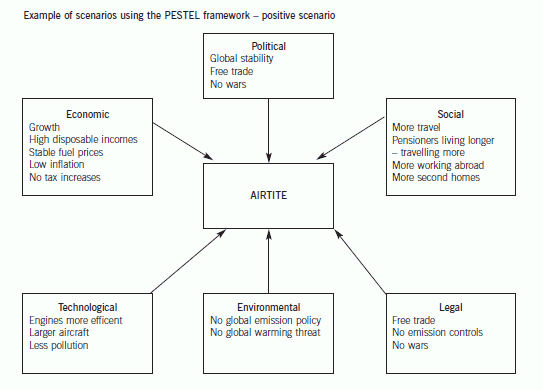
-
第18题:
(b) Compare and contrast Gray, Owen and Adams’s ‘pristine capitalist’ position with the ‘social contractarian’
position. Explain how these positions would affect responses to stakeholder concerns in the new stadium
project. (8 marks)
正确答案: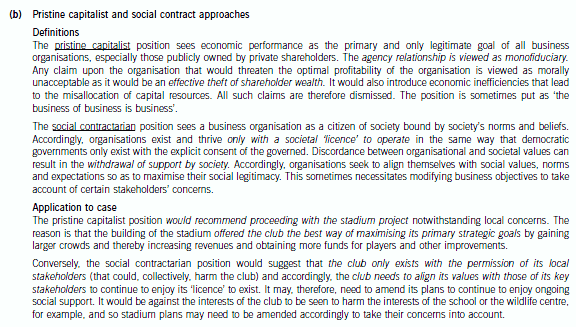
-
第19题:
(ii) Explain the organisational factors that determine the need for internal audit in public listed companies.
(5 marks)
正确答案:
(ii) Factors affecting the need for internal audit and controls
(Based partly on Turnbull guidance)
The nature of operations within the organisation arising from its sector, strategic positioning and main activities.
The scale and size of operations including factors such as the number of employees. It is generally assumed that larger
and more complex organisations have a greater need for internal controls and audit than smaller ones owing to the
number of activities occurring that give rise to potential problems.
Cost/benefit considerations. Management must weigh the benefits of instituting internal control and audit systems
against the costs of doing so. This is likely to be an issue for medium-sized companies or companies experiencing
growth.
Internal or external changes affecting activities, structures or risks. Changes arising from new products or internal
activities can change the need for internal audit and so can external changes such as PESTEL factors.
Problems with existing systems, products and/or procedures including any increase in unexplained events. Repeated or
persistent problems can signify the need for internal control and audit.
The need to comply with external requirements from relevant stock market regulations or laws. This appears to be a
relevant factor at Gluck & Goodman. -
第20题:
(b) (i) Explain how the use of Ansoff’s product-market matrix might assist the management of Vision plc to
reduce the profit-gap that is forecast to exist at 30 November 2009. (3 marks)
正确答案:
-
第21题:
4 (a) Explain the auditor’s responsibilities for other information in documents containing audited financial
statements. (5 marks)
正确答案:
4 HEGAS
(a) Auditor’s responsibilities for ‘other information’
■ The auditor has a professional responsibility to read other information to identify material inconsistencies with the
audited financial statements (ISA 720 ‘Other Information in Documents Containing Audited Financial Statements’).
■ A ‘material inconsistency’ arises when other information contradicts that which is contained in the audited financial
statements. It may give rise to doubts about:
– the auditor’s conclusions drawn from audit evidence; and
– the basis for the auditor’s opinion on the financial statements.
■ In certain circumstances, the auditor may have a statutory obligation (under national legislation) to report on other
information (e.g. Management Report).
■ Even where there is no such obligation (e.g. chairman’s statement), the auditor should consider it, as the credibility of
the financial statements may be undermined by any inconsistency.
■ The auditor must arrange to have access to the other information on a timely basis prior to dating the auditor’s report.
Material inconsistency
■ If a material inconsistency is identified, the auditor should determine whether it is the audited financial statements or
the other information which needs amending.
■ If an amendment to the audited financial statements is required but not made, there will be disagreement, resulting in
the expression of a qualified or adverse opinion. (Such a situation would be extremely rare.)
■ Where an amendment to other information is necessary, but refused, the auditor’s report may include an emphasis of
matter paragraph (since the audit opinion cannot be other than unqualified with respect to this matter).
Material misstatement of fact
■ A material misstatement of fact in other information exists when information which is not related to matters appearing
in the audited financial statements is incorrectly stated or presented in a misleading manner.
■ If management do not act on advice to correct a material misstatement the auditors should document their concerns to
those charged with corporate governance and obtain legal advice.
Tutorial note: Marks would be awarded here for the implications for the auditor’s report. However, such marks, which are
for the restatement of knowledge would NOT be awarded again if repeated in answers to (b). -
第22题:
(ii) Briefly explain the implications of Parr & Co’s audit opinion for your audit opinion on the consolidated
financial statements of Cleeves Co for the year ended 30 September 2006. (3 marks)
正确答案:
(ii) Implications for audit opinion on consolidated financial statements of Cleeves
■ If the potential adjustments to non-current asset carrying amounts and loss are not material to the consolidated
financial statements there will be no implication. However, as Howard is material to Cleeves and the modification
appears to be ‘so material’ (giving rise to adverse opinion) this seems unlikely.
Tutorial note: The question clearly states that Howard is material to Cleeves, thus there is no call for speculation
on this.
■ As Howard is wholly-owned the management of Cleeves must be able to request that Howard’s financial statements
are adjusted to reflect the impairment of the assets. The auditor’s report on Cleeves will then be unmodified
(assuming that any impairment of the investment in Howard is properly accounted for in the separate financial
statements of Cleeves).
■ If the impairment losses are not recognised in Howard’s financial statements they can nevertheless be adjusted on
consolidation of Cleeves and its subsidiaries (by writing down assets to recoverable amounts). The audit opinion
on Cleeves should then be unmodified in this respect.
■ If there is no adjustment of Howard’s asset values (either in Howard’s financial statements or on consolidation) it
is most likely that the audit opinion on Cleeves’s consolidated financial statements would be ‘except for’. (It should
not be adverse as it is doubtful whether even the opinion on Howard’s financial statements should be adverse.)
Tutorial note: There is currently no requirement in ISA 600 to disclose that components have been audited by another
auditor unless the principal auditor is permitted to base their opinion solely upon the report of another auditor. -
第23题:
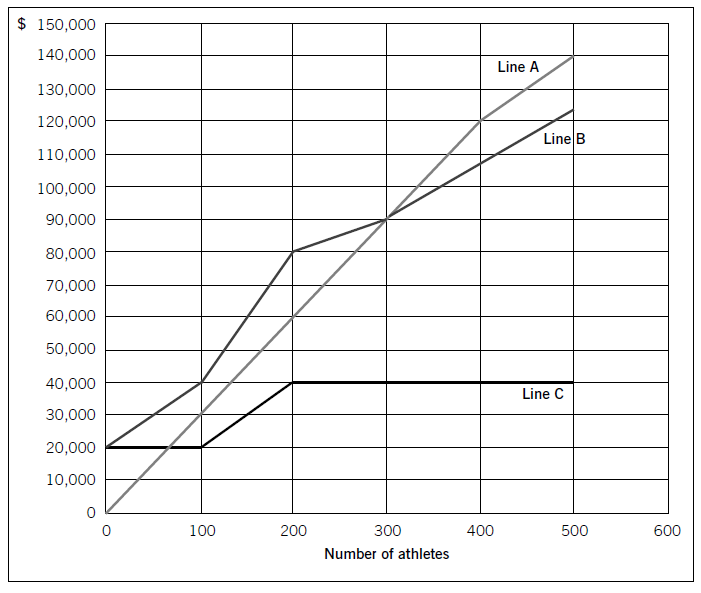
Swim Co offers training courses to athletes and has prepared the following breakeven chart:
Required:
(a) State the breakeven sales revenue for Swim Co and estimate, to the nearest $10,000, the company’s profit if 500 athletes attend a training course. (2 marks)
(b) Using the chart above, explain the cost and revenue structure of the company. (8 marks)
正确答案:
(a)ThebreakevensalesrevenueforSwimCois$90,000.Thecompany’sprofit,tothenearest$10,000,if500athletesattendthecourseis$20,000($140,000–$120,000).(Fromthegraph,itisclearthatthepreciseamountwillbenearer$17,000,i.e.$140,000–approximately$123,000.)(b)CoststructureFromthechart,itisclearthatLineCrepresentsfixedcosts,LineBrepresentstotalcostsandLineArepresentstotalrevenue.LineCshowsthatinitially,fixedcostsare$20,000evenifnoathletesattendthecourse.Thisleveloffixedcostsremainsthesameif100athletesattendbutoncethenumberofattendeesincreasesabovethislevel,fixedcostsincreaseto$40,000.LineBrepresentstotalcosts.If100athletesattend,totalcostsare$40,000($400perathlete).Since$20,000ofthisrelatestofixedcosts,thevariablecostperathletemustbe$200.Whenfixedcostsstepupbeyondthispointatthelevelof200athletes,totalcostsobviouslyincreaseaswellandLineBconsequentlygetsmuchsteeper.However,sincetherearenow200athletestoabsorbthefixedcosts,thecostperathleteremainsthesameat$400perathlete($80,000/200),eventhoughfixedcostshavedoubled.If300athletesattendthecourse,totalcostperathletebecomes$300each($90,000/300).Sincefixedcostsaccountfor$40,000ofthistotalcost,variablecoststotal$50,000,i.e.$166·67perathlete.So,economiesofscaleariseatthislevel,asdemonstratedbythefactthatLineBbecomesflatter.At400athletes,thegradientofthetotalcostslineisunchangedfrom300athleteswhichindicatesthatthevariablecostshaveremainedthesame.Thereisnofurtherchangeat500athletes;fixedandvariablecostsremainsteady.RevenuestructureAsregardstherevenuestructure,itcanbeseenfromLineAthatfor100–400athletesthepriceremainsthesameat$300perathlete.However,if500athletesattend,thepricehasbeenreducedasthetotalrevenuelinebecomesflatter.$140,000/500meansthatthepricehasgonedownto$280perathlete.Thiswasobviouslynecessarytoincreasethenumberofattendeesandatthispoint,profitismaximised.1