
(b) The Sarbanes-Oxley Act contains provisions for the attestation (verification) and reporting to shareholders ofinternal controls over financial reporting.Required:Describe the typical contents of an external report on internal controls. (8 marks)
题目
(b) The Sarbanes-Oxley Act contains provisions for the attestation (verification) and reporting to shareholders of
internal controls over financial reporting.
Required:
Describe the typical contents of an external report on internal controls. (8 marks)
相似考题
更多“(b) The Sarbanes-Oxley Act contains provisions for the attestation (verification) and reporting to shareholders ofinternal controls over financial reporting.Required:Describe the typical contents of an external report on internal controls. (8 marks)”相关问题
-
第1题:
5 Financial statements have seen an increasing move towards the use of fair values in accounting. Advocates of ‘fair
value accounting’ believe that fair value is the most relevant measure for financial reporting whilst others believe that
historical cost provides a more useful measure.
Issues have been raised over the reliability and measurement of fair values, and over the nature of the current level
of disclosure in financial statements in this area.
Required:
(a) Discuss the problems associated with the reliability and measurement of fair values and the nature of any
additional disclosures which may be required if fair value accounting is to be used exclusively in corporate
reporting. (13 marks)
正确答案:
(a) Reliability and Measurement
Fair value can be defined as the price that would be received to sell an asset or paid to transfer a liability. The fair value can
be thought of as an ‘exit price’. A fair value measurement assumes that the transaction to sell the asset or transfer the liability
occurs in the principal market for the asset or liability or, in the absence of a principal market, the most advantageous market
for the asset or liability which is the market in which the reporting entity would sell the asset or transfer the liability with the
price that maximises the amount that would be received or minimises the amount that would be paid. IAS39 ‘Financial
Instruments: Recognition and Measurement’ requires an entity to use the most advantageous active market in measuring the
fair value of a financial asset or liability when multiple markets exist whereas IAS41 ‘Agriculture’ requires an entity to use the
most relevant market. Thus there can be different approaches for estimating exit prices. Additionally valuation techniques and
current replacement cost could be used.
A hierarchy of fair value measurements would have to be developed in order to convey information about the nature of the
information used in creating the fair values. For example quoted prices (unadjusted) in active markets would provide better
quality information than quoted prices for similar assets and liabilities in active markets which would provide better quality
information than prices which reflect the reporting entity’s own thinking about the assumptions that market participants would
use in pricing the asset or liability. Enron made extensive use of what it called ‘mark-to-market’ accounting which was based
on valuation techniques and estimates. IFRSs currently do not have a single hierarchy that applies to all fair value measures.
Instead individual standards indicate preferences for certain inputs and measures of fair value over others, but this guidance
is not consistent among all IFRSs.
Some companies, in order to effectively manage their businesses, have already developed models for determining fair values.
Businesses manage their operations by managing risks. A risk management process often requires measurement of fair values
of contracts, financial instruments, and risk positions.
If markets were liquid and transparent for all assets and liabilities, fair value accounting clearly would give reliable information
which is useful in the decision making process. However, because many assets and liabilities do not have an active market,
the inputs and methods for estimating their fair value are more subjective and, therefore, the valuations are less reliable. Fair
value estimates can vary greatly, depending on the valuation inputs and methodology used. Where management uses
significant judgment in selecting market inputs when market prices are not available, reliability will continue to be an issue.
Management can use significant judgment in the valuation process. Management bias, whether intentional or unintentional,
may result in inappropriate fair value measurements and consequently misstatements of earnings and equity capital. Without
reliable fair value estimates, the potential for misstatements in financial statements prepared using fair value measurements
will be even greater.
Consideration must be given to revenue recognition issues in a fair value system. It must be ensured that unearned revenue
is not recognised early as it recently was by certain high-tech companies.
As the variety and complexity of financial instruments increases, so does the need for independent verification of fair value
estimates. However, verification of valuations that are not based on observable market prices is very challenging. Users of
financial statements will need to place greater emphasis on understanding how assets and liabilities are measured and how
reliable these valuations are when making decisions based on them.
Disclosure
Fair values reflect point estimates and do not result in transparent financial statements. Additional disclosures are necessary
to bring meaning to these fair value estimates. These disclosures might include key drivers affecting valuations, fair-valuerange
estimates, and confidence levels. Another important disclosure consideration relates to changes in fair value amounts.
For example, changes in fair values on securities can arise from movements in interest rates, foreign-currency rates, and credit
quality, as well as purchases and sales from the portfolio. For users to understand fair value estimates, they must be given
adequate disclosures about what factors caused the changes in fair value. It could be argued that the costs involved in
determining fair values may exceed the benefits derived therefrom. When considering how fair value information should be
presented in the financial statements, it is important to consider what type of financial information investors want. There are
indications that some investors desire both fair value information and historical cost information. One of the issues affecting
the credibility of fair value disclosures currently is that a number of companies include ‘health warnings’ with their disclosures
indicating that the information is not used by management. This language may contribute to users believing that the fair value
disclosures lack credibility.
-
第2题:
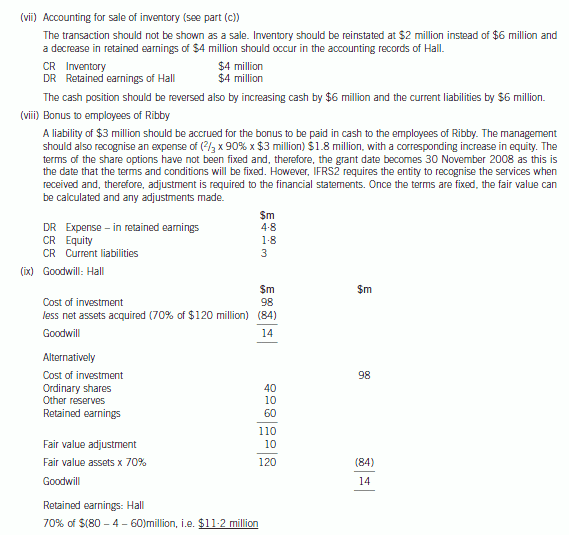
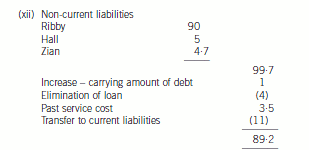
(b) Prepare a consolidated statement of financial position of the Ribby Group at 31 May 2008 in accordance
with International Financial Reporting Standards. (35 marks)
正确答案: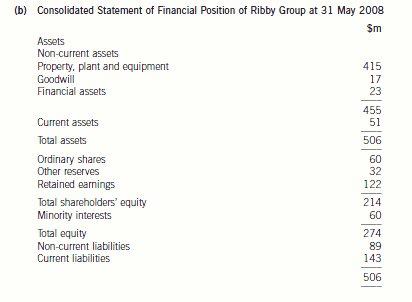

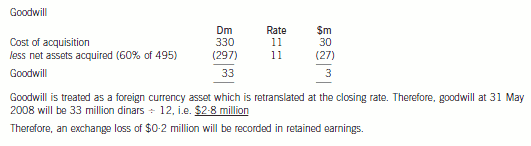
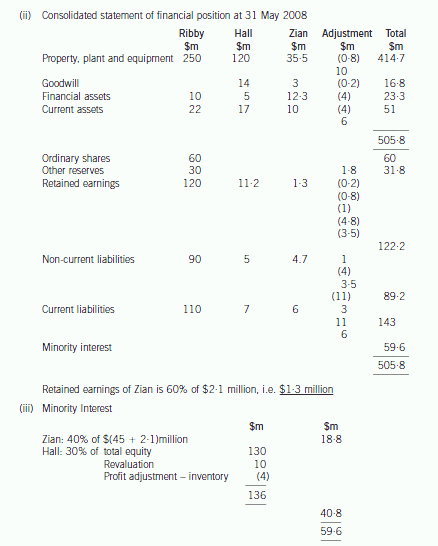
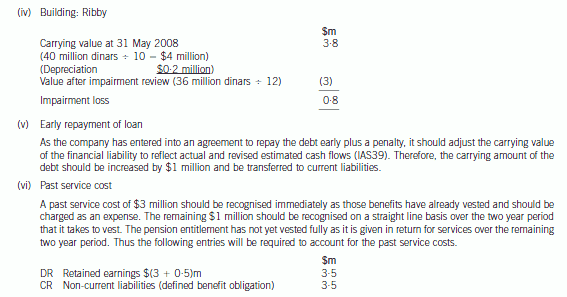

-
第3题:
(b) Discuss how management’s judgement and the financial reporting infrastructure of a country can have a
significant impact on financial statements prepared under IFRS. (6 marks)
Appropriateness and quality of discussion. (2 marks)
正确答案:
(b) Management judgement may have a greater impact under IFRS than generally was the case under national GAAP. IFRS
utilises fair values extensively. Management have to use their judgement in selecting valuation methods and formulating
assumptions when dealing with such areas as onerous contracts, share-based payments, pensions, intangible assets acquired
in business combinations and impairment of assets. Differences in methods or assumptions can have a major impact on
amounts recognised in financial statements. IAS1 expects companies to disclose the sensitivity of carrying amounts to the
methods, assumptions and estimates underpinning their calculation where there is a significant risk of material adjustment
to their carrying amounts within the next financial year. Often management’s judgement is that there is no ‘significant risk’
and they often fail to disclose the degree of estimation or uncertainty and thus comparability is affected.
In addition to the IFRSs themselves, a sound financial reporting infrastructure is required. This implies effective corporate
governance practices, high quality auditing standards and practices, and an effective enforcement or oversight mechanism.
Therefore, consistency and comparability of IFRS financial statements will also depend on the robust nature of the other
elements of the financial reporting infrastructure.
Many preparers of financial statements will have been trained in national GAAP and may not have been trained in the
principles underlying IFRS and this can lead to unintended inconsistencies when implementing IFRS especially where the
accounting profession does not have a CPD requirement. Additionally where the regulatory system of a country is not well
developed, there may not be sufficient market information to utilise fair value measurements and thus this could lead to
hypothetical markets being created or the use of mathematical modelling which again can lead to inconsistencies because of
lack of experience in those countries of utilising these techniques. This problem applies to other assessments or estimates
relating to such things as actuarial valuations, investment property valuations, impairment testing, etc.
The transition to IFRS can bring significant improvement to the quality of financial performance and improve comparability
worldwide. However, there are issues still remaining which can lead to inconsistency and lack of comparability with those
financial statements. -
第4题:
4 At an academic conference, a debate took place on the implementation of corporate governance practices in
developing countries. Professor James West from North America argued that one of the key needs for developing
countries was to implement rigorous systems of corporate governance to underpin investor confidence in businesses
in those countries. If they did not, he warned, there would be no lasting economic growth as potential foreign inward
investors would be discouraged from investing.
In reply, Professor Amy Leroi, herself from a developing country, reported that many developing countries are
discussing these issues at governmental level. One issue, she said, was about whether to adopt a rules-based or a
principles-based approach. She pointed to evidence highlighting a reduced number of small and medium sized initial
public offerings in New York compared to significant growth in London. She suggested that this change could be
attributed to the costs of complying with Sarbanes-Oxley in the United States and that over-regulation would be the
last thing that a developing country would need. She concluded that a principles-based approach, such as in the
United Kingdom, was preferable for developing countries.
Professor Leroi drew attention to an important section of the Sarbanes-Oxley Act to illustrate her point. The key
requirement of that section was to externally report on – and have attested (verified) – internal controls. This was, she
argued, far too ambitious for small and medium companies that tended to dominate the economies of developing
countries.
Professor West countered by saying that whilst Sarbanes-Oxley may have had some problems, it remained the case
that it regulated corporate governance in the ‘largest and most successful economy in the world’. He said that rules
will sometimes be hard to follow but that is no reason to abandon them in favour of what he referred to as ‘softer’
approaches.
(a) There are arguments for both rules and principles-based approaches to corporate governance.
Required:
(i) Describe the essential features of a rules-based approach to corporate governance; (3 marks)
正确答案:
(a) (i) Describe rules-based
In a rules-based jurisdiction, corporate governance provisions are legally binding and enforceable in law.
Non-compliance is punishable by fines or ultimately (in extremis) by delisting and director prosecutions.
There is limited latitude for interpretation of the provisions to match individual circumstances (‘one size fits all’). Some
have described this as a ‘box ticking’ exercise as companies seek to comply despite some provisions applying to their
individual circumstances more than others.
Investor confidence is underpinned by the quality of the legislation rather than the degree of compliance (which will be
total for the most part). -
第5题:
(b) Describe the principal matters that should be included in your firm’s submission to provide internal audit
services to RBG. (10 marks)
正确答案:
(b) Principal matters to be included in submission to provide internal audit services
■ Introduction/background – details about York including its organisation (of functions), offices (locations) and number of
internal auditors working within each office. The office that would be responsible for managing the contract should be
stated.
■ A description of York’s services most relevant to RBG’s needs (e.g. in the areas of risk management, IT audits, value for
money (VFM) and corporate governance).
■ Client-specific issues identified. For example, revenue audits will be required routinely for control purposes and to
substantiate the contingent rents due. Other areas of expertise that RBG may be interested in taking advantage of, for
example, special projects such as acquisitions and mergers.
■ York’s approach to assessing audit needs including the key stages and who will be involved. For example:
(1) Preliminary – review of business, industry and the entity’s operating characteristics
(2) Planning – including needs analysis and co-ordination with external audit plan
(3) Post-Audit – assurance that activities were effectively and efficiently executed
(4) Review – of services provided, reports issued and management’s responses.
■ A description of internal audit tools used and methodologies/approach to audit fieldwork including use of embedded
audit software and programs developed by York.
■ A description of York’s systems-based audit, the IT issues to be addressed and the technological support that can be
provided.
■ Any training that will be offered to RBG’s managers and staff, for example, in a risk management approach.
■ A description and quantity of resources, in particular the number of full-time staff, to be deployed in providing services
to RBG. An outline of RBG’s track record in human resource retention and development.
■ Relevant experience – e.g. in internal and external audit in the retail industry. The relative qualifications and skills of
each grade of audit staff and the contract manager in particular.
■ Insurance certifications covering, for example, public liability and professional indemnity insurance.
■ Work ethic policies relating to health and safety, equal opportunities’ and race relations.
■ How York ensures quality throughout the internal audit process including standards to be followed (e.g. Institute of
Internal Auditors’ standards).
■ Sample report templates – e.g. for reporting the results of risk analysis, audit plans and quarterly reporting of findings
to the Audit and Risk Management Committee.
■ Current clients to whom internal audit services are provided from whom RBG will be able to take up references, by
arrangement, if York is short-listed.
■ Any work currently carried out/competed for that could cause a conflict of interest (and the measures to avoid such
conflicts).
■ Fees (daily rates) for each grade of staff and travel and other expenses to be reimbursed. An indication of price increases,
if any, over the three-year contract period. Invoicing terms (e.g. on presentation of reports) and payment terms (e.g. the
end of the month following receipt of the invoice).
■ Performance targets to be met such as deadlines for completing work and submitting and issuing reports. -
第6题:
(d) Discuss the professional accountant’s liability for reporting on prospective financial information and the
measures that the professional accountant might take to reduce that liability. (6 marks)
正确答案:
(d) Professional accountant’s liability
Liability for reporting on PFI
Independent accountants may be required to report on PFI for many reasons (e.g. to help secure a bank loan). Such forecasts
and projections are inherently unreliable. If the forecast or projection does not materialise, and the client or lenders (or
investors) consequently sustain financial loss, the accountant may face lawsuits claiming financial loss.
Courts in different jurisdictions use various criteria to define the group of persons to whom independent accountants may be
held liable for providing a report on an inaccurate forecast or projection. The most common of these are that an accountant
is liable to persons with whom there is proximity:
(i) only (i.e. the client who engaged the independent accountant);
(ii) or whose relationship with the accountant sufficiently approaches privity;
(iii) and to persons or members of a limited group of persons for whose benefit and guidance the accountant supplied the
information or knew that the recipient of the information intended to supply it;
(iv) and to persons who reasonably can be foreseen to rely on the information.
Measures to reduce liability
As significant assumptions will be essential to a reader’s understanding of a financial forecast, the independent accountant
should ensure that they are adequately disclosed and clearly stated to be the management’s responsibility. Hypothetical
assumptions should be clearly distinguished from best estimates.
The introduction to any forecast (and/or report thereon) should include a caveat that the prospective results may not be
attained. Specific and extensive warnings (‘the actual results … will vary’) and disclaimers (‘we do not express an opinion’)
may be effective in protecting an independent accountant sued for inaccuracies in forecasts or projections that they have
reported on.
Any report to a third party should state:
■ for whom it is prepared, who is entitled to rely on it (if anyone) and for what purpose;
■ that the engagement was undertaken in accordance with the engagement terms;
■ the work performed and the findings.
An independent accountant’s report should avoid inappropriate and open-ended wording, for example, ‘we certify …’ and ‘we
obtained all the explanations we considered necessary’.
Engagement terms to report on PFI should include an appropriate liability cap that is reasonable given the specific
circumstances of the engagement.
The independent accountant may be able to obtain indemnity from a client in respect of claims from third parties. Such ‘hold
harmless’ clauses obligate the client to indemnify the independent accountant from third party claims. -
第7题:
The finance director of Blod Co, Uma Thorton, has requested that your firm type the financial statements in the form
to be presented to shareholders at the forthcoming company general meeting. Uma has also commented that the
previous auditors did not use a liability disclaimer in their audit report, and would like more information about the use
of liability disclaimer paragraphs.
Required:
(b) Discuss the ethical issues raised by the request for your firm to type the financial statements of Blod Co.
(3 marks)
正确答案:
(b) It is not uncommon for audit firms to word process and typeset the financial statements of their clients, especially where the
client is a relatively small entity, which may lack the resources and skills to perform. this task. It is not prohibited by ethical
standards.
However, there could be a perceived threat to independence, with risk magnified in the case of Blod Co, which is a listed
company. The auditors could be perceived to be involved with the preparation of the financial statements of a listed client
company, which is prohibited by ethical standards. IFAC’s Code of Ethics for Professional Accountants states that for a listed
client, the audit firm should not be involved with the preparation of financial statements, which would create a self-review
threat so severe that safeguards could not reduce the threat to an acceptable level. Although the typing of financial statements
itself is not prohibited by ethical guidance, the risk is that providing such a service could be perceived to be an element of
the preparation of the financial statements.
It is possible that during the process of typing the financial statements, decisions and judgments would be made. This could
be perceived as making management decisions in relation to the financial statements, a clear breach of independence.
Therefore to eliminate any risk exposure, the prudent decision would be not to type the financial statements, ensuring that
Blod Co appreciates the ethical problems that this would cause.
Tutorial note: This is an area not specifically covered by ethical guides, where different audit firms may have different views
on whether it is acceptable to provide a typing service for the financial statements of their clients. Credit will be awarded for
sensible discussion of the issues raised bearing in mind other options for the audit firm, for example, it could be argued that
it is acceptable to offer the typing service provided that it is performed by people independent of the audit team, and that
the matter has been discussed with the audit committee/those charged with governance -
第8题:
(a) Contrast the role of internal and external auditors. (8 marks)
(b) Conoy Co designs and manufactures luxury motor vehicles. The company employs 2,500 staff and consistently makes a net profit of between 10% and 15% of sales. Conoy Co is not listed; its shares are held by 15 individuals, most of them from the same family. The maximum shareholding is 15% of the share capital.
The executive directors are drawn mainly from the shareholders. There are no non-executive directors because the company legislation in Conoy Co’s jurisdiction does not require any. The executive directors are very successful in running Conoy Co, partly from their training in production and management techniques, and partly from their ‘hands-on’ approach providing motivation to employees.
The board are considering a significant expansion of the company. However, the company’s bankers are
concerned with the standard of financial reporting as the financial director (FD) has recently left Conoy Co. The board are delaying provision of additional financial information until a new FD is appointed.
Conoy Co does have an internal audit department, although the chief internal auditor frequently comments that the board of Conoy Co do not understand his reports or provide sufficient support for his department or the internal control systems within Conoy Co. The board of Conoy Co concur with this view. Anders & Co, the external auditors have also expressed concern in this area and the fact that the internal audit department focuses work on control systems, not financial reporting. Anders & Co are appointed by and report to the board of Conoy Co.
The board of Conoy Co are considering a proposal from the chief internal auditor to establish an audit committee.
The committee would consist of one executive director, the chief internal auditor as well as three new appointees.
One appointee would have a non-executive seat on the board of directors.
Required:
Discuss the benefits to Conoy Co of forming an audit committee. (12 marks)
正确答案:
(a)Roleofinternalandexternalauditors–differencesObjectivesThemainobjectiveofinternalauditistoimproveacompany’soperations,primarilyintermsofvalidatingtheefficiencyandeffectivenessoftheinternalcontrolsystemsofacompany.Themainobjectiveoftheexternalauditoristoexpressanopiniononthetruthandfairnessofthefinancialstatements,andotherjurisdictionspecificrequirementssuchasconfirmingthatthefinancialstatementscomplywiththereportingrequirementsincludedinlegislation.ReportingInternalauditreportsarenormallyaddressedtotheboardofdirectors,orotherpeoplechargedwithgovernancesuchastheauditcommittee.Thosereportsarenotpubliclyavailable,beingconfidentialbetweentheinternalauditorandtherecipient.Externalauditreportsareprovidedtotheshareholdersofacompany.Thereportisattachedtotheannualfinancialstatementsofthecompanyandisthereforepubliclyavailabletotheshareholdersandanyreaderofthefinancialstatements.ScopeofworkTheworkoftheinternalauditornormallyrelatestotheoperationsoftheorganisation,includingthetransactionprocessingsystemsandthesystemstoproducetheannualfinancialstatements.Theinternalauditormayalsoprovideotherreportstomanagement,suchasvalueformoneyauditswhichexternalauditorsrarelybecomeinvolvedwith.Theworkoftheexternalauditorrelatesonlytothefinancialstatementsoftheorganisation.However,theinternalcontrolsystemsoftheorganisationwillbetestedastheseprovideevidenceonthecompletenessandaccuracyofthefinancialstatements.RelationshipwithcompanyInmostorganisations,theinternalauditorisanemployeeoftheorganisation,whichmayhaveanimpactontheauditor’sindependence.However,insomeorganisationstheinternalauditfunctionisoutsourced.Theexternalauditorisappointedbytheshareholdersofanorganisation,providingsomedegreeofindependencefromthecompanyandmanagement.(b)BenefitsofauditcommitteeinConoyCoAssistancewithfinancialreporting(nofinanceexpertise)TheexecutivedirectorsofConoyCodonotappeartohaveanyspecificfinancialskills–asthefinancialdirectorhasrecentlyleftthecompanyandhasnotyetbeenreplaced.ThismaymeanthatfinancialreportinginConoyCoislimitedorthattheothernon-financialdirectorsspendasignificantamountoftimekeepinguptodateonfinancialreportingissues.AnauditcommitteewillassistConoyCobyprovidingspecialistknowledgeoffinancialreportingonatemporarybasis–atleastoneofthenewappointeesshouldhaverelevantandrecentfinancialreportingexperienceundercodesofcorporategovernance.ThiswillallowtheexecutivedirectorstofocusonrunningConoyCo.EnhanceinternalcontrolsystemsTheboardofConoyCodonotnecessarilyunderstandtheworkoftheinternalauditor,ortheneedforcontrolsystems.ThismeansthatinternalcontrolwithinConoyComaybeinadequateorthatemployeesmaynotrecognisetheimportanceofinternalcontrolsystemswithinanorganisation.TheauditcommitteecanraiseawarenessoftheneedforgoodinternalcontrolsystemssimplybybeingpresentinConoyCoandbyeducatingtheboardontheneedforsoundcontrols.Improvingtheinternalcontrol‘climate’willensuretheneedforinternalcontrolsisunderstoodandreducecontrolerrors.RelianceonexternalauditorsConoyCo’sinternalauditorscurrentlyreporttotheboardofConoyCo.Aspreviouslynoted,thelackoffinancialandcontrolexpertiseontheboardwillmeanthatexternalauditorreportsandadvicewillnotnecessarilybeunderstood–andtheboardmayrelytoomuchonexternalauditorsIfConoyCoreporttoanauditcommitteethiswilldecreasethedependenceoftheboardontheexternalauditors.Theauditcommitteecantaketimetounderstandtheexternalauditor’scomments,andthenviathenon-executivedirector,ensurethattheboardtakeactiononthosecomments.AppointmentofexternalauditorsAtpresent,theboardofConoyCoappointtheexternalauditors.Thisraisesissuesofindependenceastheboardmaybecometoofamiliarwiththeexternalauditorsandsoappointonthisfriendshipratherthanmerit.Ifanauditcommitteeisestablished,thenthiscommitteecanrecommendtheappointmentoftheexternalauditors.Thecommitteewillhavethetimeandexpertisetoreviewthequalityofserviceprovidedbytheexternalauditors,removingtheindependenceissue.Corporategovernancerequirements–bestpracticeConoyCodonotneedtofollowcorporategovernancerequirements(thecompanyisnotlisted).However,notfollowingthoserequirementsmaystarttohaveadverseeffectsonConoy.Forexample,ConoyCo’sbankisalreadyconcernedaboutthelackoftransparencyinreporting.EstablishinganauditcommitteewillshowthattheboardofConoyCoarecommittedtomaintainingappropriateinternalsystemsinthecompanyandprovidingthestandardofreportingexpectedbylargecompanies.Obtainingthenewbankloanshouldalsobeeasierasthebankwillbesatisfiedwithfinancialreportingstandards.Givennonon-executives–independentadvicetoboardCurrentlyConoyCodoesnothaveanynon-executivedirectors.Thismeansthatthedecisionsoftheexecutivedirectorsarenotbeingchallengedbyotherdirectorsindependentofthecompanyandwithlittleornofinancialinterestinthecompany.Theappointmentofanauditcommitteewithonenon-executivedirectorontheboardofConoyCowillstarttoprovidesomenon-executiveinputtoboardmeetings.Whilenotsufficientintermsofcorporategovernancerequirements(aboutequalnumbersofexecutiveandnon-executivedirectorsareexpected)itdoesshowtheboardofConoyCoareattemptingtoestablishappropriategovernancesystems.AdviceonriskmanagementFinally,thereareothergeneralareaswhereConoyCowouldbenefitfromanauditcommittee.Forexample,lackofcorporategovernancestructuresprobablymeansConoyCodoesnothaveariskmanagementcommittee.Theauditcommitteecanalsoprovideadviceonriskmanagement,helpingtodecreasetheriskexposureofthecompany. -
第9题:
Which of the following statements relating to internal and external auditors is correct?
A.Internal auditors are required to be members of a professional body
B.Internal auditors’ scope of work should be determined by those charged with governance
C.External auditors report to those charged with governance
D.Internal auditors can never be independent of the company
正确答案:BA is incorrect as internal auditors are not required to be members of any professional body. C is incorrect as external auditors report to shareholders rather than those charged with governance. D is incorrect as internal auditors can be independent of the company, if, for example, the internal audit function has been outsourced.
-
第10题:
资料:Many people think of internal control as a means of safeguarding cash and preventing fraud. Although internal control is an important factor in protecting assets and preventing fraud, this is only a part of its roles. Remember that business decisions are based on accounting data and the system of internal control provides assurance of the dependability of the accounting data used in making decisions.
The decisions made by management are communicated throughout the organization and become company policy. The results of the policies-----the consequences of managerial decisions----must be reported back to management so that the soundness of company policies can be evaluated. Among the means of communication included in the system of internal control are organization charts, manuals of accounting policies and procedures, flow charts, financial forecasts, purchase orders, receiving reports, invoices, and other documents. The term documentation refers to all the charts, forms, reports, and other business papers that guide and describe the working of a company's system of accounting and internal control.
Internal controls fall into two major classes: administrative controls and accounting controls. Administrative controls are measures that increase operational efficiency and compliance with policies in all parts of organization. For example, an administrative control may be a requirement that traveling salespersons submit reports showing the number of calls made on customers each day. Another example is a directive require airline pilots to have regular medical examinations. These internal administrative controls have no direct bearing on the reliability of the financial statements. Consequently, administrative controls are not of direct interest on accountants and independent auditors.
Internal accounting controls are measures that relate to protection of assets and to the reliability of accounting and financial reports. An example is the requirement that a person whose duties involve handling cash shall not also maintain accounting records. More broadly stated, the accounting function must be kept separate from the custody of assets. Another accounting control is the requirement that checks, purchase orders, and other documents be serially numbered. Still another example is the rule that a person who orders merchandise and supplies should not be the one to receive them and should not sign checks to pay for them.
Which one of the following is not the role of internal control?A.Preventing fraud.
B.Providing help for making decisions.
C.Improving the sense of responsibility of employees.
D.Protecting assets.答案:C解析:本题考查细节理解。
【关键词】not the role of internal control
【主题句】第1自然段Many people think of internal control as a means of safeguarding cash and preventing fraud. Although internal control is an important factor in protecting assets and preventing fraud, this is only a part of its roles. Remember that business decisions are based on accounting data and the system of internal control provides assurance of the dependability of the accounting data used in making decisions. 很多人认为内部控制是保护现金和防止欺诈的一种手段。尽管内部控制确实是保护资产和防止欺诈的重要因素,但这仅仅是内部控制所起作用的一小部分。要知道,商业决策建立在会计数据上,而内部控制确保了这些用以决策的会计数据的可靠性。
【解析】题干意为“以下哪一项不属于内部控制所起的作用?” 选项A意为“防止欺诈”;选项B意为“为决策提供帮助”;选项C意为“提高员工的责任心”;选项D意为“保护资产”。根据主题句可知,内部控制的作用包括保护资产、防止欺诈、有助于做决策,因此选项A、B、D均被提及,故选项C符合题意。 -
第11题:
资料:Many people think of internal control as a means of safeguarding cash and preventing fraud. Although internal control is an important factor in protecting assets and preventing fraud, this is only a part of its roles. Remember that business decisions are based on accounting data and the system of internal control provides assurance of the dependability of the accounting data used in making decisions.
The decisions made by management are communicated throughout the organization and become company policy. The results of the policies-----the consequences of managerial decisions----must be reported back to management so that the soundness of company policies can be evaluated. Among the means of communication included in the system of internal control are organization charts, manuals of accounting policies and procedures, flow charts, financial forecasts, purchase orders, receiving reports, invoices, and other documents. The term documentation refers to all the charts, forms, reports, and other business papers that guide and describe the working of a company's system of accounting and internal control.
Internal controls fall into two major classes: administrative controls and accounting controls. Administrative controls are measures that increase operational efficiency and compliance with policies in all parts of organization. For example, an administrative control may be a requirement that traveling salespersons submit reports showing the number of calls made on customers each day. Another example is a directive require airline pilots to have regular medical examinations. These internal administrative controls have no direct bearing on the reliability of the financial statements. Consequently, administrative controls are not of direct interest on accountants and independent auditors.
Internal accounting controls are measures that relate to protection of assets and to the reliability of accounting and financial reports. An example is the requirement that a person whose duties involve handling cash shall not also maintain accounting records. More broadly stated, the accounting function must be kept separate from the custody of assets. Another accounting control is the requirement that checks, purchase orders, and other documents be serially numbered. Still another example is the rule that a person who orders merchandise and supplies should not be the one to receive them and should not sign checks to pay for them.
( )are not the means of communication included in the system of internal controls.A.Financial forecasts
B.According rules
C.Manuals of accounting policies and procedures
D.Organization charts答案:B解析:本题考查细节理解。
应改为:
【关键词】not the means of communication; included in the system of internal controls
【主题句】第2自然段Among the means of communication included in the system of internal control are organization charts, manuals of accounting policies and procedures, flow charts, financial forecasts, purchase orders, receiving reports, invoices, and other documents. 内部控制系统的交流方式包括企业组织图、会计政策及程序说明、流程图、财务预测、采购订单、验收单、发票和其他文件。
【解析】题干意为“________不是内部控制系统的交流方式?” 选项A意为“财务预测”;选项B意为“相应规则”;选项C意为“会计政策和程序手册”;选项D意为“组织结构图”。根据主题句可知,选项A、C、D均被提及,故选项B符合题意。 -
第12题:
Which application is installed with IBM Enterprise Asset Management for providing reporting capability?()
- A、Open Database Platform
- B、External Report Integration
- C、Business Objects/Crystal Reports
- D、Business Intelligence Reporting Tool
正确答案:D -
第13题:
(b) Describe to the Beth Group the possible advantages of producing a separate environmental report.
(8 marks)
正确答案:
(b) An environmental report allows an organisation to communicate with different stakeholders. The benefits of an environmental
report include:
(i) evaluating environmental performance can highlight inefficiencies in operations and help to improve management
systems. Beth could identify opportunities to reduce resource use, waste and operating costs.
(ii) communicating the efforts being made to improve social and environmental performance can foster community support
for a business and can also contribute towards its reputation as a good corporate citizen. At present Beth has a poor
reputation in this regard.
(iii) reporting efforts to improve the organisation’s environmental, social and economic performance can lead to increased
consumer confidence in its products and services.
(iv) commitment to reporting on current impacts and identifying ways to improve environmental performance can improve
relationships with regulators, and could reduce the potential threat of litigation which is hanging over Beth.
(v) investors, financial analysts and brokers increasingly ask about the sustainability aspects of operations. A high quality
report shows the measures the organisation is taking to reduce risks, and will make Beth more attractive to investors.
(vi) disclosing the organisation’s environmental, social and economic best practices can give a competitive market edge.
Currently Beth’s corporate image is poor and this has partly contributed to its poor stock market performance.
(vii) the international trend towards improved corporate sustainability is growing and access to international markets will
require increasing transparency, and this will help Beth’s corporate image.
(viii) large organisations are increasingly requiring material and service suppliers and contractors to submit performance
information to satisfy the expectations of their own shareholders. Disclosing such information can make the company a
more attractive supplier than their competitors, and increase Beth’s market share.
It is important to ensure that the policies are robust and effective and not just compliance based. -
第14题:
(d) Sirus raised a loan with a bank of $2 million on 1 May 2007. The market interest rate of 8% per annum is to
be paid annually in arrears and the principal is to be repaid in 10 years time. The terms of the loan allow Sirus
to redeem the loan after seven years by paying the full amount of the interest to be charged over the ten year
period, plus a penalty of $200,000 and the principal of $2 million. The effective interest rate of the repayment
option is 9·1%. The directors of Sirus are currently restructuring the funding of the company and are in initial
discussions with the bank about the possibility of repaying the loan within the next financial year. Sirus is
uncertain about the accounting treatment for the current loan agreement and whether the loan can be shown as
a current liability because of the discussions with the bank. (6 marks)
Appropriateness of the format and presentation of the report and quality of discussion (2 marks)
Required:
Draft a report to the directors of Sirus which discusses the principles and nature of the accounting treatment of
the above elements under International Financial Reporting Standards in the financial statements for the year
ended 30 April 2008.
正确答案:
(d) Repayment of the loan
If at the beginning of the loan agreement, it was expected that the repayment option would not be exercised, then the effective
interest rate would be 8% and at 30 April 2008, the loan would be stated at $2 million in the statement of financial position
with interest of $160,000 having been paid and accounted for. If, however, at 1 May 2007, the option was expected to be
exercised, then the effective interest rate would be 9·1% and at 30 April 2008, the cash interest paid would have been
$160,000 and the interest charged to the income statement would have been (9·1% x $2 million) $182,000, giving a
statement of financial position figure of $2,022,000 for the amount of the financial liability. However, IAS39 requires the
carrying amount of the financial instrument to be adjusted to reflect actual and revised estimated cash flows. Thus, even if
the option was not expected to be exercised at the outset but at a later date exercise became likely, then the carrying amount
would be revised so that it represented the expected future cash flows using the effective interest rate. As regards the
discussions with the bank over repayment in the next financial year, if the loan was shown as current, then the requirements
of IAS1 ‘Presentation of Financial Statements’ would not be met. Sirus has an unconditional right to defer settlement for longer
than twelve months and the liability is not due to be legally settled in 12 months. Sirus’s discussions should not be considered
when determining the loan’s classification.
It is hoped that the above report clarifies matters. -
第15题:
(e) Internal controls are very important in a complex civil engineering project such as the Giant Dam Project.
Required:
Describe the difficulties of maintaining sound internal controls in the Giant Dam Project created by working
through sub-contractors. (4 marks)
正确答案:
(e) Control and sub-contractors
Specifically in regard to the maintenance of internal controls when working with sub-contractors, the prominent difficulties
are likely to be in the following areas:
Configuring and co-ordinating the many activities of sub-contractors so as to keep progress on track. This may involve taking
the different cultures of sub-contractor organisations into account.
Loss of direct control over activities as tasks are performed by people outside R&M’s direct employment and hence its
management structure.
Monitoring the quality of work produced by the sub-contractors. Monitoring costs will be incurred and any quality problems
will be potentially costly.
Budget ‘creep’ and cost control. Keeping control of budgets can be a problem in any large civil engineering project (such the
construction of the new Wembley Stadium in the UK) and problems are likely to be made worse when the principal contractor
does not have direct control over all activities.
Time limit over-runs. Many projects (again, such as the new Wembley Stadium, but others also) over-run significantly on time.
Tutorial note: only four difficulties need to be described. -
第16题:
(c) Construct the arguments in favour of Professor Leroi’s remark that external reporting requirements on internal
controls were ‘too ambitious’ for small and medium companies. (4 marks)
正确答案:
(c) The external reporting requirements (from the Sarbanes-Oxley section 404) being ‘too ambitious’ for small and medium
companies
There are several arguments to support Professor Leroi’s remark.
Fewer spare resources to carry out internal control. SMEs tend to operate with lower levels of spare resource than larger
businesses and conducting internal reviews would be more of a challenge for them.
The extra attestation fee (over and above normal audit fee) for the attestation of the internal control report could be a constraint
for many SMEs.
Lack of expertise from within existing employees (to internally audit/police as well as carry out internal activities) would be a
likely constraint.
SMEs will have fewer activities and less complexity, hence less need for shareholders to require the information (less to go
wrong). -
第17题:
(c) Describe the examination procedures you should use to verify Cusiter Co’s prospective financial information.
(9 marks)
正确答案:
(c) Examination procedures
■ The arithmetic accuracy of the PFI should be confirmed, i.e. subtotals and totals should be recast and agreed.
■ The actual information for the year to 31 December 2006 that is shown as comparative information should be agreed
to the audited financial statements for that year to ensure consistency.
■ Balances and transaction totals for the quarter to 31 March 2007 should be agreed to general ledger account balances
at that date. The net book value of property, plant and equipment should be agreed to the non-current asset register;
accounts receivable/payable to control accounts and cash at bank to a bank reconciliation statement.
■ Tenders for the new equipment should be inspected to confirm the additional cost included in property, plant and
equipment included in the forecast for the year to 31 December 2008 and that it can be purchased with the funds being
lent by the bank.
■ The reasonableness of all new assumptions should be considered. For example, the expected useful life of the new
equipment, the capacity at which it will be operating, the volume of new product that can be sold, and at what price.
■ The forecast income statement should be reviewed for completeness of costs associated with the expansion. For
example, operating expenses should include salaries of additional equipment operatives or supervisors.
■ The consistency of accounting practices reflected in the forecast with International Financial Reporting Standards (IFRS)
should be considered. For example, the intangible asset might be expected to be less than $10,000 at 31 December
2008 as it should be carried at amortised cost.
■ The cost of property, plant and equipment at 31 December 2008 is $280,000 more than as at 31 December 2007.
Consideration should be given to the adequacy of borrowing $250,000 if the actual investment is $30,000 more.
■ The terms of existing borrowings (both non-current and short-term) should be reviewed to ensure that the forecast takes
full account of existing repayment schedules. For example, to confirm that only $23,000 of term borrowings will become
current by the end of 2007.
Trends should be reviewed and fluctuations explained, for example:
■ Revenue for the first quarter of 2007 is only 22% of revenue for 2006 and so may appear to be understated. However,
revenue may not be understated if sales are seasonal and the first quarter is traditionally ‘quieter’.
■ Forecast revenue for 2007 is 18% up on 2006. However, forecast revenue for 2008 is only 19% up on 2007. As the
growth in 2007 is before the investment in new plant and equipment it does not look as though the new investment
will be contributing significantly to increased growth in the first year.
■ The gross profit % is maintained at around 29% for the three years. However, the earnings before interest and tax (EBIT)
% is forecast to fall by 2% for 2008. Earnings after interest might be worrying to the potential lender as this is forecast
to rise from 12·2% in 2006 to 13·7% in 2007 but then fall to 7·6% in 2008.
The reasonableness of relationships between income statement and balance sheet items should be considered. For example:
■ The average collection period at each of the balance sheet dates presented is 66, 69, 66 and 66 days respectively (e.g.
71/394 × 365 = 66 days). Although it may be realistic to assume that the current average collection period may be
maintained in future it is possible that it could deteriorate if, for example, new customers taken on to launch the new
product are not as credit worthy as the existing customer base.
■ The number of days sales in inventory at each balance sheet date is 66, 88, 66 and 65 days respectively (e.g. 50/278
× 365 = 66 days). The reason for the increase to 88 at the end of the first quarter must be established and
management’s assertion that 66 days will be re-established as the ‘norm’ corroborated.
■ As the $42,000 movement on retained earnings from 2007 to 2008 is the earnings before income tax for 2008 it may
be that there is no tax in 2008 or that tax effects have not been forecast. (However, some deferred tax effect might be
expected if the investment in new plant and equipment is likely to attract accelerated capital allowances.) -
第18题:
(b) Describe the potential benefits for Hugh Co in choosing to have a financial statement audit. (4 marks)
正确答案:
(b) There are several benefits for Hugh Co in choosing a voluntary financial statement audit.
An annual audit will ensure that any material mistakes made by the part-qualified accountant in preparing the year end
financial statements will be detected. This is important as the directors will be using the year end accounts to review their
progress in the first year of trading and will need reliable figures to assess performance. An audit will give the directors comfort
that the financial statements are a sound basis for making business decisions.
Accurate first year figures will also enable more effective budgeting and forecasting, which will be crucial if rapid growth is to
be achieved.
The auditors are likely to use the quarterly management accounts as part of normal audit procedures. The auditors will be
able to advise Monty Parkes of any improvements that could be made to the management accounts, for example, increased
level of detail, more frequent reporting. Better quality management accounts will help the day-to-day running of the business
and enable a speedier response to any problems arising during the year.
As a by-product of the audit, a management letter (report to those charged with governance) will be produced, identifying
weaknesses and making recommendations on areas such as systems and controls which will improve the smooth running of
the business.
It is likely that Hugh Co will require more bank funding in order to expand, and it is likely that the bank would like to see
audited figures for review, before deciding on further finance. It will be easier and potentially cheaper to raise finance from
other providers with an audited set of financial statements.
As the business deals in cash sales, and retails small, luxury items there is a high risk of theft of assets. The external audit
can act as both a deterrent and a detective control, thus reducing the risk of fraud and resultant detrimental impact on the
financial statements.
Accurate financial statements will be the best basis for tax assessment and tax planning. An audit opinion will enhance the
credibility of the figures.
If the business grows rapidly, then it is likely that at some point in the future, the audit exemption limit will be exceeded and
thus an audit will become mandatory.
Choosing to have an audit from the first year of incorporation will reduce potential errors carried down to subsequent periods
and thus avoid qualifications of opening balances. -
第19题:
Overall objective of financial reporting is to provide financial information useful to internal users in making economic decisions.()
正确答案:错
-
第20题:
JJG Co is planning to raise $15 million of new finance for a major expansion of existing business and is considering a rights issue, a placing or an issue of bonds. The corporate objectives of JJG Co, as stated in its Annual Report, are to maximise the wealth of its shareholders and to achieve continuous growth in earnings per share. Recent financial information on JJG Co is as follows:
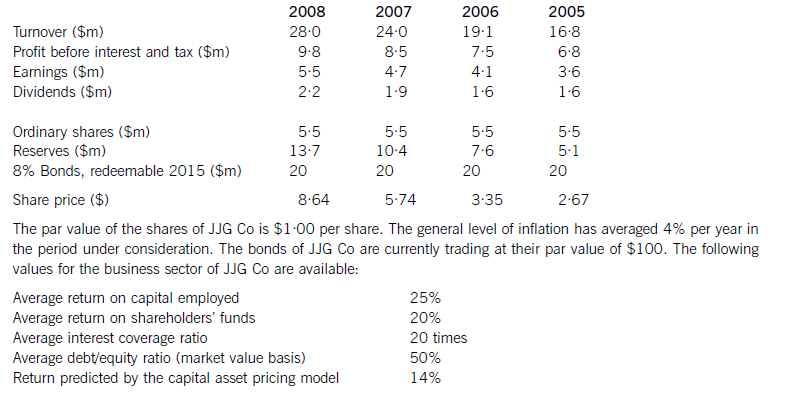
Required:
(a) Evaluate the financial performance of JJG Co, and analyse and discuss the extent to which the company has achieved its stated corporate objectives of:
(i) maximising the wealth of its shareholders;
(ii) achieving continuous growth in earnings per share.
Note: up to 7 marks are available for financial analysis.(12 marks)
(b) If the new finance is raised via a rights issue at $7·50 per share and the major expansion of business has
not yet begun, calculate and comment on the effect of the rights issue on:
(i) the share price of JJG Co;
(ii) the earnings per share of the company; and
(iii) the debt/equity ratio. (6 marks)
(c) Analyse and discuss the relative merits of a rights issue, a placing and an issue of bonds as ways of raising the finance for the expansion. (7 marks)
正确答案:
AchievementofcorporateobjectivesJJGCohasshareholderwealthmaximisationasanobjective.Thewealthofshareholdersisincreasedbydividendsreceivedandcapitalgainsonsharesowned.Totalshareholderreturncomparesthesumofthedividendreceivedandthecapitalgainwiththeopeningshareprice.TheshareholdersofJJGCohadareturnof58%in2008,comparedwithareturnpredictedbythecapitalassetpricingmodelof14%.Thelowestreturnshareholdershavereceivedwas21%andthehighestreturnwas82%.Onthisbasis,theshareholdersofthecompanyhaveexperiencedasignificantincreaseinwealth.Itisdebatablewhetherthishasbeenasaresultoftheactionsofthecompany,however.Sharepricesmayincreaseirrespectiveoftheactionsanddecisionsofmanagers,orevendespitethem.Infact,lookingatthedividendpersharehistoryofthecompany,therewasoneyear(2006)wheredividendswereconstant,eventhoughearningspershareincreased.Itisalsodifficulttoknowwhenwealthhasbeenmaximised.Anotherobjectiveofthecompanywastoachieveacontinuousincreaseinearningspershare.Analysisshowsthatearningspershareincreasedeveryyear,withanaverageincreaseof14·9%.Thisobjectiveappearstohavebeenachieved.CommentonfinancialperformanceReturnoncapitalemployed(ROCE)hasbeengrowingtowardsthesectoraverageof25%onayear-by-yearbasisfrom22%in2005.Thissteadygrowthintheprimaryaccountingratiocanbecontrastedwithirregulargrowthinturnover,thereasonsforwhichareunknown.Returnonshareholders’fundshasbeenconsistentlyhigherthantheaverageforthesector.ThismaybeduemoretothecapitalstructureofJJGCothantogoodperformancebythecompany,however,inthesensethatshareholders’fundsaresmalleronabookvaluebasisthanthelong-termdebtcapital.Ineverypreviousyearbut2008thegearingofthecompanywashigherthanthesectoraverage.(b)CalculationoftheoreticalexrightspershareCurrentshareprice=$8·64pershareCurrentnumberofshares=5·5millionsharesFinancetoberaised=$15mRightsissueprice=$7·50pershareNumberofsharesissued=15m/7·50=2millionsharesTheoreticalexrightspricepershare=((5·5mx8·64)+(2mx7·50))/7·5m=$8·34pershareThesharepricewouldfallfrom$8·64to$8·34pershareHowever,therewouldbenoeffectonshareholderwealthEffectofrightsissueonearningspershareCurrentEPS=100centspershareRevisedEPS=100x5·5m/7·5m=73centspershareTheEPSwouldfallfrom100centspershareto73centspershareHowever,asmentionedearlier,therewouldbenoeffectonshareholderwealthEffectofrightsissueonthedebt/equityratioCurrentdebt/equityratio=100x20/47·5=42%Revisedmarketvalueofequity=7·5mx8·34=$62·55millionReviseddebt/equityratio=100x20/62·55=32%Thedebt/equityratiowouldfallfrom42%to32%,whichiswellbelowthesectoraveragevalueandwouldsignalareductioninfinancialrisk(c)Thecurrentdebt/equityratioofJJGCois42%(20/47·5).Althoughthisislessthanthesectoraveragevalueof50%,itismoreusefulfromafinancialriskperspectivetolookattheextenttowhichinterestpaymentsarecoveredbyprofits.Theinterestonthebondissueis$1·6million(8%of$20m),givinganinterestcoverageratioof6·1times.IfJJGCohasoverdraftfinance,theinterestcoverageratiowillbelowerthanthis,butthereisinsufficientinformationtodetermineifanoverdraftexists.Theinterestcoverageratioisnotonlybelowthesectoraverage,itisalsolowenoughtobeacauseforconcern.Whiletheratioshowsanupwardtrendovertheperiodunderconsideration,itstillindicatesthatanissueoffurtherdebtwouldbeunwise.Aplacing,oranyissueofnewsharessuchasarightsissueorapublicoffer,woulddecreasegearing.Iftheexpansionofbusinessresultsinanincreaseinprofitbeforeinterestandtax,theinterestcoverageratiowillincreaseandfinancialriskwillfall.GiventhecurrentfinancialpositionofJJGCo,adecreaseinfinancialriskiscertainlypreferabletoanincrease.Aplacingwilldiluteownershipandcontrol,providingthenewequityissueistakenupbynewinstitutionalshareholders,whilearightsissuewillnotdiluteownershipandcontrol,providingexistingshareholderstakeuptheirrights.Abondissuedoesnothaveownershipandcontrolimplications,althoughrestrictiveornegativecovenantsinbondissuedocumentscanlimittheactionsofacompanyanditsmanagers.Allthreefinancingchoicesarelong-termsourcesoffinanceandsoareappropriateforalong-terminvestmentsuchastheproposedexpansionofexistingbusiness.Equityissuessuchasaplacingandarightsissuedonotrequiresecurity.Noinformationisprovidedonthenon-currentassetsofJJGCo,butitislikelythattheexistingbondissueissecured.Ifanewbondissuewasbeingconsidered,JJGCowouldneedtoconsiderwhetherithadsufficientnon-currentassetstoofferassecurity,althoughitislikelythatnewnon-currentassetswouldbeboughtaspartofthebusinessexpansion. -
第21题:
资料:Many people think of internal control as a means of safeguarding cash and preventing fraud. Although internal control is an important factor in protecting assets and preventing fraud, this is only a part of its roles. Remember that business decisions are based on accounting data and the system of internal control provides assurance of the dependability of the accounting data used in making decisions.
The decisions made by management are communicated throughout the organization and become company policy. The results of the policies-----the consequences of managerial decisions----must be reported back to management so that the soundness of company policies can be evaluated. Among the means of communication included in the system of internal control are organization charts, manuals of accounting policies and procedures, flow charts, financial forecasts, purchase orders, receiving reports, invoices, and other documents. The term documentation refers to all the charts, forms, reports, and other business papers that guide and describe the working of a company's system of accounting and internal control.
Internal controls fall into two major classes: administrative controls and accounting controls. Administrative controls are measures that increase operational efficiency and compliance with policies in all parts of organization. For example, an administrative control may be a requirement that traveling salespersons submit reports showing the number of calls made on customers each day. Another example is a directive require airline pilots to have regular medical examinations. These internal administrative controls have no direct bearing on the reliability of the financial statements. Consequently, administrative controls are not of direct interest on accountants and independent auditors.
Internal accounting controls are measures that relate to protection of assets and to the reliability of accounting and financial reports. An example is the requirement that a person whose duties involve handling cash shall not also maintain accounting records. More broadly stated, the accounting function must be kept separate from the custody of assets. Another accounting control is the requirement that checks, purchase orders, and other documents be serially numbered. Still another example is the rule that a person who orders merchandise and supplies should not be the one to receive them and should not sign checks to pay for them.
The results of managerial decisions must be reported back to managements so that ( )can be evaluated?A.The means of communication
B.The level of performance in all divisions of the company
C.The effectiveness of company policies
D.The financial reports答案:C解析:本题考查细节理解。
【关键词】The results of managerial decisions must be reported back to managements
【主题句】第2自然段The results of the policies-----the consequences of managerial decisions----must be reported back to management so that the soundness of company policies can be evaluated. 政策的结果-----管理层决定的执行结果-----必须被反馈给管理层,这样公司政策的合理性才能被评估。
【解析】题干意为“管理层决定的执行结果必须被反馈的原因是________”。选项A意为“交流的手段”;选项B意为“公司各部门的业绩水平”;选项C意为“公司政策的有效性”;选项D意为“财务报告”。根据主题句可知,管理层决定的执行结果必须被反馈后,公司政策的合理性才能被评估。故选项C符合题意。 -
第22题:
资料:Many people think of internal control as a means of safeguarding cash and preventing fraud. Although internal control is an important factor in protecting assets and preventing fraud, this is only a part of its roles. Remember that business decisions are based on accounting data and the system of internal control provides assurance of the dependability of the accounting data used in making decisions.
The decisions made by management are communicated throughout the organization and become company policy. The results of the policies-----the consequences of managerial decisions----must be reported back to management so that the soundness of company policies can be evaluated. Among the means of communication included in the system of internal control are organization charts, manuals of accounting policies and procedures, flow charts, financial forecasts, purchase orders, receiving reports, invoices, and other documents. The term documentation refers to all the charts, forms, reports, and other business papers that guide and describe the working of a company's system of accounting and internal control.
Internal controls fall into two major classes: administrative controls and accounting controls. Administrative controls are measures that increase operational efficiency and compliance with policies in all parts of organization. For example, an administrative control may be a requirement that traveling salespersons submit reports showing the number of calls made on customers each day. Another example is a directive require airline pilots to have regular medical examinations. These internal administrative controls have no direct bearing on the reliability of the financial statements. Consequently, administrative controls are not of direct interest on accountants and independent auditors.
Internal accounting controls are measures that relate to protection of assets and to the reliability of accounting and financial reports. An example is the requirement that a person whose duties involve handling cash shall not also maintain accounting records. More broadly stated, the accounting function must be kept separate from the custody of assets. Another accounting control is the requirement that checks, purchase orders, and other documents be serially numbered. Still another example is the rule that a person who orders merchandise and supplies should not be the one to receive them and should not sign checks to pay for them.
Which of the following is an example of internal accounting controls?( ).A.person is required to keep the custody of asset as well as accounting records.
B.person is required to order merchandise and supplies and to receive them as well.
C.person is required to handle cash and another one to maintain accounting records.
D.traveling salesperson is required to present reports showing the number of calls made on customers.答案:C解析:本题考查细节理解。
【关键词】an example of internal accounting controls
【主题句】第4自然段An example is the requirement that a person whose duties involve handling cash shall not also maintain accounting records. More broadly stated, the accounting function must be kept separate from the custody of assets. Still another example is the rule that a person who orders merchandise and supplies should not be the one to receive them and should not sign checks to pay for them. 举例来说,要求管理现金的人不能同时管理会计记录。更大范围来说,会计职能与资产监管必须分开。最后,负责采购与供应的和负责接受并签字支付的不能是同一人。
【解析】题干意为“下列哪一项是会计控制的例子?” 选项A意为“保管资产和管理会计记录应是同一人”;选项B意为“订购商品和用品与接收它们的应是同一人”;选项C意为“一个人处理现金,而另一个维护会计记录”;选项D意为“旅行销售员需要每天提交拨打客户电话数量”。根据主题句可知,选项A、B与原文不符,选项D是行政控制的例子,故选项C符合题意。 -
第23题:
资料:Many people think of internal control as a means of safeguarding cash and preventing fraud. Although internal control is an important factor in protecting assets and preventing fraud, this is only a part of its roles. Remember that business decisions are based on accounting data and the system of internal control provides assurance of the dependability of the accounting data used in making decisions.
The decisions made by management are communicated throughout the organization and become company policy. The results of the policies-----the consequences of managerial decisions----must be reported back to management so that the soundness of company policies can be evaluated. Among the means of communication included in the system of internal control are organization charts, manuals of accounting policies and procedures, flow charts, financial forecasts, purchase orders, receiving reports, invoices, and other documents. The term documentation refers to all the charts, forms, reports, and other business papers that guide and describe the working of a company's system of accounting and internal control.
Internal controls fall into two major classes: administrative controls and accounting controls. Administrative controls are measures that increase operational efficiency and compliance with policies in all parts of organization. For example, an administrative control may be a requirement that traveling salespersons submit reports showing the number of calls made on customers each day. Another example is a directive require airline pilots to have regular medical examinations. These internal administrative controls have no direct bearing on the reliability of the financial statements. Consequently, administrative controls are not of direct interest on accountants and independent auditors.
Internal accounting controls are measures that relate to protection of assets and to the reliability of accounting and financial reports. An example is the requirement that a person whose duties involve handling cash shall not also maintain accounting records. More broadly stated, the accounting function must be kept separate from the custody of assets. Another accounting control is the requirement that checks, purchase orders, and other documents be serially numbered. Still another example is the rule that a person who orders merchandise and supplies should not be the one to receive them and should not sign checks to pay for them.
An airline pilot having regular medical examinations is an example of( ).A.internal accounting controls
B.internal financial controls
C.administrative controls
D.external controls答案:C解析:本题考查细节理解。
【关键词】An airline pilot having regular medical examinations; an example of
【主题句】第3自然段For example, an administrative control may be a requirement that traveling salespersons submit reports showing the number of calls made on customers each day. Another example is a directive require airline pilots to have regular medical examinations. 举例来说,行政控制可能是要求旅行销售员每天提交拨打客户电话数量;另一个例子是要求飞机驾驶员定期体检。
【解析】题干意为“飞机驾驶员定期体检是________的例子”。选项A意为“内部会计控制”;选项B意为“内部财务控制”;选项C意为“管理控制”;选项D意为“外部控制”。根据主题句可知,飞行员要定期进行体检是举例说明行政控制的,故选项C符合题意。