
(ii) Explain why Galileo is able to pay the inheritance tax due in instalments, state when the instalments aredue and identify any further issues relevant to Galileo relating to the payments. (3 marks)
题目
(ii) Explain why Galileo is able to pay the inheritance tax due in instalments, state when the instalments are
due and identify any further issues relevant to Galileo relating to the payments. (3 marks)
相似考题
参考答案和解析
(ii) Payment by instalments
The inheritance tax can be paid by instalments because Messier Ltd is an unquoted company controlled by Kepler at
the time of the gift and is still unquoted at the time of his death.
The tax is due in ten equal annual instalments starting on 30 November 2008.
Interest will be charged on any instalments paid late; otherwise the instalments will be interest free because Messier is
a trading company that does not deal in property or financial assets.
All of the outstanding inheritance tax will become payable if Galileo sells the shares in Messier Ltd.
Tutorial note
Candidates were also given credit for stating that payment by instalments is available because the shares represent at
least 10% of the company’s share capital and are valued at £20,000 or more.
更多“(ii) Explain why Galileo is able to pay the inheritance tax due in instalments, state when the instalments aredue and identify any further issues relevant to Galileo relating to the payments. (3 marks)”相关问题
-
第1题:
(b) Explain the capital gains tax (CGT) and inheritance tax (IHT) implications of Graeme gifting his remaining ‘T’
ordinary shares at their current value either:
(i) to his wife, Catherine; or
(ii) to his son, Barry.
Your answer should be supported by relevant calculations and clearly identify the availability and effect of
any reliefs (other than the CGT annual exemption) that might be used to reduce or defer any tax liabilities
arising. (9 marks)
正确答案: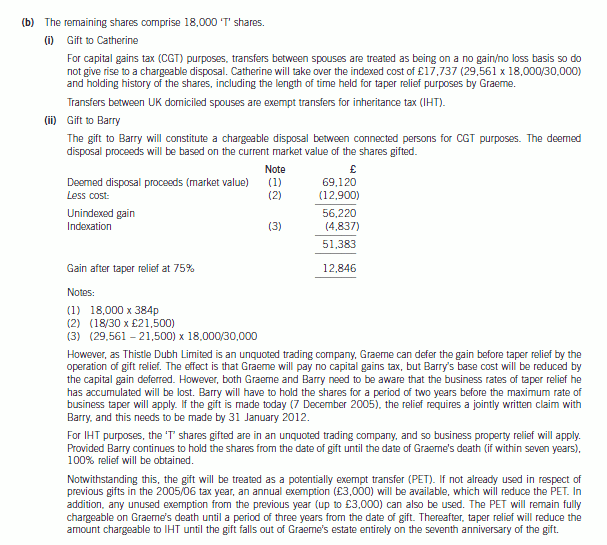
-
第2题:
(ii) State when the inheritance tax (IHT) calculated in (i) would be payable and by whom. (2 marks)
正确答案:
(ii) Inheritance tax administration
The tax on Debbie’s estate (personalty and realty) would be paid by the personal representatives, usually an executor.
Inheritance tax is due six months from the end of the month in which death occurred (31 December 2005) or the date
on which probate is obtained (if earlier). However, an instalment option is available for certain assets, which includes
land and buildings i.e. the residence whereby the tax can be paid in 10 equal annual instalments. -
第3题:
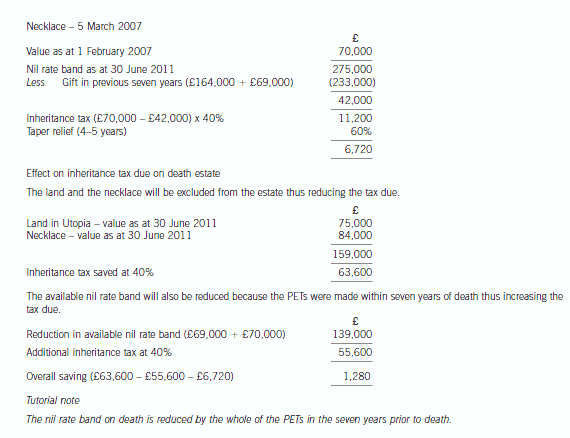
(b) Mabel has two objectives when making the gifts to Bruce and Padma:
(1) To pay no tax on any gift in her lifetime; and
(2) To reduce the eventual liability to inheritance tax on her death.
Advise Mabel which item to gift to Bruce and to Padma in order to satisfy her objectives. Give reasons for
your advice.
Your advice should include a computation of the inheritance tax saved as a result of the two gifts, on the
assumption that Mabel dies on 30 June 2011. (10 marks)
正确答案: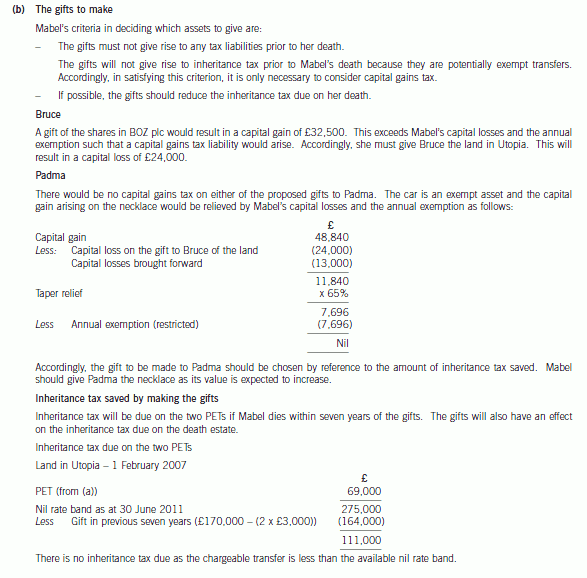
-
第4题:
(b) Explain by reference to Hira Ltd’s loss position why it may be beneficial for it not to claim any capital
allowances for the year ending 31 March 2007. Support your explanation with relevant calculations.
(6 marks)
正确答案:
(b) The advantage of Hira Ltd not claiming any capital allowances
In the year ending 31 March 2007 Hira Ltd expects to make a tax adjusted trading loss, before deduction of capital
allowances, of £55,000 and to surrender the maximum amount possible of trading losses to Belgrove Ltd and Dovedale Ltd.
For the first nine months of the year from 1 April 2006 to 31 December 2006 Hira Ltd is in a loss relief group with Belgrove
Ltd. The maximum surrender to Belgrove Ltd for this period is the lower of:
– the available loss of £41,250 (£55,000 x 9/12); and
– the profits chargeable to corporation tax of Belgrove of £28,500 (£38,000 x 9/12).
i.e. £28,500. This leaves losses of £12,750 (£41,250 – £28,500) unrelieved.
For the remaining three months from 1 January 2007 to 31 March 2007 Hira Ltd is a consortium company because at least
75% of its share capital is owned by companies, each of which own at least 5%. It can surrender £8,938 (£55,000 x 3/12
x 65%) to Dovedale Ltd and £4,812 (£55,000 x 3/12 x 35%) to Belgrove Ltd as both companies have sufficient taxable
profits to offset the losses. Accordingly, there are no losses remaining from the three-month period.
The unrelieved losses from the first nine months must be carried forward as Hira Ltd has no income or gains in that year or
the previous year. However, the losses cannot be carried forward beyond 1 January 2007 (the date of the change of
ownership of Hira Ltd) if there is a major change in the nature or conduct of the trade of Hira Ltd. Even if the losses can be
carried forward, the earliest year in which they can be relieved is the year ending 31 March 2009 as Hira Ltd is expected to
make a trading loss in the year ending 31 March 2008.
Any capital allowances claimed by Hira Ltd in the year ending 31 March 2007 would increase the tax adjusted trading loss
for that year and consequently the unrelieved losses arising in the first nine months.
If the capital allowances are not claimed, the whole of the tax written down value brought forward of £96,000 would be
carried forward to the year ending 31 March 2008 thus increasing the capital allowances and the tax adjusted trading loss,
for that year. By not claiming any capital allowances, Hira Ltd can effectively transfer a current period trading loss, which
would be created by capital allowances, of £24,000 (25% x £96,000) from the year ending 31 March 2007 to the following
year where it can be surrendered to the two consortium members. -
第5题:
(ii) Explain, with reasons, the relief available in respect of the fall in value of the shares in All Over plc,
identify the years in which it can be claimed and state the time limit for submitting the claim.
(3 marks)
正确答案: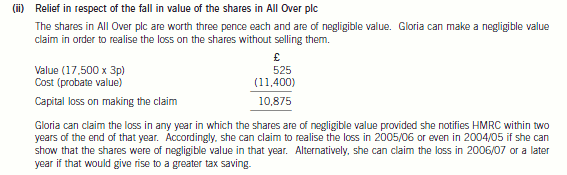
-
第6题:
(c) Explain the capital gains tax (CGT) and income tax (IT) issues Paul and Sharon should consider in deciding
which form. of trust to set up for Gisella and Gavin. You are not required to consider inheritance tax (IHT) or
stamp duty land tax (SDLT) issues. (10 marks)
You should assume that the tax rates and allowances for the tax year 2005/06 apply throughout this question.
正确答案:
(c) As the trust is created in the settlors’ (Paul and Sharon’s) lifetime its creation will constitute a chargeable disposal for capital
gains tax. Also, as the settlors and trustees are connected persons, the disposal will be deemed to be at market value, resulting
in a chargeable gain of £80,000 (160,000 – 80,000). No taper relief will be available as the property is a non-business
asset, and has been held for less than three years, but annual exemptions of £17,000 (2 x £8,500) will be available.
However, in the case of a discretionary trust, gift hold over relief will be available. This is because the gift will constitute a
chargeable lifetime transfer and because there is an immediate charge to inheritance tax (even though no tax is payable due
to the nil rate band) relief is available if a specific accumulation and maintenance trust is used, as in this case the gift will
qualify as a potentially exempt transfer and so gift relief would only be available in respect of business assets. The use of a
basic discretionary trust will thus facilitate the deferral of an immediate capital gains tax charge of £25,200 (63,000 x 40%).
If/when the property is disposed of, however, the trustees will pay capital gains tax on the deferred gain at the trust income
tax rate of 40%, and have an annual exemption of only £4,250 (50% of the normal individual rate) available to them. The
40% rate of tax and lower annual exemption rate also apply to chargeable gains arising in a specific accumulation and
maintenance trust, as well as a basic discretionary trust.
A chargeable disposal between connected persons will also arise for the purposes of capital gains tax if/when the property
vests in a beneficiary, i.e. one or more of the beneficiaries becomes absolutely entitled to all or part of the income or capital
of the trust. Gift hold over relief will again be available on all assets in the case of a discretionary trust, but only on business
assets in the case of an accumulation and maintenance trust, except where a beneficiary becomes entitled to both income
and capital at the same time.
The trust will have taxable property income in the form. of net rents from its creation and in future years is also likely to have
other investment income, probably in the form. of interest, to the extent that monies are retained in the trust. Whichever form
of trust is used, the trustees will pay tax at the standard trust rate of 40% on income other than dividend income (32·5%),
except to the extent of (1) the first £500 of taxable income, which is taxed at the rate that would otherwise apply to such
income (i.e. 22% for non-savings (rental) income, 20% for savings income (interest) and 10% for dividends) but, only to the
extent that it is not distributed; and (2) the legitimate trust management expenses, which are offsettable for the purposes of
the higher trust tax rates against the income with the lowest rate(s) of normal tax and so bear tax only at that rate. The higher
trust tax rate always applies to income that is distributed, other than to the extent that it has been treated as the settlor’s
income, and taxed at that settlor’s marginal tax rate.
As Paul and Sharon intend to create a trust for their unmarried minor (under 18) children, then even if the trust specifically
excludes them from any benefit under the trust, the trust income will be treated as theirs for income tax purposes to the extent
that it constitutes income paid for on behalf (including maintenance payments) of Gisella and Gavin; except where (1) the
total income arising does not exceed £100 gross per annum, and (2) income is held for the benefit of a child under an
accumulation and maintenance settlement, to the extent that it is not paid out. -
第7题:
(c) Briefly outline the corporation tax (CT) issues that Tay Limited should consider when deciding whether to
acquire the shares or the assets of Tagus LDA. You are not required to discuss issues relating to transfer
pricing. (7 marks)
正确答案:
(c) (1) Acquisition of shares
Status
The acquisition of shares in Tagus LDA will add another associated company to the group. This may have an adverse
effect on the rates of corporation tax paid by the two existing group companies, particularly Tay Limited.
Taxation of profits
Profits will be taxed in Portugal. Any profits remitted to the UK as dividends will be taxable as Schedule D Case V income,
but will attract double tax relief. Double tax relief will be available against two types of tax suffered in Portugal. Credit
will be given for any tax withheld on payments from Tagus LDA to Tay Limited and relief will also be available for the
underlying tax as Tay Limited owns at least 10% of the voting power of Tagus LDA. The underlying tax is the tax
attributable to the relevant profits from which the dividend was paid. Double tax relief is given at the lower rate of the
UK tax and the foreign tax (withholding and underlying taxes) suffered.
Losses
As Tagus LDA is a non-UK resident company, losses arising in Tagus LDA cannot be group relieved against profits of the
two UK companies. Similarly, any UK trading losses cannot be used against profits generated by Tagus LDA.
(2) Acquisition of assets
Status
The business of Tagus will be treated as a branch of Tay Limited i.e. an extension of the UK company’s activities. The
number of associated companies will be unaffected.
Taxation of profits
Tay Limited will be treated as having a permanent establishment in Portugal. Profits attributable to the Tagus business
will thus still be taxed in Portugal. In addition, the profits will be taxed in the UK as trading income. Double tax relief
will be available for the tax already suffered in Portugal at the lower of the two rates.
Capital allowances will be available. As the assets in question will not previously have been subject to a claim for UK
capital allowances, there will be no cost restriction and the consideration attributable to each asset will form. the basis
for the capital allowance claim.
Losses
The Tagus trade is part of Tay Limited’s trade, so any losses incurred by the Portuguese trade will automatically be offset
against the trading profits of the UK trade, and vice versa. -
第8题:
(c) (i) Explain the inheritance tax (IHT) implications and benefits of Alvaro Pelorus varying the terms of his
father’s will such that part of Ray Pelorus’s estate is left to Vito and Sophie. State the date by which a
deed of variation would need to be made in order for it to be valid; (3 marks)
正确答案:
(c) (i) Variation of Ray’s will
The variation by Alvaro of Ray’s will, such that assets are left to Vito and Sophie, will not be regarded as a gift by Alvaro.
Instead, provided the deed states that it is intended to be effective for IHT purposes, it will be as if Ray had left the assets
to the children in his will.
This strategy, known as skipping a generation, will have no effect on the IHT due on Ray’s death but will reduce the
assets owned by Alvaro and thus his potential UK IHT liability. A deed of variation is more tax efficient than Alvaro
making gifts to the children as such gifts would be PETs and IHT may be due if Alvaro were to die within seven years.
The deed of variation must be entered into by 31 January 2009, i.e. within two years of the date of Ray’s death. -
第9题:
(ii) Explain how the inclusion of rental income in Coral’s UK income tax computation could affect the
income tax due on her dividend income. (2 marks)
You are not required to prepare calculations for part (b) of this question.
Note: you should assume that the tax rates and allowances for the tax year 2006/07 and for the financial year to
31 March 2007 will continue to apply for the foreseeable future.
正确答案:
(ii) The effect of taxable rental income on the tax due on Coral’s dividend income
Remitting rental income to the UK may cause some of Coral’s dividend income currently falling within the basic rate
band to fall within the higher rate band. The effect of this would be to increase the tax on the gross dividend income
from 0% (10% less the 10% tax credit) to 221/2% (321/2% less 10%).
Tutorial note
It would be equally acceptable to state that the effective rate of tax on the dividend income would increase from 0%
to 25%. -
第10题:
(c) (i) Explain how Messier Ltd can assist Galileo with the cost of relocating to the UK and/or provide him with
interest-free loan finance for this purpose without increasing his UK income tax liability; (3 marks)
正确答案:
(c) (i) Relocation costs
Direct assistance
Messier Ltd can bear the cost of certain qualifying relocation costs of Galileo up to a maximum of £8,000 without
increasing his UK income tax liability. Qualifying costs include the legal, professional and other fees in relation to the
purchase of a house, the costs of travelling to the UK and the cost of transporting his belongings. The costs must be
incurred before the end of the tax year following the year of the relocation, i.e. by 5 April 2010.
Assistance in the form. of a loan
Messier Ltd can provide Galileo with an interest-free loan of up to £5,000 without giving rise to any UK income tax. -
第11题:
(ii) Identify and explain the principal audit procedures to be performed on the valuation of the investment
properties. (6 marks)
正确答案:
(ii) Additional audit procedures
Audit procedures should focus on the appraisal of the work of the expert valuer. Procedures could include the following:
– Inspection of the written instructions provided by Poppy Co to the valuer, which should include matters such as
the objective and scope of the valuer’s work, the extent of the valuer’s access to relevant records and files, and
clarification of the intended use by the auditor of their work.
– Evaluation, using the valuation report, that any assumptions used by the valuer are in line with the auditor’s
knowledge and understanding of Poppy Co. Any documentation supporting assumptions used by the valuer should
be reviewed for consistency with the auditor’s business understanding, and also for consistency with any other
audit evidence.
– Assessment of the methodology used to arrive at the fair value and confirmation that the method is consistent with
that required by IAS 40.
– The auditor should confirm, using the valuation report, that a consistent method has been used to value each
property.
– It should also be confirmed that the date of the valuation report is reasonably close to the year end of Poppy Co.
– Physical inspection of the investment properties to determine the physical condition of the properties supports the
valuation.
– Inspect the purchase documentation of each investment property to ascertain the cost of each building. As the
properties were acquired during this accounting period, it would be reasonable to expect that the fair value at the
year end is not substantially different to the purchase price. Any significant increase or decrease in value should
alert the auditor to possible misstatement, and lead to further audit procedures.
– Review of forecasts of rental income from the properties – supporting evidence of the valuation.
– Subsequent events should be monitored for any additional evidence provided on the valuation of the properties.
For example, the sale of an investment property shortly after the year end may provide additional evidence relating
to the fair value measurement.
– Obtain a management representation regarding the reasonableness of any significant assumptions, where relevant,
to fair value measurements or disclosures. -
第12题:
James died on 22 January 2015. He had made the following gifts during his lifetime:
(1) On 9 October 2007, a cash gift of £35,000 to a trust. No lifetime inheritance tax was payable in respect of this gift.
(2) On 14 May 2013, a cash gift of £420,000 to his daughter.
(3) On 2 August 2013, a gift of a property valued at £260,000 to a trust. No lifetime inheritance tax was payable in respect of this gift because it was covered by the nil rate band. By the time of James’ death on 22 January 2015, the property had increased in value to £310,000.
On 22 January 2015, James’ estate was valued at £870,000. Under the terms of his will, James left his entire estate to his children.
The nil rate band of James’ wife was fully utilised when she died ten years ago.
The nil rate band for the tax year 2007–08 is £300,000, and for the tax year 2013–14 it is £325,000.
Required:
(a) Calculate the inheritance tax which will be payable as a result of James’ death, and state who will be responsible for paying the tax. (6 marks)
(b) Explain why it might have been beneficial for inheritance tax purposes if James had left a portion of his estate to his grandchildren rather than to his children. (2 marks)
(c) Explain why it might be advantageous for inheritance tax purposes for a person to make lifetime gifts even when such gifts are made within seven years of death.
Notes:
1. Your answer should include a calculation of James’ inheritance tax saving from making the gift of property to the trust on 2 August 2013 rather than retaining the property until his death.
2. You are not expected to consider lifetime exemptions in this part of the question. (2 marks)
正确答案:(a) James – Inheritance tax arising on death
Lifetime transfers within seven years of death
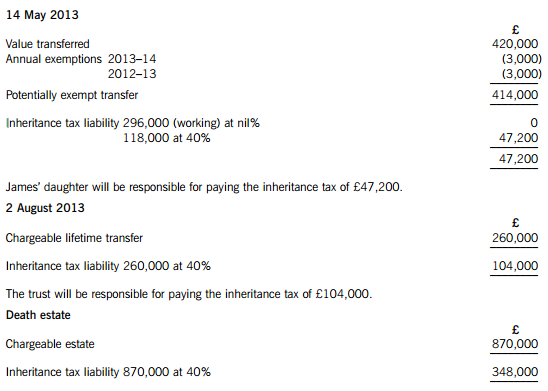
The personal representatives of James’ estate will be responsible for paying the inheritance tax of £348,000.
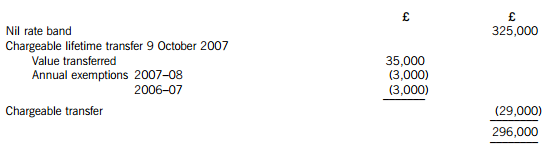
Working – Available nil rate band
(b) Skipping a generation avoids a further charge to inheritance tax when the children die. Gifts will then only be taxed once before being inherited by the grandchildren, rather than twice.
(c) (1) Even if the donor does not survive for seven years, taper relief will reduce the amount of IHT payable after three years.
(2) The value of potentially exempt transfers and chargeable lifetime transfers are fixed at the time they are made.
(3) James therefore saved inheritance tax of £20,000 ((310,000 – 260,000) at 40%) by making the lifetime gift of property.
-
第13题:
(ii) State, giving reasons, the tax reliefs in relation to inheritance tax (IHT) and capital gains tax (CGT) which
would be available to Alasdair if he acquires the warehouse and leases it to Gallus & Co, rather than to
an unconnected tenant. (4 marks)
正确答案:
(ii) Apart from the fact that Alasdair can keep an eye on his tenant, the main advantages are twofold:
IHT: If the firm are the tenants, the property will be land and buildings used in a business carried on by a partnership
in which the donor is a partner. Thus, Alasdair will be able to claim business property relief (BPR) at a rate of 50%
so long as he remains a partner in the firm. However, this relief would not be available until Alasdair has owned
the property for at least two years from his firm taking up the tenancy.
CGT: As Alasdair is a partner in the firm using the building, it will also be a qualifying asset for the purposes of rollover
relief on any gains arising from the disposal of the property. Assuming that Alasdair acquires a replacement asset
which will be used in the trade, the gain on sale can be deferred against the tax base cost of the replacement asset.
In the event that rollover relief cannot be used, any gains on disposal will be subject to business asset taper relief. -
第14题:
(ii) Explain the income tax (IT), national insurance (NIC) and capital gains tax (CGT) implications arising on
the grant to and exercise by an employee of an option to buy shares in an unapproved share option
scheme and on the subsequent sale of these shares. State clearly how these would apply in Henry’s
case. (8 marks)
正确答案:
(ii) Exercising of share options
The share option is not part of an approved scheme, and will not therefore enjoy the benefits of such a scheme. There
are three events with tax consequences – grant, exercise and sale.
Grant. If shares or options over shares are sold or granted at less than market value, an income tax charge can arise on
the difference between the price paid and the market value. [Weight v Salmon]. In addition, if options can be exercised
more than 10 years after the date of the grant, an employment income charge can arise. This is based on the market
value at the date of grant less the grant and exercise priced.
In Henry’s case, the options were issued with an exercise price equal to the then market value, and cannot be exercised
more than 10 years from the grant. No income tax charge therefore arises on grant.
Exercise. On exercise, the individual pays the agreed amount in return for a number of shares in the company. The price
paid is compared with the open market value at that time, and if less, the difference is charged to income tax. National
insurance also applies, and the company has to pay Class 1 NIC. If the company and shareholder agree, the national
insurance can be passed onto the individual, and the liability becomes a deductible expense in calculating the income
tax charge.
In Henry’s case on exercise, the difference between market value (£14) and the price paid (£1) per share will be taxed
as income. Therefore, £130,000 (10,000 x (£14 – £1)) will be taxed as income. In addition, national insurance will
be chargeable on the company at 12·8% (£16,640) and on Henry at the rate of 1% (£1,300).
Sale. The base cost of the shares is taken to be the market value at the time of exercise. On the sale of the shares, any
gain or loss arising falls under the capital gains tax rules, and CGT will be payable on any gain. Business asset taper
relief will be available as the company is an unquoted trading company, but the relief will only run from the time that
the share options are exercised – i.e. from the time when the shares were acquired.
In Henry’s case, the sale of the shares will immediately follow the exercise of the option (6 days later). The sale proceeds
and the market value at the time of exercise are likely to be similar; thus little to no gain is likely to arise. -
第15题:
(c) Without changing the advice you have given in (b), or varying the terms of Luke’s will, explain how Mabel
could further reduce her eventual inheritance tax liability and quantify the tax saving that could be made.
(3 marks)
The increase in the retail prices index from April 1984 to April 1998 is 84%.
You should assume that the rates and allowances for the tax year 2005/06 will continue to apply for the
foreseeable future.
正确答案:
(c) Further advice
Mabel should consider delaying one of the gifts until after 1 May 2007 such that it is made more than seven years after the
gift to the discretionary trust. Both PETs would then be covered by the nil rate band resulting in a saving of inheritance tax
of £6,720 (from (b)).
Mabel should ensure that she uses her inheritance tax annual exemption of £3,000 every year by, say, making gifts of £1,500
each year to both Bruce and Padma. The effect of this will be to save inheritance tax of £1,200 (£3,000 x 40%) every year. -
第16题:
(ii) Compute the annual income tax saving from your recommendation in (i) above as compared with the
situation where Cindy retains both the property and the shares. Identify any other tax implications
arising from your recommendation. Your answer should consider all relevant taxes. (3 marks)
正确答案: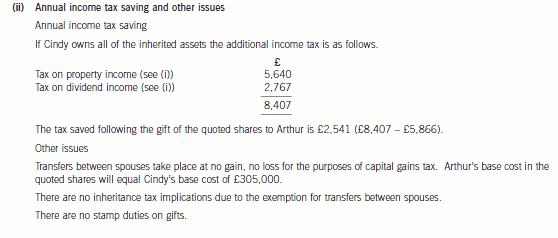
-
第17题:
(d) Explain how Gloria would be taxed in the UK on the dividends paid by Bubble Inc and the capital gains tax
and inheritance tax implications of a future disposal of the shares. Clearly state, giving reasons, whether or
not the payment made to Eric is allowable for capital gains tax purposes. (9 marks)
You should assume that the rates and allowances for the tax year 2005/06 apply throughout this question.
正确答案:
(d) UK tax implications of shares in Bubble Inc
Income tax
Gloria is UK resident and is therefore subject to income tax on her worldwide income. However, because she is non-UK
domiciled, she will only be taxed on the foreign dividends she brings into the UK.
Dividends brought into the UK will be grossed up for any tax paid in Oceania. The gross amount is taxed at 10% if it falls
into the starting or basic rate band and at 321/2% if it falls into the higher rate band. The tax suffered in Oceania is available
for offset against the UK tax liability. The offset is restricted to a maximum of the UK tax on the dividend income.
Capital gains tax
Individuals are subject to capital gains tax on worldwide assets if they are resident or ordinarily resident in the UK. However,
because Gloria is non-UK domiciled and the shares are situated abroad, the gain is only taxable to the extent that the sales
proceeds are brought into the UK. Any tax suffered in Oceania in respect of the gain is available for offset against the UK
capital gains tax liability arising on the shares.
Any loss arising on the disposal of the shares would not be available for relief in the UK.
In computing a capital gain or allowable loss, a deduction is available for the incidental costs of acquisition. However, to be
allowable, such costs must be incurred wholly and exclusively for the purposes of acquiring the asset. The fee paid to Eric
related to general investment advice and not to the acquisition of the shares and therefore, would not be deductible in
computing the gain.
Taper relief will be at non-business asset rates as Bubble Inc is an investment company.
Inheritance tax
Assets situated abroad owned by non-UK domiciled individuals are excluded property for the purposes of inheritance tax.
However, Gloria will be deemed to be UK domiciled (for the purposes of inheritance tax only) if she has been resident in the
UK for 17 out of the 20 tax years ending with the year in which the disposal occurs.
Gloria has been running a business in the UK since June 1992 and would therefore, appear to have been resident for at least
15 tax years (1992/93 to 2006/07 inclusive).
If Gloria is deemed to be UK domiciled such that the shares in Bubble Inc are not excluded property, business property relief
will not be available because Bubble Inc is an investment company. -
第18题:
(iii) State the value added tax (VAT) and stamp duty (SD) issues arising as a result of inserting Bold plc as
a holding company and identify any planning actions that can be taken to defer or minimise these tax
costs. (4 marks)
You should assume that the corporation tax rates for the financial year 2005 and the income tax rates
and allowances for the tax year 2005/06 apply throughout this question.
正确答案:
(iii) Bold plc will be making a taxable supply of services, likely to exceed the VAT threshold. It should therefore consider
registering for VAT – either immediately on a voluntary basis, or when its cumulative taxable supplies in the previous
twelve months exceed £60,000.
As an alternative, the new group can apply for a group VAT registration. This will simplify its VAT administration as intragroup
transactions are broadly disregarded for VAT purposes, and only one VAT return is required for the group as a
whole.
Stamp duty normally applies at 0·5% on the consideration payable in respect of transactions in shares. However, an
exemption is available in the case of a takeover, reconstruction or amalgamation where there is no real change in
ownership, i.e. the new shareholdings mirror the old shareholdings, and the transaction is for commercial purposes. The
insertion of a new holding company over an existing company, as proposed here, would qualify for this exemption.
There is no VAT on transactions in shares. -
第19题:
(ii) Advise Andrew of the tax implications arising from the disposal of the 7% Government Stock, clearly
identifying the tax year in which any liability will arise and how it will be paid. (3 marks)
正确答案:
(ii) Government stock is an exempt asset for the purposes of capital gains tax, however, as Andrew’s holding has a nominal
value in excess of £5,000, a charge to income tax will arise under the accrued income scheme. This charge to income
tax will arise in 2005/06, being the tax year in which the next interest payment following disposal falls due (20 April
2005) and it will relate to the income accrued for the period 21 October 2004 to 14 March 2005 of £279 (145/182
x £350). As interest on Government Stock is paid gross (unless the holder applies to receive it net), the tax due of £112
(£279 x 40%) will be collected via the self-assessment system and as the interest was an ongoing source of income
will be included within Andrew’s half yearly payments on account payable on 31 January and 31 July 2006. -
第20题:
(ii) Any increase or decrease in the group’s budgeted corporation tax liability for the year ending 30 June
2008 due to the restructuring on the assumption that trading losses will be used as efficiently as
possible. (8 marks)
正确答案:(ii) The budgeted corporation tax liability for the year ending 30 June 2008
Following the proposed restructuring, Rapier Ltd will be carrying on four separate trades. The current year loss arising
in the Dirk trade can be offset against its total profits. Its three subsidiaries will be dormant and will not be associates
for the purpose of determining the rate of corporation tax.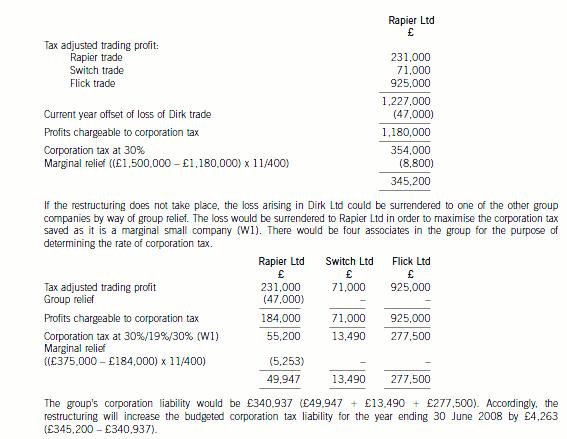
-
第21题:
(b) State the immediate tax implications of the proposed gift of the share portfolio to Avril and identify an
alternative strategy that would achieve Crusoe’s objectives whilst avoiding a possible tax liability in the
future. State any deadline(s) in connection with your proposed strategy. (5 marks)
正确答案:
(b) Gift of the share portfolio to Avril
Inheritance tax
The gift would be a potentially exempt transfer at market value. No inheritance tax would be due at the time of the gift.
Capital gains tax
The gift would be a disposal by Crusoe deemed to be made at market value for the purposes of capital gains tax. No gain
would arise as the deemed proceeds will equal Crusoe’s base cost of probate value.
Stamp duty
There is no stamp duty on a gift of shares for no consideration.
Strategy to avoid a possible tax liability in the future
Crusoe should enter into a deed of variation directing the administrators to transfer the shares to Avril rather than to him. This
will not be regarded as a gift by Crusoe. Instead, provided the deed states that it is intended to be effective for inheritance tax
purposes, it will be as if Noland had left the shares to Avril in a will.
This strategy is more tax efficient than Crusoe gifting the shares to Avril as such a gift would be a potentially exempt transfer
and inheritance tax may be due if Crusoe were to die within seven years.
The deed of variation must be entered into by 1 October 2009, i.e. within two years of the date of Noland’s death. -
第22题:
(ii) State, with reasons, whether Messier Ltd can provide Galileo with accommodation in the UK without
giving rise to a UK income tax liability. (2 marks)
正确答案:
(ii) Tax-free accommodation
It is not possible for Messier Ltd to provide Galileo with tax-free accommodation. The provision of accommodation by an
employer to an employee will give rise to a taxable benefit unless it is:
– necessary for the proper performance of the employee’s duties, e.g. a caretaker; or
– for the better performance of the employee’s duties and customary, e.g. a hotel manager; or
– part of arrangements arising out of threats to the employee’s security, e.g. a government minister.
As a manager of Messier Ltd Galileo is unable to satisfy any of the above conditions. -
第23题:
(ii) Identify and explain the potential financial statement risks caused by the breach of planning regulations
discussed in the press cutting. (6 marks)
正确答案:
(ii) Several significant financial statement risks are indicated by the press cutting.
Overstatement of property, plant and equipment
Medix Co has constructed a research laboratory which is likely to be impaired at the year end. The local authority has
the power to shut down the facility, and it is clear from the press cutting that this is likely to happen before the year end.
Following IAS 36 Impairment of Assets, the premises should be written down to recoverable amount, and the
impairment loss recognised as an expense. The directors should carry out an impairment review before the year end. If
the premises cannot be used as intended then the recoverable amount (measured using the higher of value in use and
fair value less selling cost) is likely to be less than current carrying value. In this case, assuming the local authority is
successful in shutting down the research laboratory, the recoverable amount is likely to be nil, as the premises have no
value in use, as it will never be used commercially, and has no market value as it is likely to be demolished.
In addition, any tangible assets such as laboratory equipment located at the premises should be tested for impairment
as if the company cannot use the premises then the assets contained within it are likely to have a lower recoverable
amount than carrying value.
Contingency – fines or penalties imposed by local authority
The press cutting indicates that Medix Co has been sued before, and that the local authority may again take legal action
against the company. IAS 37 Provisions, Contingent Liabilities and Contingent Assets states that a provision should be
recognised if the company has a probable obligation at the year end which can be measured reliably. If payment is
deemed only possible at the year end, then disclosure of the contingent liability should be made in a note to the financial
statements.
If the local authority commences legal proceedings against Medix Co before the year end of 30 June 2008, then
management should assess the probability of payment. The financial statement risk is not recognising a provision (and
associated expense within the income statement), or not disclosing a contingency.
Demolition costs
The local authority may require Medix Co to demolish the premises. If this demand is made before the year end, Medix
Co should recognise a provision for demolition costs as an unavoidable legal obligation would have been created. The
financial statement risk is that in this situation, Medix Co fails to recognise a provision and associated expense within
the income statement.
Going concern
The above issues could indicate that the company may not continue in operational existence. The potential lack of
disclosure of these issues represents a financial statement risk.