
(c) Explain how absolutist (dogmatic) and relativist (pragmatic) ethical assumptions would affect the outcomeof Anne’s decision. (6 marks)
题目
(c) Explain how absolutist (dogmatic) and relativist (pragmatic) ethical assumptions would affect the outcome
of Anne’s decision. (6 marks)
相似考题
更多“(c) Explain how absolutist (dogmatic) and relativist (pragmatic) ethical assumptions would affect the outcomeof Anne’s decision. (6 marks)”相关问题
-
第1题:
(b) Explain how the process of developing scenarios might help John better understand the macro-environmental
factors influencing Airtite’s future strategy. (8 marks)
正确答案:(b) Carrying out a systematic PESTEL analysis is a key step in developing alternative scenarios about the future. Johnson and
Scholes define scenarios as ‘detailed and plausible views of how the business environment of an organisation might develop
in the future based on groupings of key environmental influences and drivers of change about which there is a high level of
uncertainty’. In developing scenarios it is necessary to isolate the key drivers of change, which have the potential to have a
significant impact on the company and are associated with high levels of uncertainty. Development of scenarios enables
managers to share assumptions about the future and the key variables shaping that future. This provides an opportunity for
real organisational learning. They are then in a position to monitor these key variables and amend strategies accordingly. It
is important to note that different stakeholder groups will have different expectations about the future and each may provide
a key input to the process of developing scenarios. By their very nature scenarios should not attempt to allocate probabilities
to the key factors and in so doing creating ‘spurious accuracy’ about those factors. A positive scenario is shown below and
should provide a shared insight into the external factors most likely to have a significant impact on Airtite‘s future strategy.
For most companies operating in global environments the ability to respond flexibly and quickly to macro-environmental
change would seem to be a key capability.
The scenario as illustrated below, clearly could have a major impact on the success or otherwise of Airtite’s strategy for the
future. The key drivers for change would seem to be the link between technology and global emissions, fuel prices and the
stability of the global political environment. Through creating a process which considers the drivers which will have most
impact on Airtite and which are subject to the greatest uncertainty, Airtite will have a greater chance of its strategy adaptingto changing circumstances.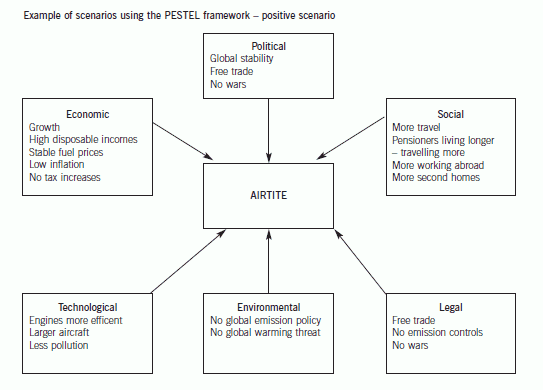
-
第2题:
(b) Compare and contrast Gray, Owen and Adams’s ‘pristine capitalist’ position with the ‘social contractarian’
position. Explain how these positions would affect responses to stakeholder concerns in the new stadium
project. (8 marks)
正确答案: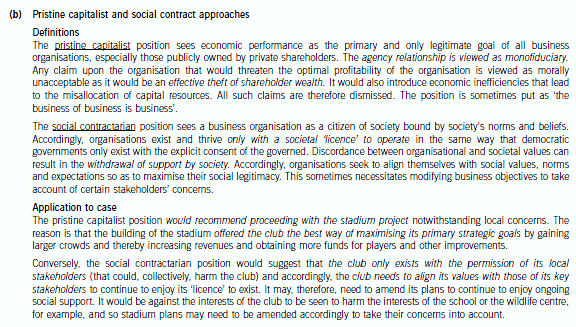
-
第3题:
(c) Mr Cobar, the chief executive of SHC, has decided to draft two alternative statements to explain both possible
outcomes of the secrecy/licensing decision to shareholders. Once the board has decided which one to pursue,
the relevant draft will be included in a voluntary section of the next corporate annual report.
Required:
(i) Draft a statement in the event that the board chooses the secrecy option. It should make a convincing
business case and put forward ethical arguments for the secrecy option. The ethical arguments should
be made from the stockholder (or pristine capitalist) perspective. (8 marks)
(ii) Draft a statement in the event that the board chooses the licensing option. It should make a convincing
business case and put forward ethical arguments for the licensing option. The ethical arguments should
be made from the wider stakeholder perspective. (8 marks)
(iii) Professional marks for the persuasiveness and logical flow of arguments: two marks per statement.
(4 marks)
正确答案:(c) (i) For the secrecy option
Important developments at SHC
This is an exciting time for the management and shareholders of Swan Hill Company. The research and development
staff at SHC have made a groundbreaking discovery (called the ‘sink method’) that will enable your company to produce
its major product at lower cost, in higher volumes and at a much higher quality than our competitors will be able to
using, as they do, the existing production technology. The sink process also produces at a lower rate of environmental
emissions which, as I’m sure shareholders will agree, is a very welcome development.
When considering the options following the discovery, your board decided that we should press ahead with the
investment needed to transform. the production facilities without offering the use of the technology to competitors under
a licensing arrangement. This means that once the new sink production comes on stream, SHC shareholders can, your
board believes, look forward to a significant strengthening of our competitive position.
The business case for this option is overwhelming. By pushing ahead with the investment needed to implement the sink
method, the possibility exists to gain a substantial competitive advantage over all of SHC’s competitors. It will place SHC
in a near monopolist position in the short term and in a dominant position long term. This will, in turn, give the company
pricing power in the industry and the likelihood of superior profits for many years to come. We would expect SHC to
experience substantial ‘overnight’ growth and the returns from this will reward shareholders’ loyalty and significantly
increase the value of the company. Existing shareholders can reasonably expect a significant increase in the value of
their holdings over the very short term and also over the longer term.
Ethical implications of the secrecy option
In addition to the overwhelming business case, however, there is a strong ethical case for the secrecy option. SHC
recognises that it is the moral purpose of SHC to make profits in order to reward those who have risked their own money
to support it over many years. Whilst some companies pursue costly programmes intended to serve multiple stakeholder
interests, SHC recognises that it is required to comply with the demands of its legal owners, its shareholders, and not
to dilute those demands with other concerns that will reduce shareholder returns. This is an important part of the agency
relationship: the SHC board will always serve the best economic interests of its shareholders: its legal owners. The SHC
board believes that any action taken that renders shareholder returns suboptimal is a threat to shareholder value and an
abuse of the agency position. Your board will always seek to maximise shareholder wealth; hence our decision to pursue
the secrecy option in this case. The secrecy option offers the possibility of optimal shareholder value and because
shareholders invest in SHC to maximise returns, that is the only ethical action for the board to pursue. Happily, this
option will also protect the employees’ welfare in SHC’s hometown of Swan Hill and demonstrate its commitment to the
locality. This, in turn, will help to manage two of the key value-adding resources in the company, its employees and its
reputation. This will help in local recruitment and staff retention in future years.
(ii) For the licensing option
Important developments at SHC
Your board was recently faced with a very difficult business and ethical decision. After the discovery by SHC scientists
of the groundbreaking sink production method, we had a choice of keeping the new production technology secret or
sharing the breakthrough under a licensing arrangement with our competitors. After a lengthy discussion, your board
decided that we should pursue the licensing option and I would like to explain our reasons for this on both business and
ethical grounds.
In terms of the business case for licensing, I would like shareholders to understand that although the secrecy option may
have offered SHC the possibility of an unassailable competitive advantage, in reality, it would have incurred a number
of risks. Because of the speed with which we would have needed to have acted, it would have necessitated a large
increase in our borrowing, bringing about a substantial change in our financial structure. This would, in turn, increase
liquidity pressures and make us more vulnerable to rising interest rates. A second risk with the secrecy option would
involve the security of the sink technology ‘secret’. If the sink process was leaked or discovered by competitors and
subsequently copied, our lack of a legally binding patent would mean we would have no legal way to stop them
proceeding with their own version of the sink process.
As well as avoiding the risks, however, the licensing option offers a number of specific business advantages. The royalties
from the licences granted to competitors are expected to be very large indeed. These will be used over the coming years
to extend our existing competitive advantage in the future. Finally, the ‘improvement sharing’ clause in the licensing
contract will ensure that the sink process will be improved and perfected with several manufacturers using the
technology at the same time. SHC’s sink production may, in consequence, improve at a faster rate than would have
been the case were we to have pursued the secrecy option.
Ethical implications of the licensing option
In addition to the business case, there is also a powerful ethical case for the decision we have taken. As a good,
responsible corporate citizen, Swan Hill Company acknowledges its many stakeholders and recognises the impacts that
a business decision has on others. Your board recognises that in addition to external stakeholders having influence over
our operations, our decisions can also affect others. In this case, we have carefully considered the likelihood that keeping
the new technology a secret from our competitors would radically reshape the industry. The superior environmental
performance of the sink process over existing methods will also mean that when fully adopted, the environmental
emissions of the entire industry will be reduced. SHC is very proud of this contribution to this reduction in overall
environmental impact.
There seems little doubt that the secrecy option would have had far-reaching and unfortunate effects upon our industry
and our competitors. The licensing option will allow competitors, and their employees and shareholders, to survive. It
is a compassionate act on our part and shows mercy to the other competitors in the industry. It recognises the number
of impacts that a business decision has and would be the fairest (and most just) option given the number of people
affected. -
第4题:
2 (a) Explain the term ‘backflush accounting’ and the circumstances in which its use would be appropriate.
(6 marks)
正确答案:
(a) Backflush accounting focuses upon output of an organisation and then works backwards when allocating costs between cost
of goods sold and inventories. It can be argued that backflush accounting simplifies costing since it ignores both labour
variances and work-in-progress. Whilst in a perfect just-in-time environment there would be no work-in-progress at all, there
will in practice be a small amount of work-in-progress in the system at any point in time. This amount, however, is likely to
be negligible in quantity and therefore not significant in terms of value. Thus, a backflush accounting system simplifies the
accounting records by avoiding the need to follow the movement of materials and work-in-progress through the manufacturing
process within the organisation.
The backflush accounting system is likely to involve the maintenance of a raw materials and work-in–progress account
together with a finished goods account. The use of standard costs and variances is likely to be incorporated into the
accounting entries. Transfers from raw materials and work-in-progress account to finished goods (or cost of sales) will probably
be made at standard cost. The difference between the actual inputs and the standard charges from the raw materials and
work-in-progress account will be recorded as a residual variance, which will be recorded in the profit and loss account. Thus,
it is essential that standard costs are a good surrogate for actual costs if large variances are to be avoided. Backflush
accounting is ideally suited to a just-in-time philosophy and is employed where the overall cycle time is relatively short and
inventory levels are low. Naturally, management will still be eager to ascertain the cause of any variances that arise from the
inefficient usage of materials, labour and overhead. However investigations are far more likely to be undertaken using nonfinancial
performance indicators as opposed to detailed cost variances. -
第5题:
(b) Explain how the use of SWOT analysis may be of assistance to the management of Diverse Holdings Plc.
(3 marks)
正确答案:
(b) The use of SWOT analysis will focus management attention on current strengths and weaknesses of each subsidiary company
which will be of assistance in the formulating of the business strategy of Diverse Holdings Plc. It will also enable management
to monitor trends and developments in the constantly changing environments of their subsidiaries. Each trend or development
may be classified as an opportunity or a threat that will provide a stimulus for an appropriate management response.
Management can make an assessment of the feasibility of required actions in order that the company may capitalise upon
opportunities whilst considering how best to negate or minimise the effect of any threats.
A SWOT analysis should assist the management of Diverse Holdings Plc as they must identify their strengths, weaknesses,
opportunities and threats. These may be classified as follows:
Strengths which appear to include both OFL and HTL.
Weaknesses which must include PSL and its limited outlets, which generate little growth and could collapse overnight. KAL
is also a weakness due to its declining profitability.
Opportunities where OFT, HTL and OPL are operating in growth markets.
Threats from which KAL is suffering.
If these four categories are identified and analysed then the group should be strengthened. -
第6题:
(b) (i) Explain how the use of Ansoff’s product-market matrix might assist the management of Vision plc to
reduce the profit-gap that is forecast to exist at 30 November 2009. (3 marks)
正确答案:
-
第7题:
(b) Explain THREE problems in undertaking a performance comparison of GBC and TTC and also explain THREE
items of additional information that would be of assistance in assessing the operating and financial
performance of GBC and TTC. (6 marks)
正确答案:
(b) The relative performance of GBC and TTC is difficult to assess due to the following:
(i) They would appear to have differing objectives. GBC provides free transport for senior citizens and charges lower fares
than TTC. GBC also uses environmentally friendly fuel. Each of these factors inhibits a direct comparison of the two
organisations.
(ii) The organisations are funded differently. It is evident that TTC uses loan finance to fund operations which gives rise to
interest charges which are not incurred by GBC. On the other hand GBC is funded by the government.
(iii) TTC has higher fixed asset values which precipitate much higher depreciation charges.
(iv) There is also a lack of non-financial performance indicators such as the number of on-time arrivals, number of accidents,
complaints re passenger dissatisfaction, staff turnover, adherence to relevant legislation, convenience of pick-up/drop-off
points etc.
The following items of additional information would assist in assessing the financial and operating performance of the two
companies:
(1) The number of staff employed by each organisation would assist in the assessment of the financial and operating
performance. Ratios such as revenue generated per employee and operating costs per employee might provide useful
comparators of financial and operating efficiency.
(2) Safety and accident records of each organisation would give an indication of the reliability and safety afforded to
passengers by each organisation. Passenger safety is of paramount importance to all passenger transport businesses.
(3) Records of late/cancelled buses together with the number of complaints received from the passengers would provide an
indication of the efficiency of the service provided by each organisation.
(4) The accessibility of the services, location of pick-up/drop-off points would provide an indication of the flexibility of service
delivery provided by each organisation.
(5) The comfort, cleanliness and age of the respective bus fleets would provide a further indication of the level of service
quality provided by each organisation.
(6) The fuel emission levels of the buses operated by each organisation would provide an indication of the extent of their
‘social responsibility’.
Notes: (i) Only three items of additional information were required.
(ii) Alternative relevant discussion and examples would be acceptable. -
第8题:
(ii) Explain the income tax (IT), national insurance (NIC) and capital gains tax (CGT) implications arising on
the grant to and exercise by an employee of an option to buy shares in an unapproved share option
scheme and on the subsequent sale of these shares. State clearly how these would apply in Henry’s
case. (8 marks)
正确答案:
(ii) Exercising of share options
The share option is not part of an approved scheme, and will not therefore enjoy the benefits of such a scheme. There
are three events with tax consequences – grant, exercise and sale.
Grant. If shares or options over shares are sold or granted at less than market value, an income tax charge can arise on
the difference between the price paid and the market value. [Weight v Salmon]. In addition, if options can be exercised
more than 10 years after the date of the grant, an employment income charge can arise. This is based on the market
value at the date of grant less the grant and exercise priced.
In Henry’s case, the options were issued with an exercise price equal to the then market value, and cannot be exercised
more than 10 years from the grant. No income tax charge therefore arises on grant.
Exercise. On exercise, the individual pays the agreed amount in return for a number of shares in the company. The price
paid is compared with the open market value at that time, and if less, the difference is charged to income tax. National
insurance also applies, and the company has to pay Class 1 NIC. If the company and shareholder agree, the national
insurance can be passed onto the individual, and the liability becomes a deductible expense in calculating the income
tax charge.
In Henry’s case on exercise, the difference between market value (£14) and the price paid (£1) per share will be taxed
as income. Therefore, £130,000 (10,000 x (£14 – £1)) will be taxed as income. In addition, national insurance will
be chargeable on the company at 12·8% (£16,640) and on Henry at the rate of 1% (£1,300).
Sale. The base cost of the shares is taken to be the market value at the time of exercise. On the sale of the shares, any
gain or loss arising falls under the capital gains tax rules, and CGT will be payable on any gain. Business asset taper
relief will be available as the company is an unquoted trading company, but the relief will only run from the time that
the share options are exercised – i.e. from the time when the shares were acquired.
In Henry’s case, the sale of the shares will immediately follow the exercise of the option (6 days later). The sale proceeds
and the market value at the time of exercise are likely to be similar; thus little to no gain is likely to arise. -
第9题:
(ii) Explain how the inclusion of rental income in Coral’s UK income tax computation could affect the
income tax due on her dividend income. (2 marks)
You are not required to prepare calculations for part (b) of this question.
Note: you should assume that the tax rates and allowances for the tax year 2006/07 and for the financial year to
31 March 2007 will continue to apply for the foreseeable future.
正确答案:
(ii) The effect of taxable rental income on the tax due on Coral’s dividend income
Remitting rental income to the UK may cause some of Coral’s dividend income currently falling within the basic rate
band to fall within the higher rate band. The effect of this would be to increase the tax on the gross dividend income
from 0% (10% less the 10% tax credit) to 221/2% (321/2% less 10%).
Tutorial note
It would be equally acceptable to state that the effective rate of tax on the dividend income would increase from 0%
to 25%. -
第10题:
6 The explosive growth of investing and raising capital in the global markets has put new emphasis on the development
of international accounting, auditing and ethical standards. The International Federation of Accountants (IFAC) has
been at the forefront of the development of the worldwide accountancy profession through its activities in ethics,
auditing and education.
Required:
Explain the developments in each of the following areas and indicate how they affect Chartered Certified
Accountants:
(a) IFAC’s ‘Code of Ethics for Professional Accountants’; (5 marks)
正确答案:
6 DEVELOPMENTS AND CERTIFIED CHARTERED ACCOUNTANTS
Tutorial note: The answer which follows is indicative of the range of points which might be made. Other relevant material will
be given suitable credit.
(a) IFAC’s ‘Code of Ethics for Professional Accountants’
Since its issue in 1996, IFAC’s ‘Code of Ethics for Professional Accountants’ (‘The Code’) has undergone several revisions
(1996, 1998, 2001, 2004 and 2005). IFAC holds the view that due to national differences (of culture, language, legal and
social systems) the task of preparing detailed ethical requirements is primarily that of the member bodies in each country
concerned (and that they also have the responsibility to implement and enforce such requirements).
In recognizing the responsibilities of the accountancy profession, IFAC considers its own role to be in providing guidance and
promoting harmonization. IFAC has established ‘The Code’ to provide a basis on which the ethical requirements for
professional accountants in each country should be founded.
IFAC’s conceptual approach is principles-based. It provides a route to convergence that emphasises the profession’s integrity.
This approach may be summarised as:
■ identifying and evaluating circumstances and relationships that create threats (e.g. to independence); and
■ taking appropriate action to:
– eliminate these threats; or
– reduce them to an acceptable level by the application of safeguards.
If no safeguards are available to reduce a threat to an acceptable level an assurance engagement must be refused or
discontinued.
This approach was first introduced to Section 8 of The Code, on independence, and is applicable to assurance engagements
when the assurance report is dated on or after 31 December 2004.
Further to the cases of Enron, Worldcom and Parmalat, IFAC issued a revised Code in July 2005 that applies to all professional
accountants, whether in public practice, business, industry or government2.
A member body of IFAC may not apply less stringent standards than those stated in the Code. The Code is effective from
30 June 2006.
Practicing accountants and members in business must maintain the high standards of professional ethics that are expected
by their professional bodies (such as ACCA). These developments codify current best practice in the wake of the
aforementioned recent corporate scandals.
The developments in The Code have wider application in that it:
■ applies to all assurance services (not just audit);
■ considers the standpoints of the firm and of the assurance team.
Since ACCA is a member-body of IFAC the elevation of The Code to a standard will affect all Chartered Certified Accountants.
. -
第11题:
(b) With reference to CF Co, explain the ethical and other professional issues raised. (9 marks)
正确答案:
(b) There are several issues that must be addressed as a matter of urgency:
Extra work must be planned to discover the extent of the breakdown in internal controls that occurred during the year. It is
important to decide whether the errors were isolated, or continued through the accounting period and whether similar errors
have occurred in other areas e.g. cash receipts from existing customers or cash payments. A review of the working papers of
the internal audit team should be carried out as soon as possible. The materiality of the errors should be documented.
Errors discovered in the accounting systems will have serious implications for the planned audit approach of new customer
deposits. Nate & Co must plan to expand audit testing on this area as control risk is high. Cash deposits will represent a
significant class of transaction in CF Co. A more detailed substantive approach than used in prior year audits may be needed
in this material area if limited reliance can be placed on internal controls.
A combination of the time spent investigating the reasons for the errors, their materiality, and a detailed substantive audit on
this area means that the audit is likely to take longer than previously anticipated. This may have cost and recoverability
implications. Extra staff may need to be assigned to the audit team, and the deadline for completion of audit procedures may
need to be extended. This will need to be discussed with CF Co.
Due to the increased audit risk, Nate & Co should consider increasing review procedures throughout the audit. In addition CF
Co is likely to be a highly regulated company as it operates in financial services, increasing possible attention focused on the
audit opinion. These two factors indicate that a second partner review would be recommended.
A separate issue is that of Jin Sayed offering advice to the internal audit team. The first problem raised is that of quality control.
A new and junior member of the audit team should be subject to close direction and supervision which does not appear to
have been the case during this assignment.
Secondly, Jin Sayed should not have offered advice to the internal audit team. On being made aware of the errors, he should
have alerted a senior member of the audit team, who then would have decided the action to be taken. This implies that he
does not understand the limited extent of his responsibilities as a junior member of the audit team. Nate & Co may wish to
review the training provided to new members of staff, as it should be made clear when matters should be reported to a senior,
and when matters can be dealt with by the individual.
Thirdly, Jin Sayed must be questioned to discover what exactly he advised the internal audit team to do. Despite his academic
qualification, he has little practical experience in the financial information systems of CF Co. He may have given inappropriate
advice, and it will be crucial to confirm that no action has been taken by the internal audit team.
The audit partner should consider if Nate & Co are at risk because of the advice that has been provided by Jin Sayed. As he
is a member of the audit team, his advice would be considered by the client as advice offered by Nate & Co, and the partner
should ascertain by discussion with the client whether this advice has been acted upon.
Finally Nate & Co should consider whether as a firm they could provide the review of the financial information technology
system, as requested by CF Co. IFAC’s Code of Ethics, and ACCA’s Code of Ethics and Conduct places restrictions on the
provision of non-audit services. Nate & Co must be clear in what exactly the ‘review’ will involve.
Providing a summary of weaknesses in the system, with appropriate recommendations is considered part of normal audit
procedures. However, given the errors that have arisen in the year, CF Co may require Nate & Co to design and implement
changes to the system. This would constitute a self-review threat and should only be considered if significant safeguards are
put in place, for example, using a separate team to provide the non-audit service and/or having a second partner review of
the work. -
第12题:
(c) Assess how the fundamental ethical principles of IFAC’s Code of Ethics for Professional Accountants should
be applied to the provision of a forensic investigation service. (6 marks)
正确答案:
(c) Application of ethical principles to a fraud investigation
IFAC’s Code of Ethics for Professional Accountants applies to all ACCA members involved in professional assignments,
including forensic investigations. There are specific considerations in the application of each of the principles in providing
such a service.
Integrity
The forensic investigator is likely to deal frequently with individuals who lack integrity, are dishonest, and attempt to conceal
the true facts from the investigator. It is imperative that the investigator recognises this, and acts with impeccable integrity
throughout the whole investigation.
Objectivity
As in an audit engagement, the investigator’s objectivity must be beyond question. The report that is the outcome of the
forensic investigation must be perceived as independent, as it forms part of the legal evidence presented at court. The
investigator must adhere to the concept that the overriding objective of court proceedings is to deal with cases fairly and justly.
Any real or perceived threats to objectivity could undermine the credibility of the evidence provided by the investigator.
This issue poses a particular problem where an audit client requests its auditors to conduct a forensic investigation. In this
situation, the audit firm would be exposed to threats to objectivity in terms of advocacy, management involvement and selfreview.
The advocacy threat arises because the audit firm may feel pressured into promoting the interests and point of view
of their client, which would breach the overriding issue of objectivity in court proceedings. Secondly, the investigators could
be perceived to be involved in management decisions regarding the implications of the fraud, especially where the investigator
acts as an expert witness. It is however the self-review threat that would be the most significant threat to objectivity. The selfreview
threat arises because the investigation is likely to involve the estimation of an amount (i.e. the loss), which could be
material to the financial statements.
For the reasons outlined above, The Code states that the firm should evaluate threats and put appropriate safeguards in place,
and if safeguards cannot reduce the threats to an acceptable level, then the firm cannot provide both the audit service and
the forensic investigation.
Professional competence and due care
Forensic investigations will involve very specialist skills, which accountants are unlikely to possess without extensive training.
Such skills would include:
– Detailed knowledge of the relevant legal framework surrounding fraud,
– An understanding of how to gather specialist evidence,
– Skills in the safe custody of evidence, including maintaining a clear ‘chain’ of evidence, and
– Strong personal skills in, for example, interview techniques, presentation of material at court, and tactful dealing with
difficult and stressful situations.
It is therefore essential that forensic work is only ever undertaken by highly skilled individuals, under the direction and
supervision of an experienced fraud investigator. Any doubt over the competence of the investigation team could severely
undermine the credibility of the evidence presented at court.
Confidentiality
Normally accountants should not disclose information without the explicit consent of their client. However, during legal
proceedings arising from a fraud investigation, the court will require the investigator to reveal information discovered during
the investigation. There is an overriding requirement for the investigator to disclose all of the information deemed necessary
by the court.
Outside of the court, the investigator must ensure faultless confidentiality, especially because much of the information they
have access to will be highly sensitive.
Professional behaviour
Fraud investigations can become a matter of public interest, and much media attention is often focused on the work of the
forensic investigator. A highly professional attitude must be displayed at all times, in order to avoid damage to the reputation
of the firm, and of the profession. Any lapse in professional behaviour could also undermine the integrity of the forensic
evidence, and of the credibility of the investigator, especially when acting in the capacity of expert witness.
During legal proceedings, the forensic investigator may be involved in discussions with both sides in the court case, and here
it is essential that a courteous and considerate attitude is presented to all parties. -
第13题:
(b) Explain the meaning of Stephanie’s comment: ‘I would like to get risk awareness embedded in the culture
at the Southland factory.’ (5 marks)
正确答案:
Embedded risk
Risk awareness is the knowledge of the nature, hazards and probabilities of risk in given situations. Whilst management will
typically be more aware than others in the organisation of many risks, it is important to embed awareness at all levels so as
to reduce the costs of risk to an organisation and its members (which might be measured in financial or non-financial terms).
In practical terms, embedding means introducing a taken-for-grantedness of risk awareness into the culture of an organisation
and its internal systems. Culture, defined in Handy’s terms as ‘the way we do things round here’ underpins all risk
management activity as it defines attitudes, actions and beliefs.
The embedding of risk awareness into culture and systems involves introducing risk controls into the process of work and the
environment in which it takes place. Risk awareness and risk mitigation become as much a part of a process as the process
itself so that people assume such measures to be non-negotiable components of their work experience. In such organisational
cultures, risk management is unquestioned, taken for granted, built into the corporate mission and culture and may be used
as part of the reward system.
Tutorial note: other meaningful definitions of culture in an organisational context are equally acceptable. -
第14题:
(b) Distinguish between strategic and operational risks, and explain why the secrecy option would be a source
of strategic risk. (10 marks)
正确答案:
(b) Strategic and operational risks
Strategic risks
These arise from the overall strategic positioning of the company in its environment. Some strategic positions give rise to
greater risk exposures than others. Because strategic issues typically affect the whole of an organisation and not just one or
more of its parts, strategic risks can potentially concern very high stakes – they can have very high hazards and high returns.
Because of this, they are managed at board level in an organisation and form. a key part of strategic management.
Operational risks
Operational risks refer to potential losses arising from the normal business operations. Accordingly, they affect the day-to-day
running of operations and business systems in contrast to strategic risks that arise from the organisation’s strategic positioning.
Operational risks are managed at risk management level (not necessarily board level) and can be managed and mitigated by
internal control systems.
The secrecy option would be a strategic risk for the following reasons.
It would radically change the environment that SHC is in by reducing competition. This would radically change SHC’s strategic
fit with its competitive environment. In particular, it would change its ‘five forces’ positioning which would change its risk
profile.
It would involve the largest investment programme in the company’s history with new debt substantially changing the
company’s financial structure and making it more vulnerable to short term liquidity problems and monetary pressure (interest
rates).
It would change the way that stakeholders view SHC, for better or worse. It is a ‘crisis issue’, certain to polarise opinion either
way.
It will change the economics of the industry thereby radically affecting future cost, revenue and profit forecasts.
There may be retaliatory behaviour by SHC’s close competitor on 25% of the market.
[Tutorial note: similar reasons if relevant and well argued will attract marks] -
第15题:
(ii) Explain the ethical tensions between these roles that Anne is now experiencing. (4 marks)
正确答案:
(ii) Tensions in roles
On one hand, Anne needs to cultivate and manage her relationship with her manager (Zachary) who seems convinced
that Van Buren, and Frank in particular, are incapable of bad practice. He shows evidence of poor judgment and
compromised independence. Anne must decide how to deal with Zachary’s poor judgment.
On the other hand, Anne has a duty to both the public interest and the shareholders of Van Buren to ensure that the
accounts do contain a ‘true and fair view’. Under a materiality test, she may ultimately decide that the payment in
question need not hold up the audit signoff but the poor client explanation (from Frank) is also a matter of concern to
Anne as a professional accountant. -
第16题:
(c) Identify TWO QUALITATIVE benefits that might arise as a consequence of the investment in a new IT system
and explain how you would attempt to assess them. (4 marks)
正确答案:
(c) One of the main qualitative benefits that may arise from an investment in a new IT system by Moffat Ltd is the improved level
of service to its customers in the form. of reduced waiting times which may arise as a consequence of better scheduling of
appointments, inventory management etc. This could be assessed via the introduction of a questionnaire requiring customers
to rate the service that they have received from their recent visit to a location within Moffat Ltd according to specific criteria
such as adherence to appointment times, time taken to service the vehicle, cleanliness of the vehicle, attitude of staff etc.
Alternatively a follow-up telephone call from a centralised customer services department may be made by Moffat Ltd
personnel in order to gather such information.
Another qualitative benefit of the proposed investment may arise in the form. of competitive advantage. Improvements in
customer specific information and service levels may give Moffat Ltd a competitive advantage. Likewise, improved inventory
management may enable costs to be reduced thereby enabling a ‘win-win’ relationship to be enjoyed with its customers. -
第17题:
(c) Explain how the use of activity-based techniques may benefit Taliesin Ltd. (5 marks)
正确答案:
(c) The usefulness of activity-based techniques is accentuated in situations where overheads comprise a significant proportion of
product costs. Manufacturing overheads comprise 30·9% of turnover during the year ended 31 May 2005. Traditional
methods of allocating overheads to products might result in product cost information which is misleading and detrimental to
managerial decision-making. Calculations of product costs are more prone to error in situations where higher levels of
overhead exist. The consequences can prove disastrous as, for example, in the under-pricing or over-pricing of products.
Since Taliesin Ltd is going to confine its activities to its home country it must be prepared to face increased competition and
this increases the need for greater visibility and more accurate product cost information.
At present, Taliesin Ltd offers a range of products which is increasing in number and this may lead to the need for a more
detailed costing system. Traditional absorption systems might well be inadequate as the number of product variants increases.
One would expect that each new product developed is more complex than its predecessors. The company would probably
start with simple Vanilla, then a few basic flavours but as Taliesin Ltd has expanded one would expect it to take longer to
originate and test new products until they are ready to be introduced. It will probably take longer to mix the ingredients for a
run of each product.
These two, development and mixing ingredients, are examples of activities which arise when new products are considered.
If traditional absorption costing and budgeting are used based on machine-time in production then the effect of these activities
would be ignored.
In order to gain a full appreciation of the impact of new product introduction activity-based techniques should be used to
guide Taliesin Ltd into the easiest way to maintain its policy of growth. It may be a better decision to expand abroad or into
new markets at home with the existing products than pursue growth by introducing new products to a dwindling number of
customers.
We are not told of the composition of the customer base of Taliesin Ltd. However, one thing we do know is that the scope of
activity-based techniques extends beyond products and services. For example, the application of activity-based costing can
provide vital information that enables management to undertake customer profitability analysis, thereby further improving
management decision-making and operating performance.
-
第18题:
(ii) Explain how the existing product range and the actions per Note (3) would feature in Ansoff’s
product-market matrix. (7 marks)
正确答案:
(ii) Market Penetration
With regard to existing products it would appear that a strategy of market penetration is being followed, whereby attempts
are made to sell existing products into existing markets. This is a low risk strategy which is most unlikely to lead to high
rates of growth, reflected in the forecast increase of 2% per annum in the years ending 30 November 2008 and 2009.
Management seeks here to increase its market share with the current product range. In pursuing a penetration strategy
the management of Vision plc may to some extent be able to exploit opportunities including the following:
– Encouraging existing customers to buy more of their brand
– Encouraging customers who are buying a competitor’s brand to switch to their brand
– Encouraging non-users within the segment to buy their brand
‘Strengths’ within the current portfolio will need to be consolidated and any areas of weakness addressed with remedial
action.
Market Development
The purchase of the retail outlets will enable management to sell existing products via new channels of distribution. The
products of both the Astronomy and Outdoor Pursuits divisions could be sold via the retail outlets. Very often new
markets can be established in geographical terms. Management could, for example, look to promote the sale of
microscopes and associated equipment to overseas hospitals.
Product Development
The launch of the Birdcam-V is an example of a product development strategy whereby new products are targeted at
existing markets. Very often, existing products can be improved, or if an organisation possesses adequate resources,
completely new products can be developed to meet existing market needs. Some of the main risks here lie in the ‘time
to market’ and product development costs which frequently go well beyond initial estimates.
Diversification
The purchase of Racquets Ltd is an example of diversification on the part of Vision plc since the products and markets
of Racquets Ltd bear no relationship to the existing products and markets of the company. In this regard the
diversification is said to be unrelated.
The establishment of the Oceanic division could be regarded as a related diversification since existing technology will be
used to develop new products for new markets. The success of this strategy will very much depend on the strength of
the Vision brand. -
第19题:
(c) Explain how the introduction of an ERPS could impact on the role of management accountants. (5 marks)
正确答案:
(c) The introduction of ERPS has the potential to have a significant impact on the work of management accountants. The use of
ERPS causes a substantial reduction in the gathering and processing of routine information by management accountants.
Instead of relying on management accountants to provide them with information, managers are able to access the system to
obtain the information they require directly via a suitable electronic access medium.
ERPS integrate separate business functions in one system for the entire organisation and therefore co-ordination is usually
undertaken centrally by information management specialists who have a dual responsibility for the implementation and
operation of the system.
ERPS perform. routine tasks that not so long ago were seen as an essential part of the daily routines of management
accountants, for example perpetual inventory valuation. Therefore if the value of the role of management accountants is not
to be diminished then it is of necessity that management accountants should seek to expand their roles within their
organisations.
The management accountant will also control and audit the ERPS data input and analysis. Hence the implementation of ERPS
provides the management accountant with an opportunity to change the emphasis of their role from information gathering
and processing to that of the role of advisers and internal consultants to their organisations. This new role will require
management accountants to be involved in interpreting the information generated from the ERPS and to provide business
support for all levels of management within an organisation. -
第20题:
(c) (i) Explain the inheritance tax (IHT) implications and benefits of Alvaro Pelorus varying the terms of his
father’s will such that part of Ray Pelorus’s estate is left to Vito and Sophie. State the date by which a
deed of variation would need to be made in order for it to be valid; (3 marks)
正确答案:
(c) (i) Variation of Ray’s will
The variation by Alvaro of Ray’s will, such that assets are left to Vito and Sophie, will not be regarded as a gift by Alvaro.
Instead, provided the deed states that it is intended to be effective for IHT purposes, it will be as if Ray had left the assets
to the children in his will.
This strategy, known as skipping a generation, will have no effect on the IHT due on Ray’s death but will reduce the
assets owned by Alvaro and thus his potential UK IHT liability. A deed of variation is more tax efficient than Alvaro
making gifts to the children as such gifts would be PETs and IHT may be due if Alvaro were to die within seven years.
The deed of variation must be entered into by 31 January 2009, i.e. within two years of the date of Ray’s death. -
第21题:
6 (a) Explain the term ‘money laundering’. (3 marks)
正确答案:
6 MONEY LAUNDERING
Tutorial note: The answer which follows is indicative of the range of points which might be made. Other relevant material will
be given suitable credit.
(a) Meaning of the term
■ Money laundering is the process by which criminals attempt to conceal the true origin and ownership of the proceeds
of their criminal activity (‘dirty’ money) allowing them to maintain control over the proceeds and, ultimately, providing a
legitimate cover for their sources of income.
■ The term is widely defined to include:
– possessing; or
– in any way dealing with; or
– concealing
the proceeds of any crime (‘criminal property’).
■ It also includes:
– an attempt or conspiracy or incitement to commit such an offence; or
– aiding, abetting, counselling or procuring the commission of such an offence.
■ Further, it includes failure by an individual in a regulated sector to inform. the financial intelligence unit (FIU), as soon
as practicable, of knowledge or suspicion that another person is engaged in money laundering.
Tutorial note: The FIU serves as a national centre for receiving (and, as permitted, requesting), analysing and
disseminating suspicious transaction reports (STRs). -
第22题:
6 Certain practices have developed that threaten to damage the integrity and objectivity of professional accountants and
the reputation of the accounting profession.
Required:
Explain the following practices and associated ethical risks and discuss whether current ethical guidance is
sufficient:
(a) ‘lowballing’; (5 marks)
正确答案:
6 CERTAIN PRACTICES
Tutorial note: The answer which follows is indicative of the range of points which might be made. Other relevant material will
be given suitable credit.
(a) ‘Lowballing’
Explanation of term
‘Lowballing’ is the ‘loss-leading’ practice in which auditors compete for clients by reducing their fees for statutory audits.
Lower audit fees are then compensated by the auditor carrying out more lucrative non-audit work (e.g. consultancy and tax
advice). Audits may even be offered for free.
Such ‘predatory pricing’ may undercut an incumbent auditor to secure an appointment into which higher price consultancy
services may be sold.
Ethical risks
There is a risk of incompetence if the non-audit work does not materialise and the lowballing firm comes under pressure to
cut corners or resort to irregular practices (e.g. the falsification of audit working papers) in order to ‘keep within budget’.
However, a lack of audit quality may only be discovered if the situation arises that the company collapses and the auditors
are charged with negligence.
If, rather than comprise the quality of the audit, an audit firm substantially increases audit fees, a fee dispute could arise. In
this case the client might refuse to pay the higher fee. It could be difficult then for the firm to take the matter to arbitration
if the client was misled. Thus an advocacy threat may arise.
Financial dependence is a direct incentive that threatens independence. A self-interest threat therefore arises when, having
secured the audit, the audit firm needs the client to retain its services in order to recoup any losses initially incurred.
The provision of many other services gives rise to a self-review threat (as well as a self-interest threat).
Sufficiency of current ethical guidance
In current ethical guidance, the fact that an accountancy firm quotes a lower fee than other tendering firms is not improper,
providing that the prospective client is not misled about:
– the precise range of services that the quoted fee is intended to cover; and
– the likely level of fees for any other work undertaken.
This is clearly insufficient to prevent the practice of lowballing.
Legal prohibitions on the provision of many non-audit services (e.g. bookkeeping, financial information systems design and
implementation, valuation services, actuarial services, internal audit (outsourced), human resource services for executive
positions, investment and legal services) should make lowballing a riskier pricing strategy. This may curb the tendency to
lowball.
Lowballing could be eliminated if, for example, auditors were required to act ‘exclusively as auditors’. Although regulatory
environments have moved towards this there is not a total prohibition on non-audit services. -
第23题:
(c) Identify and discuss the ethical and professional matters raised at the inventory count of LA Shots Co.
(6 marks)
正确答案:
(c) There are several ethical and professional issues raised in relation to the inventory count of LA Shots Co.
Firstly, it was inappropriate of Brenda Mangle to offer the incentive to the audit juniors. As she is a new manager, it may be
that she didn’t realise how the incentive would be perceived. Brenda should be informed that her actions could have serious
implications.
The offer could be viewed as a bribe of the audit juniors, and could be perceived as a self-interest independence threat as
there is a financial benefit offered to members of the audit team.
The value of the ten bottles of ‘Super Juice’ should be considered, as it is only appropriate for a member of the audit team to
accept any goods or hospitality from the audit client if the value is ‘clearly insignificant’. Ultimately it would be the decision
of the audit partner as to whether the value is clearly insignificant. It is likely that this does not constitute a significant threat
to independence, however the offer should still be referred to the audit partner.
Also, if the juniors took ten bottles of ‘Super Juice’, this could interfere with the physical count of goods and/or with cut off
details obtained at the count. The juniors should therefore have declined the offer and informed a senior member of the audit
team of the situation.
There may be a need to adequately train new members of staff on ethical matters if the juniors were unsure of how to react
to the offer.
The work performed by the juniors at the inventory count must be reviewed. The audit procedures were performed very
quickly compared to last year and therefore sufficient evidence may not have been gathered. In an extreme situation the whole
inventory count may have to be reperformed if it is found that the procedures performed cannot be relied upon.
In addition, the juniors should not have attended the audit client’s office party without the permission of the audit manager.
The party appears to have taken place during work time, when the juniors should have been completing the inventory count
procedures. The two juniors have not acted with due professional consideration, and could be considered to lack integrity.
The actions of the juniors should be discussed with them, possibly with a view to disciplinary action.
There may also be questions over whether the direction and supervision of the juniors was adequate. As the two juniors are
both recent recruits, this is likely to be the first inventory count that they have attended. It appears that they may not have
been adequately briefed as to the importance of the inventory count as a source of audit evidence, or that they have
disregarded any such briefing that was provided to them. In either case possibly a more senior auditor should have
accompanied them to the inventory count and supervised their actions.