
(c) Explain how Perfect Shopper might re-structure its downstream supply chain to address the problemsidentified in the scenario. (10 marks)
题目
(c) Explain how Perfect Shopper might re-structure its downstream supply chain to address the problems
identified in the scenario. (10 marks)
相似考题
更多“(c) Explain how Perfect Shopper might re-structure its downstream supply chain to address the problemsidentified in the scenario. (10 marks)”相关问题
-
第1题:
(b) Examine how adopting a Six Sigma approach would help address the quality problems at UPC.
(10 marks)
正确答案:
(b) In many ways Six Sigma started out as a quality control methodology. It focused on measurement and the minimisation of
faults through pursuing Six Sigma as a statistical measure of some aspects of organisational performance. However, Six Sigma
has developed into something much more than a process control technique. It includes a problem-solving process called
DMAIC and a comprehensive toolkit ranging from brainstorming to balanced scorecards and process dashboards. It also has
defined team roles for managers and employees, often with martial arts names such as Black Belt, Green Belt and Master
Black Belt.
Six Sigma was first used in organisations in the early 1990s. However, it was its adoption and promotion by Jack Welch, the
CEO of GE that brought Six Sigma wider publicity. He announced that ‘Six Sigma is the most important initiative GE has ever
undertaken’. As Paul Harmon comments, ‘Welch’s popularity with the business press, and his dynamic style, guaranteed that
Six Sigma would become one of the hot management techniques of the late 1990s’.
Six Sigma uses an approach called DMAIC in its problem solving process. This stands for Define, Measure, Analyse, Improve
and Control. Three aspects of this are considered below in the context of how they would address the problems at UPC.
Defining the problem
Part of defining the problem is the identification of the customer. It is important to understand what customers really want
and value and one of the main themes of Six Sigma is its focus on the customer. Six Sigma explicitly recognises the ‘voice of
the customer’ (VOC) in its approach. In the UPC situation quality requirements are currently defined by the physical condition
of the goods and by the alignment of the image. However, this may be a limiting view of quality because there is no evidence
of any systematic investigation of the requirements of the customer. Solving these problems may not lead to any significant
long-term gain; they may be quickly replaced by other ‘quality issues’. Furthermore, the customer is also perceived in a limited
way. These quality requirements are in the eye of the gift shop owner who is interested in saleable products. The end customer
– the consumer – who buys and uses the product may have other requirements which can also be addressed at this time.
By considering the VOC the problem and scope of the project becomes re-defined and the solution of the problems potentially
more valuable.
Measurement
Measurement is fundamental to Six Sigma. This includes the gathering of data to validate and quantify the problem. The
creation of the inspection team was based on initial evidence about an increase in breakages. This needs to be quantified.
The inaccurate printing of the image had been quantified as 500 units per month, out of the 250,000 shipped out of the
company. This equates to a failure rate of 0·2%, so that 99·8% of items are shipped with a correctly aligned image. This
sounds quite reasonable but it still raises issues and complaints that have to be dealt with, as well as creating wastage costs
of $10,000 per month. The problem is that even a relatively low percentage of defects can lead to a lot of unhappy customers.
Aiming for Six Sigma would reduce defects down to about one faulty item per month, reducing the wastage cost to $20.
Analysis
Analysis is concerned with understanding the process to find the root cause. Six Sigma focuses on processes and their
analysis. Analysis concerns methods, machines, materials, measures, Mother Nature and people. The alignment problem
needs investigation to find out what causes the imaging machine to irregularly produce misaligned images. Management
currently appear to blame the machine but it may be due to the way that certain people load the machine. The analysis of
the breakages is particularly important. It is unclear at present where these breakages occur (for example, are some of the
items broken before they leave UPC’s despatch facility) or are they all broken in transit? Neither is it understood why the
breakages occur. Management appear to blame the packers for packing incorrectly and not following the correct method.
However, it may be that the material is just not strong enough to withstand heavy handling by couriers who are outside the
control of UPC. Additionally, the breakages may be due to some manufacturing problem or raw material imperfection in the
items that break. Six Sigma stresses understanding the problem before solving it.
Although DMAIC has been selected as the framework for the sample answer, focusing on other aspects of Six Sigma would
be acceptable – as long as they are presented in the context of the UPC scenario.
-
第2题:
(b) How might the marketing mix vary between the three channels Helen is considering using? (8 marks)
正确答案:
(b) The analysis of each of the market entry strategies has begun the process of identifying how the marketing mix of product,
price, place and promotion will vary significantly between the three outlets.
Product – here the nature of the product in terms of recipes and product range can be varied reasonably easily to meet the
demands of the outlet.
Price – again this will vary in significance between the three outlets with the greatest pressure coming from the supermarkets
and catering wholesalers. Margins may come under pressure with the supermarkets looking for a contribution to sales
promotions.
Promotion – here the issue of brand development is a crucial factor. Using her own brand, Helen can develop the product
range and extend the outlets she sells through.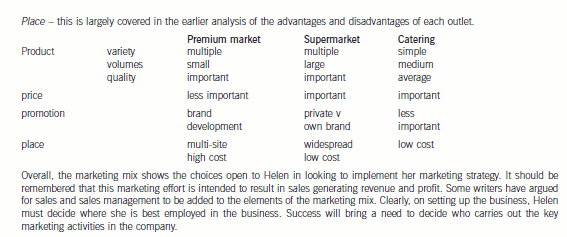
-
第3题:
(b) Using the TARA framework, construct four possible strategies for managing the risk presented by Product 2.
Your answer should describe each strategy and explain how each might be applied in the case.
(10 marks)
正确答案:
(b) Risk management strategies and Chen Products
Risk transference strategy
This would involve the company accepting a portion of the risk and seeking to transfer a part to a third party. Although an
unlikely possibility given the state of existing claims, insurance against future claims would serve to limit Chen’s potential
losses and place a limit on its losses. Outsourcing manufacture may be a way of transferring risk if the ourtsourcee can be
persuaded to accept some of the product liability.
Risk avoidance strategy
An avoidance strategy involves discontinuing the activity that is exposing the company to risk. In the case of Chen this would
involve ceasing production of Product 2. This would be pursued if the impact (hazard) and probability of incurring an
acceptable level of liability were both considered to be unacceptably high and there were no options for transference or
reduction.
Risk reduction strategy
A risk reduction strategy involves seeking to retain a component of the risk (in order to enjoy the return assumed to be
associated with that risk) but to reduce it and thereby limit its ability to create liability. Chen produces four products and it
could reconfigure its production capacity to produce proportionately more of Products 1, 3 and 4 and proportionately less of
Product 2. This would reduce Product 2 in the overall portfolio and therefore Chen’s exposure to its risks. This would need
to be associated with instructions to other departments (e.g. sales and marketing) to similarly reconfigure activities to sell
more of the other products and less of Product 2.
Risk acceptance strategy
A risk acceptance strategy involves taking limited or no action to reduce the exposure to risk and would be taken if the returns
expected from bearing the risk were expected to be greater than the potential liabilities. The case mentions that Product 2 is
highly profitable and it may be that the returns attainable by maintaining and even increasing Product 2’s sales are worth the
liabilities incurred by compensation claims. This is a risk acceptance strategy. -
第4题:
(c) Explain how absolutist (dogmatic) and relativist (pragmatic) ethical assumptions would affect the outcome
of Anne’s decision. (6 marks)
正确答案:
(c) Absolutism and relativism
Absolutism and relativism represent two extreme positions of ethical assumptions.
Definitions
An absolutist assumption is one that believes that there are ‘eternal’ rules that should guide all ethical and moral decision
making in all situations. Accordingly, in any given situation, there is likely to be one right course of action regardless of the
outcome. An absolutist believes that this should be chosen regardless of the consequences or the cost. A dogmatic approach
to morality is an example of an absolutist approach to ethics. A dogmatic assumption is one that is accepted without
discussion or debate.
Relativist assumptions are ‘situational’ in nature. Rather than arguing that there is a single right choice, a relativist will tend
to adopt a pragmatic approach and decide, in the light of the situation being considered, which is the best outcome. This will
involve a decision on what outcome is the most favourable and that is a matter of personal judgment.
Outcomes
If Anne were to adopt absolutist/dogmatic assumptions, she would be likely to decide that she would need to pursue what
she perceives is the right course of action regardless of cost to herself or the relationship with the client or her manager. Given
that she unearthed a suspect and unaccounted-for payment, and that she received an inadequate explanation from the client,
she would probably recommend extension to the audit beyond the weekend.
If Ann were to adopt relativist or pragmatic assumptions, she would have a potentially much more complicated decision to
make. She would have to decide whether it was more important, ethically, to yield to the pressure from Zachary in the
interests of her short-term career interests or ‘hold out’ to protect the interests of the shareholders. Anne could recommend
sign off and trust the FD’s explanation but she is more likely to seek further evidence or assurance from the company before
she does so. -
第5题:
2 (a) Explain the term ‘backflush accounting’ and the circumstances in which its use would be appropriate.
(6 marks)
正确答案:
(a) Backflush accounting focuses upon output of an organisation and then works backwards when allocating costs between cost
of goods sold and inventories. It can be argued that backflush accounting simplifies costing since it ignores both labour
variances and work-in-progress. Whilst in a perfect just-in-time environment there would be no work-in-progress at all, there
will in practice be a small amount of work-in-progress in the system at any point in time. This amount, however, is likely to
be negligible in quantity and therefore not significant in terms of value. Thus, a backflush accounting system simplifies the
accounting records by avoiding the need to follow the movement of materials and work-in-progress through the manufacturing
process within the organisation.
The backflush accounting system is likely to involve the maintenance of a raw materials and work-in–progress account
together with a finished goods account. The use of standard costs and variances is likely to be incorporated into the
accounting entries. Transfers from raw materials and work-in-progress account to finished goods (or cost of sales) will probably
be made at standard cost. The difference between the actual inputs and the standard charges from the raw materials and
work-in-progress account will be recorded as a residual variance, which will be recorded in the profit and loss account. Thus,
it is essential that standard costs are a good surrogate for actual costs if large variances are to be avoided. Backflush
accounting is ideally suited to a just-in-time philosophy and is employed where the overall cycle time is relatively short and
inventory levels are low. Naturally, management will still be eager to ascertain the cause of any variances that arise from the
inefficient usage of materials, labour and overhead. However investigations are far more likely to be undertaken using nonfinancial
performance indicators as opposed to detailed cost variances. -
第6题:
(c) Identify TWO QUALITATIVE benefits that might arise as a consequence of the investment in a new IT system
and explain how you would attempt to assess them. (4 marks)
正确答案:
(c) One of the main qualitative benefits that may arise from an investment in a new IT system by Moffat Ltd is the improved level
of service to its customers in the form. of reduced waiting times which may arise as a consequence of better scheduling of
appointments, inventory management etc. This could be assessed via the introduction of a questionnaire requiring customers
to rate the service that they have received from their recent visit to a location within Moffat Ltd according to specific criteria
such as adherence to appointment times, time taken to service the vehicle, cleanliness of the vehicle, attitude of staff etc.
Alternatively a follow-up telephone call from a centralised customer services department may be made by Moffat Ltd
personnel in order to gather such information.
Another qualitative benefit of the proposed investment may arise in the form. of competitive advantage. Improvements in
customer specific information and service levels may give Moffat Ltd a competitive advantage. Likewise, improved inventory
management may enable costs to be reduced thereby enabling a ‘win-win’ relationship to be enjoyed with its customers. -
第7题:
(ii) Explain THREE strategies that might be adopted in order to improve the future prospects of Diverse
Holdings Plc. (6 marks)
正确答案:
(ii) The forecast situation of Diverse Holdings Plc is not without its problems. KAL and OPL require the immediate attention
of management. The position of KAL is precarious to say the least. There is a choice of strategies for it:
(i) Outsource the manufacture of appliances
(ii) Set up a manufacturing operation overseas
(ii) Withdraw from the market.
Each alternative must be assessed. Whatever decision is taken it is unlikely to affect the other four subsidiaries.
PSL is also independent of the other subsidiaries. A strategic decision to widen its range of products and outlets must
surely help. Hence management should endeavour to find new markets for its products, which are separate and distinct
from those markets served by its appointed distributors.
21
In order to improve the prospects of OPL management need to adopt appropriate strategies since at the present time the
company appears to be in a high growth market but is unable to capture a reasonable market share. Perhaps the answer
lies in increased or more effective advertising of the endorsement of the product range by health and safety experts.
Management should endeavour to develop a strategy to integrate further its subsidiaries so that they can benefit from
each other and also derive as much synergy as possible from the acquisition of HTL.
It is of paramount importance that management ensure that sufficient funds are channelled into growing OFL and HTL,
which are both showing a rising trend in profitability. The group has depleted cash reserves which must to some extent
be attributable to the purchase of HTL. It is possible that the divestment of KAL would provide some much needed
funding. -
第8题:
(c) Explain how the use of activity-based techniques may benefit Taliesin Ltd. (5 marks)
正确答案:
(c) The usefulness of activity-based techniques is accentuated in situations where overheads comprise a significant proportion of
product costs. Manufacturing overheads comprise 30·9% of turnover during the year ended 31 May 2005. Traditional
methods of allocating overheads to products might result in product cost information which is misleading and detrimental to
managerial decision-making. Calculations of product costs are more prone to error in situations where higher levels of
overhead exist. The consequences can prove disastrous as, for example, in the under-pricing or over-pricing of products.
Since Taliesin Ltd is going to confine its activities to its home country it must be prepared to face increased competition and
this increases the need for greater visibility and more accurate product cost information.
At present, Taliesin Ltd offers a range of products which is increasing in number and this may lead to the need for a more
detailed costing system. Traditional absorption systems might well be inadequate as the number of product variants increases.
One would expect that each new product developed is more complex than its predecessors. The company would probably
start with simple Vanilla, then a few basic flavours but as Taliesin Ltd has expanded one would expect it to take longer to
originate and test new products until they are ready to be introduced. It will probably take longer to mix the ingredients for a
run of each product.
These two, development and mixing ingredients, are examples of activities which arise when new products are considered.
If traditional absorption costing and budgeting are used based on machine-time in production then the effect of these activities
would be ignored.
In order to gain a full appreciation of the impact of new product introduction activity-based techniques should be used to
guide Taliesin Ltd into the easiest way to maintain its policy of growth. It may be a better decision to expand abroad or into
new markets at home with the existing products than pursue growth by introducing new products to a dwindling number of
customers.
We are not told of the composition of the customer base of Taliesin Ltd. However, one thing we do know is that the scope of
activity-based techniques extends beyond products and services. For example, the application of activity-based costing can
provide vital information that enables management to undertake customer profitability analysis, thereby further improving
management decision-making and operating performance.
-
第9题:
(ii) Comment briefly on how divisional managers might respond to the results achieved and ONE potential
problem that might be experienced by Our Timbers Ltd. (2 marks)
正确答案: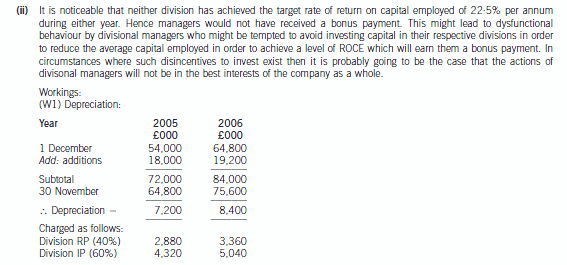
-
第10题:
(ii) Briefly explain the extent to which the application of sensitivity analysis might be useful in deciding
which refrigeration system to purchase and discuss the limitations inherent in its use. (3 marks)
正确答案:
(ii) Sensitivity analysis could be used to assess how responsive the NPV calculated in part (a) in respect of each decision
option change is to changes in the variables used to calculate it. The application of sensitivity analysis requires that the
net present values are calculated under alternative assumptions in order to determine how sensitive they are to changing
conditions. In this particular example then a relatively small change in the forecast cash flows might lead to a change
in the investment decision. The application of sensitivity analysis can indicate those variables to which the NPV is most
sensitive and the extent to which these variables may change before an investment results in a negative NPV. Thus the
application of sensitivity analysis may provide management with an indication of why a particular project might fail. The
directors of Stay Cool Ltd should give consideration to the potential variations in the independent variables which feature
in the decision-making process such as:
– estimated revenues
– estimated operating costs
– estimated working lives
– estimated repair costs
– the estimated discount rate i.e. cost of capital of each alternative investment.
Sensitivity analysis has some serious limitations. The use of the method requires changes in each variable under
consideration are isolated. However management may be focused on what happens if changes occur in two or more
critical variables. Another problem relating to the use of sensitivity analysis to forecast outcomes lies in the fact that it
provides no indication of the likelihood of the occurrence of changes in critical variables. -
第11题:
(c) Explain how the introduction of an ERPS could impact on the role of management accountants. (5 marks)
正确答案:
(c) The introduction of ERPS has the potential to have a significant impact on the work of management accountants. The use of
ERPS causes a substantial reduction in the gathering and processing of routine information by management accountants.
Instead of relying on management accountants to provide them with information, managers are able to access the system to
obtain the information they require directly via a suitable electronic access medium.
ERPS integrate separate business functions in one system for the entire organisation and therefore co-ordination is usually
undertaken centrally by information management specialists who have a dual responsibility for the implementation and
operation of the system.
ERPS perform. routine tasks that not so long ago were seen as an essential part of the daily routines of management
accountants, for example perpetual inventory valuation. Therefore if the value of the role of management accountants is not
to be diminished then it is of necessity that management accountants should seek to expand their roles within their
organisations.
The management accountant will also control and audit the ERPS data input and analysis. Hence the implementation of ERPS
provides the management accountant with an opportunity to change the emphasis of their role from information gathering
and processing to that of the role of advisers and internal consultants to their organisations. This new role will require
management accountants to be involved in interpreting the information generated from the ERPS and to provide business
support for all levels of management within an organisation. -
第12题:
Carl Sagan believes that Venus might be colonized from earth because__________.A.it might be possible to change its atmosphere
B.its atmosphere is the same as the earth's
C.there is a good supply of water on Venus
D.the days on Venus are long enough答案:A解析:此题考查因果关系。由第二段第一句中的“it will be possible to change the atmosphere ofVenus and so create a new world”可知,so是表示因果的连接词,前因后果,所以正确答案为A。 -
第13题:
(b) Explain how the process of developing scenarios might help John better understand the macro-environmental
factors influencing Airtite’s future strategy. (8 marks)
正确答案:(b) Carrying out a systematic PESTEL analysis is a key step in developing alternative scenarios about the future. Johnson and
Scholes define scenarios as ‘detailed and plausible views of how the business environment of an organisation might develop
in the future based on groupings of key environmental influences and drivers of change about which there is a high level of
uncertainty’. In developing scenarios it is necessary to isolate the key drivers of change, which have the potential to have a
significant impact on the company and are associated with high levels of uncertainty. Development of scenarios enables
managers to share assumptions about the future and the key variables shaping that future. This provides an opportunity for
real organisational learning. They are then in a position to monitor these key variables and amend strategies accordingly. It
is important to note that different stakeholder groups will have different expectations about the future and each may provide
a key input to the process of developing scenarios. By their very nature scenarios should not attempt to allocate probabilities
to the key factors and in so doing creating ‘spurious accuracy’ about those factors. A positive scenario is shown below and
should provide a shared insight into the external factors most likely to have a significant impact on Airtite‘s future strategy.
For most companies operating in global environments the ability to respond flexibly and quickly to macro-environmental
change would seem to be a key capability.
The scenario as illustrated below, clearly could have a major impact on the success or otherwise of Airtite’s strategy for the
future. The key drivers for change would seem to be the link between technology and global emissions, fuel prices and the
stability of the global political environment. Through creating a process which considers the drivers which will have most
impact on Airtite and which are subject to the greatest uncertainty, Airtite will have a greater chance of its strategy adaptingto changing circumstances.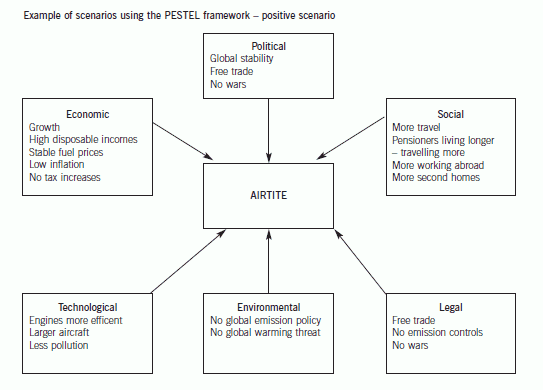
-
第14题:
(c) Discuss how the manipulation of financial statements by company accountants is inconsistent with their
responsibilities as members of the accounting profession setting out the distinguishing features of a
profession and the privileges that society gives to a profession. (Your answer should include reference to the
above scenario.) (7 marks)
Note: requirement (c) includes 2 marks for the quality of the discussion.
正确答案:
(c) Accounting and ethical implications of sale of inventory
Manipulation of financial statements often does not involve breaking laws but the purpose of financial statements is to present
a fair representation of the company’s position, and if the financial statements are misrepresented on purpose then this could
be deemed unethical. The financial statements in this case are being manipulated to show a certain outcome so that Hall
may be shown to be in a better financial position if the company is sold. The retained earnings of Hall will be increased by
$4 million, and the cash received would improve liquidity. Additionally this type of transaction was going to be carried out
again in the interim accounts if Hall was not sold. Accountants have the responsibility to issue financial statements that do
not mislead the public as the public assumes that such professionals are acting in an ethical capacity, thus giving the financial
statements credibility.
A profession is distinguished by having a:
(i) specialised body of knowledge
(ii) commitment to the social good
(iii) ability to regulate itself
(iv) high social status
Accountants should seek to promote or preserve the public interest. If the idea of a profession is to have any significance,
then it must make a bargain with society in which they promise conscientiously to serve the public interest. In return, society
allocates certain privileges. These might include one or more of the following:
– the right to engage in self-regulation
– the exclusive right to perform. particular functions
– special status
There is more to being an accountant than is captured by the definition of the professional. It can be argued that accountants
should have the presentation of truth, in a fair and accurate manner, as a goal. -
第15题:
(b) ‘Strategic positioning’ is about the way that a company as a whole is placed in its environment and concerns its
‘fit’ with the factors in its environment.
With reference to the case as appropriate, explain how a code of ethics can be used as part of a company’s
overall strategic positioning. (7 marks)
正确答案:
(b) Code of ethics and strategic positioning
Strategic positioning is about the way that a whole company is placed in its environment as opposed to the operational level,
which considers the individual parts of the organisation.
Ethical reputation and practice can be a key part of environmental ‘fit’, along with other strategic issues such as generic
strategy, quality and product range.
The ‘fit’ enables the company to more fully meet the expectations, needs and demands of its relevant stakeholders – in this
case, European customers.
The ‘quality’ of the strategic ‘fit’ is one of the major determinants of business performance and so is vital to the success of
the business.
HPC has carefully manoeuvred itself to have the strategic position of being the highest ethical performer locally and has won
orders on that basis.
It sees its strategic position as being the ethical ‘benchmark’ in its industry locally and protects this position against its parent
company seeking to impose a new code of ethics.
The ethical principles are highly internalised in Mr Hogg and in the company generally, which is essential for effective strategic
implementation. -
第16题:
(c) Define ‘retirement by rotation’ and explain its importance in the context of Rosh and Company.
(5 marks)
正确答案:
(c) Retirement by rotation.
Definition
Retirement by rotation is an arrangement in a director’s contract that specifies his or her contract to be limited to a specific
period (typically three years) after which he or she must retire from the board or offer himself (being eligible) for re-election.
The director must be actively re-elected back onto the board to serve another term. The default is that the director retires
unless re-elected.
Importance of
Retirement by rotation reduces the cost of contract termination for underperforming directors. They can simply not be
re-elected after their term of office expires and they will be required to leave the service of the board as a retiree (depending
on contract terms).
It encourages directors’ performance (they know they are assessed by shareholders and reconsidered every three years) and
focuses their minds upon the importance of meeting objectives in line with shareholders’ aims.
It is an opportunity, over time, to replace the board membership whilst maintaining medium term stability of membership
(one or two at a time).
Applied to Rosh
Retirement by rotation would enable the board of Rosh to be changed over time. There is evidence that some directors may
have stayed longer than is ideal because of links with other board members going back many years. -
第17题:
(b) Identify and explain THREE approaches that the directors of Moffat Ltd might apply in assessing the
QUALITATIVE benefits of the proposed investment in a new IT system. (6 marks)
正确答案:
(b) One approach that the directors of Moffat Ltd could adopt would be to ignore the qualitative benefits that may arise on the
basis that there is too much subjectivity involved in their assessment. The problem that this causes is that the investment will
probably look unattractive since all costs will be included in the evaluation whereas significant benefits and savings will have
been ignored. Hence such an approach is lacking in substance and is not recommended.
An alternative approach would involve attempting to attribute values to each of the identified benefits that are qualitative in
nature. Such an approach will necessitate the use of management estimates in order to derive the cash flows to be
incorporated in a cost benefit analysis. The problems inherent in this approach include gaining consensus among interested
parties regarding the footing of the assumptions from which estimated cash flows have been derived. Furthermore, if the
proposed investment does take place then it may well be impossible to prove that the claimed benefits of the new system
have actually been realised.
Perhaps the preferred approach is to acknowledge the existence of qualitative benefits and attempt to assess them in a
reasonable manner acceptable to all parties including the company’s bank. The financial evaluation would then not only
incorporate ‘hard’ facts relating to costs and benefits that are quantitative in nature, but also would include details of
qualitative benefits which management consider exist but have not attempted to assess in financial terms. Such benefits might
include, for example, the average time saved by location managers in analysing information during each operating period.
Alternatively the management of Moffat Ltd could attempt to express qualitative benefits in specific terms linked to a hierarchy
of organisational requirements. For example, qualitative benefits could be categorised as being:
(1) Essential to the business
(2) Very useful attributes
(3) Desirable, but not essential
(4) Possible, if funding is available
(5) Doubtful and difficult to justify. -
第18题:
(b) Explain how the use of SWOT analysis may be of assistance to the management of Diverse Holdings Plc.
(3 marks)
正确答案:
(b) The use of SWOT analysis will focus management attention on current strengths and weaknesses of each subsidiary company
which will be of assistance in the formulating of the business strategy of Diverse Holdings Plc. It will also enable management
to monitor trends and developments in the constantly changing environments of their subsidiaries. Each trend or development
may be classified as an opportunity or a threat that will provide a stimulus for an appropriate management response.
Management can make an assessment of the feasibility of required actions in order that the company may capitalise upon
opportunities whilst considering how best to negate or minimise the effect of any threats.
A SWOT analysis should assist the management of Diverse Holdings Plc as they must identify their strengths, weaknesses,
opportunities and threats. These may be classified as follows:
Strengths which appear to include both OFL and HTL.
Weaknesses which must include PSL and its limited outlets, which generate little growth and could collapse overnight. KAL
is also a weakness due to its declining profitability.
Opportunities where OFT, HTL and OPL are operating in growth markets.
Threats from which KAL is suffering.
If these four categories are identified and analysed then the group should be strengthened. -
第19题:
(b) Explain how the adoption of residual income (RI) using the annuity method of depreciation might prove to
be a superior basis for the management incentive plan operated by NCL plc.
(N.B. No illustrative calculations should be incorporated into your explanation). (4 marks)
正确答案:
(b) The use of residual income as a basis for the management incentive plan operated by NCL plc would have the following
advantages:
Divisional management would be more willing to accept a project with a positive residual income and this would contribute
to the improved performance of NCL plc. Also, the disincentive to accept a project with a positive residual income but a return
on investment regarded by divisional management as not being in their best interests would be removed, because divisional
management would be rewarded.
The use of annuity depreciation may improve performance appraisal by removing the effect of straight-line depreciation which
tends to distort project returns especially in the early years of a project’s life when invested capital remains relatively high due
to the constant depreciation charge. The residual income approach using annuity depreciation will only match the NPV if the
annual cashflows of a project are constant. Hence the method when applied to the North or South projects would produce
an NPV which does not exactly match that previously calculated. By way of contrast it is forecast that the East project will
have constant cashflows and in this instance the NPV and residual income based approach when discounted, will produce
the same result. -
第20题:
(b) (i) Explain how the use of Ansoff’s product-market matrix might assist the management of Vision plc to
reduce the profit-gap that is forecast to exist at 30 November 2009. (3 marks)
正确答案:
-
第21题:
(c) Explain the term ‘target costing’ and how it may be applied by GWCC. Briefly discuss any potential
limitations in its application. (8 marks)
正确答案:
(c) Target costing should be viewed as an integral part of a strategic profit management system. The initial consideration in target
costing is the determination of an estimate of the selling price for a new product which will enable a firm to capture its required
share of the market. In this particular example, Superstores plc, which on the face of it looks a powerful commercial
organisation, wishes to apply a 35% mark-up on the purchase price of each cake from GWCC. Since Superstores plc has
already decided on a launch price of £20·25 then it follows that the maximum selling price that can be charged by GWCC
is (100/135) x £20·25 which is £15·00.
This is clearly a situation which lends itself to the application of target costing/pricing techniques as in essence GWCC can
see the extent to which they fall short of the required level of return with regard to a contract with Superstores plc which ends
after twelve months. Thus it is necessary to reduce the total costs by £556,029 to this figure in order to achieve the desired
level of profit, having regard to the rate of return required on new capital investment. The deduction of required profit from
the proposed selling price will produce a target price that must be met in order to ensure that the desired rate of return is
obtained. Thus the main theme that underpins target costing can be seen to be ‘what should a product cost in order to achieve
the desired level of return’.
Target costing will necessitate comparison of current estimated cost levels against the target level which must be achieved if
the desired levels of profitability, and hence return on investment, are to be achieved. Thus where a gap exists between the
current estimated cost levels and the target cost, it is essential that this gap be closed.
The Directors of GWCC plc should be aware of the fact that it is far easier to ‘design out’ cost during the pre-production phase
than to ‘control out’ cost during the production phase. Thus cost reduction at this stage of a product’s life cycle is of critical
significance to business success.
A number of techniques may be employed in order to help in the achievement and maintenance of the desired level of target
cost. Attention should be focussed upon the identification of value added and non-value added activities with the aim of the
elimination of the latter. The product should be developed in an atmosphere of ‘continuous improvement’. In this regard, total
quality techniques such as the use of Quality circles may be used in attempting to find ways of achieving reductions in product
cost.
Value engineering techniques can be used to evaluate necessary product features such as the quality of materials used. It is
essential that a collaborative approach is taken by the management of GWCC and that all interested parties such as suppliers
and customers are closely involved in order to engineer product enhancements at reduced cost.
The degree of success that will be achieved by GWCC via the application of target costing principles will be very much
dependent on the extent of ‘flexibility’ in variable costs. Also the accuracy of information gathered by GWCC will assume
critical importance because the use of inaccurate information will produce calculated ‘cost gaps’ which are meaningless and
render the application of target costing principles of little value. -
第22题:
(b) Explain FIVE critical success factors to the performance of HSC on which the directors must focus if HSC is
to achieve success in its marketplace. (10 marks)
正确答案:
(b) Critical success factors are as follows:
Product quality
The fact that the production staff have no previous experience in a food production environment is likely to prove problematic.
It is vital that a comprehensive training programme is put in place at the earliest opportunity. HSC need to reach and maintain
the highest level of product quality as soon as possible.
Supply quality
The quality of delivery into SFG supermarkets assumes critical significance. Time literally will be of the essence since 90%
of all sandwiches are sold in SFG’s supermarkets before 2 pm each day. Hence supply chain management must be extremely
robust as there is very little scope for error.
Technical quality
Compliance with existing regulations regarding food production including all relevant factory health and safety requirements
is vital in order to establish and maintain the reputation of HSC as a supplier of quality products. The ability to store products
at the correct temperature is critical because sandwiches are produced for human consumption and in extreme circumstance
could cause fatalities.
External credibility
Accreditation by relevant trade associations/regulators will be essential if nationwide acceptance of HSC as a major producer
of sandwiches is to be established.
New product development
Whilst HSC have developed a range of healthy eating sandwiches it must be recognised that consumer tastes change and
that in the face of competition there will always be a need for a continuous focus on new product development.
Margin
Whilst HSC need to recognise all other critical success factors they should always be mindful that the need to obtain the
desired levels of gross and net margin remain of the utmost importance.
Notes: (i) Only five critical success factors were required.
(ii) Alternative relevant discussion and examples would be acceptable. -
第23题:
(c) Explain the possible impact of RBG outsourcing its internal audit services on the audit of the financial
statements by Grey & Co. (4 marks)
正确答案:
(c) Impact on the audit of the financial statements
Tutorial note: The answer to this part should reflect that it is not the external auditor who is providing the internal audit
services. Thus comments regarding objectivity impairment are not relevant.
■ As Grey & Co is likely to be placing some reliance on RBG’s internal audit department in accordance with ISA 610
Considering the Work of Internal Auditing the degree of reliance should be reassessed.
■ The appointment will include an evaluation of organisational risk. The results of this will provide Grey with evidence,
for example:
– supporting the appropriateness of the going concern assumption;
– of indicators of obsolescence of goods or impairment of other assets.
■ As the quality of internal audit services should be higher than previously, providing a stronger control environment, the
extent to which Grey may rely on internal audit work could be increased. This would increase the efficiency of the
external audit of the financial statements as the need for substantive procedures should be reduced.
■ However, if internal audit services are performed on a part-time basis (e.g. fitting into the provider’s less busy months)
Grey must evaluate the impact of this on the prevention, detection and control of fraud and error.
■ The internal auditors will provide a body of expertise within RBG with whom Grey can consult on contentious matters.
Tutorial note: Appropriate credit will be given for arguing that less reliance may be placed on internal audit in this year of
change of provider.