
(c) Define ‘retirement by rotation’ and explain its importance in the context of Rosh and Company.(5 marks)
题目
(c) Define ‘retirement by rotation’ and explain its importance in the context of Rosh and Company.
(5 marks)
相似考题
更多“(c) Define ‘retirement by rotation’ and explain its importance in the context of Rosh and Company.(5 marks)”相关问题
-
第1题:
5 All managers need to understand the importance of motivation in the workplace.
Required:
(a) Explain the ‘content theory’ of motivation. (5 marks)
正确答案:
5 The way in which managers treat their employees can significantly influence the satisfaction that the employees derive from their work and thus the overall success of the organisation. Understanding the importance of motivation is therefore an important management skill.
(a) Content theories address the question ‘What are the things that motivate people?’
Content theories are also called need theories (because they concentrate on the needs fulfilled by work) and are based on the notion that all human beings have a set of needs or required outcomes, and according to this theory, these needs can be satisfied through work. The theory focuses on what arouses, maintains and regulates good, directed behaviour and what specific individual forces motivate people. However, content theories assume that everyone responds to motivating factors in the same way and that consequently there is one, best way to motivate everybody.
-
第2题:
(b) Explain how Perfect Shopper might re-structure its upstream supply chain to address the problems identified
in the scenario. (10 marks)
正确答案:
(b) Perfect Shopper currently has a relatively short upstream supply chain. They are bulk purchasers from established suppliers
of branded goods. Their main strength at the moment is to offer these branded goods at discounted prices to neighbourhood
shops that would normally have to pay premium prices for these goods.
In the upstream supply chain, the issue of branding is a significant one. At present, Perfect Shopper only provides branded
goods from established names to its customers. As far as the suppliers are concerned, Perfect Shopper is the customer and
the company’s regional warehouses are supplied as if they were the warehouses of conventional supermarkets. Perfect
Shopper might look at the following restructuring opportunities within this context:
– Examining the arrangements for the delivery of products from suppliers to the regional warehouses. At present this is in
the hands of the suppliers or contractors appointed by suppliers. It appears that when Perfect Shopper was established
it decided not to contract its own distribution. This must now be open to review. It is likely that competitors have
established contractual arrangements with logistics companies to collect products from suppliers. Perfect Shopper must
examine this, accompanied by an investigation into downstream distribution. A significant distribution contract would
probably include the branding of lorries and vans and this would provide an opportunity to increase brand visibility and
so tackle this issue at the same time.
– Contracting the supply and distribution of goods also offers other opportunities. Many integrated logistics contractors also
supply storage and warehousing solutions and it would be useful for Perfect Shopper to evaluate the costs of these.
Essentially, distribution, warehousing and packaging could be outsourced to an integrated logistics company and Perfect
Shopper could re-position itself as a primarily sales and marketing operation.
– Finally, Perfect Shopper must review how it communicates orders and ordering requirements with its suppliers. Their
reliance on supplier deliveries suggests that the relationship is a relatively straightforward one. There may be
opportunities for sharing information and allowing suppliers access to forecasted demand. There are many examples
where organisations have allowed suppliers access to their information to reduce costs and to improve the efficiency of
the supply chain as a whole.
The suggestions listed above assume that Perfect Shopper continues to only supply branded goods. Moving further upstream
in the supply chain potentially moves the company into the manufacture and supply of goods. This will raise a number of
significant issues about the franchise itself.
At present Perfect Shopper has, by necessity, concentrated on branded goods. It has not really had to understand how these
goods sell in specific locations because it has not been able to offer alternatives. The content of the standing order reflects
how the neighbourhood shop wishes to compete in its locality. However, if Perfect Shopper decides to commission its own
brand then the breadth of products is increased. Neighbourhood shops would be able to offer ‘own brand’ products to compete
with supermarkets who also focus on own brand products. It would also increase the visibility of the brand. However, Perfect
Shopper must be sure that this approach is appropriate as a whole. It could easily produce an own brand that reduces the
overall image of the company and hence devalues the franchise. Much more research is needed to assess the viability ofproducing ‘own brand’ goods. -
第3题:
Churchill Ice Cream has to date made two unsuccessful attempts to become an international company.
(d) What reasons would you suggest to explain this failure of Churchill Ice Cream to become an international
company? (5 marks)
正确答案:
(d) The two international strategies pursued to date are through organic growth (the stores in North America) and acquisition (the
companies in Germany and Italy). Neither seems to have worked. Here there seem to be some contradictions while global
tastes and lifestyles are argued to have developed – convergence of consumer tastes lies at the heart of this – but this does
not seem to have benefited Churchill. One questions the learning that these two unfortunate experiences have created. Of the
three core methods of achieving growth, namely organic, acquisition and joint venture, only joint venture remains to be tried.
The reasons for the international failures are clearly complex but one could argue that the strategy has been curiously na?ve.
Certainly, it has pursued a high-risk strategy. Exporting, perhaps through identifying a suitable partner, might create the
learning to lead to a more significant market entry. There is a need to understand local tastes; indeed the whole of the
marketing mix in the chosen market(s), and decide on appropriate strategy. A strategy based upon the acquisition of
companies and their consequent development represents a large investment of capital and requires considerable managerial
attention and expertise. Equally, the attempt to use the Churchill domestic format of opening its own stores creates both a
major financial commitment and the need to manage a radically different operation. One must seriously question whether
Churchill has these capabilities within a family-owned business. Clearly there are differences between the ice cream markets
in various countries, though the emergence of global brands suggests some convergence of tastes. Such differences reflect
differing cultures, tastes and competitive behaviour in each country. The lesson from Churchill’s international initiatives is that
national differences need to be carefully understood. There is little evidence that Churchill has understood these differencesor indeed learnt from them. -
第4题:
(ii) Explain the organisational factors that determine the need for internal audit in public listed companies.
(5 marks)
正确答案:
(ii) Factors affecting the need for internal audit and controls
(Based partly on Turnbull guidance)
The nature of operations within the organisation arising from its sector, strategic positioning and main activities.
The scale and size of operations including factors such as the number of employees. It is generally assumed that larger
and more complex organisations have a greater need for internal controls and audit than smaller ones owing to the
number of activities occurring that give rise to potential problems.
Cost/benefit considerations. Management must weigh the benefits of instituting internal control and audit systems
against the costs of doing so. This is likely to be an issue for medium-sized companies or companies experiencing
growth.
Internal or external changes affecting activities, structures or risks. Changes arising from new products or internal
activities can change the need for internal audit and so can external changes such as PESTEL factors.
Problems with existing systems, products and/or procedures including any increase in unexplained events. Repeated or
persistent problems can signify the need for internal control and audit.
The need to comply with external requirements from relevant stock market regulations or laws. This appears to be a
relevant factor at Gluck & Goodman. -
第5题:
(b) ‘Strategic positioning’ is about the way that a company as a whole is placed in its environment and concerns its
‘fit’ with the factors in its environment.
With reference to the case as appropriate, explain how a code of ethics can be used as part of a company’s
overall strategic positioning. (7 marks)
正确答案:
(b) Code of ethics and strategic positioning
Strategic positioning is about the way that a whole company is placed in its environment as opposed to the operational level,
which considers the individual parts of the organisation.
Ethical reputation and practice can be a key part of environmental ‘fit’, along with other strategic issues such as generic
strategy, quality and product range.
The ‘fit’ enables the company to more fully meet the expectations, needs and demands of its relevant stakeholders – in this
case, European customers.
The ‘quality’ of the strategic ‘fit’ is one of the major determinants of business performance and so is vital to the success of
the business.
HPC has carefully manoeuvred itself to have the strategic position of being the highest ethical performer locally and has won
orders on that basis.
It sees its strategic position as being the ethical ‘benchmark’ in its industry locally and protects this position against its parent
company seeking to impose a new code of ethics.
The ethical principles are highly internalised in Mr Hogg and in the company generally, which is essential for effective strategic
implementation. -
第6题:
2 (a) Explain the term ‘backflush accounting’ and the circumstances in which its use would be appropriate.
(6 marks)
正确答案:
(a) Backflush accounting focuses upon output of an organisation and then works backwards when allocating costs between cost
of goods sold and inventories. It can be argued that backflush accounting simplifies costing since it ignores both labour
variances and work-in-progress. Whilst in a perfect just-in-time environment there would be no work-in-progress at all, there
will in practice be a small amount of work-in-progress in the system at any point in time. This amount, however, is likely to
be negligible in quantity and therefore not significant in terms of value. Thus, a backflush accounting system simplifies the
accounting records by avoiding the need to follow the movement of materials and work-in-progress through the manufacturing
process within the organisation.
The backflush accounting system is likely to involve the maintenance of a raw materials and work-in–progress account
together with a finished goods account. The use of standard costs and variances is likely to be incorporated into the
accounting entries. Transfers from raw materials and work-in-progress account to finished goods (or cost of sales) will probably
be made at standard cost. The difference between the actual inputs and the standard charges from the raw materials and
work-in-progress account will be recorded as a residual variance, which will be recorded in the profit and loss account. Thus,
it is essential that standard costs are a good surrogate for actual costs if large variances are to be avoided. Backflush
accounting is ideally suited to a just-in-time philosophy and is employed where the overall cycle time is relatively short and
inventory levels are low. Naturally, management will still be eager to ascertain the cause of any variances that arise from the
inefficient usage of materials, labour and overhead. However investigations are far more likely to be undertaken using nonfinancial
performance indicators as opposed to detailed cost variances. -
第7题:
(ii) Briefly explain the extent to which the application of sensitivity analysis might be useful in deciding
which refrigeration system to purchase and discuss the limitations inherent in its use. (3 marks)
正确答案:
(ii) Sensitivity analysis could be used to assess how responsive the NPV calculated in part (a) in respect of each decision
option change is to changes in the variables used to calculate it. The application of sensitivity analysis requires that the
net present values are calculated under alternative assumptions in order to determine how sensitive they are to changing
conditions. In this particular example then a relatively small change in the forecast cash flows might lead to a change
in the investment decision. The application of sensitivity analysis can indicate those variables to which the NPV is most
sensitive and the extent to which these variables may change before an investment results in a negative NPV. Thus the
application of sensitivity analysis may provide management with an indication of why a particular project might fail. The
directors of Stay Cool Ltd should give consideration to the potential variations in the independent variables which feature
in the decision-making process such as:
– estimated revenues
– estimated operating costs
– estimated working lives
– estimated repair costs
– the estimated discount rate i.e. cost of capital of each alternative investment.
Sensitivity analysis has some serious limitations. The use of the method requires changes in each variable under
consideration are isolated. However management may be focused on what happens if changes occur in two or more
critical variables. Another problem relating to the use of sensitivity analysis to forecast outcomes lies in the fact that it
provides no indication of the likelihood of the occurrence of changes in critical variables. -
第8题:
(c) Explain how the introduction of an ERPS could impact on the role of management accountants. (5 marks)
正确答案:
(c) The introduction of ERPS has the potential to have a significant impact on the work of management accountants. The use of
ERPS causes a substantial reduction in the gathering and processing of routine information by management accountants.
Instead of relying on management accountants to provide them with information, managers are able to access the system to
obtain the information they require directly via a suitable electronic access medium.
ERPS integrate separate business functions in one system for the entire organisation and therefore co-ordination is usually
undertaken centrally by information management specialists who have a dual responsibility for the implementation and
operation of the system.
ERPS perform. routine tasks that not so long ago were seen as an essential part of the daily routines of management
accountants, for example perpetual inventory valuation. Therefore if the value of the role of management accountants is not
to be diminished then it is of necessity that management accountants should seek to expand their roles within their
organisations.
The management accountant will also control and audit the ERPS data input and analysis. Hence the implementation of ERPS
provides the management accountant with an opportunity to change the emphasis of their role from information gathering
and processing to that of the role of advisers and internal consultants to their organisations. This new role will require
management accountants to be involved in interpreting the information generated from the ERPS and to provide business
support for all levels of management within an organisation. -
第9题:
(c) Explain the possible impact of RBG outsourcing its internal audit services on the audit of the financial
statements by Grey & Co. (4 marks)
正确答案:
(c) Impact on the audit of the financial statements
Tutorial note: The answer to this part should reflect that it is not the external auditor who is providing the internal audit
services. Thus comments regarding objectivity impairment are not relevant.
■ As Grey & Co is likely to be placing some reliance on RBG’s internal audit department in accordance with ISA 610
Considering the Work of Internal Auditing the degree of reliance should be reassessed.
■ The appointment will include an evaluation of organisational risk. The results of this will provide Grey with evidence,
for example:
– supporting the appropriateness of the going concern assumption;
– of indicators of obsolescence of goods or impairment of other assets.
■ As the quality of internal audit services should be higher than previously, providing a stronger control environment, the
extent to which Grey may rely on internal audit work could be increased. This would increase the efficiency of the
external audit of the financial statements as the need for substantive procedures should be reduced.
■ However, if internal audit services are performed on a part-time basis (e.g. fitting into the provider’s less busy months)
Grey must evaluate the impact of this on the prevention, detection and control of fraud and error.
■ The internal auditors will provide a body of expertise within RBG with whom Grey can consult on contentious matters.
Tutorial note: Appropriate credit will be given for arguing that less reliance may be placed on internal audit in this year of
change of provider. -
第10题:
(b) Explain the need for a first time group auditor to analyse the group structure. (5 marks)
正确答案:
(b) Need to analyse the group structure
A certain amount of analysis of the group structure will be undertaken before an auditor accepts the role of group auditor,
particularly if the auditor is not directly responsible for the whole group.
An analysis of the group structure is necessary to:
■ ensure that particular attention is given to the more unusual aspects of corporate structures (e.g. partnership
arrangements that may be a joint venture, components in tax havens, shell companies and horizontal groups);
■ arrange access to information relating to all ‘significant’ components (i.e. those representing 20% or more of group
assets, liabilities, cash flows, profit or revenue), on a timely basis;
■ identify the applicable financial reporting framework for each component and any local statutory reporting requirements;
■ plan work to deal with different accounting frameworks/policies applied throughout the group and differences between
International Auditing Standards (ISAs) and national standards;
■ integrate the group audit process effectively with local statutory audit requirements;
■ identify related parties and effectively audit the completeness of disclosures in the group accounts in accordance with
IAS 24 Related Party Disclosures.
Any doubts about the group structure will need to be clarified against publicly available information as soon as possible to
ensure an effective audit of the relevant components (i.e. subsidiaries, associates and joint ventures). The auditor can then
plan the level of assurance required on each component well in advance of the year end.
Having established thoroughly the group structure from the outset the auditor will then need only to update the structure for
changes year-on-year. -
第11题:
During the year the internal auditor of Mulligan Co discovered several discrepancies in the inventory records. In a
statement made to the board of directors, the internal auditor said:
‘I think that someone is taking items from the warehouse. A physical inventory count is performed every three months,
and it has become apparent that about 200 boxes of flat-packed chairs and tables are disappearing from the
warehouse every month. We should get someone to investigate what has happened and quantify the value of the
loss.’
Required:
(c) Define ‘forensic accounting’ and explain its relevance to the statement made by the internal auditor.
(5 marks)
正确答案:
(c) Forensic accounting is where an assurance provider investigates a specific issue, often with a legal consequence, such as a
suspected fraud. Specifically it is the process of gathering, analysing and reporting on data for the purpose of finding facts
and/or evidence in the context of financial/legal disputes and/or irregularities. The forensic accountant will also give
preventative advice based on evidence gathered. This advice is based usually on recommendations to improve the internal
control systems to prevent and detect fraud.
The relevance here is that Webb & Co are likely to be asked to provide a forensic accounting service to Mulligan Co.
The investigation will consider two issues – firstly whether the fraud actually happened, and secondly, if a fraud has taken
place, the financial value of the fraud. The investigation should determine who has perpetrated the fraud, and collect evidence
to help prosecute those involved in the deception.
In this case the suspicion that inventory is being stolen should be investigated, as there could be other reasons for the
discrepancy found in the inventory records. For example, the discrepancy could be caused by:
– Obsolete or damaged inventory thrown away but not eliminated from the inventory records
– Despatches from the warehouse not recorded in the inventory management system
– Incoming inventory being recorded incorrectly (e.g. recorded twice in the inventory management system)
– Inventory being held at a separate location and therefore not included in the count.
If it is found that thefts have taken place, then the forensic accountant should gather evidence to:
– Prove the identity of the persons involved
– Quantify the value of inventory taken.
The evidence gathered could be used to start criminal proceedings against those found to have been involved in the fraud. -
第12题:
(a) List and explain FOUR methods of selecting a sample of items to test from a population in accordance with ISA 530 (Redrafted) Audit Sampling and Other Means of Testing. (4 marks)
(b) List and explain FOUR assertions from ISA 500 Audit Evidence that relate to the recording of classes of
transactions. (4 marks)
(c) In terms of audit reports, explain the term ‘modified’. (2 marks)
正确答案:
(a)SamplingmethodsMethodsofsamplinginaccordancewithISA530AuditSamplingandOtherMeansofTesting:Randomselection.Ensureseachiteminapopulationhasanequalchanceofselection,forexamplebyusingrandomnumbertables.Systematicselection.Inwhichanumberofsamplingunitsinthepopulationisdividedbythesamplesizetogiveasamplinginterval.Haphazardselection.Theauditorselectsthesamplewithoutfollowingastructuredtechnique–theauditorwouldavoidanyconsciousbiasorpredictability.Sequenceorblock.Involvesselectingablock(s)ofcontinguousitemsfromwithinapopulation.Tutorialnote:Othermethodsofsamplingareasfollows:MonetaryUnitSampling.Thisselectionmethodensuresthateachindividual$1inthepopulationhasanequalchanceofbeingselected.Judgementalsampling.Selectingitemsbasedontheskillandjudgementoftheauditor.(b)Assertions–classesoftransactionsOccurrence.Thetransactionsandeventsthathavebeenrecordedhaveactuallyoccurredandpertaintotheentity.Completeness.Alltransactionsandeventsthatshouldhavebeenrecordedhavebeenrecorded.Accuracy.Theamountsandotherdatarelatingtorecordedtransactionsandeventshavebeenrecordedappropriately.Cut-off.Transactionsandeventshavebeenrecordedinthecorrectaccountingperiod.Classification.Transactionsandeventshavebeenrecordedintheproperaccounts.(c)AuditreporttermModified.Anauditormodifiesanauditreportinanysituationwhereitisinappropriatetoprovideanunmodifiedreport.Forexample,theauditormayprovideadditionalinformationinanemphasisofmatter(whichdoesnotaffecttheauditor’sopinion)orqualifytheauditreportforlimitationofscopeordisagreement. -
第13题:
(b) Explain what is meant by McGregor’s
(i) Theory X; (5 marks)
正确答案:
(b) Douglas McGregor has suggested that the managers’ view of the individuals’ attitude to work can be divided into two categories, which he called Theory X and Theory Y. The style. of management adopted will stem from the view taken as to how subordinates behave. However, these two typologies are not distinct; they do in fact represent the two ends of a continuum.
(i) Theory X is based on traditional organisational thinking. It assumes that the average person is basically indolent and has an inherent dislike of work which should be avoided at all costs. The individual lacks ambition, shuns responsibility, has no ambition and is resistant to change. This theory holds that the individual seeks only security and is driven solely by self-interest. It follows that because of this dislike of work, most have to be directed, controlled, organised or coerced. Management is based on fear and punishment and will have an exploitative or authoritarian style. This reflects the thinking of the classical school of management, based on a scientific approach, specialisation, standardisation and obedience to superiors.
-
第14题:
(c) Explain how Perfect Shopper might re-structure its downstream supply chain to address the problems
identified in the scenario. (10 marks)
正确答案:
(c) A number of opportunities appear to exist in the downstream supply chain.
As already mentioned above, Perfect Shopper can revisit its contract distribution arrangements. At present, distribution to
neighbourhood shops is in the hands of locally appointed contract distributors. As already suggested, it may be possible to
contract one integrated logistics company to carry out both inbound and outbound logistics, so gaining economies of scale
and opportunities for branding.
One of the problems identified in the independent report was the inflexibility of the ordering and delivering system. The
ordering system appears to be built around a fixed standard delivery made every two weeks, agreed in advance for a three
month period. Variations can be made to this standard order, but only increases – not decreases. Presumably, this
arrangement is required to allow Perfect Shopper to forecast demand over a three month period and to place bulk orders to
reflect these commitments. However, this may cause at least two problems. The first is that participating shops place a
relatively low standard order and rely on variations to fulfil demand. This causes problems for Perfect Shopper. Secondly, any
unpredictable fall in demand during the three month period leads to the shop having storage problems and unsold stock. This
potentially creates problems for the shop owner, who may also begin to question the value of the franchise. Hence Perfect
Shopper might wish to consider a much more flexible system where orders can be made to match demand and deliveries
can be made as required. This would also remove the requirement for a three monthly meeting between the franchisee andthe sales representative from Perfect Shopper. Investments in IT systems will be required to support this, with participating
shops placing orders over the Internet to reflect their requirements. This move towards a more flexible purchasing arrangement
may also make the outsourcing of warehousing and distribution even more appealing.
Perfect Shopper may also wish to investigate whether they can also provide value added services to customers, which not
only simplify the ordering system but also allow the shop managers to better understand their customers and fulfil their
requirements. The supply chain may legitimately include the customer’s customers, particularly for franchisers. This is already
acknowledged because Perfect Shopper produces tailored marketing material aimed at the end-consumer. Point of Sales (PoS)
devices feeding information back to Perfect Shopper would allow sales information to be analysed and fed back to the
shopkeeper as well as allowing automatic replenishment based on purchasing trends. However, this may be culturally difficult
for independent neighbourhood shopkeepers to accept. Furthermore, it would potentially include information outside the
products offered by Perfect Shopper and the implications of this would have to be considered. However, a whole shop sales
analysis might be a useful service to offer existing and potential franchisees.
Customers are increasingly willing to order products over the Internet. It seems unlikely that individual shopkeepers would be
able to establish and maintain their own Internet-based service. It would be useful for Perfect Shopper to explore the potential
of establishing a central website with customers placing orders from local shops. Again there are issues about scope, because
Perfect Shopper does not offer a whole-shop service. However, Michael de Kare-Silver has identified groceries as a product
area that has good potential for Internet purchase. In his electronic shopping potential test any product scoring over 20 hasgood potential. Groceries scored 27. -
第15题:
4 (a) Explain the meaning of the term ‘working capital cycle’ for a trading company. (4 marks)
正确答案:
(a) The working capital cycle illustrates the changing make-up of working capital in the course of the trading operations of a
business:
1 Purchases are made on credit and the goods go into inventory.
2 Inventory is sold and converted into receivables
3 Credit customers pay their accounts
4 Cash is used to pay suppliers. -
第16题:
(c) Define ‘market risk’ for Mr Allejandra and explain why Gluck and Goodman’s market risk exposure is
increased by failing to have an effective audit committee. (5 marks)
正确答案:
(c) Market risk
Definition of market risk
Market risks are those arising from any of the markets that a company operates in. Most common examples are those risks
from resource markets (inputs), product markets (outputs) or capital markets (finance).
[Tutorial note: markers should exercise latitude in allowing definitions of market risk. IFRS 7, for example, offers a technical
definition: ‘Market risk is the risk that the fair value or cash flows of a financial instrument will fluctuate due to changes in
market prices. Market risk reflects interest rate risk, currency risk, and other price risks’.]
Why non-compliance increases market risk
The lack of a fully compliant committee structure (such as having a non-compliant audit committee) erodes investor
confidence in the general governance of a company. This will, over time, affect share price and hence company value. Low
company value will threaten existing management (possibly with good cause in the case of Gluck and Goodman) and make
the company a possible takeover target. It will also adversely affect price-earnings and hence market confidence in Gluck and
Goodman’s shares. This will make it more difficult to raise funds from the stock market. -
第17题:
(b) Explain the roles of a nominations committee and assess the potential usefulness of a nominations committee
to the board of Rosh and Company. (8 marks)
正确答案:
(b) Nominations committees
General roles of a nominations committee.
It advises on the balance between executives and independent non-executive directors and establishes the appropriate
number and type of NEDs on the board. The nominations committee is usually made up of NEDs.
It establishes the skills, knowledge and experience possessed by current board and notes any gaps that will need to be filled.
It acts to meet the needs for continuity and succession planning, especially among the most senior members of the board.
It establishes the desirable and optimal size of the board, bearing in mind the current size and complexity of existing and
planned activities and strategies.
It seeks to ensure that the board is balanced in terms of it having board members from a diversity of backgrounds so as to
reflect its main constituencies and ensure a flow of new ideas and the scrutiny of existing strategies.
In the case of Rosh, the needs that a nominations committee could address are:
To recommend how many directors would be needed to run the business and plan for recruitment accordingly. The perceived
similarity of skills and interests of existing directors is also likely to be an issue.
To resolve the issues over numbers of NEDs. It seems likely that the current number is inadequate and would put Rosh in a
position of non-compliance with many of the corporate governance guidelines pertaining to NEDs.
To resolve the issues over the independence of NEDs. The closeness that the NEDs have to existing executive board members
potentially undermines their independence and a nominations committee should be able to identify this as an issue and make
recommendations to rectify it.
To make recommendations over the succession of the chairmanship. It may not be in the interests of Rosh for family members
to always occupy senior positions in the business. -
第18题:
(c) Explain how the use of activity-based techniques may benefit Taliesin Ltd. (5 marks)
正确答案:
(c) The usefulness of activity-based techniques is accentuated in situations where overheads comprise a significant proportion of
product costs. Manufacturing overheads comprise 30·9% of turnover during the year ended 31 May 2005. Traditional
methods of allocating overheads to products might result in product cost information which is misleading and detrimental to
managerial decision-making. Calculations of product costs are more prone to error in situations where higher levels of
overhead exist. The consequences can prove disastrous as, for example, in the under-pricing or over-pricing of products.
Since Taliesin Ltd is going to confine its activities to its home country it must be prepared to face increased competition and
this increases the need for greater visibility and more accurate product cost information.
At present, Taliesin Ltd offers a range of products which is increasing in number and this may lead to the need for a more
detailed costing system. Traditional absorption systems might well be inadequate as the number of product variants increases.
One would expect that each new product developed is more complex than its predecessors. The company would probably
start with simple Vanilla, then a few basic flavours but as Taliesin Ltd has expanded one would expect it to take longer to
originate and test new products until they are ready to be introduced. It will probably take longer to mix the ingredients for a
run of each product.
These two, development and mixing ingredients, are examples of activities which arise when new products are considered.
If traditional absorption costing and budgeting are used based on machine-time in production then the effect of these activities
would be ignored.
In order to gain a full appreciation of the impact of new product introduction activity-based techniques should be used to
guide Taliesin Ltd into the easiest way to maintain its policy of growth. It may be a better decision to expand abroad or into
new markets at home with the existing products than pursue growth by introducing new products to a dwindling number of
customers.
We are not told of the composition of the customer base of Taliesin Ltd. However, one thing we do know is that the scope of
activity-based techniques extends beyond products and services. For example, the application of activity-based costing can
provide vital information that enables management to undertake customer profitability analysis, thereby further improving
management decision-making and operating performance.
-
第19题:
(b) Explain FIVE critical success factors to the performance of HSC on which the directors must focus if HSC is
to achieve success in its marketplace. (10 marks)
正确答案:
(b) Critical success factors are as follows:
Product quality
The fact that the production staff have no previous experience in a food production environment is likely to prove problematic.
It is vital that a comprehensive training programme is put in place at the earliest opportunity. HSC need to reach and maintain
the highest level of product quality as soon as possible.
Supply quality
The quality of delivery into SFG supermarkets assumes critical significance. Time literally will be of the essence since 90%
of all sandwiches are sold in SFG’s supermarkets before 2 pm each day. Hence supply chain management must be extremely
robust as there is very little scope for error.
Technical quality
Compliance with existing regulations regarding food production including all relevant factory health and safety requirements
is vital in order to establish and maintain the reputation of HSC as a supplier of quality products. The ability to store products
at the correct temperature is critical because sandwiches are produced for human consumption and in extreme circumstance
could cause fatalities.
External credibility
Accreditation by relevant trade associations/regulators will be essential if nationwide acceptance of HSC as a major producer
of sandwiches is to be established.
New product development
Whilst HSC have developed a range of healthy eating sandwiches it must be recognised that consumer tastes change and
that in the face of competition there will always be a need for a continuous focus on new product development.
Margin
Whilst HSC need to recognise all other critical success factors they should always be mindful that the need to obtain the
desired levels of gross and net margin remain of the utmost importance.
Notes: (i) Only five critical success factors were required.
(ii) Alternative relevant discussion and examples would be acceptable. -
第20题:
(iii) The extent to which Amy will be subject to income tax in the UK on her earnings in respect of duties
performed for Cutlass Inc and the travel costs paid for by that company. (5 marks)
Appropriateness of format and presentation of the report and the effectiveness with which its advice is
communicated. (2 marks)
Note:
You should assume that the income tax rates and allowances for the tax year 2006/07 and the corporation tax
rates and allowances for the financial year 2006 apply throughout this questio
正确答案:
(iii) Amy’s UK income tax position
Amy will remain UK resident and ordinarily resident as she is not leaving the UK permanently or for a complete tax year
under a full time contract of employment. Accordingly, she will continue to be subject to UK tax on her worldwide income
including her earnings in respect of the duties she performs for Cutlass Inc. The earnings from these duties will also be
taxable in Sharpenia as the income arises in that country.
The double tax treaty between the UK and Sharpenia will either exempt the employment income in one of the two
countries or give double tax relief for the tax paid in Sharpenia. The double tax relief will be the lower of the UK tax and
the Sharpenian tax on the income from Cutlass Inc.
Amy will not be subject to UK income tax on the expenses borne by Cutlass Inc in respect of her flights to and from
Sharpenia provided her journeys are wholly and exclusively for the purposes of performing her duties in Sharpenia.
The amounts paid by Cutlass Inc in respect of Amy’s family travelling to Sharpenia will be subject to UK income tax as
Amy will not be absent from the UK for a continuous period of at least 60 days. -
第21题:
In relation to the courts’ powers to interpret legislation, explain and differentiate between:
(a) the literal approach, including the golden rule; and (5 marks)
(b) the purposive approach, including the mischief rule. (5 marks)
正确答案:Tutorial note:
In order to apply any piece of legislation, judges have to determine its meaning. In other words they are required to interpret the
statute before them in order to give it meaning. The diffi culty, however, is that the words in statutes do not speak for themselves and
interpretation is an active process, and at least potentially a subjective one depending on the situation of the person who is doing
the interpreting.
Judges have considerable power in deciding the actual meaning of statutes, especially when they are able to deploy a number of
competing, not to say contradictory, mechanisms for deciding the meaning of the statute before them. There are, essentially, two
contrasting views as to how judges should go about determining the meaning of a statute – the restrictive, literal approach and the
more permissive, purposive approach.
(a) The literal approach
The literal approach is dominant in the English legal system, although it is not without critics, and devices do exist for
circumventing it when it is seen as too restrictive. This view of judicial interpretation holds that the judge should look primarily
to the words of the legislation in order to construe its meaning and, except in the very limited circumstances considered below,
should not look outside of, or behind, the legislation in an attempt to fi nd its meaning.
Within the context of the literal approach there are two distinct rules:
(i) The literal rule
Under this rule, the judge is required to consider what the legislation actually says rather than considering what it might
mean. In order to achieve this end, the judge should give words in legislation their literal meaning, that is, their plain,
ordinary, everyday meaning, even if the effect of this is to produce what might be considered an otherwise unjust or
undesirable outcome (Fisher v Bell (1961)) in which the court chose to follow the contract law literal interpretation of
the meaning of offer in the Act in question and declined to consider the usual non-legal literal interpretation of the word
(offer).(ii) The golden rule
This rule is applied in circumstances where the application of the literal rule is likely to result in what appears to the court
to be an obviously absurd result. It should be emphasised, however, that the court is not at liberty to ignore, or replace,
legislative provisions simply on the basis that it considers them absurd; it must fi nd genuine diffi culties before it declines
to use the literal rule in favour of the golden one. As examples, there may be two apparently contradictory meanings to a
particular word used in the statute, or the provision may simply be ambiguous in its effect. In such situations, the golden
rule operates to ensure that preference is given to the meaning that does not result in the provision being an absurdity.
Thus in Adler v George (1964) the defendant was found guilty, under the Offi cial Secrets Act 1920, with obstruction
‘in the vicinity’ of a prohibited area, although she had actually carried out the obstruction ‘inside’ the area.
(b) The purposive approach
The purposive approach rejects the limitation of the judges’ search for meaning to a literal construction of the words of
legislation itself. It suggests that the interpretative role of the judge should include, where necessary, the power to look beyond
the words of statute in pursuit of the reason for its enactment, and that meaning should be construed in the light of that purpose
and so as to give it effect. This purposive approach is typical of civil law systems. In these jurisdictions, legislation tends to set
out general principles and leaves the fi ne details to be fi lled in later by the judges who are expected to make decisions in the
furtherance of those general principles.
European Community (EC) legislation tends to be drafted in the continental manner. Its detailed effect, therefore, can only be
determined on the basis of a purposive approach to its interpretation. This requirement, however, runs counter to the literal
approach that is the dominant approach in the English system. The need to interpret such legislation, however, has forced
a change in that approach in relation to Community legislation and even with respect to domestic legislation designed to
implement Community legislation. Thus, in Pickstone v Freemans plc (1988), the House of Lords held that it was permissible,
and indeed necessary, for the court to read words into inadequate domestic legislation in order to give effect to Community
law in relation to provisions relating to equal pay for work of equal value. (For a similar approach, see also the House of Lords’
decision in Litster v Forth Dry Dock (1989) and the decision in Three Rivers DC v Bank of England (No 2) (1996).) However,
it has to recognise that the purposive rule is not particularly modern and has its precursor in a long established rule of statutory
interpretation, namely the mischief rule.The mischief rule
This rule permits the court to go behind the actual wording of a statute in order to consider the problem that the statute is
supposed to remedy.
In its traditional expression it is limited by being restricted to using previous common law rules in order to decide the operation
of contemporary legislation. Thus in Heydon’s case (1584) it was stated that in making use of the mischief rule the court
should consider what the mischief in the law was which the common law did not adequately deal with and which statute law
had intervened to remedy. Use of the mischief rule may be seen in Corkery v Carpenter (1950), in which a man was found
guilty of being drunk in charge of a carriage although he was in fact only in charge of a bicycle. -
第22题:
(b) (i) Explain the matters you should consider to determine whether capitalised development costs are
appropriately recognised; and (5 marks)
正确答案:
(b) (i) Materiality
The net book value of capitalised development costs represent 7% of total assets in 2007 (2006 – 7·7%), and is
therefore material. The net book value has increased by 13%, a significant trend.
The costs capitalised during the year amount to $750,000. If it was found that the development cost had been
inappropriately capitalised, the cost should instead have been expensed. This would reduce profit before tax by
$750,000, representing 42% of the year’s profit. This is highly material. It is therefore essential to gather sufficient
evidence to support the assertion that development costs should be recognised as an asset.
In 2007, $750,000 capitalised development costs have been incurred, when added to $160,000 research costs
expensed, total research and development costs are $910,000 which represents 20·2% of total revenue, again
indicating a high level of materiality for this class of transaction.
Relevant accounting standard
Development costs should only be capitalised as an intangible asset if the recognition criteria of IAS 38 Intangible Assets
have been demonstrated in full:
– Intention to complete the intangible asset and use or sell it
– Technical feasibility and ability to use or sell
– Ability to generate future economic benefit
– Availability of technical, financial and other resources to complete
– Ability to measure the expenditure attributable to the intangible asset.
Research costs must be expensed, as should development costs which do not comply with the above criteria. The
auditors must consider how Sci-Tech Co differentiates between research and development costs.
There is risk that not all of the criteria have been demonstrated, especially due to the subjective nature of the
development itself:
– Pharmaceutical development is highly regulated. If the government does not license the product then the product
cannot be sold, and economic benefits will therefore not be received.
– Market research should justify the commercial viability of the product. The launch of a rival product to Flortex
means that market share is likely to be much lower than anticipated, and the ability to sell Flortex is reduced. This
could mean that Flortex will not generate an overall economic benefit if future sales will not recover the research
and development costs already suffered, and yet to be suffered, prior to launch. The existence of the rival product
could indicate that Flortex is no longer commercially viable, in which case the capitalised development costs
relating to Flortex should be immediately expensed.
– The funding on which development is dependent may be withdrawn, indicating that there are not adequate
resources to complete the development of the products. Sci-Tech has failed to meet one of its required key
performance indicators (KPI) in the year ended 30 November 2007, as products valued at 0·8% revenue have
been donated to charity, whereas the required KPI is 1% revenue.
Given that there is currently a breach of the target KPIs, this is likely to result in funding equivalent to 25% of
research and development expenditure being withdrawn. If Sci-Tech Co is unable to source alternative means of
finance, then it would seem that adequate resources may not be available to complete the development of new
products. -
第23题:
Swim Co offers training courses to athletes and has prepared the following breakeven chart:
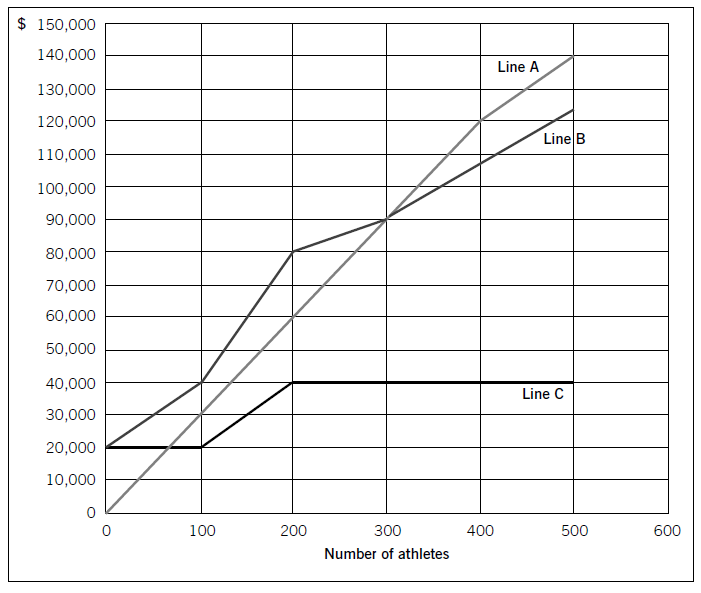
Required:
(a) State the breakeven sales revenue for Swim Co and estimate, to the nearest $10,000, the company’s profit if 500 athletes attend a training course. (2 marks)
(b) Using the chart above, explain the cost and revenue structure of the company. (8 marks)
正确答案:
(a)ThebreakevensalesrevenueforSwimCois$90,000.Thecompany’sprofit,tothenearest$10,000,if500athletesattendthecourseis$20,000($140,000–$120,000).(Fromthegraph,itisclearthatthepreciseamountwillbenearer$17,000,i.e.$140,000–approximately$123,000.)(b)CoststructureFromthechart,itisclearthatLineCrepresentsfixedcosts,LineBrepresentstotalcostsandLineArepresentstotalrevenue.LineCshowsthatinitially,fixedcostsare$20,000evenifnoathletesattendthecourse.Thisleveloffixedcostsremainsthesameif100athletesattendbutoncethenumberofattendeesincreasesabovethislevel,fixedcostsincreaseto$40,000.LineBrepresentstotalcosts.If100athletesattend,totalcostsare$40,000($400perathlete).Since$20,000ofthisrelatestofixedcosts,thevariablecostperathletemustbe$200.Whenfixedcostsstepupbeyondthispointatthelevelof200athletes,totalcostsobviouslyincreaseaswellandLineBconsequentlygetsmuchsteeper.However,sincetherearenow200athletestoabsorbthefixedcosts,thecostperathleteremainsthesameat$400perathlete($80,000/200),eventhoughfixedcostshavedoubled.If300athletesattendthecourse,totalcostperathletebecomes$300each($90,000/300).Sincefixedcostsaccountfor$40,000ofthistotalcost,variablecoststotal$50,000,i.e.$166·67perathlete.So,economiesofscaleariseatthislevel,asdemonstratedbythefactthatLineBbecomesflatter.At400athletes,thegradientofthetotalcostslineisunchangedfrom300athleteswhichindicatesthatthevariablecostshaveremainedthesame.Thereisnofurtherchangeat500athletes;fixedandvariablecostsremainsteady.RevenuestructureAsregardstherevenuestructure,itcanbeseenfromLineAthatfor100–400athletesthepriceremainsthesameat$300perathlete.However,if500athletesattend,thepricehasbeenreducedasthetotalrevenuelinebecomesflatter.$140,000/500meansthatthepricehasgonedownto$280perathlete.Thiswasobviouslynecessarytoincreasethenumberofattendeesandatthispoint,profitismaximised.1