
In the United States there are six million tennis players and twelve million golfers. These figures would not surprise most people. But many would be surprised to learn that twenty million Americans ride motorcycles. Few people realize that motorcycling i
题目
In the United States there are six million tennis players and twelve million golfers. These figures would not surprise most people. But many would be surprised to learn that twenty million Americans ride motorcycles. Few people realize that motorcycling is fast becoming one of America's most popular sports.
Many kinds of people enjoy motorcycling. The average American motorcyclist is between the ages of twenty-one and thirty-five. He owns his own house, and has a wife, more than one child, and at least one car. He is a responsible citizen.
Cycle Magazine, a monthly publication with almost 280,000 readers, claims that about fifty-five per cent of American motorcyclists are businessmen, with three per cent in the professions and nine per cent in government service. Such information is offered by motorcyclists in the hope of improving the general public's impression of their sport. The public has tended to believe that all motorcycles are ridden by wild, irresponsible, lawless young man.
There are several things about motorcycling that the average citizen dislikes.
Motorcyclists often look dirty; in fact, they are dirty. On the road there is little to protect them from mud, crushed insects, and bird droppings. For practical reasons they often dress in old clothing which looks much less respectable than the clothing of people who ride in cars.
Probably the machine itself also produces anger and fear. Motorcycles are noisy, though some big trucks are even noisier. But trucks are big and carry heavy loads; they are accepted because they perform. a needed service, making America move. Motorcycles, on the other hand, make an unpleasant noise just to give their riders pleasure. That is what is commonly thought.
Of course the danger of motorcycling also helps account for many people'slow opinion of the sport. Its defenders, however, claim that careful cyclists arein less danger than is commonly believed.
As motorcycling becomes more common in years to come, it will be interesting to see how people in general feel about the sport. Perhaps it will someday become as respectable as tennis or golf.
(1) Motorcyclists ().
A、are wild, irresponsible, lawless young man
B、are all businessmen
C、hope to improve the general public's impression of their sport
D、want to own his own house and at least one car
(2) The average citizen dislikes motorcycling not because ().
A、motorcyclists often look dirty
B、motorcycles make an unpleasant noise
C、it is dangerous
D、it is not as popular as tennis
(3) Why do motorcyclists often dress in old clothing?
A、For practical reasons.
B、It looks cool and wild.
C、They do not want to be looked respectable.
D、Because motorcycles are dirty.
(4) People accept noisier big trucks because ().
A、they are big and carry heavy loads
B、they perform. a needed service
C、they give their riders pleasure
D、they are not roaring along quiet streets.
(5) Which of the following ideas is suggested in the passage?
A、In the United States there are twelve million tennis players and six million golfers.
B、There are 280,000 motorcyclists in the United States.
C、Many people realize that motorcycling is becoming one of America's most popular sports.
D、Motorcycling becomes more common in the future.
相似考题
更多“In the United States there are six million tennis players and twelve million golfers. ”相关问题
-
第1题:
3 You are the manager responsible for the audit of Seymour Co. The company offers information, proprietary foods and
medical innovations designed to improve the quality of life. (Proprietary foods are marketed under and protected by
registered names.) The draft consolidated financial statements for the year ended 30 September 2006 show revenue
of $74·4 million (2005 – $69·2 million), profit before taxation of $13·2 million (2005 – $15·8 million) and total
assets of $53·3 million (2005 – $40·5 million).
The following issues arising during the final audit have been noted on a schedule of points for your attention:
(a) In 2001, Seymour had been awarded a 20-year patent on a new drug, Tournose, that was also approved for
food use. The drug had been developed at a cost of $4 million which is being amortised over the life of the
patent. The patent cost $11,600. In September 2006 a competitor announced the successful completion of
preliminary trials on an alternative drug with the same beneficial properties as Tournose. The alternative drug is
expected to be readily available in two years time. (7 marks)
Required:
For each of the above issues:
(i) comment on the matters that you should consider; and
(ii) state the audit evidence that you should expect to find,
in undertaking your review of the audit working papers and financial statements of Seymour Co for the year ended
30 September 2006.
NOTE: The mark allocation is shown against each of the three issues.
正确答案: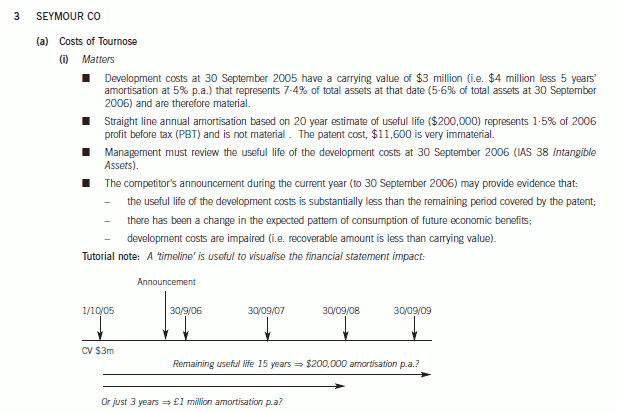
■ A change in the estimated useful life should be accounted for as a change in accounting estimate in accordance
with IAS 8 Accounting Policies, Changes in Accounting Estimates and Errors. For example, if the development
costs have little, if any, useful life after the introduction of the alternative drug (‘worst case’ scenario), the carrying
value ($3 million) should be written off over the current and remaining years, i.e. $1 million p.a. The increase in
amortisation/decrease in carrying value ($800,000) is material to PBT (6%) and total assets (1·5%).
■ Similarly a change in the expected pattern of consumption of the future economic benefits should be accounted for
as a change in accounting estimate (IAS 8). For example, it may be that the useful life is still to 2020 but that
the economic benefits may reduce significantly in two years time.
■ After adjusting the carrying amount to take account of the change in accounting estimate(s) management should
have tested it for impairment and any impairment loss recognised in profit or loss.
(ii) Audit evidence
■ $3 million carrying amount of development costs brought forward agreed to prior year working papers and financial
statements.
■ A copy of the press release announcing the competitor’s alternative drug.
■ Management’s projections of future cashflows from Tournose-related sales as evidence of the useful life of the
development costs and pattern of consumption.
■ Reperformance of management’s impairment test on the development costs: Recalculation of management’s
calculation of the carrying amount after revising estimates of useful life and/or consumption of benefits compared
with management’s calculation of value in use.
■ Sensitivity analysis on management’s key assumptions (e.g. estimates of useful life, discount rate).
■ Written management representation on the key assumptions concerning the future that have a significant risk of
causing material adjustment to the carrying amount of the development costs. (These assumptions should be
disclosed in accordance with IAS 1 Presentation of Financial Statements.) -
第2题:
(b) You are the audit manager of Petrie Co, a private company, that retails kitchen utensils. The draft financial
statements for the year ended 31 March 2007 show revenue $42·2 million (2006 – $41·8 million), profit before
taxation of $1·8 million (2006 – $2·2 million) and total assets of $30·7 million (2006 – $23·4 million).
You are currently reviewing two matters that have been left for your attention on Petrie’s audit working paper file
for the year ended 31 March 2007:
(i) Petrie’s management board decided to revalue properties for the year ended 31 March 2007 that had
previously all been measured at depreciated cost. At the balance sheet date three properties had been
revalued by a total of $1·7 million. Another nine properties have since been revalued by $5·4 million. The
remaining three properties are expected to be revalued later in 2007. (5 marks)
Required:
Identify and comment on the implications of these two matters for your auditor’s report on the financial
statements of Petrie Co for the year ended 31 March 2007.
NOTE: The mark allocation is shown against each of the matters above.
正确答案:
(b) Implications for auditor’s report
(i) Selective revaluation of premises
The revaluations are clearly material to the balance sheet as $1·7 million and $5·4 million represent 5·5% and 17·6%
of total assets, respectively (and 23·1% in total). As the effects of the revaluation on line items in the financial statements
are clearly identified (e.g. revalued amount, depreciation, surplus in statement of changes in equity) the matter is not
pervasive.
The valuations of the nine properties after the year end provide additional evidence of conditions existing at the year end
and are therefore adjusting events per IAS 10 Events After the Balance Sheet Date.
Tutorial note: It is ‘now’ still less than three months after the year end so these valuations can reasonably be expected
to reflect year end values.
However, IAS 16 Property, Plant and Equipment does not permit the selective revaluation of assets thus the whole class
of premises would need to have been revalued for the year to 31 March 2007 to change the measurement basis for this
reporting period.
The revaluation exercise is incomplete. Unless the remaining three properties are revalued before the auditor’s report on
the financial statements for the year ended 31 March 2007 is signed off:
(1) the $7·1 revaluation made so far must be reversed to show all premises at depreciated cost as in previous years;
OR
(2) the auditor’s report would be qualified ‘except for’ disagreement regarding non-compliance with IAS 16.
When it is appropriate to adopt the revaluation model (e.g. next year) the change in accounting policy (from a cost model
to a revaluation model) should be accounted for in accordance with IAS 16 (i.e. as a revaluation).
Tutorial note: IAS 8 Accounting Policies, Changes in Accounting Estimates and Errors does not apply to the initial
application of a policy to revalue assets in accordance with IAS 16.
Assuming the revaluation is written back, before giving an unmodified opinion, the auditor should consider why the three
properties were not revalued. In particular if there are any indicators of impairment (e.g. physical dilapidation) there
should be sufficient evidence on the working paper file to show that the carrying amount of these properties is not
materially greater than their recoverable amount (i.e. the higher of value in use and fair value less costs to sell).
If there is insufficient evidence to confirm that the three properties are not impaired (e.g. if the auditor was prevented
from inspecting the properties) the auditor’s report would be qualified ‘except for’ on grounds of limitation on scope.
If there is evidence of material impairment but management fail to write down the carrying amount to recoverable
amount the auditor’s report would be qualified ‘except for’ disagreement regarding non-compliance with IAS 36
Impairment of Assets.
-
第3题:
R1 has 5 working interfaces, with EIGRP neighbors existing off each interface. R1 has routes for subnets 10.1.1.0/24, 10.1.2.0/24, and 10.1.3.0/24, with EIGRP integer metrics of roughly 1 million, 2 million, a nd 3 million, respectively. An engineer then adds the ip summary - address eigrp 1 10.1.0.0 255.255.0.0 command to interface Fa0/0.Which of the following is true?()
A. R1 loses and then reestablishes neighborships with all neighbors.
B. R1 no longer advert ises 10.1.1.0/24 to neighbors connected to Fa0/0.
C. 1 advertises a 10.1.0.0/16 route out Fa0/0, with metric of around 3 million (largest metric of component subnets).
D. R1 advertises a 10.1.0.0/16 route out Fa0/0,with metric of around 2 million (med ian metric of component subnets).
参考答案:B
-
第4题:
3 You are the manager responsible for the audit of Lamont Co. The company’s principal activity is wholesaling frozen
fish. The draft consolidated financial statements for the year ended 31 March 2007 show revenue of $67·0 million
(2006 – $62·3 million), profit before taxation of $11·9 million (2006 – $14·2 million) and total assets of
$48·0 million (2006 – $36·4 million).
The following issues arising during the final audit have been noted on a schedule of points for your attention:
(a) In early 2007 a chemical leakage from refrigeration units owned by Lamont caused contamination of some of its
property. Lamont has incurred $0·3 million in clean up costs, $0·6 million in modernisation of the units to
prevent future leakage and a $30,000 fine to a regulatory agency. Apart from the fine, which has been expensed,
these costs have been capitalised as improvements. (7 marks)
Required:
For each of the above issues:
(i) comment on the matters that you should consider; and
(ii) state the audit evidence that you should expect to find,
in undertaking your review of the audit working papers and financial statements of Lamont Co for the year ended
31 March 2007.
NOTE: The mark allocation is shown against each of the three issues.
正确答案:
3 LAMONT CO
(a) Chemical leakage
(i) Matters
■ $30,000 fine is very immaterial (just 1/4% profit before tax). This is revenue expenditure and it is correct that it
has been expensed to the income statement.
■ $0·3 million represents 0·6% total assets and 2·5% profit before tax and is not material on its own. $0·6 million
represents 1·2% total assets and 5% profit before tax and is therefore material to the financial statements.
■ The $0·3 million clean-up costs should not have been capitalised as the condition of the property is not improved
as compared with its condition before the leakage occurred. Although not material in isolation this amount should
be adjusted for and expensed, thereby reducing the aggregate of uncorrected misstatements.
■ It may be correct that $0·6 million incurred in modernising the refrigeration units should be capitalised as a major
overhaul (IAS 16 Property, Plant and Equipment). However, any parts scrapped as a result of the modernisation
should be treated as disposals (i.e. written off to the income statement).
■ The carrying amount of the refrigeration units at 31 March 2007, including the $0·6 million for modernisation,
should not exceed recoverable amount (i.e. the higher of value in use and fair value less costs to sell). If it does,
an allowance for the impairment loss arising must be recognised in accordance with IAS 36 Impairment of Assets.
(ii) Audit evidence
■ A breakdown/analysis of costs incurred on the clean-up and modernisation amounting to $0·3 million and
$0·6 million respectively.
■ Agreement of largest amounts to invoices from suppliers/consultants/sub-contractors, etc and settlement thereof
traced from the cash book to the bank statement.
■ Physical inspection of the refrigeration units to confirm their modernisation and that they are in working order. (Do
they contain frozen fish?)
■ Sample of components selected from the non-current asset register traced to the refrigeration units and inspected
to ensure continuing existence.
■ $30,000 penalty notice from the regulatory agency and corresponding cash book payment/payment per the bank
statement.
■ Written management representation that there are no further penalties that should be provided for or disclosed other
than the $30,000 that has been accounted for. -
第5题:
1 Your client, Island Co, is a manufacturer of machinery used in the coal extraction industry. You are currently planning
the audit of the financial statements for the year ended 30 November 2007. The draft financial statements show
revenue of $125 million (2006 – $103 million), profit before tax of $5·6 million (2006 – $5·1 million) and total
assets of $95 million (2006 – $90 million). Your firm was appointed as auditor to Island Co for the first time in June
2007.
Island Co designs, constructs and installs machinery for five key customers. Payment is due in three instalments: 50%
is due when the order is confirmed (stage one), 25% on delivery of the machinery (stage two), and 25% on successful
installation in the customer’s coal mine (stage three). Generally it takes six months from the order being finalised until
the final installation.
At 30 November, there is an amount outstanding of $2·85 million from Jacks Mine Co. The amount is a disputed
stage three payment. Jacks Mine Co is refusing to pay until the machinery, which was installed in August 2007, is
running at 100% efficiency.
One customer, Sawyer Co, communicated in November 2007, via its lawyers with Island Co, claiming damages for
injuries suffered by a drilling machine operator whose arm was severely injured when a machine malfunctioned. Kate
Shannon, the chief executive officer of Island Co, has told you that the claim is being ignored as it is generally known
that Sawyer Co has a poor health and safety record, and thus the accident was their fault. Two orders which were
placed by Sawyer Co in October 2007 have been cancelled.
Work in progress is valued at $8·5 million at 30 November 2007. A physical inventory count was held on
17 November 2007. The chief engineer estimated the stage of completion of each machine at that date. One of the
major components included in the coal extracting machinery is now being sourced from overseas. The new supplier,
Locke Co, is located in Spain and invoices Island Co in euros. There is a trade payable of $1·5 million owing to Locke
Co recorded within current liabilities.
All machines are supplied carrying a one year warranty. A warranty provision is recognised on the balance sheet at
$2·5 million (2006 – $2·4 million). Kate Shannon estimates the cost of repairing defective machinery reported by
customers, and this estimate forms the basis of the provision.
Kate Shannon owns 60% of the shares in Island Co. She also owns 55% of Pacific Co, which leases a head office to
Island Co. Kate is considering selling some of her shares in Island Co in late January 2008, and would like the audit
to be finished by that time.
Required:
(a) Using the information provided, identify and explain the principal audit risks, and any other matters to be
considered when planning the final audit for Island Co for the year ended 30 November 2007.
Note: your answer should be presented in the format of briefing notes to be used at a planning meeting.
Requirement (a) includes 2 professional marks. (13 marks)
正确答案:
1 ISLAND CO
(a) Briefing Notes
Subject: Principal Audit Risks – Island Co
Revenue Recognition – timing
Island Co raises sales invoices in three stages. There is potential for breach of IAS 18 Revenue, which states that revenue
should only be recognised once the seller has the right to receive it, in other words the seller has performed its contractual
obligations. This right does not necessarily correspond to amounts falling due for payment in accordance with an invoice
schedule agreed with a customer as part of a contract. Island Co appears to receive payment from its customers in advance
of performing any obligation, as the stage one invoice is raised when an order is confirmed i.e. before any work has actually
taken place. This creates the potential for revenue to be recognised too early, in advance of any performance of contractual
obligation. When a payment is received in advance of performance, a liability should be recognised equal to the amount
received, representing the obligation under the contract. Therefore a significant risk is that revenue is overstated and liabilities
understated.
Tutorial note: Equivalent guidance is also provided in IAS 11 Construction Contracts and credit will be awarded where
candidates discuss revenue recognition under IAS 11 as Island Co is providing a single substantial asset for a customer
under the terms of a contract.
Disputed receivable
The amount owed from Jacks Mine Co is highly material as it represents 50·9% of profit before tax, 2·3% of revenue, and
3% of total assets. The risk is that the receivable is overstated if no impairment of the disputed receivable is recognised.
Legal claim
The claim should be investigated seriously by Island Co. The chief executive officer’s (CEO) opinion that the claim will not
result in any financial consequence for Island Co is na?ve and flippant. Damages could be awarded against Island Co if it is
found that the machinery is faulty. The recurring high level of warranty provision implies that machinery faults are fairly
common and therefore the accident could be the result of a defective machine being supplied to Sawyer Co. The risk is that
no provision is created for the potential damages under IAS 37 Provisions, Contingent Liabilities and Contingent Assets, if the
likelihood of paying damages is considered probable. Alternatively, if the likelihood of damages being paid to Sawyer Co is
considered a possibility then a disclosure note should be made in the financial statements describing the nature and possible
financial effect of the contingent liability. As discussed below, the CEO, Kate Shannon, has an incentive not to make a
provision or disclose a contingent liability due to the planned share sale post year end.
A further risk is that any legal fees associated with the claim have not been accrued within the financial statements. As the
claim has arisen during the year, the expense must be included in this year’s income statement, even if the claim is still ongoing
at the year end.
The fact that the legal claim is effectively being ignored may cast doubts on the overall integrity of senior management, and
on the integrity of the financial statements. Management representations should be approached with a degree of professional
scepticism during the audit.
Sawyer Co has cancelled two orders. If the amounts are still outstanding at the year end then it is highly likely that Sawyer
Co will not pay the invoiced amounts, and thus receivables are overstated. If the stage one payments have already been made,
then Sawyer Co may claim a refund, in which case a provision should be made to repay the amount, or a contingent liability
disclosed in a note to the financial statements.
Sawyer Co is one of only five major customers, and losing this customer could have future going concern implications for
Island Co if a new source of revenue cannot be found to replace the lost income stream from Sawyer Co. If the legal claim
becomes public knowledge, and if Island Co is found to have supplied faulty machinery, then it will be difficult to attract new
customers.
A case of this nature could bring bad publicity to Island Co, a potential going concern issue if it results in any of the five key
customers terminating orders with Island Co. The auditors should plan to extend the going concern work programme to
incorporate the issues noted above.
Inventories
Work in progress is material to the financial statements, representing 8·9% of total assets. The inventory count was held two
weeks prior to the year end. There is an inherent risk that the valuation has not been correctly rolled forward to a year end
position.
The key risk is the estimation of the stage of completion of work in progress. This is subjective, and knowledge appears to
be confined to the chief engineer. Inventory could be overvalued if the machines are assessed to be more complete than they
actually are at the year end. Absorption of labour costs and overheads into each machine is a complex calculation and must
be done consistently with previous years.
It will also be important that consumable inventories not yet utilised on a machine, e.g. screws, nuts and bolts, are correctly
valued and included as inventories of raw materials within current assets.
Overseas supplier
As the supplier is new, controls may not yet have been established over the recording of foreign currency transactions.
Inherent risk is high as the trade payable should be retranslated using the year end exchange rate per IAS 21 The Effects of
Changes in Foreign Exchange Rates. If the retranslation is not performed at the year end, the trade payable could be
significantly over or under valued, depending on the movement of the dollar to euro exchange rate between the purchase date
and the year end. The components should remain at historic cost within inventory valuation and should not be retranslated
at the year end.
Warranty provision
The warranty provision is material at 2·6% of total assets (2006 – 2·7%). The provision has increased by only $100,000,
an increase of 4·2%, compared to a revenue increase of 21·4%. This could indicate an underprovision as the percentage
change in revenue would be expected to be in line with the percentage change in the warranty provision, unless significant
improvements had been made to the quality of machines installed for customers during the year. This appears unlikely given
the legal claim by Sawyer Co, and the machines installed at Jacks Mine Co operating inefficiently. The basis of the estimate
could be understated to avoid charging the increase in the provision as an expense through the income statement. This is of
special concern given that it is the CEO and majority shareholder who estimates the warranty provision.
Majority shareholder
Kate Shannon exerts control over Island Co via a majority shareholding, and by holding the position of CEO. This greatly
increases the inherent risk that the financial statements could be deliberately misstated, i.e. overvaluation of assets,
undervaluation of liabilities, and thus overstatement of profits. The risk is severe at this year end as Kate Shannon is hoping
to sell some Island Co shares post year end. As the price that she receives for these shares will be to a large extent influenced
by the balance sheet position of the company at 30 November 2007, she has a definite interest in manipulating the financial
statements for her own personal benefit. For example:
– Not recognising a provision or contingent liability for the legal claim from Sawyer Co
– Not providing for the potentially irrecoverable receivable from Jacks Mines Co
– Not increasing the warranty provision
– Recognising revenue earlier than permitted by IAS 18 Revenue.
Related party transactions
Kate Shannon controls Island Co and also controls Pacific Co. Transactions between the two companies should be disclosed
per IAS 24 Related Party Disclosures. There is risk that not all transactions have been disclosed, or that a transaction has
been disclosed at an inappropriate value. Details of the lease contract between the two companies should be disclosed within
a note to the financial statements, in particular, any amounts owed from Island Co to Pacific Co at 30 November 2007 should
be disclosed.
Other issues
– Kate Shannon wants the audit to be completed as soon as possible, which brings forward the deadline for completion
of the audit. The audit team may not have time to complete all necessary procedures, or there may not be time for
adequate reviews to be carried out on the work performed. Detection risk, and thus audit risk is increased, and the
overall quality of the audit could be jeopardised.
– This is especially important given that this is the first year audit and therefore the audit team will be working with a
steep learning curve. Audit procedures may take longer than originally planned, yet there is little time to extend
procedures where necessary.
– Kate Shannon may also exert considerable influence on the members of the audit team to ensure that the financial
statements show the best possible position of Island Co in view of her share sale. It is crucial that the audit team
members adhere strictly to ethical guidelines and that independence is beyond question.
– Due to the seriousness of the matters noted above, a final matter to be considered at the planning stage is that a second
partner review (Engagement Quality Control Review) should be considered for the audit this year end. A suitable
independent reviewer should be indentified, and time planned and budgeted for at the end of the assignment.
Conclusion
From the range of issues discussed in these briefing notes, it can be seen that the audit of Island Co will be a relatively high
risk engagement. -
第6题:
快速数字转换(英到中): 1 thousand, 10 thousand, 100 thousand, 1 million, 10 million, 100 million, 1 billion, 10 billion, 100 billion, 1 trillion
一千,一万,十万,一百万,一千万,一亿,十亿,一百亿,一千亿,一万亿