
The future value of an annual income flow of $1000 for 2 years at 10% is:A . ¥2,200B . ¥2,280C . ¥2,300D . ¥2,310E . None of the above
题目
The future value of an annual income flow of $1000 for 2 years at 10% is:
A . ¥2,200
B . ¥2,280
C . ¥2,300
D . ¥2,310
E . None of the above
相似考题
更多“The future value of an annual income flow of $1000 for 2 years at 10% is:A . ¥2,200B . ¥2,280C . ¥2,300D . ¥2,310E . None of the above”相关问题
-
第1题:
Present value measures
A.the value to us today of future cash flows.
B.the rate of return on an investment when we take account of cash inflows and outflows
C.the current estimates of our project budget
D.the dollars worth of work accomplished as of today
E.All of the above.
正确答案:A
A -
第2题:
A technique that can be used to measure the total income of a project compared to the total moneys expended at any period of time is:
A . return on investment (ROI)
B . net present value (NPV)
C . discounted cash flow (DCF)
D . B and C
E . All of the above.
正确答案:E
-
第3题:
The technique most commonly used to determine the profitability of a project includes _____ methods.
A . Net present value (NPV).
B . Return on investment (ROI).
C . Discounted cash flow (DCF)
D . Payout time and risk sensitivity analysis.
E . All of the above.
正确答案:E
-
第4题:
24 A comparison of completion status to baseline is referred to as _____.
A. Earned value measurement.
B. Percent complete.
C. ACWP.
D. BCWS
E. None of above
正确答案:A
-
第5题:
56 The future value of an annual income flow of $1000 for 2 years at 10% is:
A. $2,200
B. $2,280
C. $2,300
D. $2,310
E. None of the above
正确答案:D
-
第6题:
48 The ability to achieve cost savings is inversely proportional to _____.
A. the earned value achieved to date
B. the estimated costs to complete
C. empowerment to the P.M.
D. productivity
E. None of the above
正确答案:A
-
第7题:
10 Using the situation stated in the Special window, what is present value of $1000 at 12% at the end of 5 years?
A. $3605.00
B. $0.57
C. $567.00
D. $892.86
E. $3.61
正确答案:C
-
第8题:
● The first step in building a PERT/CPM network is to:
A Create a flow chart
B Determine the critical path
C Show task relationships
D Create a work breakdown structure
E None of the above.
正确答案:D
-
第9题:
(ii) Compute the annual income tax saving from your recommendation in (i) above as compared with the
situation where Cindy retains both the property and the shares. Identify any other tax implications
arising from your recommendation. Your answer should consider all relevant taxes. (3 marks)
正确答案: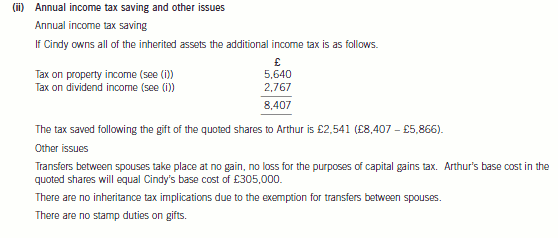
-
第10题:
如何查看一台路由器IPtraffic类型和统计信息()
- A、show ip traffic
- B、show ip flow cache
- C、show ip cache
- D、None of the above
正确答案:A -
第11题:
By setting the value of MEMORY_TARGET to zero and setting the value of SGA_TARGET to a nonzero value, you will enable which of the following memory-management options?()
- A、 Automatic PGA Memory Management
- B、 Automatic SGA Memory Management
- C、 Automatic Shared Memory Management
- D、 Automatic Memory Management
- E、 Manual SGA Memory Management
- F、 None of the above
正确答案:C -
第12题:
单选题Income tax rates are()to one's annual income.Arelated
Bdependent
Cbased
Dassociated
正确答案: C解析: 暂无解析 -
第13题:
Using the situation stated in the Special window, what is net present value of an annual income flow of $1600 at 14% over the next three years?
A . ¥3,713.60
B . ¥0.68
C . ¥1,080.00
D . ¥476.19
E . ¥2.32
正确答案:A
-
第14题:
Which of the following is not a measure of the profitability of a project or program?
A . Return on original investment.
B . Net present value.
C . Depreciation.
D . Discounted cash flow.
E . None of the above
正确答案:C
-
第15题:
115 The technique most commonly used to determine the profitability of a project includes _____ methods.
A. Net present value (NPV).
B. Return on investment (ROI).
C. Discounted cash flow (DCF)
D. Payout time and risk sensitivity analysis.
E. All of the above
正确答案:E
-
第16题:
137 Which of the following is not a measure of the profitability of a project or program?
A. Return on original investment.
B. Net present value.
C. Depreciation.
D. Discounted cash flow.
E. None of the above
正确答案:C
-
第17题:
136 A technique that can be used to measure the total income of a project compared to the total moneys expended at any period of time is:
A. return on investment (ROI)
B. net present value (NPV)
C. discounted cash flow (DCF)
D. B and C
E. All of the above
正确答案:E
-
第18题:
113 Using the possible profit and loss outcomes shown in the Special window, find the expected profit (loss)
A. ($1000)
B. $1000
C. $2000
D. $1200
E. None of the above
正确答案:D
-
第19题:
● Including the customer in the process of project planning is:
A Slow and counterproductive.
B Essential in the definition and documentation of project goals.
C Necessary, but of limited value.
D Unnecessary because project goals are defined in the proposal stage.
E None of the above.
正确答案:B
-
第20题:
(c) Issue of bond
The club proposes to issue a 7% bond with a face value of $50 million on 1 January 2007 at a discount of 5%
that will be secured on income from future ticket sales and corporate hospitality receipts, which are approximately
$20 million per annum. Under the agreement the club cannot use the first $6 million received from corporate
hospitality sales and reserved tickets (season tickets) as this will be used to repay the bond. The money from the
bond will be used to pay for ground improvements and to pay the wages of players.
The bond will be repayable, both capital and interest, over 15 years with the first payment of $6 million due on
31 December 2007. It has an effective interest rate of 7·7%. There will be no active market for the bond and
the company does not wish to use valuation models to value the bond. (6 marks)
Required:
Discuss how the above proposals would be dealt with in the financial statements of Seejoy for the year ending
31 December 2007, setting out their accounting treatment and appropriateness in helping the football club’s
cash flow problems.
(Candidates do not need knowledge of the football finance sector to answer this question.)
正确答案:(c) Issue of bond
This form. of financing a football club’s operations is known as ‘securitisation’. Often in these cases a special purpose vehicle
is set up to administer the income stream or assets involved. In this case, a special purpose vehicle has not been set up. The
benefit of securitisation of the future corporate hospitality sales and season ticket receipts is that there will be a capital
injection into the club and it is likely that the effective interest rate is lower because of the security provided by the income
from the receipts. The main problem with the planned raising of capital is the way in which the money is to be used. The
use of the bond for ground improvements can be commended as long term cash should be used for long term investment but
using the bond for players’ wages will cause liquidity problems for the club.
This type of securitisation is often called a ‘future flow’ securitisation. There is no existing asset transferred to a special purpose
vehicle in this type of transaction and, therefore, there is no off balance sheet effect. The bond is shown as a long term liability
and is accounted for under IAS39 ‘Financial Instruments: Recognition and Measurement’. There are no issues of
derecognition of assets as there can be in other securitisation transactions. In some jurisdictions there are legal issues in
assigning future receivables as they constitute an unidentifiable debt which does not exist at present and because of this
uncertainty often the bond holders will require additional security such as a charge on the football stadium.
The bond will be a financial liability and it will be classified in one of two ways:
(i) Financial liabilities at fair value through profit or loss include financial liabilities that the entity either has incurred for
trading purposes and, where permitted, has designated to the category at inception. Derivative liabilities are always
treated as held for trading unless they are designated and effective as hedging instruments. An example of a liability held
for trading is an issued debt instrument that the entity intends to repurchase in the near term to make a gain from shortterm
movements in interest rates. It is unlikely that the bond will be classified in this category.
(ii) The second category is financial liabilities measured at amortised cost. It is the default category for financial liabilities
that do not meet the criteria for financial liabilities at fair value through profit or loss. In most entities, most financial
liabilities will fall into this category. Examples of financial liabilities that generally would be classified in this category are
account payables, note payables, issued debt instruments, and deposits from customers. Thus the bond is likely to be
classified under this heading. When a financial liability is recognised initially in the balance sheet, the liability is
measured at fair value. Fair value is the amount for which a liability can be settled between knowledgeable, willing
parties in an arm’s length transaction. Since fair value is a market transaction price, on initial recognition fair value will
usually equal the amount of consideration received for the financial liability. Subsequent to initial recognition financial
liabilities are measured using amortised cost or fair value. In this case the company does not wish to use valuation
models nor is there an active market for the bond and, therefore, amortised cost will be used to measure the bond.
The bond will be shown initially at $50 million × 95%, i.e. $47·5 million as this is the consideration received. Subsequentlyat 31 December 2007, the bond will be shown as follows:
-
第21题:
What is the principal function of a financial system? ______.
A.Production and distribution of goods and services
B.Providing a means of payment and facilitating the saving and investment process
C.Directing the flow of goods and services from producer to consumer
D.None of the above
正确答案:B
解析:本题针对的是金融体系的主要功能,应该选B项,其他选项的含义都不属于这一类。 -
第22题:
In Oracle 11g,by default which one of the following conditions implicitly enables Automatic PGA Memory Management?()
- A、 Setting a nonzero value for SGA_TARGET
- B、 Configuring Automatic Shared Memory Management
- C、 Configuring Automatic Memory Management
- D、 Setting a nonzero value for SGA_MAX_SIZE and PGA_AGGREGATE_TARGET
- E、 None of the above
正确答案:B -
第23题:
单选题By setting the value of MEMORY_TARGET to zero and setting the value of SGA_TARGET to a nonzero value, you will enable which of the following memory-management options?()AAutomatic PGA Memory Management
BAutomatic SGA Memory Management
CAutomatic Shared Memory Management
DAutomatic Memory Management
EManual SGA Memory Management
FNone of the above
正确答案: C解析: 暂无解析