阅读以下说明和C语言函数,将应填入(n)处的语句写在对应栏内。【说明】本程序从正文文件text.in中读入一篇英文短文,统计该短文中不同单词及出现次数,并按词典编辑顺序将单词及出现次数输出到正文文件word.out中。程序用一棵有序二叉树存储这些单词及其出现的次数,边读入边建立,然后中序遍历该二叉树,将遍历经过的二叉树上的结点内容输出。【函数】include <stdio.h>include <malloc.h>include <ctype.h>include <string.h>define INF "
题目
阅读以下说明和C语言函数,将应填入(n)处的语句写在对应栏内。
【说明】
本程序从正文文件text.in中读入一篇英文短文,统计该短文中不同单词及出现次数,并按词典编辑顺序将单词及出现次数输出到正文文件word.out中。
程序用一棵有序二叉树存储这些单词及其出现的次数,边读入边建立,然后中序遍历该二叉树,将遍历经过的二叉树上的结点内容输出。
【函数】
include <stdio.h>
include <malloc.h>
include <ctype.h>
include <string.h>
define INF "text.in"
define OUTF "word.our'
typedef struct treenode {
char *word;
int count;
struct treenode *left, *right;
} BNODE;
int getword(FILE *fpt, char *word)
{ char c;
c=fgetc(tpt);
if (c==EOF)
return 0;
while(!(tolower(c)>= 'a' && tolower(c)<= 'z'))
{ c=fgetc(fpt);
if (c==EOF)
return 0;
} /* 跳过单词间的所有非字母字符 */
while(tolower(c)>= 'a' && tolower(c)<= 'z')
{ *word++=c;
c=fgetc(fpt);
}
*word='\0';
return 1;
}
void binary_tree(BNODE **t, char *word)
{ BNODE *ptr, *p; int compres;
p=NULL;
(1);
while (ptr) /* 寻找插入位置 */
{ compres=strcmp(word, ptr->word);/* 保存当前比较结果 */
if (!compres)
{ (2); return;}
else
{ p=ptr;
ptr=compres>0 ? ptr->right: ptr->left;
}
}
ptr=(BNODE *)malloc(sizeof(BNODE));
ptr->left=ptr->right=NULL;
ptr->word=(char *)malloc(strlen(word)+1);
strcpy(ptr->word, word);
(3);
if (p==NULL)
*t=ptr;
else if (compres>0)
p->right=ptr;
else
p->left=ptr;
}
void midorder(FILE *fpt, BNODE *t)
{ if (t==NULL)
return;
midorder(fpt,(4));
fprintf(fpt, "%s %d\n", t->word, t->count);
midorder(fpt, t->right);
}
void main()
{ FILE *fpt; char word[40];
BNODE *root=NULL;
if ((fpt=fopen(INF, "r"))==NULL)
{ printf("Can't open file %s\n", INF);
return;
}
while(getword(fpt, word)==1)
binary_tree((5));
fclose(fpt);
fpt=fopen(OUTF, "w");
if (fpt==NULL)
{ printf("Can't open fife %s\n", OUTF);
return;
}
midorder(fpt, root);
fclose(fpt);
}
相似考题
参考答案和解析
(1)ptr=*t (2)ptr->count++ (3)ptr->count=1 (4)t->left (5)&root,word 解析:本题考查在C语言中实现字母的统计和有序二叉树的建立及遍历。
题目要求统计一篇英文短文中不同单词及出现次数,并将这些单词及其出现的次数用一棵有序二叉树存储,然后中序遍历该二叉树,将遍历经过的二叉树上的结点的内容输出。内容的输出是按词典编辑顺序将单词及出现次数输出的,因此二叉树的排序是按单词在词典中编辑顺序进行的,并且有序二叉树是动态生成的。
本题目的关键是有序二叉树是动态生成的,我们先来看其生成的步骤:
(1)如果相同键值的结点已在二叉排序中,则不再插入,只需修改其count的值即可;
(2)如果二叉排序树为空树,则以新结点为根建立二叉排序树;
(3)根据要插入结点的键值与插入后父结点的键值比较,就能确定新结点是父结点的左子结点,还是右子结点,并作相应插入。
重复这几步,直到单词统计结束。
下面我们来分析代码。函数getword()已经完全实现了,用来统计短文中的单词,并返回1,说明此单词出现了一次。函数binary_tree()是用来生成有序二叉树的。函数 midorder()用来实现中序遍历。
第(1)空在函数binary_tree()中,结合程序不难看出,此空应该是赋初值,而且是给指针变量ptr赋值。函数binary_tree()的形参中有一个指针变量*t,用来传递待插入到有序二叉树中的结点地址,在这里是让指针变量ptr指向这个地址,因此答案为ptr=*t。
第(2)空在条件判断语句if(!compres)下,而compres存放的是上步的比较结果值,如果条件判断语句结果为真,说明word与ptr->word的值相等,即树中已经存在该字母结点,根据有序二叉树的生成步骤知道,不需要再插入,只需修改其count的值即可,因此,第(2)空答案为ptr->count++。
第(3)空在动态生成了新结点后面。生成了一个新结点后,自然要对新结点的几个域值进行赋初值,程序中对指针域都赋了空,对字符指针域也赋了值,剩下的只有count值没有被修改,那么此空应该是用来修改count的值。在一个字母对应的结点刚插入树中时,它肯定是第一次出现,因此,此空答案为ptr->count=1。
第(4)空在函数midorder()中,此函数的功能是实现对有序二叉树的中序遍历。它是用递归方法来实现的,如果树不为空,应该先对其左子树进行递归遍历,然后才是右子树,因此,第(4)空答案为t->left。
第(5)空是当主函数调用函数binary_tree()时,需要传递的参数。根据binary_tree()的定义,我们知道它的第一个参数是指向有序二叉树的二重指针,而第二个参数是指向当前需要处理的字母的指针。在主函数中,表明有序二叉树是一重指针root,而存放当前需要处理字母的是word数组。在一重指针与二重指针进行参数传递时,需要注意加取地址运算符“&”,因此,此空答案为&root,word。
更多“阅读以下说明和C语言函数,将应填入(n)处的语句写在对应栏内。【说明】 本程序从正文文件text.in中读 ”相关问题
-
第1题:
阅读下列程序说明和C++程序,把应填入其中(n)处的字句,写在对应栏内。
【说明】
阅读下面几段C++程序回答相应问题。
比较下面两段程序的优缺点。
①for (i=0; i<N; i++ )
{
if (condition)
//DoSomething
…
else
//DoOtherthing
…
}
②if (condition) {
for (i =0; i<N; i++ )
//DoSomething
}else {
for (i=0; i <N; i++ )
//DoOtherthing
…
}
正确答案:程序1优点:程序简洁;缺点:多执行了N-1次逻辑判断并且程序无法循环“流水”作业使得编译器无法对循环进行优化处理降低了效率。 程序2优点:循环的效率高;缺点:程序不简洁。
程序1优点:程序简洁;缺点:多执行了N-1次逻辑判断,并且程序无法循环“流水”作业,使得编译器无法对循环进行优化处理,降低了效率。 程序2优点:循环的效率高;缺点:程序不简洁。 -
第2题:
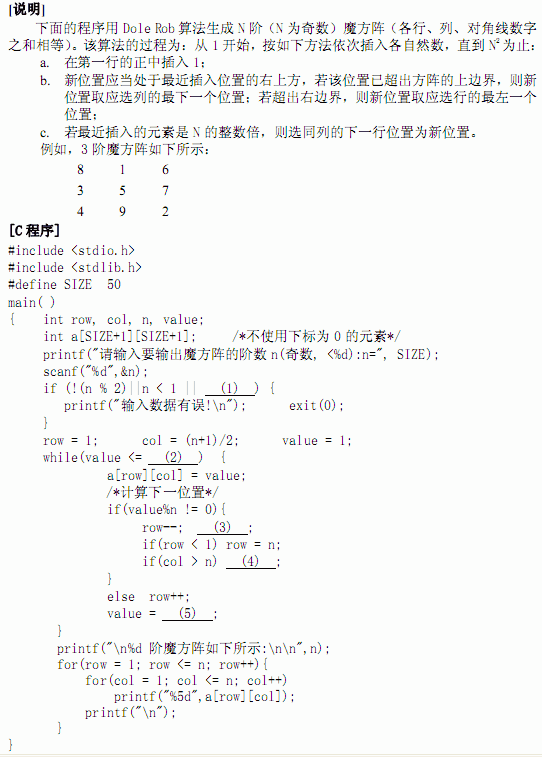
试题三(共 15 分)
阅读以下说明和 C 程序,将应填入 (n) 处的字句写在答题纸的对应栏内。
 正确答案:
正确答案: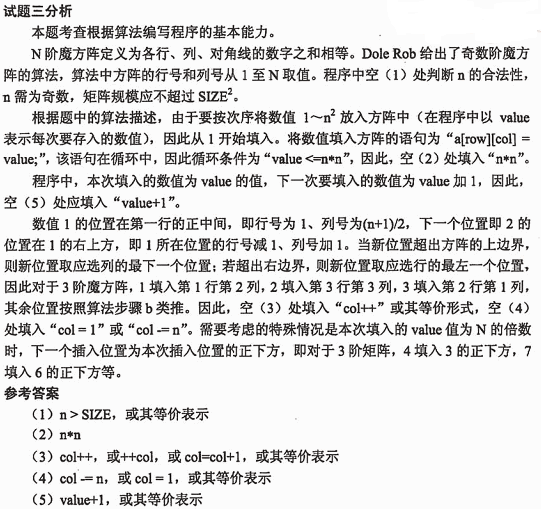
-
第3题:
()阅读下列说明和C语言程序,将应填入 (n)处的语句写在答题纸的对应栏内。[说明]下面程序是一个带参数的主函数,其功能是显示在命令行中输入的文本文件内容。[C语言函数]#include"stdio.h"main(argc,argv) int argc; char *argv[]; { (1) ; if((fp=fopen(argv[1],”r’’))== (2) ) { printf(”file not open!\n”);exit(0);} while( (3) ) putchar( (4) ); (5); }
正确答案:()
(1)FILE *fp; (2)NULL (3)!feof(fp) (4)fgetc(fp) (5)fclose(fp)
从程序功能来看,程序中需要用到文件型指针变量中,而主函数体没有定义,所以(1)应该填写的是“FILE *fp;”。接下来的语句是标准的打开只读文本文件的语句,显示的是文件没打开,说明文件名不存在,也就是为“NULL”。接着的while循环语句中有两处空白。前一个空白是控制循环的条件,从程序功能来看,要将文本文件中的所有字符显示出来,这儿当然只能填写“不是文件尾则继续循环”,具体说,需要填写的是“!feof(fp)”。(4)出现在循环体中的语句中,该循环体的功能是从fp指向的文本文件中读取单个字符并显示在屏幕上,此处使用的是putchar函数,该函数的功能是将形参对应的字符显示在屏幕上,所以该处的空白就是要显示的字符,这个字符必须是从文本文件中读取的单个字符,完成这项工作的可以利用fgetc()函数,所以(4)填写的是“fgetc(fp)”。最后一句应当是关闭文件,所以(5)应填fclose(fp)。
-
第4题:
阅读下列说明和流程图,将应填入(n)处的语句写在对应栏内。
【说明】
设学生(学生数少于50人)某次考试的成绩按学号顺序逐行存放于某文件中,文件以单行句点“.”为结束符。下面的流程图用于读取该文件,并把全部成绩从高到低排序到数组B[50]中。
【流程图】
 正确答案:(1)B[0]←a (2)i←0 (3)a="." (4)aB[j] (5)j--
(1)B[0]←a (2)i←0 (3)a="." (4)aB[j] (5)j-- 解析:本题考查用程序流程图来描述排序。
题目要求将文件中学生的成绩读出,并把全部成绩从高到低排序到数组B[50]中。这里面涉及两个问题,第一是从文件中读数,文件中的数据是以单行句点“.”为结束符的,在未读到此符号前,应该将继续取数据。第二是排序,每取到一个学生的成绩都要与数组的学生成绩比较,按照从高到低的顺序在数组中找到合适的位置存放。下面来具体分析流程图。
第(1)空在条件判断为假的情况下执行流程中,如果条件为假说明从文件中取到的数据是学生成绩。从程序流程图中可以看到,从文件中读的数据存放在变量a中,而此空是第一次取数据,应该存放数组B的第一个位置,因此此空答案为B[0]←a。
第(2)空是紧接着第(1)空来的,在上面已经把从文件中读到的第一个数存放到了数组中,接下来应该处理数组的下标问题,从后面的流程中可以推断出变量i是存放数组当前下标的,而且没有初值,那么此空的任务应该是用来给变量i赋一个初值,而对数组的操作应该从头开始,因此此空答案为i←0。
第(3)空是循环的判断条件,如果条件成立则结束,在这之前又对文件进行了一次读数,根据我们上面的分析只有在读到了结束符时程序才结束,那么此空肯定是判断从文件中读到的数据是否为结束符,因此此空答案为a="."?。
第(4)空也是一个循环的判断条件,如果条件成立,则将取到的数存放到数组的当前下标位置;如果不成立,则循环找到合适的位置再存放。从这里我们不难推断出,流程图中是将从文件取到的成绩与当前数组中的最小成绩进行比较的,而当前数组中的最小成绩存放在位置j中,因此此空答案为aB[i]?。
第(5)空在循环体中,这个循环的作用是为当前从文件中读到的成绩在已经排好序的数组元素中找到合适的位置,找到了就要插入,数组中的元素是按从大到小排列的,在查找合适位置时是从后往前依次比较,因此此空的任务应该是将数组的下标往前移动,所以此空答案为“i--”。 -
第5题:
()阅读下列说明和C语言程序,将应填入 (n)处的语句写在答题纸的对应栏内。[说明]有一个一维数组cj,内放20个学生成绩,求平均成绩。函数ave用来求20个学生的平均成绩。[C语言函数]float ave(float a[20]){ int i;float aver,sum= (1) ;for(i=1;i<20;i++) sum= (2) ;aver= (3) ;return( (4) );}main(){ float cj[20],aver;int i;printf(“input 20 cj:\n”);for(i=0;i<20;i++) scanf(“%f”,&cj[i]);printf(“\n”);aver= (5) ;printf(“average cj is %6.2f”,aver);}
正确答案:()
(1)a[0] (2)sum+a[i] (3)sum/20 (4)aver (5)ave(cj)
sum是用来存放学生的总成绩的,所以又由于在下面的for循环里i是从1开始的,所以(1)应填a[0],(2)应填sum+a[i],aver是用来求平均成绩的,所以(3)应填sum/20,(4)应填返回的结果,因此应将平均值aver返回。所以(4)应填aver,(5)应该是调用函数ave求平均值,所以应填ave(cj)。
-
第6题:
阅读下列说明和?C++代码,将应填入(n)处的字句写在答题纸的对应栏内。
【说明】
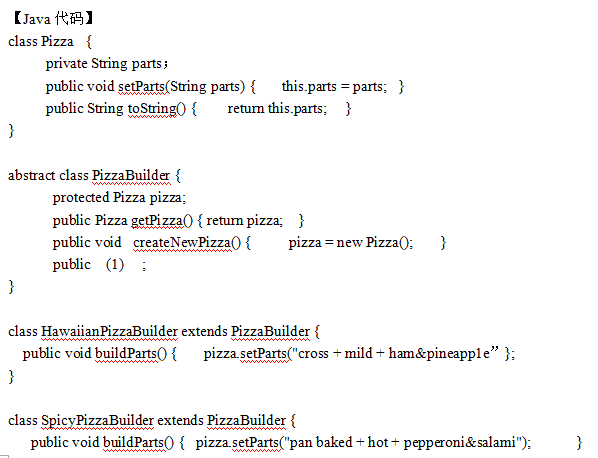
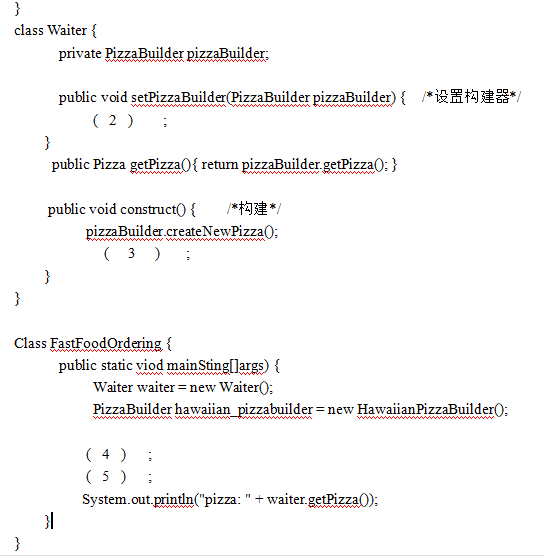
阅读下列说明和?Java代码,将应填入?(n)?处的字句写在答题纸的对应栏内。
【说明】
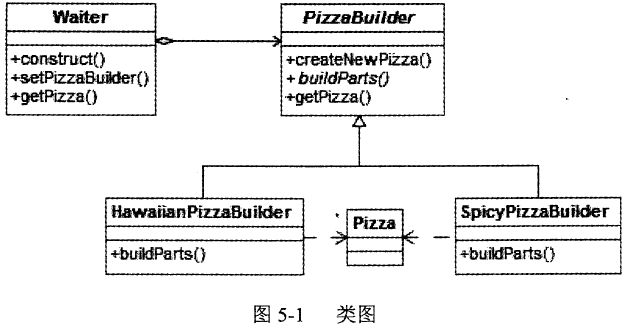
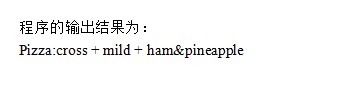
某快餐厅主要制作并出售儿童套餐,一般包括主餐(各类比萨)、饮料和玩具,其餐品种
类可能不同,但其制作过程相同。前台服务员?(Waiter)?调度厨师制作套餐。现采用生成器?(Builder)?模式实现制作过程,得到如图?6-1?所示的类图。
 答案:解析: