
Frame. Relay is simplified form. of(71), similar in principle to(72), in which synchronous, frames of data are routed to different destinations depending on header information . Packets are routed throught one or more Virtual Circuits known as(73). Most V
题目
Frame. Relay is simplified form. of(71), similar in principle to(72), in which synchronous, frames of data are routed to different destinations depending on header information . Packets are routed throught one or more Virtual Circuits known as(73). Most Virtual Circuits are(74),which means that the network provider sets up all DLCI connections at subscription time.(75)are also part of the Frame. Relay specification . They privide a link that only lasts only as long as the session.
A.Datagram Switching
B.Datagram Routing
C.Packet Switching
D.packet Routing
相似考题
参考答案和解析
更多“Frame. Relay is simplified form. of(71), similar in principle to(72),in which synchronous, ”相关问题
-
第1题:
●SDLC was invented by IBM to replace the older Bisynchronous protocol for wide area connections between IBM equipment .A varietion of the (71) protocol called NRM is essentially the same as SDLC.SDLC is (72) protocol like HDLC , Frame. Relay or X.25.An SDLC network is made up of (73) that controls all communications , and (74) .It is capable of (75) operation, but almost all practical applications are strictly half duplex.
(71) A.HDLC
B.Frame. Relay
C.X.25
D.X.21
(72) A.a peer to peer
B.a point-to-point
C.not a peer to peer
D.a peer to peers
(73) A.a primary station
B.one or more primary stations
C.a secondary station
D.one or more secondary stations
(74) A.a primary station
B.one or more primary stations
C.a secondary station
D.one or more secondary stations
(75) A.half duplex
B.full duplex
C.half or full duplex
D.half and full duplex
正确答案:A,C,A,D,B
【解析】SDLC是IBM用来连接广泛区域的IBM设备而发明的。另一重变化了的协议HDLC称为NRM,它与SDLC特别相似。SDLC跟HDLC、帧中继和X.25一样不是点对点协议,一个SDLC网络由一些控制网络通信及从站的主站组成。它是全双工的,但实际上很多应用都是半双工的。
-
第2题:
● (71) In the strength of the carrier signal is varied to represent binary 1 or 0.
(72) is a system that can map a name to an address and conversely an address to an name.
(73) is a three-way handshaking authentication protocol that it's packets are encapsulated in the point-to-point protocol
(74) is an approach that enables an ATM Switch to behave like a LAN switch.
(75) is an guided media which is made of glass or plastic and transmits signals in the form. of light.
(71) A.ASK
B.PSK
C.FSK
D.FDM
(72) A.NAT
B.NCP
C.DDN
D.DNS
(73) A.PPP
B.PAP
C.CHAP
D.LCP
(74) A.VLAN
B.LANE
C.VPN
D.IPOA
(75) A.Coaxial cable
B.Optical fiber
C.Unshielded Twisted-pair Cable
D.Shielded Twisted-pair Cable
正确答案:A,D,C,B,B
【解析】在幅频键控(ASK)调制中,载波的振幅随所表示的0、1变化;DNS是一种能够将名字映射为IP地址同时也可以将IP地址映射为名字的系统;CHAP是一种利用三次握手机制的认证协议,它的数据包被封装在点对点链路协议上:LANE是一种能够让ATM交换机象局域网交换机一样的方式;光纤是一种用玻璃纤维和塑料外套制成的传输介质,它上面以光的形式来传输信号。
-
第3题:
Frame. Relay is simplified form. of(71), similar in principle to(72), in which synchronous, frames of data are routed to different destinations depending on header information.
Packets are routed throught one or more Virtual Circuits known as(73)Most Virtual Circuits are(74), which means that the network provider sets up all DLCI connections at subscription time.(75)are also part of the Frame. Relay specification. They privide a link that only lasts only as long as the session.
A.Datagram Switching
B.Datagram Routing
C.Packet Switchig
D.packet Routing
正确答案:C
-
第4题:
A Ezonexam Ethernet switch receives a unicast frame. with a destination MAC that is listed in the switch table. What will this switch do with the frame?
A. The switch will forward the frame. to a specific port
B. The switch will forward the frame. to all ports except the port on which it was received
C. The switch will return a copy of the frame. out the source port
D. The switch will not forward unicast frames
E. The switch will remove the destination MAC from the switch table
F. None of the above.
正确答案:A
A 解析:Explanation:
How Does the Switch Find Host MACs?
Let's use the diagram below to help us understand how address learning process takes place.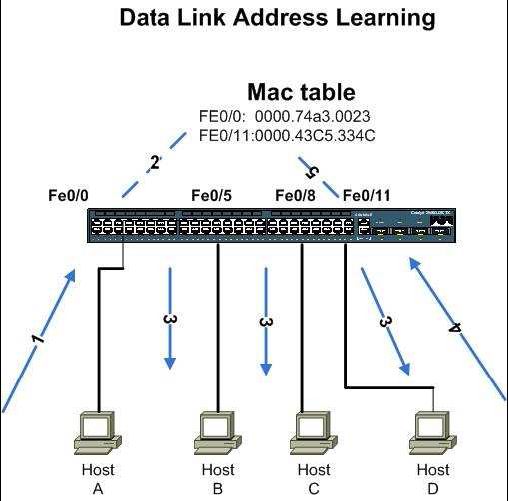
Let's assume that we have just powered on the switch. It has nothing in its MAC table. We connect the cables from the hosts on the switch interfaces as shown in the diagram. Host A initiates a connection towards Host D, and the following takes place:
1. Host A (interface fe0/0) sends a frame. to Host D (MAC address:0000.43c5.334c).
2. The switch inspects the Source Address in the frame. and notes in its table the MAC address of Host A along with the Interface number from which the frame. originated.
3. The switch inspects the Destination Address in the frame. Since it does not have Hosts D MAC address in its table, it constructs a broadcast frame. and forwards out all interfaces except the interface from where the original frame. arrived.
4. Host D identifies itself as the expected recipient and responds back to Host A. The switch receives the respond frame. on interface fe0/11 and places the SA in its table along with the interface number where the frame. came from.
5. From now on, further communication between the two hosts will be switched to the appropriate interfaces based on the MAC tables entries.
This process takes place every time a new host is attached on the switch and initiates traffic. The switch tries to keep its MAC table up-to-date, therefore if some hosts do not initiate traffic for a certain amount of time, the switch removes them from its table and reinserts them when they begin sending traffic.
-
第5题:
Which configuration is correct for a DHCP Relay Proxy?()A. set dhcp relay 1.1.1.1 set dhcp relay 2.2.2.2 set dhcp relay
B. set dhcp relay proxy set dhcp relay 1.1.1.1 set dhcp relay 2.2.2.2
C. set dhcp relay 1.1.1.1 proxy set dhcp relay 2.2.2.2
D. set dhcp relay 1.1.1.1 set dhcp relay 2.2.2.2 proxy
参考答案:C
-
第6题:
The(71) program is generally translated to an object program, which is in a form. directly understandably by the computer。
A.transfer
B.assemble
C.source
D.compile
正确答案:C
解析:源程序通常要翻译成目标程序,这才是计算机直接可理解的形式。 -
第7题:
● The usual way to ensure reliable delivery is to provide the (71) with some feedback about what is happening at the other end of the line. Typically, the protocol calls for the receiver to send back special (72) frame. bearing positive or negative (73) about the incoming frames. If the sender receives a positive acknowledgement about a frame, it knows the frame. has arrived safely. On the other hand, a negative acknowledgement means that something has gone wrong, and the frame. must be transmitted again. An additional complication comes from the possibility that hardware troubles may cause a
frame. to (74) completely. In this case, the receiver will not react at all, since it has no any reason to react. It should be clear that a protocol in which the sender transmits a frame. and then waits for an acknowledgement, positive or negative, will hang forever if a frame. is ever lost due to, for example, (75) hardware.
(71)
A. receiver
B. controller
C. sender
D. customer
(72)
A. data
B. control
C. request
D. session
(73)
A. application
B. connection
C. stream
D. acknowledgement
(74)
A. vanish
B. vary
C. appear
D. incline
(75)
A. acting
B. working
C. malfunctioning
D. functioning
正确答案:C,B,D,A,C
-
第8题:
Which statement is true about logical units?()
- A、Logical units are similar to VLANs used by other vendors.
- B、A logical unit is required for transit interfaces.
- C、Frame Relay encapsulation supports one logical unit.
- D、Link speed and duplex are configured in the logical unit properties.
正确答案:B -
第9题:
Which command is required for connectivity in a Frame Relay network if Inverse ARP is not operational? ()
- A、frame-relay arp
- B、frame-relay map
- C、frame-relay interface-dlci
- D、frame-relay lmi-type
正确答案:B -
第10题:
单选题Which command is required for connectivity in a Frame Relay network if Inverse ARP is not operational? ()Aframe-relay arp
Bframe-relay map
Cframe-relay interface-dlci
Dframe-relay lmi-type
正确答案: A解析: 暂无解析 -
第11题:
单选题When students learn apple, orange, the teacher gives students another word fruit. Which principle does the teacher follow in his/her vocabulary teaching?AWord-choice principle,
BPresentation principle.
CCulture principle.
DSystematic principle.
正确答案: D解析: -
第12题:
单选题Which statement is true about logical units?()ALogical units are similar to VLANs used by other vendors.
BA logical unit is required for transit interfaces.
CFrame Relay encapsulation supports one logical unit.
DLink speed and duplex are configured in the logical unit properties.
正确答案: B解析: 暂无解析 -
第13题:
Object-oriented analysis(OOA)is a semiformal specification technique for the object-oriented paradigm. Object-oriented analysis consists of three steps. The first step is(71). It determines how the various results are computed by the product and presents this information in the form. of a(72)and associated scenarios. The second is(73), which determines the classes and their attributes. Then determine the interrelationships and interaction among the classes. The last step is(74), which determines the actions performed by or to each class or subclass and presents this information in the form. of(75).
A.use-case modeling
B.class modeling
C.dynamic modeling
D.behavioral modeling
正确答案:A
-
第14题:
试题(71)~(75)Object-oriented analysis (OOA) is a semiformal specification technique for the object-oriented paradigm. Object-oriented analysis consists of three steps. The first step is (71). It determines how the various results are computed by the product and presents this information in the form. of a (72) and associated scenarios. The second is (73) , which determines the classes and their attributes. Then determine the interrelationships and interaction among the classes. The last step is (74) , which determines the actions performed by or to each class or subclass and presents this information in the form. of (75) .
(71)
A. use-case modeling
B. class modeling
C. dynamic modeling
D. behavioral modeling
(72)
A. collaboration diagram
B. sequence diagram
C. use-case diagram
D. activity diagram
(73)
A. use-case modeling
B. class modeling
C. dynamic modeling
D. behavioral modeling
(74)
A. use-case modeling
B. class modeling
C. dynamic modeling
D. behavioral modeling(75)
A. activity diagram
B. component diagram
C. sequence diagram
D. state diagram
正确答案:A,C,B,C,D
参考译文
面向对象的分析(OOA)是一种面向对象范型的半形式化描述技术。面向对象的分析包括3个步骤:第1步是用例建模,它决定了如何由产品得到各项计算结果,并以用例图和相关场景的方式展现出来;第2步是类建模,它决定了类及其属性,然后确定类之间的关系和交互;第3步是动态建模,它决定了类或每个子类的行为,并以状态图的形式进行表示。
-
第15题:
●Object-oriented analysis (OOA) is a semiformal specification technique for the object-oriented paradigm. Object-oriented analysis consists of three steps. The first step is (71). It determines how the various results are computed by the product and presents this information in the form. of a (72) and associated scenarios. The second is (73) , which determines the classes and their attributes, then determines the interrelationships and interaction among the classes. The last step is (74) , which determines the actions performed by or to each class or subclass and presents this information in the form. of (75) .
(71)
A.use-case modeling
B. class modeling
C. dynamic modeling
D. behavioral modeling
(72)
A. collaboration diagram
B. sequence diagram
C. use-case diagram
D. activity diagram
(73)
A. use-case modeling
B. class modeling
C. dynamic modeling
D. behavioral modeling
(74)
A.use-case modeling
B. class modeling
C. dynamic modeling
D. behavioral modeling
(75)
A. activity diagram
B. component diagram
C. sequence diagram
D. state diagram
正确答案:A,C,B,C,D
-
第16题:
SDLC was invented by IBM to replace the older Bisynchronous protocol for wide area connections between IBM equipment . A varietion of the (71) protocol called NRM is essentially the same as SDLC. SDLC is (72) protocol like HDLC, Frame. Relay or X.25. An SDLC network is made up of (73) that controls all communications, and (74) . It is capable of (75) operation, but almost all practical applications are strictly half duplex.
A.HDLC
B.Frame. Relay
C.X.25
D.X.21
正确答案:A
-
第17题:
Frame. Relay is simplified form. of(66), similar in principle to(67), in which synchronous, frames of data are routed to different destinations depending on header information.
Packets are routed throught one or more Virtual Circuits known as(68). Most Virtual Circuits are(69), which means that the network provider sets up all DLCI connections at subscription time.(70)are also part of the Frame. Relay specification. They privide a link that only lasts only as long as the session.
A.Datagram Switching
B.Datagram Routing
C.Packet Switching
D.packet Routing
正确答案:C
-
第18题:
Which command is required for connectivity in a Frame Relay network if Inverse ARP is not operational? ()A. frame-relay arp
B. frame-relay map
C. frame-relay interface-dlci
D. frame-relay lmi-type
参考答案:B
-
第19题:
The usual way to ensure reliable delivery is to provide the (71) with some feedback about what is happening at the other end of the line. Typically, the protocol calls for the receiver to send back special (72) flame bearing positive or negative (73) about the incoming frames. If the sender receives a positive acknowledgement about a frame, it knows the frame. has arrived safely. On the other hand, a negative acknowledgement means that' something has gone wrong, and the frame. must be transmitted again.
An additional complication comes from the possibility that hardware troubles may cause a flame to (74) completely. In this case, the receiver will not react at all, since it has no any reason to react. It should be clear that a protocol in which the sender transmits a frame. and then waits for an acknowledgement, positive or negative, will hang forever if a frame. is ever lost due to, for example, (75) hardware.
A.receiver
B.controller
C.sender
D.customer
正确答案:C
-
第20题:
Which command can be used to verify the DLCI destination address in a Frame Relay static configuration?()
- A、show frame-relay end-to-end
- B、show frame-relay map
- C、show frame-relay lmi
- D、show frame-relay pvc
正确答案:B -
第21题:
which command allows you to verify the encapsulation type CISCO OR IETF for a frame relay link?()
- A、show frame-relay map
- B、show frame-relay lmi
- C、show inter serial
- D、show frame-relay pvc
正确答案:C -
第22题:
单选题When students learn apple, orange, the teacher gives students another word fruit.Which principle does the teacher follow in his/her vocabulary teaching?AWord-choice principle.
BPresentation principle.
CCulture principle.
DSystematic principle.
正确答案: B解析: -
第23题:
单选题Which configuration is correct for a DHCP Relay Proxy?()Aset dhcp relay 1.1.1.1 set dhcp relay 2.2.2.2 set dhcp relay
Bset dhcp relay proxy set dhcp relay 1.1.1.1 set dhcp relay 2.2.2.2
Cset dhcp relay 1.1.1.1 proxy set dhcp relay 2.2.2.2
Dset dhcp relay 1.1.1.1 set dhcp relay 2.2.2.2 proxy
正确答案: B解析: 暂无解析