
Text 3Everyone has heard of the San Andreas fault, which constantly threatens California and the West Coast with earth- quakes. But how many people know about the equally serious New Madrid fault in Missouri.'?Between December of 1811 and February of 1812
题目
Text 3
Everyone has heard of the San Andreas fault, which constantly threatens California and the West Coast with earth- quakes. But how many people know about the equally serious New Madrid fault in Missouri.'?
Between December of 1811 and February of 1812, three major earthquakes occurred, all centered around the town of New Madrid, Missouri, on the Mississippi River. Property damage was severe.
Buildings in the area were almost dest oyed. Whole forests fell at once, and huge cracks opened in the ground, allowing smell of sulfur to filter upward.
The Mississippi River itself completely changed character, developing sudden rapids and whirlpools. Several times it changed its course, and once, according to some observers, it actually appeared to run backwards. Few people were killed in the New Madrid earthquakes, probably simply because few people lived in the area in 1811; but the severity of the earth- quakes are shown by the fact that the shock waves rang bells in church towers in Charleston, South Carolina, on the coast. Buildings shook in New York City, and clocks were stopped in Washington D.C. Scientists now know that America's two major faults are essentially different. The San Andreas is a horizontal boundary between two major land masses that are slowly moving in opposite directions. California earthquakes result when the movement of these two masses suddenly lurches forward.
The New Madrid fault, on the other hand, is a vertical fault; at some point, possibly hundreds of millions of years ago, rock was pushed up toward the surface, probably by volcanoes under the surface. Suddenly, the volcanoes cooled and the rock collapsed, leaving huge cracks. Even now', the rock continues to settle downwards, and sudden sinking motions trigger earthquakes in the region. The fault itself, a large crack in this layer of rock, with dozens of other cracks that split off from it, extends from northeast Arkansas through Missouri and into southern Illinois.
Scientists who have studied the New Madrid fault say there have been numerous smaller quakes in the area since 1811; these smaller quakes indicate that larger ones are probably coming, but rite scientists say they have no method of predicting when a large earthquake will occur.
31. This passage is mainly about ______.
A) the New Madrid fault in Missouri
B) the San Andreas and the New Madrid faults
C) the causes of faults
D) current scientific knowledge about faults
相似考题
更多“Text 3Everyone has heard of the San Andreas fault, which constantly threatens California a ”相关问题
-
第1题:
Mary rarely speaks to Susan.A:slowly
B:seldom
C:weakly
D:constantly答案:B解析:本句意思:玛丽很少和苏珊说话。单词seldom意思为“几乎不,很少”,与rarely(不常,难 得)意思接近。单词。lowly意思为“缓慢地”;weakly意思为“虚弱地”;constantly意思为“持 久地”。 -
第2题:
若某文件系统的目录结构如下图所示,假设用户要访问文件fault.swf,且当前工作目录为swshare,则该文件的全文件名为(27),相对路径和绝对路径分别为(28)。
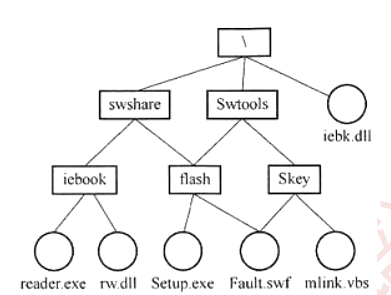 A.fault.swf
B.flash\fault.swf
C.swshare\flash\fault.swf
D.\swshare\flash\fault.swf答案:D解析:全文件名应该从根目录开始,因此为\swshare\flash\fault.swf。相对路径是从当前路径开始的路径,fault.swf在当前工作目录swshare下的flash文件夹中,因此相对路径为flash\。绝对路径是指从根目录开始的路径,即\swshare\flash\。 -
第3题:
下列可以作为变量名的是?
A.San_Francisco
B.___NewYork
C.A_r_u_b_a
D.California
NEXT_DAY?A3B?_b5?int1 -
第4题:
Rumors began to circulate about his financial problems.A:send
B:spread
C:hear
D:confirm答案:B解析:本句意思:关于他的财产问题的流言已经传播开来。circulate意为“使循环,使流通;流 传,传播”,与spread(传播,散布,蔓延)意思相近。send寄出,送出;hear听到;confirm证实, 确认。 -
第5题:
若某文件系统的目录结构如下图所示,假设用户要访问文件 fault.Swf,且当前工作目录为 swshare,则该文件的全文件名为( )。A. fault.swf
B. flash\fault.swf
C. swshare\flash\fault.swf
D. \swshare\flash\fault.swf答案:D解析: -
第6题:
下面属于内容过滤选择器的是()
A.:contains(text)
B.:has(selector)
C.:empty
D.:parent
contains(text);:has(selector);:empty;:parent