
下列程序的运行结果为【14】#include <stdio.h>#include <string.h>struct A{int a;char b[10];double c;};void f (struct A *t);main(){struct A a=(1001,”ZhangDa”,1098,0);f(&a);printf(“&d,&s,&6,if\n”,a.a,a.b,a.c);}void f(struct A *t){strcpy(t->b,”ChangRong”); }
题目
下列程序的运行结果为【14】
#include <stdio.h>
#include <string.h>
struct A
{int a;char b[10];double c;};
void f (struct A *t);
main()
{struct A a=(1001,”ZhangDa”,1098,0);
f(&a);printf(“&d,&s,&6,if\n”,a.a,a.b,a.c);
}
void f(struct A *t)
{strcpy(t->b,”ChangRong”); }
相似考题
更多“下列程序的运行结果为【14】 #include <stdio.h> #include <string.h> struct ”相关问题
-
第1题:
有以下程序includemain(){int a=5,b=lt; t=(a<<2)|b;printf("%d\n",t);}程序运行后的 有以下程序 #include<stdio.h> main() { int a=5,b=lt; t=(a<<2)|b;printf("%d\n",t); } 程序运行后的输出结果是______。
A.21
B.11
C.6
D.1
正确答案:A
解析:本题主要考查了C语言的逻辑运算符,先将变量a,b的值转换为2进制数,a=00000101,b=00000001,a先左移 2位结果为00010100,再与b按位或运算,结果为00010101,转换为十进制数为21,因此,选项A是正确的。 -
第2题:
有以下程序:
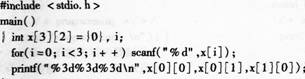
若运行时输入:2 4 6<;回车>;,则输出结果为( )。
A.2 0 4
B.2 0 0
C.2 4 0
D.2 4 6
正确答案:A
本题中输入的3个数据2,4,6分别赋值给了x[0[0],x[1][0],x[2][0]。x[o][1]仍为初始时的0,所以打印输出时的结果为A选项。 -
第3题:
阅读以下程序,给出运行结果 #include <iostream> #include <cstring> using namespace std; int main() { string str="I love China!"; cout << str; return 0; }
emoclew emoclew -
第4题:
以下程序的运行结果是【】。 includeinclude using namespace std; void main() 以下程序的运行结果是【 】。
include<iostream>
include<string>
using namespace std;
void main(){
chara[10]="China",b[]="Chin",c[]="ese";
cout<<strlen(strcat(strcpy(a,b),c))<<endl;
}
正确答案:7
7 解析:本题主要考查C++中字符串函数的使用。strcpy(s1,s2)将s2的内容赋值到s1中; strcat(s1,s2)连接s1和s2两个字符串;strlen(s)返回字符数组s的长度。因此最后输出的结果是b和c进行连接后的字符串长度,即7。 -
第5题:
下列表达式结果为“真”的是
A.2 #gt# 3 #and# 4 #gt# 2 ;
B.2 #lt# 3 #and# 4 #lt# 2 ;
C.2 #gt# 3 #and# 4 #lt# 2 ;
D.2 #lt# 3 #and# 4 #gt# 2;
[AB]$“ABCDEFGH” -
第6题:
3、阅读下列程序,则在执行后,程序的运行结果为() #include <string.h> #include<stdio.h> int main() { char a[30]="nice to meet you!"; strcpy(a+strlen(a)/2,"you"); printf("%s\n",a); }
A.nice to meet you you
B.nice to
C.meet you you
D.nice to you
D 在C中,数据只能从实际参数单向传递给形参。