
小学英语?语音 一、考题回顾二、考题解析 【教案】 Teaching aims: Knowledge aim: Students will master the meaning and pronunciation of the word. Ability aim: Students will know how to pronounce “-er” in words. Emotional aim: Students will be interested in learning English. Key an
题目
小学英语?语音
一、考题回顾

二、考题解析
【教案】
Teaching aims:
Knowledge aim:
Students will master the meaning and pronunciation of the word.
Ability aim:
Students will know how to pronounce “-er” in words.
Emotional aim:
Students will be interested in learning English.
Key and difficult point:
Key Point:
Students will master the meaning and pronunciation of the word.
Students will know how to pronounce “-er” in words.
Difficult Point:
Students will be interested in learning English.
Teaching procedure:
Step 1: Warming-up
1. Greetings.
2. Sing a song Finger Family.
Daddy finger, daddy finger, where are you?
Here I am, here I am, how do you do?
Mommy finger, mommy finger, where are you?
Here I am, here I am, how do you do?
Ask them if they know the name of the song. Then may guess it is Finger Family. Then tell them that we are going to learn some pronunciation in “finger”.
Step 2: Presentation
1. Use some riddles to introduce the words. For example, “I will drink it every day. What is it? Yes, it’s water.” Then draw the according pictures(introduce “sister” by explaining its meaning). And write the words at last.
2. Ask the students to read the words after the teacher for twice. Then play high and low voice. If the teacher speak one word loudly, the students should speak it lowly, and vice versa.
3. Ask students to find similarities among the words. They may say that they all contain “-er” at the end of the words. Then introduce the rules of the pronunciation.
4. Ask students if they know other words containing “-er”. They may say “winter”, “river” or others.
Step 3: Practice
1. Finish Read, underline, and say in the textbook. Check answers, and ask students to read after the teacher.
2. Finish Look, listen and write in the textbook. Then invite students share their answers on the blackboard. Give encouragement.
Step4: Production
1. Ask students to make up a chant using the words we learned. For example:
Water, water, tiger likes water.
Sister, sister, sister likes computer.
Dinner, dinner, let’s have dinner.
Step5: Summary and Homework
Summary: ask a student to conclude the content of the lesson and summarize with the whole class.
Homework: chant for the students’ parents.
Blackboard design:

1. What is a good pronunciation lesson?
2. What will you do if one of the students in your class doesn’t do homework?
一、考题回顾
二、考题解析
【教案】
Teaching aims:
Knowledge aim:
Students will master the meaning and pronunciation of the word.
Ability aim:
Students will know how to pronounce “-er” in words.
Emotional aim:
Students will be interested in learning English.
Key and difficult point:
Key Point:
Students will master the meaning and pronunciation of the word.
Students will know how to pronounce “-er” in words.
Difficult Point:
Students will be interested in learning English.
Teaching procedure:
Step 1: Warming-up
1. Greetings.
2. Sing a song Finger Family.
Daddy finger, daddy finger, where are you?
Here I am, here I am, how do you do?
Mommy finger, mommy finger, where are you?
Here I am, here I am, how do you do?
Ask them if they know the name of the song. Then may guess it is Finger Family. Then tell them that we are going to learn some pronunciation in “finger”.
Step 2: Presentation
1. Use some riddles to introduce the words. For example, “I will drink it every day. What is it? Yes, it’s water.” Then draw the according pictures(introduce “sister” by explaining its meaning). And write the words at last.
2. Ask the students to read the words after the teacher for twice. Then play high and low voice. If the teacher speak one word loudly, the students should speak it lowly, and vice versa.
3. Ask students to find similarities among the words. They may say that they all contain “-er” at the end of the words. Then introduce the rules of the pronunciation.
4. Ask students if they know other words containing “-er”. They may say “winter”, “river” or others.
Step 3: Practice
1. Finish Read, underline, and say in the textbook. Check answers, and ask students to read after the teacher.
2. Finish Look, listen and write in the textbook. Then invite students share their answers on the blackboard. Give encouragement.
Step4: Production
1. Ask students to make up a chant using the words we learned. For example:
Water, water, tiger likes water.
Sister, sister, sister likes computer.
Dinner, dinner, let’s have dinner.
Step5: Summary and Homework
Summary: ask a student to conclude the content of the lesson and summarize with the whole class.
Homework: chant for the students’ parents.
Blackboard design:
1. What is a good pronunciation lesson?
2. What will you do if one of the students in your class doesn’t do homework?
相似考题
更多“小学英语?语音 ”相关问题
-
第1题:
小学英语 词汇
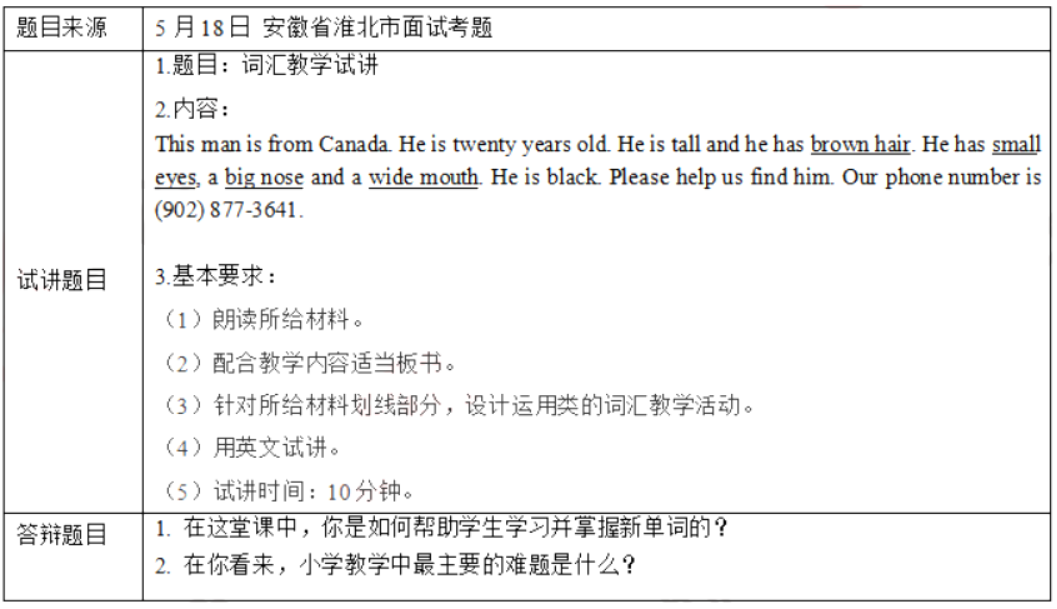
一、考题回顾
 答案:解析:二、考题解析
【教案】
1. Teaching aims:
Knowledge aim:
Students can understand the meanings and pronunciation of the new words including “brown hair, small eyes, big nose, and wide mouth”.
Ability aim:
Students can talk about the body with the new words in daily life.
Emotional aim:
Students can improve their confidence and interests in learning English after class.
2. Key and difficult point:
Key Point:
Students can master the meaning and usage of the new words including “brown hair, small eyes, big nose, and wide mouth”.
Difficult Point:
Students can use the new words about body in daily life.
Students can improve the interest in learning English and cultivate the spirit of cooperation.
Teaching procedures:
Step 1: Warming-up
1. Greetings. Ask students whether they can find any difference in the classroom. Tell them there is a flower and ask them to water it every day.
2. Sing a song for students.
One little finger, one little finger, tap tap tap.
Put your finger up.
Put your finger down.
Put it on your head, head!
One little finger, one little finger, tap tap tap
Put your finger up.
Put your finger down
Put it on your nose, nose!
Ask students if they can figure out any body word in this song, and they may say “finger” and “head”. Then tell them today we will learn more words about our body..
Step 2: Presentation
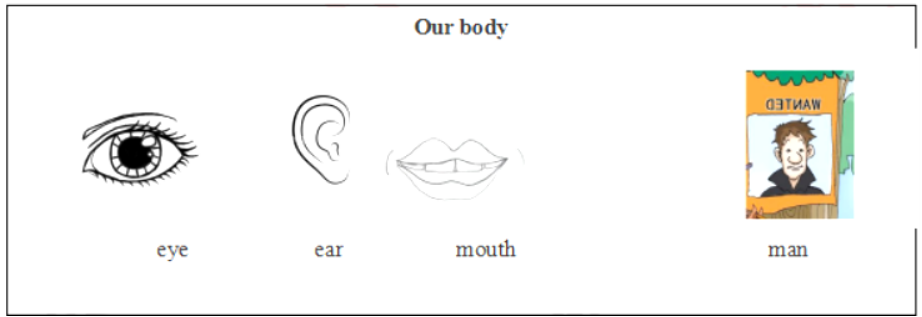
1. Draw the stick figures according to the different body part and describe them simply, and then teacher reads the words in both rising tone and falling tone to the students follow the teacher.
2. Read the passage for the students. Ask students to listen carefully and find what the man looks like. Invite students to answer and draw the picture of the man according to their description.
Step 3: Practice
Do the “touch your body” game. The teacher gives the order and students do as the teacher says, for example, when the teacher says “touch your ears”, the students should touch their own ears.
Step4: Production
Do the “describe and guess” game. Ask students to discuss about their favorite teacher’s look. 5 minutes will be given. Then invite the group leader to describe in front of the class. Teachers asks which teacher is it., and the rest students will guess. Then teacher gives the encouragement and asks students to care and love their teachers.
Step5: Summary and Homework
Summary: Invite one student to be the little teacher to summarize the whole class.
Homework: Ask students to draw the picture about their parents’ looks. Then present and describe their picture next class.
Blackboard design:
【答辩题目解析】
1. What do you think the blackboard should present?
【参考答案】
First, the blackboard should present the key knowledge of the class. The words about body are the class’s teaching knowledge aim, and the blackboard should present these new words.
Second, the blackboard should present the students’ ideas or practices. The picture of the man is created by the student, and it reflects the students’ thinking in the class.
【答辩题目解析】
2. What’s the mainly difficulty in primary school teaching in your view?
【参考答案】
In my view, I think the main difficulty in primary school teaching is that pupils are easily distracted by something else, and they only can remember the new knowledge for a short time. So teachers should pay attention to their features, and take positive and active measures for that. We can make use of funny games or activities to help students memorize and consolidate what they have learned timely, and review the knowledge regularly. -
第2题:
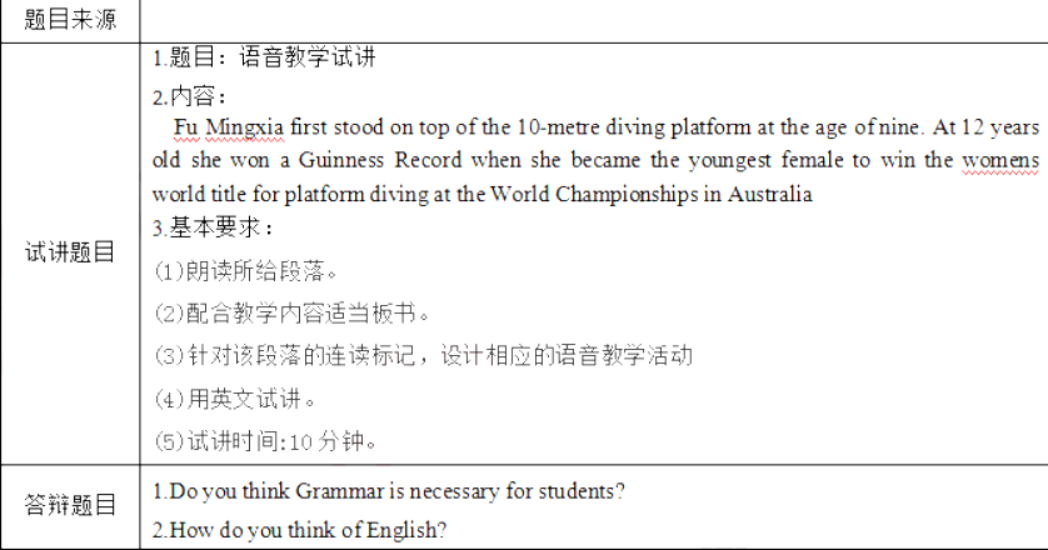
高中英语 语音
一、考题回顾
 答案:解析:二、考题解析
【教案】
Teaching aims:
Knowledge aims:
Students are able to understand the content of the passage.
Students can know some basic information of liaison.
Ability aim:
Students can use different basic reading strategies like analyzing, grasping details correctly in their reading process.
After this lesson, students can use the target knowledge into their daily life.
Emotional aim:
Students will be more willing to get involved in class activities and boost their interest in learning English.
Key and difficult point:
Key Point: master the rules of liaison.
Difficult Point: use the target knowledge to their daily life correctly.
Teaching procedures:
Step 1: Warming-up
1.Greeting:talk about weather
2.Sing a song “hand in hand”, and ask students “when you hear this song, which event comes to your mind?”
Step 2: Presentation
1.Ask students to open the book and the teacher reads the passage and ask students the main idea of the passage.
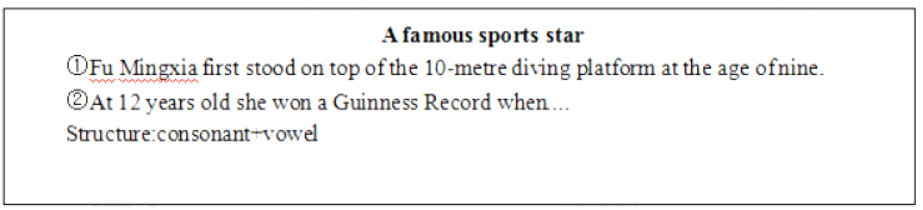
2.Read this article for students, and read the first sentence for them twice.Then ask them to discuss the differences between these two times and write down the sentence on the blackboard.
①Fu Mingxia first stood on top of the 10-metre diving platform at the age of nine.
②At 12 years old she won a Guinness Record when....
3.Invite students to share their ideas then make a conclusion of liaison, structure: consonant+vowel
Step 3: Practice
Ask students read the article again then invite ss come to the front and read for others.
Step4: Production
4 of a group, show students Shelley’s poem, ode to the west wind. Give them 5 minutes to practise this poem,then invite some students read the poem for us ,choose the best one.
Step5: Summary and Homework
Summary: ask a student to conclude the content of the lesson and summarize with the whole class.
Homework: Try to surf on the Internet and find more rules of liaison.
Blackboard design:

As for me, I think grammar is necessary for primary school students. Because the primary school students have been learning English for a short time, there may be weak in spelling, vocabulary, words or other fields. It is a stage for them to lay a good foundation for further study. Besides, we are not native English speakers, for us, grammar is bound to be taught at the beginning of English study. Thus, It is still important for us to teach spelling, grammar, pronunciation, practical sentences, as well as some simple grammar rules, which can help them acquire exquisite English. 2.How do you think of English?
【参考答案】
English is a sort of language, which is of greater and greater importance.Nowadays, with the development of society and globalization, English has become a global language, which has over 1 billion learners and 54.6million users around the world. We can see how important English language is during the process of global communication. Most people regarded English as their own hobbies.As for us, Learning English well can not only makes us learn form other countries their developed cultures, but also can spread the fine culture of the Chinese nation. When learning English, we must practical, in other words, we should learn some basic words and expressions, at the same time, we should pay attention to the improvement of language abilities and the usage of knowledge. -
第3题:
小学英语教学应听力先行,这要求教师必须( )
A.具有较快的听说速度
B.进行大量的听力自我练习
C.具备标准的英式英语语音语调
D.提高自身的辨音能力和听力教学修养答案:D解析:听说法教学主要是通过大量的听说活动激发学生的学习动机,实现良好的教学效果,这除了要求教师自身准确的发音外,还要求其自身的听力教学修养。 -
第4题:
小学英语教学属于第二语言教学
正确答案:正确 -
第5题:
国际音标只能记录英语和汉语普通话等的语音,不能记录汉语方言的语音。
正确答案:错误 -
第6题:
小学英语教学应听力先行,这要求教师必须( )
- A、具有较快的听说速度
- B、进行大量的听力自我练习
- C、具备标准的英式英语语音语调
- D、提高自身的辨音能力和听力教学修养
正确答案:D -
第7题:
小学生学习汉语拼音会干扰英语音标的学习,这是()。
- A、水平迁移
- B、垂直迁移
- C、正迁移
- D、负迁移
正确答案:D -
第8题:
《英语课程标准》规定,从()起开设英语课程。
- A、小学一年级
- B、小学二年级
- C、小学三年级
- D、初中一年级
正确答案:C -
第9题:
国家农村中小学教育节目分为三大类,即()。
- A、教育电视节目(如CETV—1、CETV—2、空中课堂)
- B、语音广播节目(如卫星英语课堂)
- C、IP数据广播节目(信息类、课件类、节目类教学资源)
- D、全选
正确答案:D -
第10题:
填空题汉语拼音的学习干扰英语音标的学习,叫做()迁移。正确答案: 负解析: 暂无解析 -
第11题:
单选题《英语课程标准》规定,从()起开设英语课程。A小学一年级
B小学二年级
C小学三年级
D初中一年级
正确答案: B解析: 暂无解析 -
第12题:
判断题国际音标只能记录英语和汉语普通话等的语音,不能记录汉语方言的语音。A对
B错
正确答案: 对解析: 国际音标能够记录世界上所有语言及其方言的语音。 -
第13题:
小学英语语音
 答案:解析:
Put your ear, near my ear,
put your ear, near my ear,
and you will hear, and you will hear,
and you will hear,
NOTHING!
Ask them “are you happy now?” and lead them to circle out some words they learned last lesson. They may point out “ear”, “near”, “ hear”. Then tell them we will learn the pronunciation secret of these words.
Step 2: Presentation
1. Show some pictures based on these target words, and briefly explain them for students.
2. Ask students to look at them carefully and try to find the same part of these words. They may say there is the letter group “ear” in the words.
3. Conclude the pronunciation rule of “ear”. Tell them that when they see “ear” in a word, in most cases, they sound same. Also I will remind them the right pronunciation again. And ask them to read the letter group “ear” and the words three times.
Step 3: Practice
1. Play the game named Hot Potato with students to consolidate the pronunciation of “ear”. when I sing, students will pass a pencil one by one. When I stop, the one who gets the pencil needs to read the letter group “ear” and the word I point out.
2. Ask students to pick up other words that share the letter group “ear” as much as possible.
Step 4: Production
Show a tongue twister on the screen. And read twice for students. Ask them to give a performance in front the class five minutes later. Give encouragement.
I shed tears for he shears my dear toy deer’s ear.
Step 5: Summary and homework
Summary: Conclude the content of the lesson and summarize with whole class.
Homework: let their parents to make a small video of their chant o1r tongue twister performance.
Blackboard design:

【答辩题目解析】
1.Do you think vocabulary teaching is essential, yes or not?
【参考答案】
Yes, I think vocabulary teaching is essential. Vocabulary is the base of language. Without sufficient vocabulary, we can't effectively speak, read, and write, and can't communicate effectively in English as well. Mastering enough vocabulary is the key to successful use of foreign languages.
【答辩题目解析】
2.Why do you want to be an English teacher?
【参考答案】
First, I love English very much. Every time I am reading English aloud,I feel I was singing the most beautiful song. Second, Teacher is one of the most respectable jobs though it is not very profitable.I feel very good to be a teacher.I can help my students figure out their questions and improve their English.There is a kind of accomplishment here,you know.Third,I love to hang around the campus because the atmosphere here is very pure and honest.I love being with teachers and students.They are all so kind. -
第14题:
听说法认为小学英语教学应听力先行,这要求教师必须( )
A.具有较快的听说速度
B.进行大量的听力自我练习
C.具备标准的英式英语语音语调
D.提高自身的辨音能力和听力教学修养答案:D解析:听说法教学主要是通过大量的听说活动激发学生的学习动机,实现良好的教学效果,这除了要求教师自身准确的发音外,还要求其自身的听力教学修养。 -
第15题:
国际音标只能记录英语和汉语普通话等的语音,不能记录汉语方言的语音。
A对
B错
错
国际音标能够记录世界上所有语言及其方言的语音。 -
第16题:
作为小学英语教师,你认为如何给小学生上好英语课?
正确答案: 小学生的年龄一般是六至十二岁,属于童年期,正处于心理发展变化的关键时期。在这一时期,儿童的心理变化和大脑思维最活跃。根据儿童时期的特点,我认为在小学英语课上应该做好以下几点:
1.重视持续培养和激发学生学习英语的浓厚兴趣。
在英语教学过程中,要把握好小学生的初步兴趣,这种初步兴趣就是学生在开始学习英语时有一种很强的好奇心,而这种初步兴趣是极不稳定的。作为教师要使学生对学习英语的兴趣持续下去,并升华为热情和爱好,就要在教学活动中下工夫,要懂得童年期的心理特征,要懂得小学生对学习英语的兴趣主要不是来源于英语语言本身,更多的则是来自于英语教学活动的形式。如果教师所设计的教学形式不符合小学生的认知规律和心理特征,那么,学生对英语学习的初步兴趣就会丧失殆尽,更谈不上对英语的热情和爱好了。
2.在教学活动中,要有和谐的语言教学氛围。
在课堂上,教师态度和蔼,平易近人,语言里要流露出安慰和鼓励,这样才能提高学生的学习热情和树立学好英语的信心。任何训斥、讥笑和讽刺都不利于双边活动的开展,还将削弱学生学习英语的积极性。在教学活动中,教师还应该积极地关心、帮助学生,积极引导他们参加集体活动。对有困难的学生更要耐心帮助,同时鼓励他们要互相关心和帮助,使教学活动得以顺利进行。
3.要重视学生基本技能和学习习惯的培养。
在培养技能方面,教师在教学活动中不能灌输大量的语言知识,要充分利用图片、挂图、实物、幻灯、录音、录像等开展多种形式的英语游戏、学唱英语竞赛、表演、学唱英语歌曲等活动,做到寓教于乐,使学生置身于情境之中,使学生的听力、英语的口头表达能力及实际运用英语的能力得到巩固和提高。要重视英语的基础训练,从而使学生获得一些运用英语的基本技能。
在培养习惯方面,教师在开展灵活多样的教学活动的同时,要多为学生创造一些运用英语的语言环境,让学生多听、多说、敢于大胆开口,要体现出学生的主体作用,使学生养成良好的语言习惯。书写也是小学英语教学的主要内容和目的之一,从小学起教师就应当狠抓学生的书写教学,并常抓不懈。为了培养学生良好的书写习惯,教师要起到示范和身教的作用,教师自己的书写首先要做到工整和规范,这样才能做到言传身教。 -
第17题:
客户拨打英语台时,是否可以要求转接语音节点?
正确答案: 英语技能专席不提供语音节点的转接和短信节点的下发。 -
第18题:
为什么说英语语音的训练和教学是首要的、基础的,它要贯穿在英语教与学活动的始终?
正确答案: 首先英语是拼音文字系统,它与形义之间关系密切,三者相互依存,相辅相成,语义的获取是以语音为中介的;
其次,就个体语言发展而言,口语(语音)先于书面语而存在,而发展。
离开了语音,英语语言教与学便是一句空话。
所以说英语语音训练和教学是首要的,是基础的。 -
第19题:
英语阅读和汉语阅读不一样,它不会涉及语音解码。
正确答案:错误 -
第20题:
洋泾浜英语的基本特征是()
- A、语音、词汇是英语的,语法基本上是汉语的
- B、词汇主要是英语的,语音、语法基本上是汉语的
- C、语音有较大改动,词汇、语法基本上是英语的
- D、语音有较大改动,词汇主要是英语的,语法基本上是汉语的
正确答案:D -
第21题:
问答题作为小学英语教师,你认为如何给小学生上好英语课?正确答案: 小学生的年龄一般是六至十二岁,属于童年期,正处于心理发展变化的关键时期。在这一时期,儿童的心理变化和大脑思维最活跃。根据儿童时期的特点,我认为在小学英语课上应该做好以下几点:
1.重视持续培养和激发学生学习英语的浓厚兴趣。
在英语教学过程中,要把握好小学生的初步兴趣,这种初步兴趣就是学生在开始学习英语时有一种很强的好奇心,而这种初步兴趣是极不稳定的。作为教师要使学生对学习英语的兴趣持续下去,并升华为热情和爱好,就要在教学活动中下工夫,要懂得童年期的心理特征,要懂得小学生对学习英语的兴趣主要不是来源于英语语言本身,更多的则是来自于英语教学活动的形式。如果教师所设计的教学形式不符合小学生的认知规律和心理特征,那么,学生对英语学习的初步兴趣就会丧失殆尽,更谈不上对英语的热情和爱好了。
2.在教学活动中,要有和谐的语言教学氛围。
在课堂上,教师态度和蔼,平易近人,语言里要流露出安慰和鼓励,这样才能提高学生的学习热情和树立学好英语的信心。任何训斥、讥笑和讽刺都不利于双边活动的开展,还将削弱学生学习英语的积极性。在教学活动中,教师还应该积极地关心、帮助学生,积极引导他们参加集体活动。对有困难的学生更要耐心帮助,同时鼓励他们要互相关心和帮助,使教学活动得以顺利进行。
3.要重视学生基本技能和学习习惯的培养。
在培养技能方面,教师在教学活动中不能灌输大量的语言知识,要充分利用图片、挂图、实物、幻灯、录音、录像等开展多种形式的英语游戏、学唱英语竞赛、表演、学唱英语歌曲等活动,做到寓教于乐,使学生置身于情境之中,使学生的听力、英语的口头表达能力及实际运用英语的能力得到巩固和提高。要重视英语的基础训练,从而使学生获得一些运用英语的基本技能。
在培养习惯方面,教师在开展灵活多样的教学活动的同时,要多为学生创造一些运用英语的语言环境,让学生多听、多说、敢于大胆开口,要体现出学生的主体作用,使学生养成良好的语言习惯。书写也是小学英语教学的主要内容和目的之一,从小学起教师就应当狠抓学生的书写教学,并常抓不懈。为了培养学生良好的书写习惯,教师要起到示范和身教的作用,教师自己的书写首先要做到工整和规范,这样才能做到言传身教。解析: 暂无解析 -
第22题:
单选题小学生学习汉语拼音会干扰英语音标的学习,这是()。A水平迁移
B垂直迁移
C正迁移
D负迁移
正确答案: C解析: 干扰说明起到了负迁移作用。所以选D。 -
第23题:
问答题为什么说英语语音的训练和教学是首要的、基础的,它要贯穿在英语教与学活动的始终?正确答案: 首先英语是拼音文字系统,它与形义之间关系密切,三者相互依存,相辅相成,语义的获取是以语音为中介的;
其次,就个体语言发展而言,口语(语音)先于书面语而存在,而发展。
离开了语音,英语语言教与学便是一句空话。
所以说英语语音训练和教学是首要的,是基础的。解析: 暂无解析 -
第24题:
单选题小学英语教学应听力先行,这要求教师必须( )A具有较快的听说速度
B进行大量的听力自我练习
C具备标准的英式英语语音语调
D提高自身的辨音能力和听力教学修养
正确答案: A解析: 听说法教学主要是通过大量的听说活动激发学生的学习动机,实现良好的教学效果,这除了要求教师自身准确的发音外,还要求其自身的听力教学修养。