
Teachers who believe in the __________ model will enable students to understand the meaning and usage of the words first, and then make full use of the words in listening, reading or writing tasks, ask representatives to show products of the tasks, and gi
题目
Teachers who believe in the __________ model will enable students to understand the meaning and usage of the words first, and then make full use of the words in listening, reading or writing tasks, ask representatives to show products of the tasks, and give an evaluation for it at last when teaching vocabulary.
A.PPP
B.PWP
C.PPT
D.TBLT
B.PWP
C.PPT
D.TBLT
相似考题
参考答案和解析
答案:D
解析:
考查词汇教学模式。任务型教学模式(Task-based Language Teaching)是新课标所倡导的一种教学模式。在展示环节,教师通过展示让学生理解词语的意义和用法。任务环节,教师要通过将词汇最大限度置于听读写练习中。汇报环节,学生推举各组代表来展示听读写的任务完成情况。评价和联系环节:教师对学生的任务汇报进行评价.评价他们对新词的使用.
更多“Teachers who believe in the __________ model will enable students to understand the meaning and usage of the words first, and then make full use of the words in listening, reading or writing tasks, a”相关问题
-
第1题:
Which of the following should a teacher avoid when his/her focus is on developing students' ability to use words appropriately?A.Teaching both the spoken and written form.
B.Teaching words in context and giving examples.
C.Presenting the form, meaning, and use of a word.
D.Asking students to memorize bilingual word lists.答案:D解析:本题考查语言知识教学。题干的意思:如果教师专注于培养学生恰当地使用单词的能力,那么他/她应该避免以下哪种方式A项“教单词的口语和书面形式”,B项“在语境中教单词并举例子”,C项“呈现单词的形式、意义及用法”,D项“要求学生记忆双语单词表”。在词汇教学中,教师不仅要讲授单词的形式,还要创设具体的语境,让学生在运用中加深对词汇意义的理解,掌握词汇的用法和功能,进而恰当得体地运用词汇表情达意。记忆双语单词表属于单纯的记忆活动,不能起到促进学生恰当使用词汇的作用。故本题选D。 -
第2题:
Teachers believing in the _______model in a general sense usually follow the sequence of teaching new words, sentences and then the whole passage in the ,reading class.A.interactive
B.bottom-up
C.top-down
D.interactional答案:B解析:考查阅读教学模式。阅读课的教学模式通常包括boaom-up(自下而上),top-bouom(自上而下).intelactive(交互补偿模式)。自下而上的模式是遵循从小的语言单位开始进行教学,直到最大的教学单位.即单词、句子和篇章,这也正是题目中说到的模式,故选B。 -
第3题:
Teachers’believing in the_____model in a general sense usually follow the sequence of teaching new words,sentences and then the whole passage in the reading class.A.interactive
B.bottom-up
C.top-down
D.interactional答案:B解析:考查阅读技能。
B选项,the bottom-up approach,自下而上模式。是一种从单词,短语,句型,最后到对整篇文章理解的一种模式。符合题意,故此题的正确选项为B。
A选项,互动,不合题意,故排除。
C选项,自上而下模式,和B正好相反,从文章到句型,短语,单词,不合题意,故排除。
D选项,相互作用的,不合题意,故排除。
故此题的正确选项为B。 -
第4题:
根据下面资料,回答
Reading aloud and silent reading are two different types of reading practice. Each has a function in the teaching of reading and should not be 16 by the other. However, we need to be aware when we should use them. When we 17 teaching reading or developing reading skills, we are mostly referring to silent reading. To develop 18 readers in a foreign language, silent reading activities must be given enough 19 and time in class with the proper guidance from the 20 . Reading aloud also has its particular 21 for our students who are learning English as a foreign language. 22 can help them acquire good pronunciation and intonation, 23 them with new words and the stress patterns of English, help 24 their eontidenee in speaking the language. Therefore, opportunities should be 25 for students to read aloud only after they have comprehended the text 26 before comprehension can be very 27 and it can easily destroy their self-confidence. With 28 reading, it sets up a poor reading model for other students as well. It is 29 that we first help students learn the text through 30 reading activities and then with comprehension we give our students practice by using an audio tape to 31 a good model for practicing reading aloud. With adequate 32 , we may ask the students to read aloud to the whole class to 33 their motivation and confidence. By asking the students to read aloud, it is also a good chance for the teacher to get 34 on the students′ comprehension as we can notice 35 there are wrong pauses or mispronounced words which indicate possible difficulties or misunderstanding of the text.
第(34)题选A.suggestion
B.feedback
C.promotion
D.inspiration答案:B解析:考查名词辨析。suggestion“建议”,feedback“反馈”,promotion“提升”,inspiration“灵感”。这里指的是大声朗读也能够让教师从学生的理解中获得反馈。故选B。 -
第5题:
Text 2 A study published in the International Journal of Business Administration found that what students read in college directly effects the level of writing they achieve.In fact,researchers found that reading content and frequency may exert more significant impacts on students'writing ability than writing instruction and writing frequency.Students who read academic journals,literary fiction,or general nonfiction wrote with greater svntactic SODhistication(more comDlex sentences)than those who read genre fiction(mysteries,fantasy,or science fiction)or exclusively web-based aggregators.The highest scores went to those who read academic journals;the lowest scores went to those who relied sotely on web-based content.Recent research also revealed that"deep reading"-defined as reading that is slow,immersive,rich in sensory detail and emotional and moral complexity-is distinctive from light reading-little more than the decoding of words.Deep reading occurs when the language is rich in detail,allusion,and metaphor,and taps into the same brain regions that would activate if the reader were experiencing the event.Deep reading is great exercise for the brain and has been shown to increase empathy,as the reader dives deeper and adds reflection,analysis,and personal subtext to what is being read.It also offers writers a way to appreciate all the qualities that make novels fascinating and meaningful-and to tap into his abllity to write on a deeper level.Light reading is equated to what one might read in online blogs,or"headline news"or"entertainment news"websites,particularly those that breezily rely on lists or punchy headlines,and even occasionally use emojis to communicate.These types of light reading lack a genuine voice,a viewpoint,or the sort of analyses that might stimulate thought.It's light and breezy reading that you can skim through and will likely forget within minutes.Deep reading activates our brain's centers for speech,vision,and hearing,all of which work together to help us speak,read,and write.Reading and writing engages Broca's area,which enables us to perceive rhythm and syntax;Wernicke's area,which impacts our perception of words and meaning;and the angular gyrus,which is central to perception and use oflanguage.These areas are wired together by a band of fibres,and this interconnectivity likely helps writers mimic and synchronize language and rhythms they encounter while reading.Your reading brain senses a cadence that accompanies more complex writing,which your brain then seeks to emulate when writing.
Light reading always relies on_____.A.astonishing headlines
B.social networking
C.sincere communication
D.fantasy stories答案:A解析:事实细节题。根据定位词定位到第三段。该段是关于浅阅读的描述,第一句提到,“浅阅读类似于阅读博客、新闻头条或娱乐版块,尤其是那些简单罗列、标题抢眼……的文章”,故A项为正确选项。【干扰排除】浅阅读主要依靠的是那些抢眼的头版头条,故B项、D项不正确,第三段第二句写到“这种类型的浅阅读缺乏真诚的声音”,故C项不正确。 -
第6题:
Text 2 A study published in the International Journal of Business Administration found that what students read in college directly effects the level of writing they achieve.In fact,researchers found that reading content and frequency may exert more significant impacts on students'writing ability than writing instruction and writing frequency.Students who read academic journals,literary fiction,or general nonfiction wrote with greater svntactic SODhistication(more comDlex sentences)than those who read genre fiction(mysteries,fantasy,or science fiction)or exclusively web-based aggregators.The highest scores went to those who read academic journals;the lowest scores went to those who relied sotely on web-based content.Recent research also revealed that"deep reading"-defined as reading that is slow,immersive,rich in sensory detail and emotional and moral complexity-is distinctive from light reading-little more than the decoding of words.Deep reading occurs when the language is rich in detail,allusion,and metaphor,and taps into the same brain regions that would activate if the reader were experiencing the event.Deep reading is great exercise for the brain and has been shown to increase empathy,as the reader dives deeper and adds reflection,analysis,and personal subtext to what is being read.It also offers writers a way to appreciate all the qualities that make novels fascinating and meaningful-and to tap into his abllity to write on a deeper level.Light reading is equated to what one might read in online blogs,or"headline news"or"entertainment news"websites,particularly those that breezily rely on lists or punchy headlines,and even occasionally use emojis to communicate.These types of light reading lack a genuine voice,a viewpoint,or the sort of analyses that might stimulate thought.It's light and breezy reading that you can skim through and will likely forget within minutes.Deep reading activates our brain's centers for speech,vision,and hearing,all of which work together to help us speak,read,and write.Reading and writing engages Broca's area,which enables us to perceive rhythm and syntax;Wernicke's area,which impacts our perception of words and meaning;and the angular gyrus,which is central to perception and use oflanguage.These areas are wired together by a band of fibres,and this interconnectivity likely helps writers mimic and synchronize language and rhythms they encounter while reading.Your reading brain senses a cadence that accompanies more complex writing,which your brain then seeks to emulate when writing.
Deep reading happens when_____.A.we have read for a long time
B.we fully understand the words
C.we write on a deeper level
D.we read complicated works答案:D解析:事实细节题。根据定位词定位到第二段。该段是关于深阅读的描述,第二句提到“当阅读内容的语言富于细节、典故和隐喻,并且令读者感同身受的时候,深阅读就出现了”,故D项为正确选项。【干扰排除】第二段中,关于深阅读的描述没有提到时间长和完全理解文字就能引发深阅读,故A项、B项不正确;第二段最后一句提到“作者可以更深层次地挖掘自己的写作潜力”,并非C项“我们在更深的层次上写作”,故C项不正确。 -
第7题:
高中英语?阅读
一、考题回顾
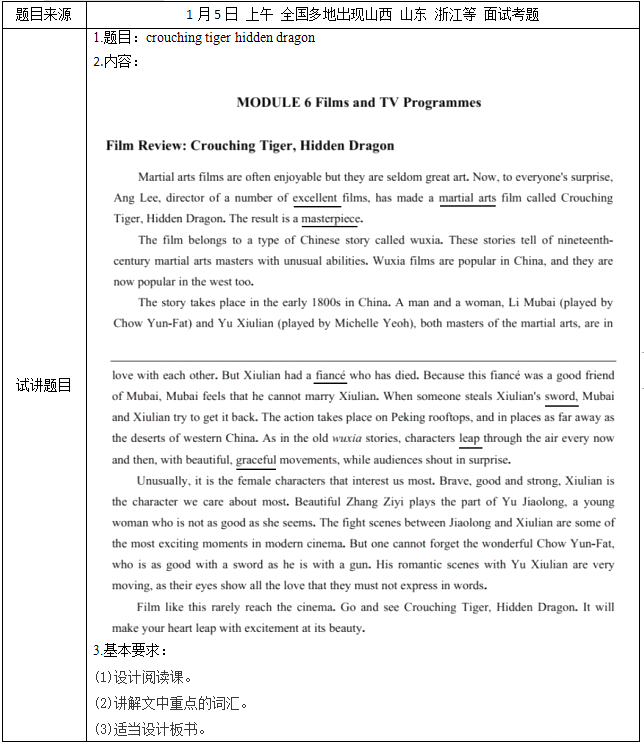
二、考题解析
【教案】
Teaching aims:
Knowledge aim:
(1)Students are able to distinguish the words and Expressions and comprehend their meanings in sentences and paragraphs:leap,enjoyable, graceful,excellent, Martial arts etc.
(2)Studentsunderstand this review and make a film review.
Ability aim:
(1)Students can guess the meaning of new words and phrases while reading, understand what this review is talking about.
(2)After this lesson, students can learn how to write a review about films by using the words and expressions learnt.
Emotional aim:
Students are able to love learning English after this lesson
Key and difficult point:
Key Point: Learn to make a film review based on: director, plot, setting, characters, and actors and develop the reading skill of fast reading and scanning.
Difficult Point: Learn the reading skill of scanning for the specific information of the text and to be able to make a review in writing by the words they learnt.
Teaching procedure:
Step 1: Warming-up
1. Greetings.
2. Show the English trailer of Crouching Tiger, Hidden Dragon and ask students several questions:
Do you like watching movies?
What’s your favorite movie?
Do you want to know more about this film after watching this video?
Step 2: Pre-reading
1. Introduce the topic: Film Review Crouching Tiger, Hidden Dragon
2. Present vocabularies in PPT about Crouching Tiger, Hidden Dragon and then the teacher will ask several questions. The teacher will give the new words and explain new words with sentences.
How does this person looks like?
Is she or he happy or anything else?
Could you please give me some word to describe it?
What does this word means?
3.After learning new words, Give students a table and help them study movie types. At the same time, give students the words about types of film (Romantic film; Martial arts film; Adventure film; Thriller; Comedy); and then show representatives one by one: Titanic; The ShaoLin Temple; Kung Fu Panda; and Bean; last show the definitions

Step 3: While-reading
1.Fast reading: ask students to read the text fast and choose a best summary of this review.
Check the answers.
It is a martial arts film that tells the story of a stolen sword, and the fight to get it back.
2.Careful reading: ask students to scan and read the text again, then discuss the questions:
Discuss the following questions.
When did the story took place?
Where did the story happened?
Who are the main characters in this film?
What this story is talking about?
And then ask students to discuss the reasons why LiMubai did not marry Yu Xiulian, and whether they should get married? Invite two students express ideas in class.
Step4: Post-reading
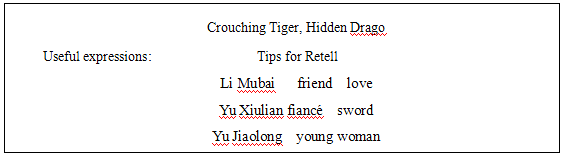
1. Retell: Ask students to use the words and expressions learnt to retell part of the story according to following clues;
Li Mubai friend love
Yu Xiulian fiancé sword
Yu Jiaolong young woman
2. Discussion: Ask students to choose one of the favorite characters based on the introduction of the text and explain why in their own words. Then find some students to describe one character in public and give students feedback on their performance.
Step5: Summary and Homework
Summary: ask a student to conclude the content of the lesson and summarize with the whole class.
Homework: write a review on your favorite film more than 100 words.
Blackboard design:
1.What's your favorite sports?
2.Please introduce yourself答案:解析:1.I think it is jogging. It is a simple sport and doesn't require skills of any sort. This leaves room for me to enjoy the beautiful suburban scenery while jogging. Fresh air caresses my face and blows into my chest, which translates into inspirations. And inspirations are really good stuff for me. It can hepl me to lead a better life.Besides, it can make me relax, and forget my troubles and also after it, I can get the energy and chase my dream again.
2.I’m number 2. I have just graduated from Peking University. And get my English degree. In my life, I like doing some sports,like jogging, yoga, playing the badminton with my friends. They all good for my body. Besides, I also read some books which concludes a large number of aspects, such as education, literature, medicine and so on. And my favorite book is The Pilgrim, which give me some inspiration about life.
-
第8题:

二、考题解析
【教案】
Teaching aims:
Knowledge aim:
Students will master the meaning and pronunciation of the words.
Ability aim:
Students will know how to pronounce “ch” and “sh” in words.
Emotional aim:
Students will be interested in learning English.
Key and difficult point:
Key Point:
Students will master the meaning and pronunciation of the words.
Students will know how to pronounce “ch” and “sh” in words.
Difficult Point:
Students will be interested in learning English.
Teaching procedure:
Step 1: Warming-up
1. Greetings. Talk about the weather.
2. Chant with the students
Tomato tomato wash wash wash
Tomato tomato cut cut cut
Tomato tomato cook cook cook
Tomato tomato eat eat eat
Ask them if they remember the first step in the chant. They may say that it is to “wash” the tomato. Then tell them that today we are going to learn some pronunciation in it.
Step 2: Presentation
1. Draw some pictures according to different words, and then explain the meanings to the students.
2. Play the finger show with the students to consolidate the words. For example, finger 1 refers to “chicken”, and finger 2 refers to “lunch”. When the teacher points finger 1, the students should read “chicken” loudly. The rest could be done in the same manner.
3. Ask students to find similarities and differences among the words. They may say that in the first two words, there is “ch” in the words, while in the last two words, there is “sh” in the words. And they pronounce similarly.
4. Conclude the rules of “ch” and “sh”. Tell them that when they see “ch”, they should pronounce [ch], and when they see “sh”, they should pronounce [sh]. They may sound similar, but they are different. Please be notice that.
Step 3: Practice
1. Ask a few students if there are other words containing “ch” or “sh”. They may answer “chopsticks”, “ship” or “shop”.
2. Read the words in a different order, and ask students to rank the words according to the listening. At the same time, invite one students to come to the front and write the words down on the blackboard. Check answers later.
Step4: Production
Ask students to make up dialogues with their deskmates. 5 minutes will be given. After that, invite 2 pairs to share their dialogues. Give encouragement.
Step5: Summary and Homework
Summary: Ask a student to conclude the content of the lesson and summarize with the whole class.
Homework: Read the words to their parents.
Blackboard design:

1. What will you do to help students master the pronunciation of what we need to learn?
2. What will you do if the students can’t focus on your class?答案:解析:1.
First, they should know how to pronounce the syllables. So I will pronounce them exaggeratedly to let them notice the place of articulation. I will correct their pronunciations if they make some mistakes. Then, I ask them if they know other words sharing the same syllables. Also, few activities were arranged to make them really use the rules. So I believe they will master the rules of the pronunciations.
2.
There are some options to deal with the problem. First, I could arrange some interesting activities to stimulate their interest. Second, when imparting some knowledge, I could show some examples closely related to their daily lives. They will be interested in familiar things. Third, I could ask some students to answer my questions from time to time, so they will be more focused in case of being asked. So I will try to use the most appropriate method to attract their attention. -
第9题:

二、考题解析
【教案】
Teaching aims:
Knowledge aims:
Students will know how to describe a day using proper conjunctions and tense.
Students will master some words, such as waste, value... and a sentence structure: I usually + simple present tense.
Ability aim:
Students will improve their abilities of speaking and listening.
Emotional aim:
Students will be more confident in speaking English.
Key and difficult point:
Key Point: Students will know how to introduce a day in English.
Difficult Point: Students will use the sentence structure in real communicative situation.
Teaching procedure:
Step 1: Warming-up
1. Greetings.
2. Play a video about Tom’s day and ask students what kind of information have they caught.
Step 2: Pre-listening
1. Review the knowledge about simple present tense. Ask students to make sentences using simple present tense.
2.Using pictures to explain some words: waste-value, brush.
Step 3: While-listening
1st listening: Ask students to listen to the tape for the first time and try to get the main idea of the passage and underline the conjunctions used.
2nd listening: Ask students to listen to the tape for the second time and complete the timetable below.
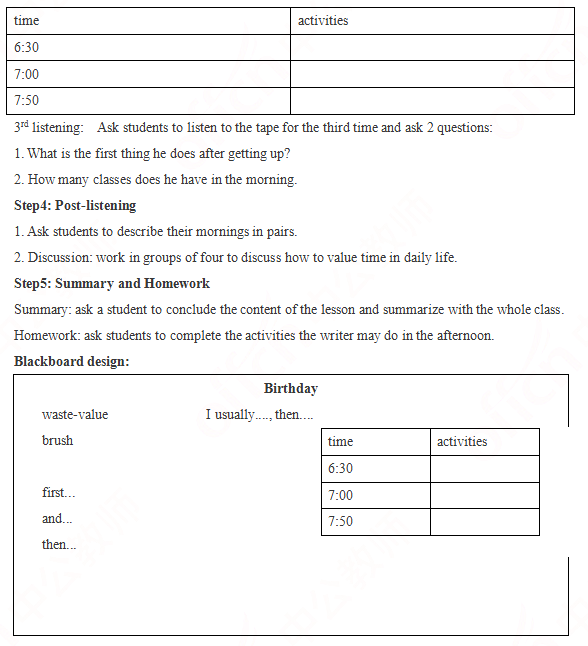 答案:解析:暂无解析
 -
第10题:
高中英语?语法
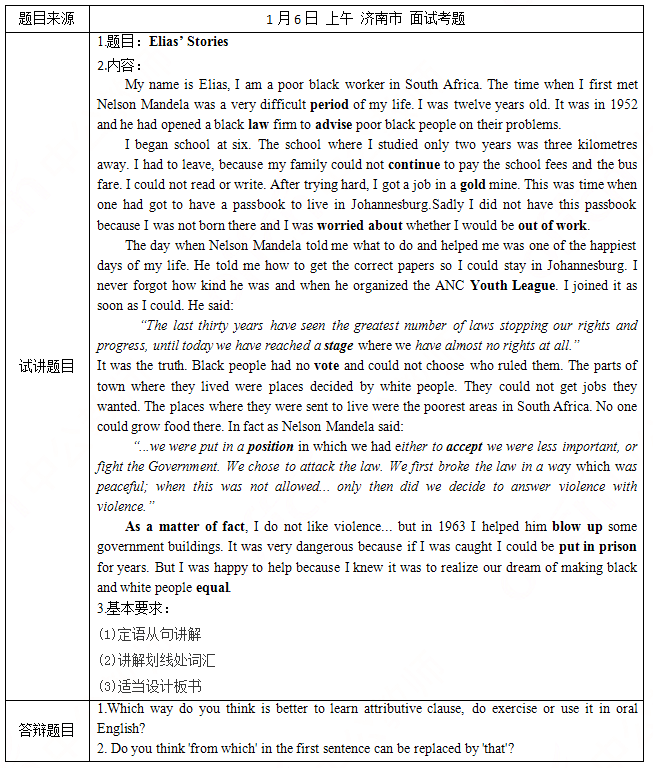
一、考题回顾
二、考题解析
【教案】
Teaching aims:
Knowledge aims:
(1)Students are able to master the meaning of bold words and phrases: period, law, advise, gold, worried about, out of work, Youth League, stage, stage, position, as a matter of fact, blow up, put in prison, equal
(2)Students can master the usage of adverb in attributive clause.
(3)After this lesson, students can know the difference of usage of adverb in attributive clause and the usage of pronoun in attributive clause.
Ability aim:
After this lesson, students can use grammar of attributive clause in reading and writing.
Emotional aim:
Students are able to love learning English after this lesson.
Key and difficult point:
Key Point: master the meaning of words and phrases :period, law, advise,gold,worried about etc.
Difficult Point: use grammar of attributive clause in reading and writing
Teaching procedures:
Step 1: Warming-up
1. Greetings.
2. Ask students to make several sentences using the grammar of usage of pronoun in attributive clause. Then write a sentence needing to use adverb in attributive clause. And then lead in the new grammar, adverb in attributive clause.
Step 2: Presentation
1.Ask students to open the book and read the passage to guess the meaning the bold words and then paraphrase the bold words with the help of PPT.
2. Then Ask students to find out more complex sentences that the clause is after a noun or pronoun and the words that are used to introduce the sentences: where, when, why or preposition plus which.
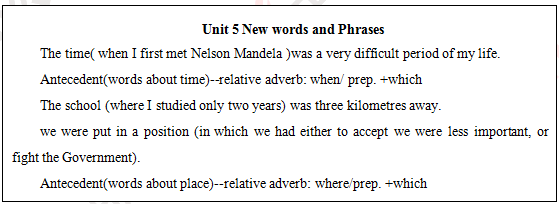
The time( when I first met Nelson Mandela )was a very difficult period of my life.
The school (where I studied only two years) was three kilometres away.
This was time (when one had got to have a passbook )to live in Johannesburg.
we were put in a position (in which we had either to accept we were less important, or fight the Government). ...
Then ask students to find the similarity of these sentences and invite several students to share their ideas. Then lead the students to conclude the rules of relative adverb in attributive clause and preposition plus which in attributive clause. (They all function as adverbials)
Step 3: Practice
1.Make sentences: Ask students to use the grammar that has just learnt to describe the pictures which are presented on the PPT.
2.Combine the sentences: Ask students to combine the sentences according to the grammar in attributive clause.
(1)This is a book. Its cover is blue. (whose)
(2)He is the teacher. He helped me. (who/that)
(3)Beijing is the place. I was born in this place. (where/ in which)
(4)This is the hotel. You will stay at the hotel. (where/at which)
Step4: Production
1.Make stories: Ask students to use the grammar that has just learnt to describe the video.
2.Discussion: Ask students to tell their daily life to use the grammar that has just learnt. And after 5minutes to invite several students to share their daily life.
Step5: Summary and Homework
Summary: ask a student to conclude the content of the lesson and summarize with the whole class.
Homework: write a short passage about his daily life using the grammar that has just learnt.
Blackboard design:
1.Which way do you think is better to learn attributive clause, do exercise or use it in oral English?
2. Do you think 'from which' in the first sentence can be replaced by 'that'?答案:解析:1.
(1)I think, first, the best way to learn attributive clause is tell the definition of this grammar in
sentence. For example, this is a beautiful teacher (who wears the red dress )is our teacher. Then ask students to pay attention to the clause to find the features of this sentence and conclude the attributive clause: noun/pronoun plus a whole sentence. Next tell the usage of pronoun in attributive clause. Last, teach the usage of adverb in attributive clause.
(2) Exercise and oral English should use togerther in practice attributive clasue. Doing exercise can make students master the structure of this grammar easily. And oral English can make students know the real situation of attributive clause in our daily life.
2.
No, I don’t think. From which is an relative adverb from the point of grammar. And that belongs to the pronoun. So it only can be used as the subject, object and so on but can not be used as the adverb or as as phrase. And this sentence doesn’t have the adverb, so we must use from which. -
第11题:
单选题A teacher may encourage students to __________ when they come across new words in fast reading.Atake notes
Bask for help
Cguess meaning from context
Dlook up the words in a dictionary
正确答案: A解析: -
第12题:
单选题Which of the following should a teacher avoid when his/her focus is on developing students' ability to use words appropriately?ATeaching both the spoken and written form.
BTeaching words in context and giving examples.
CPresenting the form, meaning, and use of a word.
DAsking students to memorize bilingual word lists.
正确答案: A解析: -
第13题:
Teachers who believe in the_________ model will enable students to understand themeaning and usage of the words first, and then make full use of the words iu listeniug, reading orwriting tasks, ask representatives to show products of the tasks, and give an evaluation her it at last
when teaching vocabulary.A.PPP
B.PWP
C.PPT
D.TBLT答案:D解析:考查词汇教学模式。任务型教学模式“Task—based language teaching”是新课标所倡导的一种教学模式。在展示环节,教师通过展示让学生理解词语的意义和用法。任务环节,教师要通过将词汇最大限度置于听读写练习中。汇报环节,学生推举各组代表来展示听读写的任务完成情况。评价和联系环节:教师对学生的任务汇报进行评价,评价他们对新词的使用。PPP模式是指教学过程中的Presentation,Practice,production。PWP模式是教学过程中的Pre-,While-,Post-;PPT模式是Presentation,Practice and Testing。 -
第14题:
Teachers who believe in the __________ model will enable students to understand the meaning and usage of the words first, and then make full use of the words in listening, reading or writing tasks, ask representatives to show products of the tasks, and give an evaluation for it at last when teaching vocabulary.A. PPP
B. PWP
C. PPT
D. TBLT答案:D解析:考查词汇教学模式。任务型教学模式(Task-based Language Teaching)是新课标所倡导的一种教学模式。在展示环节,教师通过展示让学生理解词语的意义和用法。任务环节,教师要通过将词汇最大限度置于听读写练习中。汇报环节,学生推举各组代表来展示听读写的任务完成情况。评价和联系环节:教师对学生的任务汇报进行评价.评价他们对新词的使用. -
第15题:
根据下面资料,回答
Reading aloud and silent reading are two different types of reading practice. Each has a function in the teaching of reading and should not be 16 by the other. However, we need to be aware when we should use them. When we 17 teaching reading or developing reading skills, we are mostly referring to silent reading. To develop 18 readers in a foreign language, silent reading activities must be given enough 19 and time in class with the proper guidance from the 20 . Reading aloud also has its particular 21 for our students who are learning English as a foreign language. 22 can help them acquire good pronunciation and intonation, 23 them with new words and the stress patterns of English, help 24 their eontidenee in speaking the language. Therefore, opportunities should be 25 for students to read aloud only after they have comprehended the text 26 before comprehension can be very 27 and it can easily destroy their self-confidence. With 28 reading, it sets up a poor reading model for other students as well. It is 29 that we first help students learn the text through 30 reading activities and then with comprehension we give our students practice by using an audio tape to 31 a good model for practicing reading aloud. With adequate 32 , we may ask the students to read aloud to the whole class to 33 their motivation and confidence. By asking the students to read aloud, it is also a good chance for the teacher to get 34 on the students′ comprehension as we can notice 35 there are wrong pauses or mispronounced words which indicate possible difficulties or misunderstanding of the text.
第(17)题选A.work out
B.run into
C.talk about
D.take on答案:C解析:考查短语辨析。句意为“当我们________阅读教学或发展阅读技能时,我们多数指的是默读”。workout“解决,算出”,run into“遇到,陷入”,talk about“谈论”,take on“承担,呈现”,只有C项符合题意。 -
第16题:
Text 2 A study published in the International Journal of Business Administration found that what students read in college directly effects the level of writing they achieve.In fact,researchers found that reading content and frequency may exert more significant impacts on students'writing ability than writing instruction and writing frequency.Students who read academic journals,literary fiction,or general nonfiction wrote with greater svntactic SODhistication(more comDlex sentences)than those who read genre fiction(mysteries,fantasy,or science fiction)or exclusively web-based aggregators.The highest scores went to those who read academic journals;the lowest scores went to those who relied sotely on web-based content.Recent research also revealed that"deep reading"-defined as reading that is slow,immersive,rich in sensory detail and emotional and moral complexity-is distinctive from light reading-little more than the decoding of words.Deep reading occurs when the language is rich in detail,allusion,and metaphor,and taps into the same brain regions that would activate if the reader were experiencing the event.Deep reading is great exercise for the brain and has been shown to increase empathy,as the reader dives deeper and adds reflection,analysis,and personal subtext to what is being read.It also offers writers a way to appreciate all the qualities that make novels fascinating and meaningful-and to tap into his abllity to write on a deeper level.Light reading is equated to what one might read in online blogs,or"headline news"or"entertainment news"websites,particularly those that breezily rely on lists or punchy headlines,and even occasionally use emojis to communicate.These types of light reading lack a genuine voice,a viewpoint,or the sort of analyses that might stimulate thought.It's light and breezy reading that you can skim through and will likely forget within minutes.Deep reading activates our brain's centers for speech,vision,and hearing,all of which work together to help us speak,read,and write.Reading and writing engages Broca's area,which enables us to perceive rhythm and syntax;Wernicke's area,which impacts our perception of words and meaning;and the angular gyrus,which is central to perception and use oflanguage.These areas are wired together by a band of fibres,and this interconnectivity likely helps writers mimic and synchronize language and rhythms they encounter while reading.Your reading brain senses a cadence that accompanies more complex writing,which your brain then seeks to emulate when writing.
Students'writing abilities are mostly infiuenced by_____A.writing frequencies of students
B.writing instructions from teachers
C.students'reading content
D.teachers'scores and evaluations答案:C解析:事实细节题。根据定位词定位到第一段。该段第二句提到“阅读的内容和频率才是影响学生写作能力最显著的因索”,故C项为正确选项。【干扰排除】根据第一段第二句,阅读频率会影响写作能力,并非A项“学生的写作频率”,故A项不正确;该句提到“比起写作教学和写作频率,阅读的内容和频率才是影响学生写作能力最显著的因素”,故B项“老师的写作教学”不正确;D项“老师的打分和评估”文中没有提到,故D项不正确。 -
第17题:
Text 2 A study published in the International Journal of Business Administration found that what students read in college directly effects the level of writing they achieve.In fact,researchers found that reading content and frequency may exert more significant impacts on students'writing ability than writing instruction and writing frequency.Students who read academic journals,literary fiction,or general nonfiction wrote with greater svntactic SODhistication(more comDlex sentences)than those who read genre fiction(mysteries,fantasy,or science fiction)or exclusively web-based aggregators.The highest scores went to those who read academic journals;the lowest scores went to those who relied sotely on web-based content.Recent research also revealed that"deep reading"-defined as reading that is slow,immersive,rich in sensory detail and emotional and moral complexity-is distinctive from light reading-little more than the decoding of words.Deep reading occurs when the language is rich in detail,allusion,and metaphor,and taps into the same brain regions that would activate if the reader were experiencing the event.Deep reading is great exercise for the brain and has been shown to increase empathy,as the reader dives deeper and adds reflection,analysis,and personal subtext to what is being read.It also offers writers a way to appreciate all the qualities that make novels fascinating and meaningful-and to tap into his abllity to write on a deeper level.Light reading is equated to what one might read in online blogs,or"headline news"or"entertainment news"websites,particularly those that breezily rely on lists or punchy headlines,and even occasionally use emojis to communicate.These types of light reading lack a genuine voice,a viewpoint,or the sort of analyses that might stimulate thought.It's light and breezy reading that you can skim through and will likely forget within minutes.Deep reading activates our brain's centers for speech,vision,and hearing,all of which work together to help us speak,read,and write.Reading and writing engages Broca's area,which enables us to perceive rhythm and syntax;Wernicke's area,which impacts our perception of words and meaning;and the angular gyrus,which is central to perception and use oflanguage.These areas are wired together by a band of fibres,and this interconnectivity likely helps writers mimic and synchronize language and rhythms they encounter while reading.Your reading brain senses a cadence that accompanies more complex writing,which your brain then seeks to emulate when writing.
The word"emojis"(Para.3)probably means_____A.network language
B.characters of emotion
C.voice mail
D.specific Intemet signs答案:B解析:词汇理解题。根据定位词定位到第三段。该段提到emojis时说到“甚至时而用进行交流的文章”,可推测是用非常浅显的表情符号进行交流,故B项为正确选项。【干扰排除】既然浅阅读是靠标题吸引人,可知进行交流也不会使用过多语言,故A项不正确;文章中一般不会用语音交流,故C项不正确;这里泛指一些浅阅读的文章,题材不详,所以不会用特定的网络符号,故D项不正确。 -
第18题:
二、考题解析
【教案】
Teaching aims:
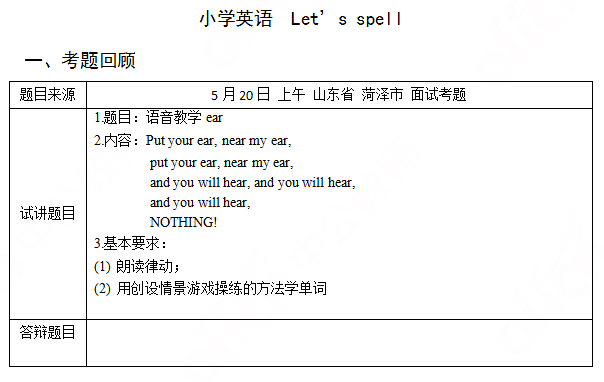
Knowledge aim: Students can understand the pronunciation of “ear”, and get some simple spelling rules.
Ability aim: Students can read the words with the pronunciation of “ear” correctly by listening and speaking. Ability of listening and speaking will be improved.
Emotional aim: Students can increase their interests in learning English.
Key and difficult point:
Key points: Students can understand the pronunciation of “ear”, and how how to read the words contain “ear”, such as hear, near and etc.
Difficult points: Students can master the pronunciation of “ear” and read the related words correctly.
Teaching procedure:
Step 1: Warming-up
Greeting the students.
Sing a song: Head shoulder keens and toes.
Step 2: Presentation
1. Show the chant and ask the students the question: Can you find the same letter combination in these words?
2. Listen to the tape and let students pay attention to the pronunciation of “ear”, and then ask the students question: what does “ear” sounds like in these words?
3. Teacher the pronunciation of “ear” ,and let students pay attention to the teacher’s mouth.
4. Game: Play the finger show to practice the new words.
Step 3: Practice
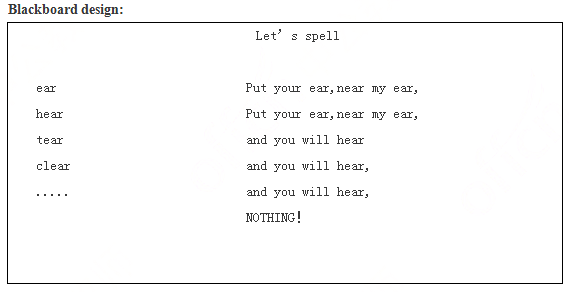
Find more words with “ear” such as tear, dear, clear... and ask students to try to read by themselves and then invite some of them to share with the class. The teacher should act the role of monitor.
Step4: Production
1. Ask students to make up their own sentences by using the words learned today, such as “He hears the bad news,and then his tears falls down. ”.
2. Reading competition: let students to read the chant as quickly as possible, and then let students choose the best one.
Step5: Summary and homework
1. Summary: ask students summary what have learned in the class.
2. Homework:
(1) read these word after class.
(2) Find more words with “ear” and make another chant.
 答案:解析:暂无解析
 -
第19题:

1.Greetings
2Use a tongue twister to warm up: How many cookies could a good cook cook if a good cook could cook cookies? A good cook could cook as much cookies as a good cook who could cook cookies.
Step 2: Presentation
1Listen to the tape for the first time and ask them to write down what are they listening to.
2Let students find out similarity between these words.
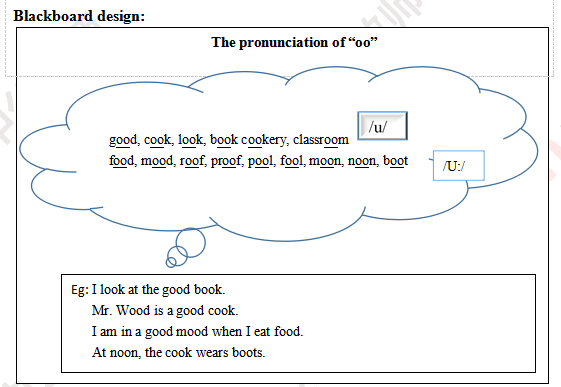
3Tell students how to pronounce “oo”, and summary the pronunciation of “oo” /u/,/u:/.
Step 3: Practice
1Let students find more words with the pronunciation of “oo” (such as: look, book, wood, cookery, classroom), and use these words to make sentence.(such as: I look at the good book. Mr. wood is a good cook. )
Step 4: Production
Dubbing contest: students work in pairs to imitate film clips; teacher will give them 8 minutes to prepare it and then invite some students make performance in the front.
Step 5: Summary & Homework
Summary: students look at the blackboard and summarize this class.
Homework: students find lyrics with the pronunciation of “oo”, and hold a singing contest in the next class.
 答案:解析:暂无解析
 -
第20题:
高中英语?词汇
一、考题回顾
题目来源1月5日 下午 太原市 面试考题
试讲题目1.题目:
2.内容:
I am always the first one to get to the office. Meetings and phone calls take up a large part of the day.Every minute of the day is filled with urgent matters.By around eight o'clock,I usually find some time to do my own paperwork and answer some personal e-mail.
3.基本要求:
(1)十分钟全英试讲
(2)讲解划线处词汇
答辩题目What will you do if students can’t understand the words you explain?
二、考题解析
【教案】
Teaching aims:
Knowledge aim:
Students are able to master the meaning and the usage of underlined words and know the relative words and phrases:get to, take up, be filled with,arrive in/at, occupy,occupation,be full of
Ability aims:
(1) Students can guess the meaning of new words and phrases while reading
(2)After this lesson, students can learn how to use these and relative words and phrases to describe their daily life.
Emotional aim:
Students are able to love learning English after this lesson.
Key and difficult point:
Key Point: master the meaning and the usage of new words and phrases :get to, take up, be filled with,arrive in/at, occupy,occupation,be full of
Difficult Point: understand the meaning of the new words and phrases and use them in their daily life.
Teaching procedures:
Step 1: Warming-up
1. Greetings.
2. Play a video about a person who is busy with his work life and ask students several questions:
What can you see from this video?
Can you describe information in detail using your own language?
Step 2: Presentation
1. Present the paragraph on the PPT. And then ask students to read this passage to guess the meaning of underlined words and phrases. Give students 5 minutes to discuss in the group. And Invite students to give the answers.
2.Then paraphrase these words in English using the pictures. For example, get to means arrive in/at or reach. If something takes up a particular amount of time, space, or effort, it uses that amount. At the same time, present a picture with a man coming the office through the door.
3. Besides introduce the relative phrases, such as take over, take on, take in and so on.
Step 3: Practice
1.Make sentences: ask students to make sentences using the new words. Then correct the grammar mistakes and give the positive feedbacks.
2.Make up a new story: Give students several pictures in disorder and ask them to describe these pictures using the sentences which concludes the new words that have just learnt. Then rank these sentences into a new story. Give students 5 minutes to discuss with their deskmates and then invite several students to share their stories.
Step4: Production
1. Discussion: Ask students to use the words and expressions learnt to describe their daily life with their partner. After 5 minutes, invite several students to share their daily life.
2. Survey: Ask students to make a survey about your classmates’ daily life using three questions in the group. Four person in one group and finish the chart in 10 minutes.Then invite the representatives to make a report for the whole class.
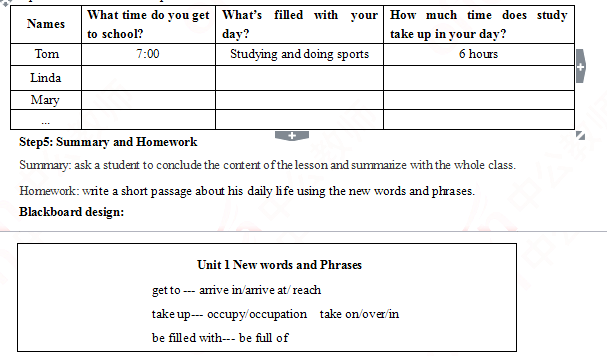
1.What will you do if students can’t understand the words you explain?
2. Do you have the experience in teaching?答案:解析:1.First, if students can’t understand the words that I explain, I will change another way to try my best way to explain this words again. Maybe last way isn’t fit for our students. For example, our students are in high school so last way may be the paraphrase, which is just in language not use other methods or approaches. I will add the video or pictures to help students to understand the new words.
Second, after class, I also need to reflect myself. Not only do I need to learn more ways to use in our class, but also I should know more my students, especially their understanding to the new knowledge in case the same situation comes again.
2.Yes, I do. I have taught a teenager in high school. She was the junior. I mainly taught her grammar. I found her grammar was not very systematic. So I taught her from the grammar in words to the grammar in sentences in order to make her master the whole grammar, especially those always appeared in her exams. And during the teaching, I find the most important that it is the teacher should have a better understanding of the whole grammar and the high school English course. Besides, the teacher should pay more attention to the patience. It will make students relax when their learning and get along with the students. -
第21题:
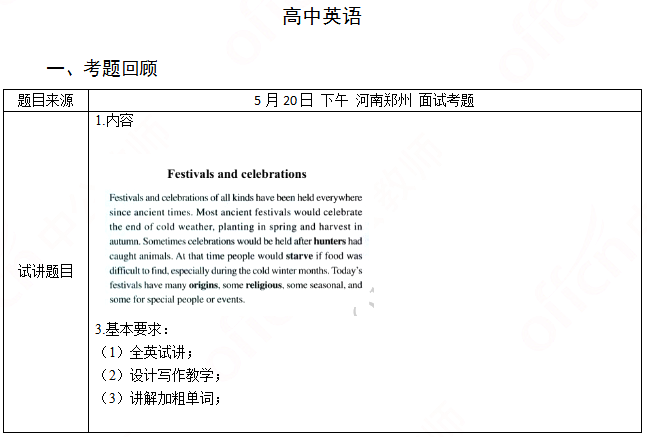
二、考题解析
【教案】
Teaching Aims:
Knowledge aim:
1. By the end of the class, students will know more about festival and its origin.
2. Students will master the meaning and the usage of some words and expressions.
Ability aim: Students can train their reading skill and the speaking skill through learning of the discourse and communicating with each other around the given topic.
Emotional aim: Students will cherish the traditional value and foster national pride through learning.
Teaching Key Points:
Students can master the meaning and the usage of words and expressions in the discourse.
Teaching Difficult Points:
Students can express themselves correctly and fluently and gain the confidence of learning
English.
Teaching Methods:
Task-based teaching method and audiolingual teaching method.
Teaching Aids:
Video, Blackboard and so on.
Teaching Procedures:
Step 1: Warming-up
Have a free talk with the student, inspire them to do a brainstorming about some Chinese festivals.
Collect the answer such as The Double Ninth Festival,The Lantern Festival, The Dragon Boat Festival and ask them “What do people celebrate on these festivals?”
Step 2: Presentation
1. Ask students to read the passage and underline all the sentences providing the information of origin of the festivals.
2.Ask students to read the passage again and guess the meaning of the bold words in these underlined sentences.
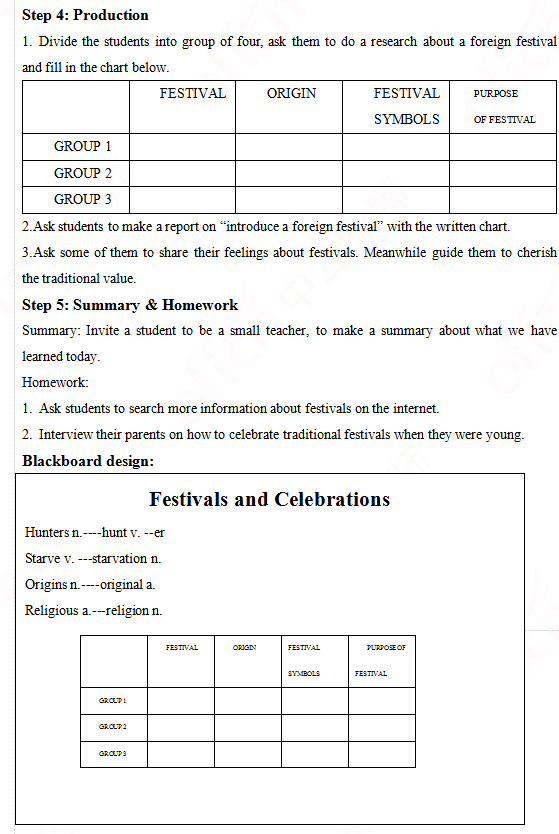
3.write down these bold words on the blackboard “hunters, starve, origins, religious”and interpret these words to the students.
Step 3: Practise
1.Let students to do an exercise -- fill in the blanks with the proper form.
a.Most ancient ____ (festival) will celebrate the end of clod weather,planting in spring and harvest in autumn.
b.Sometimes celebrations will be held after haunters had caught animals. At that time people would ____ (starve) if food was difficult to find,especially during the cold winter months.
c.Today’s festivals has many ____ (origin), some religious, some seasonal and some for special people or events.
2.Ask students to make sentence using the target words.
 答案:解析:暂无解析
 -
第22题:
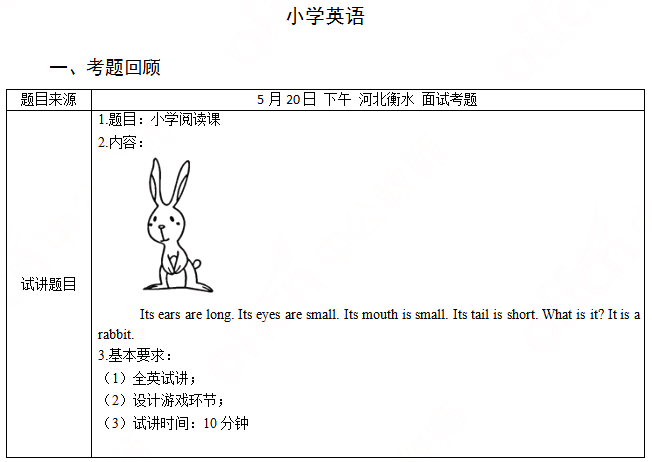
二、考题解析
【教案】
Teaching Aims:
Knowledge aim: Students will master the words “long, small,short, ears, eyes mouth,tail...”
Ability aim: Students can get the key information about rabbit and use the words to describe other animals.
Emotional aim: Students will improve their interest in English.
Teaching Key Points:
Students can understand the meaning of the words“long, small short” and use them to describe other animals.
Teaching Difficult Points:
Cultivate students awareness of loving animals and protecting animals.
Teaching Methods:
TPR teaching method, Communicative teaching method, task-based teaching method.
Teaching Aids:
Pictures, Blackboard and so on.
Teaching Procedures:
Step 1: Warming up
1.Greetings
2.Let students guess a riddle about rabbits. (Teacher need to make some actions to help students guess the answer- rabbit) and then lead in the topic “A rabbit”.
Step 2: Pre-reading
1. Show Students different pictures of rabbits to let students discover the common points.
2. Invite two students to try to describe rabbits in their own words.
3. Teach students these words “ tail, mouth ,ears,eyes”
Step 3: While-reading
1.Let students read the sentences and circle the words that are used to describe rabbits and invite one student to share.
2.Read them again and find out what part of the rabbits do they describe? After that,invite two students to write and draw a picture on the blackboard.
Step 4: Post-reading
Make a survey: Let students work in group of four. They’ll be given 15 minutes to ask each other about what are they favorite animals and fill in the survey table. After that, invite some students to share their survey result by intimating the animals in front of the blackboard.
Step 5: Summary & Homework
Summary: Invite a student to be a small teacher, to make a summary about what we have learned today.
Homework: Draw a picture of your favorite animals and share it to your friends.
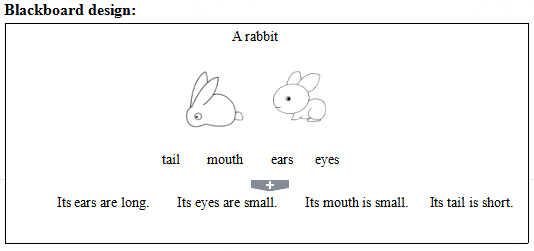 答案:解析:暂无解析
 -
第23题:
单选题Passage1Teaching children to read well from the start is the most important task of elementary schools.But relying on educators to approach this task correctly can be a great mistake. Many schools continue to employ instructional methods that have been proven inefective. The staying power of the look-sayor whole-wordmethod of teaching beginning reading is perhaps the most flagrant example of this failure to instruct effectively.The whole-word approach to reading stresses the meaning of words over the meaning of letters, thinking over decoding, developing a sight vocabulary of familiar words over developing the ability to unlock the pronunciation of unfamiliar words. It fits in with the self-directed, learning how to learn activities recommended by advocates of open classrooms and with the concept that children have to be developmentally ready to begin reading. Before 1963, no major publisher put out anything but these Run-Spot-Run readers.However, in 1955, Rudolf Flesch touched off what has been called the great debatein beginning reading. In his best-seller Why Johnny Can't Read, Flesch indicted the nation's public schools for miseducating students by using the look-say method. He said-and more scholarly studies by Jeane Chall and Rovert Dyksta later confirmed-that another approach to beginning reading, founded on phonics, is far superior.Systematic phonics first teaches children to associate letters and letter combinations with sounds; it then teaches them how to blend these sounds together to make words. Rather than building up a relatively limited vocabulary of memorized words, it imparts a code by which the pronunciations of the vast majority of the most common words in the English language can be learned. Phonics does not devalue the importance of thinking about the meaning of words and sentences; it simply recognizes that decoding is the logical and necessary first step.The author indicts the look-say reading approach because_______.Ait overlooks decoding
BRudolf Flesch agrees with him
Che says it is boring
Dmany schools continue to use this method
正确答案: C解析: