
DThis brief book is aimed at high school shjeents , but speaks to anyone learning at any stage of life.Its formal ,serious style. closely matches its content ,a school-masterly bonnk on schooling .The author , W .H . Armstrong ,starts with the basics : re
题目
D
This brief book is aimed at high school shjeents , but speaks to anyone learning at any stage of life.
Its formal ,serious style. closely matches its content ,a school-masterly bonnk on schooling .The author , W .H . Armstrong ,starts with the basics : reading and writing . In his opinion , reading doesn’t just mean recognizing each word on the page ; it means taking a sandwich and makes it a part of himself .The goal is to bring the information back to life , not just to treat it as dead facts on paper from dead trees . Reading and writing cannot be completely separated from each other ; in fact ,the aim of reading is to express the information you have got from the text .I’ve seen it again and again :some-one who can’t express an idea after reading a text is just as ineffective as someone who hasn’t read it at all.
Only a thied of the bonk remains after that discussion ,which Armstrong devotes to specific tips for studying languages ,math , science and history . He generally handles these topics thoroughly(透彻地) and equally ,except for some weakness in the science and math sections and a bit too much passion(激情) regarding history to his students , that was a hundred times more than my history teachers ever got across .to my disappointment , in this part of the book he ignores the arts .As a matter of fact ,they demand all the concentration and study that math and science do,though the study differs slightly in kind .Although it’s commonly believed that the arts can only be naturally acquired ,actually ,learning the arts is no more natural than learning French or mathematics.
My other comment is that the text aged. The first edition apparently dates to the 1960s---none of the references(参考文献)seem newer than the late 1950s. As a result, the discussion misses the entire computer age.
These are small points, though, and don’t affect the main discussion. I recommend it to any student and any teacher, including the self-taught student.
63. According to Armstrong, the goal of reading is to________.
A. gain knowledge and expand one’s view
B. understand the meaning between the lines
C. experts ideas based on what one has read
D. get information and keep it alive in memory
相似考题
更多“D This brief book is aimed at high school shjeents , but speaks to anyone learning at any ”相关问题
-
第1题:
This Chinese-English dictionary is useful ( ) high school students.A、with
B、to
C、by
D、at
参考答案:B
-
第2题:
To graduate from high school, we will begin our new life in college.()
正确答案:错
-
第3题:
What grades did you get at high school?
正确答案:
-
第4题:
This diploma _____ that you have completed high school.
[A] proves
[B] certifies
[C] secures
[D] approves
正确答案:B
-
第5题:
What's an Apprentice?
As everyone knows, opportunities in the skilled trades are set to explode in the next five to ten years.
Many skilled trades train workers through apprenticeships - new workers spend up to 80% of their days
learning on the job, and only 20% in the classroom. This is accomplished through being paired with an expert in the trade who will guide the apprentice through their learning process.
Many countries have developed special ””pre-apprenticeship”” secondary school programs. If you are in high school, by participating in these programs you can learn job skills and earn credits towards your apprenticeship before you even graduate. Apprenticeships range from auto mechanics to cabinetmaking, construction, and pastry making
What is an apprentice according to this article?A. Anyone who spends 20% of his or her time inside a classroom
B. An expert in a skilled trade who spends 80% of his or her time on the job
C. Any high school student who is learning job skills
D. A new worker matched with an expert to learn a skilled trade答案:D解析: -
第6题:
共用题干
第二篇
Going Her Own Way
When she was twelve,Maria made her first important decision about the course of her life.She decided
that she wanted to continue her education.Most girls from middle-class families chose to stay at home after
primary school,though some attended private Catholic"finishing"schools.There they learned a little about
music,art,needlework,and how to make polite conversation. This was not the sort of education that interested
Maria-or her mother. By this time,she had begun to take her studies more seriously.She read constantly
and brought her books everywhere.One time she even brought her math book to the theater and tried to study
in the dark.
Maria knew that she wanted to go on learning in a serious way.That meant attending the public high
school,something that very few girls did.In Italy at the time,there were two types of high schools:the
"classical"schools and the"technical"schools. In the classical schools,the students followed a very tradi-
tional program of studies,with courses in Latin and Greek language and literature,and Italian literature and
history. The few girls who continued studying after primary school usually chose these schools.
Maria,however,wanted to attend a technical school.The technical schools were more modern than the
classical schools and they offered courses in modern languages,mathematics,science,and accounting. Most
people一including Maria's father一believed that girls would never be able to understand these subjects.
Furthermore,they did not think it was proper for girls to study them.
Maria did not care if it was proper or not.Math and science were the subjects that interested her most.
But before she could sign up for the technical school,she had to win her father's approval. She finally did,
with her mother's help,though for many years after,there was tension in the family. Maria's father continued to
oppose her plans,while her mother helped her.
In 1883,at age thirteen,Maria entered the"Regia Scuola Tecnica Michelangelo Buonarroti"in Rome.
Her experience at this school is difficult for us to imagine.Though the courses included modern subjects,the
teaching methods were very traditional. Learning consisted of memorizing long lists of facts and repeating
them back to the teacher. Students were not supposed to ask questions or think for themselves in any way.
Teachers were very demanding;discipline in the classroom was strict;punishment was severe for those who
failed to achieve or were disobedient.Maria wanted to attend a__________.
A:private"finishing" school
B:school with Latin and Greek
C:technical high school
D:school for art and music答案:C解析:由文章第三段第一句话“Maria, however, wanted to attend a technical school.”可知答案为C。
由文章第一段第三句话“Most girls from middle-class families chose to stay at home afterprimary school...”可知答案为B
由文章第三段倒数第二句话“Most people including Maria' s father believed that girls would never be able to understand these subjects.”说明玛利亚的父亲对女人所持的是传统观念。
由文章最后一段最后一句话可知,在那时的意大利高中学校中,教师是非常严格的。
文章内容表明,玛利亚意志非常坚定,她冲破传统的束缚,进了她向往的技校。 -
第7题:
下面那些标签符合(X)HTML的语法结构()
- A、<School>国家开放大学</ School >
- B、<Book> <Name>哈利波特 </ Book > </Name>
- C、[body] [/body]
- D、{book=网页设计}
正确答案:A -
第8题:
单选题The only lucid arguments printed in the newspaper concerning the new bond proposal was put forth by the high school principal who wrote a series of letters to the newspaper’s editor.AThe only lucid arguments printed in the newspaper concerning the new bond proposal was put forth by the high school principal in a series of letters to the newspaper’s editor.
BThe principal of the high school wrote a series of letters to the newspaper’s editor that put forth the only lucid argument concerning the new bond proposal that was printed in the newspaper.
CIn a series of letters to the newspaper’s editor, the principal of the high school put forth the only lucid argument concerning the new bond proposal to be printed in the newspaper.
DThe high schoolh principal’s series of letters to the newspaper’s editor lucidly put forth the only arguments concerning the new bond proposal to be printed in the newspaper.
EPutting forth the only lucid arguments concerning the new bond proposal to be printed in the newspaper, the series of letters to the newspaper’s editor were written by the high school’s principal.
正确答案: C解析:
A、D项“arguments…was”和“series…puts forth”表达存在主谓不一致问题;B项表达与句意不符;E项不符合习惯表达,故本题应选C项。 -
第9题:
单选题In this passage the author argues that______.Amore and more evidence shows college education may not be the best thing for high school graduates
Bcollege education is not enough if one wants to be successful
Ccollege education benefits only the intelligent, ambitious, and quick-learning people
Dintelligent people may learn quicker if they don’ t go to college
正确答案: A解析:
本题考查作者的观点态度。综观全文尤其是最后一段首句“college may not be the best,the proper,the only place for every young person after the completion of high school”,表明上大学并不是高中毕业生最佳的、最合适的惟一的出路,且越来越多的证据表明了此观点的正确性,故选项A正确。 -
第10题:
单选题As a graduate from high school. Tom is faced with three choices: attending college, finding a job or the army.AAs
Bfrom high school
Cis faced with
Darmy
正确答案: D解析: -
第11题:
单选题According to the author______.Apeople used to question the value of college education
Bpeople used to have full confidence in higher education
Call high school graduates went to college
Dvery few high school graduates chose to go to college
正确答案: B解析:
本题为态度题由首段“The case for college has been accepted without question for more than a generation. All high school graduates ought to go,says conventional wisdom and statistical evidence…”可知B项正确。A、D项理解错误,C项太绝对。 -
第12题:
单选题Brief,violent showers frequently accompanied by thunder and lightning are usually associated with().Apassage of a warm front
Bpassage of a cold front
Cwinds shifting counterclockwise in the Northern Hemisphere
Dstationary high pressure systems
正确答案: D解析: 暂无解析 -
第13题:
You are not ______ anyone in any aspect.
A、inferior to
B、 inferior than
C、more inferior
D、less inferior than
参考答案:A
-
第14题:
Where did you attend high school?
正确答案:
-
第15题:
( )Many pictures in the book “Learning How to Learn” can __________.
A.make children read slowly
B.make children understand the book easily
C.make the book boring
D.make children draw beautifully
正确答案:B
-
第16题:
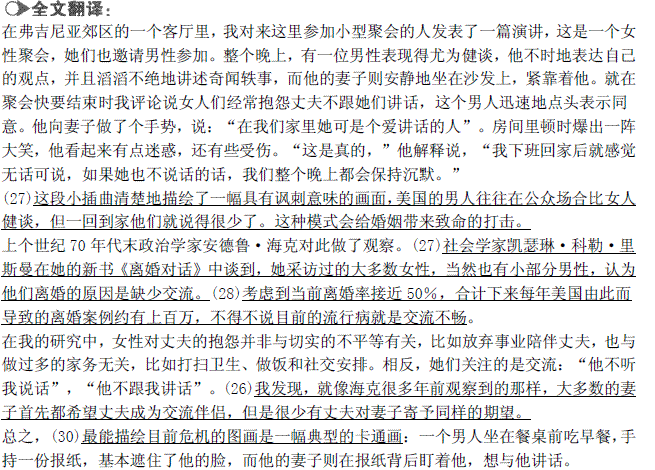
In the following part immediately after this text, the author will most probably focus on( )
[A] a vivid account of the new book Divorce Talk
[B] a detailed description of the stereotypical cartoon
[C] other possible reasons for a high divorce rate in the U. S.
[D] a brief introduction to the political scientist Andrew Hacker
正确答案:B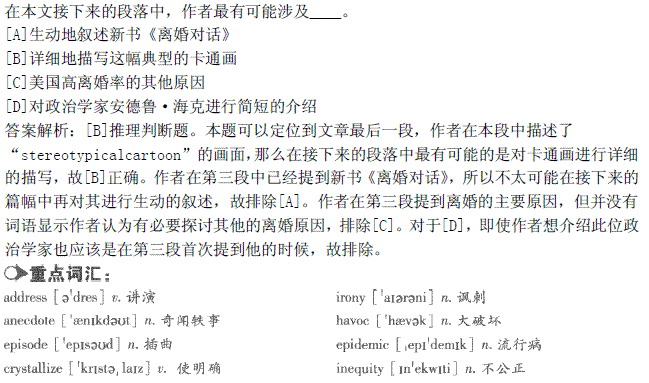
-
第17题:
The book provides a concise analysis of the country's history.A:clean
B:perfect
C:real
D:brief答案:D解析:本句意思:这本书对这个国家的历史做了一个简要的分析。concise简明的,简练的。 brief简短的;clean清洁的,干净的;perfect完美的;real真的,真实的。 -
第18题:
共用题干
第二篇
Going Her Own Way
When she was twelve,Maria made her first important decision about the course of her life.She decided
that she wanted to continue her education.Most girls from middle-class families chose to stay at home after
primary school,though some attended private Catholic"finishing"schools.There they learned a little about
music,art,needlework,and how to make polite conversation. This was not the sort of education that interested
Maria-or her mother. By this time,she had begun to take her studies more seriously.She read constantly
and brought her books everywhere.One time she even brought her math book to the theater and tried to study
in the dark.
Maria knew that she wanted to go on learning in a serious way.That meant attending the public high
school,something that very few girls did.In Italy at the time,there were two types of high schools:the
"classical"schools and the"technical"schools. In the classical schools,the students followed a very tradi-
tional program of studies,with courses in Latin and Greek language and literature,and Italian literature and
history. The few girls who continued studying after primary school usually chose these schools.
Maria,however,wanted to attend a technical school.The technical schools were more modern than the
classical schools and they offered courses in modern languages,mathematics,science,and accounting. Most
people一including Maria's father一believed that girls would never be able to understand these subjects.
Furthermore,they did not think it was proper for girls to study them.
Maria did not care if it was proper or not.Math and science were the subjects that interested her most.
But before she could sign up for the technical school,she had to win her father's approval. She finally did,
with her mother's help,though for many years after,there was tension in the family. Maria's father continued to
oppose her plans,while her mother helped her.
In 1883,at age thirteen,Maria entered the"Regia Scuola Tecnica Michelangelo Buonarroti"in Rome.
Her experience at this school is difficult for us to imagine.Though the courses included modern subjects,the
teaching methods were very traditional. Learning consisted of memorizing long lists of facts and repeating
them back to the teacher. Students were not supposed to ask questions or think for themselves in any way.
Teachers were very demanding;discipline in the classroom was strict;punishment was severe for those who
failed to achieve or were disobedient.High school teachers in Italy in those days were very_________.
A:modern
B:intelligent
C:scientific
D:strict答案:D解析:由文章第三段第一句话“Maria, however, wanted to attend a technical school.”可知答案为C。
由文章第一段第三句话“Most girls from middle-class families chose to stay at home afterprimary school...”可知答案为B
由文章第三段倒数第二句话“Most people including Maria' s father believed that girls would never be able to understand these subjects.”说明玛利亚的父亲对女人所持的是传统观念。
由文章最后一段最后一句话可知,在那时的意大利高中学校中,教师是非常严格的。
文章内容表明,玛利亚意志非常坚定,她冲破传统的束缚,进了她向往的技校。 -
第19题:
单选题Based on the tone and content of the passage, it is most likely which of the following?AA book review in a journal intended for astrophysics professionals
BA movie review in an entertainment industry publication
CA book review in a science magazine aimed at a general audience
DA book review in a newspaper
EA transcript of a talk given at a science fiction convention dedicated to “the poetry of space”
正确答案: A解析:
推断题。文章中没有运用大量专业名词,而且是对Egbert Larson的书进行的评读,故可以推测本文是面向大众的一片书评文章,故本题选C项。 -
第20题:
单选题According to the author _____.Apeople used to question the value of college education
Bpeople used to have full confidence in higher education
Call high school graduates went to college
Dvery few high school graduates chose to go to college
正确答案: B解析:
本题为态度题。由首段“The case for college has been accepted without question for more than a generation. All high school graduates ought to go,says conventional wisdom and statistical evidence ...”可知B项正确。A、D项理解错误,C项太绝对。 -
第21题:
单选题The book gives a brief______ of the history of the castle which was built in the Middle Ages.Aaccount
Bstatement
Creference
Dcomment
正确答案: D解析:
这本书对这个中世纪建造的城堡的历史进行了简单的描述。account报告, 报道; 说明, 记事, give an account of对…进行报道,是固定搭配,其他选项无此搭配。 -
第22题:
单选题Which of the following is the best version of sentence 1 (reproduced below)?Mike Reynolds who is the author of the book, The New Girl came to our school to speak about his book, which tells about him portraying a woman for six weeks.A(As it is now)
BMike Reynolds, the author of The New Girl, spoke at our school about his book, in which he describes how he portrayed a woman for six weeks.
CMike Reynolds, the author of The New Girl, came to our school and told us about his book, where he portrayed a woman for six weeks.
DThe author of The New Girl, Mike Reynolds came to our school to speak, in it he portrayed a woman for six weeks,
EThe author of The New Girl, Mike Reynolds, spoke at our school about his book, that portrays a woman for six weeks.
正确答案: D解析:
A项不正确因为同位语“The New Girl”应该用逗号括起来,“him”应改为“his”。B项没有错误。C项中“where”的使用不正确。D项中的同位语不正确,且用一个逗号连接两个独立的主句,因此不正确。D项也改变了句子的意思。E项也不正确,因为“that”的使用不恰当,因为“that”不能用来修饰人。 -
第23题:
单选题The police chief argued that first-time offenders who have no high school diploma but who have families with a record of crime will probably break the law again.Awho have no high school diploma but who have families with a record of crime
Bwithout a high school diploma and families having a criminal record
Cwithout a high school diploma whose families have a record of crime
Dwhose families have criminal records and lacking high school diplomas
Elacking high school diplomas and also having families having criminal records
正确答案: D解析:
通过通读全句,可知C项的表达在逻辑和语义上优于其余选项,故选C项。