
单选题______A industry B literature C education D IT
题目
industry
literature
education
IT
相似考题
更多“单选题______A industry B literature C education D IT”相关问题
-
第1题:
in britain,children from the age of 5 to 16_______________.
A. can not receive free education at all.
B. can legally receive partly free education.
C. can not receive free education if their parents are rich.
D. can legally receive completely free education.
参考答案:D
-
第2题:
Which of the following is true according to the first paragraph?
[A] Democratic ideas started with education.
[B] Federalists were opposed to education.
[C] New education helped confirm people’s social status.
[D] Old education had been in tune with hierarchical society.
正确答案:D本题是推理引申题。文章第一段第一句指出,随着19世纪上半叶民主权利的扩展以及随之而来的联邦主义机构的削弱,一种新的教育观念出现了。接下来的内容主要是围绕这种新的教育观念展开论述。从第一句话中可以得知,是民主权利的扩展带来了新的教育观念的产生,[A]项颠倒了二者的先后顺序,应排除。文中提到“新”的教育观念是在联邦主义机构削弱的情况下产生的。由此只能得出,新的教育观念与联邦主义有些冲突,并不能得出联邦主义者反对整个教育即[B]项的结论。第二句作者指出,教育不再是对人们先前存在的地位的确定,而成了获得更高地位的手段。[C]项与文意相悖,因此不正确。通过该句“不再”(no longer)可以推断出,从前的教育可以确定人们的社会地位,因此[D]项为正确答案。
-
第3题:
共用题干
The Beginning of American Literature America has always been a land of beginnings.After Europeans"discovered"America in the fifteenth century,the mysterious New World became for many people a genuine hope of a new life,an escape from poverty and persecution,a chance to start again.We can say that,as a nation,America begins with that hope.When,however,does American literature begin?
American literature begins with American experiences.Long before the first colonists arrived,before Christopher Columbus,before the Northmen who"found"America about the year 1000,native Americans lived here.Each tribe's literature was tightly woven into the fabric of daily life and reflected the unmistakably American experience of linking with the land.Another kind of experience,one filled with fear and excitement,found its expression in the reports that Columbus and other explorers sent home in Spain, French and English.In addition,the journals of the people who lived and died in the New England wilder- ness tell unforgettable tales of hard and sometimes heartbreaking experiences of those early years. Experience,then, is the key to early American literature.
The New World provided a great variety of experiences,and these experiences demanded a wide variety of expressions by an even wider variety of early American writers.These writers included John Smith,who spent only two-and-a-half year on the American continent.
They included Jonathan Edwards and William Byrd,who thought of themselves as British subjects,never suspecting a revolution that would create a United States of America with a literature of its own.American Indians,explorers,Puritan ministers,frontier wives,plantation owners-they are all the creators of the first American literature.According to the last paragraph,which of the following statements is true about American literature?
A:Some British writers started American literature.
B:Early-day American literature is a reflection of the boring life then.
C:Some British writers had'doubts about the future of American literature.
D:Some British writers had great confidence in the future of American literature.答案:D解析:由文章第一段第二句话“… a genuine hope of a new life …”可知,that hope指的是人们对在美洲新大陆开始新生活的希望。故选B。
由文章第二段第二句可知,早在大约公元1000年北欧人发现美洲之前,美洲土著居民就居住在这里。第一句说“美国文学来源于美国人的生活经历”,由此可知,美国文学产生于公元1000年前就居住在这里的美洲土著居民的生活经历。故选D。
由文章第二段第三句话“Each tribe ' s literature was tightly woven into the fabric of dail life and reflected the unmistakably American experience of linking with the land.”可知,美洲土部落的文学是他们日常生活的真实写照。故选A。
文章最后一段的第一句话“Experience , then , is the key to early American literature."本段的主题句,说的是:美洲的生活经历是美国早期文学产生的关键因素。故选D。
由文章最后一段第四句话“They included Jonathan Edwards and William Byrd , wh thought of themselves as British subjects,never suspecting a revolution that would create a United States of America with a literature of its own.”可知,这两位自认为是大英帝国臣民的英国作家对一场将会创造出一个拥有自己文学的美利坚合众国的革命从来没有任何怀疑。可见,一些英国作家对美国文学的将来充满信心。故选D。 -
第4题:
( ) is commonly considered to be the beginning of English literature and is the oldest surviving epic in English literatureA.Beowulf
B.The Canterbury Tales
C.Sir Gawain and the Green Knight
D.The Fates of the Apostles答案:A解析:考查英国文学。被称作英国文学开端的作品是Beowulf《贝奥武甫》,也是英国文学保存下来的最古老的史诗。 -
第5题:
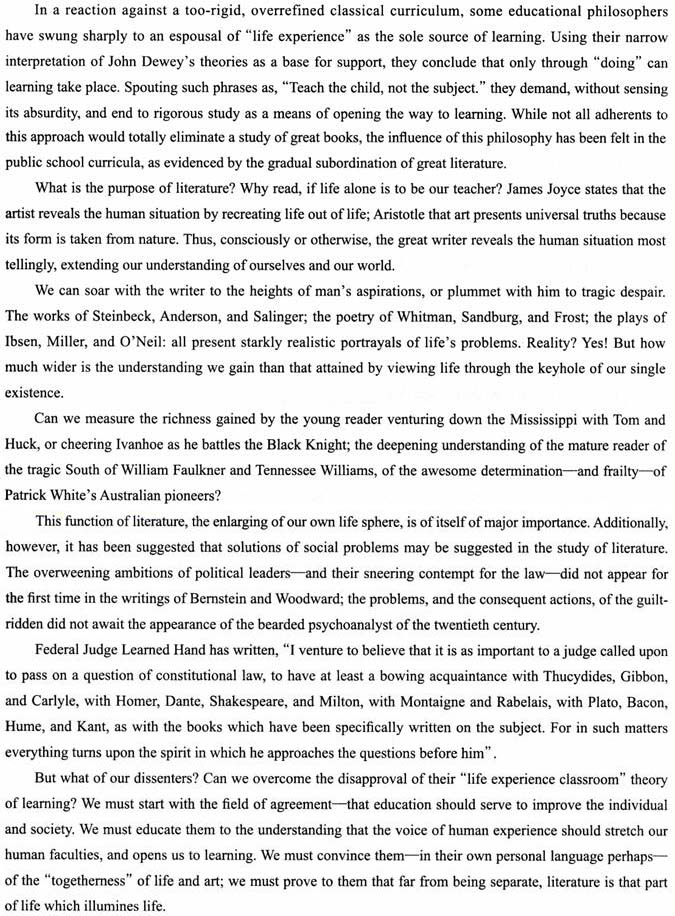
The author’s purpose in this passage is to( )A.list those writers who make up the back bone of a great literature curriculum
B.compare the young reader’s experience with literature to that of the mature reader
C.advocate the adoption of the“life experience” approach to teaching
D.plead for the retention of great literature as a fundamental part of the curriculum答案:D解析:主旨题。文章首段首先提到“life experience”这种方法的狭隘性,使得公立学校课程中的文学作品地位下降。紧接着作者开始论证优秀作品的目的及重要作用,并且在最后一段中提到,需要通过教育来了解优秀作品,克服“经验说”理论。由此可见,本文目的实际上是在呼吁保留文学课程并提高对其的重视,因此D项符合文意。故本题选D。 -
第6题:
以下位置算符检索中,哪项不属于Education(2w)school 的检索结果()
- A、Education school
- B、Education of the countryside school
- C、Education schools
- D、Education and music school
正确答案:B -
第7题:
单选题The author believes that the enjoyment of literature comes from ______.Ashock
Ban anticipation of phrase
Cthe originality of the thought
Dingeniousness
正确答案: B解析:
语义的理解和判断。根据录音中提到的“so that we are led to foresee, to expect, and to welcome the successive phrase. The pleasure may be heightened by…”,可知在艺术家的引导下,我们会去预测,期待并乐于接受后续语句,从而得到一种愉悦。而这种愉悦可能会因……得以加强。由此可知,对文学的享受来自于对后续语句的期待。因此选项B为正确答案。
【录音原文】
Music and literature, the two temporal arts, contrive their pattern of sound in time; or, in other words, of sounds and pauses. Communication may be made in broken words, the business of life be carried on with substantive alone; but that is not what we call literature; and the true business of the literary artist is to plait or weave his meaning, involving it around itself; so that each sentence, by successive phrases, shall first come into a kind of knot, and then, after a moment of suspended meaning, solve and clear itself. In every properly constructed sentence there should be observed this knot or hitch; so that we are led to foresee, to expect, and to welcome the successive phrase. The pleasure may be heightened by an element of surprise, as, very grossly, in the common figure of the antithesis, or with much greater subtlety, where an antithesis is first suggested and then deftly evaded. Each phrase, besides, is to be comely in itself; and between the implication and the evolution of the sentence there should be a satisfying equipoise of sound; for nothing more often disappoints the ear than a sentence solemnly and sonorously prepared, and hastily and weakly finished. Nor should the balance be too striking and exact, for the one rule is to be infinitely various; to interest, to disappoint, to surprise, and yet still to gratify; to be ever changing, as it were, the stitch, and yet still to give the effect of an ingenious neatness. -
第8题:
单选题When the author uses the automobile industry as an example, she argues that ______.AJapan’s auto industry is exceeding America’s auto industry
Bthe public schooling has stagnated because of competition
Cthe current American education system is better than the Japanese one
Dcompetition must be introduced into the public education system
正确答案: D解析:
文章倒数第二段将美国汽车和日本汽车在价格上的巨大差异进行了对比,然后把话题转到对美国的public education system的讨论上,指出美国的教育制度就是缺少这种competition而遭受损害。因此选项D的分析符合文章内容。 -
第9题:
单选题William Faulkner won the Nobel Prize in literature in _____.A1954
B1950
C1949
D1948
正确答案: C解析:
威廉·福克纳(1897年9月25日—1962年7月6日),美国文学史上最具影响力的作家之一,意识流文学在美国的代表人物,1949年诺贝尔文学奖得主,获奖原因为“因为他对当代美国小说做出了强有力的和艺术上无与伦比的贡献”。 -
第10题:
单选题It is Du Bois’s belief that ______.Athe blacks have a priority in terms of education.
Bhigher education should be free for all races.
Ceveryone has an equal right to education.
Ddevelopment in education should be gradual.
正确答案: A解析:
推理判断题。根据题干信息定位到第三段第四句话“In terms of its educational policy, the NAACP position Was that all American children and youth should have genuine equality of educational opportunity.”,由此可知,在教育政策方面,NAACP认为所有的美国儿童和青年都应该拥有真正平等的受教育机会,即无论是黑人还是白人或者其他种族,在教育方面都没有特权,故A选项错误; 第三段第五句中的schooling指的是中小学,不包括高等教育,故B选项错误;D选项的内容是华盛顿所持的观点,混淆对象故排除。故答案为C项。 -
第11题:
单选题According to the passage, which of the following has nothing to do with coffee?ALiterature.
BNewspapers.
CThe insurance industry.
DThe oil industry.
正确答案: A解析:
结合选项,在原文里我们发现文中第三段提到受到咖啡影响的行业,其中有insurance industry(保险业),literature(文学),newspapers(报纸),works of great composers(作曲家的工作),唯独没有提到石油工业,因此D项与咖啡无关,故答案选D。 -
第12题:
单选题What is the woman’s major field of study?AAmerican literature.
BElementary education.
CArt history.
正确答案: C解析:
由录音中女士参加儿童文学课程,问男士是否也是基础教育专业以及后面她对孩子的想法问题很关注等方面可以看出她的主修专业是基础教育。 -
第13题:
According to the passage, early-twentieth-century education reformers believed that ______.
A) different groups needed different kinds of education
B) special programs Should be set up in frontier communities to modernize them
C) corporations and other organizations damaged educational progress
D) more women should be involved in education and industry
正确答案:A
答案:A
[试题分析] 推理题。
[详细解答] 根据文章第三段的Reformers early in the twentieth century suggested that education programs should suit the needs of specific populations.这句话的内容,不难判断选项 A为正确答案。
-
第14题:
The best title for the passage is _____.
[A] Education and Progress
[B] Old and New Social Norms
[C] New Education: Opportunities for More
[D] Demerits of Hierarchical Society
正确答案:C本题考查了文章的主旨大意。考生需通篇把握全文,不应将注意力放到某个事实细节上。文章一开始就提到民主权利的延展和联邦主义的削弱带来了新教育制度的出现。接下来,作者主要介绍了这一新的教育观念的内涵,及其与旧式教育观念的异同。并对新旧两种教育体制下的学生进行比较。纵览全文可以推断,文章主要讲的是新的教育观念,并未涉及教育的发展问题、社会准则问题,所以[A]、[B]项都错误。[D]项虽然在文中有所提及,但只是部分内容,不能概括全文主旨。[C]项为最佳答案。
-
第15题:
The word“literature”in the last sentence refers to_______.A.stories,poems,plays,etc.
B.written works on a particular subject
C.any printed material
D.the modern literature of America答案:B解析: -
第16题:
( ) is commonly considered to be the beginning of English literature and is the oldest surviving epic in English literature.A.Beowulf
B.The Canterbury Tales
C.Sir Gawain and the Green Knight
D.The Fates of the Apostles答案:A解析:考查英国文学。被称作英国文学开端的作品是Beowulf《贝奥武甫》,也是英国文学保存下来的最古老的史诗。 -
第17题:
The goals for secondary education are()from those for higher education.
different
略 -
第18题:
单选题_____ gives people more knowledge of the society than literature.AAnything
BNothing
CSomething
DEverything
正确答案: C解析:
句意:在给人们增加社会知识方面,没有什么能够与文学相比。故选择nothing。 -
第19题:
单选题The first paragraph implies that ______.Athere is a conflict between laws and public opinions on the purpose of education.
Bthe moral purpose of education varies in form with the social situation.
CGreeks and the medieval Church had the same moral purpose in education.
Dthe moral purpose of education is to advocate religious beliefs.
正确答案: B解析:
推理判断题。根据题干信息定位到第一段第三句“In today’s world,the moral purpose of education takes non—religious forms:racial integration,sex education,good citizenship”,由此可知,在当今世界,道德教育采取非宗教形式:种族融合、性教育以及公民教育,从而可以判断出在不同时代社会状况下,道德教育的形式也不一样,故B选项正确;同时 D项意为教育的道德目的是为了拥护宗教信仰,陈述过于片面和绝对,故排除;第一段第一句只是提及美国最高法院禁止公立学校举行祈祷仪式,并不代表法律和公众在教育目的的观点上存在矛盾,曲解文意,故A项错误;第一段第二句提到“It is an idea common to both the Greeks and the medieval Church”,即希腊和中世纪的教会都认同道德教育应该是教育的目的之一,并不能转述为两者道德教育的目的一致,故C项错误。 -
第20题:
单选题The service industry is also called _____.Asubsidiary industry
Blight industry
Csecondary industry
Dtertiary industry
正确答案: D解析:
服务业也称第三产业,指不生产物质产品的行业,或者说是指除第一、二产业以外的其他行业。 -
第21题:
单选题Who is responsible for the state schools in a district?ADepartment of Education and Science.
BLocal Education Authorities.
CEducation Committees.
DThe headmaster.
正确答案: B解析:
英国公立学校都由地方教育当局负责,不过注意校内管理主要由校长进行。 -
第22题:
单选题Education for education’s sake was probably opposed by ______.Ascholars in the Renaissance period
BJill Kerr Conway
Cscholars in the Dark Ages
DPlato
正确答案: B解析:
分析推理题。短本文第二段论述了文艺复兴时期的人文主义者的教育观点。他们认为,知识的传授不需要宗教、社会、经济或政治理由,其目的仅仅是将知识整体代代传承下去。还引用Erasmus和John Dewey的话,说明教育的目的就是教育本身。而由该段首句可知,柏拉图是反对这种观点的,故D项为正确答案。由该段第二句的前半句可知,人们认为人文知识(classical learning)在“黑暗时代”消失了,并不能推知这一时代的学者是否反对“为教育而教育”的观点。 -
第23题:
单选题What do most studies show?AA decline in the tobacco industry would lead to more unemployment.
BThe rate of employment has nothing to do with the tobacco industry.
CIncrease in tobacco production will result in the decline of employment.
DThe workforce may be better off with a reduced tobacco industry.
正确答案: B解析:
大多数有关烟草业产生所有经济影响的严肃分析表明,烟草业的衰退并不会引起就业量的减少,实际上随着烟草业行业就业的减少,整体的就业水平可能保持不变或甚至有所增加,选项D与录音的意思一致。 -
第24题:
单选题What is the earliest adjective associated with literature?ALiterary.
BLiterate.
CLiteracy.
DLiteral.
正确答案: B解析:
第一段讲的是literature的总体发展,根据The normal adjective associated with literature was literate一句可知,最早的与literature有关的形容词是Literate。