
问答题San Francisco, open your Golden Gate, sang the girl in the theatre. She never finished her song. That date was 18th April, 1906. The earth shook and the roof suddenly divided, buildings crashed to the ground and people rushed out into the streets. The
题目
相似考题
参考答案和解析
“旧金山,敞开你的金门吧!”剧院里女歌手唱道,可惜她再也没能唱完。这一天是1906年4月18日,大地震动,屋顶猛地开裂,楼房轰然2倒塌,人们纷纷从屋里逃出,冲上街头。这座城市早在人们于加州沙漠发现金矿起,就兴盛起来,却遭此可怕的地震,毁于一旦(却毁于这场可怕的地震)。然而,时至今日,旧金山的街道四处延伸(四通八达),遍布四十多座陡峭的小山。那些小山像悬崖峭壁般高耸于太平洋蓝色的海域之上。
更多“问答题San Francisco, open your Golden Gate, sang the girl in the theatre. She never finished her song. That date was 18th April, 1906. The earth shook and the roof suddenly divided, buildings crashed to the ground and people rushed out into the streets. The ”相关问题
-
第1题:
All the people who went to the new supermarket had one great hope: to be the lucky customer who did not have to pay for his shopping. For this was what the notice just inside the entrance promised. It said, "Remember, once a week, one of our customers gets free goods. This may be your lucky day!"
For several weeks Mrs. White hoped, like many of her friends, to be the lucky customer. Unlike her friends, however, she never lost heart. Her kitchen was full of things which she did not really need. Her husband tried again and again to persuade her to give it up, but she just wouldn't listen. She dreamed of the day when the manager of the supermarket would come up to say, "Madam. this is your lucky day. Everything in your basket today is free."
One Friday morning, after she had finished her shopping and had taken it to her car, she found that she had forgotten to buy some tea. She rushed back to the supermarket, got the tea and went to the desk to pay for it. As she was walking, she saw the manager of the supermarket coming up. "Madam," he said warmly, holding out his hand, "I want to congratulate you! You are our lucky customer today. Everything you've got in your basket is free."
People went to the supermarket to ______.
A.buy food
B.be lucky customers
C.get free things
D.meet the manager
正确答案:B
解析:一般而言,第一道题的依据句可以从文章的开始部分寻找。本题的依据句为文章的第一句话“All the people who went to the new supermarket had one great hope:to be the lucky customer who did not have to pay for his shopping.”B选项答案非常明确;其他选项在本句中没有涉及,属于无关信息。 -
第2题:
Which of the sentences below apply the rhetorical device of rhetorical question?
A、Was that wise?
B、What would they say of her in the Stores when they found out that she had run away with a fellow?
C、Why should she be unhappy?
D、He took her to see The
B、ohemian Girl and she felt elated as she sat in an unaccustomed part of the theatre with him.
参考答案:ABC
-
第3题:
A centuries-old tradition,illustrated in a modem children's book. 1inks the sweetness of honey with the joy of learning to read.
“The grandpa held a jar of honey so that all the family could see. He then dipped a spoon into it and put some honey on the cover of a small book.
The little girl had just turned five.
‘Stand up,little one,’he asked the girl softly. ‘I did this for your mother,your uncles,your older brother,and now you!’
Then,he handed the book to her. ‘Taste!’
She touched the honey with her finger and put it into her mouth.
‘What's that taste?’the grandpa asked.
The little girl answered,‘Sweet!’
Then all of the family said in a single voice,‘Yes,and so is knowledge,but knowledge is from the bee that made that sweet honey,you have to go after it through the pages of a book!’
The little girl knew that the promise to read was at last hers. Soon she was going to learn to read. ”
This is the beginning of a profoundly moving children's book entitled Thank You,Mr. Falker. In this book,Patricia Polacco writes of her own passion to read,inspired by the honey on the book. It wasn't until fifth grade that she met her beloved teacher who provided the hlep that she needed to finally unlock the magic of the written word.
Reading this book,we are in fact acquainted with some enduring traditions of child education that stress the importance of verbal capacity at a very early age.
The child learning to read is admitted into a collective memory by way of books. And with the printed words that are active with meaning,the child becomes acquainted with a common past which he or she renews,to a greater or lesser degree,in every reading. Much as the author of the book Thank You,Mr. Falker puts it,“Almost as if it were magic,or as if light poured into her brain,the words and sentences started to take shape on the page as they never had before…And she understood the whole thing…Then she went into the living room and found the book on a shelf,the very book that her grandpa had shown her so many years ago. She spooned honey on the cover and tasted the sweetness…Then she held the book,honey and all,close to her chest. She could feel tears roll down her cheeks,but they weren't tears of sadness-she was happy,so very happy. ”
The girl who tasted the honey on the book was______.
A.nearly six years old
B.less than five years old
C.more than six years old
D.a little more than five years old
正确答案:D
解析:事实细节题。由第三段可知:那个女孩刚过5岁。因此,D项符合题意。 -
第4题:
Christine was just a girl in one of my class. I never knew much about
Her except for that she was strang . she didn’t talk many .her hair was black
and purple, and she worn black sports shoes and a black sweater ,although in the
summer .she was ,infact, rather attractively, and she never seemed ^care what
the rest if us thought about her .like the rest of my classmate ,I didn’t really
want to get closest to her . it was only when we did their chemistry projiect
together that I begin to uanderstand why christine dressed the way she did .
__________
正确答案: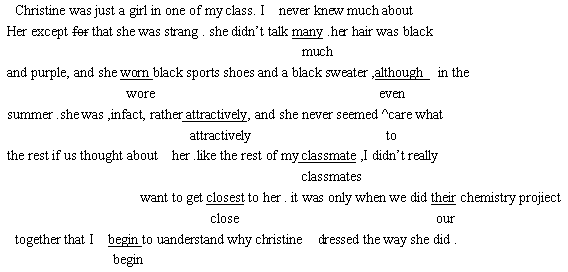
-
第5题:
She was so angry that she rushed out into the rain__________I could stop her.A.before
B.off
C.from
D.away答案:A解析:该句意为她是如此地生气以致于冲进雨里——我能阻止她。before“在…之前”,符合句意,故选A。 -
第6题:
All the housewives who went to the new supermarket had one great amhition:to De the lucky?customer who did not have to pay for her shopping.For this was what the notice just inside the?entrance promised.It said:"Remember,once a week,one of our customers gets free goods.This?May Be Your Lucky Day!"
For several weeks Mrs.Edwards hoped,like ninny of her friends,to be the lucky customer.Unlike her friends,she never gave up hoping.The cupboards in kitchen were full of things which?she did not need.Her husband tried to advise her against buying things but failed.She dreamed of?the day when the manager of the supermarket would approach her and say:"Madam,this is Your Lucky Day.Everything in your basket is free."
One Friday morning,after she had finished her shopping and had taken it to her car,she found that she had forgotten to buy any tea.She dashed back to the supermarket,got the tea and went towards the cash-desk.As she did so,she saw the manager of the supermarket approach her."Madam,"he said,holding out his hand,"I want to congratulate you!You are our lucky customer and everything you have in your basket is free!"
Mrs.Edwards__________.A.is always very lucky
B.had no friends
C.hoped to get free shopping
D.gets disappointed easily答案:C解析:【考情点拨】事实细节题。【应试指导】由第二段前两句可知答案为C。 -
第7题:
It was Ann′s first experience of flying..She had always been afraid of heights and so was prepared?to be frightened.Only the fact that she was going to meet her son who she had not seen for?three years had given her the courage to make the flight.
She sat in her seat,her hands gripping its arms,her seat belt already fastened.The air hostess?was talking,telling everyone what to do in case of emergency,showing them where their life-jackets?were.The plane was crowded,and every seat was full.From her window seat,getting out in a hurry?would be impossible,thought Ann.In any case who would want to get out of a plane in mid-air?
The engines began to shake--the noise increased till it was like a great rushing wind.She?looked out to see the runway slip past at astonishing speed.She wanted to cry out--to stop the plane?before it left the ground,but she knew she was trapped in this great roaring machine.I must scream,she told herself,and put her hands over her eyes.
There was a strange feeling as if she were going up in a lift.The noise died down.Carefully she?opened her eyes.Through the window she saw a great carpet of cloud above,so beautiful that she?stared in wonder,hardly turning away from the window till they touched down.
Why did Ann want to scream?《》()A.Because the plane didn't leave the ground.
B.Because she couldn't make the plane stop.
C.Because she couldn't hear the wind.
D.Because she couldn't see the runway.答案:B解析:【考情点拨】事实细节题。【应试指导】文章第三段第三、四句指出,在飞机起飞前安想叫喊出来让它停下来.但她又不能让飞机停下来,所以她想scream。 -
第8题:
All the housewives who went to the new supermarket had one great amhition:to De the lucky?customer who did not have to pay for her shopping.For this was what the notice just inside the?entrance promised.It said:"Remember,once a week,one of our customers gets free goods.This?May Be Your Lucky Day!"
For several weeks Mrs.Edwards hoped,like ninny of her friends,to be the lucky customer.Unlike her friends,she never gave up hoping.The cupboards in kitchen were full of things which?she did not need.Her husband tried to advise her against buying things but failed.She dreamed of?the day when the manager of the supermarket would approach her and say:"Madam,this is Your Lucky Day.Everything in your basket is free."
One Friday morning,after she had finished her shopping and had taken it to her car,she found that she had forgotten to buy any tea.She dashed back to the supermarket,got the tea and went towards the cash-desk.As she did so,she saw the manager of the supermarket approach her."Madam,"he said,holding out his hand,"I want to congratulate you!You are our lucky customer and everything you have in your basket is free!"
Mrs.Edwards must have beenA.pleased
B.delighted
C.proud
D.disappointed答案:D解析:【考情点拨】推理判断题。【应试指导】pleased与delighted都意为“高兴的”,可排除A、B两项。proud自豪的,也可排除。Mrs.Edwards成为幸运顾客时,她已把买好的东西都放进车里了,此时只有茶叶还未付款,所以她失望的是她现在只买了茶叶。 -
第9题:
共用题干
A Great Quake Coming?
Everyone who lives in San Francisco knows that earthquakes are common in the Bay Area一and they
can be devastating. In 1906,for example,a major quake destroyed about 28,000 buildings and killed
hundreds,perhaps thousands of people.Residents now wonder when the next"Big One"will strike.It's
bound to happen someday. At least seven active fault(断层)lines run through the San Francisco area. Faults
are places where pieces of Earth'S crust(地壳)slide past each other.When these pieces slip,the ground
shakes.
To prepare for that day,scientists are using new techniques to reanalyze the 1906 earthquake and pre-
diet how bad the damage might be when the next one happens.
One new finding about the 1906 earthquake is that the San Andreas fault split apart faster than scientists
had assumed at the time. During small earthquakes,faults rupture(断裂)at about 2.7 kilometers per second.
During bigger quakes,however.ruptures can happen at rates faster than 3.5 kilometers per second.
At such high speeds,massive amounts of pressure build up,generating underground waves that can
cause more damage than the quake itself. Lucky for San Francisco , these pressure pulses(脉冲)traveled
away from the city during the 1906 event.As bad as the damage was,it could have been far worse.
Looking ahead,scientists are trying to predict when the next major quake will occur. Records show that
earthquakes were common before 1906.Since then,the area has been relatively quiet.Patterns in the data,
however,suggest that the probability of a major earthquake striking the Bay Area before 2032 is at least 62
percent.
New buildings in San Francisco are quite safe in case of future quakes.Still,more than S4 percent of the
city’s buildings are old and weak.Analyses suggest that another massive earthquake would cause extensive
damage.
People who live there today tend to feel safe because San Francisco has remained pretty quiet for a
while.According to the new research,however,it's not a matter of"if" the Rig One will hit.It',just a mat-
ter of when.Scientists will be able to predict the exact time of an earthquake soon.
A:Right
B:Wrong
C:Not mentioned答案:C解析:短文第一段的倒数第兰句提到至少有7条地质断层线穿越旧金山。
短文虽然说旧金山大地震的破坏力非常大,但没有明确指出其程度是美国历史之最。
从第兰段最后一句话可知答案。
第五段的第二句话提到1906年前地震频繁。
倒数第二段提到:城里超过84%的建筑是旧的、不坚固的。所以旧金山并没有为地震做好准备。
第五段的最后一句话说科学家们顶测地震发生的概率荃少为62%,但是这并不意味着 科学家们就能预测出准确的时间,最后一段也只说明这是个时间问题,而没有说出具体时间。
短文末尾提到:问题已不再是“是否”将会发生大地震,而是“什么时候”会发生。第3部分:概括大意与完成句子 -
第10题:
问答题Practice 5 This isn’t the sort of girl to let the rock ‘n’ roll lifestyle go to her head. Even if she did, her family would bring her down to earth. “When I started at Capital the only thing my brothers asked was whether they’d get free records,” she remembers. “And my mum couldn’t even find the station on her radio.” Margherita Taylor is very nice and very easy-going, but very much in control. She is so much a “Capital Radio girl” that you might think she is just doing a good job for the station’s publicity department, although you know what she’s saying really comes from the heart. She smiles a lot, laughs a lot and is generally a great advert for Capital.正确答案:
【参考译文】
她不是那种让摇滚乐风格的生活方式充斥大脑的女孩。即使她这样做了,她家人也不会赞同。“我来首都电台工作后,我哥哥问的唯一事情是是否可以得到免费唱片,”她回忆说,“我妈妈甚至在收音机上找不到首都电台。”
玛格丽特·泰勒平易近人,但有控制力强。她是个很好的“首都电台女孩”,你可能觉得她所做的就是给电台的宣传部做好工作,虽然你知道她说的都是心里话。她常常微笑或大笑,她本身就是首都电台的一则很好的广告。解析: 暂无解析 -
第11题:
填空题Have run out of fuel, the plane crashed to the ground.正确答案: Have应该改为Having[解析] 本题考查的是现在分词作原因状语,由于分句的逻辑主语是plane,与主句主语一致,且与谓语run out of之间存在因果前后顺序,故应用现在分词的完成式。解析: 暂无解析 -
第12题:
问答题San Francisco San Francisco, open your Golden Gate, sang the girl in the theatre. She never1 finished her song. That date was 18th April, 1906. The earth shook and the roof suddenly divided, buildings crashed2 to the ground and people rushed out into the streets. The dreadful earthquake destroyed the city that had grown up when men discovered gold in the deserts of California. But today the streets of San Francisco stretch over more than forty steep hills, rising like huge cliffs above the blue waters of the Pacific Ocean The best way to see this splendid city, where Spanish people were the first to make their homes, is to take one of the old cable cars which run along the nine main avenues. Fares are cheap;they have not risen, I’m told, for almost a hundred years4. You leave5 the palm trees in Union Square—the heart of San Francisco—and from the shop signs and the faces around you, you will notice that in the city live people from many nations—Austrians, Italians, Chinese and others—giving each part a special character. More Chinese live in China Town than in any other part of the world outside China. Here, with Chinese restaurants, Chinese post-boxes, and even odd telephone-boxes that look like pagodas, it is easy to feel you are in China itself. Fisherman’s Wharf, a place all foreigners want to see, is at the end of the ride. You get out, pause perhaps to help the other travelers to swing the cable Car on its turntable(a city custom), and then set out to find a table in one of the gay little restaurants beside the harbor. As you enjoy the fresh Pacific seafood you can admire the bright red paint of the Golden Gate Bridge in the harbor and watch the traffic crossing beneath the tall towers on its way to the pretty village of Tiberon.正确答案: 【参考译文】
漫步旧金山 “旧金山,敞开你的金门吧!”剧院里女歌手唱道,可惜她再也没能唱完。这一天是1906年4月18日,大地震动,屋顶猛地开裂,楼房轰然倒塌,人们纷纷从屋里逃出,冲上街头。这座城市早在人们于加州沙漠发现金矿起,就兴盛起来,却遭此可怕的地震,毁于一旦(却毁于这场可怕的地震)。然而,时至今日,旧金山的街道四处延伸(四通八达),遍布四十多座陡峭的小山。那些小山像悬崖峭壁般高耸于太平洋蓝色的海域之上。
要游览这座西班牙人最早在此落户的绚丽城市,最好的办法是乘坐旧式缆车。缆车穿越九条主大街,收费低廉,据说近百年来一直没涨过价。
联合广场是旧金山的中心。你从广场棕榈树下向外行,扫视店铺招牌和周围形形色色的面孔,就会注意到这座城市里居住着来自许多国家的人——奥地利人、意大利人、中国人等等——这就使每一地段呈现出迥然不同的特色。唐人街住着许多华人,其人数之众超过中国本土之外任何地方。这里有中国风味的餐馆、中国式邮筒,甚至还有奇异的电话亭,形如宝塔。凡此种种,不费想象就令你恍若置身中国境内了。
缆车的终点站是“渔民码头”,海外游客均想一睹为快。你下车后,稍做停留,遵照当地风俗,帮助其他游客推动转车台上的缆车,使之掉头转向,然后移步到码头旁边一家装饰华丽的小饭馆里找个座位坐下。你可以一边品尝太平洋的海鲜,一边欣赏海港里漆色鲜红的金门大桥,观看林立的高楼之下通往美丽村庄“蒂伯龙”的交通线上络绎不绝的车辆。解析: 暂无解析 -
第13题:
根据下列材料请回答 1~20 题:
I close my eyes and can still hear her—the little girl with a 1 . SO strong and powerful we could hear her halfway down the block. She was a(n) 2 peasant who asked for money and 3 gave the。nly thing she had--her V。ice.I paused。utside a small shop and listened She brought to my mind the 4 of Little Orphan Annie.I could not understand the words she 5 , but her voice begged for 6 .It stood out from the noises of Arbat Street,pure and impressive, like the chime of a bell.She sang 7 an old—style. lamp post in the shadow of a building,her anns extended and 8 thrown back. She was small and of unremarkable looks.Her brown hair 9 the bun(发髻)it had been pulled into,and she occasionally reached up to 10 a stray Diece fmm her face.Her clothing I call’t recall.Her voice,on the other hand,is 11 imprinted
in my mind. I asked one of the translators about the gin.Elaina told me that she and hundreds of others like her throughout the 12 soviet union add to their families'income by working on the streets. The children are unable to 13 school,and their parents work fulltime.These children know that the consequence of all 14 day is no food for the table.Similar situations occurred during the De’pression(萧条)in the United States,but those Amefican children were 15 shoeshine boys of me 16 .This girl was real to me.
When we walked past her I gave her money.It was not out of pity 17 rather admiration Her smile of 18 did not interrupt her singing.The girl watched US as we walked down the street.I know this because when I looked back she smiled again. We 19 that smile,and I knew I could never forget her courage and 20 strength.
第 1 题
A.will
B.strength
C.voice
D.determination
正确答案:C
根据下文的“hear her halfway down the block”及“gave the only thing she had—her voice”可推断出答案为C。 -
第14题:
Nellie Melba was Australia's "Queen of Opera".She was born in 1861 and her real name was Helen Porter Mitchell.She grew up in musical family.When she was 20 Helen Mitchell married the manager of a Queensland sugar farm. But she was not happy and the next year she went back to Melbourne to continue her music and singing lessons. She wanted to make a name for herself as an opera singer.
She stayed in Melbourne for four years then left for London. But no one seemed interested in this young unknown singer from Australia. She went to Paris to have lessons from a well-known teacher. In December the same year she gave a concert in which she used the name "Nellie Melba in honour of Melbourne her home city.
Nellie Melba was soon a star. She sang in London Europe Russia and America. She was paid well every time she sang. In 1902 she turned to Melbourne. The city was decorated (装饰) and thousands of people waited in the streets to wave and cheer as she drove by. From then on she divided her time between London and Australia. During World War I she sang in many concerts to raise money.
In 1918 Nellie Melba was made a Dame of the British Empire.
1.Nellie Melba's parents probably were ()
A.musicians
B.engineers
C.fanners
D.scientists
2.She went to London because she()
A.no one showed interest in her singing
B.she was not happy in Australia
C.she wanted to study music
D.she wanted to be a great singer
3.She became famous in her ()
A.thirties
B.twenties
C.fifties
D.forties
4.Which of the following is true?
A.She loved Melbourne but the people there didn't love her.
B.She didn't love Melbourne but the people there loved her.
C.She loved Melbourne and the people there loved her.
D.She didn't love Melbourne and the people there didn't love her.
5.What do you suppose "a Dame of the British Empire"?
A.A very beautiful woman.
B.A woman singer.
C.Queen of Opera.
D.A respected woman.
6.What does the author wants to tell us?
A.A Canadian girl tries record flying
B.A Canadian girl flew with her father
C.Two Youngest pilots
D.A Two-week flight
参考答案ADBCDA
-
第15题:
The girl had hardly rung the bell the door was opened suddenly, and her friend rushed out to greet her .
A.before
B.until
C.as
D.since
正确答案:A
-
第16题:
Passage Three
My husband and children feel very happy to live here. They can't see that we live on a dirty street in a dirty house among people who aren't good. They can't see that our neighbors have to make happiness out of all this dirt. I decided that my children must get out of this. The money that we've saved isn't nearly enough.
The McGaritys have money but they are so proud. They look down upon the poor The McGarity girl just yesterday stood out there in the street eating from a bag of candy while a ring of hungry children watched her. I saw those children looking at her and crying in their hearts; and when she couldn't eat any more she threw the rest down the sewer (下水道). Why? Is it only because they have money? There is more to happiness than money in the world, isn't there?
Miss Jackson who teaches at the Settlement House isn't rich, but she knows things. She understands people. Her eyes look straight into yours when she talks with you. She can read your mind. I'd like to see the children will be like Miss Jackson when they grow up.
44. This passage suggests that the writer______.
A. is easy to get along with
B. is never pleased with her neighbors
C. is unhappy with the life they are living
D. is good at observing and understanding people
正确答案:C
参见第一段。
-
第17题:
根据下列内容,回答191-195题。
Mrs.Janes gave music lessons at a school.She had a good voice and enjoyed singing,except that some of her high tones sounded like a gate that had been forgotten to oil.Mrs.Janes knew her weakness well,and took every chance she could to practice these high tones.As she lived in a small house,where she could not practice without disturbing the rest of the family,she usually went for long walks along the country roads whenever she had time and practiced her high tones there.Whenever she heard a car or a person coming along the road,she stopped and waited until she could no longer be heard before she started practicing again,because she was a shy person.
One afternoon,a fast,opened car came up behind her so silently and so fast that she didn’t hear it until it was only a few yards from her.She was singing some of her highest and most difficult tones at that time and as the car passed;she saw an anxious expression came over the driver’s face.
He stopped his car suddenly,jumped out and began to examine all the tyres carefully. Mrs.Janes didn’t dare to tell him what noise he had heard really was,so he got back into the car and drove off.
How did Mrs.Janes sing? __________A.She sang well,but she didn’t practice singing hard.
B.She enjoyed singin9,but she had a terrible voice.
C.She was a good singer,but she could not sing the high tones well.
D.She sang terribly,and she was not singer at all.答案:C解析:推断题。根据第一段“She had a good voice and enjoyed singing,except that some of herhigh tones sounded like a gate that had been forgotten to oil”可推知,她是一个好歌手,只是某些高音符唱不好。故答案为C。 -
第18题:
It was Ann′s first experience of flying..She had always been afraid of heights and so was prepared?to be frightened.Only the fact that she was going to meet her son who she had not seen for?three years had given her the courage to make the flight.
She sat in her seat,her hands gripping its arms,her seat belt already fastened.The air hostess?was talking,telling everyone what to do in case of emergency,showing them where their life-jackets?were.The plane was crowded,and every seat was full.From her window seat,getting out in a hurry?would be impossible,thought Ann.In any case who would want to get out of a plane in mid-air?
The engines began to shake--the noise increased till it was like a great rushing wind.She?looked out to see the runway slip past at astonishing speed.She wanted to cry out--to stop the plane?before it left the ground,but she knew she was trapped in this great roaring machine.I must scream,she told herself,and put her hands over her eyes.
There was a strange feeling as if she were going up in a lift.The noise died down.Carefully she?opened her eyes.Through the window she saw a great carpet of cloud above,so beautiful that she?stared in wonder,hardly turning away from the window till they touched down.
Ann thought she would be frightened because__________《》()A.she had never flown before
B.she had a fear of being in high places
C.she hadn't made proper preparations
D.she was naturally timid答案:B解析:【考情点拨】事实细节题=【应试指导】文章第一段第二句指出,安患有恐高症,所以已做好了首次坐飞机害怕的准备。 -
第19题:
All the housewives who went to the new supermarket had one great amhition:to De the lucky?customer who did not have to pay for her shopping.For this was what the notice just inside the?entrance promised.It said:"Remember,once a week,one of our customers gets free goods.This?May Be Your Lucky Day!"
For several weeks Mrs.Edwards hoped,like ninny of her friends,to be the lucky customer.Unlike her friends,she never gave up hoping.The cupboards in kitchen were full of things which?she did not need.Her husband tried to advise her against buying things but failed.She dreamed of?the day when the manager of the supermarket would approach her and say:"Madam,this is Your Lucky Day.Everything in your basket is free."
One Friday morning,after she had finished her shopping and had taken it to her car,she found that she had forgotten to buy any tea.She dashed back to the supermarket,got the tea and went towards the cash-desk.As she did so,she saw the manager of the supermarket approach her."Madam,"he said,holding out his hand,"I want to congratulate you!You are our lucky customer and everything you have in your basket is free!"
Mrs.Edwards went back to the supermarket quickly because she had to__A.buy another thing
B.talk to the manager
C.pay for her shopping
D.find her shopping答案:A解析:【考情点拨】事实细节题。【应试指导】由最后一段前两句可知,Mrs.Edwards已经把东西放进车里了,这时她发现她忘记买茶了,所以又返回超市去买茶。 -
第20题:
共用题干
A Great Quake Coming?
Everyone who lives in San Francisco knows that earthquakes are common in the Bay Area一and they
can be devastating. In 1906,for example,a major quake destroyed about 28,000 buildings and killed
hundreds,perhaps thousands of people.Residents now wonder when the next"Big One"will strike.It's
bound to happen someday. At least seven active fault(断层)lines run through the San Francisco area. Faults
are places where pieces of Earth'S crust(地壳)slide past each other.When these pieces slip,the ground
shakes.
To prepare for that day,scientists are using new techniques to reanalyze the 1906 earthquake and pre-
diet how bad the damage might be when the next one happens.
One new finding about the 1906 earthquake is that the San Andreas fault split apart faster than scientists
had assumed at the time. During small earthquakes,faults rupture(断裂)at about 2.7 kilometers per second.
During bigger quakes,however.ruptures can happen at rates faster than 3.5 kilometers per second.
At such high speeds,massive amounts of pressure build up,generating underground waves that can
cause more damage than the quake itself. Lucky for San Francisco , these pressure pulses(脉冲)traveled
away from the city during the 1906 event.As bad as the damage was,it could have been far worse.
Looking ahead,scientists are trying to predict when the next major quake will occur. Records show that
earthquakes were common before 1906.Since then,the area has been relatively quiet.Patterns in the data,
however,suggest that the probability of a major earthquake striking the Bay Area before 2032 is at least 62
percent.
New buildings in San Francisco are quite safe in case of future quakes.Still,more than S4 percent of the
city’s buildings are old and weak.Analyses suggest that another massive earthquake would cause extensive
damage.
People who live there today tend to feel safe because San Francisco has remained pretty quiet for a
while.According to the new research,however,it's not a matter of"if" the Rig One will hit.It',just a mat-
ter of when.A major earthquake striking San Francisco someday is inevitable.
A:Right
B:Wrong
C:Not mentioned答案:A解析:短文第一段的倒数第兰句提到至少有7条地质断层线穿越旧金山。
短文虽然说旧金山大地震的破坏力非常大,但没有明确指出其程度是美国历史之最。
从第兰段最后一句话可知答案。
第五段的第二句话提到1906年前地震频繁。
倒数第二段提到:城里超过84%的建筑是旧的、不坚固的。所以旧金山并没有为地震做好准备。
第五段的最后一句话说科学家们顶测地震发生的概率荃少为62%,但是这并不意味着 科学家们就能预测出准确的时间,最后一段也只说明这是个时间问题,而没有说出具体时间。
短文末尾提到:问题已不再是“是否”将会发生大地震,而是“什么时候”会发生。第3部分:概括大意与完成句子 -
第21题:
Have run out of fuel, the plane crashed to the ground.
Have应该改为Having[解析] 本题考查的是现在分词作原因状语,由于分句的逻辑主语是plane,与主句主语一致,且与谓语run out of之间存在因果前后顺序,故应用现在分词的完成式。
略 -
第22题:
单选题Some museums in San Francisco are open every day, but some are only open ______.Aon weekdays
Bon weekends
Con certain days
Don holidays
正确答案: B解析:
细节理解题。第一段第五句提到“Some are only open on certain days. ”可知,答案选C正确。 -
第23题:
问答题San Francisco, open your Golden Gate, sang the girl in the theatre. She never finished her song. That date was 18th April, 1906. The earth shook and the roof suddenly divided, buildings crashed to the ground and people rushed out into the streets. The dreadful earthquake destroyed the city that had grown up when men discovered gold in the deserts of California. But today the streets of San Francisco stretch over more than forty steep hills, rising like huge cliffs above the blue waters of the Pacific Ocean.正确答案:
“旧金山,敞开你的金门吧!”剧院里女歌手唱道,可惜她再也没能唱完。这一天是1906年4月18日,大地震动,屋顶猛地开裂,楼房轰然2倒塌,人们纷纷从屋里逃出,冲上街头。这座城市早在人们于加州沙漠发现金矿起,就兴盛起来,却遭此可怕的地震,毁于一旦(却毁于这场可怕的地震)。然而,时至今日,旧金山的街道四处延伸(四通八达),遍布四十多座陡峭的小山。那些小山像悬崖峭壁般高耸于太平洋蓝色的海域之上。解析: 暂无解析 -
第24题:
问答题Practice 7 When Mary Lennox was sent to Misselthwaite Manor to live with her uncle everybody said she was the most disagreeable-looking child ever seen. It was true, too. She had a little thin face and a little thin body, thin light hair and a sour expression. Her hair was yellow, and her face was yellow because she had been born in India and had always been ill in one way or another. Her father had held a position under the English Government and had always been busy and ill himself, and her mother had been a great beauty who cared only to go to parties and amuse herself with gay people. She had not wanted a little girl at all, and when Mary was born she handed her over to the care of an Ayah, who was made to understand that if she wished to please the Mem Sahib she must keep the child out of sight as much as possible. So when she was a sickly, fretful, ugly little baby she was kept out of the way, and when she became a sickly, fretful, toddling thing she was kept out of the way also. She never remembered seeing familiarly anything but the dark faces of her Ayah and the other native servants. And as they always obeyed her and gave her her own way in everything, because the Mem Sahib would be angry if she was disturbed by her crying, by the time she was six years old she was as tyrannical and selfish a little pig as ever lived. The young English governess who came to teach her to read and write disliked her so much that she gave up her place in three months, and when other governesses came to try to fill it they always went away in a shorter time than the first one. So if Mary had not chosen to really want to know how to read books she would never have learned her letters at all.正确答案:
【参考译文】
当玛丽·劳诺克斯被送到米瑟斯威特庄园,和她舅舅一起生活的时候,每个人都说她是他们见过的长相最令人不舒服孩子。这也对,玛丽有着消瘦的脸蛋、单薄的身体、薄薄的头发和一副不高兴的表情。她的头发是黄色的,由于出生在印度并且总是因为这样或那样的原因而生病,她的脸蛋也显得那么蜡黄。玛丽的父亲在英国政府中有份工作,经常很忙也时不时地生病,她的母亲是个大美人,只关心各种聚会以及和一些男人们寻欢作乐。玛丽的母亲从来没有想过要一个小女孩,当玛丽出生后,她就把她交给奶妈来照顾,奶妈知道,如果她想让女主人高兴的话,她就必须尽可能地把这个孩子带离她的视线。所以,当玛丽还是个多病、爱哭、难看的小婴孩时,她就被带离大人们的视线。当玛丽长成为一个多病、爱哭、蹒跚学步的小孩时,她还是被带离大人们的视线。除了奶妈和其他印度仆人的黑脸,玛丽从没记得见过任何熟悉的东西。因为女主人会被她的哭声打扰到而生气,所以奶妈和仆人们非常顺从玛丽,让她为所欲为。当玛丽长到6岁时,她像一头小猪那样乖戾而自私。来教她阅读和书写的年轻英语家庭女教师非常不喜欢玛丽,三个月后就放弃了这份工作,而后来试图教她的家庭教师也总是干不到第一位那么长的时间就离开了。所以如果不是玛丽自己真的想要读书的话,恐怕她连自己的名字也不会写。解析: 暂无解析