
单选题What is mentioned as a reason for visiting Mr. Fraser's blog?A To give him feedback on his ideasB To contribute to his political campaignC To find out about his policiesD To learn more about his political party
题目
To give him feedback on his ideas
To contribute to his political campaign
To find out about his policies
To learn more about his political party
相似考题
更多“单选题What is mentioned as a reason for visiting Mr. Fraser's blog?A To give him feedback on his ideasB To contribute to his political campaignC To find out about his policiesD To learn more about his political party”相关问题
-
第1题:
Passage Four
One evening Mr. Green was driving home along a lonely country road. He had £ 100.00 in his pock et. At the loneliest part of the road, a man asked for a lift (搭车). Mr. Green told him to get into the car and continued his driving. When he talked to the man and learned that the man had been in prison for robbery and had broken out of prison two days before, Mr. Green was very worried.
Suddenly he saw a police-car and had a bright idea. He just reached a small town where the speed limit (限制速度) was 30 miles an hour. But he drove the car as fast as it could go. He looked back and saw that the police-car had begun to chase (追) him. After a mile or so the police-car overtook (赶上) him and ordered him to stop. A policeman got out and came to Mr. Green's car. Mr. Green hoped that he could tell the policeman about the escaped robber, but he felt the man had put a gun against his back. The policeman took out his notebook and pencil, saying he wanted Mr. Green's name and address. Mr. Green asked to be taken to the police station, but the policeman said, "No, you will have to appear at the police station later." Mr. Green had to do as the policeman told him. The policeman wrote his name and address down, put his notebook and pencil back in his pocket and gave Mr. Green a talk about dangerous driving. Then Mr. Green started up his car again and drove on.
Just as he reached the outskirts (郊区) of London, the passenger said, "! want to get off here." Mr. Green stopped the car, the man got out and said, "Thanks for the lift. You've been good to me. This is the least I can do in return (报答)." And he handed Mr. Green the policeman's notebook, which he stole while the policeman was talking to Mr. Green.
46. The man asking for a lift was ______.
A. a robber who robs drivers
B. a policeman who had worked in prison
C. a prisoner who had escaped from prison
D. a stranger with £ 100.00 in his pocket
正确答案:C
本题是对有关人物细节信息的考查。其中关键词是man...lift...was。首先,考生从选项中得知需判断搭车人的身份。通过第1段倒数第2句中的...the man...in prison for robbery...broken out of prison two days before了解到此人曾因抢劫而入狱,但又于两天前越狱逃走。 A、B、D项都与文中内容不符,应被排除。唯有C项(越狱的犯人)合乎文中情节,是正确答案。
-
第2题:
What do we learn about Thomas Jefferson?
A.His political view changed his attitude towards slavery.
B.His status as a father made him free the child slaves.
C.His attitude towards slavery was complex.
D.His affair with a slave stained his prestige.
正确答案:C
从文章的内容来看,Jefferson知道奴隶制是错误的,但是他又作出了compromise(妥协),从此而知,其对待奴隶制的态度是复杂的(complex). -
第3题:
What does the reporter want most from his editors in their talks?
A. Finding the news value of his stories.
B. Giving him financial support.
C. Helping him to find issues.
D. Improving his good ideas.
正确答案:D
-
第4题:
When your colleague brings about a problem, you should _______ .
A. find a better way to handle the problem
B. blame him for his lack of responsibility
C. tell him to find the cause of the problem
D. ask a more able colleague for help
正确答案:A由第二段if your colleague causes you problems on the job for lack of responsibility or ability, find ways of dealing with his irresponsibility or inability rather than simply blame the person.可知
-
第5题:
When we talk about intelligence we do not mean the ability to get good scores on certain kinds of tests or even the ability to do well in school. By intelligence we mean a way of living and behaving, especially in a new situation. If we want to test intelligence, we need to find out how a person acts instead of how much he knows to do.
For example, when in a new situation, an intelligent person thinks about the situation, not about himself or what might happen to him. He tries to find out all he can do, and then he acts immediately and tries to do something about it. He probably isn’t sure how it all works out, but at least he tries. And if he cannot make things work out right, he doesn’t feel ashamed that he failed, he just tries to learn from his mistakes. An intelligent person, even if he is very young, has a special outlook in life, a special feeling about life, and a special way of how he fits into it.
If you look at children, you’ll see a great difference between what we call ”bright” children and “not bright” children. They are actually two different kinds of people, not just the same kind with different amounts of intelligence. For example, the bright child really wants to find out about life—he tries to get in touch with everything around him. But the unintelligent child keeps more to himself and his own dream world; he seems to have a wall between him and life in general
1、According to this passage, intelligence is the ability to______.
A、work by oneself do well in any
B、situation
C、know what is right and wrong
D、adapt oneself to a new situation
2、In a new situation, an intelligent person ____________.
A、knows more about what might happen to him
B、is well-prepared for his action
C、pays greater attention to the situation
D、completely ignores himself
3、If an intelligent person failed, he would ________
A、feel ashamed about the failure
B、learn from his experiences
C、find out what he can’t do
D、make sure what’s wrong with
his outlook in life
4、An intelligent child ________
A、learns more about himself
B、shows interest in things around him
C、studies everything that may be interesting
D、looks down upon unintelligent children
5、Why does an unintelligent child seem to have a wall between him and life in general?
A、Because he can hardly see the outside world.
B、Because life is far away from him.
C、Because he knows nothing about life in general.
D、Because he has little interest in things around himself.
正确答案:1D 2C 3B 4B 5D
-
第6题:
What relation is the woman to Mr. Cooper?
A His wife
B His boss.
C His secretary.
正确答案:C
-
第7题:
Mr. Jefferson has a reputation for taking risks, but his coworkers describe him as reason-ably __________ in most aspects of his job.A.cautious
B.caution
C.cautiously
D.cautioning答案:A解析:“reasonably”是副词,“合理地”;“cautious”是形容词,“小心的,谨慎的”;副词修饰形容词。 -
第8题:
单选题The “Mozart problem”, as defined by the author, is that.Ait is difficult to understand Mozart’s letters and his music
Bthere is little connection between his personality and his music
CMozart gave us nothing of a clue about his music in his letters
Dhis music is quite different from that of Beethoven or Wagner
正确答案: B解析:
推断题。第四段第一句提到了Mozart Problem,指出“这就是我所说的因此Mozart Problem…”,可知Mozart Problem应在前文提及。第三段第一句提到“你无法明白驱动他的动力是什么,也无法理解从他体内呼之而出的乐曲”。接下来一句指出“at any rate useless, to seek for internal ones either”,可知人们难以从莫扎特的作品中寻求其动力,也无法将他的作品和他的性格联系起来。因此选B。 -
第9题:
单选题Which of the following statements best describes the organization of the author’s discussion of the role of political knowledge in the formation of political ideology during adolescence?AHe acknowledges its importance, but then modifies his initial assertion of that importance.
BHe consistently resists the idea that it is important, using series of examples to support his stand.
CHe wavers in evaluating it and finally uses analogies to explain why he is indecisive.
DHe takes care not to make an initial judgment about it, but later confirms its critical role.
正确答案: C解析:
分析推理题。需要考生在理解全文的基础上,对作者论述的结构和思路进行把握。由第二段可知,本文首先指出快速获得政治知识对于青少年政治理念的形成有促进作用。再由第三段可知,不能过分强调这一重要性。故A项为正确答案。 -
第10题:
单选题According to the passage, one of Verdi’s achievements within the framework of nineteenth-century opera and its conventions was to _____.Alimit the extent to which singers influenced the musical compositions and performance of his operas
Buse his operas primarily as forums to protest both the moral corruption and dogmatic rigidity of the political leaders of his time
Cportray psychologically complex characters shaped by the political environment surrounding them
Dincorporate elements of folklore into both the music and plots of his operas
正确答案: D解析:
文章第三段倒数第二句指出,“once he had become established, Verdi did not rewrite his music for different singers or countenance alterations or substitutions of somebody else’s arias in one of his operas, as every eighteenth-century composer had done”,由此可知A项最符合要求。B、C、D三项都是Verdi在创作方面的独特创举,而不是“conventions”,因此不符合题意。 -
第11题:
单选题What does Mr. Saunders request the company do?AReplace his new water heater
BRemove a late charge from his bill
CRegister him for equalized payments
DGive him a discount on next month’s bill
正确答案: B解析:
信中第4段最后1句要求the late charge from last month’s payment period be erased,即希望把上个月产生的滞纳金从总额中扣除出去,故选B。 -
第12题:
单选题The selection is mainly about .Ahow the narrator’s father died
Bthe inner feelings of the narrator as he visits his dying father
Cthe narrator’s childhood memories of his father
Dthe narrator’s relationship with his aunt
正确答案: B解析:
本文主要讲作者见弥留的父亲时的内心感受。 -
第13题:
49) But his primary task is not to think about the moral code, which governs his activity, any more than a businessman is expected to dedicate his energies to an exploration of rules of conduct in business.
正确答案:
但是,他的首要任务并不是考虑支配自己行为的道德规范,就如同不能指望商人专注于探索行业规范一样。 -
第14题:
B
Open Letter to an Editor
I had an interesting conversation with a reporter recently---one who works for you. In fact, he's one of your best reporters. He wants to leave.
Your reporter gave me a copy of his resume (简历) and photocopies of six stories that he wrote for you. The headlines showed you played them proudly. With great enthusiasm, he talked about how he finds issues (问题), approaches them, and writes about them, which tells me he is one of your best. I'm sure you would hate to lose him. Surprisingly, your reporter is not unhappy. In fact, he told me he really likes his job. He has a great assignment (分工), and said you run a great paper. It would be easy for you to keep him, he said. He knows that the paper values him. He appreciates the responsibility you've given him, takes ownership of his profession, and enjoys his freedom.
So why is he looking for a way out?
He talked to me because he wants his editors to demand so much more of him. He wants to be pushed, challenged, coached to new heights.
The reporter believes that good stories spring from good questions, but his editors usually ask how long the story will be, when it will be in, where it can play, and what the budget is.
He longs for conversations with an editor who will help him turn his good ideas into great ones. He wants someone to get excited about what he's doing and to help him turn his story idea upside down and inside out, exploring the best ways to report it. He wants to be more valuable for your paper. That's what you want for him, too, isn't it?
So your reporter has set me thinking.
Our best hope in keeping our best reporters, copy editors, photographers, artists---everyone--is to work harder to make sure they get the help they are demanding to reach their potential. If we can't do it, they'll find someone who can.
60. What does the writer think of the reporter?
A. Optimistic.
B. Imaginative.
C. Ambitious.
D. Proud.
正确答案:C
-
第15题:
What is NOT TRUE about Henry's electromagnet?
A. His magnet could. hold 2,300 pounds.
B. His magnet was more dangerous.
C. There were more turns of wire around the iron rod in his magnet.
D. His magnet was an improved model.
正确答案:B
[解析] 通过阅读可知选项B文中未提及。
-
第16题:
According to the author ,a politician's morality
[A] is no match for his political ambition.
[B] has been undervalued by Machiavelli and his likes.
[C] is usually of secondary importance.
[D] should be taken as a yardstick of his capability
正确答案:C
59.C该题为细节题。根据第一段倒数第四句,“What is good politics may be bad morals, and in fact, by a strange fatality,where mor- als and politics clash, the latter generally gets the upper hand.”可知作者认为政治上的好事从道德方面看可能是坏事,事实上,很奇怪的是当道德和政治发生冲突时,往往后者会占据上风。即作者认为对于政治家来说道德往往置于政治之后,处于第二位,故选C。 -
第17题:
What caused him _______ his job?
A、give up
B、giving up
C、given up
D、to give up
参考答案:D
-
第18题:
What does Ms. Luddon want to do?A.Inquire about the source of information mentioned in the article
B.Contradict what Doctor Steiner wrote in his article
C.Learn as many languages as possible
D.Pursue her studies in cross-cultural communications答案:D解析:朱莉·勒登读过斯坦纳博士的文章之后,想阅读更多的相关资料,因此她想从事这方面的研究。答案为D。 -
第19题:
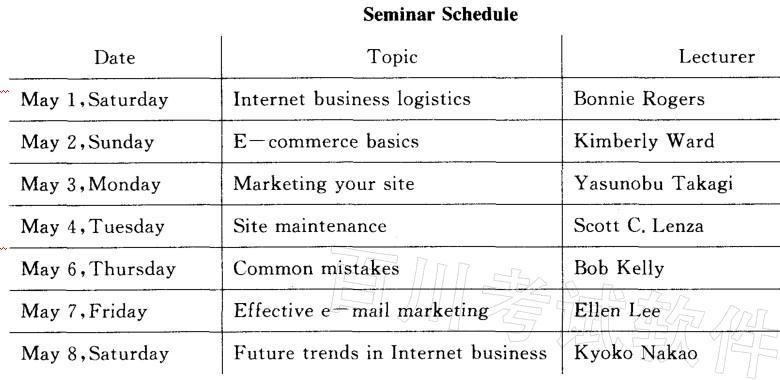
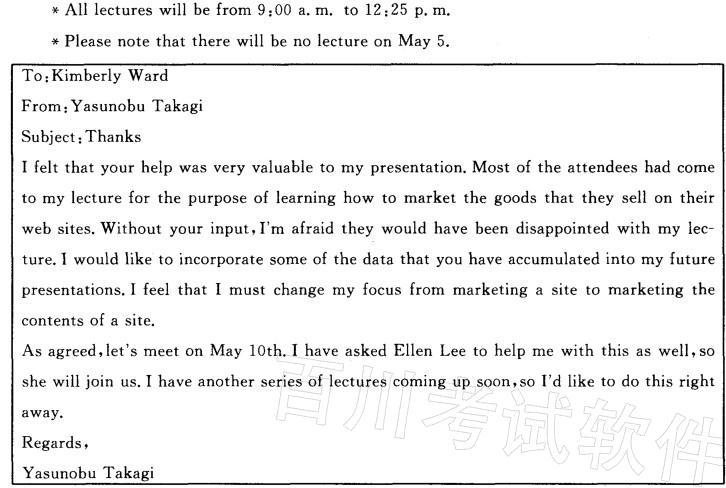
What did Ms. Ward do for Mr. Takagi?
A. She gave him a presentation
B. She combined her lecture with his.
C. She helped him plan his lecture.
D. She gave input during his presentation.答案:D解析:Takagi给Ward写的信中说,“如果没有您的帮助,恐怕他们会对我的演讲失望。(Without your input,I’m afraid they would have been disappointed with my lecture.)”因此可以得知,Ward 在 Takagi 发表演讲时提供过帮助。正确答案是D。 -
第20题:
单选题What is Mr. Weeks proud of?AAll his students have become famous persons.
BAll his students often write to him.
CSome of his students have been famous.
DHe’s been a teacher for twenty-six years.
正确答案: B解析:
细节理解题。第一段倒数第二句提到“Some of his students have become famous persons, but they still remember him and often write to him. ”可知,他的一些学生变得很出名,C项表述正确。 -
第21题:
单选题What does Dane find boring about his job?AFollowing the same routine
BAllowing students time for photos
CRepeating instructions for students
正确答案: B解析:
当女士问男士工作中枯燥的地方时,男士回答Possibly number one is swimming around … for my students to be able to take photos of each other to show to their friends可知留给学生时间拍照时最令人讨厌的。 -
第22题:
单选题What was Pepys doing when his wife told him about the fire?AHe was asleep.
BHe was writing something.
CHe was putting things back.
DHe was looking out of the window.
正确答案: B解析:
事实细节题。题干意为“当Pepys的妻子告诉他关于大火的情况时,他在做什么”。由文章第一段最后一句和第二段第一句…he set to work to tidy his room and put his things back where he wanted them. While he was doing this,Jane came in to say that she had heard the fire was a bad one…可知,他在收拾东西。 -
第23题:
单选题What odes George say about his part of London?AIt is a place well worth visiting.
BIt has problems as well as advantages.
CIt is the city’s center.
正确答案: A解析:
男士指出自己多年住在east London,提到”This part of the city has problems, but there are also many good things about it”,可见在作者看来他所居住的地方既有问题也有优势。