
Evaluate the following command: SQL>ALTER SYSTEM SET db_securefile = ’IGNORE’; What is the impact of this setting on the usage of SecureFiles?()A、 It forces BasicFiles to be created even if the SECUREFILE option is specified to create the LOBB、 It fo
题目
Evaluate the following command: SQL>ALTER SYSTEM SET db_securefile = ’IGNORE’; What is the impact of this setting on the usage of SecureFiles?()
- A、 It forces BasicFiles to be created even if the SECUREFILE option is specified to create the LOB
- B、 It forces SecureFiles to be created even if the BASICFILE option is specified to create the LOB
- C、 It does not allow the creation of SecureFiles and generates an error if the SECUREFILE option is specified to create the LOB
- D、 It ignores the SECUREFILE option only if a Manual Segment Space Management tablespace is used and creates a BasicFile
相似考题
参考答案和解析
更多“Evaluate the followin”相关问题
-
第1题:
Management by Objectives (MBO)
A . is a method used to evaluate personnel by objectively comparing them to common performance standards
B . requires a supervisor and a subordinate to jointly establish performance objectives
C . should be the responsibility of the organization's personnel department
D . should always involve the establishment of objectives that are quantifiable
E . B and D
正确答案:B
-
第2题:
7 Feasibility studies evaluate alternatives in terms of
A. Cost-effectiveness
B. Ease of performance
C. Risk
D. Safety
E. All or part of A through D
正确答案:E
-
第3题:
● The scope baseline once established and approved, is used:
A as the basis for making future decisions.
B to accomplish verification measures.
C to evaluate potential changes.
D All of the above.
E A and C only.
正确答案:D
-
第4题:
(b) Using the information provided in the case scenario, strategically evaluate the performance of the company
up to 2004, indicating any areas of particular concern. (20 marks)
正确答案:
(b) Essentially, Universal is a one product or service company selling its services into two main customer segments in the housing
market. From the performance information provided in Table 1, the company has achieved impressive rates of growth over
the 2001–4 period and this growth has come almost exclusively from private house owners. Universal is in the replacement
market. Its customers are looking to replace existing roofing systems with low maintenance/high attractiveness Universal
systems. To date growth has been exclusively within one region and been achieved by growing the area served through
investment in showrooms and depots.
Universal has chosen to grow its business through a differentiation focus strategy. It has identified a niche not served by the
major PVC doors and windows installers and poorly served by small independent installers. The value chain analysis
discussed above has shown the ways in which Universal has successfully distinguished itself from its competitors. Growth
has been through increasing its market penetration of one particular region. Such is the size of the private house owner market
and the lack of effective competition that the company has achieved a significant share of the market in its particular region.
However, in national terms, with 1% of the available market, Universal is a small operator. What is clear from the sales figures
is that as the firm grows bigger the relative rate of growth inevitably slows down, so that by 2004 it has an annual growth of
27% – still impressive by most companies standards. The move into supplying the commercial housing market has been
successful, but the share of total sales seems to have stabilised at around 5%. Universal clearly is finding it difficult to commit
sufficient new resources to this sector while coping with the growth from the domestic housing sector. Direct labour and other
direct costs seem to be a reasonable proportion of sales and predictably grow with the number of installation teams. Overall,
the gross margin, which sustains sales, marketing and overhead expenses, is moving in the right direction with a gross margin
of 52·6% achieved in 2004.
Labour, not surprisingly in a service business, consumes a considerable amount of costs. If one combines the direct labour
with the commission costs of sales canvassers and representatives together with salaries to staff in head office, one is in a
business where well over 50% of costs are attributable to people. Equally important is the fact that over 80% of the staff
employed by Universal is paid by results. This has significant consequences for the structure of reward systems and the
training and development of staff looking to maximise their incomes through either their individual or team performance.
Clearly, Universal sees no incompatibility between a reward system dominated by payments by results and the delivery of a
quality service differentiating it from its competitors.
Marketing has grown considerably over the period and reflects the recruitment of Mick Hendry as Sales and Marketing Director
in 2002. The marketing and sales model is very much one influenced by the one used by large PVC installers of doors and
windows. Here there is a heavy emphasis on direct selling techniques supported by increasing levels of advertising. Universal
sells to its customers directly and therefore avoids the costs and channel complications of using third parties to provide its
services. In many ways the direct selling techniques used are a very well established way of reaching the customer. Elements
of the marketing mix may be influenced by changes in communication technology, but the nature of the service requires
effective face-to-face contact with the customer. Sales to private house owners using credit generates significant finance
commission and is an important source of extra margin to Universal. Often in businesses depending on significant amounts
of credit sales the sales representative receives significant reward for selling a finance arrangement to the customer.
In terms of net profit achieved, 2001 and 2002 represents a significant change and, as argued in the scenario, this reflects
the recruitment of the Sales and Marketing Director. The achievement of this ‘step change’ in sales required commensurate
increases in most costs, but it is the significant increase in sales costs that explains the losses experienced in 2002. Sales
costs as a proportion of total sales rose from 14% in 2001 to almost 34% in 2002.
Particularly significant is the increase in sales commissions paid. The detailed changes in the way commission is paid is not
given in the case scenario, but it seems likely to reflect the previous experience of the Sales and Marketing Director in a closely
related industry. Similar levels of sales costs are incurred in 2003 and 2004 but the increase in sales, improvement in gross
margin and slower rate of growth in commissions paid explain the improved return on sales from –6·7% in 2002 to 4·2%
in 2003 and 5·8% in 2004.
Equally significant is the growth in showrooms and depots to support the growth in sales. Each additional facility costs in the
order of £30K with significant additions to costs in terms of staff and stock. Overall the performance of Universal over the
2001–2004 period is of a company achieving high rates of growth, incurring significant costs in so doing and moving into
modest levels of profit over the period. Its cost structure reflects the service it provides and the staff and reward systemsenabling the service to be provided. -
第5题:
(ii) Evaluate the relative advantages and disadvantages of Chen’s risk management committee being
non-executive rather than executive in nature. (7 marks)
正确答案:
(ii) Advantages and disadvantages of being non-executive rather than executive
The UK Combined Code, for example, allows for risk committees to be made up of either executive or non-executive
members.
Advantages of non-executive membership
Separation and detachment from the content being discussed is more likely to bring independent scrutiny.
Sensitive issues relating to one or more areas of executive oversight can be aired without vested interests being present.
Non-executive directors often bring specific expertise that will be more relevant to a risk problem than more
operationally-minded executive directors will have.
Chen’s four members, being from different backgrounds, are likely to bring a range of perspectives and suggested
strategies which may enrich the options open to the committee when considering specific risks.
Disadvantages of non-executive membership (advantages of executive membership)
Direct input and relevant information would be available from executives working directly with the products, systems
and procedures being discussed if they were on the committee. Non-executives are less likely to have specialist
knowledge of products, systems and procedures being discussed and will therefore be less likely to be able to comment
intelligently during meetings.
The membership, of four people, none of whom ‘had direct experience of Chen’s industry or products’ could produce
decisions taken without relevant information that an executive member could provide.
Non-executive directors will need to report their findings to the executive board. This reporting stage slows down the
process, thus requiring more time before actions can be implemented, and introducing the possibility of some
misunderstanding. -
第6题:
(ii) Following on from your answer to (i), evaluate the two purchase proposals, and advise Bill and Ben
which course of action will result in the highest amount of after tax cash being received by the
shareholders if the disposal takes place on 31 March 2006. (4 marks)
正确答案: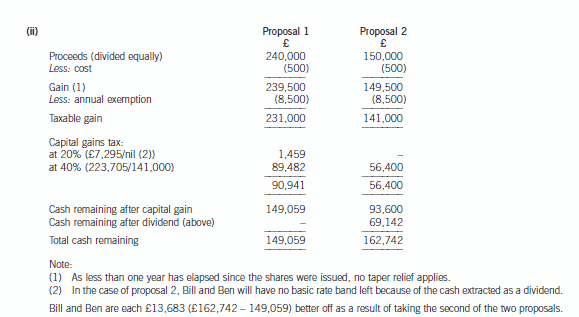
-
第7题:
Which two statements are true about applying Host Checker at the realm level?()A. If Evaluate is checked then the client must pass policy to get the sign-in page.
B. If Evaluate is checked then the client can fail policy and still get the sign-in page.
C. If Require and Enforce is checked then the client must pass policy to get the sign-in page.
D. If Require and Enforce is checked then the client can fail policy and still get the sign-in page.
参考答案:B, C
-
第8题:
Which activity is appropriate in the post-speaking step?A.Evaluate.
B.Group discussion.
C.Presentation.
D.Self-correction.答案:A解析:考查口语技能教学。
题干问的是下列哪个活动适合在说后环节?
A选项,是评价,B是集体讨论,C是知识展示,D是自我纠错。说后环节包括评价,符合题意,故此题的正确选项为A。
B和D都是在while-speaking的活动,不合题意,故排除。
C是pre-speaking的活动。不合题意,故排除。
故此题的正确选项为A。 -
第9题:
多选题Which two statements are true about applying Host Checker at the realm level?()AIf Evaluate is checked then the client must pass policy to get the sign-in page.
BIf Evaluate is checked then the client can fail policy and still get the sign-in page.
CIf Require and Enforce is checked then the client must pass policy to get the sign-in page.
DIf Require and Enforce is checked then the client can fail policy and still get the sign-in page.
正确答案: B,C解析: 暂无解析 -
第10题:
多选题Which three logical expressions evaluate to true?()A(a = = c)
B(d = = c)
C(b = = d)
D(a = = b)
E(b = = c)
F(d == 10.0)
正确答案: D,A解析: 暂无解析 -
第11题:
多选题By default, which two statements are true about export routing polices?()AExport polices can evaluate only active routes
BExport polices can evaluate all routes
CExport polices can be applied to the forwarding table
DExport polices can be applied to interfaces
正确答案: B,A解析: 暂无解析 -
第12题:
多选题By default, which two statements are true about export routing policies?()AExport policies can evaluate only active routes
BExport policies can evaluate all routes
CExport policies can be applied to the forwarding table
DExport policies can be applied directly to interfaces
正确答案: D,B解析: 暂无解析 -
第13题:
139 The scope baseline once established and approved, is used:
A. as the basis for making future decisions.
B. to accomplish verification measures.
C. to evaluate potential changes.
D. All of the above.
E. A and C only
正确答案:D
-
第14题:
● Feasibility studies evaluate alternatives in terms of
A Cost-effectiveness
B Ease of performance
C Risk
D Safety
E All or part of A through D
正确答案:E
-
第15题:
(c) Identify and evaluate other strategic options ONA could consider to address the airline’s current financial and
operational weaknesses.
Note: requirement (c) includes 2 professional marks (10 marks)
正确答案:(c) Within the strategy clock, ONA might consider both differentiation and focus. A differentiation strategy seeks to provide
products or services that offer different benefits from those offered by competitors. These benefits are valued by customers
and so can lead to increased market share and, in the context of ONA, higher seat utilisation. Differentiation is particularly
attractive when it provides the opportunity of providing a price premium. In other words, margins are enhanced through
differentiation. Air travellers may be willing to pay more to travel with an airline that offers seat allocation and free in-flight
food and drinks.
However, such a broad-based differentiation strategy may be inappropriate for ONA because of the need to service both
business and leisure travellers. Consequently, the potential strategy also has to be considered in the context of the two sectors
that the company perceives that it services. In the regional sector a focused differentiation strategy looks particularly attractive.
Here, the strategy focuses on a selected niche or market segment. The most obvious focus is on business travel and building
the company’s strengths in this sector. This focus on the business traveller might be achieved through:
– Ensuring that flight times are appropriate for the business working day. This is already a perceived strength of the
company. This needs to be built on.
– Providing more space in the aircraft by changing the seating configuration – and the balance between business and
standard class. ONA currently has a low seat occupancy rate and a reduction in seat capacity could be borne.
– Fewer passengers in the aircraft may also lead to improved throughput times. Loading and unloading aircraft is quicker,
minimising the delays encountered by the traveller.
– Providing supporting business services – lounges with fax and internet facilities.
– Speeding the process of booking and embarkation (through electronic check-in), so making the process of booking and
embarkation easier and faster.
– Providing loyalty schemes that are aimed at the business traveller.
Although this focused differentiation is aimed at the business customer it is also likely that particular aspects of it will be
valued by certain leisure travellers. Given the strong regional brand (people from Oceania are likely to travel ONA) and the
nature of the leisure travel in this sector (families visiting relatives) it seems unlikely that there will be a significant fall off in
leisure travel in the regional sector.
In the international sector, the strategic customer is less clear. This sector is serving both the leisure and business market and
is also competing with strong ‘no frills’ competitors. The nature of customer and competition is different. A strategy of
differentiation could still be pursued, although perhaps general differentiation (without a price premium) may be more effective
with the aim of increasing seat occupancy rate. This sector would also benefit from most of the suggested improvements of
the regional sector – providing more space in aircraft, faster passenger throughput, electronic check-in etc. However, these
small changes will not address the relatively low flight frequency in this sector. This could be addressed through seeking
alliances with established airlines in the continental countries that it services. Simple code share agreements could double
ONA’s frequencies overnight. Obviously, ONA would be seeking a good cultural fit – the ‘no frills’ low-cost budget airlineswould not be candidates for code shares.ONA’s perception of market segmentation, reflected in splitting regional from international travel and distinguishing leisure
from business appears to be a sensible understanding of the marketplace. However, it might also be useful for them to
consider on-line customers and commission customers (travel agents) as different segments. Perceiving travel agents as the
strategic customer would lead to a different strategic focus, one in which the amount and structure of commission played an
important part.
Finally, whichever strategy ONA adopts, it must continue to review its operational efficiency. An important strategic capability
in any organisation is to ensure that attention is paid to cost-efficiency. It can be argued that a continual reduction in costs
is necessary for any organisation in a competitive market. Management of costs is a threshold competence for survival. ONA
needs to address some of the weaknesses identified earlier in the question. Specific points, not covered elsewhere, include:
– Improved employee productivity to address the downward decline in efficiency ratios.
– Progressive standardisation of the fleet to produce economies of scale in maintenance and training. This should reduce
the cost base.
– Careful monitoring of expenditure, particularly on wages and salaries, to ensure that these do not exceed revenue
increases.
Candidates may address this question in a number of ways. In the model answer given above, the strategy clock is used –
as it uses the term ‘no frills’ in its definition and so it seems appropriate to look at other options within this structure. However,
answers that use other frameworks (such as Ansoff’s product/market matrix) are perfectly acceptable. Furthermore, answerswhich focus on the suitability, acceptability and feasibility of certain options are also acceptable. -
第16题:
(c) Critically evaluate Vincent Viola’s view that corporate governance provisions should vary by country.
(8 marks)
正确答案:
(c) Corporate governance provisions varying by country
There is a debate about the extent to which corporate governance provisions (in the form. of either written codes, laws or
general acceptances) should be global or whether they should vary to account for local differences. In this answer, Vincent
Viola’s view is critically evaluated.
In general terms, corporate governance provisions vary depending on such factors as local business culture, businesses’
capital structures, the extent of development of capital funding of businesses and the openness of stock markets. In Germany,
for example, companies have traditionally drawn much of their funding from banks thereby reducing their dependence on
shareholders’ equity. Stock markets in the Soviet Union are less open and less liquid than those in the West. In many
developing countries, business activity is concentrated among family-owned enterprises.
Against Vincent’s view
Although business cultures vary around the world, all business financed by private capital have private shareholders. Any
dilution of the robustness of provisions may ignore the needs of local investors to have their interests adequately represented.
This dilution, in turn, may allow bad practice, when present, to exist and proliferate.
Some countries suffer from a poor reputation in terms of endemic corruption and fraud and any reduction in the rigour with
which corporate governance provisions are implemented fail to address these shortcomings, notwithstanding the fact that they
might be culturally unexpected or difficult to implement.
In terms of the effects of macroeconomic systems, Vincent’s views ignore the need for sound governance systems to underpin
confidence in economic systems. This is especially important when inward investment needs are considered as the economic
wealth of affected countries are partly underpinned by the robustness, or not, of their corporate governance systems.
Supporting Vincent’s view
In favour of Vincent’s view are a number of arguments. Where local economies are driven more by small family businesses
and less by public companies, accountability relationships are quite different (perhaps the ‘family reasons’ referred to in the
case) and require a different type of accounting and governance.
There is a high compliance and monitoring cost to highly structured governance regimes that some developing countries may
deem unnecessary to incur.
There is, to some extent, a link between the stage of economic development and the adoption of formal governance codes.
It is generally accepted that developing countries need not necessarily observe the same levels of formality in governance as
more mature, developed economies.
Some countries’ governments may feel that they can use the laxity of their corporate governance regimes as a source of
international comparative advantage. In a ‘race to the bottom’, some international companies seeking to minimise the effects
of structured governance regimes on some parts of their operations may seek countries with less tight structures for some
operations.
-
第17题:
(d) Evaluate the circumstances in which a government can act as an aid to business performance. (5 marks)
正确答案:
(d) Governments may act as an aid to business performance in the following ways:
– A government can increase aggregate demand for goods and services by increased government spending and/or by
reducing taxation so that firms (and individuals) have more after tax income available to spend.
– Government policy may encourage firms to locate to particular areas. This is particularly the case where there is high
unemployment in such areas.
– Government policy via the use of quotas and import tariffs might make it more difficult for overseas firms to compete in
domestic markets.
– A government can regulate monopolies in particular with regard to the prices they charge and the quality of their goods
and services.
– Government policy can regulate the activities of those firms which do not act in the best interests of the environment.
(Alternative relevant discussion would be acceptable) -
第18题:
Members of Internet-based supply chains will need to evaluate their () and employ () and other electronic security tools to protect confidential data.A.security needs
B.patent
C.firework
D.encryption technologies
正确答案:AD
-
第19题:
By default, which two statements are true about export routing polices?()A. Export polices can evaluate only active routes
B. Export polices can evaluate all routes
C. Export polices can be applied to the forwarding table
D. Export polices can be applied to interfaces
参考答案:A, C
-
第20题:
By default, which two statements are true about export routing policies?()
- A、Export policies can evaluate only active routes.
- B、Export policies can evaluate all routes.
- C、Export policies can be applied to the forwarding table.
- D、Export policies can be applied directly to interfaces
正确答案:A,C -
第21题:
单选题During system startup, many applications are starting that are not needed. Which of the following can be used to evaluate all startup applications?()AComputer Management Utility
BAdd/Remove Programs
CAutoexec.bat file
DMSCONFIG
正确答案: A解析: 暂无解析 -
第22题:
单选题In managing a situation involving multiple injuries,the rescuer must be able to().Aprovide the necessary medication
Brapidly evaluate the seriousness of obvious injuries
Caccurately diagnose the ailment or injury
Dprescribe treatment for the victim
正确答案: D解析: 暂无解析 -
第23题:
单选题According to the passage, which of the following statements is NOT true? _____AAs there exist weak parts in different departments of a firm, the training of its staff is highly necessary.
BA training specification is based on the information collected from a job description and a job specification.
CTraining in using skills and learning about skills usually do not happen at the same place
DIt is easier to evaluate management training than to evaluate the training of workers and technicians.
正确答案: B解析:
从第四段“The evaluation of management training is much more complex than that.”可知,评价经理培训要比评价员工及技工培训复杂得多。 -
第24题:
单选题_____Aevaluate
Bevaluating
Cevaluated
Dto evaluate
正确答案: D解析:
be happy to do为固定句型,选择D。