
听力原文:M: There are several reasons why careful analysis of financial statements is necessary. What are they?W: First, financial statements are general-purpose statements. Secondly, the relationships between amounts on successive financial statements are no
题目
听力原文:M: There are several reasons why careful analysis of financial statements is necessary. What are they?
W: First, financial statements are general-purpose statements. Secondly, the relationships between amounts on successive financial statements are not obvious without analysis. And thirdly, users of financial statements may be interested in seeing how well a company is performing.
Q: What are they talking about?
(17)
A.The methods of financial statements.
B.The necessity of careful analysis of financial statements
C.The relationship among financial statements.
D.The purpose of financial statements.
相似考题
更多“听力原文:M: There are several reasons why careful analysis of financial statements is necessary. What are they?W: First, financial statements are general-purpose statements. Secondly, the relationships between amounts on successive financial statements are no”相关问题
-
第1题:
(b) Describe with suitable calculations how the goodwill arising on the acquisition of Briars will be dealt with in
the group financial statements and how the loan to Briars should be treated in the financial statements of
Briars for the year ended 31 May 2006. (9 marks)
正确答案:(b) IAS21 ‘The Effects of Changes in Foreign Exchange Rates’ requires goodwill arising on the acquisition of a foreign operation
and fair value adjustments to acquired assets and liabilities to be treated as belonging to the foreign operation. They should
be expressed in the functional currency of the foreign operation and translated at the closing rate at each balance sheet date.
Effectively goodwill is treated as a foreign currency asset which is retranslated at the closing rate. In this case the goodwillarising on the acquisition of Briars would be treated as follows: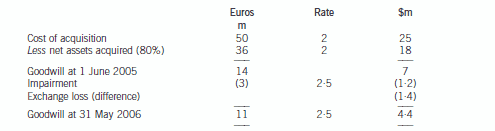
At 31 May 2006, the goodwill will be retranslated at 2·5 euros to the dollar to give a figure of $4·4 million. Therefore this
will be the figure for goodwill in the balance sheet and an exchange loss of $1·4 million recorded in equity (translation
reserve). The impairment of goodwill will be expensed in profit or loss to the value of $1·2 million. (The closing rate has been
used to translate the impairment; however, there may be an argument for using the average rate.)
The loan to Briars will effectively be classed as a financial liability measured at amortised cost. It is the default category for
financial liabilities that do not meet the definition of financial liabilities at fair value through profit or loss. For most entities,
most financial liabilities will fall into this category. When a financial liability is recognised initially in the balance sheet, the
liability is measured at fair value. Fair value is the amount for which a liability can be settled, between knowledgeable, willing
parties in an arm’s length transaction. In other words, fair value is an actual or estimated transaction price on the reporting
date for a transaction taking place between unrelated parties that have adequate information about the asset or liability being
measured.
Since fair value is a market transaction price, on initial recognition fair value generally is assumed to equal the amount of
consideration paid or received for the financial asset or financial liability. Accordingly, IAS39 specifies that the best evidence
of the fair value of a financial instrument at initial recognition generally is the transaction price. However for longer-term
receivables or payables that do not pay interest or pay a below-market interest, IAS39 does require measurement initially at
the present value of the cash flows to be received or paid.
Thus in Briars financial statements the following entries will be made: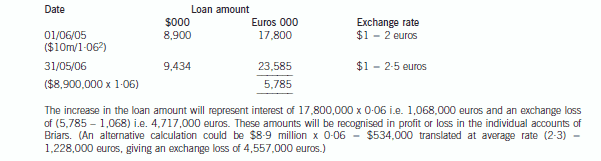
-
第2题:
5 Financial statements have seen an increasing move towards the use of fair values in accounting. Advocates of ‘fair
value accounting’ believe that fair value is the most relevant measure for financial reporting whilst others believe that
historical cost provides a more useful measure.
Issues have been raised over the reliability and measurement of fair values, and over the nature of the current level
of disclosure in financial statements in this area.
Required:
(a) Discuss the problems associated with the reliability and measurement of fair values and the nature of any
additional disclosures which may be required if fair value accounting is to be used exclusively in corporate
reporting. (13 marks)
正确答案:
(a) Reliability and Measurement
Fair value can be defined as the price that would be received to sell an asset or paid to transfer a liability. The fair value can
be thought of as an ‘exit price’. A fair value measurement assumes that the transaction to sell the asset or transfer the liability
occurs in the principal market for the asset or liability or, in the absence of a principal market, the most advantageous market
for the asset or liability which is the market in which the reporting entity would sell the asset or transfer the liability with the
price that maximises the amount that would be received or minimises the amount that would be paid. IAS39 ‘Financial
Instruments: Recognition and Measurement’ requires an entity to use the most advantageous active market in measuring the
fair value of a financial asset or liability when multiple markets exist whereas IAS41 ‘Agriculture’ requires an entity to use the
most relevant market. Thus there can be different approaches for estimating exit prices. Additionally valuation techniques and
current replacement cost could be used.
A hierarchy of fair value measurements would have to be developed in order to convey information about the nature of the
information used in creating the fair values. For example quoted prices (unadjusted) in active markets would provide better
quality information than quoted prices for similar assets and liabilities in active markets which would provide better quality
information than prices which reflect the reporting entity’s own thinking about the assumptions that market participants would
use in pricing the asset or liability. Enron made extensive use of what it called ‘mark-to-market’ accounting which was based
on valuation techniques and estimates. IFRSs currently do not have a single hierarchy that applies to all fair value measures.
Instead individual standards indicate preferences for certain inputs and measures of fair value over others, but this guidance
is not consistent among all IFRSs.
Some companies, in order to effectively manage their businesses, have already developed models for determining fair values.
Businesses manage their operations by managing risks. A risk management process often requires measurement of fair values
of contracts, financial instruments, and risk positions.
If markets were liquid and transparent for all assets and liabilities, fair value accounting clearly would give reliable information
which is useful in the decision making process. However, because many assets and liabilities do not have an active market,
the inputs and methods for estimating their fair value are more subjective and, therefore, the valuations are less reliable. Fair
value estimates can vary greatly, depending on the valuation inputs and methodology used. Where management uses
significant judgment in selecting market inputs when market prices are not available, reliability will continue to be an issue.
Management can use significant judgment in the valuation process. Management bias, whether intentional or unintentional,
may result in inappropriate fair value measurements and consequently misstatements of earnings and equity capital. Without
reliable fair value estimates, the potential for misstatements in financial statements prepared using fair value measurements
will be even greater.
Consideration must be given to revenue recognition issues in a fair value system. It must be ensured that unearned revenue
is not recognised early as it recently was by certain high-tech companies.
As the variety and complexity of financial instruments increases, so does the need for independent verification of fair value
estimates. However, verification of valuations that are not based on observable market prices is very challenging. Users of
financial statements will need to place greater emphasis on understanding how assets and liabilities are measured and how
reliable these valuations are when making decisions based on them.
Disclosure
Fair values reflect point estimates and do not result in transparent financial statements. Additional disclosures are necessary
to bring meaning to these fair value estimates. These disclosures might include key drivers affecting valuations, fair-valuerange
estimates, and confidence levels. Another important disclosure consideration relates to changes in fair value amounts.
For example, changes in fair values on securities can arise from movements in interest rates, foreign-currency rates, and credit
quality, as well as purchases and sales from the portfolio. For users to understand fair value estimates, they must be given
adequate disclosures about what factors caused the changes in fair value. It could be argued that the costs involved in
determining fair values may exceed the benefits derived therefrom. When considering how fair value information should be
presented in the financial statements, it is important to consider what type of financial information investors want. There are
indications that some investors desire both fair value information and historical cost information. One of the issues affecting
the credibility of fair value disclosures currently is that a number of companies include ‘health warnings’ with their disclosures
indicating that the information is not used by management. This language may contribute to users believing that the fair value
disclosures lack credibility.
-
第3题:
(b) Discuss how management’s judgement and the financial reporting infrastructure of a country can have a
significant impact on financial statements prepared under IFRS. (6 marks)
Appropriateness and quality of discussion. (2 marks)
正确答案:
(b) Management judgement may have a greater impact under IFRS than generally was the case under national GAAP. IFRS
utilises fair values extensively. Management have to use their judgement in selecting valuation methods and formulating
assumptions when dealing with such areas as onerous contracts, share-based payments, pensions, intangible assets acquired
in business combinations and impairment of assets. Differences in methods or assumptions can have a major impact on
amounts recognised in financial statements. IAS1 expects companies to disclose the sensitivity of carrying amounts to the
methods, assumptions and estimates underpinning their calculation where there is a significant risk of material adjustment
to their carrying amounts within the next financial year. Often management’s judgement is that there is no ‘significant risk’
and they often fail to disclose the degree of estimation or uncertainty and thus comparability is affected.
In addition to the IFRSs themselves, a sound financial reporting infrastructure is required. This implies effective corporate
governance practices, high quality auditing standards and practices, and an effective enforcement or oversight mechanism.
Therefore, consistency and comparability of IFRS financial statements will also depend on the robust nature of the other
elements of the financial reporting infrastructure.
Many preparers of financial statements will have been trained in national GAAP and may not have been trained in the
principles underlying IFRS and this can lead to unintended inconsistencies when implementing IFRS especially where the
accounting profession does not have a CPD requirement. Additionally where the regulatory system of a country is not well
developed, there may not be sufficient market information to utilise fair value measurements and thus this could lead to
hypothetical markets being created or the use of mathematical modelling which again can lead to inconsistencies because of
lack of experience in those countries of utilising these techniques. This problem applies to other assessments or estimates
relating to such things as actuarial valuations, investment property valuations, impairment testing, etc.
The transition to IFRS can bring significant improvement to the quality of financial performance and improve comparability
worldwide. However, there are issues still remaining which can lead to inconsistency and lack of comparability with those
financial statements. -
第4题:
5 An enterprise has made a material change to an accounting policy in preparing its current financial statements.
Which of the following disclosures are required by IAS 8 Accounting policies, changes in accounting estimates
and errors in these financial statements?
1 The reasons for the change.
2 The amount of the consequent adjustment in the current period and in comparative information for prior periods.
3 An estimate of the effect of the change on future periods, where possible.
A 1 and 2 only
B 1 and 3 only
C 2 and 3 only
D All three items
正确答案:A
-
第5题:
12 Which of the following statements are correct?
(1) Contingent assets are included as assets in financial statements if it is probable that they will arise.
(2) Contingent liabilities must be provided for in financial statements if it is probable that they will arise.
(3) Details of all adjusting events after the balance sheet date must be given in notes to the financial statements.
(4) Material non-adjusting events are disclosed by note in the financial statements.
A 1 and 2
B 2 and 4
C 3 and 4
D 1 and 3
正确答案:B
-
第6题:
4 (a) The purpose of ISA 250 Consideration of Laws and Regulations in an Audit of Financial Statements is to
establish standards and provide guidance on the auditor’s responsibility to consider laws and regulations in an
audit of financial statements.
Explain the auditor’s responsibilities for reporting non-compliance that comes to the auditor’s attention
during the conduct of an audit. (5 marks)
正确答案:
4 CLEEVES CO
(a) Reporting non-compliance
Non-compliance refers to acts of omission or commission by the entity being audited, either intentional or unintentional, that
are contrary to the prevailing laws or regulations.
To management
Regarding non-compliance that comes to the auditor’s attention the auditor should, as soon as practicable, either:
■ communicate with those charged with governance; or
■ obtain audit evidence that they are appropriately informed.
However, the auditor need not do so for matters that are clearly inconsequential or trivial and may reach agreement1 in
advance on the nature of such matters to be communicated.
If in the auditor’s judgment the non-compliance is believed to be intentional and material, the auditor should communicate
the finding without delay.
If the auditor suspects that members of senior management are involved in non-compliance, the auditor should report the
matter to the next higher level of authority at the entity, if it exists (e.g. an audit committee or a supervisory board). Where
no higher authority exists, or if the auditor believes that the report may not be acted upon or is unsure as to the person to
whom to report, the auditor would consider seeking legal advice.
To the users of the auditor’s report on the financial statements
If the auditor concludes that the non-compliance has a material effect on the financial statements, and has not been properly
reflected in the financial statements, the auditor expresses a qualified (i.e. ‘except for disagreement’) or an adverse opinion.
If the auditor is precluded by the entity from obtaining sufficient appropriate audit evidence to evaluate whether or not noncompliance
that may be material to the financial statements has (or is likely to have) occurred, the auditor should express a
qualified opinion or a disclaimer of opinion on the financial statements on the basis of a limitation on the scope of the audit.
Tutorial note: For example, if management denies the auditor access to information from which he would be able to assess
whether or not illegal dumping had taken place (and, if so, the extent of it).
If the auditor is unable to determine whether non-compliance has occurred because of limitations imposed by circumstances
rather than by the entity, the auditor should consider the effect on the auditor’s report.
Tutorial note: For example, if new legal requirements have been announced as effective but the detailed regulations are not
yet published.
To regulatory and enforcement authorities
The auditor’s duty of confidentiality ordinarily precludes reporting non-compliance to a third party. However, in certain
circumstances, that duty of confidentiality is overridden by statute, law or by courts of law (e.g. in some countries the auditor
is required to report non-compliance by financial institutions to the supervisory authorities). The auditor may need to seek
legal advice in such circumstances, giving due consideration to the auditor’s responsibility to the public interest. -
第7题:
3 (a) Financial statements often contain material balances recognised at fair value. For auditors, this leads to additional
audit risk.
Required:
Discuss this statement. (7 marks)
正确答案:
3 Poppy Co
(a) Balances held at fair value are frequently recognised as material items in the statement of financial position. Sometimes it is
required by the financial reporting framework that the measurement of an asset or liability is at fair value, e.g. certain
categories of financial instruments, whereas it is sometimes the entity’s choice to measure an item using a fair value model
rather than a cost model, e.g. properties. It is certainly the case that many of these balances will be material, meaning that
the auditor must obtain sufficient appropriate evidence that the fair value measurement is in accordance with the
requirements of financial reporting standards. ISA 540 (Revised and Redrafted) Auditing Accounting Estimates Including Fair
Value Accounting Estimates and Related Disclosures and ISA 545 Auditing Fair Value Measurements and Disclosures
contain guidance in this area.
As part of the understanding of the entity and its environment, the auditor should gain an insight into balances that are stated
at fair value, and then assess the impact of this on the audit strategy. This will include an evaluation of the risk associated
with the balance(s) recognised at fair value.
Audit risk comprises three elements; each is discussed below in the context of whether material balances shown at fair value
will lead to increased risk for the auditor.
Inherent risk
Many measurements based on estimates, including fair value measurements, are inherently imprecise and subjective in
nature. The fair value assessment is likely to involve significant judgments, e.g. regarding market conditions, the timing of
cash flows, or the future intentions of the entity. In addition, there may be a deliberate attempt by management to manipulate
the fair value to achieve a desired aim within the financial statements, in other words to attempt some kind of window
dressing.
Many fair value estimation models are complicated, e.g. discounted cash flow techniques, or the actuarial calculations used
to determine the value of a pension fund. Any complicated calculations are relatively high risk, as difficult valuation techniques
are simply more likely to contain errors than simple valuation techniques. However, there will be some items shown at fair
value which have a low inherent risk, because the measurement of fair value may be relatively straightforward, e.g. assets
that are regularly bought and sold on open markets that provide readily available and reliable information on the market prices
at which actual exchanges occur.
In addition to the complexities discussed above, some fair value measurement techniques will contain significant
assumptions, e.g. the most appropriate discount factor to use, or judgments over the future use of an asset. Management
may not always have sufficient experience and knowledge in making these judgments.
Thus the auditor should approach some balances recognised at fair value as having a relatively high inherent risk, as their
subjective and complex nature means that the balance is prone to contain an error. However, the auditor should not just
assume that all fair value items contain high inherent risk – each balance recognised at fair value should be assessed for its
individual level of risk.
Control risk
The risk that the entity’s internal monitoring system fails to prevent and detect valuation errors needs to be assessed as part
of overall audit risk assessment. One problem is that the fair value assessment is likely to be performed once a year, outside
the normal accounting and management systems, especially where the valuation is performed by an external specialist.
Therefore, as a non-routine event, the assessment of fair value is likely not to have the same level of monitoring or controls
as a day-to-day business transaction.
However, due to the material impact of fair values on the statement of financial position, and in some circumstances on profit,
management may have made great effort to ensure that the assessment is highly monitored and controlled. It therefore could
be the case that there is extremely low control risk associated with the recognition of fair values.
Detection risk
The auditor should minimise detection risk via thorough planning and execution of audit procedures. The audit team may
lack experience in dealing with the fair value in question, and so would be unlikely to detect errors in the valuation techniques
used. Over-reliance on an external specialist could also lead to errors not being found.
Conclusion
It is true that the increasing recognition of items measured at fair value will in many cases cause the auditor to assess the
audit risk associated with the balance as high. However, it should not be assumed that every fair value item will be likely to
contain a material misstatement. The auditor must be careful to identify and respond to the level of risk for fair value items
on an individual basis to ensure that sufficient and appropriate evidence is gathered, thus reducing the audit risk to an
acceptable level. -
第8题:
The finance director of Blod Co, Uma Thorton, has requested that your firm type the financial statements in the form
to be presented to shareholders at the forthcoming company general meeting. Uma has also commented that the
previous auditors did not use a liability disclaimer in their audit report, and would like more information about the use
of liability disclaimer paragraphs.
Required:
(b) Discuss the ethical issues raised by the request for your firm to type the financial statements of Blod Co.
(3 marks)
正确答案:
(b) It is not uncommon for audit firms to word process and typeset the financial statements of their clients, especially where the
client is a relatively small entity, which may lack the resources and skills to perform. this task. It is not prohibited by ethical
standards.
However, there could be a perceived threat to independence, with risk magnified in the case of Blod Co, which is a listed
company. The auditors could be perceived to be involved with the preparation of the financial statements of a listed client
company, which is prohibited by ethical standards. IFAC’s Code of Ethics for Professional Accountants states that for a listed
client, the audit firm should not be involved with the preparation of financial statements, which would create a self-review
threat so severe that safeguards could not reduce the threat to an acceptable level. Although the typing of financial statements
itself is not prohibited by ethical guidance, the risk is that providing such a service could be perceived to be an element of
the preparation of the financial statements.
It is possible that during the process of typing the financial statements, decisions and judgments would be made. This could
be perceived as making management decisions in relation to the financial statements, a clear breach of independence.
Therefore to eliminate any risk exposure, the prudent decision would be not to type the financial statements, ensuring that
Blod Co appreciates the ethical problems that this would cause.
Tutorial note: This is an area not specifically covered by ethical guides, where different audit firms may have different views
on whether it is acceptable to provide a typing service for the financial statements of their clients. Credit will be awarded for
sensible discussion of the issues raised bearing in mind other options for the audit firm, for example, it could be argued that
it is acceptable to offer the typing service provided that it is performed by people independent of the audit team, and that
the matter has been discussed with the audit committee/those charged with governance -
第9题:
听力原文:M: The primary objective of financial reporting is to provide information useful for making investment and lending decisions.
W: The information must be relevant, reliable, and comparable.
Q: What is the primary objective of financial reporting?
(15)
A.To make investment.
B.To record data.
C.To provide useful information.
D.To understand some basic accounting principles.
正确答案:C
解析:根据男士的说法,财务报告的作用在于为投资决策和筹资决策提供有用的信息。 -
第10题:
What is the stable-monetary-unit concept?
A.It is the prime means of measuring assets.
B.It is the common denominator in business transactions.
C.It is an orderly basis for handling account balances to produce the financial statements.
D.It is monetary terms in accounting information.
正确答案:C
解析:文章第一段最后一句提到The stable—monetary—unit concept provides…produce the financial statements.货币计量单位的理念,使处理账户余额,生成财务报表能够有序进行。 -
第11题:
Under certain circumstances, profits made on transactions between members of a group need to be eliminated from the consolidated financial statements under IFRS.
Which of the following statements about intra-group profits in consolidated financial statements is/are correct?
(i) The profit made by a parent on the sale of goods to a subsidiary is only realised when the subsidiary sells the goods to a third party
(ii) Eliminating intra-group unrealised profits never affects non-controlling interests
(iii) The profit element of goods supplied by the parent to an associate and held in year-end inventory must be eliminated in full
A.(i) only
B.(i) and (ii)
C.(ii) and (iii)
D.(iii) only
正确答案:A(i) is the only correct elimination required by IFRS.
-
第12题:
名词解释题会计报表(Financial Statements)正确答案: 是会计报告的核心内容,也称财务报表。是指综合反映企业某一特定日期资产、负债和所有者权益及其结构情况,某一特定时期经营成果的实现及分配情况和某一特定时期先紧流入、现金流出及净增加情况的书面文件。它有主表和相关的附表组成,其中主表包括资产负债表、利润表和现金流量表,附表包括资产减值准备明细表、利润分配表等。全面反映企业在一定时期内经营成果、现金流量和截止时点的财务状况的报告文件。解析: 暂无解析 -
第13题:
(c) Wader is reviewing the accounting treatment of its buildings. The company uses the ‘revaluation model’ for its
buildings. The buildings had originally cost $10 million on 1 June 2005 and had a useful economic life of
20 years. They are being depreciated on a straight line basis to a nil residual value. The buildings were revalued
downwards on 31 May 2006 to $8 million which was the buildings’ recoverable amount. At 31 May 2007 the
value of the buildings had risen to $11 million which is to be included in the financial statements. The company
is unsure how to treat the above events. (7 marks)
Required:
Discuss the accounting treatments of the above items in the financial statements for the year ended 31 May
2007.
Note: a discount rate of 5% should be used where necessary. Candidates should show suitable calculations where
necessary.
正确答案: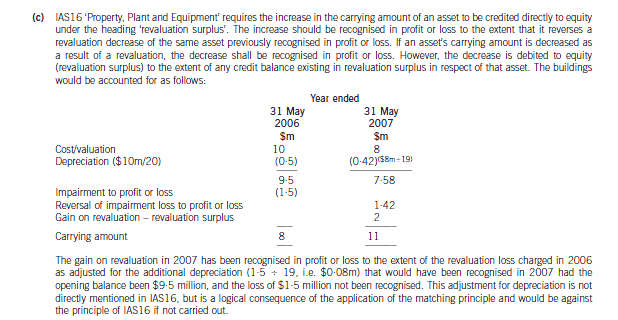
-
第14题:
4 The transition to International Financial Reporting Standards (IFRSs) involves major change for companies as IFRSs
introduce significant changes in accounting practices that were often not required by national generally accepted
accounting practice. It is important that the interpretation and application of IFRSs is consistent from country to
country. IFRSs are partly based on rules, and partly on principles and management’s judgement. Judgement is more
likely to be better used when it is based on experience of IFRSs within a sound financial reporting infrastructure. It is
hoped that national differences in accounting will be eliminated and financial statements will be consistent and
comparable worldwide.
Required:
(a) Discuss how the changes in accounting practices on transition to IFRSs and choice in the application of
individual IFRSs could lead to inconsistency between the financial statements of companies. (17 marks)
正确答案:
(a) The transition to International Financial Reporting Standards (IFRS) involves major change for companies as IFRS introduces
significant changes in accounting practices that often were not required by national GAAPs. For example financial instruments
and share-based payment plans in many instances have appeared on the statements of financial position of companies for
the first time. As a result IFRS financial statements are often significantly more complex than financial statements based on
national GAAP. This complexity is caused by the more extensive recognition and measurement rules in IFRS and a greater
number of disclosure requirements. Because of this complexity, it can be difficult for users of financial statements which have
been produced using IFRS to understand and interpret them, and thus can lead to inconsistency of interpretation of those
financial statements.
The form. and presentation of financial statements is dealt with by IAS1 ‘Presentation of Financial Statements’. This standard
sets out alternative forms or presentations of financial statements. Additionally local legislation often requires supplementary
information to be disclosed in financial statements, and best practice as to the form. or presentation of financial statements
has yet to emerge internationally. As a result companies moving to IFRS have tended to adopt IFRS in a way which minimises
the change in the form. of financial reporting that was applied under national GAAP. For example UK companies have tended
to present a statement of recognised income and expense, and a separate statement of changes in equity whilst French
companies tend to present a single statement of changes in equity.
It is possible to interpret standards in different ways and in some standards there is insufficient guidance. For example there
are different acceptable methods of classifying financial assets under IAS39 ‘Financial Instruments: Recognition and
Measurement’ in the statement of financial position as at fair value through profit or loss (subject to certain conditions) or
available for sale.
IFRSs are not based on a consistent set of principles, and there are conceptual inconsistencies within and between standards.
Certain standards allow alternative accounting treatments, and this is a further source of inconsistency amongst financial
statements. IAS31 ‘Interests in Joint Ventures’ allows interests in jointly controlled entities to be accounted for using the equity
method or proportionate consolidation. Companies may tend to use the method which was used under national GAAP.
Another example of choice in accounting methods under IFRS is IAS16 ‘Property, Plant and equipment’ where the cost or
revaluation model can be used for a class of property, plant and equipment. Also there is very little industry related accounting
guidance in IFRS. As a result judgement plays an important role in the selection of accounting policies. In certain specific
areas this can lead to a degree of inconsistency and lack of comparability.
IFRS1, ‘First time Adoption of International Financial Reporting Standards’, allows companies to use a number of exemptions
from the requirements of IFRS. These exemptions can affect financial statements for several years. For example, companies
can elect to recognise all cumulative actuarial gains and losses relating to post-employment benefits at the date of transition
to IFRS but use the ‘corridor’ approach thereafter. Thus the effect of being able to use a ‘one off write off’ of any actuarial
losses could benefit future financial statements significantly, and affect comparability. Additionally after utilising the above
exemption, companies can elect to recognise subsequent gains and losses outside profit or loss in ‘other comprehensive
income’ in the period in which they occur and not use the ‘corridor’ approach thus affecting comparability further.
Additionally IAS18 ‘Revenue’ allows variations in the way revenue is recognised. There is no specific guidance in IFRS on
revenue arrangements with multiple deliverables. Transactions have to be analysed in accordance with their economic
substance but there is often no more guidance than this in IFRS. The identification of the functional currency under IAS21,
‘The effects of changes in foreign exchange rates’, can be subjective. For example the functional currency can be determined
by the currency in which the commodities that a company produces are commonly traded, or the currency which influences
its operating costs, and both can be different.
Another source of inconsistency is the adoption of new standards and interpretations earlier than the due date of application
of the standard. With the IASB currently preparing to issue standards with an adoption date of 1 January 2009, early adoption
or lack of it could affect comparability although IAS8 ‘Accounting Policies, Changes in Accounting Estimates and Errors’
requires a company to disclose the possible impact of a new standard on its initial application. Many companies make very
little reference to the future impact of new standards. -
第15题:
(b) Discuss the relative costs to the preparer and benefits to the users of financial statements of increased
disclosure of information in financial statements. (14 marks)
Quality of discussion and reasoning. (2 marks)
正确答案:
(b) Increased information disclosure benefits users by reducing the likelihood that they will misallocate their capital. This is
obviously a direct benefit to individual users of corporate reports. The disclosure reduces the risk of misallocation of capital
by enabling users to improve their assessments of a company’s prospects. This creates three important results.
(i) Users use information disclosed to increase their investment returns and by definition support the most profitable
companies which are likely to be those that contribute most to economic growth. Thus, an important benefit of
information disclosure is that it improves the effectiveness of the investment process.
(ii) The second result lies in the effect on the liquidity of the capital markets. A more liquid market assists the effective
allocation of capital by allowing users to reallocate their capital quickly. The degree of information asymmetry between
the buyer and seller and the degree of uncertainty of the buyer and the seller will affect the liquidity of the market as
lower asymmetry and less uncertainty will increase the number of transactions and make the market more liquid.
Disclosure will affect uncertainty and information asymmetry.
(iii) Information disclosure helps users understand the risk of a prospective investment. Without any information, the user
has no way of assessing a company’s prospects. Information disclosure helps investors predict a company’s prospects.
Getting a better understanding of the true risk could lower the price of capital for the company. It is difficult to prove
however that the average cost of capital is lowered by information disclosure, even though it is logically and practically
impossible to assess a company’s risk without relevant information. Lower capital costs promote investment, which can
stimulate productivity and economic growth.
However although increased information can benefit users, there are problems of understandability and information overload.
Information disclosure provides a degree of protection to users. The benefit is fairness to users and is part of corporate
accountability to society as a whole.
The main costs to the preparer of financial statements are as follows:
(i) the cost of developing and disseminating information,
(ii) the cost of possible litigation attributable to information disclosure,
(iii) the cost of competitive disadvantage attributable to disclosure.
The costs of developing and disseminating the information include those of gathering, creating and auditing the information.
Additional costs to the preparers include training costs, changes to systems (for example on moving to IFRS), and the more
complex and the greater the information provided, the more it will cost the company.
Although litigation costs are known to arise from information disclosure, it does not follow that all information disclosure leads
to litigation costs. Cases can arise from insufficient disclosure and misleading disclosure. Only the latter is normally prompted
by the presentation of information disclosure. Fuller disclosure could lead to lower costs of litigation as the stock market would
have more realistic expectations of the company’s prospects and the discrepancy between the valuation implicit in the market
price and the valuation based on a company’s financial statements would be lower. However, litigation costs do not
necessarily increase with the extent of the disclosure. Increased disclosure could reduce litigation costs.
Disclosure could weaken a company’s ability to generate future cash flows by aiding its competitors. The effect of disclosure
on competitiveness involves benefits as well as costs. Competitive disadvantage could be created if disclosure is made relating
to strategies, plans, (for example, planned product development, new market targeting) or information about operations (for
example, production-cost figures). There is a significant difference between the purpose of disclosure to users and
competitors. The purpose of disclosure to users is to help them to estimate the amount, timing, and certainty of future cash
flows. Competitors are not trying to predict a company’s future cash flows, and information of use in that context is not
necessarily of use in obtaining competitive advantage. Overlap between information designed to meet users’ needs and
information designed to further the purposes of a competitor is often coincidental. Every company that could suffer competitive
disadvantage from disclosure could gain competitive advantage from comparable disclosure by competitors. Published figures
are often aggregated with little use to competitors.
Companies bargain with suppliers and with customers, and information disclosure could give those parties an advantage in
negotiations. In such cases, the advantage would be a cost for the disclosing entity. However, the cost would be offset
whenever information disclosure was presented by both parties, each would receive an advantage and a disadvantage.
There are other criteria to consider such as whether the information to be disclosed is about the company. This is both a
benefit and a cost criterion. Users of corporate reports need company-specific data, and it is typically more costly to obtain
and present information about matters external to the company. Additionally, consideration must be given as to whether the
company is the best source for the information. It could be inefficient for a company to obtain or develop data that other, more
expert parties could develop and present or do develop at present.
There are many benefits to information disclosure and users have unmet information needs. It cannot be known with any
certainty what the optimal disclosure level is for companies. Some companies through voluntary disclosure may have
achieved their optimal level. There are no quantitative measures of how levels of disclosure stand with respect to optimal
levels. Standard setters have to make such estimates as best they can, guided by prudence, and by what evidence of benefits
and costs they can obtain. -
第16题:
9 Which of the following items must be disclosed in a company’s published financial statements (including notes)
if material, according to IAS1 Presentation of financial statements?
1 Finance costs.
2 Staff costs.
3 Depreciation and amortisation expense.
4 Movements on share capital.
A 1 and 3 only
B 1, 2 and 4 only
C 2, 3 and 4 only
D All four items
正确答案:D
-
第17题:
(b) Seymour offers health-related information services through a wholly-owned subsidiary, Aragon Co. Goodwill of
$1·8 million recognised on the purchase of Aragon in October 2004 is not amortised but included at cost in the
consolidated balance sheet. At 30 September 2006 Seymour’s investment in Aragon is shown at cost,
$4·5 million, in its separate financial statements.
Aragon’s draft financial statements for the year ended 30 September 2006 show a loss before taxation of
$0·6 million (2005 – $0·5 million loss) and total assets of $4·9 million (2005 – $5·7 million). The notes to
Aragon’s financial statements disclose that they have been prepared on a going concern basis that assumes that
Seymour will continue to provide financial support. (7 marks)
Required:
For each of the above issues:
(i) comment on the matters that you should consider; and
(ii) state the audit evidence that you should expect to find,
in undertaking your review of the audit working papers and financial statements of Seymour Co for the year ended
30 September 2006.
NOTE: The mark allocation is shown against each of the three issues.
正确答案:
(b) Goodwill
(i) Matters
■ Cost of goodwill, $1·8 million, represents 3·4% consolidated total assets and is therefore material.
Tutorial note: Any assessments of materiality of goodwill against amounts in Aragon’s financial statements are
meaningless since goodwill only exists in the consolidated financial statements of Seymour.
■ It is correct that the goodwill is not being amortised (IFRS 3 Business Combinations). However, it should be tested
at least annually for impairment, by management.
■ Aragon has incurred losses amounting to $1·1 million since it was acquired (two years ago). The write-off of this
amount against goodwill in the consolidated financial statements would be material (being 61% cost of goodwill,
8·3% PBT and 2·1% total assets).
■ The cost of the investment ($4·5 million) in Seymour’s separate financial statements will also be material and
should be tested for impairment.
■ The fair value of net assets acquired was only $2·7 million ($4·5 million less $1·8 million). Therefore the fair
value less costs to sell of Aragon on other than a going concern basis will be less than the carrying amount of the
investment (i.e. the investment is impaired by at least the amount of goodwill recognised on acquisition).
■ In assessing recoverable amount, value in use (rather than fair value less costs to sell) is only relevant if the going
concern assumption is appropriate for Aragon.
■ Supporting Aragon financially may result in Seymour being exposed to actual and/or contingent liabilities that
should be provided for/disclosed in Seymour’s financial statements in accordance with IAS 37 Provisions,
Contingent Liabilities and Contingent Assets.
(ii) Audit evidence
■ Carrying values of cost of investment and goodwill arising on acquisition to prior year audit working papers and
financial statements.
■ A copy of Aragon’s draft financial statements for the year ended 30 September 2006 showing loss for year.
■ Management’s impairment test of Seymour’s investment in Aragon and of the goodwill arising on consolidation at
30 September 2006. That is a comparison of the present value of the future cash flows expected to be generated
by Aragon (a cash-generating unit) compared with the cost of the investment (in Seymour’s separate financial
statements).
■ Results of any impairment tests on Aragon’s assets extracted from Aragon’s working paper files.
■ Analytical procedures on future cash flows to confirm their reasonableness (e.g. by comparison with cash flows for
the last two years).
■ Bank report for audit purposes for any guarantees supporting Aragon’s loan facilities.
■ A copy of Seymour’s ‘comfort letter’ confirming continuing financial support of Aragon for the foreseeable future. -
第18题:
(c) With specific reference to Hugh Co, discuss the objective of a review engagement and contrast the level of
assurance provided with that provided in an audit of financial statements. (6 marks)
正确答案:
(c) The objective of a review engagement is to enable the auditor to obtain moderate assurance as to whether the financial
statements have been prepared in accordance with an identified financial reporting framework. This is defined in ISRE 2400
Engagements to Review Financial Statements.
In order to obtain this assurance, it is necessary to gather evidence using analytical procedures and enquiries with
management. Detailed substantive procedures will not be performed unless the auditor has reason to believe that the
information may be materially misstated.
The auditor should approach the engagement with a high degree of professional scepticism, looking for circumstances that
may cause the financial statements to be misstated. For example, in Hugh Co, the fact that the preparer of the financial
statements is part-qualified may lead the auditor to believe that there is a high inherent risk that the figures are misstated.
As a result of procedures performed, the auditor’s objective is to provide a clear written expression of negative assurance on
the financial statements. In a review engagement the auditor would state that ‘we are not aware of any material modifications
that should be made to the financial statements….’
This is normally referred to as an opinion of ‘negative assurance’.
Negative assurance means that the auditor has performed limited procedures and has concluded that the financial statements
appear reasonable. The user of the financial statements gains some comfort that the figures have been subject to review, but
only a moderate level of assurance is provided. The user may need to carry out additional procedures of their own if they
want to rely on the financial statements. For example, if Hugh Co were to use the financial statements as a means to raise
further bank finance, the bank would presumably perform, or require Hugh Co to perform, additional procedures to provide
a higher level of assurance as to the validity of the figures contained in the financial statements.
In comparison, in an audit, a high level of assurance is provided. The auditors provide an opinion of positive, but not absolute
assurance. The user is assured that the figures are free from material misstatement and that the auditor has based the opinion
on detailed procedures. -
第19题:
You are the manager responsible for performing hot reviews on audit files where there is a potential disagreement
between your firm and the client regarding a material issue. You are reviewing the going concern section of the audit
file of Dexter Co, a client with considerable cash flow difficulties, and other, less significant operational indicators of
going concern problems. The working papers indicate that Dexter Co is currently trying to raise finance to fund
operating cash flows, and state that if the finance is not received, there is significant doubt over the going concern
status of the company. The working papers conclude that the going concern assumption is appropriate, but it is
recommended that the financial statements should contain a note explaining the cash flow problems faced by the
company, along with a description of the finance being sought, and an evaluation of the going concern status of the
company. The directors do not wish to include the note in the financial statements.
Required:
(b) Consider and comment on the possible reasons why the directors of Dexter Co are reluctant to provide the
note to the financial statements. (5 marks)
正确答案:
(b) Directors reluctance to disclose
The directors are likely to have several reasons behind their reluctance to disclose the note as recommended by the audit
manager. The first is that the disclosure of Dexter Co’s poor cash flow position and perilous going concern status may reflect
badly on the directors themselves. The company’s shareholders and other stakeholders will be displeased to see the company
in such a poor position, and the directors will be held accountable for the problems. Of course it may not be the case that
the directors have exercised poor management of the company – the problems could be caused by external influences outside
the control of the directors. However, it is natural that the directors will not want to highlight the situation in order to protect
their own position.
Secondly, the note could itself trigger further financial distress for the company. Dexter Co is trying to raise finance, and it is
probable that the availability of further finance will be detrimentally affected by the disclosure of the company’s financial
problems. In particular, if the cash flow difficulties are highlighted, providers of finance will consider the company too risky
an investment, and are not likely to make funds available for fear of non-repayment. Existing lenders may seek repayment of
their funds in fear that the company may be unable in the future to meet repayments.
In addition, the disclosures could cause operational problems, for example, suppliers may curtail trading relationships as they
become concerned that they will not be paid, or customers may be deterred from purchasing from the company if they feel
that there is no long-term future for the business. Unfortunately the mere disclosure of financial problems can be self-fulfilling,
and cause such further problems for the company that it is pushed into non-going concern status.
The directors may also be concerned that if staff were to hear of this they may worry about the future of the company and
seek alternative employment, which could lead in turn to the loss of key members of staff. This would be detrimental to the
business and trigger further operational problems.
Finally, the reluctance to disclose may be caused by an entirely different reason. The directors could genuinely feel that the
cash flow and operational problems faced by the company do not constitute factors affecting the going concern status. They
may be confident that although a final decision has not been made regarding financing, the finance is likely to be forthcoming,
and therefore there is no long-term material uncertainty over the future of the company. However audit working papers
conclude that there is a significant level of doubt over the going concern status of Dexter Co, and therefore it seems that the
directors may be over optimistic if they feel that there is no significant doubt to be disclosed in the financial statements. -
第20题:
请根据短文内容判断给出的语句是否正确,正确的写“T”,错误的写“F”。
An annual report of a company provides information about its business performance for certain people. These people include the investors, potential investors and other stakeholders. From the report, people can understand the company's business scope, recent situation and future development. The main parts of an annual report usually include chairman's letter, operation analysis and financial statements.
·Chairman's Letter
Usually, an annual report should contain a letter from the chairman. The letter should provide details about the successes and the challenges of the past year. It should also include the future outlook for the company.
·Operation Analysis
The operation analysis is an overview of the business in the past year. It usually includes new hires and new product introductions. At the same time, it will introduce business acquisitions and other important issues.
·Financial Statements
The financial statements are very important for an annual report. People can know the company's performance in the past from the statements. It usually three aspects. The first one is the profit and loss statement. The second one is the balance sheet. And the third one is the cash flow statement.
( ) 26. An annual report of a company provides some information about its business performance for certain people.
( ) 27. People can know everything of the company from the annual report.
( ) 28. An annual report usually includes chairman's letter, financial statements and operation analysis.
( ) 29. A chairman's letter should include the strategic direction moving forward.
( ) 30. This passage is mainly about the main parts of an annual report.
参考答案:26-30:T F T F T
-
第21题:
The The financial statements are the means of conveying to management and to interested outsiders a concise picture of the profitability and financial position of a business.()此题为判断题(对,错)。
参考答案:正确
-
第22题:
Financial statements should be understandable to everyone.()
正确答案:错
-
第23题:
会计报表(Financial Statements)
正确答案: 是会计报告的核心内容,也称财务报表。是指综合反映企业某一特定日期资产、负债和所有者权益及其结构情况,某一特定时期经营成果的实现及分配情况和某一特定时期先紧流入、现金流出及净增加情况的书面文件。它有主表和相关的附表组成,其中主表包括资产负债表、利润表和现金流量表,附表包括资产减值准备明细表、利润分配表等。全面反映企业在一定时期内经营成果、现金流量和截止时点的财务状况的报告文件。