
On 1 April 2009 Pandar purchased 80% of the equity shares in Salva. The acquisition was through a share exchange of three shares in Pandar for every five shares in Salva. The market prices of Pandar’s and Salva’s shares at 1 April2009 were $6 per share an
题目
On 1 April 2009 Pandar purchased 80% of the equity shares in Salva. The acquisition was through a share exchange of three shares in Pandar for every five shares in Salva. The market prices of Pandar’s and Salva’s shares at 1 April
2009 were $6 per share and $3.20 respectively.
On the same date Pandar acquired 40% of the equity shares in Ambra paying $2 per share.
The summarised income statements for the three companies for the year ended 30 September 2009 are:
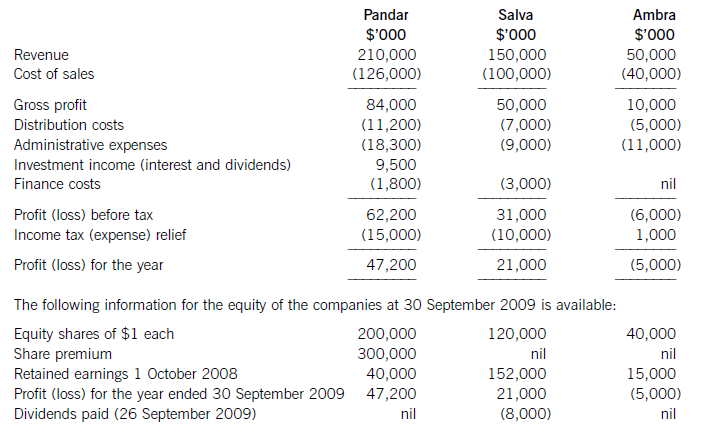
The following information is relevant:
(i) The fair values of the net assets of Salva at the date of acquisition were equal to their carrying amounts with the exception of an item of plant which had a carrying amount of $12 million and a fair value of $17 million. This plant had a remaining life of five years (straight-line depreciation) at the date of acquisition of Salva. All depreciation is charged to cost of sales.
In addition Salva owns the registration of a popular internet domain name. The registration, which had a
negligible cost, has a five year remaining life (at the date of acquisition); however, it is renewable indefinitely at a nominal cost. At the date of acquisition the domain name was valued by a specialist company at $20 million.
The fair values of the plant and the domain name have not been reflected in Salva’s financial statements.
No fair value adjustments were required on the acquisition of the investment in Ambra.
(ii) Immediately after its acquisition of Salva, Pandar invested $50 million in an 8% loan note from Salva. All interest accruing to 30 September 2009 had been accounted for by both companies. Salva also has other loans in issue at 30 September 2009.
(iii) Pandar has credited the whole of the dividend it received from Salva to investment income.
(iv) After the acquisition, Pandar sold goods to Salva for $15 million on which Pandar made a gross profit of 20%. Salva had one third of these goods still in its inventory at 30 September 2009. There are no intra-group current account balances at 30 September 2009.
(v) The non-controlling interest in Salva is to be valued at its (full) fair value at the date of acquisition. For this
purpose Salva’s share price at that date can be taken to be indicative of the fair value of the shareholding of the non-controlling interest.
(vi) The goodwill of Salva has not suffered any impairment; however, due to its losses, the value of Pandar’s
investment in Ambra has been impaired by $3 million at 30 September 2009.
(vii) All items in the above income statements are deemed to accrue evenly over the year unless otherwise indicated.
Required:
(a) (i) Calculate the goodwill arising on the acquisition of Salva at 1 April 2009; (6 marks)
(ii) Calculate the carrying amount of the investment in Ambra to be included within the consolidated
statement of financial position as at 30 September 2009. (3 marks)
(b) Prepare the consolidated income statement for the Pandar Group for the year ended 30 September 2009.(16 marks)
相似考题
参考答案和解析
更多“On 1 April 2009 Pandar purchased 80% of the equity shares in Salva. The acquisition was through a share exchange of three shares in Pandar for every five shares in Salva. The market prices of Pandar’s and Salva’s shares at 1 April2009 were $6 per share an”相关问题
-
第1题:
(b) On 31 May 2007, Leigh purchased property, plant and equipment for $4 million. The supplier has agreed to
accept payment for the property, plant and equipment either in cash or in shares. The supplier can either choose
1·5 million shares of the company to be issued in six months time or to receive a cash payment in three months
time equivalent to the market value of 1·3 million shares. It is estimated that the share price will be $3·50 in
three months time and $4 in six months time.
Additionally, at 31 May 2007, one of the directors recently appointed to the board has been granted the right to
choose either 50,000 shares of Leigh or receive a cash payment equal to the current value of 40,000 shares at
the settlement date. This right has been granted because of the performance of the director during the year and
is unconditional at 31 May 2007. The settlement date is 1 July 2008 and the company estimates the fair value
of the share alternative is $2·50 per share at 31 May 2007. The share price of Leigh at 31 May 2007 is $3 per
share, and if the director chooses the share alternative, they must be kept for a period of four years. (9 marks)
Required:
Discuss with suitable computations how the above share based transactions should be accounted for in the
financial statements of Leigh for the year ended 31 May 2007.
正确答案:(b) Transactions that allow choice of settlement are accounted for as cash-settled to the extent that the entity has incurred a
liability (IFRS2 para 34). The share based transaction is treated as the issuance of a compound financial instrument. IFRS2
applies similar measurement principles to determine the value of the constituent parts of a compound instrument as that
required by IAS32 ‘Financial Instruments: Disclosure and Presentation’. The purchase of the property, plant and equipment
(PPE) and the grant to the director, both fall under this section of IFRS2 as the supplier and the director have a choice of
settlement. The fair value of the goods can be measured directly as regards the purchase of the PPE and therefore this fact
determines that the transaction is treated in a certain way. In the case of the director, the fair value of the service rendered
will be determined by the fair value of the equity instruments given and IFRS2 says that this type of share based transaction
should be dealt with in a certain way. Under IFRS2, if the fair value of the goods or services received can be measured directly
and easily then the equity element is determined by taking the fair value of the goods or services less the fair value of the
debt element of this instrument. The debt element is essentially the cash payment that will occur. If the fair value of the goods
or services is measured by reference to the fair value of the equity instruments given then the whole of the compound
instrument should be fair valued. The equity element becomes the difference between the fair value of the equity instruments
granted less the fair value of the debt component. It should take into account the fact that the counterparty must forfeit its
right to receive cash in order to receive the equity instrument.
When Leigh received the property, plant and equipment it should have recorded a liability of $4 million and an increase in
equity of $0·55 million being the difference between the value of the property, plant and equipment and the fair value of theliability. The fair value of the liability is the cash payment of $3·50 x 1·3 million shares, i.e. $4·55 million.
The accounting entry would be:
-
第2题:
6 Assume today’s date is 16 April 2005.
Henry, aged 48, is the managing director of Happy Home Ltd, an unquoted UK company specialising in interior
design. He is wealthy in his own right and is married to Helen, who is 45 years old. They have two children – Stephen,
who is 19, and Sally who is 17.
As part of his salary, Henry was given 3,000 shares in Happy Home Ltd with an option to acquire a further 10,000
shares. The options were granted on 15 July 2003, shortly after the company started trading, and were not part of
an approved share option scheme. The free shares were given to Henry on the same day.
The exercise price of the share options was set at the then market value of £1·00 per share. The options are not
capable of being exercised after 10 years from the date of grant. The company has been successful, and the current
value of the shares is now £14·00 per share. Another shareholder has offered to buy the shares at their market value,
so Henry exercised his share options on 14 April 2005 and will sell the shares next week, on 20 April 2005.
With the company growing in size, Henry wishes to recruit high quality staff, but the company lacks the funds to pay
them in cash. Henry believes that giving new employees the chance to buy shares in the company would help recruit
staff, as they could share in the growth in value of Happy Home Ltd. Henry has heard that there is a particular share
scheme that is suitable for small, fast growing companies. He would like to obtain further information on how such
a scheme would work.
Henry has accumulated substantial assets over the years. The family house is owned jointly with Helen, and is worth
£650,000. Henry has a £250,000 mortgage on the house. In addition, Henry has liquid assets worth £340,000
and Helen has shares in quoted companies currently worth £125,000. Henry has no forms of insurance, and believes
he should make sure that his wealth and family are protected. He is keen to find out what options he should be
considering.
Required:
(a) (i) State how the gift of the 3,000 shares in Happy Home Ltd was taxed. (1 mark)
正确答案:
(a) (i) Gift of shares
Shares, which are given free or sold at less than market value, are charged to income tax on the difference between the
market value and the amount paid (if any) for the shares. Henry was given 3,000 shares with a market value of £1 at
the time of gift, so he was assessed to income tax on £3,000, in the tax year 2003/04. -
第3题:
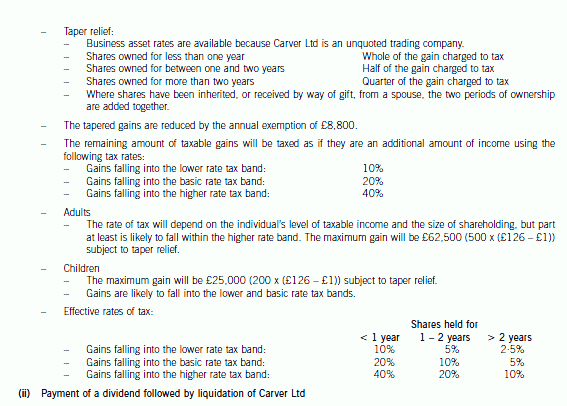
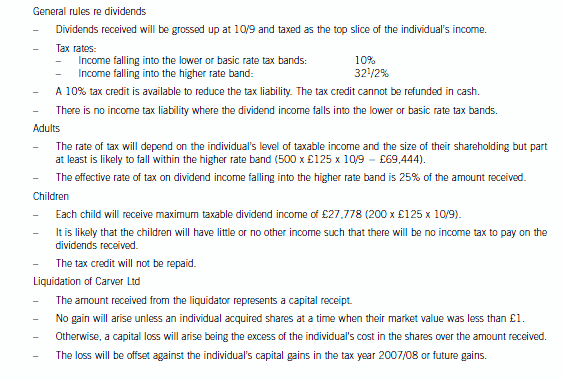
(b) The directors of Carver Ltd are aware that some of the company’s shareholders want to realise the value in their
shares immediately. Accordingly, instead of investing in the office building or the share portfolio they are
considering two alternative strategies whereby, following the sale of the company’s business, a payment will be
made to the company’s shareholders.
(i) Liquidate the company. The payment by the liquidator would be £126 per share.
(ii) The payment of a dividend of £125 per share following which a liquidator will be appointed. The payment
by the liquidator to the shareholders would then be £1 per share.
The company originally issued 20,000 £1 ordinary shares at par value to 19 members of the Cutler family.
Following a number of gifts and inheritances there are now 41 shareholders, all of whom are family members.
The directors have asked you to attend a meeting to set out the tax implications of these two alternative strategies
for each of the two main groups of shareholders: adults with shareholdings of more than 500 shares and children
with shareholdings of 200 shares or less.
Required:
Prepare notes explaining:
– the amount chargeable to tax; and
– the rates of tax that will apply
in respect of each of the two strategies for each of the two groups of shareholders ready for your meeting
with the directors of Carver Ltd. You should assume that none of the shareholders will have any capital
losses either in the tax year 2007/08 or brought forward as at 5 April 2007. (10 marks)
Note:
You should assume that the rates and allowances for the tax year 2006/07 will continue to apply for the
foreseeable future.
正确答案: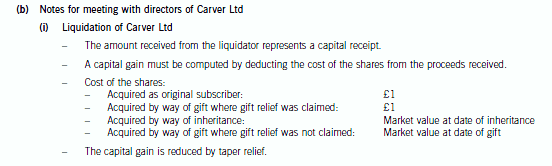
-
第4题:
2 Assume that today’s date is 1 July 2005.
Jan is aged 45 and single. He is of Danish domicile but has been working in the United Kingdom since 1 May 2004
and intends to remain in the UK for the medium to long term. Although Jan worked briefly in the UK in 1986, he
has forgotten how UK taxation works and needs some assistance before preparing his UK income tax return.
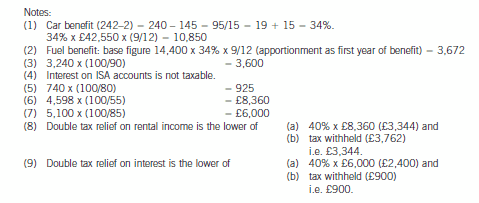
Jan’s salary from 1 May 2004 was £74,760 per annum. Jan also has a company car – a Jaguar XJ8 with a list price
of £42,550 including extras, and CO2 emissions of 242g/km. The car was available to him from 1 July 2004. Free
petrol is provided by the company. Jan has other taxable benefits amounting to £3,965.
Jan’s other 2004/05 income comprises:
£
Dividend income from UK companies (cash received) 3,240
Interest received on an ISA account 230
Interest received on a UK bank account 740
Interest remitted from an offshore account (net of 15% withholding tax) 5,100
Income remitted from a villa in Portugal (net of 45% withholding tax) 4,598
The total interest arising on the offshore account was £9,000 (gross). In addition, Jan has not remitted other
Portuguese rental income arising in the year, totalling a further £1,500 (gross).
Jan informs you that his employer is thinking of providing him with rented accommodation while he looks for a house
to buy. The accommodation would be a two bedroom flat, valued at £155,000 with an annual value of £6,000. It
would be made available from 6 August 2005. The company will pay the rent of £600 per month for the first six
months. All other bills will be paid by Jan.
Jan also informs you that he has 25,000 ordinary shares in Gilet Ltd (‘Gilet’), an unquoted UK trading company. He
has held these shares since August 1986 when he bought 2,500 shares at £4.07 per share. In January 1994, a
bonus issue gave each shareholder nine shares for each ordinary share held. In the last week all Gilet’s shareholders
have received an offer from Jumper plc (‘Jumper’) who wishes to acquire the shares. Jumper has offered the following:
– 3 shares in Jumper (currently trading at £3.55 per share) for every 5 shares in Gilet, and
– 25p cash per share
Required:
(a) Calculate Jan’s 2004/05 income tax (IT) payable. (11 marks)
正确答案: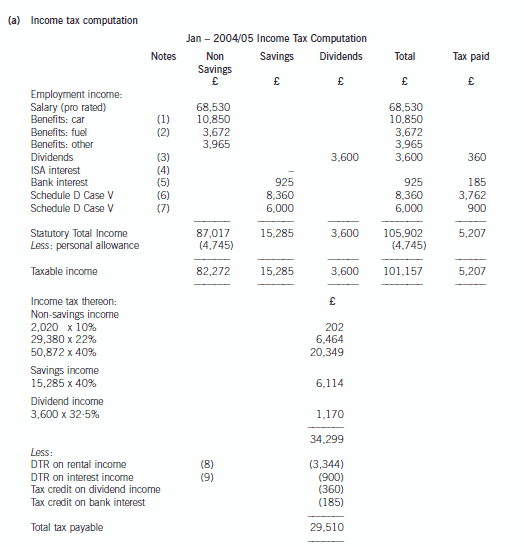
-
第5题:
The primary purpose of a stock split include ().A.to increase the number of shares outstanding
B.reduce the market price of the stock per share
C.reduce earnings per share
D.increase the market activity of the shares
E.increase paid-in capital
正确答案:ABCD
-
第6题:
阅读以下说明和C++代码,将解答写入对应栏内。
[说明]
类Stock的定义中有三处错误,分别在代码的第04、06、10行。请补齐下述代码中的空缺(1)~(3),修改错误并给出修改后该行的完整代码,最后完善程序运行后的输出结果。
[C++程序]
01 include<iostream.h>
02 using namespace std;
03 class Stock{
04 protected:
05 Stock(){shares=0; share_val=0.0;Output();}
06 Stock(int n=0,double pr=3.5): (1) {//初始化shares值为n
07 share_val=pr;
08 Output();
09 };
10 void~Stock(){};
11 void Output()(cout<<shares<<';'<<share val<<endl;}
12 public:
13 //成员函数
14 private:
15 //成员变量
16 int shares;
17 double share_val;
18 };
19
20 void main(){ //构造三个Stock对象a,b,C
21 Stock a(1);
22 Stock b;
23 Stock C;Stock();
24 //其他代码省略,且代码无输出
25 }
程序运行后的输出结果为:
1:3.5
(2)
(3)
正确答案:(1) shares(n) 04代码行修改结果:public: 06代码行修改结果:Stock(int ndouble pr=3.5):shares(n){ 10代码行修改结果:~Stock(){} (2) 0:0 (3) 0:0
(1) shares(n) 04代码行修改结果:public: 06代码行修改结果:Stock(int n,double pr=3.5):shares(n){ 10代码行修改结果:~Stock(){} (2) 0:0 (3) 0:0 解析:本题考查的是用C++程序编程。
根据程序中的注释,要求初始化shars的值为n,因此根据初始化语法应为“shares(n)”;第四行定义了构造函数的访问控制为protected,但构造函数应该是公共的,所以第四行应该更改为“public”:第六行的构造函数定义了默认值,这样构造一个对象的时候可以填写不同参数,但这个构造函数会和stock()的无参构造函数混淆,所以,不能够带有默认值,可以将带有默认参数的构造函数更改为:“Stock(int n,double pr==3.5)”或者“Stock(int n,double pr)”。函数的析构函数不能够有任何的返回值,所以第十行应为“~Stock(){}”:运行程序后,程序的输出结果为:1:3.5 0:0 0:0 -
第7题:
阅读下列说明和C++代码,请回答问题1至问题3。
【说明】
已知下列程序运行时的输出应为:
1:1
1:1
1:1
【C++程序】
01 include <iostream>
02 using namespace std;
03 class Stock{
04 protect:
05 (1) {};
06 Stock(iht n, int pr=1){
07 shares = n; share_val=pr;
08 };
09 void~Stock(){};
10 public:
11 //成员函数
12 void output(){
13 (2) << shares << ":" << share val << endl;
14 }
15 private:
16 //成员变量
17 int shares;
18 int share_val;
19 };
20
21 void main(){
22 Stock a(1); a.output();
23 Stock b; b.output();
24 Stock c = Stock(); c.output();
25 }
请补齐下述代码中的空缺1和2。
正确答案:(1)Stock():shares(1)share_val(1) 或Stock():share_val(1)shares(1) (2)cout
(1)Stock():shares(1),share_val(1) 或Stock():share_val(1),shares(1) (2)cout -
第8题:
In the first paragraph, individual borrowing is cited because_____.
[A] it shares similarities with the government’s Social Security policies
[B] there is no guarantee that it will be profitable in the stock market
[C] it is not proper for the brokerage houses to persuade people to borrow money
[D] it is an indication of the Bush administration’s serious concern over the stock market
正确答案:A
-
第9题:
Servlet A receives a request that it forwards to servlet B within another web application in the same web container. Servlet A needs to share data with servlet B and that data must not be visible to other servlets in A’s web application. In which object can the data that A shares with B be stored?()
- A、 HttpSession
- B、 ServletConfig
- C、 ServletContext
- D、 HttpServletRequest
- E、 HttpServletResponse
正确答案:D -
第10题:
问答题Practice 3 Equity securities are known as shares (or stock) in a corporation. Stockholders are considered owners of the corporation. The Articles of Incorporation must state the number of shares and the characteristics of the stock. To issue stock is actually to offer shares of stock for sale. The corporation’s Board of Directors controls when and to whom the corporation’s shares are offered and sold. Outstanding shares—Outstanding shares are shares already issued and purchased by the shareholder or stockholder. Par value—Par value is an arbitrary value assigned to each share in the Articles of Incorporation but does not necessarily reflect the true market value of the stock. Shares may not be issued and sold by the corporation for less than their par value therefore it is sometimes advisable not to state any par value at all or state a par value lower than the estimated market price. No par value allows the Board of Directors to decide each time shares are issued what the price per share will be. In a very large corporation where the stock is publicly traded at a public exchange, such as the New York Stock Exchange, the public demand for the stock of the corporation rather than the Board of Directors determines the selling price of the stock. Capital account—The capital account of a corporation is an entry in the books of the corporation and is determined by multiplying the par or stated value of the corporation’s stock by the number of shares outstanding. For example, if the corporation had sold 1,000 shares of stock which had $10 par value, the capital account would be $10,000.正确答案:
【参考译文】
股票是指公司发行的股份。股东是公司的所有者。公司条例必须说明公司股份的数量及其特征。发行股票实际上是出售公司的股份。公司董事会决定何时以及向何种人发售股票。
流动股——指已发行的,股东已购买的股票。
票面价值——指根据公司条例而赋予每股股票的价值。但它并不一定反映股票真正的市场价值。股票不能以低于票面价值发行和出售,因此有时不规定票面价值或所规定的票面价值低于估计的市场价值是非常明智的。在没有规定票面价值时,公司董事会得以在每次发行股票时决定每股的价格。某大公司的股票在大型公共交易所(如纽约证券交易所)进行公开交易时,公众对公司股票的需求而不是公司董事会决定该公司股票的交易价格。
资本性账户——指公司登记在册的资本,它等于流动股的数量与票面价值或是规定价值的乘积。比如说,某公司发行了1000股,每股票面价值为10美元,它的资本账户则是1万美元。解析: 暂无解析 -
第11题:
单选题Investors can reduce risks and still make good profits byAinvesting only in blue chip companies.
Bmonitoring share prices very closely.
Cbuying shares gradually over time.
Dchoosing a variety of investment.
正确答案: D解析:
第四段的最后一句提到,数据显示,对投资者来说,最安全的选择就是通过投资不同领域不同公司来降低投资风险。 -
第12题:
单选题The anthropologists would have considered their research a success if they would have found a language that shares lexical elements with the Borneans they were studying.Aif they would have found a language that shares lexical elements with the Borneans they were studying
Bhad they found a language that shares lexical elements with that of the Borneans they were studying
Cif they found a language that shares lexical elements with the Borneans they were studying
Dif they had found a language that shares lexical elements with the Borneans they were studying
Eif they would have found a language that shares lexical elements with that of the Borneans they were studying
正确答案: D解析:
划线部分的短语“if they would have”使用的虚拟语气不正确且拿语言和婆罗洲人对比不符合逻辑。 -
第13题:
2 Graeme, aged 57, is married to Catherine, aged 58. They work as medical consultants, and both are higher rate
taxpayers. Barry, their son, is aged 32. Graeme, Catherine and Barry are all UK resident, ordinarily resident and
domiciled. Graeme has come to you for some tax advice.
Graeme has invested in shares for some time, in particular shares in Thistle Dubh Limited. He informs you of the
following transactions in Thistle Dubh Limited shares:
(i) In December 1986, on the death of his grandmother, he inherited 10,000 £1 ordinary shares in Thistle Dubh
Limited, an unquoted UK trading company providing food supplies for sporting events. The probate value of the
shares was 360p per share.
(ii) In March 1992, he took up a rights issue, buying one share for every two held. The price paid for the rights
shares was £10 per share.
(iii) In October 1999, the company underwent a reorganisation, and the ordinary shares were split into two new
classes of ordinary share – ‘T’ shares and ‘D’ shares, each with differing rights. Graeme received two ‘T’ and three
‘D’ shares for each original Thistle Dubh Limited share held. The market values for the ‘T’ shares and the ‘D’
shares on the date of reorganisation were 135p and 405p per share respectively.
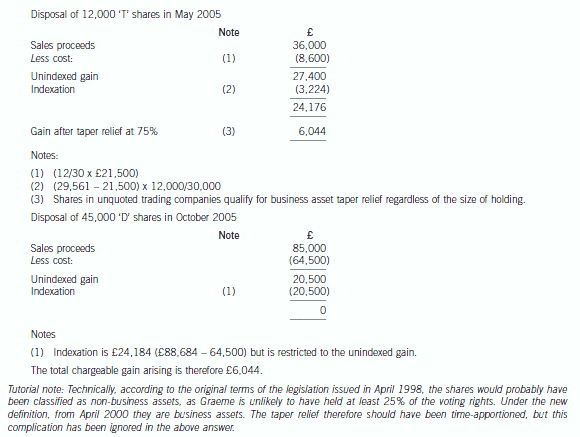
(iv) On 1 May 2005, Graeme sold 12,000 ‘T’ shares. The market values for the ‘T’ shares and the ‘D’ shares on that
day were 300p and 600p per share respectively.
(v) In October 2005, Graeme sold all of his ‘D’ shares for £85,000.
(vi) The current market value of ‘T’ shares is 384p per share. The shares remain unquoted.
Graeme and Catherine have owned a holiday cottage in a remote part of the UK for many years. In recent years, they
have used the property infrequently, as they have taken their holidays abroad and the cottage has been let out as
furnished holiday accommodation.
Graeme and Catherine are now considering selling the UK country cottage and purchasing a holiday villa abroad.
Initially they plan to let this villa out on a furnished basis, but following their anticipated retirement, would expect to
occupy the property for a significant part of the year themselves, possibly moving to live in the villa permanently.
Required:
(a) Calculate the total chargeable gains arising on Graeme’s disposals of ‘T’ and ‘D’ ordinary shares in May and
October 2005 respectively. (7 marks)
正确答案: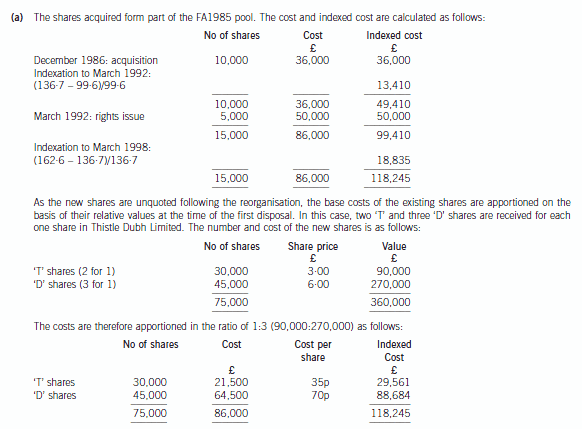
-
第14题:
(ii) Explain the income tax (IT), national insurance (NIC) and capital gains tax (CGT) implications arising on
the grant to and exercise by an employee of an option to buy shares in an unapproved share option
scheme and on the subsequent sale of these shares. State clearly how these would apply in Henry’s
case. (8 marks)
正确答案:
(ii) Exercising of share options
The share option is not part of an approved scheme, and will not therefore enjoy the benefits of such a scheme. There
are three events with tax consequences – grant, exercise and sale.
Grant. If shares or options over shares are sold or granted at less than market value, an income tax charge can arise on
the difference between the price paid and the market value. [Weight v Salmon]. In addition, if options can be exercised
more than 10 years after the date of the grant, an employment income charge can arise. This is based on the market
value at the date of grant less the grant and exercise priced.
In Henry’s case, the options were issued with an exercise price equal to the then market value, and cannot be exercised
more than 10 years from the grant. No income tax charge therefore arises on grant.
Exercise. On exercise, the individual pays the agreed amount in return for a number of shares in the company. The price
paid is compared with the open market value at that time, and if less, the difference is charged to income tax. National
insurance also applies, and the company has to pay Class 1 NIC. If the company and shareholder agree, the national
insurance can be passed onto the individual, and the liability becomes a deductible expense in calculating the income
tax charge.
In Henry’s case on exercise, the difference between market value (£14) and the price paid (£1) per share will be taxed
as income. Therefore, £130,000 (10,000 x (£14 – £1)) will be taxed as income. In addition, national insurance will
be chargeable on the company at 12·8% (£16,640) and on Henry at the rate of 1% (£1,300).
Sale. The base cost of the shares is taken to be the market value at the time of exercise. On the sale of the shares, any
gain or loss arising falls under the capital gains tax rules, and CGT will be payable on any gain. Business asset taper
relief will be available as the company is an unquoted trading company, but the relief will only run from the time that
the share options are exercised – i.e. from the time when the shares were acquired.
In Henry’s case, the sale of the shares will immediately follow the exercise of the option (6 days later). The sale proceeds
and the market value at the time of exercise are likely to be similar; thus little to no gain is likely to arise. -
第15题:
3 Spica, one of the director shareholders of Acrux Ltd, has been in dispute with the other shareholders over plans to
expand the company’s activities overseas. In order to resolve the position it has been agreed that Spica will sell her
shares back to the company. Once the purchase of her shares has taken place, the company intends to establish a
number of branches overseas and acquire a shareholding in a number of companies that are resident and trade in
overseas countries.
The following information has been obtained from client files and meetings with the parties involved.
Acrux Ltd:
– An unquoted UK resident company.
– Share capital consists of 50,000 ordinary shares issued at £1·90 per share in July 2000.
– None of the other shareholders has any connection with Spica.
The purchase of own shares:
– The company will purchase all of Spica’s shares for £8 per share.
– The transaction will take place by the end of 2008.
Spica:
– Purchased 8,000 shares in Acrux Ltd for £2 per share on 30 September 2003.
– Has no income in the tax year 2008/09.
– Has chargeable capital gains in the tax year 2008/09 of £3,800.
– Has houses in the UK and the country of Solaris and divides her time between them.
Investment in non-UK resident companies:
– Acrux Ltd will acquire between 15% and 20% of each of the non-UK resident companies.
– The companies will not be controlled foreign companies as the rates of tax in the overseas countries will be
between 23% and 42%.
– There may or may not be a double tax treaty between the UK and the overseas countries in which the companies
are resident. Where there is a treaty, it will be based on the OECD model treaty.
– None of the countries concerned levy withholding tax on dividends paid to UK companies.
– The directors of Acrux Ltd are concerned that the rate of tax suffered on the profits of the overseas companies
will be very high as they will be taxed in both the overseas country and in the UK.
Required:
(a) (i) Prepare detailed calculations to determine the most beneficial tax treatment of the payment Spica will
receive for her shares; (7 marks)
正确答案:
-
第16题:
For a limited company, this will include the money ______ issuing shares, and is known as the share capital.A raise for ;
B raised by ;
C raising at
参考答案:B
-
第17题:
阅读以下说明和C++代码。
[说明]
类Stock的定义中有三处错误,分别在代码的第04、06、10行。请补齐下述代码中的空缺(1),修改错误并给出修改后该行的完整代码,最后完善程序运行后的输出结果。
[C++代码]
01 include <iostream>
02 using namespace std;
03 class Stock{
04 protected:
05 Stock(){shares=0;share_val=0.0;Output();}
06 Stock(int n=0,double pr=3.5): (1) {//初始化shares值为n
07 share_val=pr;
08 Output();
09 };
10 void Stock(){};
11 void Output(){cout<<shares <<':'<<share_val<<end1;}
12 public:
13 //成员函数
14 private:
15 //成员变量
16 int shares;
17 double share_val;
18 };
19
20 void main(){ //构造三个Stock对象a,b,c
21 Stock a(1);
22 Stock b;
23 Stock c=Stock();
24 //其它代码省略,且代码五输出
25 }
程序运行后的输出结果为:
1:3.5
(2)
(3)
正确答案:(1) shares(n) 04代码行修改结果:public: 06代码行修改结果:Stock(int n double pr=3.5):shares(n){ 10代码行修改结果:~Stock(){} (2)0:0 (3)0:0
(1) shares(n) 04代码行修改结果:public: 06代码行修改结果:Stock(int n, double pr=3.5):shares(n){ 10代码行修改结果:~Stock(){} (2)0:0 (3)0:0 解析:根据程序中的注释,要求初始化shars的值为n,因此根据初始化语法应为share(n);第四行定义了构造函数的访问控制为protected,但构造函数应该是公共的,所以第四行应该更改为public:第六行的构造函数定义了默认值,这样构造一个对象的时候可以填写不同参数,但这个构造函数会和stock()的无参构造函数混淆,所以,不能够带有默认值,可以将带有默认参数的构造函数更改为:Stock(int n, double pr=3.5)或者Stock(int n, double pr)。函数的析构函数不能够有任何的返回值,所以第十行应为~Stock(){}:运行程序后,程序的输出结果为:
1:3.5
0:0
0:0 -
第18题:
阅读以下说明和Java代码,请回答问题1和问题2。
【说明】
己知类Stock和类cxyjava都定义在cxyjava.java文件中,类Stock的定义中第14行前共有四行出现了错误,将下面代码修改正确并完善后的输出结果为:
0:0
1:23
【Java代码】
01 public class Stock{
02 static {
03 shares = 0;
04 share val = 0.0;
O5 }
06 public Stock(){getData();}
07 public Stock(int n, iht pr=0){
08 shares = n;
09 share val = pr;
10 getData();
11 }
12 public void getData() {
13 System.out.println(shares + ":"+share_val);
14 }
15 private int shares;
16 private int share_val;
17 };
18
19 public class cxyjava{
20 public static void main(String args[]) {
21 Stock a = (1) ;
22 Stock b = new Stock(1,23);
23 //其他无输出代码省略
24 }
25 }
请指出错误所在行号并给出该行修改后的完整结果。
正确答案:错误1:第1行修改为:class Stock{ 错误2:第2行修改为:{ 错误3:第4行修改为:share val:=0; 或share_val=(int)0.0; 错误4:第7行修改为:public Stock(int nint pr){
错误1:第1行,修改为:class Stock{ 错误2:第2行,修改为:{ 错误3:第4行,修改为:share val:=0; 或share_val=(int)0.0; 错误4:第7行,修改为:public Stock(int n,int pr){ -
第19题:
(a) The following figures have been calculated from the financial statements (including comparatives) of Barstead for
the year ended 30 September 2009:
increase in profit after taxation 80%
increase in (basic) earnings per share 5%
increase in diluted earnings per share 2%
Required:
Explain why the three measures of earnings (profit) growth for the same company over the same period can
give apparently differing impressions. (4 marks)
(b) The profit after tax for Barstead for the year ended 30 September 2009 was $15 million. At 1 October 2008 the company had in issue 36 million equity shares and a $10 million 8% convertible loan note. The loan note will mature in 2010 and will be redeemed at par or converted to equity shares on the basis of 25 shares for each $100 of loan note at the loan-note holders’ option. On 1 January 2009 Barstead made a fully subscribed rights issue of one new share for every four shares held at a price of $2·80 each. The market price of the equity shares of Barstead immediately before the issue was $3·80. The earnings per share (EPS) reported for the year ended 30 September 2008 was 35 cents.
Barstead’s income tax rate is 25%.
Required:
Calculate the (basic) EPS figure for Barstead (including comparatives) and the diluted EPS (comparatives not required) that would be disclosed for the year ended 30 September 2009. (6 marks)
正确答案:
(a)Whilstprofitaftertax(anditsgrowth)isausefulmeasure,itmaynotgiveafairrepresentationofthetrueunderlyingearningsperformance.Inthisexample,userscouldinterpretthelargeannualincreaseinprofitaftertaxof80%asbeingindicativeofanunderlyingimprovementinprofitability(ratherthanwhatitreallyis:anincreaseinabsoluteprofit).Itispossible,evenprobable,that(someof)theprofitgrowthhasbeenachievedthroughtheacquisitionofothercompanies(acquisitivegrowth).Wherecompaniesareacquiredfromtheproceedsofanewissueofshares,orwheretheyhavebeenacquiredthroughshareexchanges,thiswillresultinagreaternumberofequitysharesoftheacquiringcompanybeinginissue.ThisiswhatappearstohavehappenedinthecaseofBarsteadastheimprovementindicatedbyitsearningspershare(EPS)isonly5%perannum.ThisexplainswhytheEPS(andthetrendofEPS)isconsideredamorereliableindicatorofperformancebecausetheadditionalprofitswhichcouldbeexpectedfromthegreaterresources(proceedsfromthesharesissued)ismatchedwiththeincreaseinthenumberofshares.Simplylookingatthegrowthinacompany’sprofitaftertaxdoesnottakeintoaccountanyincreasesintheresourcesusedtoearnthem.Anyincreaseingrowthfinancedbyborrowings(debt)wouldnothavethesameimpactonprofit(asbeingfinancedbyequityshares)becausethefinancecostsofthedebtwouldacttoreduceprofit.ThecalculationofadilutedEPStakesintoaccountanypotentialequitysharesinissue.Potentialordinarysharesarisefromfinancialinstruments(e.g.convertibleloannotesandoptions)thatmayentitletheirholderstoequitysharesinthefuture.ThedilutedEPSisusefulasitalertsexistingshareholderstothefactthatfutureEPSmaybereducedasaresultofsharecapitalchanges;inasenseitisawarningsign.InthiscasethelowerincreaseinthedilutedEPSisevidencethatthe(higher)increaseinthebasicEPShas,inpart,beenachievedthroughtheincreaseduseofdilutingfinancialinstruments.Thefinancecostoftheseinstrumentsislessthantheearningstheirproceedshavegeneratedleadingtoanincreaseincurrentprofits(andbasicEPS);however,inthefuturetheywillcausemoresharestobeissued.ThiscausesadilutionwherethefinancecostperpotentialnewshareislessthanthebasicEPS. -
第20题:
A company is deploying a new file server to consolidate shares from several legacy servers. Which of the following is the BEST method to ensure that the new file shares are being used?()
- A、 Setup the new file server and shut down the legacy servers.
- B、 Remove all the DNS entries for the legacy servers.
- C、 Create a logon script to remap the old file shares to the new file shares.
- D、 Go to each users computer, remove all shares and setup the new shares.
正确答案:C -
第21题:
单选题Investors can reduce risk and still make good profits by ______Ainvesting only in blue chip companies.
BMonitoring share prices very closely
CBuying shares gradually over time
DChoosing a variety of investments
正确答案: D解析:
第三段最后一句提到“数据显示,对投资者来说,最安全的选择就是投资不同领域不同公司来降低投资风险”,故选项D符合提议。 -
第22题:
单选题A company is deploying a new file server to consolidate shares from several legacy servers. Which of the following is the BEST method to ensure that the new file shares are being used?()ASetup the new file server and shut down the legacy servers.
BRemove all the DNS entries for the legacy servers.
CCreate a logon script to remap the old file shares to the new file shares.
DGo to each users computer, remove all shares and setup the new shares.
正确答案: C解析: 暂无解析 -
第23题:
单选题You are the administrator of your Windows 2000 Professional computer. You share severalfolders on your computer, which are accessible to all the users on your company’s network. You want to ensure that you have correctly assigned the appropriate permissions to all the shares.Where can you view all the shares in use on your computer, so as to verify the permissions as quickly as possible? ()AControl Panel >> Data Sources (ODBC).
BControl Panel >> System Tools >> Shared Folders.
CComputer Management >> System Tools >> System Information.
DComputer Management >> System Tools >> Shared Folders >> Open Files.
EComputer Management >> System Tools >> Shared Folders >> Sessions.
FComputer Management >> System Tools >> Shared Folders >> Shares.
正确答案: C解析: The correct answer is “Computer Management >> System Tools >> Shared Folders >> Shares”. To see the complete list of shared folder you should go to Computer Management >> System Tools >> Shared Folders >> Shares.
Choice “Control Panel >> Data Sources (ODBC)” is incorrect because ODBC is used for database connectivity not for shared folders.
Choice “Control Panel >> System Tools >> Shared Folders” does not exist.
Choice” Computer Management >> System Tools >> System Information” is used to see the complete detail of system configuration not the list of shared folders.
Choice “Computer Management >> System Tools >> Shared Folders >>Open Files is used to see the list of open shared files.
Choice “Computer Management >> System Tools >> Shared Folders >> Sessions “ is used to see the current sessions of the users who are accessing the shared files and folders.