
(a) Contrast the role of internal and external auditors. (8 marks)(b) Conoy Co designs and manufactures luxury motor vehicles. The company employs 2,500 staff and consistently makes a net profit of between 10% and 15% of sales. Conoy Co is not listed; its
题目
(a) Contrast the role of internal and external auditors. (8 marks)
(b) Conoy Co designs and manufactures luxury motor vehicles. The company employs 2,500 staff and consistently makes a net profit of between 10% and 15% of sales. Conoy Co is not listed; its shares are held by 15 individuals, most of them from the same family. The maximum shareholding is 15% of the share capital.
The executive directors are drawn mainly from the shareholders. There are no non-executive directors because the company legislation in Conoy Co’s jurisdiction does not require any. The executive directors are very successful in running Conoy Co, partly from their training in production and management techniques, and partly from their ‘hands-on’ approach providing motivation to employees.
The board are considering a significant expansion of the company. However, the company’s bankers are
concerned with the standard of financial reporting as the financial director (FD) has recently left Conoy Co. The board are delaying provision of additional financial information until a new FD is appointed.
Conoy Co does have an internal audit department, although the chief internal auditor frequently comments that the board of Conoy Co do not understand his reports or provide sufficient support for his department or the internal control systems within Conoy Co. The board of Conoy Co concur with this view. Anders & Co, the external auditors have also expressed concern in this area and the fact that the internal audit department focuses work on control systems, not financial reporting. Anders & Co are appointed by and report to the board of Conoy Co.
The board of Conoy Co are considering a proposal from the chief internal auditor to establish an audit committee.
The committee would consist of one executive director, the chief internal auditor as well as three new appointees.
One appointee would have a non-executive seat on the board of directors.
Required:
Discuss the benefits to Conoy Co of forming an audit committee. (12 marks)
相似考题
参考答案和解析
(a)Roleofinternalandexternalauditors–differencesObjectivesThemainobjectiveofinternalauditistoimproveacompany’soperations,primarilyintermsofvalidatingtheefficiencyandeffectivenessoftheinternalcontrolsystemsofacompany.Themainobjectiveoftheexternalauditoristoexpressanopiniononthetruthandfairnessofthefinancialstatements,andotherjurisdictionspecificrequirementssuchasconfirmingthatthefinancialstatementscomplywiththereportingrequirementsincludedinlegislation.ReportingInternalauditreportsarenormallyaddressedtotheboardofdirectors,orotherpeoplechargedwithgovernancesuchastheauditcommittee.Thosereportsarenotpubliclyavailable,beingconfidentialbetweentheinternalauditorandtherecipient.Externalauditreportsareprovidedtotheshareholdersofacompany.Thereportisattachedtotheannualfinancialstatementsofthecompanyandisthereforepubliclyavailabletotheshareholdersandanyreaderofthefinancialstatements.ScopeofworkTheworkoftheinternalauditornormallyrelatestotheoperationsoftheorganisation,includingthetransactionprocessingsystemsandthesystemstoproducetheannualfinancialstatements.Theinternalauditormayalsoprovideotherreportstomanagement,suchasvalueformoneyauditswhichexternalauditorsrarelybecomeinvolvedwith.Theworkoftheexternalauditorrelatesonlytothefinancialstatementsoftheorganisation.However,theinternalcontrolsystemsoftheorganisationwillbetestedastheseprovideevidenceonthecompletenessandaccuracyofthefinancialstatements.RelationshipwithcompanyInmostorganisations,theinternalauditorisanemployeeoftheorganisation,whichmayhaveanimpactontheauditor’sindependence.However,insomeorganisationstheinternalauditfunctionisoutsourced.Theexternalauditorisappointedbytheshareholdersofanorganisation,providingsomedegreeofindependencefromthecompanyandmanagement.(b)BenefitsofauditcommitteeinConoyCoAssistancewithfinancialreporting(nofinanceexpertise)TheexecutivedirectorsofConoyCodonotappeartohaveanyspecificfinancialskills–asthefinancialdirectorhasrecentlyleftthecompanyandhasnotyetbeenreplaced.ThismaymeanthatfinancialreportinginConoyCoislimitedorthattheothernon-financialdirectorsspendasignificantamountoftimekeepinguptodateonfinancialreportingissues.AnauditcommitteewillassistConoyCobyprovidingspecialistknowledgeoffinancialreportingonatemporarybasis–atleastoneofthenewappointeesshouldhaverelevantandrecentfinancialreportingexperienceundercodesofcorporategovernance.ThiswillallowtheexecutivedirectorstofocusonrunningConoyCo.EnhanceinternalcontrolsystemsTheboardofConoyCodonotnecessarilyunderstandtheworkoftheinternalauditor,ortheneedforcontrolsystems.ThismeansthatinternalcontrolwithinConoyComaybeinadequateorthatemployeesmaynotrecognisetheimportanceofinternalcontrolsystemswithinanorganisation.TheauditcommitteecanraiseawarenessoftheneedforgoodinternalcontrolsystemssimplybybeingpresentinConoyCoandbyeducatingtheboardontheneedforsoundcontrols.Improvingtheinternalcontrol‘climate’willensuretheneedforinternalcontrolsisunderstoodandreducecontrolerrors.RelianceonexternalauditorsConoyCo’sinternalauditorscurrentlyreporttotheboardofConoyCo.Aspreviouslynoted,thelackoffinancialandcontrolexpertiseontheboardwillmeanthatexternalauditorreportsandadvicewillnotnecessarilybeunderstood–andtheboardmayrelytoomuchonexternalauditorsIfConoyCoreporttoanauditcommitteethiswilldecreasethedependenceoftheboardontheexternalauditors.Theauditcommitteecantaketimetounderstandtheexternalauditor’scomments,andthenviathenon-executivedirector,ensurethattheboardtakeactiononthosecomments.AppointmentofexternalauditorsAtpresent,theboardofConoyCoappointtheexternalauditors.Thisraisesissuesofindependenceastheboardmaybecometoofamiliarwiththeexternalauditorsandsoappointonthisfriendshipratherthanmerit.Ifanauditcommitteeisestablished,thenthiscommitteecanrecommendtheappointmentoftheexternalauditors.Thecommitteewillhavethetimeandexpertisetoreviewthequalityofserviceprovidedbytheexternalauditors,removingtheindependenceissue.Corporategovernancerequirements–bestpracticeConoyCodonotneedtofollowcorporategovernancerequirements(thecompanyisnotlisted).However,notfollowingthoserequirementsmaystarttohaveadverseeffectsonConoy.Forexample,ConoyCo’sbankisalreadyconcernedaboutthelackoftransparencyinreporting.EstablishinganauditcommitteewillshowthattheboardofConoyCoarecommittedtomaintainingappropriateinternalsystemsinthecompanyandprovidingthestandardofreportingexpectedbylargecompanies.Obtainingthenewbankloanshouldalsobeeasierasthebankwillbesatisfiedwithfinancialreportingstandards.Givennonon-executives–independentadvicetoboardCurrentlyConoyCodoesnothaveanynon-executivedirectors.Thismeansthatthedecisionsoftheexecutivedirectorsarenotbeingchallengedbyotherdirectorsindependentofthecompanyandwithlittleornofinancialinterestinthecompany.Theappointmentofanauditcommitteewithonenon-executivedirectorontheboardofConoyCowillstarttoprovidesomenon-executiveinputtoboardmeetings.Whilenotsufficientintermsofcorporategovernancerequirements(aboutequalnumbersofexecutiveandnon-executivedirectorsareexpected)itdoesshowtheboardofConoyCoareattemptingtoestablishappropriategovernancesystems.AdviceonriskmanagementFinally,thereareothergeneralareaswhereConoyCowouldbenefitfromanauditcommittee.Forexample,lackofcorporategovernancestructuresprobablymeansConoyCodoesnothaveariskmanagementcommittee.Theauditcommitteecanalsoprovideadviceonriskmanagement,helpingtodecreasetheriskexposureofthecompany.
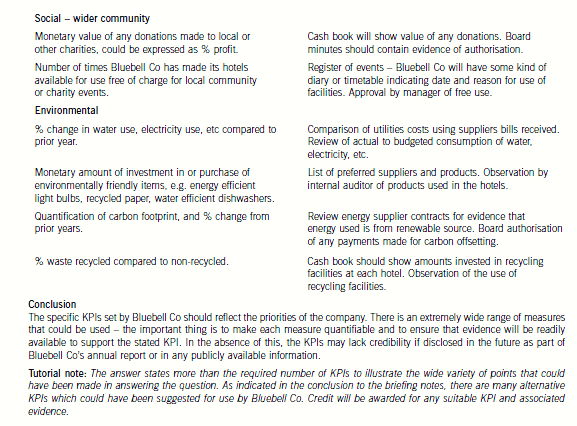
更多“(a) Contrast the role of internal and external auditors. (8 marks)(b) Conoy Co designs and manufactures luxury motor vehicles. The company employs 2,500 staff and consistently makes a net profit of between 10% and 15% of sales. Conoy Co is not listed; its”相关问题
-
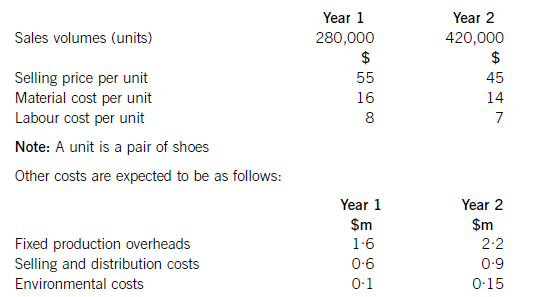
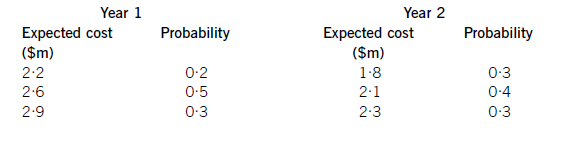
第1题:
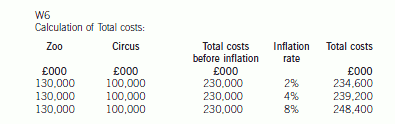
(ii) Calculate the probability of the net profit being less than £75 million. (2 marks)
正确答案: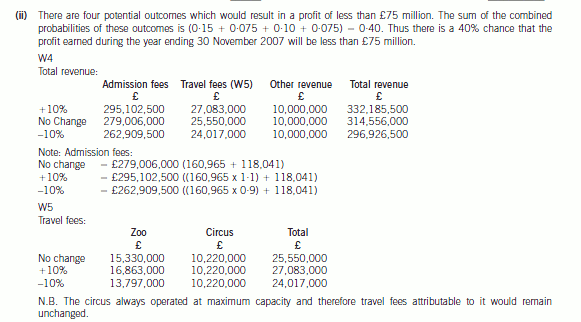
-
第2题:
(ii) vehicles. (3 marks)
正确答案:
(ii) Vehicles
■ Agreeing opening ledger balances of cost and accumulated depreciation (and impairment losses) to the non-current
asset register to confirm the comparative amounts.
■ Physically inspecting a sample of vehicles (selected from the asset register) to confirm existence and condition (for
evidence of impairment). If analytical procedures use management information on mileage records this should be
checked (e.g. against milometers) at the same time.
■ Agreeing additions to purchase invoices to confirm cost.
■ Reviewing the terms of all lease contracts entered into during the year to ensure that finance leases have been
capitalised.
■ Agreeing the depreciation rates applied to finance lease assets to those applied to similar purchased assets.
■ Reviewing repairs and maintenance accounts (included in materials expense) to ensure that there are no material
items of capital nature that have been expensed (i.e. a test for completeness). -
第3题:
In relation to company law, explain:
(a) the limitations on the use of company names; (4 marks)
(b) the tort of ‘passing off’; (4 marks)
(c) the role of the company names adjudicators under the Companies Act 2006. (2 marks)
正确答案:(a) Except in relation to specifically exempted companies, such as those involved in charitable work, companies are required to indicate that they are operating on the basis of limited liability. Thus private companies are required to end their names, either with the word ‘limited’ or the abbreviation ‘ltd’, and public companies must end their names with the words ‘public limited company’ or the abbreviation ‘plc’. Welsh companies may use the Welsh language equivalents (Companies Act (CA)2006 ss.58, 59 & 60).
Companies Registry maintains a register of business names, and will refuse to register any company with a name that is the same as one already on that index (CA 2006 s.66).
Certain categories of names are, subject to the decision of the Secretary of State, unacceptable per se, as follows:
(i) names which in the opinion of the Secretary of State constitute a criminal offence or are offensive (CA 2006 s.53)
(ii) names which are likely to give the impression that the company is connected with either government or local government authorities (s.54).
(iii) names which include a word or expression specified under the Company and Business Names Regulations 1981 (s.26(2)(b)). This category requires the express approval of the Secretary of State for the use of any of the names or expressions contained on the list, and relates to areas which raise a matter of public concern in relation to their use.
Under s.67 of the Companies Act 2006 the Secretary of State has power to require a company to alter its name under the following circumstances:
(i) where it is the same as a name already on the Registrar’s index of company names.
(ii) where it is ‘too like’ a name that is on that index.
The name of a company can always be changed by a special resolution of the company so long as it continues to comply with the above requirements (s.77).(b) The tort of passing off was developed to prevent one person from using any name which is likely to divert business their way by suggesting that the business is actually that of some other person or is connected in any way with that other business. It thus enables people to protect the goodwill they have built up in relation to their business activity. In Ewing v Buttercup
Margarine Co Ltd (1917) the plaintiff successfully prevented the defendants from using a name that suggested a link with
his existing dairy company. It cannot be used, however, if there is no likelihood of the public being confused, where for example the companies are conducting different businesses (Dunlop Pneumatic Tyre Co Ltd v Dunlop Motor Co Ltd (1907)
and Stringfellow v McCain Foods GB Ltd (1984). Nor can it be used where the name consists of a word in general use (Aerators Ltd v Tollitt (1902)).
Part 41 of the Companies Act (CA) 2006, which repeals and replaces the Business Names Act 1985, still does not prevent one business from using the same, or a very similar, name as another business so the tort of passing off will still have an application in the wider business sector. However the Act introduced a new procedure to deal specifically with company names. As previously under the CA 1985, a company cannot register with a name that was the same as any already registered (s.665 Companies Act (CA) 2006) and under CA s.67 the Secretary of State may direct a company to change its name if it has been registered in a name that is the same as, or too like a name appearing on the registrar’s index of company names. In addition, however, a completely new system of complaint has been introduced.(c) Under ss.69–74 of CA 2006 a new procedure has been introduced to cover situations where a company has been registered with a name
(i) that it is the same as a name associated with the applicant in which he has goodwill, or
(ii) that it is sufficiently similar to such a name that its use in the United Kingdom would be likely to mislead by suggesting a connection between the company and the applicant (s.69).
Section 69 can be used not just by other companies but by any person to object to a company names adjudicator if a company’s name is similar to a name in which the applicant has goodwill. There is list of circumstances raising a presumption that a name was adopted legitimately, however even then, if the objector can show that the name was registered either, to obtain money from them, or to prevent them from using the name, then they will be entitled to an order to require the company to change its name.
Under s.70 the Secretary of State is given the power to appoint company names adjudicators and their staff and to finance their activities, with one person being appointed Chief Adjudicator.
Section 71 provides the Secretary of State with power to make rules for the proceedings before a company names adjudicator.
Section 72 provides that the decision of an adjudicator and the reasons for it, are to be published within 90 days of the decision.
Section 73 provides that if an objection is upheld, then the adjudicator is to direct the company with the offending name to change its name to one that does not similarly offend. A deadline must be set for the change. If the offending name is not changed, then the adjudicator will decide a new name for the company.
Under s.74 either party may appeal to a court against the decision of the company names adjudicator. The court can either uphold or reverse the adjudicator’s decision, and may make any order that the adjudicator might have made. -
第4题:
(c) With specific reference to Hugh Co, discuss the objective of a review engagement and contrast the level of
assurance provided with that provided in an audit of financial statements. (6 marks)
正确答案:
(c) The objective of a review engagement is to enable the auditor to obtain moderate assurance as to whether the financial
statements have been prepared in accordance with an identified financial reporting framework. This is defined in ISRE 2400
Engagements to Review Financial Statements.
In order to obtain this assurance, it is necessary to gather evidence using analytical procedures and enquiries with
management. Detailed substantive procedures will not be performed unless the auditor has reason to believe that the
information may be materially misstated.
The auditor should approach the engagement with a high degree of professional scepticism, looking for circumstances that
may cause the financial statements to be misstated. For example, in Hugh Co, the fact that the preparer of the financial
statements is part-qualified may lead the auditor to believe that there is a high inherent risk that the figures are misstated.
As a result of procedures performed, the auditor’s objective is to provide a clear written expression of negative assurance on
the financial statements. In a review engagement the auditor would state that ‘we are not aware of any material modifications
that should be made to the financial statements….’
This is normally referred to as an opinion of ‘negative assurance’.
Negative assurance means that the auditor has performed limited procedures and has concluded that the financial statements
appear reasonable. The user of the financial statements gains some comfort that the figures have been subject to review, but
only a moderate level of assurance is provided. The user may need to carry out additional procedures of their own if they
want to rely on the financial statements. For example, if Hugh Co were to use the financial statements as a means to raise
further bank finance, the bank would presumably perform, or require Hugh Co to perform, additional procedures to provide
a higher level of assurance as to the validity of the figures contained in the financial statements.
In comparison, in an audit, a high level of assurance is provided. The auditors provide an opinion of positive, but not absolute
assurance. The user is assured that the figures are free from material misstatement and that the auditor has based the opinion
on detailed procedures. -
第5题:
(b) You are the manager responsible for the audit of Poppy Co, a manufacturing company with a year ended
31 October 2008. In the last year, several investment properties have been purchased to utilise surplus funds
and to provide rental income. The properties have been revalued at the year end in accordance with IAS 40
Investment Property, they are recognised on the statement of financial position at a fair value of $8 million, and
the total assets of Poppy Co are $160 million at 31 October 2008. An external valuer has been used to provide
the fair value for each property.
Required:
(i) Recommend the enquiries to be made in respect of the external valuer, before placing any reliance on their
work, and explain the reason for the enquiries; (7 marks)
正确答案:
(b) (i) Enquiries in respect of the external valuer
Enquiries would need to be made for two main reasons, firstly to determine the competence, and secondly the objectivity
of the valuer. ISA 620 Using the Work of an Expert contains guidance in this area.
Competence
Enquiries could include:
– Is the valuer a member of a recognised professional body, for example a nationally or internationally recognised
institute of registered surveyors?
– Does the valuer possess any necessary licence to carry out valuations for companies?
– How long has the valuer been a member of the recognised body, or how long has the valuer been licensed under
that body?
– How much experience does the valuer have in providing valuations of the particular type of investment properties
held by Poppy Co?
– Does the valuer have specific experience of evaluating properties for the purpose of including their fair value within
the financial statements?
– Is there any evidence of the reputation of the valuer, e.g. professional references, recommendations from other
companies for which a valuation service has been provided?
– How much experience, if any, does the valuer have with Poppy Co?
Using the above enquiries, the auditor is trying to form. an opinion as to the relevance and reliability of the valuation
provided. ISA 500 Audit Evidence requires that the auditor gathers evidence that is both sufficient and appropriate. The
auditor needs to ensure that the fair values provided by the valuer for inclusion in the financial statements have been
arrived at using appropriate knowledge and skill which should be evidenced by the valuer being a member of a
professional body, and, if necessary, holding a licence under that body.
It is important that the fair values have been arrived at using methods allowed under IAS 40 Investment Property. If any
other valuation method has been used then the value recognised in the statement of financial position may not be in
accordance with financial reporting standards. Thus it is important to understand whether the valuer has experience
specifically in providing valuations that comply with IAS 40, and how many times the valuer has appraised properties
similar to those owned by Poppy Co.
In gauging the reliability of the fair value, the auditor may wish to consider how Poppy Co decided to appoint this
particular valuer, e.g. on the basis of a recommendation or after receiving references from companies for which
valuations had previously been provided.
It will also be important to consider how familiar the valuer is with Poppy Co’s business and environment, as a way to
assess the reliability and appropriateness of any assumptions used in the valuation technique.
Objectivity
Enquiries could include:
– Does the valuer have any financial interest in Poppy Co, e.g. shares held directly or indirectly in the company?
– Does the valuer have any personal relationship with any director or employee of Poppy Co?
– Is the fee paid for the valuation service reasonable and a fair, market based price?
With these enquiries, the auditor is gaining assurance that the valuer will perform. the valuation from an independent
point of view. If the valuer had a financial interest in Poppy Co, there would be incentive to manipulate the valuation in
a way best suited to the financial statements of the company. Equally if the valuer had a personal relationship with a
senior member of staff at Poppy Co, the valuer may feel pressured to give a favourable opinion on the valuation of the
properties.
The level of fee paid is important. It should be commensurate with the market rate paid for this type of valuation. If the
valuer was paid in excess of what might be considered a normal fee, it could indicate that the valuer was encouraged,
or even bribed, to provide a favourable valuation. -
第6题:
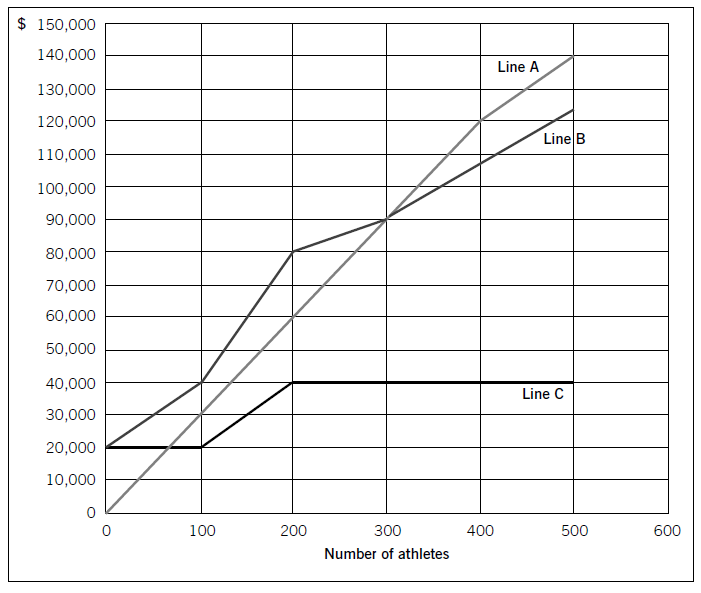
Swim Co offers training courses to athletes and has prepared the following breakeven chart:
Required:
(a) State the breakeven sales revenue for Swim Co and estimate, to the nearest $10,000, the company’s profit if 500 athletes attend a training course. (2 marks)
(b) Using the chart above, explain the cost and revenue structure of the company. (8 marks)
正确答案:
(a)ThebreakevensalesrevenueforSwimCois$90,000.Thecompany’sprofit,tothenearest$10,000,if500athletesattendthecourseis$20,000($140,000–$120,000).(Fromthegraph,itisclearthatthepreciseamountwillbenearer$17,000,i.e.$140,000–approximately$123,000.)(b)CoststructureFromthechart,itisclearthatLineCrepresentsfixedcosts,LineBrepresentstotalcostsandLineArepresentstotalrevenue.LineCshowsthatinitially,fixedcostsare$20,000evenifnoathletesattendthecourse.Thisleveloffixedcostsremainsthesameif100athletesattendbutoncethenumberofattendeesincreasesabovethislevel,fixedcostsincreaseto$40,000.LineBrepresentstotalcosts.If100athletesattend,totalcostsare$40,000($400perathlete).Since$20,000ofthisrelatestofixedcosts,thevariablecostperathletemustbe$200.Whenfixedcostsstepupbeyondthispointatthelevelof200athletes,totalcostsobviouslyincreaseaswellandLineBconsequentlygetsmuchsteeper.However,sincetherearenow200athletestoabsorbthefixedcosts,thecostperathleteremainsthesameat$400perathlete($80,000/200),eventhoughfixedcostshavedoubled.If300athletesattendthecourse,totalcostperathletebecomes$300each($90,000/300).Sincefixedcostsaccountfor$40,000ofthistotalcost,variablecoststotal$50,000,i.e.$166·67perathlete.So,economiesofscaleariseatthislevel,asdemonstratedbythefactthatLineBbecomesflatter.At400athletes,thegradientofthetotalcostslineisunchangedfrom300athleteswhichindicatesthatthevariablecostshaveremainedthesame.Thereisnofurtherchangeat500athletes;fixedandvariablecostsremainsteady.RevenuestructureAsregardstherevenuestructure,itcanbeseenfromLineAthatfor100–400athletesthepriceremainsthesameat$300perathlete.However,if500athletesattend,thepricehasbeenreducedasthetotalrevenuelinebecomesflatter.$140,000/500meansthatthepricehasgonedownto$280perathlete.Thiswasobviouslynecessarytoincreasethenumberofattendeesandatthispoint,profitismaximised.1 -
第7题:
Following a competitive tender, your audit firm Cal & Co has just gained a new audit client Tirrol Co. You are the manager in charge of planning the audit work. Tirrol Co’s year end is 30 June 2009 with a scheduled date to complete the audit of 15 August 2009. The date now is 3 June 2009.
Tirrol Co provides repair services to motor vehicles from 25 different locations. All inventory, sales and purchasing systems are computerised, with each location maintaining its own computer system. The software in each location is
the same because the programs were written specifically for Tirrol Co by a reputable software house. Data from each location is amalgamated on a monthly basis at Tirrol Co’s head office to produce management and financial accounts.
You are currently planning your audit approach for Tirrol Co. One option being considered is to re-write Cal & Co’s audit software to interrogate the computerised inventory systems in each location of Tirrol Co (except for head office)
as part of inventory valuation testing. However, you have also been informed that any computer testing will have to be on a live basis and you are aware that July is a major holiday period for your audit firm.
Required:
(a) (i) Explain the benefits of using audit software in the audit of Tirrol Co; (4 marks)
(ii) Explain the problems that may be encountered in the audit of Tirrol Co and for each problem, explain
how that problem could be overcome. (10 marks)
(b) Following a discussion with the management at Tirrol Co you now understand that the internal audit department are prepared to assist with the statutory audit. Specifically, the chief internal auditor is prepared to provide you with documentation on the computerised inventory systems at Tirrol Co. The documentation provides details of the software and shows diagrammatically how transactions are processed through the inventory system. This documentation can be used to significantly decrease the time needed to understand the computer systems and enable audit software to be written for this year’s audit.
Required:
Explain how you will evaluate the computer systems documentation produced by the internal audit
department in order to place reliance on it during your audit. (6 marks)
正确答案:
(a)(i)BenefitsofusingauditsoftwareStandardsystemsatclientThesamecomputerisedsystemsandprogramsasusedinall25branchesofTirrolCo.Thismeansthatthesameauditsoftwarecanbeusedineachlocationprovidingsignificanttimesavingscomparedtothesituationwhereclientsystemsaredifferentineachlocation.UseactualcomputerfilesnotcopiesorprintoutsUseofauditsoftwaremeansthattheTirrolCo’sactualinventoryfilescanbetestedratherthanhavingtorelyonprintoutsorscreenimages.Thelattercouldbeincorrect,byaccidentorbydeliberatemistake.Theauditfirmwillhavemoreconfidencethatthe‘real’fileshavebeentested.TestmoreitemsUseofsoftwarewillmeanthatmoreinventoryrecordscanbetested–itispossiblethatallproductlinescouldbetestedforobsolescenceratherthanasampleusingmanualtechniques.Theauditorwillthereforegainmoreevidenceandhavegreaterconfidencethatinventoryisvaluedcorrectly.CostTherelativecostofusingauditsoftwaredecreasesthemoreyearsthatsoftwareisused.Anycostoverrunsthisyearcouldbeoffsetagainsttheauditfeesinfutureyearswhentheactualexpensewillbeless.(ii)ProblemsontheauditofTirrolTimescale–sixweekreportingdeadline–auditplanningTheauditreportisduetobesignedsixweeksaftertheyearend.Thismeansthattherewillbeconsiderablepressureontheauditortocompleteauditworkwithoutcompromisingstandardsbyrushingprocedures.Thisproblemcanbeovercomebycarefulplanningoftheaudit,useofexperiencedstaffandensuringotherstaffsuchassecondpartnerreviewsarebookedwellinadvance.Timescale–sixweekreportingdeadline–softwareissuesTheauditreportisduetobesignedaboutsixweeksaftertheyearend.Thismeansthatthereislittletimetowriteandtestauditsoftware,letaloneusethesoftwareandevaluatetheresultsoftesting.Thisproblemcanbealleviatedbycarefulplanning.AccesstoTirrolCo’ssoftwareanddatafilesmustbeobtainedassoonaspossibleandworkcommencedontailoringCal&Co’ssoftwarefollowingthis.Specialistcomputerauditstaffshouldbebookedassoonaspossibletoperform.thiswork.FirstyearauditcostsTherelativecostsofanauditinthefirstyearataclienttendtobegreaterduetotheadditionalworkofascertainingclientsystems.ThismeansthatCal&Comayhavealimitedbudgettodocumentsystemsincludingcomputersystems.Thisproblemcanbealleviatedtosomeextentagainbygoodauditplanning.Themanagermustalsomonitortheauditprocesscarefully,ensuringthatanyadditionalworkcausedbytheclientnotprovidingaccesstosystemsinformationincludingcomputersystemsisidentifiedandaddedtothetotalbillingcostoftheaudit.StaffholidaysMostoftheauditworkwillbecarriedoutinJuly,whichisalsothemonthwhenmanyofCal&Costafftaketheirannualholiday.Thismeansthattherewillbeashortageofauditstaff,particularlyasauditworkforTirrolCoisbeingbookedwithlittlenotice.Theproblemcanbealleviatedbybookingstaffassoonaspossibleandthenidentifyinganyshortages.Wherenecessary,staffmaybeborrowedfromotherofficesorevendifferentcountriesonasecondmentbasiswhereshortagesareacute.Non-standardsystemsTirrolCo’scomputersoftwareisnon-standard,havingbeenwrittenspecificallyfortheorganisation.Thismeansthatmoretimewillbenecessarytounderstandthesystemthanifstandardsystemswereused.Thisproblemcanbealleviatedeitherbyobtainingdocumentationfromtheclientorbyapproachingthesoftwarehouse(withTirrolCo’spermission)toseeiftheycanassistwithprovisionofinformationondatastructuresfortheinventorysystems.ProvisionofthisinformationwilldecreasethetimetakentotailorauditsoftwareforuseinTirrolCo.IssuesoflivetestingCal&Cohasbeeninformedthatinventorysystemsmustbetestedonalivebasis.Thisincreasestheriskofaccidentalamendmentordeletionofclientdatasystemscomparedtotestingcopyfiles.Tolimitthepossibilityofdamagetoclientsystems,Cal&CocanconsiderperforminginventorytestingondayswhenTirrolCoisnotoperatinge.g.weekends.Attheworst,backupsofdatafilestakenfromthepreviousdaycanbere-installedwhenCal&Co’stestingiscomplete.ComputersystemsTheclienthas25locations,witheachlocationmaintainingitsowncomputersystem.Itispossiblethatcomputersystemsarenotcommonacrosstheclientduetoamendmentsmadeatthebranchlevel.Thisproblemcanbeovercometosomeextentbyaskingstaffateachbranchwhethersystemshavebeenamendedandfocusingauditworkonmaterialbranches.UsefulnessofauditsoftwareTheuseofauditsoftwareatTirrolCodoesappeartohavesignificantproblemsthisyear.Thismeansthateveniftheauditsoftwareisready,theremaystillbesomeriskofincorrectconclusionsbeingderivedduetolackoftesting,etc.Thisproblemcanbealleviatedbyseriouslyconsideringthepossibilityofusingamanualauditthisyear.Themanagermayneedtoinvestigatewhetheramanualauditisfeasibleandifsowhetheritcouldbecompletedwithinthenecessarytimescalewithminimalauditrisk.(b)RelianceoninternalauditdocumentationTherearetwoissuestoconsider;theabilityofinternalaudittoproducethedocumentationandtheactualaccuracyofthedocumentationitself.Theabilityoftheinternalauditdepartmenttoproducethedocumentationcanbedeterminedby:–Ensuringthatthedepartmenthasstaffwhohaveappropriatequalifications.Provisionofarelevantqualificatione.g.membershipofacomputerrelatedinstitutewouldbeappropriate.–Ensuringthatthisandsimilardocumentationisproducedusingarecognisedplanandthatthedocumentationistestedpriortouse.Theuseofdifferentstaffintheinternalauditdepartmenttoproduceandtestdocumentationwillincreaseconfidenceinitsaccuracy.–Ensuringthatthedocumentationisactuallyusedduringinternalauditworkandthatproblemswithdocumentationarenotedandinvestigatedaspartofthatwork.Beinggivenaccesstointernalauditreportsontheinventorysoftwarewillprovideappropriateevidence.Regardingtheactualdocumentation:–Reviewingthedocumentationtoensurethatitappearslogicalandthattermsandsymbolsareusedconsistentlythroughout.Thiswillprovideevidencethattheflowcharts,etcshouldbeaccurate.–Comparingthedocumentationagainstthe‘live’inventorysystemtoensureitcorrectlyreflectstheinventorysystem.Thiscomparisonwillincludetracingindividualtransactionsthroughtheinventorysystems.–UsingpartofthedocumentationtoamendCal&Co’sauditsoftware,andthenensuringthatthesoftwareprocessesinventorysystemdataaccurately.However,thisstagemaybelimitedduetotheneedtouselivefilesatTirrolCo. -
第8题:
KFP Co, a company listed on a major stock market, is looking at its cost of capital as it prepares to make a bid to buy a rival unlisted company, NGN. Both companies are in the same business sector. Financial information on KFP Co and NGN is as follows:

NGN has a cost of equity of 12% per year and has maintained a dividend payout ratio of 45% for several years. The current earnings per share of the company is 80c per share and its earnings have grown at an average rate of 4·5% per year in recent years.
The ex div share price of KFP Co is $4·20 per share and it has an equity beta of 1·2. The 7% bonds of the company are trading on an ex interest basis at $94·74 per $100 bond. The price/earnings ratio of KFP Co is eight times.
The directors of KFP Co believe a cash offer for the shares of NGN would have the best chance of success. It has been suggested that a cash offer could be financed by debt.
Required:
(a) Calculate the weighted average cost of capital of KFP Co on a market value weighted basis. (10 marks)
(b) Calculate the total value of the target company, NGN, using the following valuation methods:
(i) Price/earnings ratio method, using the price/earnings ratio of KFP Co; and
(ii) Dividend growth model. (6 marks)
(c) Discuss the relationship between capital structure and weighted average cost of capital, and comment on
the suggestion that debt could be used to finance a cash offer for NGN. (9 marks)
正确答案:
(b)(i)Price/earningsratiomethodEarningspershareofNGN=80cpersharePrice/earningsratioofKFPCo=8SharepriceofNGN=80x8=640cor$6·40NumberofordinarysharesofNGN=5/0·5=10millionsharesValueofNGN=6·40x10m=$64millionHowever,itcanbearguedthatareductionintheappliedprice/earningsratioisneededasNGNisunlistedandthereforeitssharesaremoredifficulttobuyandsellthanthoseofalistedcompanysuchasKFPCo.Ifwereducetheappliedprice/earningsratioby10%(othersimilarpercentagereductionswouldbeacceptable),itbecomes7·2timesandthevalueofNGNwouldbe(80/100)x7·2x10m=$57·6million(ii)DividendgrowthmodelDividendpershareofNGN=80cx0·45=36cpershareSincethepayoutratiohasbeenmaintainedforseveralyears,recentearningsgrowthisthesameasrecentdividendgrowth,i.e.4·5%.Assumingthatthisdividendgrowthcontinuesinthefuture,thefuturedividendgrowthratewillbe4·5%.Sharepricefromdividendgrowthmodel=(36x1·045)/(0·12–0·045)=502cor$5·02ValueofNGN=5·02x10m=$50·2million(c)Adiscussionofcapitalstructurecouldstartfromrecognisingthatequityismoreexpensivethandebtbecauseoftherelativeriskofthetwosourcesoffinance.Equityisriskierthandebtandsoequityismoreexpensivethandebt.Thisdoesnotdependonthetaxefficiencyofdebt,sincewecanassumethatnotaxesexist.Wecanalsoassumethatasacompanygearsup,itreplacesequitywithdebt.Thismeansthatthecompany’scapitalbaseremainsconstantanditsweightedaveragecostofcapital(WACC)isnotaffectedbyincreasinginvestment.Thetraditionalviewofcapitalstructureassumesanon-linearrelationshipbetweenthecostofequityandfinancialrisk.Asacompanygearsup,thereisinitiallyverylittleincreaseinthecostofequityandtheWACCdecreasesbecausethecostofdebtislessthanthecostofequity.Apointisreached,however,wherethecostofequityrisesataratethatexceedsthereductioneffectofcheaperdebtandtheWACCstartstoincrease.Inthetraditionalview,therefore,aminimumWACCexistsand,asaresult,amaximumvalueofthecompanyarises.ModiglianiandMillerassumedaperfectcapitalmarketandalinearrelationshipbetweenthecostofequityandfinancialrisk.Theyarguedthat,asacompanygearedup,thecostofequityincreasedataratethatexactlycancelledoutthereductioneffectofcheaperdebt.WACCwasthereforeconstantatalllevelsofgearingandnooptimalcapitalstructure,wherethevalueofthecompanywasatamaximum,couldbefound.Itwasarguedthattheno-taxassumptionmadebyModiglianiandMillerwasunrealistic,sinceintherealworldinterestpaymentswereanallowableexpenseincalculatingtaxableprofitandsotheeffectivecostofdebtwasreducedbyitstaxefficiency.Theyrevisedtheirmodeltoincludethistaxeffectandshowedthat,asaresult,theWACCdecreasedinalinearfashionasacompanygearedup.Thevalueofthecompanyincreasedbythevalueofthe‘taxshield’andanoptimalcapitalstructurewouldresultbygearingupasmuchaspossible.Itwaspointedoutthatmarketimperfectionsassociatedwithhighlevelsofgearing,suchasbankruptcyriskandagencycosts,wouldlimittheextenttowhichacompanycouldgearup.Inpractice,therefore,itappearsthatcompaniescanreducetheirWACCbyincreasinggearing,whileavoidingthefinancialdistressthatcanariseathighlevelsofgearing.Ithasfurtherbeensuggestedthatcompanieschoosethesourceoffinancewhich,foronereasonoranother,iseasiestforthemtoaccess(peckingordertheory).Thisresultsinaninitialpreferenceforretainedearnings,followedbyapreferencefordebtbeforeturningtoequity.TheviewsuggeststhatcompaniesmaynotinpracticeseektominimisetheirWACC(andconsequentlymaximisecompanyvalueandshareholderwealth).TurningtothesuggestionthatdebtcouldbeusedtofinanceacashbidforNGN,thecurrentandpostacquisitioncapitalstructuresandtheirrelativegearinglevelsshouldbeconsidered,aswellastheamountofdebtfinancethatwouldbeneeded.Earliercalculationssuggestthatatleast$58mwouldbeneeded,ignoringanypremiumpaidtopersuadetargetcompanyshareholderstoselltheirshares.Thecurrentdebt/equityratioofKFPCois60%(15m/25m).Thedebtofthecompanywouldincreaseby$58minordertofinancethebidandbyafurther$20maftertheacquisition,duetotakingontheexistingdebtofNGN,givingatotalof$93m.Ignoringotherfactors,thegearingwouldincreaseto372%(93m/25m).KFPCowouldneedtoconsiderhowitcouldservicethisdangerouslyhighlevelofgearinganddealwiththesignificantriskofbankruptcythatitmightcreate.ItwouldalsoneedtoconsiderwhetherthebenefitsarisingfromtheacquisitionofNGNwouldcompensateforthesignificantincreaseinfinancialriskandbankruptcyriskresultingfromusingdebtfinance. -
第9题:
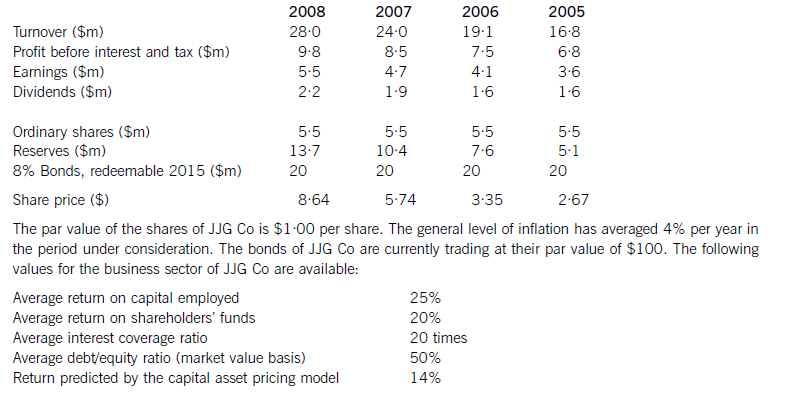
JJG Co is planning to raise $15 million of new finance for a major expansion of existing business and is considering a rights issue, a placing or an issue of bonds. The corporate objectives of JJG Co, as stated in its Annual Report, are to maximise the wealth of its shareholders and to achieve continuous growth in earnings per share. Recent financial information on JJG Co is as follows:
Required:
(a) Evaluate the financial performance of JJG Co, and analyse and discuss the extent to which the company has achieved its stated corporate objectives of:
(i) maximising the wealth of its shareholders;
(ii) achieving continuous growth in earnings per share.
Note: up to 7 marks are available for financial analysis.(12 marks)
(b) If the new finance is raised via a rights issue at $7·50 per share and the major expansion of business has
not yet begun, calculate and comment on the effect of the rights issue on:
(i) the share price of JJG Co;
(ii) the earnings per share of the company; and
(iii) the debt/equity ratio. (6 marks)
(c) Analyse and discuss the relative merits of a rights issue, a placing and an issue of bonds as ways of raising the finance for the expansion. (7 marks)
正确答案:
AchievementofcorporateobjectivesJJGCohasshareholderwealthmaximisationasanobjective.Thewealthofshareholdersisincreasedbydividendsreceivedandcapitalgainsonsharesowned.Totalshareholderreturncomparesthesumofthedividendreceivedandthecapitalgainwiththeopeningshareprice.TheshareholdersofJJGCohadareturnof58%in2008,comparedwithareturnpredictedbythecapitalassetpricingmodelof14%.Thelowestreturnshareholdershavereceivedwas21%andthehighestreturnwas82%.Onthisbasis,theshareholdersofthecompanyhaveexperiencedasignificantincreaseinwealth.Itisdebatablewhetherthishasbeenasaresultoftheactionsofthecompany,however.Sharepricesmayincreaseirrespectiveoftheactionsanddecisionsofmanagers,orevendespitethem.Infact,lookingatthedividendpersharehistoryofthecompany,therewasoneyear(2006)wheredividendswereconstant,eventhoughearningspershareincreased.Itisalsodifficulttoknowwhenwealthhasbeenmaximised.Anotherobjectiveofthecompanywastoachieveacontinuousincreaseinearningspershare.Analysisshowsthatearningspershareincreasedeveryyear,withanaverageincreaseof14·9%.Thisobjectiveappearstohavebeenachieved.CommentonfinancialperformanceReturnoncapitalemployed(ROCE)hasbeengrowingtowardsthesectoraverageof25%onayear-by-yearbasisfrom22%in2005.Thissteadygrowthintheprimaryaccountingratiocanbecontrastedwithirregulargrowthinturnover,thereasonsforwhichareunknown.Returnonshareholders’fundshasbeenconsistentlyhigherthantheaverageforthesector.ThismaybeduemoretothecapitalstructureofJJGCothantogoodperformancebythecompany,however,inthesensethatshareholders’fundsaresmalleronabookvaluebasisthanthelong-termdebtcapital.Ineverypreviousyearbut2008thegearingofthecompanywashigherthanthesectoraverage.(b)CalculationoftheoreticalexrightspershareCurrentshareprice=$8·64pershareCurrentnumberofshares=5·5millionsharesFinancetoberaised=$15mRightsissueprice=$7·50pershareNumberofsharesissued=15m/7·50=2millionsharesTheoreticalexrightspricepershare=((5·5mx8·64)+(2mx7·50))/7·5m=$8·34pershareThesharepricewouldfallfrom$8·64to$8·34pershareHowever,therewouldbenoeffectonshareholderwealthEffectofrightsissueonearningspershareCurrentEPS=100centspershareRevisedEPS=100x5·5m/7·5m=73centspershareTheEPSwouldfallfrom100centspershareto73centspershareHowever,asmentionedearlier,therewouldbenoeffectonshareholderwealthEffectofrightsissueonthedebt/equityratioCurrentdebt/equityratio=100x20/47·5=42%Revisedmarketvalueofequity=7·5mx8·34=$62·55millionReviseddebt/equityratio=100x20/62·55=32%Thedebt/equityratiowouldfallfrom42%to32%,whichiswellbelowthesectoraveragevalueandwouldsignalareductioninfinancialrisk(c)Thecurrentdebt/equityratioofJJGCois42%(20/47·5).Althoughthisislessthanthesectoraveragevalueof50%,itismoreusefulfromafinancialriskperspectivetolookattheextenttowhichinterestpaymentsarecoveredbyprofits.Theinterestonthebondissueis$1·6million(8%of$20m),givinganinterestcoverageratioof6·1times.IfJJGCohasoverdraftfinance,theinterestcoverageratiowillbelowerthanthis,butthereisinsufficientinformationtodetermineifanoverdraftexists.Theinterestcoverageratioisnotonlybelowthesectoraverage,itisalsolowenoughtobeacauseforconcern.Whiletheratioshowsanupwardtrendovertheperiodunderconsideration,itstillindicatesthatanissueoffurtherdebtwouldbeunwise.Aplacing,oranyissueofnewsharessuchasarightsissueorapublicoffer,woulddecreasegearing.Iftheexpansionofbusinessresultsinanincreaseinprofitbeforeinterestandtax,theinterestcoverageratiowillincreaseandfinancialriskwillfall.GiventhecurrentfinancialpositionofJJGCo,adecreaseinfinancialriskiscertainlypreferabletoanincrease.Aplacingwilldiluteownershipandcontrol,providingthenewequityissueistakenupbynewinstitutionalshareholders,whilearightsissuewillnotdiluteownershipandcontrol,providingexistingshareholderstakeuptheirrights.Abondissuedoesnothaveownershipandcontrolimplications,althoughrestrictiveornegativecovenantsinbondissuedocumentscanlimittheactionsofacompanyanditsmanagers.Allthreefinancingchoicesarelong-termsourcesoffinanceandsoareappropriateforalong-terminvestmentsuchastheproposedexpansionofexistingbusiness.Equityissuessuchasaplacingandarightsissuedonotrequiresecurity.Noinformationisprovidedonthenon-currentassetsofJJGCo,butitislikelythattheexistingbondissueissecured.Ifanewbondissuewasbeingconsidered,JJGCowouldneedtoconsiderwhetherithadsufficientnon-currentassetstoofferassecurity,althoughitislikelythatnewnon-currentassetswouldbeboughtaspartofthebusinessexpansion. -
第10题:
You are the audit supervisor of Maple & Co and are currently planning the audit of an existing client, Sycamore Science Co (Sycamore), whose year end was 30 April 2015. Sycamore is a pharmaceutical company, which manufactures and supplies a wide range of medical supplies. The draft financial statements show revenue of $35·6 million and profit before tax of $5·9 million.
Sycamore’s previous finance director left the company in December 2014 after it was discovered that he had been claiming fraudulent expenses from the company for a significant period of time. A new finance director was appointed in January 2015 who was previously a financial controller of a bank, and she has expressed surprise that Maple & Co had not uncovered the fraud during last year’s audit.
During the year Sycamore has spent $1·8 million on developing several new products. These projects are at different stages of development and the draft financial statements show the full amount of $1·8 million within intangible assets. In order to fund this development, $2·0 million was borrowed from the bank and is due for repayment over a ten-year period. The bank has attached minimum profit targets as part of the loan covenants.
The new finance director has informed the audit partner that since the year end there has been an increased number of sales returns and that in the month of May over $0·5 million of goods sold in April were returned.
Maple & Co attended the year-end inventory count at Sycamore’s warehouse. The auditor present raised concerns that during the count there were movements of goods in and out the warehouse and this process did not seem well controlled.
During the year, a review of plant and equipment in the factory was undertaken and surplus plant was sold, resulting in a profit on disposal of $210,000.
Required:
(a) State Maples & Co’s responsibilities in relation to the prevention and detection of fraud and error. (4 marks)
(b) Describe SIX audit risks, and explain the auditor’s response to each risk, in planning the audit of Sycamore Science Co. (12 marks)
(c) Sycamore’s new finance director has read about review engagements and is interested in the possibility of Maple & Co undertaking these in the future. However, she is unsure how these engagements differ from an external audit and how much assurance would be gained from this type of engagement.
Required:
(i) Explain the purpose of review engagements and how these differ from external audits; and (2 marks)
(ii) Describe the level of assurance provided by external audits and review engagements. (2 marks)
正确答案:(a) Fraud responsibility
Maple & Co must conduct an audit in accordance with ISA 240 The Auditor’s Responsibilities Relating to Fraud in an Audit of Financial Statements and are responsible for obtaining reasonable assurance that the financial statements taken as a whole are free from material misstatement, whether caused by fraud or error.
In order to fulfil this responsibility, Maple & Co is required to identify and assess the risks of material misstatement of the financial statements due to fraud.
They need to obtain sufficient appropriate audit evidence regarding the assessed risks of material misstatement due to fraud, through designing and implementing appropriate responses. In addition, Maple & Co must respond appropriately to fraud or suspected fraud identified during the audit.
When obtaining reasonable assurance, Maple & Co is responsible for maintaining professional scepticism throughout the audit, considering the potential for management override of controls and recognising the fact that audit procedures which are effective in detecting error may not be effective in detecting fraud.
To ensure that the whole engagement team is aware of the risks and responsibilities for fraud and error, ISAs require that a discussion is held within the team. For members not present at the meeting, Sycamore’s audit engagement partner should determine which matters are to be communicated to them.
(b) Audit risks and auditors’ responses
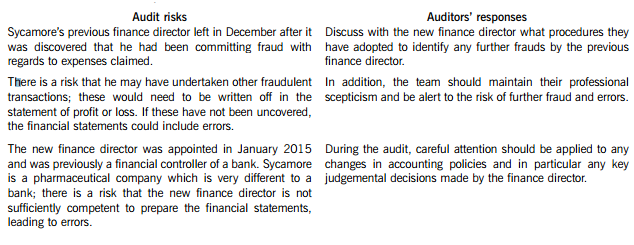
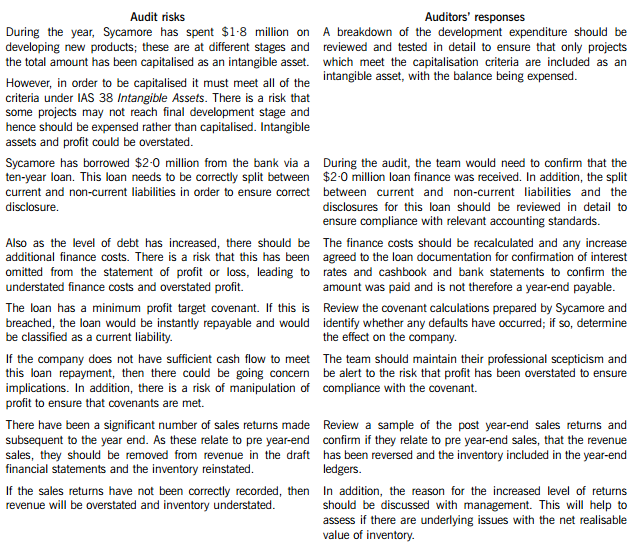
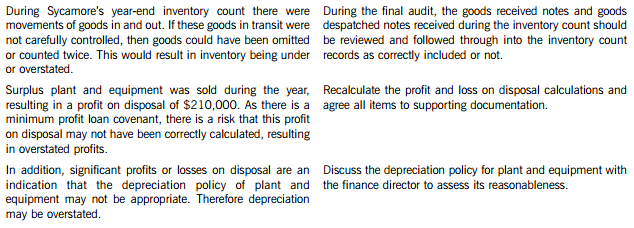
(c) (i) Review engagements
Review engagements are often undertaken as an alternative to an audit, and involve a practitioner reviewing financial data, such as six-monthly figures. This would involve the practitioner undertaking procedures to state whether anything has come to their attention which causes the practitioner to believe that the financial data is not in accordance with the financial reporting framework.
A review engagement differs to an external audit in that the procedures undertaken are not nearly as comprehensive as those in an audit, with procedures such as analytical review and enquiry used extensively. In addition, the practitioner does not need to comply with ISAs as these only relate to external audits.
(ii) Levels of assurance
The level of assurance provided by audit and review engagements is as follows:
External audit – A high but not absolute level of assurance is provided, this is known as reasonable assurance. This provides comfort that the financial statements present fairly in all material respects (or are true and fair) and are free of material misstatements.
Review engagements – where an opinion is being provided, the practitioner gathers sufficient evidence to be satisfied that the subject matter is plausible; in this case negative assurance is given whereby the practitioner confirms that nothing has come to their attention which indicates that the subject matter contains material misstatements.
-
第11题:
You are the audit manager of Chestnut & Co and are reviewing the key issues identified in the files of two audit clients.
Palm Industries Co (Palm)
Palm’s year end was 31 March 2015 and the draft financial statements show revenue of $28·2 million, receivables of $5·6 million and profit before tax of $4·8 million. The fieldwork stage for this audit has been completed.
A customer of Palm owed an amount of $350,000 at the year end. Testing of receivables in April highlighted that no amounts had been paid to Palm from this customer as they were disputing the quality of certain goods received from Palm. The finance director is confident the issue will be resolved and no allowance for receivables was made with regards to this balance.
Ash Trading Co (Ash)
Ash is a new client of Chestnut & Co, its year end was 31 January 2015 and the firm was only appointed auditors in February 2015, as the previous auditors were suddenly unable to undertake the audit. The fieldwork stage for this audit is currently ongoing.
The inventory count at Ash’s warehouse was undertaken on 31 January 2015 and was overseen by the company’s internal audit department. Neither Chestnut & Co nor the previous auditors attended the count. Detailed inventory records were maintained but it was not possible to undertake another full inventory count subsequent to the year end.
The draft financial statements show a profit before tax of $2·4 million, revenue of $10·1 million and inventory of $510,000.
Required:
For each of the two issues:
(i) Discuss the issue, including an assessment of whether it is material;
(ii) Recommend ONE procedure the audit team should undertake to try to resolve the issue; and
(iii) Describe the impact on the audit report if the issue remains UNRESOLVED.
Notes:
1 The total marks will be split equally between each of the two issues.
2 Audit report extracts are NOT required.
正确答案:Audit reports
Palm Industries Co (Palm)
(i) A customer of Palm’s owing $350,000 at the year end has not made any post year-end payments as they are disputing the quality of goods received. No allowance for receivables has been made against this balance. As the balance is being disputed, there is a risk of incorrect valuation as some or all of the receivable balance is overstated, as it may not be paid.
This $350,000 receivables balance represents 1·2% (0·35/28·2m) of revenue, 6·3% (0·35/5·6m) of receivables and 7·3% (0·35/4·8m) of profit before tax; hence this is a material issue.
(ii) A procedure to adopt includes:
– Review whether any payments have subsequently been made by this customer since the audit fieldwork was completed.
– Discuss with management whether the issue of quality of goods sold to the customer has been resolved, or whether it is still in dispute.
– Review the latest customer correspondence with regards to an assessment of the likelihood of the customer making payment.
(iii) If management refuses to provide against this receivable, the audit report will need to be modified. As receivables are overstated and the error is material but not pervasive a qualified opinion would be necessary.
A basis for qualified opinion paragraph would be needed and would include an explanation of the material misstatement in relation to the valuation of receivables and the effect on the financial statements. The opinion paragraph would be qualified ‘except for’.
Ash Trading Co (Ash)
(i) Chestnut & Co was only appointed as auditors subsequent to Ash’s year end and hence did not attend the year-end inventory count. Therefore, they have not been able to gather sufficient and appropriate audit evidence with regards to the completeness and existence of inventory.
Inventory is a material amount as it represents 21·3% (0·51/2·4m) of profit before tax and 5% (0·51/10·1m) of revenue; hence this is a material issue.
(ii) A procedure to adopt includes:
– Review the internal audit reports of the inventory count to identify the level of adjustments to the records to assess the reasonableness of relying on the inventory records.
– Undertake a sample check of inventory in the warehouse and compare to the inventory records and then from inventory records to the warehouse, to assess the reasonableness of the inventory records maintained by Ash.
(iii) The auditors will need to modify the audit report as they are unable to obtain sufficient appropriate evidence in relation to inventory which is a material but not pervasive balance. Therefore a qualified opinion will be required.
A basis for qualified opinion paragraph will be required to explain the limitation in relation to the lack of evidence over inventory. The opinion paragraph will be qualified ‘except for’.
-
第12题:
单选题Your network consists of a single Active Directory domain. All domain controllers run Windows Server2008 R2. Your company and an external partner plan to collaborate on a project. The external partner has an Active Directory domain that contains Windows Server 2008 R2 domain controllers. You need to design a collaboration solution that meets the following requirements: èAllows users to prevent sensitive documents from being forwarded to untrusted recipients or from being printed. èAllows users in the external partner organization to access the protected content to which they have been granted rights. èSends all inter-organizational traffic over port 443. èMinimizes the administrative effort required to manage the external users. What should you include in your design?()AEstablish a federated trust between your company and the external partner. Deploy a Windows Server 2008 R2 server that has Microsoft SharePoint Foundation 2010 installed.
BEstablish a federated trust between your company and the external partner. Deploy a Windows Server 2008 R2 server that runs Microsoft SharePoint 2010 and that has the Active Directory Rights Management Services (AD?RMS) role installed.
CEstablish an external forest trust between your company and the external partner. Deploy a Windows Server 2008 R2 server that has the Active Directory Certificate Services server role installed. Implement Encrypting File System (EFS).
DEstablish an external forest trust between your company and the external partner. Deploy a Windows Server 2008 R2 server that has the Active Directory Rights Management Service (AD?RMS)role installed and Microsoft SharePoint Foundation 2010 installed.
正确答案: A解析: 暂无解析 -
第13题:
3 Damian is the finance director of Linden Limited, a medium sized, unquoted, UK trading company, with a 31 July
year end. Damian personally owns 10% of the ordinary issued share capital of Linden Limited, for which he paid
£10,000 in June 1998. He estimates that the current market value of Linden Limited is £9 million and that the
company will make taxable profits of £1·4 million in the forthcoming year to 31 July 2007.
(a) Damian believes that Linden Limited should conduct its activities in a socially responsible manner and to this
end has proposed that in future all cars purchased by the company should be low emission vehicles. The sales
director has stated that several of his staff, who are the main recipients of company cars, other than the directors,
are extremely unhappy with this proposal, perceiving it as downgrading their value and status.
The cars currently provided to the sales staff have a list price of £19,600, on which Linden Limited receives a
bulk purchase discount of 6% from the dealer, and a CO2 emission rate of 168 grams/kilometre. The company
pays for up to £400 of accessories, of the salesmen’s own choice to be fitted to the cars and all of the running
costs, including private petrol. The cars are replaced every three years and the ‘old’ cars are sold at auction,
because they are high mileage vehicles.
The low emission cars it is proposed to purchase will have the same list price as the current cars, but the dealer
is only prepared to offer a bulk discount of 5% on these vehicles. Damian does not propose to make any other
changes to Linden Limited’s company car policy or practice.
Required:
(i) Explain the tax consequences of the proposed move to low emission vehicles for both the individual
salesmen and Linden Limited, illustrating your answer by means of relevant calculations of the tax and
national insurance (NIC) savings arising. (9 marks)
正确答案:
(a) (i) Individual salesmen
The taxable benefit is determined by the list price of the vehicle plus the cost of the accessories (£20,000) and the CO2
emission rate. The current vehicles have a CO2 emission rate of 168 grams/kilometre, so the benefit will be calculated
at the rate of 20% ((168 – 140)/5 + 15), resulting in a total annual car and car fuel benefit charge of £6,880 (20,000
x 20% + 14,400 x 20%). The low emission vehicles will be chargeable at the basic percentage rate of 15% resulting
in a total annual car and fuel benefit charge of £5,160 (20,000 x 15% + 14,400 x 15%). The salesmen will thus
make an annual income tax saving at their marginal rate of tax, i.e. £378 (1,720 x 22%) if they are basic rate taxpayers
and £688 (1,720 x 40%) if they are higher rate taxpayers.
Linden Limited
The current vehicles will be classed as ‘expensive’ cars based on the discounted list price plus the cost of the accessories
of £18,824 (19,600 x 94% + 400). The annual writing down allowances will thus be restricted to £3,000 throughout
the period of ownership, but there will be no restriction of the balancing allowance available on disposal. The low
emission vehicles will be eligible for a 100% first year allowance of £19,020 (19,600 x 95% + 400), but there will
also be a balancing charge on disposal equivalent to the sales proceeds. Therefore, the total of the allowances available
over the life of the cars will be effectively the same in both cases. As a single company with taxable profits of
£1·4 million, Linden Limited will pay corporation tax at the small companies marginal rate of 32·75% in the year to
31 July 2007, giving a tax benefit in that year of £5,247 for each low emission car purchased ((19,020 – 3,000) x
32·75%).
The company will also make an annual saving in terms of the Class 1A national insurance contributions payable on the
salesmen’s benefits of £220 ((6,880 – 5,160) x 12·8%). But, as these Class 1A contributions are deductible for
corporation tax, the net saving will only be £205 (220 x (100 – 32·75)%).
As the VAT liability payable on the provision of private fuel is based on engine capacity (not the CO2 emission rate) this
will not necessarily be affected. -
第14题:
(c) Explain the possible impact of RBG outsourcing its internal audit services on the audit of the financial
statements by Grey & Co. (4 marks)
正确答案:
(c) Impact on the audit of the financial statements
Tutorial note: The answer to this part should reflect that it is not the external auditor who is providing the internal audit
services. Thus comments regarding objectivity impairment are not relevant.
■ As Grey & Co is likely to be placing some reliance on RBG’s internal audit department in accordance with ISA 610
Considering the Work of Internal Auditing the degree of reliance should be reassessed.
■ The appointment will include an evaluation of organisational risk. The results of this will provide Grey with evidence,
for example:
– supporting the appropriateness of the going concern assumption;
– of indicators of obsolescence of goods or impairment of other assets.
■ As the quality of internal audit services should be higher than previously, providing a stronger control environment, the
extent to which Grey may rely on internal audit work could be increased. This would increase the efficiency of the
external audit of the financial statements as the need for substantive procedures should be reduced.
■ However, if internal audit services are performed on a part-time basis (e.g. fitting into the provider’s less busy months)
Grey must evaluate the impact of this on the prevention, detection and control of fraud and error.
■ The internal auditors will provide a body of expertise within RBG with whom Grey can consult on contentious matters.
Tutorial note: Appropriate credit will be given for arguing that less reliance may be placed on internal audit in this year of
change of provider. -
第15题:
5 You are the audit manager for three clients of Bertie & Co, a firm of Chartered Certified Accountants. The financial
year end for each client is 30 September 2007.
You are reviewing the audit senior’s proposed audit reports for two clients, Alpha Co and Deema Co.
Alpha Co, a listed company, permanently closed several factories in May 2007, with all costs of closure finalised and
paid in August 2007. The factories all produced the same item, which contributed 10% of Alpha Co’s total revenue
for the year ended 30 September 2007 (2006 – 23%). The closure has been discussed accurately and fully in the
chairman’s statement and Directors’ Report. However, the closure is not mentioned in the notes to the financial
statements, nor separately disclosed on the financial statements.
The audit senior has proposed an unmodified audit opinion for Alpha Co as the matter has been fully addressed in
the chairman’s statement and Directors’ Report.
In October 2007 a legal claim was filed against Deema Co, a retailer of toys. The claim is from a customer who slipped
on a greasy step outside one of the retail outlets. The matter has been fully disclosed as a material contingent liability
in the notes to the financial statements, and audit working papers provide sufficient evidence that no provision is
necessary as Deema Co’s lawyers have stated in writing that the likelihood of the claim succeeding is only possible.
The amount of the claim is fixed and is adequately covered by cash resources.
The audit senior proposes that the audit opinion for Deema Co should not be qualified, but that an emphasis of matter
paragraph should be included after the audit opinion to highlight the situation.
Hugh Co was incorporated in October 2006, using a bank loan for finance. Revenue for the first year of trading is
$750,000, and there are hopes of rapid growth in the next few years. The business retails luxury hand made wooden
toys, currently in a single retail outlet. The two directors (who also own all of the shares in Hugh Co) are aware that
due to the small size of the company, the financial statements do not have to be subject to annual external audit, but
they are unsure whether there would be any benefit in a voluntary audit of the first year financial statements. The
directors are also aware that a review of the financial statements could be performed as an alternative to a full audit.
Hugh Co currently employs a part-time, part-qualified accountant, Monty Parkes, who has prepared a year end
balance sheet and income statement, and who produces summary management accounts every three months.
Required:
(a) Evaluate whether the audit senior’s proposed audit report is appropriate, and where you disagree with the
proposed report, recommend the amendment necessary to the audit report of:
(i) Alpha Co; (6 marks)
正确答案:
5 BERTIE & CO
(a) (i) Alpha Co
The factory closures constitute a discontinued operation per IFRS 5 Non-Current Assets Held for Sale and Discontinued
Operations, due to the discontinuance of a separate major component of the business. It is a major component due to
the 10% contribution to revenue in the year to 30 September 2007 and 23% contribution in 2006. It is a separate
business component of the company due to the factories having made only one item, indicating a separate income
generating unit.
Under IFRS 5 there must be separate disclosure on the face of the income statement of the post tax results of the
discontinued operation, and of any profit or loss resulting from the closures. The revenue and costs of the discontinued
operation should be separately disclosed either on the face of the income statement or in the notes to the financial
statements. Cash flows relating to the discontinued operation should also be separately disclosed per IAS 7 Cash Flow
Statements.
In addition, as Alpha Co is a listed company, IFRS 8 Operating Segments requires separate segmental disclosure of
discontinued operations.
Failure to disclose the above information in the financial statements is a material breach of International Accounting
Standards. The audit opinion should therefore be qualified on the grounds of disagreement on disclosure (IFRS 5,
IAS 7 and IFRS 8). The matter is material, but not pervasive, and therefore an ‘except for’ opinion should be issued.
The opinion paragraph should clearly state the reason for the disagreement, and an indication of the financial
significance of the matter.
The audit opinion relates only to the financial statements which have been audited, and the contents of the other
information (chairman’s statement and Directors’ Report) are irrelevant when deciding if the financial statements show
a true and fair view, or are fairly presented.
Tutorial note: there is no indication in the question scenario that Alpha Co is in financial or operational difficulty
therefore no marks are awarded for irrelevant discussion of going concern issues and the resultant impact on the audit
opinion. -
第16题:
A new internal auditor, Daisy Rosepetal, has recently joined Bluebell Co. She has been asked by management to
establish and to monitor a variety of social and environmental Key Performance Indicators (KPIs). Daisy has no
experience in this area, and has asked you for some advice. It has been agreed with Bluebell Co’s audit committee
that you are to provide guidance to Daisy to help her in this part of her role, and that this does not impair the
objectivity of the audit.
(c) Recommend EIGHT KPIs which could be used to monitor Bluebell Co’s social and environmental
performance, and outline the nature of evidence that should be available to provide assurance on the
accuracy of the KPIs recommended. Your answer should be in the form. of briefing notes to be used at a
meeting with Daisy Rosepetal. (10 marks)
Note: requirement (c) includes 2 professional marks.
正确答案: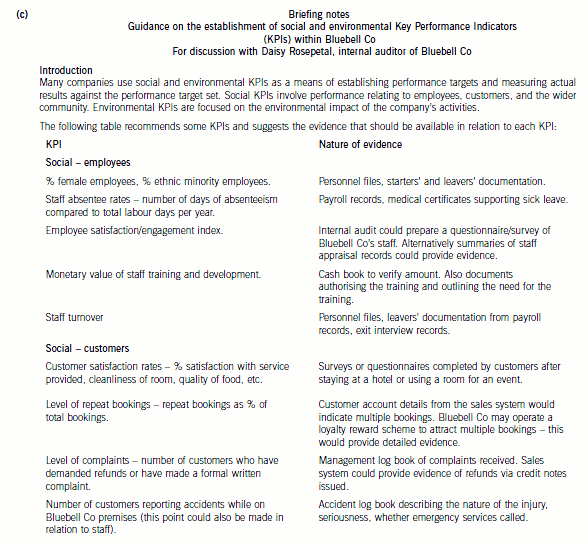
-
第17题:
Which term means “the profit that a company has obtained from selling its products or services in a particular period of time, in relation to its sales for the period”?A、Annual income
B、operation profit
C、return on sales
D、net profit
参考答案:C
-
第18题:
Shoe Co, a shoe manufacturer, has developed a new product called the ‘Smart Shoe’ for children, which has a built-in tracking device. The shoes are expected to have a life cycle of two years, at which point Shoe Co hopes to introduce a new type of Smart Shoe with even more advanced technology. Shoe Co plans to use life cycle costing to work out the total production cost of the Smart Shoe and the total estimated profit for the two-year period.
Shoe Co has spent $5·6m developing the Smart Shoe. The time spent on this development meant that the company missed out on the opportunity of earning an estimated $800,000 contribution from the sale of another product.
The company has applied for and been granted a ten-year patent for the technology, although it must be renewed each year at a cost of $200,000. The costs of the patent application were $500,000, which included $20,000 for the salary costs of Shoe Co’s lawyer, who is a permanent employee of the company and was responsible for preparing the application.
The following information is also available for the next two years:
Shoe Co is still negotiating with marketing companies with regard to its advertising campaign, so is uncertain as to what the total marketing costs will be each year. However, the following information is available as regards the probabilities of the range of costs which are likely to be incurred:
Required:
Applying the principles of life cycle costing, calculate the total expected profit for Shoe Co for the two-year period.
(10 marks)
正确答案:
Totalsalesrevenue=(280,000x$55)+(420,000x$45)=$15·4m+18·9m=$34·3m.NoteTheexpectedprofithasbeencalculatedusinglifecyclecostingnotrelevantcosting.Hence,the$20,000salarycostincludedinpatentcostsshouldbeincludedinthelifecyclecost.Similarly,theopportunitycostof$800,000isnotincludedusinglifecyclecostingwhereasifrelevantcostingwasbeingusedtodecideonaparticularcourseofaction,theopportunitycostwouldbeincluded.Working1Expectedmarketingcostinyear1:(0·2x$2·2m)+(0·5x$2·6m)+(0·3x$2·9m)=$2·61mExpectedmarketingcostyear2:(0·3x$1·8m)+(0·4x$2·1m)+(0·3x$2·3m)=$2·07mTotalexpectedmarketingcost=$4·68m -
第19题:
One of your audit clients is Tye Co a company providing petrol, aviation fuel and similar oil based products to the government of the country it is based in. Although the company is not listed on any stock exchange, it does follow best practice regarding corporate governance regulations. The audit work for this year is complete, apart from the matter referred to below.
As part of Tye Co’s service contract with the government, it is required to hold an emergency inventory reserve of 6,000 barrels of aviation fuel. The inventory is to be used if the supply of aviation fuel is interrupted due to unforeseen events such as natural disaster or terrorist activity.
This fuel has in the past been valued at its cost price of $15 a barrel. The current value of aviation fuel is $120 a barrel. Although the audit work is complete, as noted above, the directors of Tye Co have now decided to show the ‘real’ value of this closing inventory in the financial statements by valuing closing inventory of fuel at market value, which does not comply with relevant accounting standards. The draft financial statements of Tye Co currently show a profit of approximately $500,000 with net assets of $170 million.
Required:
(a) List the audit procedures and actions that you should now take in respect of the above matter. (6 marks)
(b) For the purposes of this section assume from part (a) that the directors have agreed to value inventory at
$15/barrel.
Having investigated the matter in part (a) above, the directors present you with an amended set of financial
statements showing the emergency reserve stated not at 6,000 barrels, but reported as 60,000 barrels. The final financial statements now show a profit following the inclusion of another 54,000 barrels of oil in inventory. When queried about the change from 6,000 to 60,000 barrels of inventory, the finance director stated that this change was made to meet expected amendments to emergency reserve requirements to be published in about six months time. The inventory will be purchased this year, and no liability will be shown in the financial statements for this future purchase. The finance director also pointed out that part of Tye Co’s contract with the government requires Tye Co to disclose an annual profit and that a review of bank loans is due in three months. Finally the finance director stated that if your audit firm qualifies the financial statements in respect of the increase in inventory, they will not be recommended for re-appointment at the annual general meeting. The finance director refuses to amend the financial statements to remove this ‘fictitious’ inventory.
Required:
(i) State the external auditor’s responsibilities regarding the detection of fraud; (4 marks)
(ii) Discuss to which groups the auditors of Tye Co could report the ‘fictitious’ aviation fuel inventory;
(6 marks)
(iii) Discuss the safeguards that the auditors of Tye Co can use in an attempt to overcome the intimidation
threat from the directors of Tye Co. (4 marks)
正确答案:
(a)Valuationofaviationinventory–ReviewGAAPtoensurethattherearenoexceptionsforaviationfuelorinventoryheldforemergencypurposeswhichwouldsuggestamarketvaluationshouldbeused.–Calculatethedifferenceinvaluation.Theerrorininventoryvaluationis$105*6,000barrelsor$630k,whichisamaterialamountcomparedtoprofit.–Reviewprioryearworkingpaperstodeterminewhetherasimilarsituationoccurredlastyearandascertaintheoutcomeatthatstage.–Discussthematterwiththedirectorstoobtainreasonswhytheybelievethatmarketvalueshouldbeusedfortheinventorythisyear.–Warnthedirectorsthatinyouropinion,aviationfuelshouldbevaluedatthelowerofcostornetrealisablevalue(thatis$15/barrel)andthatusingmarketvaluewillresultinamodificationtotheauditreport.–Ifthedirectorsnowamendthefinancialstatementstoshowinventoryvaluedatcost,thenconsidermentioningtheissueintheweaknessletteranddonotmodifytheauditreportinrespectofthismatter.–Ifthedirectorswillnotamendthefinancialstatements,quantifytheeffectofthedisagreementinthevaluationmethod–thesumof$630,000ismaterialtothefinancialstatementsasTyeCo’sincomestatementfigureisdecreasedfromasmalllosstoalossof$130,000althoughnetassetsdecreasebyonlyabout0·3%.–ObtainamanagementrepresentationletterfromthedirectorsofTyeCoconfirmingthatmarketvalueistobeusedfortheemergencyinventoryofaviationfuel.–Ifthedirectorswillnotamendthefinancialstatements,drafttherelevantsectionsoftheauditreport,showingaqualificationonthegroundsofdisagreementwiththeaccountingpolicyforvaluationofinventory.(b)(i)ExternalauditorresponsibilitiesregardingdetectionoffraudOverallresponsibilityofauditorTheexternalauditorisprimarilyresponsiblefortheauditopiniononthefinancialstatementsfollowingtheinternationalauditingstandards(ISAs).ISA240(Redrafted)TheAuditor’sResponsibilitiesRelatingtoFraudinanAuditofFinancialStatementsisrelevanttoauditworkregardingfraud.Themainfocusofauditworkisthereforetoensurethatthefinancialstatementsshowatrueandfairview.Thedetectionoffraudisthereforenotthemainfocusoftheexternalauditor’swork.Anauditorisresponsibleforobtainingreasonableassurancethatthefinancialstatementsasawholearefreefrommaterialmisstatement,whethercausedbyfraudorerror.Theauditorisresponsibleformaintaininganattitudeofprofessionalscepticismthroughouttheaudit,consideringthepotentialformanagementoverrideofcontrolsandrecognisingthefactthatauditproceduresthatareeffectivefordetectingerrormaynotbeeffectivefordetectingfraud.MaterialityISA240statesthattheauditorshouldreduceauditrisktoanacceptablylowlevel.Therefore,inreachingtheauditopinionandperformingauditwork,theexternalauditortakesintoaccounttheconceptofmateriality.Inotherwords,theexternalauditorisnotresponsibleforcheckingallthetransactions.Auditproceduresareplannedtohaveareasonablelikelihoodofidentifyingmaterialfraud.DiscussionamongtheauditteamAdiscussionisrequiredamongtheengagementteamplacingparticularemphasisonhowandwheretheentity’sfinancialstatementsmaybesusceptibletomaterialmisstatementduetofaud,includinghowfraudmightoccur.IdentificationoffraudInsituationswheretheexternalauditordoesdetectfraud,thentheauditorwillneedtoconsidertheimplicationsfortheentireaudit.Inotherwords,theexternalauditorhasaresponsibilitytoextendtestingintootherareasbecausetheriskofprovidinganincorrectauditopinionwillhaveincreased.(ii)GroupstoreportfraudtoReporttoauditcommitteeDisclosethesituationtotheauditcommitteeastheyarechargedwithmaintainingahighstandardofgovernanceinthecompany.Thecommitteeshouldbeabletodiscussthesituationwiththedirectorsandrecommendthattheytakeappropriateactione.g.amendthefinancialstatements.ReporttogovernmentAsTyeCoisactingunderagovernmentcontract,andtheover-statementofinventorywillmeanTyeCobreachesthatcontract(thereportedprofitbecomingaloss),thentheauditormayhavetoreportthesituationdirectlytothegovernment.TheauditorofTyeConeedstoreviewthecontracttoconfirmthereportingrequiredunderthatcontract.ReporttomembersIfthefinancialstatementsdonotshowatrueandfairviewthentheauditorneedstoreportthisfacttothemembersofTyeCo.Theauditreportwillbequalifiedwithanexceptfororadverseopinion(dependingonmateriality)andinformationconcerningthereasonforthedisagreementgiven.Inthiscasetheauditorislikelytostatefactuallytheproblemofinventoryquantitiesbeingincorrect,ratherthanstatingorimplyingthatthedirectorsareinvolvedinfraud.ReporttoprofessionalbodyIftheauditorisuncertainastothecorrectcourseofaction,advicemaybeobtainedfromtheauditor’sprofessionalbody.Dependingontheadvicereceived,theauditormaysimplyreporttothemembersintheauditreport,althoughresignationandtheconveningofageneralmeetingisanotherreportingoption.(iii)Intimidationthreat–safeguardsInresponsetotheimpliedthreatofdismissaliftheauditreportismodifiedregardingthepotentialfraud/error,thefollowingsafeguardsareavailabletotheauditor.DiscusswithauditcommitteeThesituationcanbediscussedwiththeauditcommittee.Astheauditcommitteeshouldcomprisenon-executivedirectors,theywillbeabletodiscussthesituationwiththefinancedirectorandpointoutclearlytheauditor’sopinion.Theycanalsoremindthedirectorsasawholethattheappointmentoftheauditorrestswiththemembersontherecommendationoftheauditcommittee.Iftherecommendationoftheauditcommitteeisrejectedbytheboard,goodcorporategovernancerequiresdisclosureofthereasonforrejection.ObtainsecondpartnerreviewTheengagementpartnercanaskasecondpartnertoreviewtheworkingpapersandotherevidencerelatingtotheissueofpossiblefraud.Whilethisactiondoesnotresolvetheissue,itdoesprovideadditionalassurancethatthefindingsandactionsoftheengagementpartnerarevalid.ResignationIfthematterisserious,thentheauditorcanconsiderresignationratherthannotbeingre-appointed.Resignationhastheadditionalsafeguardthattheauditorcannormallyrequirethedirectorstoconveneageneralmeetingtoconsiderthecircumstancesoftheresignation. -
第20题:
PV Co is evaluating an investment proposal to manufacture Product W33, which has performed well in test marketing trials conducted recently by the company’s research and development division. The following information relating to this investment proposal has now been prepared.
Initial investment $2 million
Selling price (current price terms) $20 per unit
Expected selling price inflation 3% per year
Variable operating costs (current price terms) $8 per unit
Fixed operating costs (current price terms) $170,000 per year
Expected operating cost inflation 4% per year
The research and development division has prepared the following demand forecast as a result of its test marketing trials. The forecast reflects expected technological change and its effect on the anticipated life-cycle of Product W33.

It is expected that all units of Product W33 produced will be sold, in line with the company’s policy of keeping no inventory of finished goods. No terminal value or machinery scrap value is expected at the end of four years, when production of Product W33 is planned to end. For investment appraisal purposes, PV Co uses a nominal (money) discount rate of 10% per year and a target return on capital employed of 30% per year. Ignore taxation.
Required:
(a) Identify and explain the key stages in the capital investment decision-making process, and the role of
investment appraisal in this process. (7 marks)
(b) Calculate the following values for the investment proposal:
(i) net present value;
(ii) internal rate of return;
(iii) return on capital employed (accounting rate of return) based on average investment; and
(iv) discounted payback period. (13 marks)
(c) Discuss your findings in each section of (b) above and advise whether the investment proposal is financially acceptable. (5 marks)
正确答案:
(a)Thekeystagesinthecapitalinvestmentdecision-makingprocessareidentifyinginvestmentopportunities,screeninginvestmentproposals,analysingandevaluatinginvestmentproposals,approvinginvestmentproposals,andimplementing,monitoringandreviewinginvestments.IdentifyinginvestmentopportunitiesInvestmentopportunitiesorproposalscouldarisefromanalysisofstrategicchoices,analysisofthebusinessenvironment,researchanddevelopment,orlegalrequirements.Thekeyrequirementisthatinvestmentproposalsshouldsupporttheachievementoforganisationalobjectives.ScreeninginvestmentproposalsIntherealworld,capitalmarketsareimperfect,soitisusualforcompaniestoberestrictedintheamountoffinanceavailableforcapitalinvestment.Companiesthereforeneedtochoosebetweencompetinginvestmentproposalsandselectthosewiththebeststrategicfitandthemostappropriateuseofeconomicresources.AnalysingandevaluatinginvestmentproposalsCandidateinvestmentproposalsneedtobeanalysedindepthandevaluatedtodeterminewhichofferthemostattractiveopportunitiestoachieveorganisationalobjectives,forexampletoincreaseshareholderwealth.Thisisthestagewhereinvestmentappraisalplaysakeyrole,indicatingforexamplewhichinvestmentproposalshavethehighestnetpresentvalue.ApprovinginvestmentproposalsThemostsuitableinvestmentproposalsarepassedtotherelevantlevelofauthorityforconsiderationandapproval.Verylargeproposalsmayrequireapprovalbytheboardofdirectors,whilesmallerproposalsmaybeapprovedatdivisionallevel,andsoon.Onceapprovalhasbeengiven,implementationcanbegin.Implementing,monitoringandreviewinginvestmentsThetimerequiredtoimplementtheinvestmentproposalorprojectwilldependonitssizeandcomplexity,andislikelytobeseveralmonths.Followingimplementation,theinvestmentprojectmustbemonitoredtoensurethattheexpectedresultsarebeingachievedandtheperformanceisasexpected.Thewholeoftheinvestmentdecision-makingprocessshouldalsobereviewedinordertofacilitateorganisationallearningandtoimprovefutureinvestmentdecisions. -
第21题:
Ms Huang, a shareholder of the Daqing Limited Liability Company (Daqing), found that the general manager, Mr Ding, had accepted bribes from several suppliers, which materially caused losses to Daqing, and adversely affected the interests of all shareholders.
Further examination, through a Certified Public Accountant firm, disclosed that there were a lot of affiliated transactions between Daqing and Everbright Co, which was the majority shareholder of Daqing. Mr Ding was recommended by Everbright Co and appointed by Daqing’s board of directors, which was substantially influenced by Everbright Co. With a series of such transactions Daqing transferred huge profits to Everbright Co and adversely affected Daqing.
Required:
(a) State whether Ms Huang was entitled to take legal action against Mr Ding for his illegal behaviour of accepting bribes which adversely affected all the shareholders. (2 marks)
(b) State TWO different legal actions Ms Huang was entitled to take to protect the rights of Daqing and its shareholders due to the affiliated transactions with Everbright Co. (4 marks)
正确答案:(a) Mr Ding’s act of accepting bribery violated the criminal law and the relevant rules of the Company Law as well. Besides the criminal charges, he should be liable for his fraudulent behaviour of damaging the interests of Daqing and its shareholders. Therefore, Ms Huang was entitled to bring a law suit against general manager Mr Ding on the ground that his acts caused her loss of interests.
(b) With respect to Daqing’s damage, Ms Huang should first request the board of directors or supervisory board to take legal action against Everbright Co. Where these two bodies refuse to take reasonable actions, Ms Huang might, in her own name but for the interests of the company, bring a shareholder representative litigation against Everbright Co. On the other hand, she might also bring a direct litigation against Everbright Co on the ground that the connected transactions caused indirect damage to the shareholder’s interests.
-
第22题:
Which of the following statements relating to internal and external auditors is correct?
A.Internal auditors are required to be members of a professional body
B.Internal auditors’ scope of work should be determined by those charged with governance
C.External auditors report to those charged with governance
D.Internal auditors can never be independent of the company
正确答案:BA is incorrect as internal auditors are not required to be members of any professional body. C is incorrect as external auditors report to shareholders rather than those charged with governance. D is incorrect as internal auditors can be independent of the company, if, for example, the internal audit function has been outsourced.
-
第23题:
Your network consists of a single Active Directory domain. All domain controllers run Windows Server2008 R2. Your company and an external partner plan to collaborate on a project. The external partner has an Active Directory domain that contains Windows Server 2008 R2 domain controllers. You need to design a collaboration solution that meets the following requirements: èAllows users to prevent sensitive documents from being forwarded to untrusted recipients or from being printed. èAllows users in the external partner organization to access the protected content to which they have been granted rights. èSends all inter-organizational traffic over port 443. èMinimizes the administrative effort required to manage the external users. What should you include in your design?()
- A、Establish a federated trust between your company and the external partner. Deploy a Windows Server 2008 R2 server that has Microsoft SharePoint Foundation 2010 installed.
- B、Establish a federated trust between your company and the external partner. Deploy a Windows Server 2008 R2 server that runs Microsoft SharePoint 2010 and that has the Active Directory Rights Management Services (AD?RMS) role installed.
- C、Establish an external forest trust between your company and the external partner. Deploy a Windows Server 2008 R2 server that has the Active Directory Certificate Services server role installed. Implement Encrypting File System (EFS).
- D、Establish an external forest trust between your company and the external partner. Deploy a Windows Server 2008 R2 server that has the Active Directory Rights Management Service (AD?RMS)role installed and Microsoft SharePoint Foundation 2010 installed.
正确答案:B