
(ii) Briefly explain the implications of Parr & Co’s audit opinion for your audit opinion on the consolidatedfinancial statements of Cleeves Co for the year ended 30 September 2006. (3 marks)
题目
(ii) Briefly explain the implications of Parr & Co’s audit opinion for your audit opinion on the consolidated
financial statements of Cleeves Co for the year ended 30 September 2006. (3 marks)
相似考题
更多“(ii) Briefly explain the implications of Parr Co’s audit opinion for your audit opinion on the consolidatedfinancial statements of Cleeves Co for the year ended 30 September 2006. (3 marks)”相关问题
-
第1题:
4 (a) Explain the auditor’s responsibilities in respect of subsequent events. (5 marks)
Required:
Identify and comment on the implications of the above matters for the auditor’s report on the financial
statements of Jinack Co for the year ended 30 September 2005 and, where appropriate, the year ending
30 September 2006.
NOTE: The mark allocation is shown against each of the matters.
正确答案:
4 JINACK CO
(a) Auditor’s responsibilities for subsequent events
■ Auditors must consider the effect of subsequent events on:
– the financial statements;
– the auditor’s report.
■ Subsequent events are all events occurring after a period end (i.e. reporting date) i.e.:
– events after the balance sheet date (as defined in IAS 10); and
– events after the financial statements have been authorised for issue.
Events occurring up to date of auditor’s report
■ The auditor is responsible for carrying out procedures designed to obtain sufficient appropriate audit evidence that all
events up to the date of the auditor’s report that may require adjustment of, or disclosure in, the financial statements
have been identified.
■ These procedures are in addition to those applied to specific transactions occurring after the period end that provide
audit evidence of period-end account balances (e.g. inventory cut-off and receipts from trade receivables). Such
procedures should ordinarily include:
– reviewing minutes of board/audit committee meetings;
– scrutinising latest interim financial statements/budgets/cash flows, etc;
– making/extending inquiries to legal advisors on litigation matters;
– inquiring of management whether any subsequent events have occurred that might affect the financial statements
(e.g. commitments entered into).
■ When the auditor becomes aware of events that materially affect the financial statements, the auditor must consider
whether they have been properly accounted for and adequately disclosed in the financial statements.
Facts discovered after the date of the auditor’s report but before financial statements are issued
Tutorial note: After the date of the auditor’s report it is management’s responsibility to inform. the auditor of facts which
may affect the financial statements.
■ If the auditor becomes aware of such facts which may materially affect the financial statements, the auditor:
– considers whether the financial statements need amendment;
– discusses the matter with management; and
– takes appropriate action (e.g. audit any amendments to the financial statements and issue a new auditor’s report).
■ If management does not amend the financial statements (where the auditor believes they need to be amended) and the
auditor’s report has not been released to the entity, the auditor should express a qualified opinion or an adverse opinion
(as appropriate).
■ If the auditor’s report has been released to the entity, the auditor must notify those charged with governance not to issue
the financial statements (and the auditor’s report thereon) to third parties.
Tutorial note: The auditor would seek legal advice if the financial statements and auditor’s report were subsequently issued.
Facts discovered after the financial statements have been issued
■ The auditor has no obligation to make any inquiry regarding financial statements that have been issued.
■ However, if the auditor becomes aware of a fact which existed at the date of the auditor’s report and which, if known
at that date, may have caused the auditor’s report to be modified, the auditor should:
– consider whether the financial statements need revision;
– discuss the matter with management; and
– take appropriate action (e.g. issuing a new report on revised financial statements). -
第2题:
(ii) Audit work on after-date bank transactions identified a transfer of cash from Batik Co. The audit senior has
documented that the finance director explained that Batik commenced trading on 7 October 2005, after
being set up as a wholly-owned foreign subsidiary of Jinack. No other evidence has been obtained.
(4 marks)
Required:
Identify and comment on the implications of the above matters for the auditor’s report on the financial
statements of Jinack Co for the year ended 30 September 2005 and, where appropriate, the year ending
30 September 2006.
NOTE: The mark allocation is shown against each of the matters.
正确答案:
(ii) Wholly-owned foreign subsidiary
■ The cash transfer is a non-adjusting post balance sheet event. It indicates that Batik was trading after the balance
sheet date. However, that does not preclude Batik having commenced trading before the year end.
■ The finance director’s oral representation is wholly insufficient evidence with regard to the existence (or otherwise)
of Batik at 30 September 2005. If it existed at the balance sheet date its financial statements should have been
consolidated (unless immaterial).
■ The lack of evidence that might reasonably be expected to be available (e.g. legal papers, registration payments,
etc) suggests a limitation on the scope of the audit.
■ If such evidence has been sought but not obtained then the limitation is imposed by the entity (rather than by
circumstances).
■ Whilst the transaction itself may not be material, the information concerning the existence of Batik may be material
to users and should therefore be disclosed (as a non-adjusting event). The absence of such disclosure, if the
auditor considered necessary, would result in a qualified ‘except for’, opinion.
Tutorial note: Any matter that is considered sufficiently material to be worthy of disclosure as a non-adjusting
event must result in such a qualified opinion if the disclosure is not made.
■ If Batik existed at the balance sheet date and had material assets and liabilities then its non-consolidation would
have a pervasive effect. This would warrant an adverse opinion.
■ Also, the nature of the limitation (being imposed by the entity) could have a pervasive effect if the auditor is
suspicious that other audit evidence has been withheld. In this case the auditor should disclaim an opinion. -
第3题:
(b) A sale of industrial equipment to Deakin Co in May 2005 resulted in a loss on disposal of $0·3 million that has
been separately disclosed on the face of the income statement. The equipment cost $1·2 million when it was
purchased in April 1996 and was being depreciated on a straight-line basis over 20 years. (6 marks)
Required:
For each of the above issues:
(i) comment on the matters that you should consider; and
(ii) state the audit evidence that you should expect to find,
in undertaking your review of the audit working papers and financial statements of Keffler Co for the year ended
31 March 2006.
NOTE: The mark allocation is shown against each of the three issues.
正确答案:
(b) Sale of industrial equipment
(i) Matters
■ The industrial equipment was in use for nine years (from April 1996) and would have had a carrying value of
$660,000 at 31 March 2005 (11/20 × $1·2m – assuming nil residual value and a full year’s depreciation charge
in the year of acquisition and none in the year of disposal). Disposal proceeds were therefore only $360,000.
■ The $0·3m loss represents 15% of PBT (for the year to 31 March 2006) and is therefore material. The equipment
was material to the balance sheet at 31 March 2005 representing 2·6% of total assets ($0·66/$25·7 × 100).
■ Separate disclosure, of a material loss on disposal, on the face of the income statement is in accordance with
IAS 16 ‘Property, Plant and Equipment’. However, in accordance with IAS 1 ‘Presentation of Financial Statements’,
it should not be captioned in any way that might suggest that it is not part of normal operating activities (i.e. not
‘extraordinary’, ‘exceptional’, etc).
Tutorial note: However, note that if there is a prior period error to be accounted for (see later), there would be
no impact on the current period income statement requiring consideration of any disclosure.
■ The reason for the sale. For example, whether the equipment was:
– surplus to operating requirements (i.e. not being replaced); or
– being replaced with newer equipment (thereby contributing to the $8·1m increase (33·8 – 25·7) in total
assets).
■ The reason for the loss on sale. For example, whether:
– the sale was at an under-value (e.g. to a related party);
– the equipment had a bad maintenance history (or was otherwise impaired);
– the useful life of the equipment is less than 20 years;
– there is any deferred consideration not yet recorded;
– any non-cash disposal proceeds have been overlooked (e.g. if another asset was acquired in a part-exchange).
■ If the useful life was less than 20 years, tangible non-current assets may be materially overstated in respect of other
items of equipment that are still in use and being depreciated on the same basis.
■ If the sale was to a related party then additional disclosure should be required in a note to the financial statements
for the year to 31 March 2006 (IAS 24 ‘Related Party Disclosures’).
Tutorial note: Since there are no specific pointers to a related party transaction (RPT), this point is not expanded
on.
■ Whether the sale was identified in the prior year audit’s post balance sheet event review. If so:
– the disclosure made in the prior year’s financial statements (IAS 10 ‘Events After the Balance Sheet Date’);
– whether an impairment loss was recognised at 31 March 2005.
■ If not, and the equipment was impaired at 31 March 2005, a prior period error should be accounted for (IAS 8
‘Accounting Policies, Changes in Accounting Estimates and Errors’). An impairment loss of $0·3m would have
been material to prior year profit (12·5%).
Tutorial note: Unless this was a RPT or the impairment arose after 31 March 2005 a prior period adjustment
should be made.
■ Failure to account for a prior period error (if any) would result in modification of the audit opinion ‘except for’ noncompliance
with IAS 8 (in the current year) and IAS 36 (in the prior period).
(ii) Audit evidence
■ Carrying amount ($0·66m as above) agreed to the non-current asset register balances at 31 March 2005 and
recalculation of the loss on disposal.
■ Cost and accumulated depreciation removed from the asset register in the year to 31 March 2006.
■ Receipt of proceeds per cash book agreed to bank statement.
■ Sales invoice transferring title to Deakin.
■ A review of maintenance expenses and records (e.g. to confirm reason for loss on sale).
■ Post balance sheet event review on prior year audit working papers file.
■ Management representation confirming that Deakin is not a related party (provided that there is no evidence to
suggest otherwise). -
第4题:
5 You are an audit manager in Fox & Steeple, a firm of Chartered Certified Accountants, responsible for allocating staff
to the following three audits of financial statements for the year ending 31 December 2006:
(a) Blythe Co is a new audit client. This private company is a local manufacturer and distributor of sportswear. The
company’s finance director, Peter, sees little value in the audit and put it out to tender last year as a cost-cutting
exercise. In accordance with the requirements of the invitation to tender your firm indicated that there would not
be an interim audit.
(b) Huggins Co, a long-standing client, operates a national supermarket chain. Your firm provided Huggins Co with
corporate financial advice on obtaining a listing on a recognised stock exchange in 2005. Senior management
expects a thorough examination of the company’s computerised systems, and are also seeking assurance that
the annual report will not attract adverse criticism.
(c) Gray Co has been an audit client since 1999 after your firm advised management on a successful buyout. Gray
provides communication services and software solutions. Your firm provides Gray with technical advice on
financial reporting and tax services. Most recently you have been asked to conduct due diligence reviews on
potential acquisitions.
Required:
For these assignments, compare and contrast:
(i) the threats to independence;
(ii) the other professional and practical matters that arise; and
(iii) the implications for allocating staff.
(15 marks)
正确答案:
5 FOX & STEEPLE – THREE AUDIT ASSIGNMENTS
(i) Threats to independence
Self-interest
Tutorial note: This threat arises when a firm or a member of the audit team could benefit from a financial interest in, or
other self-interest conflict with, an assurance client.
■ A self-interest threat could potentially arise in respect of any (or all) of these assignments as, regardless of any fee
restrictions (e.g. per IFAC’s ‘Code of Ethics for Professional Accountants’), the auditor is remunerated by clients for
services provided.
■ This threat is likely to be greater for Huggins Co (larger/listed) and Gray Co (requires other services) than for Blythe Co
(audit a statutory necessity).
■ The self-interest threat may be greatest for Huggins Co. As a company listed on a recognised stock exchange it may
give prestige and credibility to Fox & Steeple (though this may be reciprocated). Fox & Steeple could be pressurised into
taking evasive action to avoid the loss of a listed client (e.g. concurring with an inappropriate accounting treatment).
Self-review
Tutorial note: This arises when, for example, any product or judgment of a previous engagement needs to be re-evaluated
in reaching conclusions on the audit engagement.
■ This threat is also likely to be greater for Huggins and Gray where Fox & Steeple is providing other (non-audit) services.
■ A self-review threat may be created by Fox & Steeple providing Huggins with a ‘thorough examination’ of its computerised
systems if it involves an extension of the procedures required to conduct an audit in accordance with International
Standards on Auditing (ISAs).
■ Appropriate safeguards must be put in place if Fox & Steeple assists Huggins in the performance of internal audit
activities. In particular, Fox & Steeple’s personnel must not act (or appear to act) in a capacity equivalent to a member
of Huggins’ management (e.g. reporting, in a management role, to those charged with governance).
■ Fox & Steeple may provide Gray with accounting and bookkeeping services, as Gray is not a listed entity, provided that
any self-review threat created is reduced to an acceptable level. In particular, in giving technical advice on financial
reporting, Fox & Steeple must take care not to make managerial decisions such as determining or changing journal
entries without obtaining Gray’s approval.
■ Taxation services comprise a broad range of services, including compliance, planning, provision of formal taxation
opinions and assistance in the resolution of tax disputes. Such assignments are generally not seen to create threats to
independence.
Tutorial note: It is assumed that the provision of tax services is permitted in the jurisdiction (i.e. that Fox and Steeple
are not providing such services if prohibited).
■ The due diligence reviews for Gray may create a self-review threat (e.g. on the fair valuation of net assets acquired).
However, safeguards may be available to reduce these threats to an acceptable level.
■ If staff involved in providing other services are also assigned to the audit, their work should be reviewed by more senior
staff not involved in the provision of the other services (to the extent that the other service is relevant to the audit).
■ The reporting lines of any staff involved in the audit of Huggins and the provision of other services for Huggins should
be different. (Similarly for Gray.)
Familiarity
Tutorial note: This arises when, by virtue of a close relationship with an audit client (or its management or employees) an
audit firm (or a member of the audit team) becomes too sympathetic to the client’s interests.
■ Long association of a senior member of an audit team with an audit client may create a familiarity threat. This threat
is likely to be greatest for Huggins, a long-standing client. It may also be significant for Gray as Fox & Steeple have had
dealings with this client for seven years now.
■ As Blythe is a new audit client this particular threat does not appear to be relevant.
■ Senior personnel should be rotated off the Huggins and Gray audit teams. If this is not possible (for either client), an
additional professional accountant who was not a member of the audit team should be required to independently review
the work done by the senior personnel.
■ The familiarity threat of using the same lead engagement partner on an audit over a prolonged period is particularly
relevant to Huggins, which is now a listed entity. IFAC’s ‘Code of Ethics for Professional Accountants’ requires that the
lead engagement partner should be rotated after a pre-defined period, normally no more than seven years. Although it
might be time for the lead engagement partner of Huggins to be changed, the current lead engagement partner may
continue to serve for the 2006 audit.
Tutorial note: Two additional years are permitted when an existing client becomes listed, since it may not be in the
client’s best interests to have an immediate rotation of engagement partner.
Intimidation
Tutorial note: This arises when a member of the audit team may be deterred from acting objectively and exercising
professional skepticism by threat (actual or perceived), from the audit client.
■ This threat is most likely to come from Blythe as auditors are threatened with a tendering process to keep fees down.
■ Peter may have already applied pressure to reduce inappropriately the extent of audit work performed in order to reduce
fees, by stipulating that there should not be an interim audit.
■ The audit senior allocated to Blythe will need to be experienced in standing up to client management personnel such as
Peter.
Tutorial note: ‘Correct’ classification under ‘ethical’, ‘other professional’, ‘practical’ or ‘staff implications’ is not as important
as identifying the matters.
(ii) Other professional and practical matters
Tutorial note: ‘Other professional’ includes quality control.
■ The experience of staff allocated to each assignment should be commensurate with the assessment of associated risk.
For example, there may be a risk that insufficient audit evidence is obtained within the budget for the audit of Blythe.
Huggins, as a listed client, carries a high reputational risk.
■ Sufficient appropriate staff should be allocated to each audit to ensure adequate quality control (in particular in the
direction, supervision, review of each assignment). It may be appropriate for a second partner to be assigned to carry
out a ‘hot review’ (before the auditor’s report is signed) of:
– Blythe, because it is the first audit of a new client; and
– Huggins, as it is listed.
■ Existing clients (Huggins and Gray) may already have some expectation regarding who should be assigned to their
audits. There is no reason why there should not be some continuity of staff providing appropriate safeguards are put in
place (e.g. to overcome any familiarity threat).
■ Senior staff assigned to Blythe should be alerted to the need to exercise a high degree of professional skepticism (in the
light of Peter’s attitude towards the audit).
■ New staff assigned to Huggins and Gray would perhaps be less likely to assume unquestioned honesty than staff
previously involved with these audits.
Logistics (practical)
■ All three assignments have the same financial year end, therefore there will be an element of ‘competition’ for the staff
to be assigned to the year-end visits and final audit assignments. As a listed company, Huggins is likely to have the
tightest reporting deadline and so have a ‘priority’ for staff.
■ Blythe is a local and private company. Staff involved in the year-end visit (e.g. to attend the physical inventory count)
should also be involved in the final audit. As this is a new client, staff assigned to this audit should get involved at every
stage to increase their knowledge and understanding of the business.
■ Huggins is a national operation and may require numerous staff to attend year-end procedures. It would not be expected
that all staff assigned to year-end visits should all be involved in the final audit.
Time/fee/staff budgets
■ Time budgets will need to be prepared for each assignment to determine manpower requirements (and to schedule audit
work).
(iii) Implications for allocating staff
■ Fox & Steeple should allocate staff so that those providing other services to Huggins and Gray (that may create a selfreview
threat) do not participate in the audit engagement.
Competence and due care (Qualifications/Specialisation)
■ All audit assignments will require competent staff.
■ Huggins will require staff with an in-depth knowledge of their computerised system.
■ Gray will require senior audit staff to be experienced in financial reporting matters specific to communications and
software solutions (e.g. in revenue recognition issues and accounting for internally-generated intangible assets).
■ Specialists providing tax services and undertaking the due diligence reviews for Gray may not be required to have any
involvement in the audit assignment. -
第5题:
3 You are the manager responsible for the audit of Seymour Co. The company offers information, proprietary foods and
medical innovations designed to improve the quality of life. (Proprietary foods are marketed under and protected by
registered names.) The draft consolidated financial statements for the year ended 30 September 2006 show revenue
of $74·4 million (2005 – $69·2 million), profit before taxation of $13·2 million (2005 – $15·8 million) and total
assets of $53·3 million (2005 – $40·5 million).
The following issues arising during the final audit have been noted on a schedule of points for your attention:
(a) In 2001, Seymour had been awarded a 20-year patent on a new drug, Tournose, that was also approved for
food use. The drug had been developed at a cost of $4 million which is being amortised over the life of the
patent. The patent cost $11,600. In September 2006 a competitor announced the successful completion of
preliminary trials on an alternative drug with the same beneficial properties as Tournose. The alternative drug is
expected to be readily available in two years time. (7 marks)
Required:
For each of the above issues:
(i) comment on the matters that you should consider; and
(ii) state the audit evidence that you should expect to find,
in undertaking your review of the audit working papers and financial statements of Seymour Co for the year ended
30 September 2006.
NOTE: The mark allocation is shown against each of the three issues.
正确答案: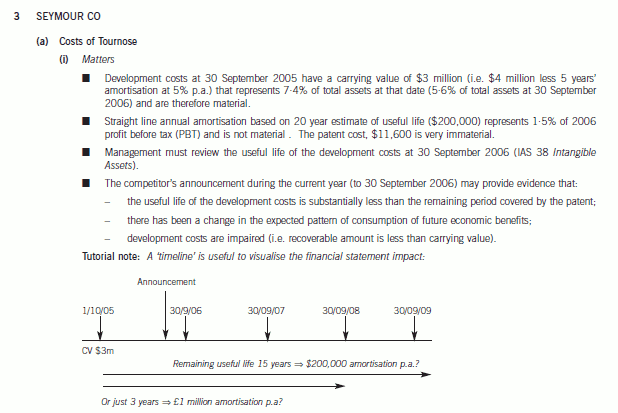
■ A change in the estimated useful life should be accounted for as a change in accounting estimate in accordance
with IAS 8 Accounting Policies, Changes in Accounting Estimates and Errors. For example, if the development
costs have little, if any, useful life after the introduction of the alternative drug (‘worst case’ scenario), the carrying
value ($3 million) should be written off over the current and remaining years, i.e. $1 million p.a. The increase in
amortisation/decrease in carrying value ($800,000) is material to PBT (6%) and total assets (1·5%).
■ Similarly a change in the expected pattern of consumption of the future economic benefits should be accounted for
as a change in accounting estimate (IAS 8). For example, it may be that the useful life is still to 2020 but that
the economic benefits may reduce significantly in two years time.
■ After adjusting the carrying amount to take account of the change in accounting estimate(s) management should
have tested it for impairment and any impairment loss recognised in profit or loss.
(ii) Audit evidence
■ $3 million carrying amount of development costs brought forward agreed to prior year working papers and financial
statements.
■ A copy of the press release announcing the competitor’s alternative drug.
■ Management’s projections of future cashflows from Tournose-related sales as evidence of the useful life of the
development costs and pattern of consumption.
■ Reperformance of management’s impairment test on the development costs: Recalculation of management’s
calculation of the carrying amount after revising estimates of useful life and/or consumption of benefits compared
with management’s calculation of value in use.
■ Sensitivity analysis on management’s key assumptions (e.g. estimates of useful life, discount rate).
■ Written management representation on the key assumptions concerning the future that have a significant risk of
causing material adjustment to the carrying amount of the development costs. (These assumptions should be
disclosed in accordance with IAS 1 Presentation of Financial Statements.) -
第6题:
(c) In November 2006 Seymour announced the recall and discontinuation of a range of petcare products. The
product recall was prompted by the high level of customer returns due to claims of poor quality. For the year to
30 September 2006, the product range represented $8·9 million of consolidated revenue (2005 – $9·6 million)
and $1·3 million loss before tax (2005 – $0·4 million profit before tax). The results of the ‘petcare’ operations
are disclosed separately on the face of the income statement. (6 marks)
Required:
For each of the above issues:
(i) comment on the matters that you should consider; and
(ii) state the audit evidence that you should expect to find,
in undertaking your review of the audit working papers and financial statements of Seymour Co for the year ended
30 September 2006.
NOTE: The mark allocation is shown against each of the three issues.
正确答案:
■ The discontinuation of the product line after the balance sheet date provides additional evidence that, as at the
balance sheet date, it was of poor quality. Therefore, as at the balance sheet date:
– an allowance (‘provision’) may be required for credit notes for returns of products after the year end that were
sold before the year end;
– goods returned to inventory should be written down to net realisable value (may be nil);
– any plant and equipment used exclusively in the production of the petcare range of products should be tested
for impairment;
– any material contingent liabilities arising from legal claims should be disclosed.
(ii) Audit evidence
■ A copy of Seymour’s announcement (external ‘press release’ and any internal memorandum).
■ Credit notes raised/refunds paid after the year end for faulty products returned.
■ Condition of products returned as inspected during physical attendance of inventory count.
■ Correspondence from customers claiming reimbursement/compensation for poor quality.
■ Direct confirmation from legal adviser (solicitor) regarding any claims for customers including estimates of possible
payouts. -
第7题:
(b) Explain what effect the acquisition of Di Rollo Co will have on the planning of your audit of the consolidated
financial statements of Murray Co for the year ending 31 March 2008. (10 marks)
正确答案:
(b) Effect of acquisition on planning the audit of Murray’s consolidated financial statements for the year ending 31 March
2008
Group structure
The new group structure must be ascertained to identify all entities that should be consolidated into the Murray group’s
financial statements for the year ending 31 March 2008.
Materiality assessment
Preliminary materiality for the group will be much higher, in monetary terms, than in the prior year. For example, if a % of
total assets is a determinant of the preliminary materiality, it may be increased by 10% (as the fair value of assets acquired,
including goodwill, is $2,373,000 compared with $21·5m in Murray’s consolidated financial statements for the year ended
31 March 2007).
The materiality of each subsidiary should be re-assessed, in terms of the enlarged group as at the planning stage. For
example, any subsidiary that was just material for the year ended 31 March 2007 may no longer be material to the group.
This assessment will identify, for example:
– those entities requiring an audit visit; and
– those entities for which substantive analytical procedures may suffice.
As Di Rollo’s assets are material to the group Ross should plan to inspect the South American operations. The visit may
include a meeting with Di Rollo’s previous auditors to discuss any problems that might affect the balances at acquisition and
a review of the prior year audit working papers, with their permission.
Di Rollo was acquired two months into the financial year therefore its post-acquisition results should be expected to be
material to the consolidated income statement.
Goodwill acquired
The assets and liabilities of Di Rollo at 31 March 2008 will be combined on a line-by-line basis into the consolidated financial
statements of Murray and goodwill arising on acquisition recognised.
Audit work on the fair value of the Di Rollo brand name at acquisition, $600,000, may include a review of a brand valuation
specialist’s working papers and an assessment of the reasonableness of assumptions made.
Significant items of plant are likely to have been independently valued prior to the acquisition. It may be appropriate to plan
to place reliance on the work of expert valuers. The fair value adjustment on plant and equipment is very high (441% of
carrying amount at the date of acquisition). This may suggest that Di Rollo’s depreciation policies are over-prudent (e.g. if
accelerated depreciation allowed for tax purposes is accounted for under local GAAP).
As the amount of goodwill is very material (approximately 50% of the cash consideration) it may be overstated if Murray has
failed to recognise any assets acquired in the purchase of Di Rollo in accordance with IFRS 3 Business Combinations. For
example, Murray may have acquired intangible assets such as customer lists or franchises that should be recognised
separately from goodwill and amortised (rather than tested for impairment).
Subsequent impairment
The audit plan should draw attention to the need to consider whether the Di Rollo brand name and goodwill arising have
suffered impairment as a result of the allegations against Di Rollo’s former chief executive.
Liabilities
Proceedings in the legal claim made by Di Rollo’s former chief executive will need to be reviewed. If the case is not resolved
at 31 March 2008, a contingent liability may require disclosure in the consolidated financial statements, depending on the
materiality of amounts involved. Legal opinion on the likelihood of Di Rollo successfully defending the claim may be sought.
Provision should be made for any actual liabilities, such as legal fees.
Group (related party) transactions and balances
A list of all the companies in the group (including any associates) should be included in group audit instructions to ensure
that intra-group transactions and balances (and any unrealised profits and losses on transactions with associates) are
identified for elimination on consolidation. Any transfer pricing policies (e.g. for clothes manufactured by Di Rollo for Murray
and sales of Di Rollo’s accessories to Murray’s retail stores) must be ascertained and any provisions for unrealised profit
eliminated on consolidation.
It should be confirmed at the planning stage that inter-company transactions are identified as such in the accounting systems
of all companies and that inter-company balances are regularly reconciled. (Problems are likely to arise if new inter-company
balances are not identified/reconciled. In particular, exchange differences are to be expected.)
Other auditors
If Ross plans to use the work of other auditors in South America (rather than send its own staff to undertake the audit of Di
Rollo), group instructions will need to be sent containing:
– proforma statements;
– a list of group and associated companies;
– a statement of group accounting policies (see below);
– the timetable for the preparation of the group accounts (see below);
– a request for copies of management letters;
– an audit work summary questionnaire or checklist;
– contact details (of senior members of Ross’s audit team).
Accounting policies
Di Rollo may have material accounting policies which do not comply with the rest of the Murray group. As auditor to Di Rollo,
Ross will be able to recalculate the effect of any non-compliance with a group accounting policy (that Murray’s management
would be adjusting on consolidation).
Timetable
The timetable for the preparation of Murray’s consolidated financial statements should be agreed with management as soon
as possible. Key dates should be planned for:
– agreement of inter-company balances and transactions;
– submission of proforma statements;
– completion of the consolidation package;
– tax review of group accounts;
– completion of audit fieldwork by other auditors;
– subsequent events review;
– final clearance on accounts of subsidiaries;
– Ross’s final clearance of consolidated financial statements.
Tutorial note: The order of dates is illustrative rather than prescriptive. -
第8题:
(c) Lamont owns a residential apartment above its head office. Until 31 December 2006 it was let for $3,000 a
month. Since 1 January 2007 it has been occupied rent-free by the senior sales executive. (6 marks)
Required:
For each of the above issues:
(i) comment on the matters that you should consider; and
(ii) state the audit evidence that you should expect to find,
in undertaking your review of the audit working papers and financial statements of Lamont Co for the year ended
31 March 2007.
NOTE: The mark allocation is shown against each of the three issues.
正确答案:
(c) Rent-free accommodation
(i) Matters
■ The senior sales executive is a member of Lamont’s key management personnel and is therefore a related party.
■ The occupation of Lamont’s residential apartment by the senior sales executive is therefore a related party
transaction, even though no price is charged (IAS 24 Related Party Disclosures).
■ Related party transactions are material by nature and information about them should be disclosed so that users of
financial statements understand the potential effect of related party relationships on the financial statements.
■ The provision of ‘housing’ is a non-monetary benefit that should be included in the disclosure of key management
personnel compensation (within the category of short-term employee benefits).
■ The financial statements for the year ended 31 March 2007 should disclose the arrangement for providing the
senior sales executive with rent-free accommodation and its fair value (i.e. $3,000 per month).
Tutorial note: Since no price is charged for the transaction, rote-learned disclosures such as ‘the amount of outstanding
balances’ and ‘expense recognised in respect of bad debts’ are irrelevant.
(ii) Audit evidence
■ Physical inspection of the apartment to confirm that it is occupied.
■ Written representation from the senior sales executive that he is occupying the apartment free of charge.
■ Written representation from the management board confirming that there are no related party transactions requiring
disclosure other than those that have been disclosed.
■ Inspection of the lease agreement with (or payments received from) the previous tenant to confirm the $3,000
monthly rental value. -
第9题:
(b) Explain the principal audit procedures to be performed during the final audit in respect of the estimated
warranty provision in the balance sheet of Island Co as at 30 November 2007. (5 marks)
正确答案:
(b) ISA 540 Audit of Accounting Estimates requires that auditors should obtain sufficient audit evidence as to whether an
accounting estimate, such as a warranty provision, is reasonable given the entity’s circumstances, and that disclosure is
appropriate. One, or a combination of the following approaches should be used:
Review and test the process used by management to develop the estimate
– Review contracts or orders for the terms of the warranty to gain an understanding of the obligation of Island Co
– Review correspondence with customers during the year to gain an understanding of claims already in progress at the
year end
– Perform. analytical procedures to compare the level of warranty provision year on year, and compare actual to budgeted
provisions. If possible disaggregate the data, for example, compare provision for specific types of machinery or customer
by customer
– Re-calculate the warranty provision
– Agree the percentage applied in the calculation to the stated accounting policy of Island Co
– Review board minutes for discussion of on-going warranty claims, and for approval of the amount provided
– Use management accounts to ascertain normal level of warranty rectification costs during the year
– Discuss with Kate Shannon the assumptions she used to determine the percentage used in her calculations
– Consider whether assumptions used are consistent with the auditors’ understanding of the business
– Compare prior year provision with actual expenditure on warranty claims in the accounting period
– Compare the current year provision with prior year and discuss any fluctuation with Kate Shannon.
Review subsequent events which confirm the estimate made
– Review any work carried out post year end on specific faults that have been provided for. Agree that all costs are included
in the year end provision.
– Agree cash expended on rectification work in the post balance sheet period to the cash book
– Agree cash expended on rectification work post year end to suppliers’ invoices, or to internal cost ledgers if work carried
out by employees of Island Co
– Read customer correspondence received post year end for any claims received since the year end. -
第10题:
(c) Maxwell Co is audited by Lead & Co, a firm of Chartered Certified Accountants. Leo Sabat has enquired as to
whether your firm would be prepared to conduct a joint audit in cooperation with Lead & Co, on the future
financial statements of Maxwell Co if the acquisition goes ahead. Leo Sabat thinks that this would enable your
firm to improve group audit efficiency, without losing the cumulative experience that Lead & Co has built up while
acting as auditor to Maxwell Co.
Required:
Define ‘joint audit’, and assess the advantages and disadvantages of the audit of Maxwell Co being conducted
on a ‘joint basis’. (7 marks)
正确答案:
(c) A joint audit is when two or more audit firms are jointly responsible for giving the audit opinion. This is very common in a
group situation where the principal auditor is appointed jointly with the auditor of a subsidiary to provide a joint opinion on
the subsidiary’s financial statements. There are several advantages and disadvantages in a joint audit being performed.
Advantages
It can be beneficial in terms of audit efficiency for a joint audit to be conducted, especially in the case of a new subsidiary.
In this case, Lead & Co will have built up an understanding of Maxwell Co’s business, systems and controls, and financial
statement issues. It will be time efficient for the two firms of auditors to work together in order for Chien & Co to build up
knowledge of the new subsidiary. This is a key issue, as Chien & Co need to acquire a thorough understanding of the
subsidiary in order to assess any risks inherent in the company which could impact on the overall assessment of risk within
the group. Lead & Co will be able to provide a good insight into the company, and advise Chien & Co of the key risk areas
they have previously identified.
On the practical side, it seems that Maxwell Co is a significant addition to the group, as it is expected to increase operating
facilities by 40%. If Chien & Co were appointed as sole auditors to Maxwell Co it may be difficult for the audit firm to provide
adequate resources to conduct the audit at the same time as auditing the other group companies. A joint audit will allow
sufficient resources to be allocated to the audit of Maxwell Co, assuring the quality of the opinion provided.
If there is a tight deadline, as is common with the audit of subsidiaries, which should be completed before the group audit
commences, then having access to two firms’ resources should enable the audit to be completed in good time.
The audit should also benefit from an improvement in quality. The two audit firms may have different points of view, and
would be able to discuss contentious issues throughout the audit process. In particular, the newly appointed audit team will
have a ‘fresh pair of eyes’ and be able to offer new insight to matters identified. It should be easier to challenge management
and therefore ensure that the auditors’ position is taken seriously.
Tutorial note: Candidates may have referred to the recent debate over whether joint audits increase competition in the
profession. In particular, joint audits have been proposed as a way for ‘mid tier’ audit firms to break into the market of
auditing large companies and groups, which at the moment is monopolised by the ‘Big 4’. Although this does not answer
the specific question set, credit will be awarded for demonstration of awareness of this topical issue.
Disadvantages
For the client, it is likely to be more expensive to engage two audit firms than to have the audit opinion provided by one firm.
From a cost/benefit point of view there is clearly no point in paying twice for one opinion to be provided. Despite the audit
workload being shared, both firms will have a high cost for being involved in the audit in terms of senior manager and partner
time. These costs will be passed on to the client within the audit fee.
The two audit firms may use very different audit approaches and terminology. This could make it difficult for the audit firms
to work closely together, negating some of the efficiency and cost benefits discussed above. Problems could arise in deciding
which firm’s method to use, for example, to calculate materiality, design and pick samples for audit procedures, or evaluate
controls within the accounting system. It may be impossible to reconcile two different methods and one firm’s methods may
end up dominating the audit process, which then eliminates the benefit of a joint audit being conducted. It could be time
consuming to develop a ‘joint’ audit approach, based on elements of each of the two firms’ methodologies, time which
obviously would not have been spent if a single firm was providing the audit.
There may be problems for the two audit firms to work together harmoniously. Lead & Co may feel that ultimately they will
be replaced by Chien & Co as audit provider, and therefore could be unwilling to offer assistance and help.
Potentially, problems could arise in terms of liability. In the event of litigation, because both firms have provided the audit
opinion, it follows that the firms would be jointly liable. The firms could blame each other for any negligence which was
discovered, making the litigation process more complex than if a single audit firm had provided the opinion. However, it could
be argued that joint liability is not necessarily a drawback, as the firms should both be covered by professional indemnity
insurance. -
第11题:
Following a competitive tender, your audit firm Cal & Co has just gained a new audit client Tirrol Co. You are the manager in charge of planning the audit work. Tirrol Co’s year end is 30 June 2009 with a scheduled date to complete the audit of 15 August 2009. The date now is 3 June 2009.
Tirrol Co provides repair services to motor vehicles from 25 different locations. All inventory, sales and purchasing systems are computerised, with each location maintaining its own computer system. The software in each location is
the same because the programs were written specifically for Tirrol Co by a reputable software house. Data from each location is amalgamated on a monthly basis at Tirrol Co’s head office to produce management and financial accounts.
You are currently planning your audit approach for Tirrol Co. One option being considered is to re-write Cal & Co’s audit software to interrogate the computerised inventory systems in each location of Tirrol Co (except for head office)
as part of inventory valuation testing. However, you have also been informed that any computer testing will have to be on a live basis and you are aware that July is a major holiday period for your audit firm.
Required:
(a) (i) Explain the benefits of using audit software in the audit of Tirrol Co; (4 marks)
(ii) Explain the problems that may be encountered in the audit of Tirrol Co and for each problem, explain
how that problem could be overcome. (10 marks)
(b) Following a discussion with the management at Tirrol Co you now understand that the internal audit department are prepared to assist with the statutory audit. Specifically, the chief internal auditor is prepared to provide you with documentation on the computerised inventory systems at Tirrol Co. The documentation provides details of the software and shows diagrammatically how transactions are processed through the inventory system. This documentation can be used to significantly decrease the time needed to understand the computer systems and enable audit software to be written for this year’s audit.
Required:
Explain how you will evaluate the computer systems documentation produced by the internal audit
department in order to place reliance on it during your audit. (6 marks)
正确答案:
(a)(i)BenefitsofusingauditsoftwareStandardsystemsatclientThesamecomputerisedsystemsandprogramsasusedinall25branchesofTirrolCo.Thismeansthatthesameauditsoftwarecanbeusedineachlocationprovidingsignificanttimesavingscomparedtothesituationwhereclientsystemsaredifferentineachlocation.UseactualcomputerfilesnotcopiesorprintoutsUseofauditsoftwaremeansthattheTirrolCo’sactualinventoryfilescanbetestedratherthanhavingtorelyonprintoutsorscreenimages.Thelattercouldbeincorrect,byaccidentorbydeliberatemistake.Theauditfirmwillhavemoreconfidencethatthe‘real’fileshavebeentested.TestmoreitemsUseofsoftwarewillmeanthatmoreinventoryrecordscanbetested–itispossiblethatallproductlinescouldbetestedforobsolescenceratherthanasampleusingmanualtechniques.Theauditorwillthereforegainmoreevidenceandhavegreaterconfidencethatinventoryisvaluedcorrectly.CostTherelativecostofusingauditsoftwaredecreasesthemoreyearsthatsoftwareisused.Anycostoverrunsthisyearcouldbeoffsetagainsttheauditfeesinfutureyearswhentheactualexpensewillbeless.(ii)ProblemsontheauditofTirrolTimescale–sixweekreportingdeadline–auditplanningTheauditreportisduetobesignedsixweeksaftertheyearend.Thismeansthattherewillbeconsiderablepressureontheauditortocompleteauditworkwithoutcompromisingstandardsbyrushingprocedures.Thisproblemcanbeovercomebycarefulplanningoftheaudit,useofexperiencedstaffandensuringotherstaffsuchassecondpartnerreviewsarebookedwellinadvance.Timescale–sixweekreportingdeadline–softwareissuesTheauditreportisduetobesignedaboutsixweeksaftertheyearend.Thismeansthatthereislittletimetowriteandtestauditsoftware,letaloneusethesoftwareandevaluatetheresultsoftesting.Thisproblemcanbealleviatedbycarefulplanning.AccesstoTirrolCo’ssoftwareanddatafilesmustbeobtainedassoonaspossibleandworkcommencedontailoringCal&Co’ssoftwarefollowingthis.Specialistcomputerauditstaffshouldbebookedassoonaspossibletoperform.thiswork.FirstyearauditcostsTherelativecostsofanauditinthefirstyearataclienttendtobegreaterduetotheadditionalworkofascertainingclientsystems.ThismeansthatCal&Comayhavealimitedbudgettodocumentsystemsincludingcomputersystems.Thisproblemcanbealleviatedtosomeextentagainbygoodauditplanning.Themanagermustalsomonitortheauditprocesscarefully,ensuringthatanyadditionalworkcausedbytheclientnotprovidingaccesstosystemsinformationincludingcomputersystemsisidentifiedandaddedtothetotalbillingcostoftheaudit.StaffholidaysMostoftheauditworkwillbecarriedoutinJuly,whichisalsothemonthwhenmanyofCal&Costafftaketheirannualholiday.Thismeansthattherewillbeashortageofauditstaff,particularlyasauditworkforTirrolCoisbeingbookedwithlittlenotice.Theproblemcanbealleviatedbybookingstaffassoonaspossibleandthenidentifyinganyshortages.Wherenecessary,staffmaybeborrowedfromotherofficesorevendifferentcountriesonasecondmentbasiswhereshortagesareacute.Non-standardsystemsTirrolCo’scomputersoftwareisnon-standard,havingbeenwrittenspecificallyfortheorganisation.Thismeansthatmoretimewillbenecessarytounderstandthesystemthanifstandardsystemswereused.Thisproblemcanbealleviatedeitherbyobtainingdocumentationfromtheclientorbyapproachingthesoftwarehouse(withTirrolCo’spermission)toseeiftheycanassistwithprovisionofinformationondatastructuresfortheinventorysystems.ProvisionofthisinformationwilldecreasethetimetakentotailorauditsoftwareforuseinTirrolCo.IssuesoflivetestingCal&Cohasbeeninformedthatinventorysystemsmustbetestedonalivebasis.Thisincreasestheriskofaccidentalamendmentordeletionofclientdatasystemscomparedtotestingcopyfiles.Tolimitthepossibilityofdamagetoclientsystems,Cal&CocanconsiderperforminginventorytestingondayswhenTirrolCoisnotoperatinge.g.weekends.Attheworst,backupsofdatafilestakenfromthepreviousdaycanbere-installedwhenCal&Co’stestingiscomplete.ComputersystemsTheclienthas25locations,witheachlocationmaintainingitsowncomputersystem.Itispossiblethatcomputersystemsarenotcommonacrosstheclientduetoamendmentsmadeatthebranchlevel.Thisproblemcanbeovercometosomeextentbyaskingstaffateachbranchwhethersystemshavebeenamendedandfocusingauditworkonmaterialbranches.UsefulnessofauditsoftwareTheuseofauditsoftwareatTirrolCodoesappeartohavesignificantproblemsthisyear.Thismeansthateveniftheauditsoftwareisready,theremaystillbesomeriskofincorrectconclusionsbeingderivedduetolackoftesting,etc.Thisproblemcanbealleviatedbyseriouslyconsideringthepossibilityofusingamanualauditthisyear.Themanagermayneedtoinvestigatewhetheramanualauditisfeasibleandifsowhetheritcouldbecompletedwithinthenecessarytimescalewithminimalauditrisk.(b)RelianceoninternalauditdocumentationTherearetwoissuestoconsider;theabilityofinternalaudittoproducethedocumentationandtheactualaccuracyofthedocumentationitself.Theabilityoftheinternalauditdepartmenttoproducethedocumentationcanbedeterminedby:–Ensuringthatthedepartmenthasstaffwhohaveappropriatequalifications.Provisionofarelevantqualificatione.g.membershipofacomputerrelatedinstitutewouldbeappropriate.–Ensuringthatthisandsimilardocumentationisproducedusingarecognisedplanandthatthedocumentationistestedpriortouse.Theuseofdifferentstaffintheinternalauditdepartmenttoproduceandtestdocumentationwillincreaseconfidenceinitsaccuracy.–Ensuringthatthedocumentationisactuallyusedduringinternalauditworkandthatproblemswithdocumentationarenotedandinvestigatedaspartofthatwork.Beinggivenaccesstointernalauditreportsontheinventorysoftwarewillprovideappropriateevidence.Regardingtheactualdocumentation:–Reviewingthedocumentationtoensurethatitappearslogicalandthattermsandsymbolsareusedconsistentlythroughout.Thiswillprovideevidencethattheflowcharts,etcshouldbeaccurate.–Comparingthedocumentationagainstthe‘live’inventorysystemtoensureitcorrectlyreflectstheinventorysystem.Thiscomparisonwillincludetracingindividualtransactionsthroughtheinventorysystems.–UsingpartofthedocumentationtoamendCal&Co’sauditsoftware,andthenensuringthatthesoftwareprocessesinventorysystemdataaccurately.However,thisstagemaybelimitedduetotheneedtouselivefilesatTirrolCo. -
第12题:
You are an audit manager at Rockwell & Co, a firm of Chartered Certified Accountants. You are responsible for the audit of the Hopper Group, a listed audit client which supplies ingredients to the food and beverage industry worldwide.
The audit work for the year ended 30 June 2015 is nearly complete, and you are reviewing the draft audit report which has been prepared by the audit senior. During the year the Hopper Group purchased a new subsidiary company, Seurat Sweeteners Co, which has expertise in the research and design of sugar alternatives. The draft financial statements of the Hopper Group for the year ended 30 June 2015 recognise profit before tax of $495 million (2014 – $462 million) and total assets of $4,617 million (2014: $4,751 million). An extract from the draft audit report is shown below:
Basis of modified opinion (extract)
In their calculation of goodwill on the acquisition of the new subsidiary, the directors have failed to recognise consideration which is contingent upon meeting certain development targets. The directors believe that it is unlikely that these targets will be met by the subsidiary company and, therefore, have not recorded the contingent consideration in the cost of the acquisition. They have disclosed this contingent liability fully in the notes to the financial statements. We do not feel that the directors’ treatment of the contingent consideration is correct and, therefore, do not believe that the criteria of the relevant standard have been met. If this is the case, it would be appropriate to adjust the goodwill balance in the statement of financial position.
We believe that any required adjustment may materially affect the goodwill balance in the statement of financial position. Therefore, in our opinion, the financial statements do not give a true and fair view of the financial position of the Hopper Group and of the Hopper Group’s financial performance and cash flows for the year then ended in accordance with International Financial Reporting Standards.
Emphasis of Matter Paragraph
We draw attention to the note to the financial statements which describes the uncertainty relating to the contingent consideration described above. The note provides further information necessary to understand the potential implications of the contingency.
Required:
(a) Critically appraise the draft audit report of the Hopper Group for the year ended 30 June 2015, prepared by the audit senior.
Note: You are NOT required to re-draft the extracts from the audit report. (10 marks)
(b) The audit of the new subsidiary, Seurat Sweeteners Co, was performed by a different firm of auditors, Fish Associates. During your review of the communication from Fish Associates, you note that they were unable to obtain sufficient appropriate evidence with regard to the breakdown of research expenses. The total of research costs expensed by Seurat Sweeteners Co during the year was $1·2 million. Fish Associates has issued a qualified audit opinion on the financial statements of Seurat Sweeteners Co due to this inability to obtain sufficient appropriate evidence.
Required:
Comment on the actions which Rockwell & Co should take as the auditor of the Hopper Group, and the implications for the auditor’s report on the Hopper Group financial statements. (6 marks)
(c) Discuss the quality control procedures which should be carried out by Rockwell & Co prior to the audit report on the Hopper Group being issued. (4 marks)
正确答案:(a) Critical appraisal of the draft audit report
Type of opinion
When an auditor issues an opinion expressing that the financial statements ‘do not give a true and fair view’, this represents an adverse opinion. The paragraph explaining the modification should, therefore, be titled ‘Basis of Adverse Opinion’ rather than simply ‘Basis of Modified Opinion’.
An adverse opinion means that the auditor considers the misstatement to be material and pervasive to the financial statements of the Hopper Group. According to ISA 705 Modifications to Opinions in the Independent Auditor’s Report, pervasive matters are those which affect a substantial proportion of the financial statements or fundamentally affect the users’ understanding of the financial statements. It is unlikely that the failure to recognise contingent consideration is pervasive; the main effect would be to understate goodwill and liabilities. This would not be considered a substantial proportion of the financial statements, neither would it be fundamental to understanding the Hopper Group’s performance and position.
However, there is also some uncertainty as to whether the matter is even material. If the matter is determined to be material but not pervasive, then a qualified opinion would be appropriate on the basis of a material misstatement. If the matter is not material, then no modification would be necessary to the audit opinion.
Wording of opinion/report
The auditor’s reference to ‘the acquisition of the new subsidiary’ is too vague; the Hopper Group may have purchased a number of subsidiaries which this phrase could relate to. It is important that the auditor provides adequate description of the event and in these circumstances it would be appropriate to name the subsidiary referred to.
The auditor has not quantified the amount of the contingent element of the consideration. For the users to understand the potential implications of any necessary adjustments, they need to know how much the contingent consideration will be if it becomes payable. It is a requirement of ISA 705 that the auditor quantifies the financial effects of any misstatements, unless it is impracticable to do so.
In addition to the above point, the auditor should provide more description of the financial effects of the misstatement, including full quantification of the effect of the required adjustment to the assets, liabilities, incomes, revenues and equity of the Hopper Group.
The auditor should identify the note to the financial statements relevant to the contingent liability disclosure rather than just stating ‘in the note’. This will improve the understandability and usefulness of the contents of the audit report.
The use of the term ‘we do not feel that the treatment is correct’ is too vague and not professional. While there may be some interpretation necessary when trying to apply financial reporting standards to unique circumstances, the expression used is ambiguous and may be interpreted as some form. of disclaimer by the auditor with regard to the correct accounting treatment. The auditor should clearly explain how the treatment applied in the financial statements has departed from the requirements of the relevant standard.
Tutorial note: As an illustration to the above point, an appropriate wording would be: ‘Management has not recognised the acquisition-date fair value of contingent consideration as part of the consideration transferred in exchange for the acquiree, which constitutes a departure from International Financial Reporting Standards.’
The ambiguity is compounded by the use of the phrase ‘if this is the case, it would be appropriate to adjust the goodwill’. This once again suggests that the correct treatment is uncertain and perhaps open to interpretation.
If the auditor wishes to refer to a specific accounting standard they should refer to its full title. Therefore instead of referring to ‘the relevant standard’ they should refer to International Financial Reporting Standard 3 Business Combinations.
The opinion paragraph requires an appropriate heading. In this case the auditors have issued an adverse opinion and the paragraph should be headed ‘Adverse Opinion’.
As with the basis paragraph, the opinion paragraph lacks authority; suggesting that the required adjustments ‘may’ materially affect the financial statements implies that there is a degree of uncertainty. This is not the case; the amount of the contingent consideration will be disclosed in the relevant purchase agreement, so the auditor should be able to determine whether the required adjustments are material or not. Regardless, the sentence discussing whether the balance is material or not is not required in the audit report as to warrant inclusion in the report the matter must be considered material. The disclosure of the nature and financial effect of the misstatement in the basis paragraph is sufficient.
Finally, the emphasis of matter paragraph should not be included in the audit report. An emphasis of matter paragraph is only used to draw attention to an uncertainty/matter of fundamental importance which is correctly accounted for and disclosed in the financial statements. An emphasis of matter is not required in this case for the following reasons:
– Emphasis of matter is only required to highlight matters which the auditor believes are fundamental to the users’ understanding of the business. An example may be where a contingent liability exists which is so significant it could lead to the closure of the reporting entity. That is not the case with the Hopper Group; the contingent liability does not appear to be fundamental.
– Emphasis of matter is only used for matters where the auditor has obtained sufficient appropriate evidence that the matter is not materially misstated in the financial statements. If the financial statements are materially misstated, in this regard the matter would be fully disclosed by the auditor in the basis of qualified/adverse opinion paragraph and no emphasis of matter is necessary.
(b) Communication from the component auditor
The qualified opinion due to insufficient evidence may be a significant matter for the Hopper Group audit. While the possible adjustments relating to the current year may not be material to the Hopper Group, the inability to obtain sufficient appropriate evidence with regard to a material matter in Seurat Sweeteners Co’s financial statements may indicate a control deficiency which the auditor was not aware of at the planning stage and it could indicate potential problems with regard to the integrity of management, which could also indicate a potential fraud. It could also indicate an unwillingness of management to provide information, which could create problems for future audits, particularly if research and development costs increase in future years. If the group auditor suspects that any of these possibilities are true, they may need to reconsider their risk assessment and whether the audit procedures performed are still appropriate.
If the detail provided in the communication from the component auditor is insufficient, the group auditor should first discuss the matter with the component auditor to see whether any further information can be provided. The group auditor can request further working papers from the component auditor if this is necessary. However, if Seurat Sweeteners has not been able to provide sufficient appropriate evidence, it is unlikely that this will be effective.
If the discussions with the component auditor do not provide satisfactory responses to evaluate the potential impact on the Hopper Group, the group auditor may need to communicate with either the management of Seurat Sweeteners or the Hopper Group to obtain necessary clarification with regard to the matter.
Following these procedures, the group auditor needs to determine whether they have sufficient appropriate evidence to draw reasonable conclusions on the Hopper Group’s financial statements. If they believe the lack of information presents a risk of material misstatement in the group financial statements, they can request that further audit procedures be performed, either by the component auditor or by themselves.
Ultimately the group engagement partner has to evaluate the effect of the inability to obtain sufficient appropriate evidence on the audit opinion of the Hopper Group. The matter relates to research expenses totalling $1·2 million, which represents 0·2% of the profit for the year and 0·03% of the total assets of the Hopper Group. It is therefore not material to the Hopper Group’s financial statements. For this reason no modification to the audit report of the Hopper Group would be required as this does not represent a lack of sufficient appropriate evidence with regard to a matter which is material to the Group financial statements.
Although this may not have an impact on the Hopper Group audit opinion, this may be something the group auditor wishes to bring to the attention of those charged with governance. This would be particularly likely if the group auditor believed that this could indicate some form. of fraud in Seurat Sweeteners Co, a serious deficiency in financial reporting controls or if this could create problems for accepting future audits due to management’s unwillingness to provide access to accounting records.
(c) Quality control procedures prior to issuing the audit report
ISA 220 Quality Control for an Audit of Financial Statements and ISQC 1 Quality Control for Firms that Perform. Audits and Reviews of Historical Financial Information, and Other Assurance and Related Services Agreements require that an engagement quality control reviewer shall be appointed for audits of financial statements of listed entities. The audit engagement partner then discusses significant matters arising during the audit engagement with the engagement quality control reviewer.
The engagement quality control reviewer and the engagement partner should discuss the failure to recognise the contingent consideration and its impact on the auditor’s report. The engagement quality control reviewer must review the financial statements and the proposed auditor’s report, in particular focusing on the conclusions reached in formulating the auditor’s report and consideration of whether the proposed auditor’s opinion is appropriate. The audit documentation relating to the acquisition of Seurat Sweeteners Co will be carefully reviewed, and the reviewer is likely to consider whether procedures performed in relation to these balances were appropriate.
Given the listed status of the Hopper Group, any modification to the auditor’s report will be scrutinised, and the firm must be sure of any decision to modify the report, and the type of modification made. Once the engagement quality control reviewer has considered the necessity of a modification, they should consider whether a qualified or an adverse opinion is appropriate in the circumstances. This is an important issue, given that it requires judgement as to whether the matters would be material or pervasive to the financial statements.
The engagement quality control reviewer should ensure that there is adequate documentation regarding the judgements used in forming the final audit opinion, and that all necessary matters have been brought to the attention of those charged with governance.
The auditor’s report must not be signed and dated until the completion of the engagement quality control review.
Tutorial note: In the case of the Hopper Group’s audit, the lack of evidence in respect of research costs is unlikely to be discussed unless the audit engagement partner believes that the matter could be significant, for example, if they suspected the lack of evidence is being used to cover up a financial statements fraud.
-
第13题:
(b) You are the audit manager of Jinack Co, a private limited liability company. You are currently reviewing two
matters that have been left for your attention on the audit working paper file for the year ended 30 September
2005:
(i) Jinack holds an extensive range of inventory and keeps perpetual inventory records. There was no full
physical inventory count at 30 September 2005 as a system of continuous stock checking is operated by
warehouse personnel under the supervision of an internal audit department.
A major systems failure in October 2005 caused the perpetual inventory records to be corrupted before the
year-end inventory position was determined. As data recovery procedures were found to be inadequate,
Jinack is reconstructing the year-end quantities through a physical count and ‘rollback’. The reconstruction
exercise is expected to be completed in January 2006. (6 marks)
Required:
Identify and comment on the implications of the above matters for the auditor’s report on the financial
statements of Jinack Co for the year ended 30 September 2005 and, where appropriate, the year ending
30 September 2006.
NOTE: The mark allocation is shown against each of the matters.
正确答案:
(b) Implications for the auditor’s report
(i) Corruption of perpetual inventory records
■ The loss of data (of physical inventory quantities at the balance sheet date) gives rise to a limitation on scope.
Tutorial note: It is the records of the asset that have been destroyed – not the physical asset.
■ The systems failure in October 2005 is clearly a non-adjusting post balance sheet event (IAS 10). If it is material
(such that non-disclosure could influence the economic decisions of users) Jinack should disclose:
– the nature of the event (i.e. systems failure); and
– an estimate of its financial effect (i.e. the cost of disruption and reconstruction of data to the extent that it is
not covered by insurance).
Tutorial note: The event has no financial effect on the realisability of inventory, only on its measurement for the
purpose of reporting it in the financial statements.
■ If material this disclosure could be made in the context of explaining how inventory has been estimated at
30 September 2005 (see later). If such disclosure, that the auditor considers to be necessary, is not made, the
audit opinion should be qualified ‘except for’ disagreement (over lack of disclosure).
Tutorial note: Such qualifications are extremely rare since management should be persuaded to make necessary
disclosure in the notes to the financial statements rather than have users’ attention drawn to the matter through
a qualification of the audit opinion.
■ The limitation on scope of the auditor’s work has been imposed by circumstances. Jinack’s accounting records
(for inventory) are inadequate (non-existent) for the auditor to perform. tests on them.
■ An alternative procedure to obtain sufficient appropriate audit evidence of inventory quantities at a year end is
subsequent count and ‘rollback’. However, the extent of ‘roll back’ testing is limited as records are still under
reconstruction.
■ The auditor may be able to obtain sufficient evidence that there is no material misstatement through a combination
of procedures:
– testing management’s controls over counting inventory after the balance sheet date and recording inventory
movements (e.g. sales and goods received);
– reperforming the reconstruction for significant items on a sample basis;
– analytical procedures such as a review of profit margins by inventory category.
■ ‘An extensive range of inventory’ is clearly material. The matter (i.e. systems failure) is not however pervasive, as
only inventory is affected.
■ Unless the reconstruction is substantially completed (i.e. inventory items not accounted for are insignificant) the
auditor cannot determine what adjustment, if any, might be determined to be necessary. The auditor’s report
should then be modified, ‘except for’, limitation on scope.
■ However, if sufficient evidence is obtained the auditor’s report should be unmodified.
■ An ‘emphasis of matter’ paragraph would not be appropriate because this matter is not one of significant
uncertainty.
Tutorial note: An uncertainty in this context is a matter whose outcome depends on future actions or events not
under the direct control of Jinack.
2006
■ If the 2005 auditor’s report is qualified ‘except for’ on grounds of limitation on scope there are two possibilities for
the inventory figure as at 30 September 2005 determined on completion of the reconstruction exercise:
(1) it is not materially different from the inventory figure reported; or
(2) it is materially different.
■ In (1), with the limitation now removed, the need for qualification is removed and the 2006 auditor’s report would
be unmodified (in respect of this matter).
■ In (2) the opening position should be restated and the comparatives adjusted in accordance with IAS 8 ‘Accounting
Policies, Changes in Accounting Estimates and Errors’. The 2006 auditor’s report would again be unmodified.
Tutorial note: If the error was not corrected in accordance with IAS 8 it would be a different matter and the
auditor’s report would be modified (‘except for’ qualification) disagreement on accounting treatment. -
第14题:
5 You are an audit manager in Dedza, a firm of Chartered Certified Accountants. Recently, you have been assigned
specific responsibility for undertaking annual reviews of existing clients. The following situations have arisen in
connection with three client companies:
(a) Dedza was appointed auditor and tax advisor to Kora Co, a limited liability company, last year and has recently
issued an unmodified opinion on the financial statements for the year ended 30 June 2005. To your surprise,
the tax authority has just launched an investigation into the affairs of Kora on suspicion of underdeclaring income.
(7 marks)
Required:
Identify and comment on the ethical and other professional issues raised by each of these matters and state what
action, if any, Dedza should now take.
NOTE: The mark allocation is shown against each of the three situations.
正确答案:
5 DEDZA CO
(a) Tax investigation
■ Kora is a relatively new client. Before accepting the assignment(s) Dedza should have carried out customer due
diligence (CDD). Dedza should therefore have a sufficient knowledge and understanding of Kora to be aware of any
suspicions that the tax authority might have.
■ As the investigation has come as a surprise it is possible that, for example:
– the tax authority’s suspicions are unfounded;
– Dedza has failed to recognise suspicious circumstances.
Tutorial note: In either case, Dedza should seek clarification on the period of suspicion and review relevant procedures.
■ Dedza should review any communication from the predecessor auditor obtained in response to its ‘professional inquiry’
(for any professional reasons why the appointment should not have been accepted).
■ A quality control for new audits is that the audit opinion should be subject to a second partner review before it is issued.
It should be considered now whether or not such a review took place. If it did, then it should be sufficiently well
documented to evidence that the review was thorough and not a mere formality.
■ Criminal property includes the proceeds of tax evasion. If Kora is found to be guilty of under-declaring income that is a
money laundering offence.
■ Dedza’s reputational risk will be increased if implicated because it knew (or ought to have known) about Kora’s activities.
(Dedza may also be liable if found to have been negligent in failing to detect any material misstatement arising in the
2004/05 financial statements as a result.)
■ Kora’s audit working paper files and tax returns should be reviewed for any suspicion of fraud being committed by Kora
or error overlooked by Dedza. Tax advisory work should have been undertaken and/or reviewed by a manager/partner
not involved in the audit work.
■ As tax advisor, Dedza could soon be making disclosures of misstatements to the tax authority on behalf of Kora. Dedza
should encourage Kora to make necessary disclosure voluntarily.
■ Dedza will not be in breach of its duty of confidentiality to Kora if Kora gives Dedza permission to disclose information
to the tax authority (or Dedza is legally required to do so).
■ If Dedza finds reasonable grounds to know or suspect that potential disclosures to the tax authority relate to criminal
conduct, then a suspicious transaction report (STR) should be made to the financial intelligence unit (FIU) also.
Tutorial note: Though not the main issue credit will be awarded for other ethical issues such as the potential selfinterest/
self-review threat arising from the provision of other services. -
第15题:
(b) You are the audit manager of Johnston Co, a private company. The draft consolidated financial statements for
the year ended 31 March 2006 show profit before taxation of $10·5 million (2005 – $9·4 million) and total
assets of $55·2 million (2005 – $50·7 million).
Your firm was appointed auditor of Tiltman Co when Johnston Co acquired all the shares of Tiltman Co in March
2006. Tiltman’s draft financial statements for the year ended 31 March 2006 show profit before taxation of
$0·7 million (2005 – $1·7 million) and total assets of $16·1 million (2005 – $16·6 million). The auditor’s
report on the financial statements for the year ended 31 March 2005 was unmodified.
You are currently reviewing two matters that have been left for your attention on the audit working paper files for
the year ended 31 March 2006:
(i) In December 2004 Tiltman installed a new computer system that properly quantified an overvaluation of
inventory amounting to $2·7 million. This is being written off over three years.
(ii) In May 2006, Tiltman’s head office was relocated to Johnston’s premises as part of a restructuring.
Provisions for the resulting redundancies and non-cancellable lease payments amounting to $2·3 million
have been made in the financial statements of Tiltman for the year ended 31 March 2006.
Required:
Identify and comment on the implications of these two matters for your auditor’s reports on the financial
statements of Johnston Co and Tiltman Co for the year ended 31 March 2006. (10 marks)
正确答案:
(b) Tiltman Co
Tiltman’s total assets at 31 March 2006 represent 29% (16·1/55·2 × 100) of Johnston’s total assets. The subsidiary is
therefore material to Johnston’s consolidated financial statements.
Tutorial note: Tiltman’s profit for the year is not relevant as the acquisition took place just before the year end and will
therefore have no impact on the consolidated income statement. Calculations of the effect on consolidated profit before
taxation are therefore inappropriate and will not be awarded marks.
(i) Inventory overvaluation
This should have been written off to the income statement in the year to 31 March 2005 and not spread over three
years (contrary to IAS 2 ‘Inventories’).
At 31 March 2006 inventory is overvalued by $0·9m. This represents all Tiltmans’s profit for the year and 5·6% of
total assets and is material. At 31 March 2005 inventory was materially overvalued by $1·8m ($1·7m reported profit
should have been a $0·1m loss).
Tutorial note: 1/3 of the overvaluation was written off in the prior period (i.e. year to 31 March 2005) instead of $2·7m.
That the prior period’s auditor’s report was unmodified means that the previous auditor concurred with an incorrect
accounting treatment (or otherwise gave an inappropriate audit opinion).
As the matter is material a prior period adjustment is required (IAS 8 ‘Accounting Policies, Changes in Accounting
Estimates and Errors’). $1·8m should be written off against opening reserves (i.e. restated as at 1 April 2005).
(ii) Restructuring provision
$2·3m expense has been charged to Tiltman’s profit and loss in arriving at a draft profit of $0·7m. This is very material.
(The provision represents 14·3% of Tiltman’s total assets and is material to the balance sheet date also.)
The provision for redundancies and onerous contracts should not have been made for the year ended 31 March 2006
unless there was a constructive obligation at the balance sheet date (IAS 37 ‘Provisions, Contingent Liabilities and
Contingent Assets’). So, unless the main features of the restructuring plan had been announced to those affected (i.e.
redundancy notifications issued to employees), the provision should be reversed. However, it should then be disclosed
as a non-adjusting post balance sheet event (IAS 10 ‘Events After the Balance Sheet Date’).
Given the short time (less than one month) between acquisition and the balance sheet it is very possible that a
constructive obligation does not arise at the balance sheet date. The relocation in May was only part of a restructuring
(and could be the first evidence that Johnston’s management has started to implement a restructuring plan).
There is a risk that goodwill on consolidation of Tiltman may be overstated in Johnston’s consolidated financial
statements. To avoid the $2·3 expense having a significant effect on post-acquisition profit (which may be negligible
due to the short time between acquisition and year end), Johnston may have recognised it as a liability in the
determination of goodwill on acquisition.
However, the execution of Tiltman’s restructuring plan, though made for the year ended 31 March 2006, was conditional
upon its acquisition by Johnston. It does not therefore represent, immediately before the business combination, a
present obligation of Johnston. Nor is it a contingent liability of Johnston immediately before the combination. Therefore
Johnston cannot recognise a liability for Tiltman’s restructuring plans as part of allocating the cost of the combination
(IFRS 3 ‘Business Combinations’).
Tiltman’s auditor’s report
The following adjustments are required to the financial statements:
■ restructuring provision, $2·3m, eliminated;
■ adequate disclosure of relocation as a non-adjusting post balance sheet event;
■ current period inventory written down by $0·9m;
■ prior period inventory (and reserves) written down by $1·8m.
Profit for the year to 31 March 2006 should be $3·9m ($0·7 + $0·9 + $2·3).
If all these adjustments are made the auditor’s report should be unmodified. Otherwise, the auditor’s report should be
qualified ‘except for’ on grounds of disagreement. If none of the adjustments are made, the qualification should still be
‘except for’ as the matters are not pervasive.
Johnston’s auditor’s report
If Tiltman’s auditor’s report is unmodified (because the required adjustments are made) the auditor’s report of Johnston
should be similarly unmodified. As Tiltman is wholly-owned by Johnston there should be no problem getting the
adjustments made.
If no adjustments were made in Tiltman’s financial statements, adjustments could be made on consolidation, if
necessary, to avoid modification of the auditor’s report on Johnston’s financial statements.
The effect of these adjustments on Tiltman’s net assets is an increase of $1·4m. Goodwill arising on consolidation (if
any) would be reduced by $1·4m. The reduction in consolidated total assets required ($0·9m + $1·4m) is therefore
the same as the reduction in consolidated total liabilities (i.e. $2·3m). $2·3m is material (4·2% consolidated total
assets). If Tiltman’s financial statements are not adjusted and no adjustments are made on consolidation, the
consolidated financial position (balance sheet) should be qualified ‘except for’. The results of operations (i.e. profit for
the period) should be unqualified (if permitted in the jurisdiction in which Johnston reports).
Adjustment in respect of the inventory valuation may not be required as Johnston should have consolidated inventory
at fair value on acquisition. In this case, consolidated total liabilities should be reduced by $2·3m and goodwill arising
on consolidation (if any) reduced by $2·3m.
Tutorial note: The effect of any possible goodwill impairment has been ignored as the subsidiary has only just been
acquired and the balance sheet date is very close to the date of acquisition. -
第16题:
(c) Explain the possible impact of RBG outsourcing its internal audit services on the audit of the financial
statements by Grey & Co. (4 marks)
正确答案:
(c) Impact on the audit of the financial statements
Tutorial note: The answer to this part should reflect that it is not the external auditor who is providing the internal audit
services. Thus comments regarding objectivity impairment are not relevant.
■ As Grey & Co is likely to be placing some reliance on RBG’s internal audit department in accordance with ISA 610
Considering the Work of Internal Auditing the degree of reliance should be reassessed.
■ The appointment will include an evaluation of organisational risk. The results of this will provide Grey with evidence,
for example:
– supporting the appropriateness of the going concern assumption;
– of indicators of obsolescence of goods or impairment of other assets.
■ As the quality of internal audit services should be higher than previously, providing a stronger control environment, the
extent to which Grey may rely on internal audit work could be increased. This would increase the efficiency of the
external audit of the financial statements as the need for substantive procedures should be reduced.
■ However, if internal audit services are performed on a part-time basis (e.g. fitting into the provider’s less busy months)
Grey must evaluate the impact of this on the prevention, detection and control of fraud and error.
■ The internal auditors will provide a body of expertise within RBG with whom Grey can consult on contentious matters.
Tutorial note: Appropriate credit will be given for arguing that less reliance may be placed on internal audit in this year of
change of provider. -
第17题:
(b) Seymour offers health-related information services through a wholly-owned subsidiary, Aragon Co. Goodwill of
$1·8 million recognised on the purchase of Aragon in October 2004 is not amortised but included at cost in the
consolidated balance sheet. At 30 September 2006 Seymour’s investment in Aragon is shown at cost,
$4·5 million, in its separate financial statements.
Aragon’s draft financial statements for the year ended 30 September 2006 show a loss before taxation of
$0·6 million (2005 – $0·5 million loss) and total assets of $4·9 million (2005 – $5·7 million). The notes to
Aragon’s financial statements disclose that they have been prepared on a going concern basis that assumes that
Seymour will continue to provide financial support. (7 marks)
Required:
For each of the above issues:
(i) comment on the matters that you should consider; and
(ii) state the audit evidence that you should expect to find,
in undertaking your review of the audit working papers and financial statements of Seymour Co for the year ended
30 September 2006.
NOTE: The mark allocation is shown against each of the three issues.
正确答案:
(b) Goodwill
(i) Matters
■ Cost of goodwill, $1·8 million, represents 3·4% consolidated total assets and is therefore material.
Tutorial note: Any assessments of materiality of goodwill against amounts in Aragon’s financial statements are
meaningless since goodwill only exists in the consolidated financial statements of Seymour.
■ It is correct that the goodwill is not being amortised (IFRS 3 Business Combinations). However, it should be tested
at least annually for impairment, by management.
■ Aragon has incurred losses amounting to $1·1 million since it was acquired (two years ago). The write-off of this
amount against goodwill in the consolidated financial statements would be material (being 61% cost of goodwill,
8·3% PBT and 2·1% total assets).
■ The cost of the investment ($4·5 million) in Seymour’s separate financial statements will also be material and
should be tested for impairment.
■ The fair value of net assets acquired was only $2·7 million ($4·5 million less $1·8 million). Therefore the fair
value less costs to sell of Aragon on other than a going concern basis will be less than the carrying amount of the
investment (i.e. the investment is impaired by at least the amount of goodwill recognised on acquisition).
■ In assessing recoverable amount, value in use (rather than fair value less costs to sell) is only relevant if the going
concern assumption is appropriate for Aragon.
■ Supporting Aragon financially may result in Seymour being exposed to actual and/or contingent liabilities that
should be provided for/disclosed in Seymour’s financial statements in accordance with IAS 37 Provisions,
Contingent Liabilities and Contingent Assets.
(ii) Audit evidence
■ Carrying values of cost of investment and goodwill arising on acquisition to prior year audit working papers and
financial statements.
■ A copy of Aragon’s draft financial statements for the year ended 30 September 2006 showing loss for year.
■ Management’s impairment test of Seymour’s investment in Aragon and of the goodwill arising on consolidation at
30 September 2006. That is a comparison of the present value of the future cash flows expected to be generated
by Aragon (a cash-generating unit) compared with the cost of the investment (in Seymour’s separate financial
statements).
■ Results of any impairment tests on Aragon’s assets extracted from Aragon’s working paper files.
■ Analytical procedures on future cash flows to confirm their reasonableness (e.g. by comparison with cash flows for
the last two years).
■ Bank report for audit purposes for any guarantees supporting Aragon’s loan facilities.
■ A copy of Seymour’s ‘comfort letter’ confirming continuing financial support of Aragon for the foreseeable future. -
第18题:
(b) You are an audit manager in a firm of Chartered Certified Accountants currently assigned to the audit of Cleeves
Co for the year ended 30 September 2006. During the year Cleeves acquired a 100% interest in Howard Co.
Howard is material to Cleeves and audited by another firm, Parr & Co. You have just received Parr’s draft
auditor’s report for the year ended 30 September 2006. The wording is that of an unmodified report except for
the opinion paragraph which is as follows:
Audit opinion
As more fully explained in notes 11 and 15 impairment losses on non-current assets have not been
recognised in profit or loss as the directors are unable to quantify the amounts.
In our opinion, provision should be made for these as required by International Accounting Standard 36
(Impairment). If the provision had been so recognised the effect would have been to increase the loss before
and after tax for the year and to reduce the value of tangible and intangible non-current assets. However,
as the directors are unable to quantify the amounts we are unable to indicate the financial effect of such
omissions.
In view of the failure to provide for the impairments referred to above, in our opinion the financial statements
do not present fairly in all material respects the financial position of Howard Co as of 30 September 2006
and of its loss and its cash flows for the year then ended in accordance with International Financial Reporting
Standards.
Your review of the prior year auditor’s report shows that the 2005 audit opinion was worded identically.
Required:
(i) Critically appraise the appropriateness of the audit opinion given by Parr & Co on the financial
statements of Howard Co, for the years ended 30 September 2006 and 2005. (7 marks)
正确答案:(b) (i) Appropriateness of audit opinion given
Tutorial note: The answer points suggested by the marking scheme are listed in roughly the order in which they might
be extracted from the information presented in the question. The suggested answer groups together some of these
points under headings to give the analysis of the situation a possible structure.
Heading
■ The opinion paragraph is not properly headed. It does not state the form. of the opinion that has been given nor
the grounds for qualification.
■ The opinion ‘the financial statements do not give a true and fair view’ is an ‘adverse’ opinion.
■ That ‘provision should be made’, but has not, is a matter of disagreement that should be clearly stated as noncompliance
with IAS 36. The title of IAS 36 Impairment of Assets should be given in full.
■ The opinion should be headed ‘Disagreement on Accounting Policies – Inappropriate Accounting Method – Adverse
Opinion’.
1 ISA 250 does not specify with whom agreement should be reached but presumably with those charged with corporate governance (e.g audit committee or
2 other supervisory board).
20
6D–INTBA
Paper 3.1INT
Content
■ It is appropriate that the opinion paragraph should refer to the note(s) in the financial statements where the matter
giving rise to the modification is more fully explained. However, this is not an excuse for the audit opinion being
‘light’ on detail. For example, the reason for impairment could be summarised in the auditor’s report.
■ The effects have not been quantified, but they should be quantifiable. The maximum possible loss would be the
carrying amount of the non-current assets identified as impaired.
■ It is not clear why the directors have been ‘unable to quantify the amounts’. Since impairments should be
quantifiable any ‘inability’ suggest a limitation in scope of the audit, in which case the opinion should be disclaimed
(or ‘except for’) on grounds of lack of evidence rather than disagreement.
■ The wording is confusing. ‘Failure to provide’ suggests disagreement. However, there must be sufficient evidence
to support any disagreement. Although the directors cannot quantify the amounts it seems the auditors must have
been able to (estimate at least) in order to form. an opinion that the amounts involved are sufficiently material to
warrant a qualification.
■ The first paragraph refers to ‘non-current assets’. The second paragraph specifies ‘tangible and intangible assets’.
There is no explanation why or how both tangible and intangible assets are impaired.
■ The first paragraph refers to ‘profit or loss’ and the second and third paragraphs to ‘loss’. It may be clearer if the
first paragraph were to refer to recognition in the income statement.
■ It is not clear why the failure to recognise impairment warrants an adverse opinion rather than ‘except for’. The
effects of non-compliance with IAS 36 are to overstate the carrying amount(s) of non-current assets (that can be
specified) and to understate the loss. The matter does not appear to be pervasive and so an adverse opinion looks
unsuitable as the financial statements as a whole are not incomplete or misleading. A loss is already being reported
so it is not that a reported profit would be turned into a loss (which is sometimes judged to be ‘pervasive’).
Prior year
■ As the 2005 auditor’s report, as previously issued, included an adverse opinion and the matter that gave rise to
the modification:
– is unresolved; and
– results in a modification of the 2006 auditor’s report,
the 2006 auditor’s report should also be modified regarding the corresponding figures (ISA 710 Comparatives).
■ The 2006 auditor’s report does not refer to the prior period modification nor highlight that the matter resulting in
the current period modification is not new. For example, the report could say ‘As previously reported and as more
fully explained in notes ….’ and state ‘increase the loss by $x (2005 – $y)’. -
第19题:
3 You are the manager responsible for the audit of Lamont Co. The company’s principal activity is wholesaling frozen
fish. The draft consolidated financial statements for the year ended 31 March 2007 show revenue of $67·0 million
(2006 – $62·3 million), profit before taxation of $11·9 million (2006 – $14·2 million) and total assets of
$48·0 million (2006 – $36·4 million).
The following issues arising during the final audit have been noted on a schedule of points for your attention:
(a) In early 2007 a chemical leakage from refrigeration units owned by Lamont caused contamination of some of its
property. Lamont has incurred $0·3 million in clean up costs, $0·6 million in modernisation of the units to
prevent future leakage and a $30,000 fine to a regulatory agency. Apart from the fine, which has been expensed,
these costs have been capitalised as improvements. (7 marks)
Required:
For each of the above issues:
(i) comment on the matters that you should consider; and
(ii) state the audit evidence that you should expect to find,
in undertaking your review of the audit working papers and financial statements of Lamont Co for the year ended
31 March 2007.
NOTE: The mark allocation is shown against each of the three issues.
正确答案:
3 LAMONT CO
(a) Chemical leakage
(i) Matters
■ $30,000 fine is very immaterial (just 1/4% profit before tax). This is revenue expenditure and it is correct that it
has been expensed to the income statement.
■ $0·3 million represents 0·6% total assets and 2·5% profit before tax and is not material on its own. $0·6 million
represents 1·2% total assets and 5% profit before tax and is therefore material to the financial statements.
■ The $0·3 million clean-up costs should not have been capitalised as the condition of the property is not improved
as compared with its condition before the leakage occurred. Although not material in isolation this amount should
be adjusted for and expensed, thereby reducing the aggregate of uncorrected misstatements.
■ It may be correct that $0·6 million incurred in modernising the refrigeration units should be capitalised as a major
overhaul (IAS 16 Property, Plant and Equipment). However, any parts scrapped as a result of the modernisation
should be treated as disposals (i.e. written off to the income statement).
■ The carrying amount of the refrigeration units at 31 March 2007, including the $0·6 million for modernisation,
should not exceed recoverable amount (i.e. the higher of value in use and fair value less costs to sell). If it does,
an allowance for the impairment loss arising must be recognised in accordance with IAS 36 Impairment of Assets.
(ii) Audit evidence
■ A breakdown/analysis of costs incurred on the clean-up and modernisation amounting to $0·3 million and
$0·6 million respectively.
■ Agreement of largest amounts to invoices from suppliers/consultants/sub-contractors, etc and settlement thereof
traced from the cash book to the bank statement.
■ Physical inspection of the refrigeration units to confirm their modernisation and that they are in working order. (Do
they contain frozen fish?)
■ Sample of components selected from the non-current asset register traced to the refrigeration units and inspected
to ensure continuing existence.
■ $30,000 penalty notice from the regulatory agency and corresponding cash book payment/payment per the bank
statement.
■ Written management representation that there are no further penalties that should be provided for or disclosed other
than the $30,000 that has been accounted for. -
第20题:
(b) You are the audit manager of Petrie Co, a private company, that retails kitchen utensils. The draft financial
statements for the year ended 31 March 2007 show revenue $42·2 million (2006 – $41·8 million), profit before
taxation of $1·8 million (2006 – $2·2 million) and total assets of $30·7 million (2006 – $23·4 million).
You are currently reviewing two matters that have been left for your attention on Petrie’s audit working paper file
for the year ended 31 March 2007:
(i) Petrie’s management board decided to revalue properties for the year ended 31 March 2007 that had
previously all been measured at depreciated cost. At the balance sheet date three properties had been
revalued by a total of $1·7 million. Another nine properties have since been revalued by $5·4 million. The
remaining three properties are expected to be revalued later in 2007. (5 marks)
Required:
Identify and comment on the implications of these two matters for your auditor’s report on the financial
statements of Petrie Co for the year ended 31 March 2007.
NOTE: The mark allocation is shown against each of the matters above.
正确答案:
(b) Implications for auditor’s report
(i) Selective revaluation of premises
The revaluations are clearly material to the balance sheet as $1·7 million and $5·4 million represent 5·5% and 17·6%
of total assets, respectively (and 23·1% in total). As the effects of the revaluation on line items in the financial statements
are clearly identified (e.g. revalued amount, depreciation, surplus in statement of changes in equity) the matter is not
pervasive.
The valuations of the nine properties after the year end provide additional evidence of conditions existing at the year end
and are therefore adjusting events per IAS 10 Events After the Balance Sheet Date.
Tutorial note: It is ‘now’ still less than three months after the year end so these valuations can reasonably be expected
to reflect year end values.
However, IAS 16 Property, Plant and Equipment does not permit the selective revaluation of assets thus the whole class
of premises would need to have been revalued for the year to 31 March 2007 to change the measurement basis for this
reporting period.
The revaluation exercise is incomplete. Unless the remaining three properties are revalued before the auditor’s report on
the financial statements for the year ended 31 March 2007 is signed off:
(1) the $7·1 revaluation made so far must be reversed to show all premises at depreciated cost as in previous years;
OR
(2) the auditor’s report would be qualified ‘except for’ disagreement regarding non-compliance with IAS 16.
When it is appropriate to adopt the revaluation model (e.g. next year) the change in accounting policy (from a cost model
to a revaluation model) should be accounted for in accordance with IAS 16 (i.e. as a revaluation).
Tutorial note: IAS 8 Accounting Policies, Changes in Accounting Estimates and Errors does not apply to the initial
application of a policy to revalue assets in accordance with IAS 16.
Assuming the revaluation is written back, before giving an unmodified opinion, the auditor should consider why the three
properties were not revalued. In particular if there are any indicators of impairment (e.g. physical dilapidation) there
should be sufficient evidence on the working paper file to show that the carrying amount of these properties is not
materially greater than their recoverable amount (i.e. the higher of value in use and fair value less costs to sell).
If there is insufficient evidence to confirm that the three properties are not impaired (e.g. if the auditor was prevented
from inspecting the properties) the auditor’s report would be qualified ‘except for’ on grounds of limitation on scope.
If there is evidence of material impairment but management fail to write down the carrying amount to recoverable
amount the auditor’s report would be qualified ‘except for’ disagreement regarding non-compliance with IAS 36
Impairment of Assets.
-
第21题:
5 You are the audit manager for three clients of Bertie & Co, a firm of Chartered Certified Accountants. The financial
year end for each client is 30 September 2007.
You are reviewing the audit senior’s proposed audit reports for two clients, Alpha Co and Deema Co.
Alpha Co, a listed company, permanently closed several factories in May 2007, with all costs of closure finalised and
paid in August 2007. The factories all produced the same item, which contributed 10% of Alpha Co’s total revenue
for the year ended 30 September 2007 (2006 – 23%). The closure has been discussed accurately and fully in the
chairman’s statement and Directors’ Report. However, the closure is not mentioned in the notes to the financial
statements, nor separately disclosed on the financial statements.
The audit senior has proposed an unmodified audit opinion for Alpha Co as the matter has been fully addressed in
the chairman’s statement and Directors’ Report.
In October 2007 a legal claim was filed against Deema Co, a retailer of toys. The claim is from a customer who slipped
on a greasy step outside one of the retail outlets. The matter has been fully disclosed as a material contingent liability
in the notes to the financial statements, and audit working papers provide sufficient evidence that no provision is
necessary as Deema Co’s lawyers have stated in writing that the likelihood of the claim succeeding is only possible.
The amount of the claim is fixed and is adequately covered by cash resources.
The audit senior proposes that the audit opinion for Deema Co should not be qualified, but that an emphasis of matter
paragraph should be included after the audit opinion to highlight the situation.
Hugh Co was incorporated in October 2006, using a bank loan for finance. Revenue for the first year of trading is
$750,000, and there are hopes of rapid growth in the next few years. The business retails luxury hand made wooden
toys, currently in a single retail outlet. The two directors (who also own all of the shares in Hugh Co) are aware that
due to the small size of the company, the financial statements do not have to be subject to annual external audit, but
they are unsure whether there would be any benefit in a voluntary audit of the first year financial statements. The
directors are also aware that a review of the financial statements could be performed as an alternative to a full audit.
Hugh Co currently employs a part-time, part-qualified accountant, Monty Parkes, who has prepared a year end
balance sheet and income statement, and who produces summary management accounts every three months.
Required:
(a) Evaluate whether the audit senior’s proposed audit report is appropriate, and where you disagree with the
proposed report, recommend the amendment necessary to the audit report of:
(i) Alpha Co; (6 marks)
正确答案:
5 BERTIE & CO
(a) (i) Alpha Co
The factory closures constitute a discontinued operation per IFRS 5 Non-Current Assets Held for Sale and Discontinued
Operations, due to the discontinuance of a separate major component of the business. It is a major component due to
the 10% contribution to revenue in the year to 30 September 2007 and 23% contribution in 2006. It is a separate
business component of the company due to the factories having made only one item, indicating a separate income
generating unit.
Under IFRS 5 there must be separate disclosure on the face of the income statement of the post tax results of the
discontinued operation, and of any profit or loss resulting from the closures. The revenue and costs of the discontinued
operation should be separately disclosed either on the face of the income statement or in the notes to the financial
statements. Cash flows relating to the discontinued operation should also be separately disclosed per IAS 7 Cash Flow
Statements.
In addition, as Alpha Co is a listed company, IFRS 8 Operating Segments requires separate segmental disclosure of
discontinued operations.
Failure to disclose the above information in the financial statements is a material breach of International Accounting
Standards. The audit opinion should therefore be qualified on the grounds of disagreement on disclosure (IFRS 5,
IAS 7 and IFRS 8). The matter is material, but not pervasive, and therefore an ‘except for’ opinion should be issued.
The opinion paragraph should clearly state the reason for the disagreement, and an indication of the financial
significance of the matter.
The audit opinion relates only to the financial statements which have been audited, and the contents of the other
information (chairman’s statement and Directors’ Report) are irrelevant when deciding if the financial statements show
a true and fair view, or are fairly presented.
Tutorial note: there is no indication in the question scenario that Alpha Co is in financial or operational difficulty
therefore no marks are awarded for irrelevant discussion of going concern issues and the resultant impact on the audit
opinion. -
第22题:
You are an audit manager responsible for providing hot reviews on selected audit clients within your firm of Chartered
Certified Accountants. You are currently reviewing the audit working papers for Pulp Co, a long standing audit client,
for the year ended 31 January 2008. The draft statement of financial position (balance sheet) of Pulp Co shows total
assets of $12 million (2007 – $11·5 million).The audit senior has made the following comment in a summary of
issues for your review:
‘Pulp Co’s statement of financial position (balance sheet) shows a receivable classified as a current asset with a value
of $25,000. The only audit evidence we have requested and obtained is a management representation stating the
following:
(1) that the amount is owed to Pulp Co from Jarvis Co,
(2) that Jarvis Co is controlled by Pulp Co’s chairman, Peter Sheffield, and
(3) that the balance is likely to be received six months after Pulp Co’s year end.
The receivable was also outstanding at the last year end when an identical management representation was provided,
and our working papers noted that because the balance was immaterial no further work was considered necessary.
No disclosure has been made in the financial statements regarding the balance. Jarvis Co is not audited by our firm
and we have verified that Pulp Co does not own any shares in Jarvis Co.’
Required:
(b) In relation to the receivable recognised on the statement of financial position (balance sheet) of Pulp Co as
at 31 January 2008:
(i) Comment on the matters you should consider. (5 marks)
正确答案:
(b) (i) Matters to consider
Materiality
The receivable represents only 0·2% (25,000/12 million x 100) of total assets so is immaterial in monetary terms.
However, the details of the transaction could make it material by nature.
The amount is outstanding from a company under the control of Pulp Co’s chairman. Readers of the financial statements
would be interested to know the details of this transaction, which currently is not disclosed. Elements of the transaction
could be subject to bias, specifically the repayment terms, which appear to be beyond normal commercial credit terms.
Paul Sheffield may have used his influence over the two companies to ‘engineer’ the transaction. Disclosure is necessary
due to the nature of the transaction, the monetary value is irrelevant.
A further matter to consider is whether this is a one-off transaction, or indicative of further transactions between the two
companies.
Relevant accounting standard
The definitions in IAS 24 must be carefully considered to establish whether this actually constitutes a related party
transaction. The standard specifically states that two entities are not necessarily related parties just because they have
a director or other member of key management in common. The audit senior states that Jarvis Co is controlled by Peter
Sheffield, who is also the chairman of Pulp Co. It seems that Peter Sheffield is in a position of control/significant influence
over the two companies (though this would have to be clarified through further audit procedures), and thus the two
companies are likely to be perceived as related.
IAS 24 requires full disclosure of the following in respect of related party transactions:
– the nature of the related party relationship,
– the amount of the transaction,
– the amount of any balances outstanding including terms and conditions, details of security offered, and the nature
of consideration to be provided in settlement,
– any allowances for receivables and associated expense.
There is currently a breach of IAS 24 as no disclosure has been made in the notes to the financial statements. If not
amended, the audit opinion on the financial statements should be qualified with an ‘except for’ disagreement. In
addition, if practicable, the auditor’s report should include the information that would have been included in the financial
statements had the requirements of IAS 24 been adhered to.
Valuation and classification of the receivable
A receivable should only be recognised if it will give rise to future economic benefit, i.e. a future cash inflow. It appears
that the receivable is long outstanding – if the amount is unlikely to be recovered then it should be written off as a bad
debt and the associated expense recognised. It is possible that assets and profits are overstated.
Although a representation has been received indicating that the amount will be paid to Pulp Co, the auditor should be
sceptical of this claim given that the same representation was given last year, and the amount was not subsequently
recovered. The $25,000 could be recoverable in the long term, in which case the receivable should be reclassified as
a non-current asset. The amount advanced to Jarvis Co could effectively be an investment rather than a short term
receivable. Correct classification on the statement of financial position (balance sheet) is crucial for the financial
statements to properly show the liquidity position of the company at the year end.
Tutorial note: Digressions into management imposing a limitation in scope by withholding evidence are irrelevant in this
case, as the scenario states that the only evidence that the auditors have asked for is a management representation.
There is no indication in the scenario that the auditors have asked for, and been refused any evidence. -
第23题:
You are the audit supervisor of Maple & Co and are currently planning the audit of an existing client, Sycamore Science Co (Sycamore), whose year end was 30 April 2015. Sycamore is a pharmaceutical company, which manufactures and supplies a wide range of medical supplies. The draft financial statements show revenue of $35·6 million and profit before tax of $5·9 million.
Sycamore’s previous finance director left the company in December 2014 after it was discovered that he had been claiming fraudulent expenses from the company for a significant period of time. A new finance director was appointed in January 2015 who was previously a financial controller of a bank, and she has expressed surprise that Maple & Co had not uncovered the fraud during last year’s audit.
During the year Sycamore has spent $1·8 million on developing several new products. These projects are at different stages of development and the draft financial statements show the full amount of $1·8 million within intangible assets. In order to fund this development, $2·0 million was borrowed from the bank and is due for repayment over a ten-year period. The bank has attached minimum profit targets as part of the loan covenants.
The new finance director has informed the audit partner that since the year end there has been an increased number of sales returns and that in the month of May over $0·5 million of goods sold in April were returned.
Maple & Co attended the year-end inventory count at Sycamore’s warehouse. The auditor present raised concerns that during the count there were movements of goods in and out the warehouse and this process did not seem well controlled.
During the year, a review of plant and equipment in the factory was undertaken and surplus plant was sold, resulting in a profit on disposal of $210,000.
Required:
(a) State Maples & Co’s responsibilities in relation to the prevention and detection of fraud and error. (4 marks)
(b) Describe SIX audit risks, and explain the auditor’s response to each risk, in planning the audit of Sycamore Science Co. (12 marks)
(c) Sycamore’s new finance director has read about review engagements and is interested in the possibility of Maple & Co undertaking these in the future. However, she is unsure how these engagements differ from an external audit and how much assurance would be gained from this type of engagement.
Required:
(i) Explain the purpose of review engagements and how these differ from external audits; and (2 marks)
(ii) Describe the level of assurance provided by external audits and review engagements. (2 marks)
正确答案:(a) Fraud responsibility
Maple & Co must conduct an audit in accordance with ISA 240 The Auditor’s Responsibilities Relating to Fraud in an Audit of Financial Statements and are responsible for obtaining reasonable assurance that the financial statements taken as a whole are free from material misstatement, whether caused by fraud or error.
In order to fulfil this responsibility, Maple & Co is required to identify and assess the risks of material misstatement of the financial statements due to fraud.
They need to obtain sufficient appropriate audit evidence regarding the assessed risks of material misstatement due to fraud, through designing and implementing appropriate responses. In addition, Maple & Co must respond appropriately to fraud or suspected fraud identified during the audit.
When obtaining reasonable assurance, Maple & Co is responsible for maintaining professional scepticism throughout the audit, considering the potential for management override of controls and recognising the fact that audit procedures which are effective in detecting error may not be effective in detecting fraud.
To ensure that the whole engagement team is aware of the risks and responsibilities for fraud and error, ISAs require that a discussion is held within the team. For members not present at the meeting, Sycamore’s audit engagement partner should determine which matters are to be communicated to them.
(b) Audit risks and auditors’ responses
(c) (i) Review engagements
Review engagements are often undertaken as an alternative to an audit, and involve a practitioner reviewing financial data, such as six-monthly figures. This would involve the practitioner undertaking procedures to state whether anything has come to their attention which causes the practitioner to believe that the financial data is not in accordance with the financial reporting framework.
A review engagement differs to an external audit in that the procedures undertaken are not nearly as comprehensive as those in an audit, with procedures such as analytical review and enquiry used extensively. In addition, the practitioner does not need to comply with ISAs as these only relate to external audits.
(ii) Levels of assurance
The level of assurance provided by audit and review engagements is as follows:
External audit – A high but not absolute level of assurance is provided, this is known as reasonable assurance. This provides comfort that the financial statements present fairly in all material respects (or are true and fair) and are free of material misstatements.
Review engagements – where an opinion is being provided, the practitioner gathers sufficient evidence to be satisfied that the subject matter is plausible; in this case negative assurance is given whereby the practitioner confirms that nothing has come to their attention which indicates that the subject matter contains material misstatements.