
(b) (i) Explain the matters you should consider to determine whether capitalised development costs areappropriately recognised; and (5 marks)
题目
(b) (i) Explain the matters you should consider to determine whether capitalised development costs are
appropriately recognised; and (5 marks)
相似考题
参考答案和解析
(b) (i) Materiality
The net book value of capitalised development costs represent 7% of total assets in 2007 (2006 – 7·7%), and is
therefore material. The net book value has increased by 13%, a significant trend.
The costs capitalised during the year amount to $750,000. If it was found that the development cost had been
inappropriately capitalised, the cost should instead have been expensed. This would reduce profit before tax by
$750,000, representing 42% of the year’s profit. This is highly material. It is therefore essential to gather sufficient
evidence to support the assertion that development costs should be recognised as an asset.
In 2007, $750,000 capitalised development costs have been incurred, when added to $160,000 research costs
expensed, total research and development costs are $910,000 which represents 20·2% of total revenue, again
indicating a high level of materiality for this class of transaction.
Relevant accounting standard
Development costs should only be capitalised as an intangible asset if the recognition criteria of IAS 38 Intangible Assets
have been demonstrated in full:
– Intention to complete the intangible asset and use or sell it
– Technical feasibility and ability to use or sell
– Ability to generate future economic benefit
– Availability of technical, financial and other resources to complete
– Ability to measure the expenditure attributable to the intangible asset.
Research costs must be expensed, as should development costs which do not comply with the above criteria. The
auditors must consider how Sci-Tech Co differentiates between research and development costs.
There is risk that not all of the criteria have been demonstrated, especially due to the subjective nature of the
development itself:
– Pharmaceutical development is highly regulated. If the government does not license the product then the product
cannot be sold, and economic benefits will therefore not be received.
– Market research should justify the commercial viability of the product. The launch of a rival product to Flortex
means that market share is likely to be much lower than anticipated, and the ability to sell Flortex is reduced. This
could mean that Flortex will not generate an overall economic benefit if future sales will not recover the research
and development costs already suffered, and yet to be suffered, prior to launch. The existence of the rival product
could indicate that Flortex is no longer commercially viable, in which case the capitalised development costs
relating to Flortex should be immediately expensed.
– The funding on which development is dependent may be withdrawn, indicating that there are not adequate
resources to complete the development of the products. Sci-Tech has failed to meet one of its required key
performance indicators (KPI) in the year ended 30 November 2007, as products valued at 0·8% revenue have
been donated to charity, whereas the required KPI is 1% revenue.
Given that there is currently a breach of the target KPIs, this is likely to result in funding equivalent to 25% of
research and development expenditure being withdrawn. If Sci-Tech Co is unable to source alternative means of
finance, then it would seem that adequate resources may not be available to complete the development of new
products.
更多“(b) (i) Explain the matters you should consider to determine whether capitalised development costs areappropriately recognised; and (5 marks)”相关问题
-
第1题:
(ii) Determine whether your decision in (b)(i) would change if you were to use the Maximin and Minimax
regret decision criteria. Your answer should be supported by relevant workings. (6 marks)
正确答案: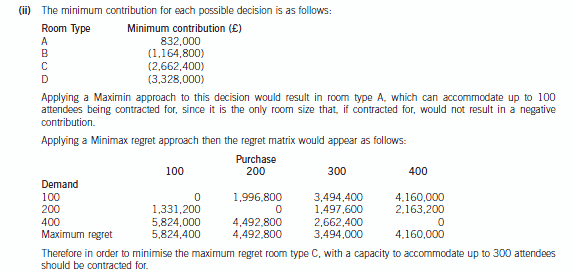
-
第2题:
(b) Determine whether your decision in (a) would change if you were to use each of the Maximin and Minimax
regret decision criteria.
Your answer should be supported by relevant workings. (6 marks)
正确答案: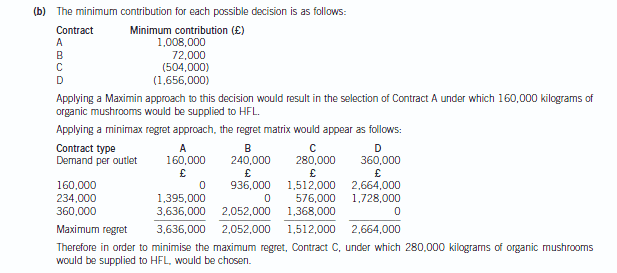
-
第3题:
Assume that the corporation tax rates for the financial year 2004 apply throughout.
(b) Explain the corporation tax (CT) and value added tax (VAT) issues that Irroy should be aware of, if she
proceeds with her proposal for the Irish subsidiary, Green Limited. Your answer should clearly identify those
factors which will determine whether or not Green Limited is considered UK resident or Irish resident and
the tax implications of each alternative situation.
You need not repeat points that are common to each situation. (16 marks)
正确答案:
(b) There are several matters that Irroy will need to be aware of in relation to value added tax and corporation tax. These are set
out below.
Residence of subsidiary
Irroy will want to ensure that the subsidiary is treated as being resident in the Republic of Ireland. It will then pay corporation
tax on its profits at lower rates than in the UK. The country of incorporation usually claims taxing rights, but this is not by
itself sufficient. Irroy needs to be aware that a company can be treated as UK resident by virtue of the location of its central
management and control. This is usually defined as being where the board of directors meets to make strategic decisions. As
a result, Irroy needs to ensure that board meetings are conducted outside the UK.
If Green Limited is treated as being UK resident, it will be taxed in the UK on its worldwide income, including that arising in
the Republic of Ireland. However, as it will be conducting trading activities in the Republic of Ireland, Green Limited will also
be treated as being Irish resident as its activities in that country are likely to constitute a permanent establishment. Thus it
may also suffer tax in the Republic of Ireland as a consequence, although double tax relief will be available (see later).
A permanent establishment is broadly defined as a fixed place of business through which a business is wholly or partly carried
on. Examples of a permanent establishment include an office, factory or workshop, although certain activities (such as storage
or ancillary activities) can be excluded from the definition.
If Green Limited is treated as being an Irish resident company, any dividends paid to Aqua Limited will be taxed under
Schedule D Case V in the UK. Despite being non resident, Green Limited will still count as an associate of the existing UK
companies, and may affect the rates of tax paid by Aqua Limited and Aria Limited in the UK. However, as a non UK resident
company, Green Limited will not be able to claim losses from the UK companies by way of group relief.
Double tax relief
If Green Limited is treated as UK resident, corporation tax at UK rates will be payable on all profits earned. However, income
arising in the Republic of Ireland is likely to have been taxed in that country also by virtue of having a permanent
establishment located there. As the same profits have been taxed twice, double tax relief is available, either by reference to
the tax treaty between the UK and the Republic of Ireland, or on a unilateral basis, where the UK will give relief for the foreign
tax suffered.
If Green Limited is treated as an Irish resident company, it will pay tax in the Republic of Ireland, based on its worldwide
taxable profits. However, any repatriation of profits to the UK by dividend will be taxed on a receipts basis in the UK. Again,
double tax relief will be available as set out above.
Double tax relief is available against two types of tax. For payments made by Green Limited to Aqua Limited on which
withholding tax has been levied, credit will be given for the tax withheld. In addition, relief is available for the underlying tax
where a dividend is received from a foreign company in which Aqua Limited owns at least 10% of the voting power. The
underlying tax is the tax attributable to the relevant profits from which the dividend was paid.
Double tax relief is given at the lower rate of the UK tax and the foreign tax (withholding and underlying taxes) suffered.
Transfer pricing
Where groups have subsidiaries in other countries, they may be tempted to divert profits to subsidiaries which pay tax at lower
rates. This can be achieved by artificially changing the prices charged (known as the transfer price) between the group
companies. While they can do this commercially through common control, anti avoidance legislation seeks to correct this by
ensuring that for taxation purposes, profits on such intra-group transactions are calculated as if the transactions were carried
out on an arms length basis. Since 1 April 2004, this legislation can also be applied to transactions between UK group
companies.
If Green Limited is treated as a UK resident company, the group’s status as a small or medium sized enterprise means that
transfer pricing issues will not apply to transactions between Green Limited and the other UK group companies.
If Green Limited is an Irish resident company, transfer pricing issues will not apply to transactions between Green Ltd and the
UK resident companies because of the group’s status as a small or medium-sized enterprise and the existence of a double
tax treaty, based on the OECD model, between the UK and the Republic of Ireland.
Controlled foreign companies
Tax legislation exists to stop a UK company accumulating profits in a foreign subsidiary which is subject to a low tax rate.
Such a subsidiary is referred to as a controlled foreign company (CFC), and exists where:
(1) the company is resident outside the UK, and
(2) is controlled by a UK resident entity or persons, and
(3) pays a ‘lower level of tax’ in its country of residence.
A lower level of tax is taken to be less than 75% of the tax that would have been payable had the company been UK resident.
If Green Limited is an Irish resident company, it will be paying corporation tax at 12·5% so would appear to be caught by
the above rules and is therefore likely to be treated as a CFC.
Where a company is treated as a CFC, its profits are apportioned to UK resident companies entitled to at least 25% of its
profits. For Aqua Limited, which would own 100% of the shares in Green Limited, any profits made by Green Limited would
be apportioned to Aqua Limited as a deemed distribution. Aqua Limited would be required to self-assess this apportionment
on its tax return and pay UK tax on the deemed distribution (with credit being given for the Irish tax suffered).
There are some exemptions which if applicable the CFC legislation does not apply and no apportionments of profits will be
made. These include where chargeable profits of the CFC do not exceed £50,000 in an accounting period, or where the CFC
follows an acceptable distribution policy (distributing at least 90% of its chargeable profits within 18 months of the relevant
period).
Value added tax (VAT)
Green Limited will be making taxable supplies in the Republic of Ireland and thus (subject to exceeding the Irish registration
limit) liable to register for VAT there. If Green Limited is registered for VAT in the Republic of Ireland, then supplies of goods
made from the UK will be zero rated. VAT on the goods will be levied in the Republic of Ireland at a rate of 21%. Aqua Limited
will need to have proof of supply in order to apply the zero rate, and will have to issue an invoice showing Green Limited’s
Irish VAT registration number as well as its own. In the absence of such evidence/registration, Aqua Limited will have to treat
its transactions with Green Limited as domestic sales and levy VAT at the UK standard rate of 17·5%.
In addition to making its normal VAT returns, Aqua Limited will also be required to complete an EU Sales List (ESL) statement
each quarter. This provides details of the sales made to customers in the return period – in this case, Green Limited. Penalties
can be applied for inaccuracies or non-compliance. -
第4题:
(c) Briefly outline the corporation tax (CT) issues that Tay Limited should consider when deciding whether to
acquire the shares or the assets of Tagus LDA. You are not required to discuss issues relating to transfer
pricing. (7 marks)
正确答案:
(c) (1) Acquisition of shares
Status
The acquisition of shares in Tagus LDA will add another associated company to the group. This may have an adverse
effect on the rates of corporation tax paid by the two existing group companies, particularly Tay Limited.
Taxation of profits
Profits will be taxed in Portugal. Any profits remitted to the UK as dividends will be taxable as Schedule D Case V income,
but will attract double tax relief. Double tax relief will be available against two types of tax suffered in Portugal. Credit
will be given for any tax withheld on payments from Tagus LDA to Tay Limited and relief will also be available for the
underlying tax as Tay Limited owns at least 10% of the voting power of Tagus LDA. The underlying tax is the tax
attributable to the relevant profits from which the dividend was paid. Double tax relief is given at the lower rate of the
UK tax and the foreign tax (withholding and underlying taxes) suffered.
Losses
As Tagus LDA is a non-UK resident company, losses arising in Tagus LDA cannot be group relieved against profits of the
two UK companies. Similarly, any UK trading losses cannot be used against profits generated by Tagus LDA.
(2) Acquisition of assets
Status
The business of Tagus will be treated as a branch of Tay Limited i.e. an extension of the UK company’s activities. The
number of associated companies will be unaffected.
Taxation of profits
Tay Limited will be treated as having a permanent establishment in Portugal. Profits attributable to the Tagus business
will thus still be taxed in Portugal. In addition, the profits will be taxed in the UK as trading income. Double tax relief
will be available for the tax already suffered in Portugal at the lower of the two rates.
Capital allowances will be available. As the assets in question will not previously have been subject to a claim for UK
capital allowances, there will be no cost restriction and the consideration attributable to each asset will form. the basis
for the capital allowance claim.
Losses
The Tagus trade is part of Tay Limited’s trade, so any losses incurred by the Portuguese trade will automatically be offset
against the trading profits of the UK trade, and vice versa. -
第5题:
(b) Explain the matters you should consider before accepting an engagement to conduct a due diligence review
of MCM. (10 marks)
正确答案:
(b) Matters to be considered (before accepting the engagement)
Tutorial note: Although candidates may approach this part from a rote-learned list of ‘matters to consider’ it is important
that answer points be tailored, in so far as the information given in the scenario permits, to the specifics of Plaza and MCM.
It is critical that answer points should not contradict the scenario (e.g. assuming that it is Plaza’s auditor who has been
asked to undertake the assignment).
■ Information about Duncan Seymour – What is the relationship of the chief finance officer to Plaza (e.g. is he on the
management board)? By what authority is he approaching Andando to undertake this assignment?
■ The purpose of the assignment must be clarified. Duncan’s approach to Andando is ‘to advise on a bid’. However,
Andando cannot make executive decisions for a client but only provide the facts of material interest. Plaza’s
management must decide whether or not to bid and, if so, how much to bid.
■ The scope of the due diligence review. It seems likely that Plaza will be interested in acquiring all of MCM’s business
as its areas of operation coincide with Plaza’s. However it must be confirmed that Plaza is not merely interested in
acquiring only the National or International business of MCM.
■ Andando’s competence and experience – Andando should not accept the engagement unless the firm has experience in
undertaking due diligence assignments. Even then, the firm must have sufficient knowledge of the territories in which
the businesses operate to evaluate whether all facts of material interest to Plaza have been identified.
Tutorial note: Candidates should be querying their competence and experience in the fields of retailing and training
as though they were dealing with highly regulated or specialist industries such as banking or insurance.
■ Whether Andando has sufficient resources (e.g. representative/associated offices), if any, in Europe and Asia to
investigate MCM’s International business.
■ Any factors which might impair Andando’s objectivity in reporting to Plaza the facts uncovered by the due diligence
review. For example, if Duncan is closely connected with a partner in Andando or if Andando is the auditor of Frontiers.
Tutorial note: Candidates will not be awarded marks for going into ‘autopilot’ on independence issues. For example,
this is a one-off assignment so size of fee is not relevant. Andando holding shares in MCM is not possible (since whollyowned).
■ Plaza’s rationale for wishing to acquire MCM. Presumably it is significant that MCM operates in the same territories as
Plaza. Plaza may be wanting to provide extensive training programs in management, communications and marketing
to its workforce.
■ The relationship, if any, between Plaza and MCM in any of the territories. Plaza may be a major client of MCM. That
is, Plaza is currently out-sourcing training to MCM. Acquiring MCM would bring training in-house.
Tutorial note: Ascertaining what a purchaser hopes to gain from an acquisition before the assignment is accepted is
important. The facts to be uncovered for a merger from which synergy is expected will be different from those relevant
to acquiring an investment opportunity.
■ Time available – Andando must have sufficient time to find all facts that would be of material interest to Plaza before
disclosing their findings.
■ The acceptability of any limitations – whether there will be restrictions on Andando’s access to information held by MCM
(e.g. if there will not be access to board minutes) and personnel.
■ The degree of secrecy required – this may go beyond the normal duties of confidentiality not to disclose information to
outsiders (e.g. if unannounced staff redundancies could arise).
■ Why Plaza’s current auditors have not been asked to conduct the due diligence review – especially as they are
responsible for (and therefore capable of undertaking) the group audit covering the relevant countries.
■ Andando should be allowed to communicate with Plaza’s current auditor:
– to inform. them of the nature of the work they have been asked to undertake; and
– to enquire if there is any reason why they should not accept this assignment.
■ In taking on Plaza as a new client Andando may have a later opportunity to offer external audit and other services to
Plaza (e.g. internal audit). -
第6题:
(b) A sale of industrial equipment to Deakin Co in May 2005 resulted in a loss on disposal of $0·3 million that has
been separately disclosed on the face of the income statement. The equipment cost $1·2 million when it was
purchased in April 1996 and was being depreciated on a straight-line basis over 20 years. (6 marks)
Required:
For each of the above issues:
(i) comment on the matters that you should consider; and
(ii) state the audit evidence that you should expect to find,
in undertaking your review of the audit working papers and financial statements of Keffler Co for the year ended
31 March 2006.
NOTE: The mark allocation is shown against each of the three issues.
正确答案:
(b) Sale of industrial equipment
(i) Matters
■ The industrial equipment was in use for nine years (from April 1996) and would have had a carrying value of
$660,000 at 31 March 2005 (11/20 × $1·2m – assuming nil residual value and a full year’s depreciation charge
in the year of acquisition and none in the year of disposal). Disposal proceeds were therefore only $360,000.
■ The $0·3m loss represents 15% of PBT (for the year to 31 March 2006) and is therefore material. The equipment
was material to the balance sheet at 31 March 2005 representing 2·6% of total assets ($0·66/$25·7 × 100).
■ Separate disclosure, of a material loss on disposal, on the face of the income statement is in accordance with
IAS 16 ‘Property, Plant and Equipment’. However, in accordance with IAS 1 ‘Presentation of Financial Statements’,
it should not be captioned in any way that might suggest that it is not part of normal operating activities (i.e. not
‘extraordinary’, ‘exceptional’, etc).
Tutorial note: However, note that if there is a prior period error to be accounted for (see later), there would be
no impact on the current period income statement requiring consideration of any disclosure.
■ The reason for the sale. For example, whether the equipment was:
– surplus to operating requirements (i.e. not being replaced); or
– being replaced with newer equipment (thereby contributing to the $8·1m increase (33·8 – 25·7) in total
assets).
■ The reason for the loss on sale. For example, whether:
– the sale was at an under-value (e.g. to a related party);
– the equipment had a bad maintenance history (or was otherwise impaired);
– the useful life of the equipment is less than 20 years;
– there is any deferred consideration not yet recorded;
– any non-cash disposal proceeds have been overlooked (e.g. if another asset was acquired in a part-exchange).
■ If the useful life was less than 20 years, tangible non-current assets may be materially overstated in respect of other
items of equipment that are still in use and being depreciated on the same basis.
■ If the sale was to a related party then additional disclosure should be required in a note to the financial statements
for the year to 31 March 2006 (IAS 24 ‘Related Party Disclosures’).
Tutorial note: Since there are no specific pointers to a related party transaction (RPT), this point is not expanded
on.
■ Whether the sale was identified in the prior year audit’s post balance sheet event review. If so:
– the disclosure made in the prior year’s financial statements (IAS 10 ‘Events After the Balance Sheet Date’);
– whether an impairment loss was recognised at 31 March 2005.
■ If not, and the equipment was impaired at 31 March 2005, a prior period error should be accounted for (IAS 8
‘Accounting Policies, Changes in Accounting Estimates and Errors’). An impairment loss of $0·3m would have
been material to prior year profit (12·5%).
Tutorial note: Unless this was a RPT or the impairment arose after 31 March 2005 a prior period adjustment
should be made.
■ Failure to account for a prior period error (if any) would result in modification of the audit opinion ‘except for’ noncompliance
with IAS 8 (in the current year) and IAS 36 (in the prior period).
(ii) Audit evidence
■ Carrying amount ($0·66m as above) agreed to the non-current asset register balances at 31 March 2005 and
recalculation of the loss on disposal.
■ Cost and accumulated depreciation removed from the asset register in the year to 31 March 2006.
■ Receipt of proceeds per cash book agreed to bank statement.
■ Sales invoice transferring title to Deakin.
■ A review of maintenance expenses and records (e.g. to confirm reason for loss on sale).
■ Post balance sheet event review on prior year audit working papers file.
■ Management representation confirming that Deakin is not a related party (provided that there is no evidence to
suggest otherwise). -
第7题:
(b) Seymour offers health-related information services through a wholly-owned subsidiary, Aragon Co. Goodwill of
$1·8 million recognised on the purchase of Aragon in October 2004 is not amortised but included at cost in the
consolidated balance sheet. At 30 September 2006 Seymour’s investment in Aragon is shown at cost,
$4·5 million, in its separate financial statements.
Aragon’s draft financial statements for the year ended 30 September 2006 show a loss before taxation of
$0·6 million (2005 – $0·5 million loss) and total assets of $4·9 million (2005 – $5·7 million). The notes to
Aragon’s financial statements disclose that they have been prepared on a going concern basis that assumes that
Seymour will continue to provide financial support. (7 marks)
Required:
For each of the above issues:
(i) comment on the matters that you should consider; and
(ii) state the audit evidence that you should expect to find,
in undertaking your review of the audit working papers and financial statements of Seymour Co for the year ended
30 September 2006.
NOTE: The mark allocation is shown against each of the three issues.
正确答案:
(b) Goodwill
(i) Matters
■ Cost of goodwill, $1·8 million, represents 3·4% consolidated total assets and is therefore material.
Tutorial note: Any assessments of materiality of goodwill against amounts in Aragon’s financial statements are
meaningless since goodwill only exists in the consolidated financial statements of Seymour.
■ It is correct that the goodwill is not being amortised (IFRS 3 Business Combinations). However, it should be tested
at least annually for impairment, by management.
■ Aragon has incurred losses amounting to $1·1 million since it was acquired (two years ago). The write-off of this
amount against goodwill in the consolidated financial statements would be material (being 61% cost of goodwill,
8·3% PBT and 2·1% total assets).
■ The cost of the investment ($4·5 million) in Seymour’s separate financial statements will also be material and
should be tested for impairment.
■ The fair value of net assets acquired was only $2·7 million ($4·5 million less $1·8 million). Therefore the fair
value less costs to sell of Aragon on other than a going concern basis will be less than the carrying amount of the
investment (i.e. the investment is impaired by at least the amount of goodwill recognised on acquisition).
■ In assessing recoverable amount, value in use (rather than fair value less costs to sell) is only relevant if the going
concern assumption is appropriate for Aragon.
■ Supporting Aragon financially may result in Seymour being exposed to actual and/or contingent liabilities that
should be provided for/disclosed in Seymour’s financial statements in accordance with IAS 37 Provisions,
Contingent Liabilities and Contingent Assets.
(ii) Audit evidence
■ Carrying values of cost of investment and goodwill arising on acquisition to prior year audit working papers and
financial statements.
■ A copy of Aragon’s draft financial statements for the year ended 30 September 2006 showing loss for year.
■ Management’s impairment test of Seymour’s investment in Aragon and of the goodwill arising on consolidation at
30 September 2006. That is a comparison of the present value of the future cash flows expected to be generated
by Aragon (a cash-generating unit) compared with the cost of the investment (in Seymour’s separate financial
statements).
■ Results of any impairment tests on Aragon’s assets extracted from Aragon’s working paper files.
■ Analytical procedures on future cash flows to confirm their reasonableness (e.g. by comparison with cash flows for
the last two years).
■ Bank report for audit purposes for any guarantees supporting Aragon’s loan facilities.
■ A copy of Seymour’s ‘comfort letter’ confirming continuing financial support of Aragon for the foreseeable future. -
第8题:
3 You are the manager responsible for the audit of Lamont Co. The company’s principal activity is wholesaling frozen
fish. The draft consolidated financial statements for the year ended 31 March 2007 show revenue of $67·0 million
(2006 – $62·3 million), profit before taxation of $11·9 million (2006 – $14·2 million) and total assets of
$48·0 million (2006 – $36·4 million).
The following issues arising during the final audit have been noted on a schedule of points for your attention:
(a) In early 2007 a chemical leakage from refrigeration units owned by Lamont caused contamination of some of its
property. Lamont has incurred $0·3 million in clean up costs, $0·6 million in modernisation of the units to
prevent future leakage and a $30,000 fine to a regulatory agency. Apart from the fine, which has been expensed,
these costs have been capitalised as improvements. (7 marks)
Required:
For each of the above issues:
(i) comment on the matters that you should consider; and
(ii) state the audit evidence that you should expect to find,
in undertaking your review of the audit working papers and financial statements of Lamont Co for the year ended
31 March 2007.
NOTE: The mark allocation is shown against each of the three issues.
正确答案:
3 LAMONT CO
(a) Chemical leakage
(i) Matters
■ $30,000 fine is very immaterial (just 1/4% profit before tax). This is revenue expenditure and it is correct that it
has been expensed to the income statement.
■ $0·3 million represents 0·6% total assets and 2·5% profit before tax and is not material on its own. $0·6 million
represents 1·2% total assets and 5% profit before tax and is therefore material to the financial statements.
■ The $0·3 million clean-up costs should not have been capitalised as the condition of the property is not improved
as compared with its condition before the leakage occurred. Although not material in isolation this amount should
be adjusted for and expensed, thereby reducing the aggregate of uncorrected misstatements.
■ It may be correct that $0·6 million incurred in modernising the refrigeration units should be capitalised as a major
overhaul (IAS 16 Property, Plant and Equipment). However, any parts scrapped as a result of the modernisation
should be treated as disposals (i.e. written off to the income statement).
■ The carrying amount of the refrigeration units at 31 March 2007, including the $0·6 million for modernisation,
should not exceed recoverable amount (i.e. the higher of value in use and fair value less costs to sell). If it does,
an allowance for the impairment loss arising must be recognised in accordance with IAS 36 Impairment of Assets.
(ii) Audit evidence
■ A breakdown/analysis of costs incurred on the clean-up and modernisation amounting to $0·3 million and
$0·6 million respectively.
■ Agreement of largest amounts to invoices from suppliers/consultants/sub-contractors, etc and settlement thereof
traced from the cash book to the bank statement.
■ Physical inspection of the refrigeration units to confirm their modernisation and that they are in working order. (Do
they contain frozen fish?)
■ Sample of components selected from the non-current asset register traced to the refrigeration units and inspected
to ensure continuing existence.
■ $30,000 penalty notice from the regulatory agency and corresponding cash book payment/payment per the bank
statement.
■ Written management representation that there are no further penalties that should be provided for or disclosed other
than the $30,000 that has been accounted for. -
第9题:
(ii) Describe the evidence you would seek to support the assertion that development costs are technically
feasible. (3 marks)
正确答案:
(ii) Evidence supporting the assertion that development costs are technically feasible would include the following:
– Review the results of scientific tests performed on the products, for example, the results of animal or human testing
of the products.
– Discuss any detrimental results of these tests, e.g. harmful side effects, with the scientists working on the project
to determine what corrective action is being taken.
– Enquire whether any licences necessary for continued development and/or commercial production have been
granted by the appropriate regulatory body.
– Compare expected to actual development costs incurred per product being developed. Where actual costs are in
excess of expected costs investigate whether the extra costs have been incurred in order to make good any problems
identified in the development process.
– Review board minutes for relevant discussion of the product development taking place during the year. -
第10题:
(b) (i) Explain the matters you should consider, and the evidence you would expect to find in respect of the
carrying value of the cost of investment of Dylan Co in the financial statements of Rosie Co; and
(7 marks)
正确答案:
(b) (i) Cost of investment on acquisition of Dylan Co
Matters to consider
According to the schedule provided by the client, the cost of investment comprises three elements. One matter to
consider is whether the cost of investment is complete.
It appears that no legal or professional fees have been included in the cost of investment (unless included within the
heading ‘cash consideration’). Directly attributable costs should be included per IFRS 3 Business Combinations, and
there is a risk that these costs may be expensed in error, leading to understatement of the investment.
The cash consideration of $2·5 million is the least problematical component. The only matter to consider is whether the
cash has actually been paid. Given that Dylan Co was acquired in the last month of the financial year it is possible that
the amount had not been paid before the year end, in which case the amount should be recognised as a current liability
on the statement of financial position (balance sheet). However, this seems unlikely given that normally control of an
acquired company only passes to the acquirer on cash payment.
IFRS 3 states that the cost of investment should be recognised at fair value, which means that deferred consideration
should be discounted to present value at the date of acquisition. If the consideration payable on 31 January 2009 has
not been discounted, the cost of investment, and the corresponding liability, will be overstated. It is possible that the
impact of discounting the $1·5 million payable one year after acquisition would be immaterial to the financial
statements, in which case it would be acceptable to leave the consideration at face value within the cost of investment.
Contingent consideration should be accrued if it is probable to be paid. Here the amount is payable if revenue growth
targets are achieved over the next four years. The auditor must therefore assess the probability of the targets being
achieved, using forecasts and projections of Maxwell Co’s revenue. Such information is inherently subjective, and could
have been manipulated, if prepared by the vendor of Maxwell Co, in order to secure the deal and maximise
consideration. Here it will be crucial to be sceptical when reviewing the forecasts, and the assumptions underlying the
data. The management of Rosie Co should have reached their own opinion on the probability of paying the contingent
consideration, but they may have relied heavily on information provided at the time of the acquisition.
Audit evidence
– Agreement of the monetary value and payment dates of the consideration per the client schedule to legal
documentation signed by vendor and acquirer.
– Agreement of $2·5 million paid to Rosie Co’s bank statement and cash book prior to year end. If payment occurs
after year end confirm that a current liability is recognised on the individual company and consolidated statement
of financial position (balance sheet).
– Board minutes approving the payment.
– Recomputation of discounting calculations applied to deferred and contingent consideration.
– Agreement that the discount rate used is pre-tax, and reflects current market assessment of the time value of money
(e.g. by comparison to Rosie Co’s weighted average cost of capital).
– Revenue and profit projections for the period until January 2012, checked for arithmetic accuracy.
– A review of assumptions used in the projections, and agreement that the assumptions are comparable with the
auditor’s understanding of Dylan Co’s business.
Tutorial note: As the scenario states that Chien & Co has audited Dylan Co for several years, it is reasonable to rely on
their cumulative knowledge and understanding of the business in auditing the revenue projections. -
第11题:
You are employed as the exchange administrator at Company.com.the Company.com network contains an exchange 2010 organization.Company.com has its headquarters in stockholm where you are located.you are responsible for managing a mailbox server named -ex02.all users within the organization make use of microsoft office outlook 2010 to connect to the exchange organization.you receive an instruction to determine the latency of user connections to-ex02. What should you do?()
- A、You should consider running the Test-OutlookConnectivity cmdlet.
- B、You should consider running the Exchange Best Practices Analyzer.
- C、You should consider running the Test-OutlookWebServices cmdlet.
- D、You should consider running the Message Tracking Performance tool.
正确答案:A -
第12题:
单选题You are employed as the enterprise exchange administrator at Company.com..com makes use of Microsoft exchange server 2010 messaging solution.you are responsible for managing the exchange network for Company.com.you are experiencing various problems in the exchange environment.you decide to determine whether one of the other administrators executed any configuration changes in the organization.What should you do?()AYou should consider running Exchange Best Practices Analyzer.
BYou should consider running Microsoft Baseline Security Analyzer (MBSA).
CYou should consider running the Get-ExchangeServer cmdlet.
DYou should consider running the Get-EventLogLevel cmdlet.
正确答案: D解析: 暂无解析 -
第13题:
(b) Explain the major benefits of pursuing a policy of internal development. (4 marks)
正确答案:
(b) The major benefits of pursuing a policy of internal development that may accrue to Taliesin Ltd are as follows:
– By confining their activities to its internal environment the company avoids the need to manage the integration of
businesses which is necessitated by an acquisition. Management teams, when considering the acquisition of another
organisation, very often underestimate the costs of integration.
– There is no need for the board of directors of Taliesin Ltd to familiarise itself with different organisational and national
cultures, values etc, thereby avoiding many potential problems.
– The board of directors of Taliesin Ltd is better able to control the activities of the business and the need for more complex
supply chains and strategic alliances with foreign organisations is rendered unnecessary.
– All investments are made at market price whereas if the board of directors was to attempt to grow the business
acquisition then significant outlays would probably be made in respect of purchased goodwill.
– As the organisation develops and expands, staff are provided with development and learning activities that may
precipitate an increase in the level of their commitment to the organisation. -
第14题:
(ii) The percentage change in revenue, total costs and net assets during the year ended 31 May 2008 that
would have been required in order to have achieved a target ROI of 20% by the Beetown centre. Your
answer should consider each of these three variables in isolation. State any assumptions that you make.
(6 marks)
正确答案:
(ii) The ROI of Beetown is currently 13·96%. In order to obtain an ROI of 20%, operating profit would need to increase to
(20% x $3,160,000) = $632,000, based on the current level of net assets. Three alternative ways in which a target
ROI of 20% could be achieved for the Beetown centre are as follows:
(1) Attempts could be made to increase revenue by attracting more clients while keeping invested capital and operating
profit per $ of revenue constant. Revenue would have to increase to $2,361,644, assuming that the current level
of profitability is maintained and fixed costs remain unchanged. The current rate of contribution to revenue is
$2,100,000 – $567,000 = $1,533,000/$2,100,000 = 73%. Operating profit needs to increase by $191,000
in order to achieve an ROI of 20%. Therefore, revenue needs to increase by $191,000/0·73 = $261,644 =
12·46%.
(2) Attempts could be made to decrease the level of operating costs by, for example, increasing the efficiency of
maintenance operations. This would have the effect of increasing operating profit per $ of revenue. This would
require that revenue and invested capital were kept constant. Total operating costs would need to fall by $191,000
in order to obtain an ROI of 20%. This represents a percentage decrease of 191,000/1,659,000 = 11·5%. If fixed
costs were truly fixed, then variable costs would need to fall to a level of $376,000, which represents a decrease
of 33·7%.
(3) Attempts could be made to decrease the net asset base of HFG by, for example, reducing debtor balances and/or
increasing creditor balances, while keeping turnover and operating profit per $ of revenue constant. Net assets
would need to fall to a level of ($441,000/0·2) = $2,205,000, which represents a percentage decrease
amounting to $3,160,000 – $2,205,000 = 955,000/3,160,000 = 30·2%. -
第15题:
(c) Explain the capital gains tax (CGT) and income tax (IT) issues Paul and Sharon should consider in deciding
which form. of trust to set up for Gisella and Gavin. You are not required to consider inheritance tax (IHT) or
stamp duty land tax (SDLT) issues. (10 marks)
You should assume that the tax rates and allowances for the tax year 2005/06 apply throughout this question.
正确答案:
(c) As the trust is created in the settlors’ (Paul and Sharon’s) lifetime its creation will constitute a chargeable disposal for capital
gains tax. Also, as the settlors and trustees are connected persons, the disposal will be deemed to be at market value, resulting
in a chargeable gain of £80,000 (160,000 – 80,000). No taper relief will be available as the property is a non-business
asset, and has been held for less than three years, but annual exemptions of £17,000 (2 x £8,500) will be available.
However, in the case of a discretionary trust, gift hold over relief will be available. This is because the gift will constitute a
chargeable lifetime transfer and because there is an immediate charge to inheritance tax (even though no tax is payable due
to the nil rate band) relief is available if a specific accumulation and maintenance trust is used, as in this case the gift will
qualify as a potentially exempt transfer and so gift relief would only be available in respect of business assets. The use of a
basic discretionary trust will thus facilitate the deferral of an immediate capital gains tax charge of £25,200 (63,000 x 40%).
If/when the property is disposed of, however, the trustees will pay capital gains tax on the deferred gain at the trust income
tax rate of 40%, and have an annual exemption of only £4,250 (50% of the normal individual rate) available to them. The
40% rate of tax and lower annual exemption rate also apply to chargeable gains arising in a specific accumulation and
maintenance trust, as well as a basic discretionary trust.
A chargeable disposal between connected persons will also arise for the purposes of capital gains tax if/when the property
vests in a beneficiary, i.e. one or more of the beneficiaries becomes absolutely entitled to all or part of the income or capital
of the trust. Gift hold over relief will again be available on all assets in the case of a discretionary trust, but only on business
assets in the case of an accumulation and maintenance trust, except where a beneficiary becomes entitled to both income
and capital at the same time.
The trust will have taxable property income in the form. of net rents from its creation and in future years is also likely to have
other investment income, probably in the form. of interest, to the extent that monies are retained in the trust. Whichever form
of trust is used, the trustees will pay tax at the standard trust rate of 40% on income other than dividend income (32·5%),
except to the extent of (1) the first £500 of taxable income, which is taxed at the rate that would otherwise apply to such
income (i.e. 22% for non-savings (rental) income, 20% for savings income (interest) and 10% for dividends) but, only to the
extent that it is not distributed; and (2) the legitimate trust management expenses, which are offsettable for the purposes of
the higher trust tax rates against the income with the lowest rate(s) of normal tax and so bear tax only at that rate. The higher
trust tax rate always applies to income that is distributed, other than to the extent that it has been treated as the settlor’s
income, and taxed at that settlor’s marginal tax rate.
As Paul and Sharon intend to create a trust for their unmarried minor (under 18) children, then even if the trust specifically
excludes them from any benefit under the trust, the trust income will be treated as theirs for income tax purposes to the extent
that it constitutes income paid for on behalf (including maintenance payments) of Gisella and Gavin; except where (1) the
total income arising does not exceed £100 gross per annum, and (2) income is held for the benefit of a child under an
accumulation and maintenance settlement, to the extent that it is not paid out. -
第16题:
(c) During the year Albreda paid $0·1 million (2004 – $0·3 million) in fines and penalties relating to breaches of
health and safety regulations. These amounts have not been separately disclosed but included in cost of sales.
(5 marks)
Required:
For each of the above issues:
(i) comment on the matters that you should consider; and
(ii) state the audit evidence that you should expect to find,
in undertaking your review of the audit working papers and financial statements of Albreda Co for the year ended
30 September 2005.
NOTE: The mark allocation is shown against each of the three issues.
正确答案:
(c) Fines and penalties
(i) Matters
■ $0·1 million represents 5·6% of profit before tax and is therefore material. However, profit has fallen, and
compared with prior year profit it is less than 5%. So ‘borderline’ material in quantitative terms.
■ Prior year amount was three times as much and represented 13·6% of profit before tax.
■ Even though the payments may be regarded as material ‘by nature’ separate disclosure may not be necessary if,
for example, there are no external shareholders.
■ Treatment (inclusion in cost of sales) should be consistent with prior year (‘The Framework’/IAS 1 ‘Presentation of
Financial Statements’).
■ The reason for the fall in expense. For example, whether due to an improvement in meeting health and safety
regulations and/or incomplete recording of liabilities (understatement).
■ The reason(s) for the breaches. For example, Albreda may have had difficulty implementing new guidelines in
response to stricter regulations.
■ Whether expenditure has been adjusted for in the income tax computation (as disallowed for tax purposes).
■ Management’s attitude to health and safety issues (e.g. if it regards breaches as an acceptable operational practice
or cheaper than compliance).
■ Any references to health and safety issues in other information in documents containing audited financial
statements that might conflict with Albreda incurring these costs.
■ Any cost savings resulting from breaches of health and safety regulations would result in Albreda possessing
proceeds of its own crime which may be a money laundering offence.
(ii) Audit evidence
■ A schedule of amounts paid totalling $0·1 million with larger amounts being agreed to the cash book/bank
statements.
■ Review/comparison of current year schedule against prior year for any apparent omissions.
■ Review of after-date cash book payments and correspondence with relevant health and safety regulators (e.g. local
authorities) for liabilities incurred before 30 September 2005.
■ Notes in the prior year financial statements confirming consistency, or otherwise, of the lack of separate disclosure.
■ A ‘signed off’ review of ‘other information’ (i.e. directors’ report, chairman’s statement, etc).
■ Written management representation that there are no fines/penalties other than those which have been reflected in
the financial statements. -
第17题:
(c) Explain the extent to which you should plan to place reliance on analytical procedures as audit evidence.
(6 marks)
正确答案:
(c) Extent of reliance on analytical procedures as audit evidence
Tutorial note: In the requirement ‘… reliance … as audit evidence’ is a direction to consider only substantive analytical
procedures. Answer points concerning planning and review stages were not asked for and earn no marks.
■ Although there is likely to be less reliance on analytical procedures than if this had been an existing audit client, the fact
that this is a new assignment does not preclude placing some reliance on such procedures.
■ Analytical procedures will not be relied on in respect of material items that require 100% testing. For example, additions
to property is likely to represent a very small number of transactions.
■ Analytical procedures alone may provide sufficient audit evidence on line items that are not individually material. For
example, inventory (less than 1/2% revenue and less than 1% total assets) may be shown to be materially correctly
stated through analytical procedures on consumable stores (i.e. fuel, lubricants, materials for servicing vehicles etc).
■ Substantive analytical procedures are best suited to large volume transactions (e.g. revenue, materials expense, staff
costs). If controls over the completeness, accuracy and validity of recording transactions in these areas are effective then
substantive analytical procedures showing that there are no unexpected fluctuations should reduce the need for
substantive detailed tests.
■ The extent of planned use will be dependent on the relationships expected between variables. (e.g. between items of
financial information and between items of financial and non-financial information). For example, if material costs rise
due to an increase in the level of business then a commensurate increase in revenue and staff costs might be expected
also.
■ ‘Proofs in total’ (or reasonableness tests) provide substantive evidence that income statement items are not materially
misstated. In the case of Yates these might be applied to staff costs (number of employees in each category ×
wage/salary rates, grossed up for social security, etc) and finance expense (interest rate × average monthly overdraft
balance).
■ However, such tests may have limited application, if any, if the population is not homogenous and cannot be subdivided.
For example, all the categories of non-current asset have a wide range of useful life. Therefore it would be
difficult/meaningless to apply an ‘average’ depreciation rate to all assets in the class to substantiate the total depreciation
expense for the year. (Although it might highlight a risk of potential over or understatement requiring further
investigation.)
■ Substantive analytical procedures are more likely to be used if there is relevant information available that is being used
by Yates. For example, as fuel costs will be significant, Yates may monitor consumption (e.g. miles per gallon (MPG)).
■ Analytical procedures may supplement alternative procedures that provide evidence regarding the same assertion. For
example, the review of after-date payments to confirm the completeness of trade payables may be supplemented by
calculations of average payment period on a monthly basis.
Tutorial note: Credit will be given for other relevant points drawn from the scenario. For example, the restructuring during
the previous year is likely to have caused fluctuations that may result in less reliance being placed on analytical procedures. -
第18题:
(c) In April 2006, Keffler was banned by the local government from emptying waste water into a river because the
water did not meet minimum standards of cleanliness. Keffler has made a provision of $0·9 million for the
technological upgrading of its water purifying process and included $45,000 for the penalties imposed in ‘other
provisions’. (5 marks)
Required:
For each of the above issues:
(i) comment on the matters that you should consider; and
(ii) state the audit evidence that you should expect to find,
in undertaking your review of the audit working papers and financial statements of Keffler Co for the year ended
31 March 2006.
NOTE: The mark allocation is shown against each of the three issues.
正确答案:
(c) Ban on emptying waste water
(i) Matter
■ $0·9m provision for upgrading the process represents 45% PBT and is very material. This provision is also
material to the balance sheet (2·7% of total assets).
■ The provision for penalties is immaterial (2·2% PBT and 0·1% total assets).
■ The ban is an adjusting post balance sheet event in respect of the penalties (IAS 10). It provides evidence that at
the balance sheet date Keffler was in contravention of local government standards. Therefore it is correct (in
accordance with IAS 37) that a provision has been made for the penalties. As the matter is not material inclusion
in ‘other provisions’ is appropriate.
■ However, even if Keffler has a legal obligation to meet minimum standards, there is no obligation for upgrading the
purifying process at 31 March 2006 and the $0·9m provision should be written back.
■ If the provision for upgrading is not written back the audit opinion should be qualified ‘except for’ (disagreement).
■ Keffler does not even have a contingent liability for upgrading the process because there is no present obligation to
do so. The obligation is to stop emptying unclean water into the river. Nor is there a possible obligation whose
existence will be confirmed by an uncertain future event not wholly within Keffler’s control.
Tutorial note: Consider that Keffler has alternatives wholly within its control. For example, it could ignore the ban
and incur fines, or relocate/close this particular plant/operation or perhaps dispose of the water by alternative
means.
■ The need for a technological upgrade may be an indicator of impairment. Management should have carried out
an impairment test on the carrying value of the water purifying process and recognised any impairment loss in the
profit for the year to 31 March 2006.
■ Management’s intention to upgrade the process is more appropriate to an environmental responsibility report (if
any).
■ Whether there is any other information in documents containing financial statements.
(ii) Audit evidence
■ Penalty notices of fines received to confirm amounts and period/dates covered.
■ After-date payment of fines agreed to the cash book.
■ A copy of the ban and any supporting report on the local government’s findings.
■ Minutes of board meetings at which the ban was discussed confirming management’s intentions (e.g. to upgrade
the process).
Tutorial note: This may be disclosed in the directors’ report and/or as a non-adjusting post balance sheet event.
■ Any tenders received/costings for upgrading.
Tutorial note: This will be relevant if, for example, capital commitment authorised (by the board) but not
contracted for at the year end are disclosed in the notes to the financial statements.
■ Physical inspection of the emptying point at the river to confirm that Keffler is not still emptying waste water into
it (unless the upgrading has taken place).
Tutorial note: Thereby incurring further penalties. -
第19题:
(b) Explain the matters that should be considered when planning the nature and scope of the examination of
Cusiter Co’s forecast balance sheet and income statement as prepared for the bank. (7 marks)
正确答案:
(b) Matters to be considered
Tutorial note: Candidates at this level must appreciate that the matters to be considered when planning the nature and
scope of the examination are not the same matters to be considered when deciding whether or not to accept an
engagement. The scenario clearly indicates that the assignment is being undertaken by the current auditor rendering any
‘pre-engagement’/‘professional etiquette’ considerations irrelevant to answering this question.
This PFI has been prepared to show an external user, the bank, the financial consequences of Cusiter’s plans to help the bank
in making an investment decision. If Cusiter is successful in its loan application the PFI provides a management tool against
which the results of investing in the plant and equipment can be measured.
The PFI is unpublished rather than published. That is, it is prepared at the specific request of a third party, the bank. It will
not be published to users of financial information in general.
The auditor’s report on the PFI will provide only negative assurance as to whether the assumptions provide a reasonable basis
for the PFI and an opinion whether the PFI is:
■ properly prepared on the basis of the assumptions; and
■ presented in accordance with the relevant financial reporting framework.
The nature of the engagement is an examination to obtain evidence concerning:
■ the reasonableness and consistency of assumptions made;
■ proper preparation (on the basis of stated assumptions); and
■ consistent presentation (with historical financial statements, using appropriate accounting principles).
Such an examination is likely to take the form. of inquiry, analytical procedures and corroboration.
The period of time covered by the prospective financial information is two years. The assumptions for 2008 are likely to be
more speculative than for 2007, particularly in relation to the impact on earnings, etc of the investment in new plant and
equipment.
The forecast for the year to 31 December 2007 includes an element of historical financial information (because only part of
this period is in the future) hence actual evidence should be available to verify the first three months of the forecast (possibly
more since another three-month period will expire at the end of the month).
Cusiter management’s previous experience in preparing PFI will be relevant. For example, in making accounting estimates
(e.g. for provisions, impairment losses, etc) or preparing cash flow forecasts (e.g. in support of the going concern assertion).
The basis of preparation of the forecast. For example, the extent to which it comprises:
■ proforma financial information (i.e. historical financial information adjusted for the effects of the planned loan and capital
expenditure transaction);
■ new information and assumptions about future performance (e.g. the operating capacity of the new equipment, sales
generated, etc).
The nature and scope of any standards/guidelines under which the PFI has been prepared is likely to assist the auditor in
discharging their responsibilities to report on it. Also, ISAE 3400 The Examination of Prospective Financial Information,
establishes standards and provides guidance on engagements to examine and report on PFI including examination
procedures.
The planned nature and scope of the examination is likely to take into account the time and fee budgets for the assignments
as adjusted for any ‘overlap’ with audit work. For example, the examination of the PFI is likely to draw on the auditor’s
knowledge of the business obtained in auditing the financial statements to 31 December 2006. Analytical procedures carried
out in respect of the PFI may provide evidence relevant to the 31 December 2007 audit. -
第20题:
(c) Lamont owns a residential apartment above its head office. Until 31 December 2006 it was let for $3,000 a
month. Since 1 January 2007 it has been occupied rent-free by the senior sales executive. (6 marks)
Required:
For each of the above issues:
(i) comment on the matters that you should consider; and
(ii) state the audit evidence that you should expect to find,
in undertaking your review of the audit working papers and financial statements of Lamont Co for the year ended
31 March 2007.
NOTE: The mark allocation is shown against each of the three issues.
正确答案:
(c) Rent-free accommodation
(i) Matters
■ The senior sales executive is a member of Lamont’s key management personnel and is therefore a related party.
■ The occupation of Lamont’s residential apartment by the senior sales executive is therefore a related party
transaction, even though no price is charged (IAS 24 Related Party Disclosures).
■ Related party transactions are material by nature and information about them should be disclosed so that users of
financial statements understand the potential effect of related party relationships on the financial statements.
■ The provision of ‘housing’ is a non-monetary benefit that should be included in the disclosure of key management
personnel compensation (within the category of short-term employee benefits).
■ The financial statements for the year ended 31 March 2007 should disclose the arrangement for providing the
senior sales executive with rent-free accommodation and its fair value (i.e. $3,000 per month).
Tutorial note: Since no price is charged for the transaction, rote-learned disclosures such as ‘the amount of outstanding
balances’ and ‘expense recognised in respect of bad debts’ are irrelevant.
(ii) Audit evidence
■ Physical inspection of the apartment to confirm that it is occupied.
■ Written representation from the senior sales executive that he is occupying the apartment free of charge.
■ Written representation from the management board confirming that there are no related party transactions requiring
disclosure other than those that have been disclosed.
■ Inspection of the lease agreement with (or payments received from) the previous tenant to confirm the $3,000
monthly rental value. -
第21题:
(c) Describe the audit procedures you should perform. to determine the validity of the amortisation rate of five
years being applied to development costs in relation to Plummet. (5 marks)
正确答案:
(c) Audit procedures to determine the validity of the amortisation rate of five years being applied to development costs in relation
to the product Plummet would include the following:
– Obtain the papers documenting market research carried out on Plummet. Review and ascertain that the market research
supports a product life span of five years.
– Review actual sales patterns since the launch of Plummet and compare to the predicted sales per the market research
document.
Tutorial note: this will help to demonstrate the accuracy of the predicted sales forecast of Plummet.
– Read the assumptions underpinning the market research sales projections, and consider whether these assumptions
agree with the auditors’ understanding of the business.
– Discuss sales trends with the sales/marketing directors and ascertain whether sales are in line with management’s
expectations.
– Read correspondence with retail outlets to ensure there is continued support for selling Plummet.
– Obtain marketing/advertising budgets and ascertain enough expenditure is continuing on Plummet to support continued
sales. -
第22题:
(ii) From the information provided above, recommend the matters which should be included as ‘findings
from the audit’ in your report to those charged with governance, and explain the reason for their
inclusion. (7 marks)
正确答案:
(ii) Control weakness
ISA 260 contains guidance on the type of issues that should be communicated. One of the matters identified is a control
weakness in the capital expenditure transaction cycle. The assets for which no authorisation was obtained amount to
0·3% of total assets (225,000/78 million x 100%), which is clearly immaterial. However, regardless of materiality, the
auditor should ensure that the weakness is brought to the attention of the management, with a clear indication of the
implication of the weakness, and recommendations as to how the control weakness should be eliminated.
The auditor is providing information to help those charged with governance improve the internal systems and controls
and ultimately reduce business risk. In this case there is a high risk of fraud, as the lack of authorisation for purchase
of office equipment could allow expenditure on assets not used for bona fide business purposes.
Disagreement with accounting treatment of brand
Audit procedures have revealed a breach of IAS 38 Intangible Assets, in which internally generated brand names are
specifically prohibited from being recognised. Blod Co has recognised an internally generated brand name which is
material to the statement of financial position (balance sheet) as it represents 12·8% of total assets (10/78 x 100%).
The statement of financial position (balance sheet) therefore contains a material misstatement.
The report to those charged with governance should clearly explain the rules on recognition of internally generated brand
names, to ensure that the management has all relevant technical facts available. In the report the auditors should
request that the financial statements be corrected, and clarify that if the brand is not derecognised, then the audit opinion
will be qualified on the grounds of a material disagreement – an ‘except for’ opinion would be provided. Once the breach
of IAS 38 is made clear to the management in the report, they then have the opportunity to discuss the matter and
decide whether to amend the financial statements, thereby avoiding a qualified audit opinion.
Audit inefficiencies
Documentation relating to inventories was not always made readily available to the auditors. This seems to be due to
poor administration by the client rather than a deliberate attempt to conceal information. The report should contain a
brief description of the problems encountered by the audit team. The management should be made aware that
significant delay to the receipt of necessary paperwork can cause inefficiencies in the audit process. This may seem a
relatively trivial issue, but it could lead to an increase in audit fee. Management should react to these comments by
ensuring as far as possible that all requested documentation is made available to the auditors in a timely fashion. -
第23题:
You are employed as the enterprise exchange administrator at Company.com..com makes use of Microsoft exchange server 2010 messaging solution.you are responsible for managing the exchange network for Company.com.you are experiencing various problems in the exchange environment.you decide to determine whether one of the other administrators executed any configuration changes in the organization.What should you do?()
- A、You should consider running Exchange Best Practices Analyzer.
- B、You should consider running Microsoft Baseline Security Analyzer (MBSA).
- C、You should consider running the Get-ExchangeServer cmdlet.
- D、You should consider running the Get-EventLogLevel cmdlet.
正确答案:A