
(b) Discuss how the operating statement you have produced can assist managers in:(i) controlling variable costs;(ii) controlling fixed production overhead costs. (8 marks)
题目
(b) Discuss how the operating statement you have produced can assist managers in:
(i) controlling variable costs;
(ii) controlling fixed production overhead costs. (8 marks)
相似考题
更多“(b) Discuss how the operating statement you have produced can assist managers in:(i) controlling variable costs;(ii) controlling fixed production overhead costs. (8 marks)”相关问题
-
第1题:
I can't say how pleased I am to have you ( )me.A.with
B.company
C.accompany
D.companion
参考答案:C
-
第2题:
(c) Discuss the ways in which budgets and the budgeting process can be used to motivate managers to
endeavour to meet the objectives of the company. Your answer should refer to:
(i) setting targets for financial performance;
(ii) participation in the budget-setting process. (12 marks)
正确答案:
(c) Examiner’s Note:
The topic of managerial motivation and budgeting has been a subject of discussion for a number of years. There are links
here to the topics of performance measurement and responsibility accounting. Discussion should be focused on the area of
budgets and the budgeting process, as specified in the question.
Setting targets for financial performance
It has been reasonably established that managers respond better in motivation and performance terms to a clearly defined,
quantitative target than to the absence of such targets. However, budget targets must be accepted by the responsible
managers if they are to have any motivational effect. Acceptance of budget targets will depend on several factors, including
the personality of an individual manager and the quality of communication in the budgeting process.
The level of difficulty of the budget target will also influence the level of motivation and performance. Budget targets that are
seen as average or above average will increase motivation and performance up to the point where such targets are seen as
impossible to achieve. Beyond this point, personal desire to achieve a particular level of performance falls off sharply. Careful
thought must therefore go into establishing budget targets, since the best results in motivation and performance terms will
arise from the most difficult goals that individual managers are prepared to accept4.
While budget targets that are seen as too difficult will fail to motivate managers to improve their performance, the same is
true of budget targets that are seen as being too easy. When budget targets are easy, managers are likely to outperform. the
budget but will fail to reach the level of performance that might be expected in the absence of a budget.
One consequence of the need for demanding or difficult budget targets is the frequent reporting of adverse variances. It is
important that these are not used to lay blame in the budgetary control process, since they have a motivational (or planning)
origin rather than an operational origin. Managerial reward systems may need to reward almost achieving, rather than
achieving, budget targets if managers are to be encouraged by receiving financial incentives.
Participation in the budget-setting process
A ‘top-down’ approach to budget setting leads to budgets that are imposed on managers. Where managers within an
organisation are believed to behave in a way that is consistent with McGregor’s Theory X perspective, imposed budgets may
improve performance, since accepting the budget is consistent with reduced responsibility and avoiding work.
It is also possible that acceptance of imposed budgets by managers who are responsible for their implementation and
achievement is diminished because they feel they have not been able to influence budget targets. Such a view is consistent
with McGregor’s Theory Y perspective, which holds that managers naturally seek responsibility and do not need to be tightly
controlled. According to this view, managers respond well to participation in the budget-setting process, since being able to
influence the budget targets for which they will be responsible encourages their acceptance. A participative approach to
budget-setting is also referred to as a ‘bottom-up’ approach.
In practice, many organisations adopt a budget-setting process that contains elements of both approaches, with senior
management providing strategic leadership of the budget-setting process and other management tiers providing input in terms
of identifying what is practical and offering detailed knowledge of their area of the organisation. -
第3题:
(ii) Discuss whether gains and losses that have been reported initially in one section of the performance
statement should be ‘recycled’ in a later period in another section and whether only ‘realised’ gains and
losses should be included in such a statement. (9 marks)
正确答案:
(ii) Recycling is an issue for both the current performance statements and the single statement. Recycling occurs where an
item of financial performance is reported in more than one accounting period because the nature of the item has in some
way changed. It raises the question as to whether gains and losses originally reported in one section of the statement
should be reported in another section at a later date. An example would be gains/losses on the retranslation of the net
investment in an overseas subsidiary. These gains could be reported annually on the retranslation of the subsidiary and
then again when the subsidiary was sold.
The main arguments for recycling to take place are as follows:
1. when unrealised items become realised they should be shown again
2. when uncertain measurements become certain they should be reported again
3. all items should be shown in operating or financing activities at some point in time as all items of performance are
ultimately part of operating or financing activities of an entity.
There is no conceptual justification for recycling. Once an item has been recognised in a statement of financial
performance it should not be recognised again in a future period in a different part of that statement. Once an item is
recognised in the statement there is an assumption that it can be reliably measured and therefore it should be recognised
in the appropriate section of the statement with no reason to show it again.
Gains and losses should not be based on the notion of realisation. Realisation may have been a critical event historically
but given the current financial exposures of many entities, such a principle has limited value. A realised gain reflects the
same economic gain as an unrealised gain. Items should be classified in the performance statement on the basis of
characteristics which are more useful than realisation. The effect of realisation is explained better in the cash flow
statement. Realisation means different things in different countries. In Europe and Asia it refers to the amount of
distributable profits but in the USA it refers to capital maintenance. The amount of distributable profits is not an
accounting but a legal issue, and therefore realisation should not be the overriding determinant of the reporting of gains
and losses.
An alternative view could be that an unrealised gain is more subjective than a realised gain. In many countries, realised
gains are recognised for distribution purposes because of their certainty because this gives more economic stability to
the payment of dividends. -
第4题:
(ii) Comment briefly on how divisional managers might respond to the results achieved and ONE potential
problem that might be experienced by Our Timbers Ltd. (2 marks)
正确答案: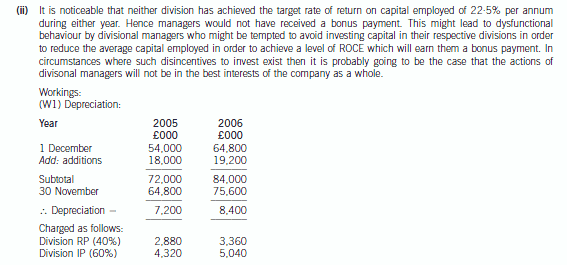
-
第5题:
(c) Critically discuss the statement (in note 12) of the managing director of GBC and suggest how the company
could calculate the value of the service provision to the population of the Western region. (6 marks)
正确答案:
(c) It would appear that in operating a bus service to the Western region of Geeland that GBC is fulfilling a social objective since
a contribution loss amounting to $38,400 ($230,400 – $268,800) was made as a consequence of operating the route to
the Western region during 2007. As an organisation which is partially funded by the government it is highly probable that
GBC has objectives which differ from those of TTC which is a profit-seeking organisation.
The value of a social service such as the provision of public transport can be quantified, albeit, in non-financial times. It is
possible to apply quantitative measures to the bus service itself, the most obvious ones being the number of passengers
carried and the number of passenger miles travelled.
The cost of the provision of alternative transport to the Western region might also enable a value to be placed on the current
service by GBC.
It might be possible to estimate quantitatively some of the social benefits resulting from the provision of the transport facility
to and from the Western region. For example, GBC could undertake a survey of the population of the Western region in order
to help estimate the extent to which rural depopulation would otherwise have occurred had the transport facility not been
made.
The application of the technique of cost-benefit analysis makes it possible to estimate money values for non-monetary
benefits. Social benefits can therefore be expressed in financial terms. It is highly probable that the fact that the Western region
is served by GBC will increase the attractiveness of living in a rural area, which may in turn precipitate an increase in property
values in the Western region and the financial benefit could be expressed in terms of the aggregate increase in property values
in the region as a whole. -
第6题:
(c) (i) Explain how Messier Ltd can assist Galileo with the cost of relocating to the UK and/or provide him with
interest-free loan finance for this purpose without increasing his UK income tax liability; (3 marks)
正确答案:
(c) (i) Relocation costs
Direct assistance
Messier Ltd can bear the cost of certain qualifying relocation costs of Galileo up to a maximum of £8,000 without
increasing his UK income tax liability. Qualifying costs include the legal, professional and other fees in relation to the
purchase of a house, the costs of travelling to the UK and the cost of transporting his belongings. The costs must be
incurred before the end of the tax year following the year of the relocation, i.e. by 5 April 2010.
Assistance in the form. of a loan
Messier Ltd can provide Galileo with an interest-free loan of up to £5,000 without giving rise to any UK income tax. -
第7题:
(ii) Describe the evidence you would seek to support the assertion that development costs are technically
feasible. (3 marks)
正确答案:
(ii) Evidence supporting the assertion that development costs are technically feasible would include the following:
– Review the results of scientific tests performed on the products, for example, the results of animal or human testing
of the products.
– Discuss any detrimental results of these tests, e.g. harmful side effects, with the scientists working on the project
to determine what corrective action is being taken.
– Enquire whether any licences necessary for continued development and/or commercial production have been
granted by the appropriate regulatory body.
– Compare expected to actual development costs incurred per product being developed. Where actual costs are in
excess of expected costs investigate whether the extra costs have been incurred in order to make good any problems
identified in the development process.
– Review board minutes for relevant discussion of the product development taking place during the year. -
第8题:
—How can people avoid food contamination nowadays?—()A. People should have balanced food to get different nutrients they need.
B. I agree with you on this point, and we should pay more to attention to food safety.
C. The government should set strict rules to standardize the production of food.
参考答案:C
-
第9题:
What can you do _________ production costs?A.to reduce
B.reduce
C.reducing
D.reduced
答案:A
-
第10题:
We have to get that car fixed ().
Ano matter it costs how much
Bno matter how much costs it
Cno matter how much it costs
Dno matter how much does it cost
C
[解析] 句意:我们要找人修好这辆车,不管花多少钱。状语从句。根据选项可知空处为一个让步状语从句,应用no matter how (=however)引导,其语序为“no matter how+adj./adv.+主语+谓语”,故应选C。 -
第11题:
Can you tell me how much a radio like this costs?()
- A、I‘d like to buy it.
- B、It‘s of very good quality.
- C、About eighty-five dollars.
- D、It depends on how you like it
正确答案:C -
第12题:
单选题We have to get that car fixed ().Ano matter it costs how much
Bno matter how much costs it
Cno matter how much it costs
Dno matter how much does it cost
正确答案: C解析: [解析] 句意:我们要找人修好这辆车,不管花多少钱。状语从句。根据选项可知空处为一个让步状语从句,应用no matter how (=however)引导,其语序为“no matter how+adj./adv.+主语+谓语”,故应选C。 -
第13题:
(c) Discuss the usefulness of the managerial grid in assessing the attributes of managers. (5 marks)
正确答案:
Part (c):
This all assumes that leadership styles can be categorised into the two dimensions and that the results can be plotted on the grid.
The position of team management is accepted as the best form. of leadership. This may not be practical or indeed advisable. In
many industries, concern for the task may be more important than concern for people, and vice versa. It will always depend on
the individual situation; behaving in a way which is alien to one’s attitudes will be seen as inconsistent and confusing.
However, if the grid has relevance to leadership skills, it can provide the basis for training and for management development. One
way in which it could be useful is (for example) to support a 9,1 leader with a 1,9 subordinate.
The managerial grid also links in to the motivational ideas of Douglas Macgregor. Theory X assumes that the average person has
an inherent dislike of work. The approach is likely to be task driven, and thus managers will have a high score on the x axis.
Theory Y is based on the idea that the goals of the individual and the organisation can be integrated. In this case, the approach
is likely to be concerned with the individual and thus managers will have a high score on the y axis. -
第14题:
(b) (i) Discuss the main factors that should be taken into account when determining how to treat gains and
losses arising on tangible non-current assets in a single statement of financial performance. (8 marks)
正确答案:
(b) (i) Currently there are many rules on how gains and losses on tangible non current assets should be reported and these
have traditionally varied from country to country. The main issues revolve around the reporting of depreciation,
disposal/revaluation gains and losses, and impairment losses. The reporting of such elements should take into account
whether the tangible non current assets have been revalued or held at historical cost. The problem facing standard
setters is where to report such gains and losses.The question is whether they should be reported as part of operating
activities or as ‘other gains and losses’.
Holding gains arising on the sale of tangible non current assets could be reported separately from operating results so
that the latter is not obscured by an asset realisation that reflects more a change in market prices than any increase in
the operating activity of the entity. Other changes in the carrying amounts of tangible non current assets will be reported
as part of the operating results. For example, the depreciation charge tries to reflect the consumption of the asset by the
entity and as such is not a holding loss. There may be cases where the depreciation charge does not reflect the
consumption of economic benefits. For example, the pattern and rate of depreciation could have been misjudged
because the asset’s useful life has been assessed incorrectly. In this case, when an asset is sold any excess or shortfall
of depreciation may need to be dealt with in the operating result.
Impairment is another factor to consider in reporting gains and losses on tangible non current assets. Impairment is
effectively accelerated depreciation. Impairment arises when the carrying amount of the asset is above its recoverable
amount. It follows therefore that any impairment loss should be reported as part of the operating result. Any losses on
disposal, to the extent that they represent impairment, could therefore be reported as part of the operating results. Any
losses which represent holding losses could be reported in ‘other gains and losses’. The difficulty will be differentiating
between holding losses and impairment losses. There will have to be clear and concise definitions of these terms or it
could lead to abuse by companies in their quest to maximise operating profits.
A distinction should be made between gains and losses arising on tangible non current assets as a result of revaluations
and those arising on disposal. The nature of the gain or loss is essentially the same although the timing and certainty
of the gain/loss is different. Therefore revaluation gains/losses may be reported in the ‘other gains and losses’ section.
Where an asset has been revalued, any loss on disposal that represents an impairment would be charged to operating
results and any remaining loss reported in ‘other gains and losses’.
Essentially, gains and losses should be reported on the basis of the characteristics of the gains and losses themselves.
Gains and losses with similar characteristics should be reported together thus helping the comparability of financial
performance nationally and internationally. -
第15题:
(b) Discuss how management’s judgement and the financial reporting infrastructure of a country can have a
significant impact on financial statements prepared under IFRS. (6 marks)
Appropriateness and quality of discussion. (2 marks)
正确答案:
(b) Management judgement may have a greater impact under IFRS than generally was the case under national GAAP. IFRS
utilises fair values extensively. Management have to use their judgement in selecting valuation methods and formulating
assumptions when dealing with such areas as onerous contracts, share-based payments, pensions, intangible assets acquired
in business combinations and impairment of assets. Differences in methods or assumptions can have a major impact on
amounts recognised in financial statements. IAS1 expects companies to disclose the sensitivity of carrying amounts to the
methods, assumptions and estimates underpinning their calculation where there is a significant risk of material adjustment
to their carrying amounts within the next financial year. Often management’s judgement is that there is no ‘significant risk’
and they often fail to disclose the degree of estimation or uncertainty and thus comparability is affected.
In addition to the IFRSs themselves, a sound financial reporting infrastructure is required. This implies effective corporate
governance practices, high quality auditing standards and practices, and an effective enforcement or oversight mechanism.
Therefore, consistency and comparability of IFRS financial statements will also depend on the robust nature of the other
elements of the financial reporting infrastructure.
Many preparers of financial statements will have been trained in national GAAP and may not have been trained in the
principles underlying IFRS and this can lead to unintended inconsistencies when implementing IFRS especially where the
accounting profession does not have a CPD requirement. Additionally where the regulatory system of a country is not well
developed, there may not be sufficient market information to utilise fair value measurements and thus this could lead to
hypothetical markets being created or the use of mathematical modelling which again can lead to inconsistencies because of
lack of experience in those countries of utilising these techniques. This problem applies to other assessments or estimates
relating to such things as actuarial valuations, investment property valuations, impairment testing, etc.
The transition to IFRS can bring significant improvement to the quality of financial performance and improve comparability
worldwide. However, there are issues still remaining which can lead to inconsistency and lack of comparability with those
financial statements. -
第16题:
(iii) whether you agree or not with the statement of the production director. (3 marks)
正确答案:
(iii) ‘If we implement a reward scheme then it is bound to be beneficial for BGL’.
The statement of the manufacturing director is not necessarily correct. Indeed there is much evidence to support the
proposition that the existence of performance-related reward schemes can encourage dysfunctional behaviour. This often
manifests itself in the form. of ‘budgetary slack’ which is incorporated into budgets in anticipation of subsequent cuts by
higher levels of management or to make subsequent performance look better. -
第17题:
(ii) Comment on the figures in the statement prepared in (a)(i) above. (4 marks)
正确答案:
(ii) The statement of product profitability shows that CTC is forecast to achieve a profit of $2·185 million in 2008 giving a
profit:sales ratio of 11·9%. However, the forecast profit in 2009 is only $22,000 which would give a profit:sales ratio
of just 0·19%! Total sales volume in 2008 is 390,000 units which represent 97·5% utilisation of total annual capacity.
In stark contrast, the total sales volume in 2009 is forecast to be 240,000 units which represents 60% utilisation of
total annual capacity and shows the expected rapid decline in sales volumes of Bruno and Kong products. The rapid
decline in the sales of these two products is only offset to a relatively small extent by increased sales volume from the
Leo product. It is vital that a new product or products with healthy contribution to sales ratios are introduced.
Management should also undertake cost/benefit analyses in order to assess the potential of extending the life of Bruno
and Kong products. -
第18题:
(ii) Discuss TWO problems that may be faced in implementing quality control procedures in a small firm of
Chartered Certified Accountants, and recommend how these problems may be overcome. (4 marks)
正确答案:
(ii) Consultation – it may not be possible to hold extensive consultations on specialist issues within a small firm, due to a
lack of specialist professionals. There may be a lack of suitably experienced peers to discuss issues arising on client
engagements. Arrangements with other practices for consultation may be necessary.
Training/Continuing Professional Development (CPD) – resources may not be available, and it is expensive to establish
an in-house training function. External training consortia can be used to provide training/CPD for qualified staff, and
training on non-exam related issues for non-qualified staff.
Review procedures – it may not be possible to hold an independent review of an engagement within the firm due to the
small number of senior and experienced auditors. In this case an external review service may be purchased.
Lack of specialist experience – where special skills are needed within an engagement; the skills may be bought in, for
example, by seconding staff from another practice. Alternatively if work is too specialised for the firm, the work could be
sub-contracted to another practice.
Working papers – the firm may lack resources to establish an in-house set of audit manuals or standard working papers.
In this case documentation can be provided by external firms or professional bodies. -
第19题:
(b) (i) Discuss the relationship between the concepts of ‘business risk’ and ‘financial statement risk’; and
(4 marks)
正确答案:
(b) (i) Business risk is defined as a threat which could mean that a business fails to meet an ongoing business objective.
Business risks represent problems which are faced by the management of a business, and these problems should be
identified and assessed for their possible impact on the business.
Financial statement risk is the risk that components of the financial statements could be misstated, through inaccurate
or incomplete recording of transactions or disclosure. Financial statement risks therefore represent potential errors or
deliberate misstatements in the published accounts of a business.
There is usually a direct relationship between business risk and financial statement risk. Generally a business risk, if not
addressed by management, will have an impact on specific components of the financial statements. For example, for
Medix Co, declining demand for metal surgical equipment has been identified as a business risk. An associated financial
statement risk is the potential over-valuation of obsolete inventory.
Sometimes business risks have a more general effect on the financial statements. Weak internal systems and controls
are often identified as a business risk. Inadequacies in systems and controls could lead to errors or misstatements in
any area of the financial statements so auditors would perceive this as a general audit risk factor.
Business risks are often linked to going concern issues, because if a business is failing to meet objectives such as cash
generation, or revenue maximisation, then it may struggle to continue in operational existence. In terms of financial
statement risk, going concern is a very specific issue, and the risk is normally the inadequate disclosure of going concern
problems. In the extreme situation where a business is definitely not a going concern, then the risk is that the financial
statements have been prepared on the wrong basis, as in this case the ‘break up basis’ should be used.
Business risk and financial statement risk concepts can both be used by auditors in order to identify areas of the financial
statements likely to be misstated at the year end. The business risk approach places the auditor ‘in the shoes’ of
management, and therefore provides deeper insight into the operations of the business and generates extensive business
understanding. -
第20题:
—I can't see the words on the blackboard. —Perhaps you need _( )
A. How long ago did you get it this
B. How long have you been like this
C. How soon have you got it
D. How soon have you liked this
正确答案:B -
第21题:
M company is a manufactory which produces toys.The budgeted production and sales of the company are both expected to be 200 units in the coming year, the budgeted selling price is $ 370 per unit. The following information mimes to the costs of producing 200 toys:
Per unit ($) Total ($)
Direct material costs 1 50 30 000
Direct labor costs 80 1 6 000
Variable production overheads 50 10 000
Variable selling and administration overheads 30 6 000
Fixed production overheads 6 000
Fixed selling and administration overheads 3 000
Requirement:
A.Calculate the total contribution margin.
B.Calculate the amounts of profit at the budgeted level of production.
C.Calculate the break - even point in units and the margin of safety.
D.If M company desires a profit of$4 800, calculate the number of units that it must produce and sell.
答案:解析:A.Total contribution margin=370*200 - (150 +80 +50 +30) *200 =12 000
B.The amounts of profit at the budgeted level of production=12 000 -(6 000 +3 000) =3 000
C.Break - even point in units= (6 000 +3 000)/(3 70 - 310) =150
The marsin of safety= (200 - 150) *370 =18 500
D.4 800= (370 - 310) *Q-9 000
The number of units = (4 800 +9 000)/ (370 -310) =230
-
第22题:
We have to get that car fixed ().
- A、no matter it costs how much
- B、no matter how much costs it
- C、no matter how much it costs
- D、no matter how much does it cost
正确答案:C -
第23题:
问答题Task II (20 marks) Write an essay of no less than 160 words in which you discuss the moral of the following passage and express your personal views on the subject. Now write the letter on the answer sheet. Courage is the greatest of all virtues, because if you don’t have courage, you will not have an opportunity to use any of the others.—Samuel Johnson正确答案:
No matter how fast-learning a child is, he can’t walk without the courage to leave his mother’s embrace; no matter how much talent a singer is endowed with, nobody knows until he marches on the stage and opens his mouth; no matter how ambitious a soldier can be, he is never a general if he dares not take up the arms. So courage is the first step to success. As an old Chinese saying goes: It is the first step that costs troublesome, we may conclude what a valuable treasure courage is. Besides giving you a chance to success, when life gets you down and when it seems that your world is at an end, courage is the only thing that you are left with, that can’t be deprived by anyone and that you can take and make the next step. Because this is not a grant from someone else, instead, it stems from deep within the heart and flushes away the paralysis created by fear.解析: 暂无解析