
(ii) Describe the procedures to verify the number of serious accidents in the year ended 30 November 2007.(4 marks)
题目
(ii) Describe the procedures to verify the number of serious accidents in the year ended 30 November 2007.
(4 marks)
相似考题
更多“(ii) Describe the procedures to verify the number of serious accidents in the year ended 30 November 2007.(4 marks)”相关问题
-
第1题:
(b) Describe with suitable calculations how the goodwill arising on the acquisition of Briars will be dealt with in
the group financial statements and how the loan to Briars should be treated in the financial statements of
Briars for the year ended 31 May 2006. (9 marks)
正确答案:(b) IAS21 ‘The Effects of Changes in Foreign Exchange Rates’ requires goodwill arising on the acquisition of a foreign operation
and fair value adjustments to acquired assets and liabilities to be treated as belonging to the foreign operation. They should
be expressed in the functional currency of the foreign operation and translated at the closing rate at each balance sheet date.
Effectively goodwill is treated as a foreign currency asset which is retranslated at the closing rate. In this case the goodwillarising on the acquisition of Briars would be treated as follows: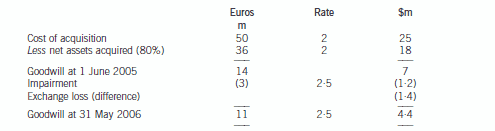
At 31 May 2006, the goodwill will be retranslated at 2·5 euros to the dollar to give a figure of $4·4 million. Therefore this
will be the figure for goodwill in the balance sheet and an exchange loss of $1·4 million recorded in equity (translation
reserve). The impairment of goodwill will be expensed in profit or loss to the value of $1·2 million. (The closing rate has been
used to translate the impairment; however, there may be an argument for using the average rate.)
The loan to Briars will effectively be classed as a financial liability measured at amortised cost. It is the default category for
financial liabilities that do not meet the definition of financial liabilities at fair value through profit or loss. For most entities,
most financial liabilities will fall into this category. When a financial liability is recognised initially in the balance sheet, the
liability is measured at fair value. Fair value is the amount for which a liability can be settled, between knowledgeable, willing
parties in an arm’s length transaction. In other words, fair value is an actual or estimated transaction price on the reporting
date for a transaction taking place between unrelated parties that have adequate information about the asset or liability being
measured.
Since fair value is a market transaction price, on initial recognition fair value generally is assumed to equal the amount of
consideration paid or received for the financial asset or financial liability. Accordingly, IAS39 specifies that the best evidence
of the fair value of a financial instrument at initial recognition generally is the transaction price. However for longer-term
receivables or payables that do not pay interest or pay a below-market interest, IAS39 does require measurement initially at
the present value of the cash flows to be received or paid.
Thus in Briars financial statements the following entries will be made: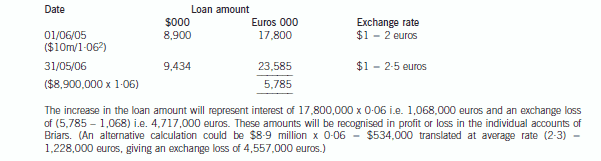
-
第2题:
(d) Additionally Router purchased 60% of the ordinary shares of a radio station, Playtime, a public limited company,
on 31 May 2007. The remaining 40% of the ordinary shares are owned by a competitor company who owns a
substantial number of warrants issued by Playtime which are currently exercisable. If these warrants are
exercised, they will result in Router only owning 35% of the voting shares of Playtime. (4 marks)
Required:
Discuss how the above items should be dealt with in the group financial statements of Router for the year ended
31 May 2007.
正确答案:(d) IAS27 paragraph 14, ‘Consolidated and Separate Financial Statements’, states that warrants that have the potential to give
the holder voting power or reduce another party’s voting power over the financial and operating policies of the issuer should
be considered when existence of control is assessed. The warrants held by the competitor company, if exercised, would grant
that company control over Playtime. One party only can control Playtime and, therefore, the competitor company should
consolidate Playtime. In coming to this decision all the facts and circumstances that affect potential voting rights (except the
intention of management and the financial ability to exercise or convert) should be considered. It seems, however, that there
is a prima facie case for not consolidating Playtime but accounting for it under IAS28 or IAS39.
-
第3题:
Required:
Discuss the principles and practices which should be used in the financial year to 30 November 2008 to account
for:(b) the costs incurred in extending the network; (7 marks)
正确答案:
Costs incurred in extending network
The cost of an item of property, plant and equipment should be recognised when
(i) it is probable that future economic benefits associated with the item will flow to the entity, and
(ii) the cost of the item can be measured reliably (IAS16, ‘Property, plant and equipment’ (PPE))
It is necessary to assess the degree of certainty attaching to the flow of economic benefits and the basis of the evidence available
at the time of initial recognition. The cost incurred during the initial feasibility study ($250,000) should be expensed as incurred,
as the flow of economic benefits to Johan as a result of the study would have been uncertain.
IAS16 states that the cost of an item of PPE comprises amongst other costs, directly attributable costs of bringing the asset to the
location and condition necessary for it to be capable of operating in a manner intended by management (IAS16, para 16).
Examples of costs given in IAS16 are site preparation costs, and installation and assembly costs. The selection of the base station
site is critical for the optimal operation of the network and is part of the process of bringing the network assets to a working
condition. Thus the costs incurred by engaging a consultant ($50,000) to find an optimal site can be capitalised as it is part of
the cost of constructing the network and depreciated accordingly as planning permission has been obtained.
Under IAS17, ‘Leases’, a lease is defined as an agreement whereby the lessor conveys to the lessee, in return for a payment or
series of payments, the right to use an asset for an agreed period of time. A finance lease is a lease that transfers substantially all
the risks and rewards incidental to ownership of the leased asset to the lessee. An operating lease is a lease other than a finance
lease. In the case of the contract regarding the land, there is no ownership transfer and the term is not for the major part of the
asset’s life as it is land which has an indefinite economic life. Thus substantially all of the risks and rewards incidental to ownership
have not been transferred. The contract should be treated, therefore, as an operating lease. The payment of $300,000 should be
treated as a prepayment in the statement of financial position and charged to the income statement over the life of the contract on
the straight line basis. The monthly payments will be expensed and no value placed on the lease contract in the statement of
financial position -
第4题:
(ii) Describe the claim of each of the four identified stakeholders. (4 marks)
正确答案:
(ii) Stakeholder claims
Four external stakeholders in the case and their claims are as follows.
The client, i.e. the government of the East Asian country. This stakeholder wants the project completed to budget and
on time. It may also be concerned to minimise negative publicity in respect of the construction of the dam and the
possible negative environmental consequences.
Stop-the-dam, the vocal and well organised pressure group. This stakeholder wants the project stopped completely,
seemingly and slightly paradoxically, for environmental and social footprint reasons.
First Nation, the indigenous people group currently resident on the land behind the dam that would be flooded after its
construction. This stakeholder also wants the project stopped so they can continue to live on and farm the land.
The banks (identified as a single group). These seem happy to lend to the project and will want it to proceed so they
make a return on their loans commensurate with the risk of the loan. They do not want to be publicly identified as being
associated with the Giant Dam Project.
Shareholders. The shareholders have the right to have their investment in the company managed in such a way as to
maximise the value of their shareholding. The shareholders seek projects providing positive NPVs within the normal
constraints of sound risk management.
Tutorial note: only four stakeholders need to be identified. Marks will be given for up to four relevant stakeholders
only. -
第5题:
(ii) Illustrate the benefit of revising the corporate structure by calculating the corporation tax (CT) payable
for the year ended 31 March 2006, on the assumptions that:
(1) no action is taken; and
(2) an amended structure as recommended in (i) above is implemented from 1 June 2005. (3 marks)
正确答案:
-
第6题:
(ii) Assuming the new structure is implemented with effect from 1 August 2006, calculate the level of
management charge that should be made by Bold plc to Linden Limited for the year ended 31 July
2007, so as to minimise the group’s overall corporation tax (CT) liability for that year. (2 marks)
正确答案:
(ii) For the year ended 31 July 2007, there will be two associated companies in the group. Bold plc will count as an
associated company as it is not dormant throughout the period in question. As a result, the corporation tax limits will be
divided by two (i.e. the number of associates) giving an upper limit of £750,000 (£1·5 million/2). As Linden Limited
is anticipated to make profits of £1·4 million in the year to 31 July 2007 it will pay corporation tax at the rate of 30%.
Bold plc can earn trading profits up to £150,000 (£300,000/2) and pay tax at the rate of 19%. It will therefore
minimise the group’s corporation tax liability if maximum use is made of this small companies rate band, as it will save
£16,500 (150,000 x (30% – 19%)) of corporation tax for the year to 31 July 2007. Bold plc should therefore make
a management charge of sufficient size to give it profits for that year equal to £150,000.
While the transfer pricing legislation no longer applies to small and medium sized enterprises, Bold plc should
nevertheless ensure that there is evidence to support the actual charge made in terms of the services provided. -
第7题:
4 (a) Explain the auditor’s responsibilities in respect of subsequent events. (5 marks)
Required:
Identify and comment on the implications of the above matters for the auditor’s report on the financial
statements of Jinack Co for the year ended 30 September 2005 and, where appropriate, the year ending
30 September 2006.
NOTE: The mark allocation is shown against each of the matters.
正确答案:
4 JINACK CO
(a) Auditor’s responsibilities for subsequent events
■ Auditors must consider the effect of subsequent events on:
– the financial statements;
– the auditor’s report.
■ Subsequent events are all events occurring after a period end (i.e. reporting date) i.e.:
– events after the balance sheet date (as defined in IAS 10); and
– events after the financial statements have been authorised for issue.
Events occurring up to date of auditor’s report
■ The auditor is responsible for carrying out procedures designed to obtain sufficient appropriate audit evidence that all
events up to the date of the auditor’s report that may require adjustment of, or disclosure in, the financial statements
have been identified.
■ These procedures are in addition to those applied to specific transactions occurring after the period end that provide
audit evidence of period-end account balances (e.g. inventory cut-off and receipts from trade receivables). Such
procedures should ordinarily include:
– reviewing minutes of board/audit committee meetings;
– scrutinising latest interim financial statements/budgets/cash flows, etc;
– making/extending inquiries to legal advisors on litigation matters;
– inquiring of management whether any subsequent events have occurred that might affect the financial statements
(e.g. commitments entered into).
■ When the auditor becomes aware of events that materially affect the financial statements, the auditor must consider
whether they have been properly accounted for and adequately disclosed in the financial statements.
Facts discovered after the date of the auditor’s report but before financial statements are issued
Tutorial note: After the date of the auditor’s report it is management’s responsibility to inform. the auditor of facts which
may affect the financial statements.
■ If the auditor becomes aware of such facts which may materially affect the financial statements, the auditor:
– considers whether the financial statements need amendment;
– discusses the matter with management; and
– takes appropriate action (e.g. audit any amendments to the financial statements and issue a new auditor’s report).
■ If management does not amend the financial statements (where the auditor believes they need to be amended) and the
auditor’s report has not been released to the entity, the auditor should express a qualified opinion or an adverse opinion
(as appropriate).
■ If the auditor’s report has been released to the entity, the auditor must notify those charged with governance not to issue
the financial statements (and the auditor’s report thereon) to third parties.
Tutorial note: The auditor would seek legal advice if the financial statements and auditor’s report were subsequently issued.
Facts discovered after the financial statements have been issued
■ The auditor has no obligation to make any inquiry regarding financial statements that have been issued.
■ However, if the auditor becomes aware of a fact which existed at the date of the auditor’s report and which, if known
at that date, may have caused the auditor’s report to be modified, the auditor should:
– consider whether the financial statements need revision;
– discuss the matter with management; and
– take appropriate action (e.g. issuing a new report on revised financial statements). -
第8题:
(ii) Briefly explain the implications of Parr & Co’s audit opinion for your audit opinion on the consolidated
financial statements of Cleeves Co for the year ended 30 September 2006. (3 marks)
正确答案:
(ii) Implications for audit opinion on consolidated financial statements of Cleeves
■ If the potential adjustments to non-current asset carrying amounts and loss are not material to the consolidated
financial statements there will be no implication. However, as Howard is material to Cleeves and the modification
appears to be ‘so material’ (giving rise to adverse opinion) this seems unlikely.
Tutorial note: The question clearly states that Howard is material to Cleeves, thus there is no call for speculation
on this.
■ As Howard is wholly-owned the management of Cleeves must be able to request that Howard’s financial statements
are adjusted to reflect the impairment of the assets. The auditor’s report on Cleeves will then be unmodified
(assuming that any impairment of the investment in Howard is properly accounted for in the separate financial
statements of Cleeves).
■ If the impairment losses are not recognised in Howard’s financial statements they can nevertheless be adjusted on
consolidation of Cleeves and its subsidiaries (by writing down assets to recoverable amounts). The audit opinion
on Cleeves should then be unmodified in this respect.
■ If there is no adjustment of Howard’s asset values (either in Howard’s financial statements or on consolidation) it
is most likely that the audit opinion on Cleeves’s consolidated financial statements would be ‘except for’. (It should
not be adverse as it is doubtful whether even the opinion on Howard’s financial statements should be adverse.)
Tutorial note: There is currently no requirement in ISA 600 to disclose that components have been audited by another
auditor unless the principal auditor is permitted to base their opinion solely upon the report of another auditor. -
第9题:
(b) You are the audit manager of Petrie Co, a private company, that retails kitchen utensils. The draft financial
statements for the year ended 31 March 2007 show revenue $42·2 million (2006 – $41·8 million), profit before
taxation of $1·8 million (2006 – $2·2 million) and total assets of $30·7 million (2006 – $23·4 million).
You are currently reviewing two matters that have been left for your attention on Petrie’s audit working paper file
for the year ended 31 March 2007:
(i) Petrie’s management board decided to revalue properties for the year ended 31 March 2007 that had
previously all been measured at depreciated cost. At the balance sheet date three properties had been
revalued by a total of $1·7 million. Another nine properties have since been revalued by $5·4 million. The
remaining three properties are expected to be revalued later in 2007. (5 marks)
Required:
Identify and comment on the implications of these two matters for your auditor’s report on the financial
statements of Petrie Co for the year ended 31 March 2007.
NOTE: The mark allocation is shown against each of the matters above.
正确答案:
(b) Implications for auditor’s report
(i) Selective revaluation of premises
The revaluations are clearly material to the balance sheet as $1·7 million and $5·4 million represent 5·5% and 17·6%
of total assets, respectively (and 23·1% in total). As the effects of the revaluation on line items in the financial statements
are clearly identified (e.g. revalued amount, depreciation, surplus in statement of changes in equity) the matter is not
pervasive.
The valuations of the nine properties after the year end provide additional evidence of conditions existing at the year end
and are therefore adjusting events per IAS 10 Events After the Balance Sheet Date.
Tutorial note: It is ‘now’ still less than three months after the year end so these valuations can reasonably be expected
to reflect year end values.
However, IAS 16 Property, Plant and Equipment does not permit the selective revaluation of assets thus the whole class
of premises would need to have been revalued for the year to 31 March 2007 to change the measurement basis for this
reporting period.
The revaluation exercise is incomplete. Unless the remaining three properties are revalued before the auditor’s report on
the financial statements for the year ended 31 March 2007 is signed off:
(1) the $7·1 revaluation made so far must be reversed to show all premises at depreciated cost as in previous years;
OR
(2) the auditor’s report would be qualified ‘except for’ disagreement regarding non-compliance with IAS 16.
When it is appropriate to adopt the revaluation model (e.g. next year) the change in accounting policy (from a cost model
to a revaluation model) should be accounted for in accordance with IAS 16 (i.e. as a revaluation).
Tutorial note: IAS 8 Accounting Policies, Changes in Accounting Estimates and Errors does not apply to the initial
application of a policy to revalue assets in accordance with IAS 16.
Assuming the revaluation is written back, before giving an unmodified opinion, the auditor should consider why the three
properties were not revalued. In particular if there are any indicators of impairment (e.g. physical dilapidation) there
should be sufficient evidence on the working paper file to show that the carrying amount of these properties is not
materially greater than their recoverable amount (i.e. the higher of value in use and fair value less costs to sell).
If there is insufficient evidence to confirm that the three properties are not impaired (e.g. if the auditor was prevented
from inspecting the properties) the auditor’s report would be qualified ‘except for’ on grounds of limitation on scope.
If there is evidence of material impairment but management fail to write down the carrying amount to recoverable
amount the auditor’s report would be qualified ‘except for’ disagreement regarding non-compliance with IAS 36
Impairment of Assets.
-
第10题:
(c) (i) Identify and describe FOUR quality control procedures that are applicable to the individual audit
engagement; and (8 marks)
正确答案:
(c) (i) ISQC 1 Quality Control for Firms That Perform. Audits and Reviews of Historical Financial Information and Other
Assurance and Related Services Engagements provides guidance on the overall quality control systems that should be
implemented by an audit firm. ISA 220 Quality Control for Audits of Historical Financial Information specifies the quality
control procedures that should be applied by the engagement team in individual audit assignments.
Procedures include the following:
Client acceptance procedures
There should be full documentation, and conclusion on, ethical and client acceptance issues in each audit assignment.
The engagement partner should consider whether members of the audit team have complied with ethical requirements,
for example, whether all members of the team are independent of the client. Additionally, the engagement partner should
conclude whether all acceptance procedures have been followed, for example, that the audit firm has considered the
integrity of the principal owners and key management of the client. Other procedures on client acceptance should
include:
– Obtaining professional clearance from previous auditors
– Consideration of any conflict of interest
– Money laundering (client identification) procedures.
Engagement team
Procedures should be followed to ensure that the engagement team collectively has the skills, competence and time to
perform. the audit engagement. The engagement partner should assess that the audit team, for example:
– Has the appropriate level of technical knowledge
– Has experience of audit engagements of a similar nature and complexity
– Has the ability to apply professional judgement
– Understands professional standards, and regulatory and legal requirements.
Direction
The engagement team should be directed by the engagement partner. Procedures such as an engagement planning
meeting should be undertaken to ensure that the team understands:
– Their responsibilities
– The objectives of the work they are to perform
– The nature of the client’s business
– Risk related issues
– How to deal with any problems that may arise; and
– The detailed approach to the performance of the audit.
The planning meeting should be led by the partner and should include all people involved with the audit. There should
be a discussion of the key issues identified at the planning stage.
Supervision
Supervision should be continuous during the engagement. Any problems that arise during the audit should be rectified
as soon as possible. Attention should be focused on ensuring that members of the audit team are carrying out their work
in accordance with the planned approach to the engagement. Significant matters should be brought to the attention of
senior members of the audit team. Documentation should be made of key decisions made during the audit engagement.
Review
The review process is one of the key quality control procedures. All work performed must be reviewed by a more senior
member of the audit team. Reviewers should consider for example whether:
– Work has been performed in accordance with professional standards
– The objectives of the procedures performed have been achieved
– Work supports conclusions drawn and is appropriately documented.
The review process itself must be evidenced.
Consultation
Finally the engagement partner should arrange consultation on difficult or contentious matters. This is a procedure
whereby the matter is discussed with a professional outside the engagement team, and sometimes outside the audit
firm. Consultations must be documented to show:
– The issue on which the consultation was sought; and
– The results of the consultation. -
第11题:
(ii) State the principal audit procedures to be performed on the consolidation schedule of the Rosie Group.
(4 marks)
正确答案:
(ii) Audit procedures on the consolidation schedule of the Rosie Group:
– Agree correct extraction of individual company figures by reference to individual company audited financial
statements.
– Cast and cross cast all consolidation schedules.
– Recalculate all consolidation adjustments, including goodwill, elimination of pre acquisition reserves, cancellation
of intercompany balances, fair value adjustments and accounting policy adjustments.
– By reference to prior year audited consolidated accounts, agree accounting policies have been consistently applied.
– Agree brought down figures to prior year audited consolidated accounts and audit working papers (e.g. goodwill
figures for Timber Co and Ben Co, consolidated reserves).
– Agree that any post acquisition profits consolidated for Dylan Co arose since the date of acquisition by reference to
date of control passing per the purchase agreement.
– Reconcile opening and closing group reserves and agree reconciling items to group financial statements. -
第12题:
单选题The British Royal Society for the Prevention of Accidents (ROSPA) is petitioning to keep the UK on British Summer Time all year round, and they claim that nearly 450 serious accidents occur each year because of the time change.Aall year round, and they claim that nearly 450 serious accidents occur each year because of the time change
Ball throughout the year, and they claim that nearly 450 serious accidents occur each year because of it
Call year, claiming that nearly 450 serious accidents occur each year because of it
Dall year round, claiming that nearly 450 serious accidents occur each year because of the time change
Eall year round, and they claim that nearly 450 serious accidents occur each and every year because of the time change
正确答案: D解析:
A,B,E项中复数形式的代词和单数形式的“The British Royal Society”不一致。C项中的代词“it”指代模糊。只有D项没有错误。 -
第13题:
4 (a) Router, a public limited company operates in the entertainment industry. It recently agreed with a television
company to make a film which will be broadcast on the television company’s network. The fee agreed for the
film was $5 million with a further $100,000 to be paid every time the film is shown on the television company’s
channels. It is hoped that it will be shown on four occasions. The film was completed at a cost of $4 million and
delivered to the television company on 1 April 2007. The television company paid the fee of $5 million on
30 April 2007 but indicated that the film needed substantial editing before they were prepared to broadcast it,
the costs of which would be deducted from any future payments to Router. The directors of Router wish to
recognise the anticipated future income of $400,000 in the financial statements for the year ended 31 May
2007. (5 marks)
Required:
Discuss how the above items should be dealt with in the group financial statements of Router for the year ended
31 May 2007.
正确答案:
(a) Under IAS18 ‘Revenue’, revenue on a service contract is recognised when the outcome of the transaction can be measured
reliably. For revenue arising from the rendering of services, provided that all of the following criteria are met, revenue should
be recognised by reference to the stage of completion of the transaction at the balance sheet date (the percentage-ofcompletion
method) (IAS18 para 20):
(a) the amount of revenue can be measured reliably;
(b) it is probable that the economic benefits will flow to the seller;
(c) the stage of completion at the balance sheet date can be measured reliably; and
(d) the costs incurred, or to be incurred, in respect of the transaction can be measured reliably.
When the above criteria are not met, revenue arising from the rendering of services should be recognised only to the extent
of the expenses recognised that are recoverable. Because the only revenue which can be measured reliably is the fee for
making the film ($5 million), this should therefore be recognised as revenue in the year to 31 May 2007 and matched against
the cost of the film of $4 million. Only when the television company shows the film should any further amounts of $100,000
be recognised as there is an outstanding ‘performance’ condition in the form. of the editing that needs to take place before the
television company will broadcast the film. The costs of the film should not be carried forward and matched against
anticipated future income unless they can be deemed to be an intangible asset under IAS 38 ‘Intangible Assets’. Additionally,
when assessing revenue to be recognised in future years, the costs of the editing and Router’s liability for these costs should
be assessed.
-
第14题:
(b) (i) Discusses the principles involved in accounting for claims made under the above warranty provision.
(6 marks)
(ii) Shows the accounting treatment for the above warranty provision under IAS37 ‘Provisions, Contingent
Liabilities and Contingent Assets’ for the year ended 31 October 2007. (3 marks)
Appropriateness of the format and presentation of the report and communication of advice. (2 marks)
正确答案:(b) Provisions – IAS37
An entity must recognise a provision under IAS37 if, and only if:
(a) a present obligation (legal or constructive) has arisen as a result of a past event (the obligating event)
(b) it is probable (‘more likely than not’), that an outflow of resources embodying economic benefits will be required to settle
the obligation
(c) the amount can be estimated reliably
An obligating event is an event that creates a legal or constructive obligation and, therefore, results in an enterprise having
no realistic alternative but to settle the obligation. A constructive obligation arises if past practice creates a valid expectation
on the part of a third party. If it is more likely than not that no present obligation exists, the enterprise should disclose a
contingent liability, unless the possibility of an outflow of resources is remote.
The amount recognised as a provision should be the best estimate of the expenditure required to settle the present obligation
at the balance sheet date, that is, the amount that an enterprise would rationally pay to settle the obligation at the balance
sheet date or to transfer it to a third party. This means provisions for large populations of events such as warranties, are
measured at a probability weighted expected value. In reaching its best estimate, the entity should take into account the risks
and uncertainties that surround the underlying events.
Expected cash outflows should be discounted to their present values, where the effect of the time value of money is material
using a risk adjusted rate (it should not reflect risks for which future cash flows have been adjusted). If some or all of the
expenditure required to settle a provision is expected to be reimbursed by another party, the reimbursement should be
recognised as a separate asset when, and only when, it is virtually certain that reimbursement will be received if the entity
settles the obligation. The amount recognised should not exceed the amount of the provision. In measuring a provision future
events should be considered. The provision for the warranty claim will be determined by using the expected value method.
The past event which causes the obligation is the initial sale of the product with the warranty given at that time. It would be
appropriate for the company to make a provision for the Year 1 warranty of $280,000 and Year 2 warranty of $350,000,
which represents the best estimate of the obligation (see Appendix 2). Only if the insurance company have validated the
counter claim will Macaljoy be able to recognise the asset and income. Recovery has to be virtually certain. If it is virtually
certain, then Macaljoy may be able to recognise the asset. Generally contingent assets are never recognised, but disclosed
where an inflow of economic benefits is probable.
The company could discount the provision if it was considered that the time value of money was material. The majority of
provisions will reverse in the short term (within two years) and, therefore, the effects of discounting are likely to be immaterial.
In this case, using the risk adjusted rate (IAS37), the provision would be reduced to $269,000 in Year 1 and $323,000 in
Year 2. The company will have to determine whether this is material.
Appendix 1
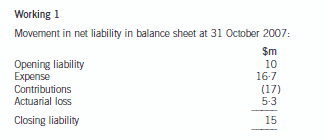
The accounting for the defined benefit plan is as follows:

-
第15题:
Discuss the principles and practices which should be used in the financial year to 30 November 2008 to account
for:(c) the purchase of handsets and the recognition of revenue from customers and dealers. (8 marks)
Appropriateness and quality of discussion. (2 marks)
正确答案:Handsets and revenue recognition
The inventory of handsets should be measured at the lower of cost and net realisable value (IAS2, ‘Inventories’, para 9). Johan
should recognise a provision at the point of purchase for the handsets to be sold at a loss. The inventory should be written down
to its net realisable value (NRV) of $149 per handset as they are sold both to prepaid customers and dealers. The NRV is $51
less than cost. Net realisable value is the estimated selling price in the normal course of business less the estimated selling costs.
IAS18, ‘Revenue’, requires the recognition of revenue by reference to the stage of completion of the transaction at the reporting
date. Revenue associated with the provision of services should be recognised as service as rendered. Johan should record the
receipt of $21 per call card as deferred revenue at the point of sale. Revenue of $18 should be recognised over the six month
period from the date of sale. The unused call credit of $3 would be recognised when the card expires as that is the point at which
the obligation of Johan ceases. Revenue is earned from the provision of services and not from the physical sale of the card.
IAS18 does not deal in detail with agency arrangements but says the gross inflows of economic benefits include amounts collected
on behalf of the principal and which do not result in increases in equity for the entity. The amounts collected on behalf of the
principal are not revenue. Revenue is the amount of the ‘commission’. Additionally where there are two or more transactions, they
should be taken together if the commercial effect cannot be understood without reference to the series of transactions as a whole.
As a result of the above, Johan should not recognise revenue when the handset is sold to the dealer, as the dealer is acting as an
agent for the sale of the handset and the service contract. Johan has retained the risk of the loss in value of the handset as they
can be returned by the dealer and the price set for the handset is under the control of Johan. The handset sale and the provision
of the service would have to be assessed as to their separability. However, the handset cannot be sold separately and is
commercially linked to the provision of the service. Johan would, therefore, recognise the net payment of $130 as a customer
acquisition cost which may qualify as an intangible asset under IAS38, and the revenue from the service contract will be recognised
as the service is rendered. The intangible asset would be amortised over the 12 month contract. The cost of the handset from the
manufacturer will be charged as cost of goods sold ($200). -
第16题:
(b) Calculate the percentage of maximum capacity at which the zoo will break even during the year ending
30 November 2007. You should assume that 50% of the revenue from sales of ticket type ZC is attributable
to the zoo. (7 marks)
正确答案:
-
第17题:
(ii) Assuming that Donald operates through a company, advise Donald on the corporation tax (CT) that
would be payable for the year ended 31 March 2007 if he pays himself a gross salary of £31,000, plus
a net dividend of £10,000, instead of a gross salary of £42,648. (4 marks)
正确答案: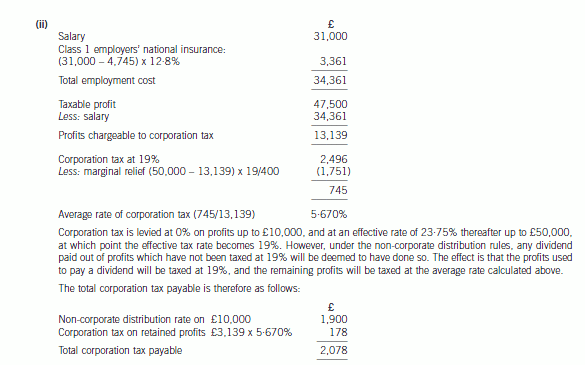
-
第18题:
(ii) Calculate the corporation tax (CT) payable by Tay Limited for the year ended 31 March 2006, taking
advantage of all available reliefs. (3 marks)
正确答案:
-
第19题:
(c) In November 2006 Seymour announced the recall and discontinuation of a range of petcare products. The
product recall was prompted by the high level of customer returns due to claims of poor quality. For the year to
30 September 2006, the product range represented $8·9 million of consolidated revenue (2005 – $9·6 million)
and $1·3 million loss before tax (2005 – $0·4 million profit before tax). The results of the ‘petcare’ operations
are disclosed separately on the face of the income statement. (6 marks)
Required:
For each of the above issues:
(i) comment on the matters that you should consider; and
(ii) state the audit evidence that you should expect to find,
in undertaking your review of the audit working papers and financial statements of Seymour Co for the year ended
30 September 2006.
NOTE: The mark allocation is shown against each of the three issues.
正确答案:
■ The discontinuation of the product line after the balance sheet date provides additional evidence that, as at the
balance sheet date, it was of poor quality. Therefore, as at the balance sheet date:
– an allowance (‘provision’) may be required for credit notes for returns of products after the year end that were
sold before the year end;
– goods returned to inventory should be written down to net realisable value (may be nil);
– any plant and equipment used exclusively in the production of the petcare range of products should be tested
for impairment;
– any material contingent liabilities arising from legal claims should be disclosed.
(ii) Audit evidence
■ A copy of Seymour’s announcement (external ‘press release’ and any internal memorandum).
■ Credit notes raised/refunds paid after the year end for faulty products returned.
■ Condition of products returned as inspected during physical attendance of inventory count.
■ Correspondence from customers claiming reimbursement/compensation for poor quality.
■ Direct confirmation from legal adviser (solicitor) regarding any claims for customers including estimates of possible
payouts. -
第20题:
(c) Describe the examination procedures you should use to verify Cusiter Co’s prospective financial information.
(9 marks)
正确答案:
(c) Examination procedures
■ The arithmetic accuracy of the PFI should be confirmed, i.e. subtotals and totals should be recast and agreed.
■ The actual information for the year to 31 December 2006 that is shown as comparative information should be agreed
to the audited financial statements for that year to ensure consistency.
■ Balances and transaction totals for the quarter to 31 March 2007 should be agreed to general ledger account balances
at that date. The net book value of property, plant and equipment should be agreed to the non-current asset register;
accounts receivable/payable to control accounts and cash at bank to a bank reconciliation statement.
■ Tenders for the new equipment should be inspected to confirm the additional cost included in property, plant and
equipment included in the forecast for the year to 31 December 2008 and that it can be purchased with the funds being
lent by the bank.
■ The reasonableness of all new assumptions should be considered. For example, the expected useful life of the new
equipment, the capacity at which it will be operating, the volume of new product that can be sold, and at what price.
■ The forecast income statement should be reviewed for completeness of costs associated with the expansion. For
example, operating expenses should include salaries of additional equipment operatives or supervisors.
■ The consistency of accounting practices reflected in the forecast with International Financial Reporting Standards (IFRS)
should be considered. For example, the intangible asset might be expected to be less than $10,000 at 31 December
2008 as it should be carried at amortised cost.
■ The cost of property, plant and equipment at 31 December 2008 is $280,000 more than as at 31 December 2007.
Consideration should be given to the adequacy of borrowing $250,000 if the actual investment is $30,000 more.
■ The terms of existing borrowings (both non-current and short-term) should be reviewed to ensure that the forecast takes
full account of existing repayment schedules. For example, to confirm that only $23,000 of term borrowings will become
current by the end of 2007.
Trends should be reviewed and fluctuations explained, for example:
■ Revenue for the first quarter of 2007 is only 22% of revenue for 2006 and so may appear to be understated. However,
revenue may not be understated if sales are seasonal and the first quarter is traditionally ‘quieter’.
■ Forecast revenue for 2007 is 18% up on 2006. However, forecast revenue for 2008 is only 19% up on 2007. As the
growth in 2007 is before the investment in new plant and equipment it does not look as though the new investment
will be contributing significantly to increased growth in the first year.
■ The gross profit % is maintained at around 29% for the three years. However, the earnings before interest and tax (EBIT)
% is forecast to fall by 2% for 2008. Earnings after interest might be worrying to the potential lender as this is forecast
to rise from 12·2% in 2006 to 13·7% in 2007 but then fall to 7·6% in 2008.
The reasonableness of relationships between income statement and balance sheet items should be considered. For example:
■ The average collection period at each of the balance sheet dates presented is 66, 69, 66 and 66 days respectively (e.g.
71/394 × 365 = 66 days). Although it may be realistic to assume that the current average collection period may be
maintained in future it is possible that it could deteriorate if, for example, new customers taken on to launch the new
product are not as credit worthy as the existing customer base.
■ The number of days sales in inventory at each balance sheet date is 66, 88, 66 and 65 days respectively (e.g. 50/278
× 365 = 66 days). The reason for the increase to 88 at the end of the first quarter must be established and
management’s assertion that 66 days will be re-established as the ‘norm’ corroborated.
■ As the $42,000 movement on retained earnings from 2007 to 2008 is the earnings before income tax for 2008 it may
be that there is no tax in 2008 or that tax effects have not been forecast. (However, some deferred tax effect might be
expected if the investment in new plant and equipment is likely to attract accelerated capital allowances.) -
第21题:
(b) Explain the principal audit procedures to be performed during the final audit in respect of the estimated
warranty provision in the balance sheet of Island Co as at 30 November 2007. (5 marks)
正确答案:
(b) ISA 540 Audit of Accounting Estimates requires that auditors should obtain sufficient audit evidence as to whether an
accounting estimate, such as a warranty provision, is reasonable given the entity’s circumstances, and that disclosure is
appropriate. One, or a combination of the following approaches should be used:
Review and test the process used by management to develop the estimate
– Review contracts or orders for the terms of the warranty to gain an understanding of the obligation of Island Co
– Review correspondence with customers during the year to gain an understanding of claims already in progress at the
year end
– Perform. analytical procedures to compare the level of warranty provision year on year, and compare actual to budgeted
provisions. If possible disaggregate the data, for example, compare provision for specific types of machinery or customer
by customer
– Re-calculate the warranty provision
– Agree the percentage applied in the calculation to the stated accounting policy of Island Co
– Review board minutes for discussion of on-going warranty claims, and for approval of the amount provided
– Use management accounts to ascertain normal level of warranty rectification costs during the year
– Discuss with Kate Shannon the assumptions she used to determine the percentage used in her calculations
– Consider whether assumptions used are consistent with the auditors’ understanding of the business
– Compare prior year provision with actual expenditure on warranty claims in the accounting period
– Compare the current year provision with prior year and discuss any fluctuation with Kate Shannon.
Review subsequent events which confirm the estimate made
– Review any work carried out post year end on specific faults that have been provided for. Agree that all costs are included
in the year end provision.
– Agree cash expended on rectification work in the post balance sheet period to the cash book
– Agree cash expended on rectification work post year end to suppliers’ invoices, or to internal cost ledgers if work carried
out by employees of Island Co
– Read customer correspondence received post year end for any claims received since the year end. -
第22题:
(ii) Identify and explain the principal audit procedures to be performed on the valuation of the investment
properties. (6 marks)
正确答案:
(ii) Additional audit procedures
Audit procedures should focus on the appraisal of the work of the expert valuer. Procedures could include the following:
– Inspection of the written instructions provided by Poppy Co to the valuer, which should include matters such as
the objective and scope of the valuer’s work, the extent of the valuer’s access to relevant records and files, and
clarification of the intended use by the auditor of their work.
– Evaluation, using the valuation report, that any assumptions used by the valuer are in line with the auditor’s
knowledge and understanding of Poppy Co. Any documentation supporting assumptions used by the valuer should
be reviewed for consistency with the auditor’s business understanding, and also for consistency with any other
audit evidence.
– Assessment of the methodology used to arrive at the fair value and confirmation that the method is consistent with
that required by IAS 40.
– The auditor should confirm, using the valuation report, that a consistent method has been used to value each
property.
– It should also be confirmed that the date of the valuation report is reasonably close to the year end of Poppy Co.
– Physical inspection of the investment properties to determine the physical condition of the properties supports the
valuation.
– Inspect the purchase documentation of each investment property to ascertain the cost of each building. As the
properties were acquired during this accounting period, it would be reasonable to expect that the fair value at the
year end is not substantially different to the purchase price. Any significant increase or decrease in value should
alert the auditor to possible misstatement, and lead to further audit procedures.
– Review of forecasts of rental income from the properties – supporting evidence of the valuation.
– Subsequent events should be monitored for any additional evidence provided on the valuation of the properties.
For example, the sale of an investment property shortly after the year end may provide additional evidence relating
to the fair value measurement.
– Obtain a management representation regarding the reasonableness of any significant assumptions, where relevant,
to fair value measurements or disclosures. -
第23题:
(ii) Recommend further audit procedures that should be carried out. (4 marks)
正确答案:
(ii) Further audit procedures:
Request from Peter Sheffield a written representation detailing:
– the exact nature of his control over Jarvis Co, i.e. if he is a shareholder then state his percentage shareholding, if
he is a member of senior management then state his exact position within the entity,
– a comment on whether in his opinion the balance is recoverable,
– a specific date by which the amount should be expected to be repaid, and
– a confirmation that there are no further balances outstanding from Jarvis Co, or any further transactions between
Jarvis Co and Pulp Co.
Tutorial note: Reference to the Exposure Draft ISA 550 Related Parties (Revised and Redrafted) requirement for both
general and specific management representations will be awarded credit.
Review the terms of any written confirmation of the amount, such as a signed agreement or invoice, checking whether
any interest is due to Pulp Co. The terms should be reviewed for details of any security offered, and the nature of the
consideration to be provided in settlement.
From discussion with Peter Sheffield, develop an understanding of the business purpose of the transaction, particularly
to understand whether the balance is a trade receivable or an investment.
Review the board minutes for evidence of any discussion of the transaction and the recoverability of the balance
outstanding.
Obtain the most recent audited financial statements of Jarvis Co and:
– ascertain whether Peter Sheffield is disclosed as the ultimate controlling party or disclosed as a member of key
management personnel,
– scrutinise the disclosure notes to find any disclosure of the transaction, where it should be described as a related
party liability, and
– perform. a liquidity analysis to establish whether the amount can be repaid from liquid assets.