
2 Clifford and Amanda, currently aged 54 and 45 respectively, were married on 1 February 1998. Clifford is a higherrate taxpayer who has realised taxable capital gains in 2007/08 in excess of his capital gains tax annual exemption.Clifford moved into Aman
题目
2 Clifford and Amanda, currently aged 54 and 45 respectively, were married on 1 February 1998. Clifford is a higher
rate taxpayer who has realised taxable capital gains in 2007/08 in excess of his capital gains tax annual exemption.
Clifford moved into Amanda’s house in London on the day they were married. Clifford’s own house in Oxford, where
he had lived since acquiring it for £129,400 on 1 August 1996, has been empty since that date although he and
Amanda have used it when visiting friends. Clifford has been offered £284,950 for the Oxford house and has decided
that it is time to sell it. The house has a large garden such that Clifford is also considering an offer for the house and
a part only of the garden. He would then sell the remainder of the garden at a later date as a building plot. His total
sales proceeds will be higher if he sells the property in this way.
Amanda received the following income from quoted investments in 2006/07:
£
Dividends in respect of quoted trading company shares 1,395
Dividends paid by a Real Estate Investment Trust out of tax exempt property income 485
On 1 May 2006, Amanda was granted a 22 year lease of a commercial investment property. She paid the landlord
a premium of £6,900 and also pays rent of £2,100 per month. On 1 June 2006 Amanda granted a nine year
sub-lease of the property. She received a premium of £14,700 and receives rent of £2,100 per month.
On 1 September 2006 Amanda gave quoted shares with a value of £2,200 to a registered charity. She paid broker’s
fees of £115 in respect of the gift.
Amanda began working for Shearer plc, a quoted company, on 1 June 2006 having had a two year break from her
career. She earns an annual salary of £38,600 and was paid a bonus of £5,750 in August 2006 for agreeing to
come and work for the company. On 1 August 2006 Amanda was provided with a fully expensed company car,
including the provision of private petrol, which had a list price when new of £23,400 and a CO2 emissions rate of
187 grams per kilometre. Amanda is required to pay Shearer plc £22 per month in respect of the private use of the
car. In June and July 2006 Amanda used her own car whilst on company business. She drove 720 business miles
during this two month period and was paid 34 pence per mile. Amanda had PAYE of £6,785 deducted from her gross
salary in the tax year 2006/07.
After working for Shearer plc for a full year, Amanda becomes entitled to the following additional benefits:
– The opportunity to purchase a large number of shares in Shearer plc on 1 July 2007 for £3·30 per share. It is
anticipated that the share price on that day will be at least £7·50 per share. The company will make an interestfree
loan to Amanda equal to the cost of the shares to be repaid in two years.
– Exclusive free use of the company sailing boat for one week in August 2007. The sailing boat was purchased by
Shearer plc in January 2005 for use by its senior employees and costs the company £1,400 a week in respect
of its crew and other running expenses.
Required:
(a) (i) Calculate Clifford’s capital gains tax liability for the tax year 2007/08 on the assumption that the Oxford
house together with its entire garden is sold on 31 July 2007 for £284,950. Comment on the relevance
to your calculations of the size of the garden; (5 marks)
相似考题
更多“2 Clifford and Amanda, currently aged 54 and 45 respectively, were married on 1 February 1998. Clifford is a higherrate taxpayer who has realised taxable capital gains in 2007/08 in excess of his capital gains tax annual exemption.Clifford moved into Aman”相关问题
-
第1题:
(c) (i) Explain the capital gains tax (CGT) implications of a takeover where the consideration is in the form. of
shares (a ‘paper for paper’ transaction) stating any conditions that need to be satisfied. (4 marks)
正确答案:
(c) (i) Paper for paper rules
The proposed transaction broadly falls under the ‘paper for paper’ rules. Where this is the case, chargeable gains do not
arise. Instead, the new holding stands in the shoes (and inherits the base cost) of the original holding.
The company issuing the new shares must:
(i) end up with more than 25% of the ordinary share capital (or a majority of the voting power) of the old company,
OR
(ii) make a general offer to shareholders in the other company with a condition that, if satisfied, would give the
acquiring company control of the other company.
The exchange must be for bona fide commercial reasons and must not have as its main purpose (or one of its main
purposes) the avoidance of CGT or corporation tax. The acquiring company can obtain advance clearance from the
Inland Revenue that the conditions will be met.
If part of the offer consideration is in the form. of cash, a gain must be calculated using the part disposal rules. If the
cash received is not more than the higher of £3,000 or 5% of the total value on takeover, then the amount received in
cash can be deducted from the base cost of the securities under the small distribution rules. -
第2题:
3 On 1 January 2007 Dovedale Ltd, a company with no subsidiaries, intends to purchase 65% of the ordinary share
capital of Hira Ltd from Belgrove Ltd. Belgrove Ltd currently owns 100% of the share capital of Hira Ltd and has no
other subsidiaries. All three companies have their head offices in the UK and are UK resident.
Hira Ltd had trading losses brought forward, as at 1 April 2006, of £18,600 and no income or gains against which
to offset losses in the year ended 31 March 2006. In the year ending 31 March 2007 the company expects to make
further tax adjusted trading losses of £55,000 before deduction of capital allowances, and to have no other income
or gains. The tax written down value of Hira Ltd’s plant and machinery as at 31 March 2006 was £96,000 and
there will be no fixed asset additions or disposals in the year ending 31 March 2007. In the year ending 31 March
2008 a small tax adjusted trading loss is anticipated. Hira Ltd will surrender the maximum possible trading losses
to Belgrove Ltd and Dovedale Ltd.
The tax adjusted trading profit of Dovedale Ltd for the year ending 31 March 2007 is expected to be £875,000 and
to continue at this level in the future. The profits chargeable to corporation tax of Belgrove Ltd are expected to be
£38,000 for the year ending 31 March 2007 and to increase in the future.
On 1 February 2007 Dovedale Ltd will sell a small office building to Hira Ltd for its market value of £234,000.
Dovedale Ltd purchased the building in March 2005 for £210,000. In October 2004 Dovedale Ltd sold a factory
for £277,450 making a capital gain of £84,217. A claim was made to roll over the gain on the sale of the factory
against the acquisition cost of the office building.
On 1 April 2007 Dovedale Ltd intends to acquire the whole of the ordinary share capital of Atapo Inc, an unquoted
company resident in the country of Morovia. Atapo Inc sells components to Dovedale Ltd as well as to other
companies in Morovia and around the world.
It is estimated that Atapo Inc will make a profit before tax of £160,000 in the year ending 31 March 2008 and will
pay a dividend to Dovedale Ltd of £105,000. It can be assumed that Atapo Inc’s taxable profits are equal to its profit
before tax. The rate of corporation tax in Morovia is 9%. There is a withholding tax of 3% on dividends paid to
non-Morovian resident shareholders. There is no double tax agreement between the UK and Morovia.
Required:
(a) Advise Belgrove Ltd of any capital gains that may arise as a result of the sale of the shares in Hira Ltd. You
are not required to calculate any capital gains in this part of the question. (4 marks)
正确答案:
(a) Capital gains that may arise on the sale by Belgrove Ltd of shares in Hira Ltd
Belgrove Ltd will realise a capital gain on the sale of the shares unless the substantial shareholding exemption applies. The
exemption will be given automatically provided all of the following conditions are satisfied.
– Belgrove Ltd has owned at least 10% of Hira Ltd for a minimum of 12 months during the two years prior to the sale.
– Belgrove Ltd is a trading company or a member of a trading group during that 12-month period and immediately after
the sale.
– Hira Ltd is a trading company or the holding company of a trading group during that 12-month period and immediately
after the sale.
Hira Ltd will no longer be in a capital gains group with Belgrove Ltd after the sale. Accordingly, a capital gain, known as a
degrouping charge, may arise in Hira Ltd. A degrouping charge will arise if, at the time it leaves the Belgrove Ltd group, Hira
Ltd owns any capital assets which were transferred to it at no gain, no loss within the previous six years by a member of the
Belgrove Ltd capital gains group. -
第3题:
(d) Explain how Gloria would be taxed in the UK on the dividends paid by Bubble Inc and the capital gains tax
and inheritance tax implications of a future disposal of the shares. Clearly state, giving reasons, whether or
not the payment made to Eric is allowable for capital gains tax purposes. (9 marks)
You should assume that the rates and allowances for the tax year 2005/06 apply throughout this question.
正确答案:
(d) UK tax implications of shares in Bubble Inc
Income tax
Gloria is UK resident and is therefore subject to income tax on her worldwide income. However, because she is non-UK
domiciled, she will only be taxed on the foreign dividends she brings into the UK.
Dividends brought into the UK will be grossed up for any tax paid in Oceania. The gross amount is taxed at 10% if it falls
into the starting or basic rate band and at 321/2% if it falls into the higher rate band. The tax suffered in Oceania is available
for offset against the UK tax liability. The offset is restricted to a maximum of the UK tax on the dividend income.
Capital gains tax
Individuals are subject to capital gains tax on worldwide assets if they are resident or ordinarily resident in the UK. However,
because Gloria is non-UK domiciled and the shares are situated abroad, the gain is only taxable to the extent that the sales
proceeds are brought into the UK. Any tax suffered in Oceania in respect of the gain is available for offset against the UK
capital gains tax liability arising on the shares.
Any loss arising on the disposal of the shares would not be available for relief in the UK.
In computing a capital gain or allowable loss, a deduction is available for the incidental costs of acquisition. However, to be
allowable, such costs must be incurred wholly and exclusively for the purposes of acquiring the asset. The fee paid to Eric
related to general investment advice and not to the acquisition of the shares and therefore, would not be deductible in
computing the gain.
Taper relief will be at non-business asset rates as Bubble Inc is an investment company.
Inheritance tax
Assets situated abroad owned by non-UK domiciled individuals are excluded property for the purposes of inheritance tax.
However, Gloria will be deemed to be UK domiciled (for the purposes of inheritance tax only) if she has been resident in the
UK for 17 out of the 20 tax years ending with the year in which the disposal occurs.
Gloria has been running a business in the UK since June 1992 and would therefore, appear to have been resident for at least
15 tax years (1992/93 to 2006/07 inclusive).
If Gloria is deemed to be UK domiciled such that the shares in Bubble Inc are not excluded property, business property relief
will not be available because Bubble Inc is an investment company. -
第4题:
(c) Explain the capital gains tax (CGT) and income tax (IT) issues Paul and Sharon should consider in deciding
which form. of trust to set up for Gisella and Gavin. You are not required to consider inheritance tax (IHT) or
stamp duty land tax (SDLT) issues. (10 marks)
You should assume that the tax rates and allowances for the tax year 2005/06 apply throughout this question.
正确答案:
(c) As the trust is created in the settlors’ (Paul and Sharon’s) lifetime its creation will constitute a chargeable disposal for capital
gains tax. Also, as the settlors and trustees are connected persons, the disposal will be deemed to be at market value, resulting
in a chargeable gain of £80,000 (160,000 – 80,000). No taper relief will be available as the property is a non-business
asset, and has been held for less than three years, but annual exemptions of £17,000 (2 x £8,500) will be available.
However, in the case of a discretionary trust, gift hold over relief will be available. This is because the gift will constitute a
chargeable lifetime transfer and because there is an immediate charge to inheritance tax (even though no tax is payable due
to the nil rate band) relief is available if a specific accumulation and maintenance trust is used, as in this case the gift will
qualify as a potentially exempt transfer and so gift relief would only be available in respect of business assets. The use of a
basic discretionary trust will thus facilitate the deferral of an immediate capital gains tax charge of £25,200 (63,000 x 40%).
If/when the property is disposed of, however, the trustees will pay capital gains tax on the deferred gain at the trust income
tax rate of 40%, and have an annual exemption of only £4,250 (50% of the normal individual rate) available to them. The
40% rate of tax and lower annual exemption rate also apply to chargeable gains arising in a specific accumulation and
maintenance trust, as well as a basic discretionary trust.
A chargeable disposal between connected persons will also arise for the purposes of capital gains tax if/when the property
vests in a beneficiary, i.e. one or more of the beneficiaries becomes absolutely entitled to all or part of the income or capital
of the trust. Gift hold over relief will again be available on all assets in the case of a discretionary trust, but only on business
assets in the case of an accumulation and maintenance trust, except where a beneficiary becomes entitled to both income
and capital at the same time.
The trust will have taxable property income in the form. of net rents from its creation and in future years is also likely to have
other investment income, probably in the form. of interest, to the extent that monies are retained in the trust. Whichever form
of trust is used, the trustees will pay tax at the standard trust rate of 40% on income other than dividend income (32·5%),
except to the extent of (1) the first £500 of taxable income, which is taxed at the rate that would otherwise apply to such
income (i.e. 22% for non-savings (rental) income, 20% for savings income (interest) and 10% for dividends) but, only to the
extent that it is not distributed; and (2) the legitimate trust management expenses, which are offsettable for the purposes of
the higher trust tax rates against the income with the lowest rate(s) of normal tax and so bear tax only at that rate. The higher
trust tax rate always applies to income that is distributed, other than to the extent that it has been treated as the settlor’s
income, and taxed at that settlor’s marginal tax rate.
As Paul and Sharon intend to create a trust for their unmarried minor (under 18) children, then even if the trust specifically
excludes them from any benefit under the trust, the trust income will be treated as theirs for income tax purposes to the extent
that it constitutes income paid for on behalf (including maintenance payments) of Gisella and Gavin; except where (1) the
total income arising does not exceed £100 gross per annum, and (2) income is held for the benefit of a child under an
accumulation and maintenance settlement, to the extent that it is not paid out. -
第5题:
4 (a) For this part, assume today’s date is 1 March 2006.
Bill and Ben each own 50% of the ordinary share capital in Flower Limited, an unquoted UK trading company
that makes electronic toys. Flower Limited was incorporated on 1 August 2005 with 1,000 £1 ordinary shares,
and commenced trading on the same day. The business has been successful, and the company has accumulated
a large cash balance of £180,000, which is to be used to purchase a new factory. However, Bill and Ben have
received an offer from a rival company, which they are considering. The offer provides Bill and Ben with two
alternative methods of payment for the purchase of their shares:
(i) £480,000 for the company, inclusive of the £180,000 cash balance.
(ii) £300,000 for the company assuming the cash available for the factory purchase is extracted prior to sale.
Bill and Ben each currently receive a gross salary of £3,750 per month from Flower Limited. Part of the offer
terms is that Bill and Ben would be retained as employees of the company on the same salary.
Neither Bill nor Ben has used any of their capital gains tax annual exemption for the tax year 2005/06.
Required:
(i) Calculate which of the following means of extracting the £180,000 from Flower Limited on 31 March
2006 will result in the highest after tax cash amount for Bill and Ben:
(1) payment of a dividend, or
(2) payment of a salary bonus.
You are not required to consider the corporation tax (CT) implications for Flower Limited in your
answer. (5 marks)
正确答案: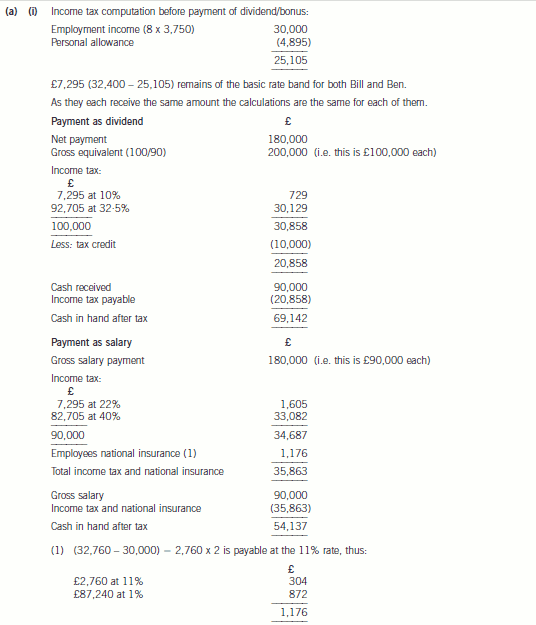
As a result, Bill and Ben would each be better off by £15,005 (69,142 – 54,137). If the cash were extracted by way
of dividend.
Tutorial note: In this answer the employers’ national insurance liability on the salary has been ignored. Credit would be
given to a candidate who recognised this issue. -
第6题:
(b) (i) Advise Andrew of the income tax (IT) and capital gains tax (CGT) reliefs available on his investment in
the ordinary share capital of Scalar Limited, together with any conditions which need to be satisfied.
Your answer should clearly identify any steps that should be taken by Andrew and the other investors
to obtain the maximum relief. (13 marks)
正确答案:
(b) (i) Andrew may be able to take advantage of tax reliefs under the enterprise investment scheme (EIS) provided the
necessary conditions are met. The conditions that have to be satisfied before full relief is available fall into three areas,
and broadly require that a ‘qualifying individual’ subscribes for ‘eligible shares’ in a ‘qualifying company’.
‘Qualifying Individual’
To be a qualifying individual, Andrew must not be connected with the EIS company. This means that he should not be
an employee (or, at the time the shares are issued, a director) or have an interest in (i.e. control) 30% or more of the
capital of the company. These conditions need to be satisfied throughout the period beginning two years before the share
issue and three years after the ‘relevant date’. Where the relevant date is defined as the later of the date the shares were
issued and the date on which the company commenced trading.
Andrew does not intend to become an employee (or director) of Scalar Limited, but he needs to exercise caution as to
how many shares he subscribes for. If only three investors subscribe for 100% of the shares, each will hold 33% of the
share capital. This exceeds the 30% limit and will mean that EIS relief (other than deferral relief) will not be available.
Therefore, Andrew and the other two investors should ensure not only that the potential fourth investor is recruited, but
that s/he subscribes for sufficient shares, such that none of them will hold 30% or more of the issued share capital, as
only then will they all attain qualifying individual status.
‘Eligible shares’
Qualifying shares need to be new ordinary shares which are subscribed for in cash and fully paid up at the time of issue.
The shares must not be redeemable for at least three years from the relevant date, and not carry any preferential rights
to dividends. On the basis of the information provided, the shares of Scalar Limited would qualify as eligible shares.
‘Qualifying Company’
The company must be unquoted, not controlled by another company, and engaged in qualifying business activities. The
latter requires that the company engage in a trading activity, which is carried on wholly or mainly in the UK, throughout
the three years following the relevant date. While certain trading activities, such as dealing in shares or trading in land,
are excluded, the manufacturing trade Scalar Limited proposes to carry on will qualify.
However, it is also necessary for at least 80% of the money raised to be used for the qualifying business activity within
12 months of the relevant date and the remaining 20% to be so used within the following 12 months. Andrew and the
other investors will thus have to ensure that Scalar Limited has not raised more funds than it is able to employ in the
business within the appropriate time periods.
Reliefs available:
Andrew can claim income tax relief at 20% income tax relief on the amount invested up to a maximum of £200,000
in any one tax year. The relief is given in the form. of a tax reducing allowance, which can reduce the investor’s income
tax liability to nil, but cannot be used to generate a tax refund. If the investment is made prior to 6 October in the tax
year, then 50% of the amount invested (up to a maximum of £25,000) can be treated as having been made in the
previous tax year.
Any capital gains arising on the sale of EIS shares will be fully exempt from capital gains tax provided that income tax
relief was given on the investment when made and has not been withdrawn. If the EIS shares are disposed of at a loss,
capital losses are still allowable, but reduced by the amount of any EIS relief attributable to the shares disposed of.
In addition, gains from the disposal of other assets can be deferred against the base cost of EIS shares acquired within
one year before and three years after their disposal. Such gains will, thus, not normally become chargeable until the EIS
shares themselves are disposed of. Further, for deferral relief to be available, it is not necessary for the investment to
qualify for EIS income tax relief, i.e. deferral is available even where the investor is not a qualifying individual. Thus,
Andrew could still defer the gain arising on the disposal of the residential property lease made in order to raise part of
the funds for his EIS investment, even if no fourth investor were to be found and his shareholding were to exceed 30%
of the issued share capital of Scalar Limited. Does not require the existence of income tax relief in order to be claimed.
Withdrawal of relief:
Any EIS relief claimed by Andrew will be withdrawn (partially or fully) if, within three year of the relevant date:
(1) he disposes of the shares;
(2) he receives value from the company;
(3) he ceases to be a qualifying individual; or
(4) Scalar Limited ceases to be a qualifying company.
With regard to receiving value from the company, the definition excludes dividends which do not exceed a normal rate
of return, but does include the repayment of any loans made to the company before the shares were issued, the provision
of benefits and the purchase of assets from the company at an undervalue. In this regard, Andrew and the other
subscribers should ensure that the £50,000 they are to invest in Scalar Limited as loan capital is appropriately timed
and structured relative to the issue of the EIS shares. -
第7题:
(ii) Advise Clifford of the capital gains tax implications of the alternative of selling the Oxford house and
garden by means of two separate disposals as proposed. Calculations are not required for this part of
the question. (3 marks)
正确答案:
(ii) The implications of selling the Oxford house and garden in two separate disposals
The additional sales proceeds would result in an increase in Clifford’s capital gains and consequently his tax liability.
When computing the gain on the sale of the house together with a small part of the garden, the allowable cost would
be a proportion of the original cost. That proportion would be A/A + B where A is the value of the house and garden
that has been sold and B is the value of the part of the garden that has been retained. Principal private residence relief
and taper relief would be available in the same way as that set out in (i) above.
When computing the gain on the sale of the remainder of the garden, the cost would be the original cost of the property
less the amount used in computing the gain on the earlier disposal. Principal private residence relief would not be
available as the land sold is not a dwelling house or part of one. -
第8题:
4 Coral is the owner and managing director of Reef Ltd. She is considering the manner in which she will make her first
pension contributions. In November 2007 she inherited her mother’s house in the country of Kalania.
The following information has been extracted from client files and from telephone conversations with Coral.
Coral:
– 1972 – Born in the country of Kalania. Her father, who died in 2002, was domiciled in Kalania.
– 1999 – Moved to the UK and has lived and worked here since then.
– 2001 – Subscribed for 100% of the ordinary share capital of Reef Ltd.
– Intends to sell Reef Ltd and return to live in the country of Kalania in 2012.
– No income apart from that received from Reef Ltd.
Reef Ltd:
– A UK resident company with annual profits chargeable to corporation tax of approximately £70,000.
– Four employees including Coral.
– Provides scuba diving lessons to members of the public.
Payments from Reef Ltd to Coral in 2007/08:
– Director’s fees of £460 per month.
– Dividends paid of £14,250 in June 2007 and £14,250 in September 2007.
Pension contributions:
– Coral has not so far made any pension contributions in the tax year 2007/08 but wishes to make gross pension
contributions of £9,000.
– The contributions are to be made by Reef Ltd or Coral or a combination of the two in such a way as to minimise
the total after tax cost.
– Any contributions made by Coral will be funded by an additional dividend from Reef Ltd.
House in the country of Kalania:
– Beachfront property with potential rental income of £550 per month after deduction of allowable expenditure.
– Coral will use it for holidays for two months each year.
The tax system in the country of Kalania:
– No capital gains tax or inheritance tax.
– Income tax at 8% on income arising in the country of Kalania.
– No double tax treaty with the UK.
Required:
(a) With the objective of minimising the total after tax cost, advise Coral as to whether the gross pension
contributions of £9,000 should be made:
– wholly by Reef Ltd; or
– by Coral to the extent that they are tax allowable with the balance made by Reef Ltd.
Your answer should include supporting calculations where necessary. (9 marks)
正确答案:
-
第9题:
(b) Prepare a reasoned explanation of how any capital gains tax arising in the UK on the sale of the paintings
can be minimised. (2 marks)
正确答案:
(b) Minimising capital gains tax on the sale of the paintings
Galileo will become resident and ordinarily resident from the date he arrives in the UK as he intends to stay for more than
three years. Prior to that date he will be neither resident nor ordinarily resident such that he will not be subject to UK capital
gains tax.
Galileo should sell the paintings before he leaves Astronomeria; this will avoid UK capital gains tax completely.
Tutorial note
The gains would be taxable on the remittance basis if the paintings were sold after Galileo’s arrival in the UK. However, this
would not help Galileo to minimise the capital gains tax due as he needs to bring the sales proceeds into the UK in order
to purchase a house. -
第10题:
(c) (i) Calculate Benny’s capital gains tax liability for 2006/07. (6 marks)
正确答案:
-
第11题:
Which of the tax concept(s) allow for the deferral of gains on nonrecognition transactions()?I. Capital Recovery Concept.II. Ability to Pay Concept.A.Only statement I is correct
B.Only statement II is correct
C.Both statements are correct
D.Neither statement is correct
参考答案:D
-
第12题:
A corporate taxpayer has under-reported its taxable revenue in 2002 and hence underpaid value added tax (VAT) and enterprise income tax (EIT). In 2014, the taxpayer was charged by the tax authority with committing an act of tax evasion in 2002.
Which of the following statements is correct?
A.The taxpayer must pay the additional taxes due, plus a late payment surcharge and a penalty
B.There is no need for the taxpayer to pay any additional taxes, late payment surcharge or penalty as the statute of limitation is ten years
C.The taxpayer must pay the additional taxes, but no late payment surcharge or penalty as the statute of limitation is ten years for late payment surcharge and penalties
D.The taxpayer must pay the additional taxes and a late payment surcharge but not a penalty as the statute of limitation is five years for penalties
正确答案:DPer Article 86 of the Tax Collection and Administrative Law, the statute of limitation for an administrative penalty on non-compliances is five years.
-
第13题:
(ii) Explain the income tax (IT), national insurance (NIC) and capital gains tax (CGT) implications arising on
the grant to and exercise by an employee of an option to buy shares in an unapproved share option
scheme and on the subsequent sale of these shares. State clearly how these would apply in Henry’s
case. (8 marks)
正确答案:
(ii) Exercising of share options
The share option is not part of an approved scheme, and will not therefore enjoy the benefits of such a scheme. There
are three events with tax consequences – grant, exercise and sale.
Grant. If shares or options over shares are sold or granted at less than market value, an income tax charge can arise on
the difference between the price paid and the market value. [Weight v Salmon]. In addition, if options can be exercised
more than 10 years after the date of the grant, an employment income charge can arise. This is based on the market
value at the date of grant less the grant and exercise priced.
In Henry’s case, the options were issued with an exercise price equal to the then market value, and cannot be exercised
more than 10 years from the grant. No income tax charge therefore arises on grant.
Exercise. On exercise, the individual pays the agreed amount in return for a number of shares in the company. The price
paid is compared with the open market value at that time, and if less, the difference is charged to income tax. National
insurance also applies, and the company has to pay Class 1 NIC. If the company and shareholder agree, the national
insurance can be passed onto the individual, and the liability becomes a deductible expense in calculating the income
tax charge.
In Henry’s case on exercise, the difference between market value (£14) and the price paid (£1) per share will be taxed
as income. Therefore, £130,000 (10,000 x (£14 – £1)) will be taxed as income. In addition, national insurance will
be chargeable on the company at 12·8% (£16,640) and on Henry at the rate of 1% (£1,300).
Sale. The base cost of the shares is taken to be the market value at the time of exercise. On the sale of the shares, any
gain or loss arising falls under the capital gains tax rules, and CGT will be payable on any gain. Business asset taper
relief will be available as the company is an unquoted trading company, but the relief will only run from the time that
the share options are exercised – i.e. from the time when the shares were acquired.
In Henry’s case, the sale of the shares will immediately follow the exercise of the option (6 days later). The sale proceeds
and the market value at the time of exercise are likely to be similar; thus little to no gain is likely to arise. -
第14题:
(c) (i) Compute Gloria’s capital gains tax liability for 2006/07 ignoring any claims or elections available to
reduce the liability. (3 marks)
正确答案:
-
第15题:
(ii) Assuming the relief in (i) is available, advise Sharon on the maximum amount of cash she could receive
on incorporation, without triggering a capital gains tax (CGT) liability. (3 marks)
正确答案:
(ii) As Sharon is entitled to the full rate of business asset taper relief, any gain will be reduced by 75%. The position is
maximised where the chargeable gain equals Sharon’s unused capital gains tax annual exemption of £8,500. Thus,
before taper relief, the gain she requires is £34,000 (1/0·25 x £8,500).
The amount to be held over is therefore £46,000 (80,000 – 34,000). Where part of the consideration is in the form
of cash, the gain eligible for incorporation relief is calculated using the formula:
Gain deferred = Gain x value of shares issued/total consideration
The formula is manipulated on the following basis:
£46,000 = £80,000 x (shares/120,000)
Shares/120,000 = £46,000/80,000
Shares = £46,000 x 120,000/80,000
i.e. £69,000.
As the total consideration is £120,000, this means that Sharon can take £51,000 (£120,000 – £69,000) in cash
without any CGT consequences. -
第16题:
(c) For commercial reasons, Damian believes that it would be sensible to place a new holding company, Bold plc,
over the existing company, Linden Limited. Bold plc would also be unquoted and would acquire the existing
Linden Limited shares in exchange for the issue of its own shares.
If the new structure is implemented, Bold plc will provide management services to Linden Limited, but the
amount that will be charged for these services is yet to be determined.
Required:
(i) State the capital gains tax (CGT) issues that Damian should be aware of before disposing of his shares
in Linden Limited to Bold plc. Your answer should include details of any conditions that will need to be
satisfied if an immediate charge to tax is to be avoided. (4 marks)
正确答案:
(c) (i) The proposed transaction broadly falls under the ‘paper for paper’ rules. Where this is the case, chargeable gains do not
arise. Instead, the new holding stands in the shoes (and inherits the base cost) of the original holding.
The company issuing the new shares must:
(i) end up with more than 25% of the ordinary share capital or a majority of the voting power of the old company,
OR
(ii) make a general offer to shareholders in the old company with a condition which would give the acquiring company
control of the company if accepted.
The exchange must be for bona fide commercial reasons and not have as its main purpose (or one of its main purposes)
the avoidance of capital gains tax or corporation tax.
The issue of shares by Bold plc satisfies these conditions, thus Damian, as a shareholder of Linden Limited, will not be
taxed on the exchange of shares. -
第17题:
(b) Advise on the capital gains implications should Trent Limited’s old building be sold as proposed. Support your
advice with relevant calculations. (4 marks)
正确答案:
This gives a higher post-entry loss of £50,000 (150,000 – 100,000) and so it is advisable for Trent Limited to make
this election.
The £100,000 of pre-entry losses are still available, but can only be set against gains on assets which:
(i) Trent Limited sold prior to being acquired (subject to the normal carry back restrictions), or
(ii) Trent Limited already owned when it was acquired, or
(iii) Trent Limited acquired from outside the group and used in its trade after being bought by Tay Limited. -
第18题:
(b) Calculate Alvaro Pelorus’s capital gains tax liability for the tax year 2006/07 on the assumption that all
available reliefs are claimed. (8 marks)
正确答案: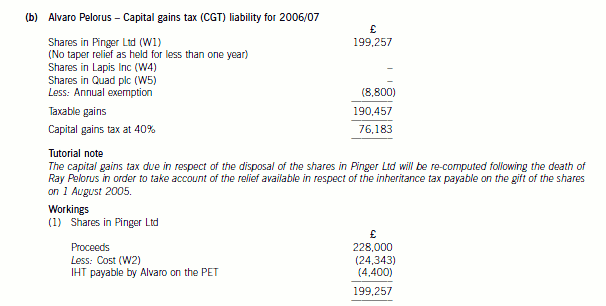

-
第19题:
5 (a) Carver Ltd was incorporated and began trading in August 2002. It is a close company with no associated
companies. It has always prepared accounts to 31 December and will continue to do so in the future.
It has been decided that Carver Ltd will sell its business as a going concern to Blade Ltd, an unconnected
company, on 31 July 2007. Its premises and goodwill will be sold for £2,135,000 and £290,000 respectively
and its machinery and equipment for £187,000. The premises, which do not constitute an industrial building,
were acquired on 1 August 2002 for £1,808,000 and the goodwill has been generated internally by the
company. The machinery and equipment cost £294,000; no one item will be sold for more than its original cost.
The tax adjusted trading profit of Carver Ltd in 2007, before taking account of both capital allowances and the
sale of the business assets, is expected to be £81,000. The balance on the plant and machinery pool for the
purposes of capital allowances as at 31 December 2006 was £231,500. Machinery costing £38,000 was
purchased on 1 March 2007. Carver Ltd is classified as a small company for the purposes of capital allowances.
On 1 August 2007, the proceeds from the sale of the business will be invested in either an office building or a
portfolio of UK quoted company shares, as follows:
Office building
The office building would be acquired for £3,100,000; the vendor is not registered for value added tax (VAT).
Carver Ltd would borrow the additional funds required from a UK bank. The building is let to a number of
commercial tenants who are not connected with Carver Ltd and will pay rent, in total, of £54,000 per calendar
quarter, in advance, commencing on 1 August 2007. The company’s expenditure for the period from 1 August
2007 to 31 December 2007 is expected to be:
£
Loan interest payable to UK bank 16,000
Building maintenance costs 7,500
Share portfolio
Shares would be purchased for the amount of the proceeds from the sale of the business with no need for further
loan finance. It is estimated that the share portfolio would generate dividends of £36,000 and capital gains, after
indexation allowance, of £10,000 in the period from 1 August 2007 to 31 December 2007.
All figures are stated exclusive of value added tax (VAT).
Required:
(i) Taking account of the proposed sale of the business on 31 July 2007, state with reasons the date(s) on
which Carver Ltd must submit its corporation tax return(s) for the year ending 31 December 2007.
(2 marks)
正确答案:
(a) (i) Due date for submission of corporation tax return
Carver Ltd intends to cease trading on 31 July 2007. This will bring to an end the accounting period that began on
1 January 2007. A new accounting period will commence on 1 August 2007 and end on the company’s accounting
reference date on 31 December 2007.
Carver Ltd is required to submit its corporation tax return by the later of:
– one year after the end of its accounting period; and
– one year after the end of the period of account in which the last day of the accounting period falls.
Accordingly, the company must submit its corporation tax returns for both accounting periods by 31 December 2008. -
第20题:
5 Crusoe has contacted you following the death of his father, Noland. Crusoe has inherited the whole of his father’s
estate and is seeking advice on his father’s capital gains tax position and the payment of inheritance tax following his
death.
The following information has been extracted from client files and from telephone conversations with Crusoe.
Noland – personal information:
– Divorcee whose only other relatives are his sister, Avril, and two grandchildren.
– Died suddenly on 1 October 2007 without having made a will.
– Under the laws of intestacy, the whole of his estate passes to Crusoe.
Noland – income tax and capital gains tax:
– Has been a basic rate taxpayer since the tax year 2000/01.
– Sales of quoted shares resulted in:
– Chargeable gains of £7,100 and allowable losses of £17,800 in the tax year 2007/08.
– Chargeable gains of approximately £14,000 each tax year from 2000/01 to 2006/07.
– None of the shares were held for long enough to qualify for taper relief.
Noland – gifts made during lifetime:
– On 1 December 1999 Noland gave his house to Crusoe.
– Crusoe has allowed Noland to continue living in the house and has charged him rent of £120 per month
since 1 December 1999. The market rent for the house would be £740 per month.
– The house was worth £240,000 at the time of the gift and £310,000 on 1 October 2007.
– On 1 November 2004 Noland transferred quoted shares worth £232,000 to a discretionary trust for the benefit
of his grandchildren.
Noland – probate values of assets held at death: £
– Portfolio of quoted shares 370,000
Shares in Kurb Ltd 38,400
Chattels and cash 22,300
Domestic liabilities including income tax payable (1,900)
– It should be assumed that these values will not change for the foreseeable future.
Kurb Ltd:
– Unquoted trading company
– Noland purchased the shares on 1 December 2005.
Crusoe:
– Long-standing personal tax client of your firm.
– Married with two young children.
– Successful investment banker with very high net worth.
– Intends to gift the portfolio of quoted shares inherited from Noland to his aunt, Avril, who has very little personal
wealth.
Required:
(a) Prepare explanatory notes together with relevant supporting calculations in order to quantify the tax relief
potentially available in respect of Noland’s capital losses realised in 2007/08. (4 marks)
正确答案: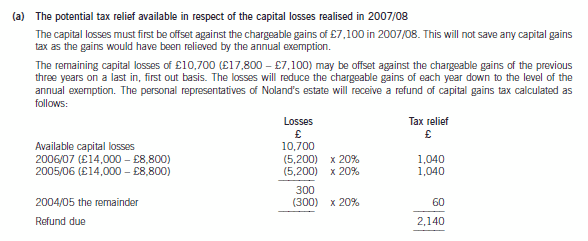
-
第21题:
1 Stuart is a self-employed business consultant aged 58. He is married to Rebecca, aged 55. They have one child,
Sam, who is aged 24 and single.
In November 2005 Stuart sold a house in Plymouth for £422,100. Stuart had inherited the house on the death of
his mother on 1 May 1994 when it had a probate value of £185,000. The subsequent pattern of occupation was as
follows:
1 May 1994 to 28 February 1995 occupied by Stuart and Rebecca as main residence
1 March 1995 to 31 December 1998 unoccupied
1 January 1999 to 31 March 2001 let out (unfurnished)
1 April 2001 to 30 November 2001 occupied by Stuart and Rebecca
1 December 2001 to 30 November 2005 used occasionally as second home
Both Stuart and Rebecca had lived in London from March 1995 onwards. On 1 March 2001 Stuart and Rebecca
bought a house in London in their joint names. On 1 January 2002 they elected for their London house to be their
principal private residence with effect from that date, up until that point the Plymouth property had been their principal
private residence.
No other capital disposals were made by Stuart in the tax year 2005/06. He has £29,500 of capital losses brought
forward from previous years.
Stuart intends to invest the gross sale proceeds from the sale of the Plymouth house, and is considering two
investment options, both of which he believes will provide equal risk and returns. These are as follows:
(1) acquiring shares in Omikron plc; or
(2) acquiring further shares in Omega plc.
Notes:
1. Omikron plc is a listed UK trading company, with 50,250,000 shares in issue. Its shares currently trade at 42p
per share.
2. Stuart and Rebecca helped start up the company, which was then Omega Ltd. The company was formed on
1 June 1990, when they each bought 24,000 shares for £1 per share. The company became listed on 1 May
1997. On this date their holding was subdivided, with each of them receiving 100 shares in Omega plc for each
share held in Omega Ltd. The issued share capital of Omega plc is currently 10,000,000 shares. The share price
is quoted at 208p – 216p with marked bargains at 207p, 211p, and 215p.
Stuart and Rebecca’s assets (following the sale of the Plymouth house but before any investment of the proceeds) are
as follows:
Assets Stuart Rebecca
£ £
Family house in London 450,000 450,000
Cash from property sale 422,100 –
Cash deposits 165,000 165,000
Portfolio of quoted investments – 250,000
Shares in Omega plc see above see above
Life insurance policy note 1 note 1
Note:
1. The life insurance policy will pay out a sum of £200,000 on the death of the first spouse to die.
Stuart has recently been diagnosed with a serious illness. He is expected to live for another two or three years only.
He is concerned about the possible inheritance tax that will arise on his death. Both he and Rebecca have wills whose
terms transfer all assets to the surviving spouse. Rebecca is in good health.
Neither Stuart nor Rebecca has made any previous chargeable lifetime transfers for the purposes of inheritance tax.
Required:
(a) Calculate the taxable capital gain on the sale of the Plymouth house in November 2005 (9 marks)
正确答案:
Note that the last 36 months count as deemed occupation, as the house was Stuart’s principal private residence (PPR)
at some point during his period of ownership.
The first 36 months of the period from 1 March 1995 to 31 March 2001 qualifies as a deemed occupation period as
Stuart and Rebecca returned to occupy the property on 1 April 2001. The remainder of the period will be treated as a
period of absence, although letting relief is available for part of the period (see below).
The exempt element of the gain is the proportion during which the property was occupied, real or deemed. This is
£138,665 (90/139 x £214,160).
(2) The chargeable gain is restricted for the period that the property was let out. This is restricted to the lowest of the
following:
(i) the gain attributable to the letting period (27/139 x 214,160) = £41,599
(ii) £40,000
(iii) the total exempt PPR gain = £138,665
i.e. £40,000.
(3) The taper relief is effectively wasted, having restricted losses b/f to preserve the annual exemption. -
第22题:
3 The Stiletto Partnership consisted of three partners, Clint, Ben and Amy, who shared the profits of the business
equally. On 28 February 2007 the partners sold the business to Razor Ltd, in exchange for shares in Razor Ltd, with
each former partner owning one third of the new company.
The recent, tax adjusted, trading profits of the Stiletto Partnership have been as follows:
£
Year ended 30 June 2006 92,124
1 July 2006 to 28 February 2007 81,795
Clint, who was 65 on 5 October 2006, retired when the business was sold to Razor Ltd. He is now suggesting that
if the sale of the partnership, and his retirement, had been delayed until 30 April 2007, his total tax liability would
have been reduced. Clint’s only other income is gross pension income of £6,100 per year, which he began receiving
in the tax year 2005/06. Clint did not receive any salary or dividends from Razor Ltd. It is estimated that the
partnership’s tax adjusted trading profits for the period from 1 March 2007 to 30 April 2007 would have been
£20,760. Clint has overlap profits of £14,250 brought forward from when the partnership began trading.
Razor Ltd manufactures industrial cutting tools. On 1 July 2007, Razor Ltd will subscribe for the whole of the ordinary
share capital of Cutlass Inc, a company newly incorporated in the country of Sharpenia. It is intended that Cutlass
Inc will purchase partly finished tools from Razor Ltd and customise them in Sharpenia. It is anticipated that Cutlass
Inc’s annual profits chargeable to corporation tax will be approximately £120,000.
Ben and Amy will be the directors of Cutlass Inc, although Ben will not be involved in the company’s business on a
day-to-day basis. Amy intends to spend one or two weeks each month in the country of Sharpenia looking after the
company’s affairs. The remainder of her time will be spent in the UK. Amy has employment contracts with both Razor
Ltd and Cutlass Inc and her duties for Cutlass Inc will be carried out wholly in Sharpenia. Cutlass Inc will pay for
Amy’s flights to and from Sharpenia and for her husband and baby to visit her there twice a year. Amy is currently
UK resident and ordinarily resident.
The system of income tax and corporation tax in the country of Sharpenia is broadly similar to that in the UK although
the rate of corporation tax is 38% regardless of the level of profits. There is a double tax treaty between the UK and
Sharpenia based on the OECD model treaty. The clause in the treaty dealing with company residency states that a
company resident in both countries under domestic law will be regarded under the treaty as being resident only in the
country where it is effectively managed and controlled. Sharpenia is not a member of the European Union.
Required:
(a) (i) Calculate Clint’s taxable trading profits for the tax years 2006/07 and 2007/08 for both of the
alternative retirement dates (28 February 2007 and 30 April 2007). (3 marks)
正确答案: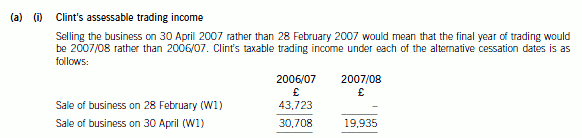
-
第23题:
Which of the following items is a capital asset in the hands of the taxpayer?()A、Taxpayer owns a 10-year old Harley-Davidson motorcycle
B、Taxpayer owns a used car lot. He owns a 1962 Cadillac that is for sale on the lot
C、Taxpayer owns a notebook computer that he carries to his clients for work purposes
D、Taxpayer, a farmer, has a prize winning steer in his herd
E、None of the above items are capital assets
答案:B