
(ii) Advise Andrew of the tax implications arising from the disposal of the 7% Government Stock, clearlyidentifying the tax year in which any liability will arise and how it will be paid. (3 marks)
题目
(ii) Advise Andrew of the tax implications arising from the disposal of the 7% Government Stock, clearly
identifying the tax year in which any liability will arise and how it will be paid. (3 marks)
相似考题
参考答案和解析
(ii) Government stock is an exempt asset for the purposes of capital gains tax, however, as Andrew’s holding has a nominal
value in excess of £5,000, a charge to income tax will arise under the accrued income scheme. This charge to income
tax will arise in 2005/06, being the tax year in which the next interest payment following disposal falls due (20 April
2005) and it will relate to the income accrued for the period 21 October 2004 to 14 March 2005 of £279 (145/182
x £350). As interest on Government Stock is paid gross (unless the holder applies to receive it net), the tax due of £112
(£279 x 40%) will be collected via the self-assessment system and as the interest was an ongoing source of income
will be included within Andrew’s half yearly payments on account payable on 31 January and 31 July 2006.
更多“(ii) Advise Andrew of the tax implications arising from the disposal of the 7% Government Stock, clearlyidentifying the tax year in which any liability will arise and how it will be paid. (3 marks)”相关问题
-
第1题:
(c) Advise Alan on the proposed disposal of the shares in Mobile Ltd. Your answer should include calculations
of the potential capital gain, and explain any options available to Alan to reduce this tax liability. (7 marks)
正确答案: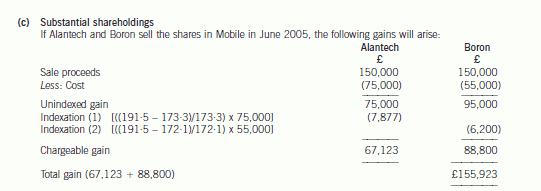
However, an exemption from corporation tax exists for any gain arising when a trading company (or member of a trading
group) sells the whole or any part of a substantial shareholding in another trading company.
A substantial shareholding is one where the investing company holds 10% of the ordinary share capital and is beneficially
entitled to at least 10% of the
(i) profits available for distribution to equity holders and
(ii) assets of the company available for distribution to equity holders on a winding up.
In meeting the 10% test, shares owned by a chargeable gains group may be amalgamated. The 10% test must have been
met for a continuous 12 month period during the 2 years preceding the disposal.
The companies making the disposals must have been trading companies (or members of a trading group) throughout the
12 month period, as well as at the date of disposal. In addition, they must also be trading companies (or members of a trading
group) immediately after the disposal.
The exemption is given automatically, and acts to deny losses as well as eliminate gains.
While Alantech Ltd has owned its holding in Mobile Ltd for 33 months, its ownership of the Boron holding has only lasted
for 10 months (at 1 June 2005) since Boron was acquired on 1 July 2004. Selling the shares in June 2005 will fail the
12 month test, and the gain will become chargeable.
It would be better for the companies to wait for a further month until July 2005 before selling the amalgamated shareholding.
By doing so, they will both be able to take advantage of the substantial shareholdings relief, thereby saving tax of £29,625
assuming a corporation tax rate of 19%. -
第2题:
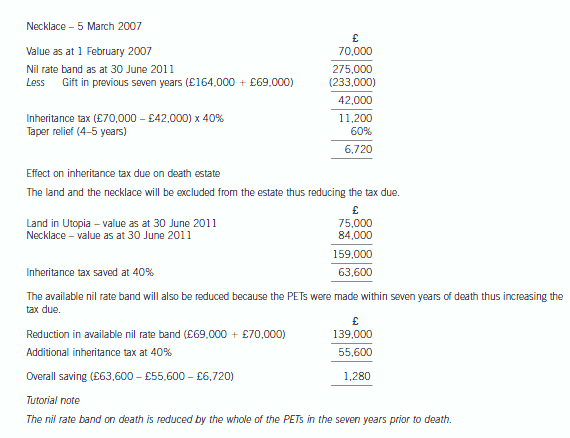
(b) Mabel has two objectives when making the gifts to Bruce and Padma:
(1) To pay no tax on any gift in her lifetime; and
(2) To reduce the eventual liability to inheritance tax on her death.
Advise Mabel which item to gift to Bruce and to Padma in order to satisfy her objectives. Give reasons for
your advice.
Your advice should include a computation of the inheritance tax saved as a result of the two gifts, on the
assumption that Mabel dies on 30 June 2011. (10 marks)
正确答案: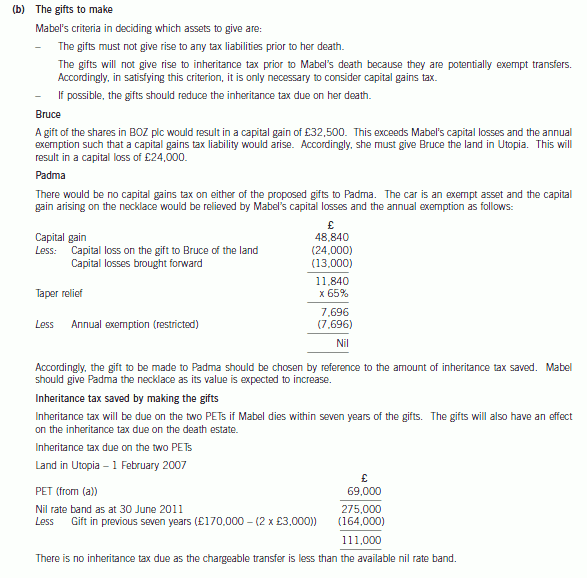
-
第3题:
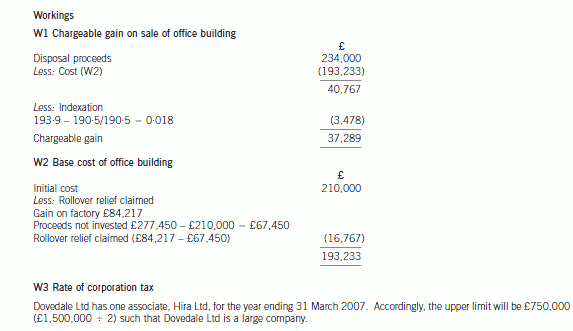
(c) Calculate the expected corporation tax liability of Dovedale Ltd for the year ending 31 March 2007 on the
assumption that all available reliefs are claimed by Dovedale Ltd but that Hira Ltd will not claim any capital
allowances in that year. (4 marks)
正确答案:
-
第4题:
(d) Explain how Gloria would be taxed in the UK on the dividends paid by Bubble Inc and the capital gains tax
and inheritance tax implications of a future disposal of the shares. Clearly state, giving reasons, whether or
not the payment made to Eric is allowable for capital gains tax purposes. (9 marks)
You should assume that the rates and allowances for the tax year 2005/06 apply throughout this question.
正确答案:
(d) UK tax implications of shares in Bubble Inc
Income tax
Gloria is UK resident and is therefore subject to income tax on her worldwide income. However, because she is non-UK
domiciled, she will only be taxed on the foreign dividends she brings into the UK.
Dividends brought into the UK will be grossed up for any tax paid in Oceania. The gross amount is taxed at 10% if it falls
into the starting or basic rate band and at 321/2% if it falls into the higher rate band. The tax suffered in Oceania is available
for offset against the UK tax liability. The offset is restricted to a maximum of the UK tax on the dividend income.
Capital gains tax
Individuals are subject to capital gains tax on worldwide assets if they are resident or ordinarily resident in the UK. However,
because Gloria is non-UK domiciled and the shares are situated abroad, the gain is only taxable to the extent that the sales
proceeds are brought into the UK. Any tax suffered in Oceania in respect of the gain is available for offset against the UK
capital gains tax liability arising on the shares.
Any loss arising on the disposal of the shares would not be available for relief in the UK.
In computing a capital gain or allowable loss, a deduction is available for the incidental costs of acquisition. However, to be
allowable, such costs must be incurred wholly and exclusively for the purposes of acquiring the asset. The fee paid to Eric
related to general investment advice and not to the acquisition of the shares and therefore, would not be deductible in
computing the gain.
Taper relief will be at non-business asset rates as Bubble Inc is an investment company.
Inheritance tax
Assets situated abroad owned by non-UK domiciled individuals are excluded property for the purposes of inheritance tax.
However, Gloria will be deemed to be UK domiciled (for the purposes of inheritance tax only) if she has been resident in the
UK for 17 out of the 20 tax years ending with the year in which the disposal occurs.
Gloria has been running a business in the UK since June 1992 and would therefore, appear to have been resident for at least
15 tax years (1992/93 to 2006/07 inclusive).
If Gloria is deemed to be UK domiciled such that the shares in Bubble Inc are not excluded property, business property relief
will not be available because Bubble Inc is an investment company. -
第5题:
(ii) Assuming the relief in (i) is available, advise Sharon on the maximum amount of cash she could receive
on incorporation, without triggering a capital gains tax (CGT) liability. (3 marks)
正确答案:
(ii) As Sharon is entitled to the full rate of business asset taper relief, any gain will be reduced by 75%. The position is
maximised where the chargeable gain equals Sharon’s unused capital gains tax annual exemption of £8,500. Thus,
before taper relief, the gain she requires is £34,000 (1/0·25 x £8,500).
The amount to be held over is therefore £46,000 (80,000 – 34,000). Where part of the consideration is in the form
of cash, the gain eligible for incorporation relief is calculated using the formula:
Gain deferred = Gain x value of shares issued/total consideration
The formula is manipulated on the following basis:
£46,000 = £80,000 x (shares/120,000)
Shares/120,000 = £46,000/80,000
Shares = £46,000 x 120,000/80,000
i.e. £69,000.
As the total consideration is £120,000, this means that Sharon can take £51,000 (£120,000 – £69,000) in cash
without any CGT consequences. -
第6题:
(ii) Assuming the new structure is implemented with effect from 1 August 2006, calculate the level of
management charge that should be made by Bold plc to Linden Limited for the year ended 31 July
2007, so as to minimise the group’s overall corporation tax (CT) liability for that year. (2 marks)
正确答案:
(ii) For the year ended 31 July 2007, there will be two associated companies in the group. Bold plc will count as an
associated company as it is not dormant throughout the period in question. As a result, the corporation tax limits will be
divided by two (i.e. the number of associates) giving an upper limit of £750,000 (£1·5 million/2). As Linden Limited
is anticipated to make profits of £1·4 million in the year to 31 July 2007 it will pay corporation tax at the rate of 30%.
Bold plc can earn trading profits up to £150,000 (£300,000/2) and pay tax at the rate of 19%. It will therefore
minimise the group’s corporation tax liability if maximum use is made of this small companies rate band, as it will save
£16,500 (150,000 x (30% – 19%)) of corporation tax for the year to 31 July 2007. Bold plc should therefore make
a management charge of sufficient size to give it profits for that year equal to £150,000.
While the transfer pricing legislation no longer applies to small and medium sized enterprises, Bold plc should
nevertheless ensure that there is evidence to support the actual charge made in terms of the services provided. -
第7题:
(ii) Following on from your answer to (i), evaluate the two purchase proposals, and advise Bill and Ben
which course of action will result in the highest amount of after tax cash being received by the
shareholders if the disposal takes place on 31 March 2006. (4 marks)
正确答案: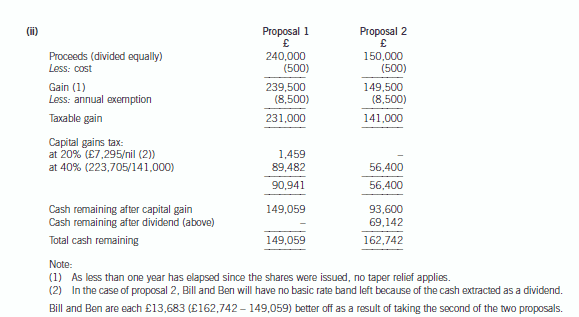
-
第8题:
(b) (i) Advise Andrew of the income tax (IT) and capital gains tax (CGT) reliefs available on his investment in
the ordinary share capital of Scalar Limited, together with any conditions which need to be satisfied.
Your answer should clearly identify any steps that should be taken by Andrew and the other investors
to obtain the maximum relief. (13 marks)
正确答案:
(b) (i) Andrew may be able to take advantage of tax reliefs under the enterprise investment scheme (EIS) provided the
necessary conditions are met. The conditions that have to be satisfied before full relief is available fall into three areas,
and broadly require that a ‘qualifying individual’ subscribes for ‘eligible shares’ in a ‘qualifying company’.
‘Qualifying Individual’
To be a qualifying individual, Andrew must not be connected with the EIS company. This means that he should not be
an employee (or, at the time the shares are issued, a director) or have an interest in (i.e. control) 30% or more of the
capital of the company. These conditions need to be satisfied throughout the period beginning two years before the share
issue and three years after the ‘relevant date’. Where the relevant date is defined as the later of the date the shares were
issued and the date on which the company commenced trading.
Andrew does not intend to become an employee (or director) of Scalar Limited, but he needs to exercise caution as to
how many shares he subscribes for. If only three investors subscribe for 100% of the shares, each will hold 33% of the
share capital. This exceeds the 30% limit and will mean that EIS relief (other than deferral relief) will not be available.
Therefore, Andrew and the other two investors should ensure not only that the potential fourth investor is recruited, but
that s/he subscribes for sufficient shares, such that none of them will hold 30% or more of the issued share capital, as
only then will they all attain qualifying individual status.
‘Eligible shares’
Qualifying shares need to be new ordinary shares which are subscribed for in cash and fully paid up at the time of issue.
The shares must not be redeemable for at least three years from the relevant date, and not carry any preferential rights
to dividends. On the basis of the information provided, the shares of Scalar Limited would qualify as eligible shares.
‘Qualifying Company’
The company must be unquoted, not controlled by another company, and engaged in qualifying business activities. The
latter requires that the company engage in a trading activity, which is carried on wholly or mainly in the UK, throughout
the three years following the relevant date. While certain trading activities, such as dealing in shares or trading in land,
are excluded, the manufacturing trade Scalar Limited proposes to carry on will qualify.
However, it is also necessary for at least 80% of the money raised to be used for the qualifying business activity within
12 months of the relevant date and the remaining 20% to be so used within the following 12 months. Andrew and the
other investors will thus have to ensure that Scalar Limited has not raised more funds than it is able to employ in the
business within the appropriate time periods.
Reliefs available:
Andrew can claim income tax relief at 20% income tax relief on the amount invested up to a maximum of £200,000
in any one tax year. The relief is given in the form. of a tax reducing allowance, which can reduce the investor’s income
tax liability to nil, but cannot be used to generate a tax refund. If the investment is made prior to 6 October in the tax
year, then 50% of the amount invested (up to a maximum of £25,000) can be treated as having been made in the
previous tax year.
Any capital gains arising on the sale of EIS shares will be fully exempt from capital gains tax provided that income tax
relief was given on the investment when made and has not been withdrawn. If the EIS shares are disposed of at a loss,
capital losses are still allowable, but reduced by the amount of any EIS relief attributable to the shares disposed of.
In addition, gains from the disposal of other assets can be deferred against the base cost of EIS shares acquired within
one year before and three years after their disposal. Such gains will, thus, not normally become chargeable until the EIS
shares themselves are disposed of. Further, for deferral relief to be available, it is not necessary for the investment to
qualify for EIS income tax relief, i.e. deferral is available even where the investor is not a qualifying individual. Thus,
Andrew could still defer the gain arising on the disposal of the residential property lease made in order to raise part of
the funds for his EIS investment, even if no fourth investor were to be found and his shareholding were to exceed 30%
of the issued share capital of Scalar Limited. Does not require the existence of income tax relief in order to be claimed.
Withdrawal of relief:
Any EIS relief claimed by Andrew will be withdrawn (partially or fully) if, within three year of the relevant date:
(1) he disposes of the shares;
(2) he receives value from the company;
(3) he ceases to be a qualifying individual; or
(4) Scalar Limited ceases to be a qualifying company.
With regard to receiving value from the company, the definition excludes dividends which do not exceed a normal rate
of return, but does include the repayment of any loans made to the company before the shares were issued, the provision
of benefits and the purchase of assets from the company at an undervalue. In this regard, Andrew and the other
subscribers should ensure that the £50,000 they are to invest in Scalar Limited as loan capital is appropriately timed
and structured relative to the issue of the EIS shares. -
第9题:
(ii) Advise Clifford of the capital gains tax implications of the alternative of selling the Oxford house and
garden by means of two separate disposals as proposed. Calculations are not required for this part of
the question. (3 marks)
正确答案:
(ii) The implications of selling the Oxford house and garden in two separate disposals
The additional sales proceeds would result in an increase in Clifford’s capital gains and consequently his tax liability.
When computing the gain on the sale of the house together with a small part of the garden, the allowable cost would
be a proportion of the original cost. That proportion would be A/A + B where A is the value of the house and garden
that has been sold and B is the value of the part of the garden that has been retained. Principal private residence relief
and taper relief would be available in the same way as that set out in (i) above.
When computing the gain on the sale of the remainder of the garden, the cost would be the original cost of the property
less the amount used in computing the gain on the earlier disposal. Principal private residence relief would not be
available as the land sold is not a dwelling house or part of one. -
第10题:
(ii) Any increase or decrease in the group’s budgeted corporation tax liability for the year ending 30 June
2008 due to the restructuring on the assumption that trading losses will be used as efficiently as
possible. (8 marks)
正确答案:(ii) The budgeted corporation tax liability for the year ending 30 June 2008
Following the proposed restructuring, Rapier Ltd will be carrying on four separate trades. The current year loss arising
in the Dirk trade can be offset against its total profits. Its three subsidiaries will be dormant and will not be associates
for the purpose of determining the rate of corporation tax.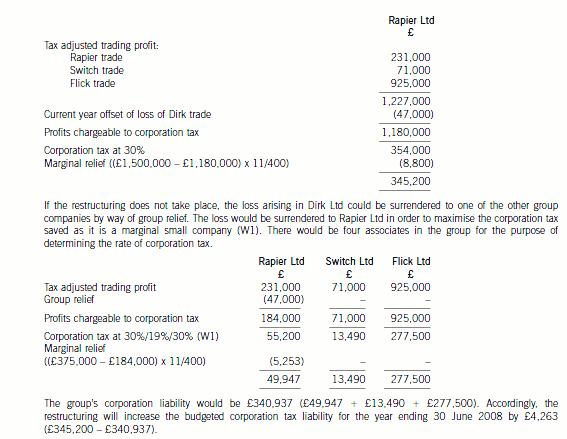
-
第11题:
(b) (i) Explain, by reference to Coral’s residence, ordinary residence and domicile position, how the rental
income arising in respect of the property in the country of Kalania will be taxed in the UK in the tax year
2007/08. State the strategy that Coral should adopt in order to minimise the total income tax suffered
on the rental income. (7 marks)
正确答案:
(b) (i) UK tax on the rental income
Coral is UK resident in 2007/08 because she is present in the UK for more than 182 days. Accordingly, she will be
subject to UK income tax on her Kalanian rental income.
Coral is ordinarily resident in the UK in 2007/08 as she is habitually resident in the UK.
Coral will have acquired a domicile of origin in Kalania from her father. She has not acquired a domicile of choice in the
UK as she has not severed her ties with Kalania and does not intend to make her permanent home in the UK.
Accordingly, the rental income will be taxed in the UK on the remittance basis.
Any rental income remitted to the UK will fall into the basic rate band and will be subject to income tax at 22% on the
gross amount (before deduction of Kalanian tax). Unilateral double tax relief will be available in respect of the 8% tax
suffered in Kalania such that the effective rate of tax suffered by Coral in the UK on the grossed up amount of income
remitted will be 14%.
In order to minimise the total income tax suffered on the rental income Coral should ensure that it is not brought into or
used in the UK such that it will not be subject to income tax in the UK.
Coral should retain evidence, for example bank statements, to show that the rental income has not been removed from
Kalania. Coral can use the money whilst she is on holiday in Kalania with no UK tax implications. -
第12题:
(b) Prepare a reasoned explanation of how any capital gains tax arising in the UK on the sale of the paintings
can be minimised. (2 marks)
正确答案:
(b) Minimising capital gains tax on the sale of the paintings
Galileo will become resident and ordinarily resident from the date he arrives in the UK as he intends to stay for more than
three years. Prior to that date he will be neither resident nor ordinarily resident such that he will not be subject to UK capital
gains tax.
Galileo should sell the paintings before he leaves Astronomeria; this will avoid UK capital gains tax completely.
Tutorial note
The gains would be taxable on the remittance basis if the paintings were sold after Galileo’s arrival in the UK. However, this
would not help Galileo to minimise the capital gains tax due as he needs to bring the sales proceeds into the UK in order
to purchase a house. -
第13题:
(ii) Explain the income tax (IT), national insurance (NIC) and capital gains tax (CGT) implications arising on
the grant to and exercise by an employee of an option to buy shares in an unapproved share option
scheme and on the subsequent sale of these shares. State clearly how these would apply in Henry’s
case. (8 marks)
正确答案:
(ii) Exercising of share options
The share option is not part of an approved scheme, and will not therefore enjoy the benefits of such a scheme. There
are three events with tax consequences – grant, exercise and sale.
Grant. If shares or options over shares are sold or granted at less than market value, an income tax charge can arise on
the difference between the price paid and the market value. [Weight v Salmon]. In addition, if options can be exercised
more than 10 years after the date of the grant, an employment income charge can arise. This is based on the market
value at the date of grant less the grant and exercise priced.
In Henry’s case, the options were issued with an exercise price equal to the then market value, and cannot be exercised
more than 10 years from the grant. No income tax charge therefore arises on grant.
Exercise. On exercise, the individual pays the agreed amount in return for a number of shares in the company. The price
paid is compared with the open market value at that time, and if less, the difference is charged to income tax. National
insurance also applies, and the company has to pay Class 1 NIC. If the company and shareholder agree, the national
insurance can be passed onto the individual, and the liability becomes a deductible expense in calculating the income
tax charge.
In Henry’s case on exercise, the difference between market value (£14) and the price paid (£1) per share will be taxed
as income. Therefore, £130,000 (10,000 x (£14 – £1)) will be taxed as income. In addition, national insurance will
be chargeable on the company at 12·8% (£16,640) and on Henry at the rate of 1% (£1,300).
Sale. The base cost of the shares is taken to be the market value at the time of exercise. On the sale of the shares, any
gain or loss arising falls under the capital gains tax rules, and CGT will be payable on any gain. Business asset taper
relief will be available as the company is an unquoted trading company, but the relief will only run from the time that
the share options are exercised – i.e. from the time when the shares were acquired.
In Henry’s case, the sale of the shares will immediately follow the exercise of the option (6 days later). The sale proceeds
and the market value at the time of exercise are likely to be similar; thus little to no gain is likely to arise. -
第14题:
(c) Without changing the advice you have given in (b), or varying the terms of Luke’s will, explain how Mabel
could further reduce her eventual inheritance tax liability and quantify the tax saving that could be made.
(3 marks)
The increase in the retail prices index from April 1984 to April 1998 is 84%.
You should assume that the rates and allowances for the tax year 2005/06 will continue to apply for the
foreseeable future.
正确答案:
(c) Further advice
Mabel should consider delaying one of the gifts until after 1 May 2007 such that it is made more than seven years after the
gift to the discretionary trust. Both PETs would then be covered by the nil rate band resulting in a saving of inheritance tax
of £6,720 (from (b)).
Mabel should ensure that she uses her inheritance tax annual exemption of £3,000 every year by, say, making gifts of £1,500
each year to both Bruce and Padma. The effect of this will be to save inheritance tax of £1,200 (£3,000 x 40%) every year. -
第15题:
(c) (i) Compute Gloria’s capital gains tax liability for 2006/07 ignoring any claims or elections available to
reduce the liability. (3 marks)
正确答案:
-
第16题:
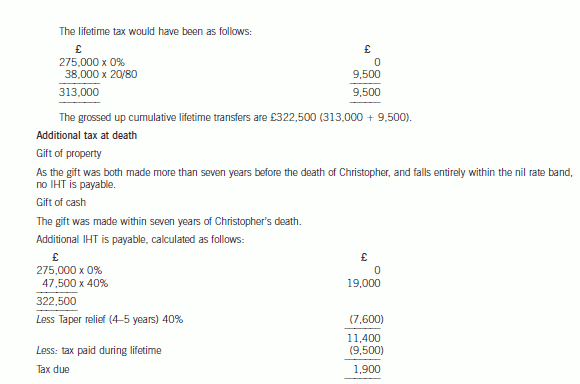
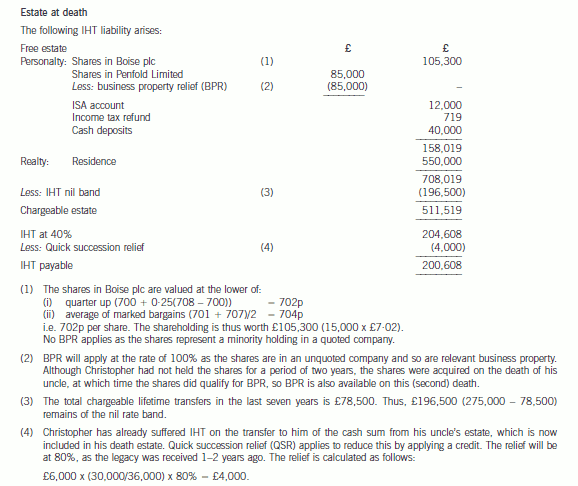
(b) Calculate the inheritance tax (IHT) liability arising as a result of Christopher’s death. (11 marks)
正确答案:
-
第17题:
(ii) Calculate Paul’s tax liability if he exercises the share options in Memphis plc and subsequently sells the
shares in Memphis plc immediately, as proposed, and show how he may reduce this tax liability.
(4 marks)
正确答案:
-
第18题:
(iii) State the value added tax (VAT) and stamp duty (SD) issues arising as a result of inserting Bold plc as
a holding company and identify any planning actions that can be taken to defer or minimise these tax
costs. (4 marks)
You should assume that the corporation tax rates for the financial year 2005 and the income tax rates
and allowances for the tax year 2005/06 apply throughout this question.
正确答案:
(iii) Bold plc will be making a taxable supply of services, likely to exceed the VAT threshold. It should therefore consider
registering for VAT – either immediately on a voluntary basis, or when its cumulative taxable supplies in the previous
twelve months exceed £60,000.
As an alternative, the new group can apply for a group VAT registration. This will simplify its VAT administration as intragroup
transactions are broadly disregarded for VAT purposes, and only one VAT return is required for the group as a
whole.
Stamp duty normally applies at 0·5% on the consideration payable in respect of transactions in shares. However, an
exemption is available in the case of a takeover, reconstruction or amalgamation where there is no real change in
ownership, i.e. the new shareholdings mirror the old shareholdings, and the transaction is for commercial purposes. The
insertion of a new holding company over an existing company, as proposed here, would qualify for this exemption.
There is no VAT on transactions in shares. -
第19题:
(d) Advise Trent Limited of the consequences arising from the submission of the incorrect value added tax (VAT)
return, assuming that the company has previously had a good compliance record with regard to accounting
for VAT. (6 marks)
正确答案:
(d) Default surcharge
Although the VAT return was submitted on time (i.e. within one month of the end of the tax period), part of the quarterly VAT
liability has not yet been paid. As a result this payment will be made late and a surcharge liability notice will be issued on
the company. The surcharge period will run from the date of the notice until the anniversary of the end of the period for which
the VAT was paid late (i.e. until 31 March 2007). During this period any further default will extend the surcharge period and
any further late payments of VAT will attract a surcharge penalty of 2% on the first occasion, rising to 15% for successive late
payments.
Mis-declaration penalty
As the return understates the VAT payable, a potential mis-declaration penalty arises. The amount understated exceeds 30%
of the sum of the true input tax and output tax, known as the gross amount of tax (GAT) ((30% of (87,500 + 55,000) +
40,000) = 54,750). There has, thus, been a significant understatement of the true VAT return liability, resulting in a penalty
rate of 15% of the VAT which would have been lost had the error not been discovered. However, where an under declaration
arises out of a true error i.e. there is no intention to evade tax involved, and it is voluntarily disclosed, then a mis-declaration
penalty is not normally imposed. Although the company is still within the ‘period of grace’ allowed by HMRC for the correction
of errors in the next following VAT return, it would be advisable for Trent Limited to notify HMRC of the error immediately, in
writing, unless it has a ‘reasonable excuse’ for the error having occurred.
Default interest
Default interest is chargeable when an assessment to VAT arises for an amount that has been under declared in a previous
period, whether as a result of voluntary disclosure or as identified by HMRC. Interest is charged on a daily basis from the
date the under declaration should have been declared (i.e. 1 May 2006) to the date shown on the notice of assessment or
notice of voluntary disclosure. As given the size of the error the de minimis relief for voluntarily declared errors of less than
£2,000 is not applicable, the only way for Trent Limited to minimise the interest charge is by means of early disclosure and
payment of the additional VAT due. -
第20题:
(b) Calculate Alvaro Pelorus’s capital gains tax liability for the tax year 2006/07 on the assumption that all
available reliefs are claimed. (8 marks)
正确答案: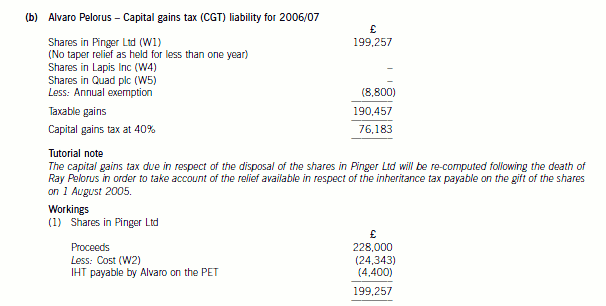

-
第21题:
(ii) Advise Mr Fencer of the income tax implications of the proposed financing arrangements. (2 marks)
正确答案:
(ii) The income tax implications of the proposed financing arrangements
Mr Fencer has borrowed money from a UK bank in order to make a loan to Rapier Ltd, a close company. The interest
paid by Mr Fencer to the bank will be an allowable charge on income as long as he continues to hold more than 5% of
Rapier Ltd. Charges on income are deductible in arriving at an individual’s statutory total income.
Mr Fencer will receive interest from Rapier Ltd net of 20% income tax. The gross amount of interest will be subject to
income tax at either 10%, 20% or 40% depending on whether the income falls into Mr Fencer’s starting rate, basic rate
or higher rate tax band. Mr Fencer will obtain a tax credit for the 20% income tax suffered at source. -
第22题:
(ii) A proposal which will increase the after tax proceeds from the sale of the Snapper plc loan stock and a
reasoned recommendation of a more appropriate form. of external finance. (3 marks)
正确答案:
(ii) Proposal to increase the after tax proceeds from the sale of the loan stock
AS should delay the sale of the loan stock until after 5 April 2008. The gain made at the time of the takeover would
then crystallise in 2008/09 and would be covered by the annual exemption for that year. The net proceeds would be
increased by the capital gains tax saved of £3,446 (£8,616 x 40%).
More appropriate forms of external finance
A bank overdraft is not the most appropriate form. of long term business finance. This is because the bank can demand
repayment of the overdraft at any time and the rates of interest charged are fairly high.
AS should seek long term finance for his long term business needs, for example a bank loan secured on the theatre, and
use the bank overdraft to finance the working capital required on a day-to-day basis. -
第23题:
(b) State the immediate tax implications of the proposed gift of the share portfolio to Avril and identify an
alternative strategy that would achieve Crusoe’s objectives whilst avoiding a possible tax liability in the
future. State any deadline(s) in connection with your proposed strategy. (5 marks)
正确答案:
(b) Gift of the share portfolio to Avril
Inheritance tax
The gift would be a potentially exempt transfer at market value. No inheritance tax would be due at the time of the gift.
Capital gains tax
The gift would be a disposal by Crusoe deemed to be made at market value for the purposes of capital gains tax. No gain
would arise as the deemed proceeds will equal Crusoe’s base cost of probate value.
Stamp duty
There is no stamp duty on a gift of shares for no consideration.
Strategy to avoid a possible tax liability in the future
Crusoe should enter into a deed of variation directing the administrators to transfer the shares to Avril rather than to him. This
will not be regarded as a gift by Crusoe. Instead, provided the deed states that it is intended to be effective for inheritance tax
purposes, it will be as if Noland had left the shares to Avril in a will.
This strategy is more tax efficient than Crusoe gifting the shares to Avril as such a gift would be a potentially exempt transfer
and inheritance tax may be due if Crusoe were to die within seven years.
The deed of variation must be entered into by 1 October 2009, i.e. within two years of the date of Noland’s death.