
(c) (i) Explain the inheritance tax (IHT) implications and benefits of Alvaro Pelorus varying the terms of hisfather’s will such that part of Ray Pelorus’s estate is left to Vito and Sophie. State the date by which adeed of variation would need to be made
题目
(c) (i) Explain the inheritance tax (IHT) implications and benefits of Alvaro Pelorus varying the terms of his
father’s will such that part of Ray Pelorus’s estate is left to Vito and Sophie. State the date by which a
deed of variation would need to be made in order for it to be valid; (3 marks)
相似考题
参考答案和解析
(c) (i) Variation of Ray’s will
The variation by Alvaro of Ray’s will, such that assets are left to Vito and Sophie, will not be regarded as a gift by Alvaro.
Instead, provided the deed states that it is intended to be effective for IHT purposes, it will be as if Ray had left the assets
to the children in his will.
This strategy, known as skipping a generation, will have no effect on the IHT due on Ray’s death but will reduce the
assets owned by Alvaro and thus his potential UK IHT liability. A deed of variation is more tax efficient than Alvaro
making gifts to the children as such gifts would be PETs and IHT may be due if Alvaro were to die within seven years.
The deed of variation must be entered into by 31 January 2009, i.e. within two years of the date of Ray’s death.
更多“(c) (i) Explain the inheritance tax (IHT) implications and benefits of Alvaro Pelorus varying the terms of hisfather’s will such that part of Ray Pelorus’s estate is left to Vito and Sophie. State the date by which adeed of variation would need to be made”相关问题
-
第1题:
Assume that the corporation tax rates for the financial year 2004 apply throughout.
(b) Explain the corporation tax (CT) and value added tax (VAT) issues that Irroy should be aware of, if she
proceeds with her proposal for the Irish subsidiary, Green Limited. Your answer should clearly identify those
factors which will determine whether or not Green Limited is considered UK resident or Irish resident and
the tax implications of each alternative situation.
You need not repeat points that are common to each situation. (16 marks)
正确答案:
(b) There are several matters that Irroy will need to be aware of in relation to value added tax and corporation tax. These are set
out below.
Residence of subsidiary
Irroy will want to ensure that the subsidiary is treated as being resident in the Republic of Ireland. It will then pay corporation
tax on its profits at lower rates than in the UK. The country of incorporation usually claims taxing rights, but this is not by
itself sufficient. Irroy needs to be aware that a company can be treated as UK resident by virtue of the location of its central
management and control. This is usually defined as being where the board of directors meets to make strategic decisions. As
a result, Irroy needs to ensure that board meetings are conducted outside the UK.
If Green Limited is treated as being UK resident, it will be taxed in the UK on its worldwide income, including that arising in
the Republic of Ireland. However, as it will be conducting trading activities in the Republic of Ireland, Green Limited will also
be treated as being Irish resident as its activities in that country are likely to constitute a permanent establishment. Thus it
may also suffer tax in the Republic of Ireland as a consequence, although double tax relief will be available (see later).
A permanent establishment is broadly defined as a fixed place of business through which a business is wholly or partly carried
on. Examples of a permanent establishment include an office, factory or workshop, although certain activities (such as storage
or ancillary activities) can be excluded from the definition.
If Green Limited is treated as being an Irish resident company, any dividends paid to Aqua Limited will be taxed under
Schedule D Case V in the UK. Despite being non resident, Green Limited will still count as an associate of the existing UK
companies, and may affect the rates of tax paid by Aqua Limited and Aria Limited in the UK. However, as a non UK resident
company, Green Limited will not be able to claim losses from the UK companies by way of group relief.
Double tax relief
If Green Limited is treated as UK resident, corporation tax at UK rates will be payable on all profits earned. However, income
arising in the Republic of Ireland is likely to have been taxed in that country also by virtue of having a permanent
establishment located there. As the same profits have been taxed twice, double tax relief is available, either by reference to
the tax treaty between the UK and the Republic of Ireland, or on a unilateral basis, where the UK will give relief for the foreign
tax suffered.
If Green Limited is treated as an Irish resident company, it will pay tax in the Republic of Ireland, based on its worldwide
taxable profits. However, any repatriation of profits to the UK by dividend will be taxed on a receipts basis in the UK. Again,
double tax relief will be available as set out above.
Double tax relief is available against two types of tax. For payments made by Green Limited to Aqua Limited on which
withholding tax has been levied, credit will be given for the tax withheld. In addition, relief is available for the underlying tax
where a dividend is received from a foreign company in which Aqua Limited owns at least 10% of the voting power. The
underlying tax is the tax attributable to the relevant profits from which the dividend was paid.
Double tax relief is given at the lower rate of the UK tax and the foreign tax (withholding and underlying taxes) suffered.
Transfer pricing
Where groups have subsidiaries in other countries, they may be tempted to divert profits to subsidiaries which pay tax at lower
rates. This can be achieved by artificially changing the prices charged (known as the transfer price) between the group
companies. While they can do this commercially through common control, anti avoidance legislation seeks to correct this by
ensuring that for taxation purposes, profits on such intra-group transactions are calculated as if the transactions were carried
out on an arms length basis. Since 1 April 2004, this legislation can also be applied to transactions between UK group
companies.
If Green Limited is treated as a UK resident company, the group’s status as a small or medium sized enterprise means that
transfer pricing issues will not apply to transactions between Green Limited and the other UK group companies.
If Green Limited is an Irish resident company, transfer pricing issues will not apply to transactions between Green Ltd and the
UK resident companies because of the group’s status as a small or medium-sized enterprise and the existence of a double
tax treaty, based on the OECD model, between the UK and the Republic of Ireland.
Controlled foreign companies
Tax legislation exists to stop a UK company accumulating profits in a foreign subsidiary which is subject to a low tax rate.
Such a subsidiary is referred to as a controlled foreign company (CFC), and exists where:
(1) the company is resident outside the UK, and
(2) is controlled by a UK resident entity or persons, and
(3) pays a ‘lower level of tax’ in its country of residence.
A lower level of tax is taken to be less than 75% of the tax that would have been payable had the company been UK resident.
If Green Limited is an Irish resident company, it will be paying corporation tax at 12·5% so would appear to be caught by
the above rules and is therefore likely to be treated as a CFC.
Where a company is treated as a CFC, its profits are apportioned to UK resident companies entitled to at least 25% of its
profits. For Aqua Limited, which would own 100% of the shares in Green Limited, any profits made by Green Limited would
be apportioned to Aqua Limited as a deemed distribution. Aqua Limited would be required to self-assess this apportionment
on its tax return and pay UK tax on the deemed distribution (with credit being given for the Irish tax suffered).
There are some exemptions which if applicable the CFC legislation does not apply and no apportionments of profits will be
made. These include where chargeable profits of the CFC do not exceed £50,000 in an accounting period, or where the CFC
follows an acceptable distribution policy (distributing at least 90% of its chargeable profits within 18 months of the relevant
period).
Value added tax (VAT)
Green Limited will be making taxable supplies in the Republic of Ireland and thus (subject to exceeding the Irish registration
limit) liable to register for VAT there. If Green Limited is registered for VAT in the Republic of Ireland, then supplies of goods
made from the UK will be zero rated. VAT on the goods will be levied in the Republic of Ireland at a rate of 21%. Aqua Limited
will need to have proof of supply in order to apply the zero rate, and will have to issue an invoice showing Green Limited’s
Irish VAT registration number as well as its own. In the absence of such evidence/registration, Aqua Limited will have to treat
its transactions with Green Limited as domestic sales and levy VAT at the UK standard rate of 17·5%.
In addition to making its normal VAT returns, Aqua Limited will also be required to complete an EU Sales List (ESL) statement
each quarter. This provides details of the sales made to customers in the return period – in this case, Green Limited. Penalties
can be applied for inaccuracies or non-compliance. -
第2题:
(b) (i) Calculate the inheritance tax (IHT) that will be payable if Debbie were to die today (8 June 2005).
Assume that no tax planning measures are taken and that there has been no change in the value of any
of the assets since David’s death. (4 marks)
正确答案:
-
第3题:
(c) Assuming that she will survive until July 2009, advise on the lifetime inheritance tax (IHT) planning
measures that could be undertaken by Debbie, quantifying the savings that can be made. (7 marks)
For this question you should assume that the rates and allowances for 2004/05 apply throughout.
正确答案:
(c) Debbie survives until July 2009
Debbie should consider giving away some of her assets to her children, while ensuring that she still has enough to live on.
Such gifts would be categorised as PETs. Although Debbie will not survive seven years (at which point the gifts would fall out
of Debbie’s estate for IHT purposes), taper relief will reduce the amount chargeable to IHT. If gifts were made prior to July
2005, 40% taper relief would be available.
It is important to remember that Debbie’s annual exemptions will reduce the value of any PET when assets are gifted. Debbie
has not used her annual exemption for the last two years, and so she can gift £6,000 (2 x £3,000) in the current tax year
as well as £3,000 per year in future tax years. Debbie could therefore give away £18,000, saving tax of £7,200 (£18,000
x 40%). Debbie can also make small exempt gifts of up to £250 per donee per year.
Debbie should consider making gifts to Allison’s children instead of Allison (using, for example, an accumulation &
maintenance trust). This would ensure that the gifts were excluded from Allison’s estate.
It does not make sense for Debbie to gift shares in Dee Limited, as these qualify for full business property relief and therefore
are not subject to IHT.
As Andrew is shortly to be married, Debbie could give up to £5,000 in consideration of his marriage. This would save £2,000
in IHT.
Expenditure out of normal income is also exempt from IHT. This is where the transferor is left with sufficient income to
maintain his/her usual standard of living. Broadly, you need to demonstrate evidence of a prior commitment, or a settled
pattern of expenditure.
If substantial gifts are made, the donees would be advised to consider taking out insurance policies on Debbie’s life to cover
the potential tax liabilities that may arise on PETs in the event of her early death. -
第4题:
(ii) Explain the income tax (IT), national insurance (NIC) and capital gains tax (CGT) implications arising on
the grant to and exercise by an employee of an option to buy shares in an unapproved share option
scheme and on the subsequent sale of these shares. State clearly how these would apply in Henry’s
case. (8 marks)
正确答案:
(ii) Exercising of share options
The share option is not part of an approved scheme, and will not therefore enjoy the benefits of such a scheme. There
are three events with tax consequences – grant, exercise and sale.
Grant. If shares or options over shares are sold or granted at less than market value, an income tax charge can arise on
the difference between the price paid and the market value. [Weight v Salmon]. In addition, if options can be exercised
more than 10 years after the date of the grant, an employment income charge can arise. This is based on the market
value at the date of grant less the grant and exercise priced.
In Henry’s case, the options were issued with an exercise price equal to the then market value, and cannot be exercised
more than 10 years from the grant. No income tax charge therefore arises on grant.
Exercise. On exercise, the individual pays the agreed amount in return for a number of shares in the company. The price
paid is compared with the open market value at that time, and if less, the difference is charged to income tax. National
insurance also applies, and the company has to pay Class 1 NIC. If the company and shareholder agree, the national
insurance can be passed onto the individual, and the liability becomes a deductible expense in calculating the income
tax charge.
In Henry’s case on exercise, the difference between market value (£14) and the price paid (£1) per share will be taxed
as income. Therefore, £130,000 (10,000 x (£14 – £1)) will be taxed as income. In addition, national insurance will
be chargeable on the company at 12·8% (£16,640) and on Henry at the rate of 1% (£1,300).
Sale. The base cost of the shares is taken to be the market value at the time of exercise. On the sale of the shares, any
gain or loss arising falls under the capital gains tax rules, and CGT will be payable on any gain. Business asset taper
relief will be available as the company is an unquoted trading company, but the relief will only run from the time that
the share options are exercised – i.e. from the time when the shares were acquired.
In Henry’s case, the sale of the shares will immediately follow the exercise of the option (6 days later). The sale proceeds
and the market value at the time of exercise are likely to be similar; thus little to no gain is likely to arise. -
第5题:
(d) Explain how Gloria would be taxed in the UK on the dividends paid by Bubble Inc and the capital gains tax
and inheritance tax implications of a future disposal of the shares. Clearly state, giving reasons, whether or
not the payment made to Eric is allowable for capital gains tax purposes. (9 marks)
You should assume that the rates and allowances for the tax year 2005/06 apply throughout this question.
正确答案:
(d) UK tax implications of shares in Bubble Inc
Income tax
Gloria is UK resident and is therefore subject to income tax on her worldwide income. However, because she is non-UK
domiciled, she will only be taxed on the foreign dividends she brings into the UK.
Dividends brought into the UK will be grossed up for any tax paid in Oceania. The gross amount is taxed at 10% if it falls
into the starting or basic rate band and at 321/2% if it falls into the higher rate band. The tax suffered in Oceania is available
for offset against the UK tax liability. The offset is restricted to a maximum of the UK tax on the dividend income.
Capital gains tax
Individuals are subject to capital gains tax on worldwide assets if they are resident or ordinarily resident in the UK. However,
because Gloria is non-UK domiciled and the shares are situated abroad, the gain is only taxable to the extent that the sales
proceeds are brought into the UK. Any tax suffered in Oceania in respect of the gain is available for offset against the UK
capital gains tax liability arising on the shares.
Any loss arising on the disposal of the shares would not be available for relief in the UK.
In computing a capital gain or allowable loss, a deduction is available for the incidental costs of acquisition. However, to be
allowable, such costs must be incurred wholly and exclusively for the purposes of acquiring the asset. The fee paid to Eric
related to general investment advice and not to the acquisition of the shares and therefore, would not be deductible in
computing the gain.
Taper relief will be at non-business asset rates as Bubble Inc is an investment company.
Inheritance tax
Assets situated abroad owned by non-UK domiciled individuals are excluded property for the purposes of inheritance tax.
However, Gloria will be deemed to be UK domiciled (for the purposes of inheritance tax only) if she has been resident in the
UK for 17 out of the 20 tax years ending with the year in which the disposal occurs.
Gloria has been running a business in the UK since June 1992 and would therefore, appear to have been resident for at least
15 tax years (1992/93 to 2006/07 inclusive).
If Gloria is deemed to be UK domiciled such that the shares in Bubble Inc are not excluded property, business property relief
will not be available because Bubble Inc is an investment company. -
第6题:
(b) (i) State the condition that would need to be satisfied for the exercise of Paul’s share options in Memphis
plc to be exempt from income tax and the tax implications if this condition is not satisfied.
(2 marks)
正确答案:
(b) (i) Paul has options in an HMRC approved share scheme. Under such schemes, no tax liabilities arise either on the grant
or exercise of the option. The excess of the proceeds over the price paid for the shares (the exercise price) is charged to
capital gains tax on their disposal.
However, in order to secure this treatment, one of the conditions to be satisfied is that the options cannot be exercised
within three years of the date of grant. If Paul were to exercise his options now (i.e. before the third anniversary of the
grant), the exercise would instead be treated as an unapproved exercise. At that date, income tax would be charged on
the difference between the market value of the shares on exercise and the price paid to exercise the option. -
第7题:
(b) For this part, assume today’s date is 1 May 2010.
Bill and Ben decided not to sell their company, and instead expanded the business themselves. Ben, however,
is now pursuing other interests, and is no longer involved with the day to day activities of Flower Limited. Bill
believes that the company would be better off without Ben as a voting shareholder, and wishes to buy Ben’s
shares. However, Bill does not have sufficient funds to buy the shares himself, and so is wondering if the
company could acquire the shares instead.
The proposed price for Ben’s shares would be £500,000. Both Bill and Ben pay income tax at the higher rate.
Required:
Write a letter to Ben:
(1) stating the income tax (IT) and/or capital gains tax (CGT) implications for Ben if Flower Limited were to
repurchase his 50% holding of ordinary shares, immediately in May 2010; and
(2) advising him of any available planning options that might improve this tax position. Clearly explain any
conditions which must be satisfied and quantify the tax savings which may result.
(13 marks)
Assume that the corporation tax rates for the financial year 2005 and the income tax rates and allowances
for the tax year 2005/06 apply throughout this question.
正确答案:(b) [Ben’s address] [Firm’s address]
Dear Ben [Date]
A company purchase of own shares can be subject to capital gains treatment if certain conditions are satisfied. However, one
of these conditions is that the shares in question must have been held for a minimum period of five years. As at 1 May 2010,
your shares in Flower Limited have only been held for four years and ten months. As a result, the capital gains treatment will
not apply.
In the absence of capital gains treatment, the position on a company repurchase of its own shares is that the payment will
be treated as an income distribution (i.e. a dividend) in the hands of the recipient. The distribution element is calculated as
the proceeds received for the shares less the price paid for them. On the basis that the purchase price is £500,000, then the
element of distribution will be £499,500 (500,000 – 500). This would be taxed as follows: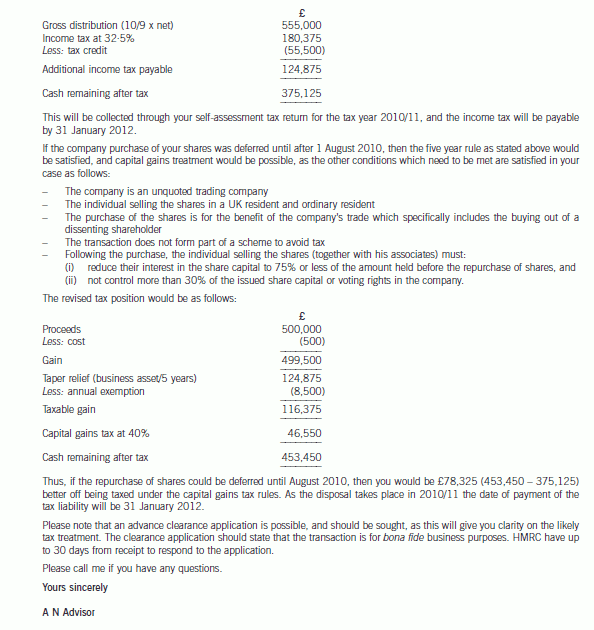
-
第8题:
(b) Calculate Alvaro Pelorus’s capital gains tax liability for the tax year 2006/07 on the assumption that all
available reliefs are claimed. (8 marks)
正确答案: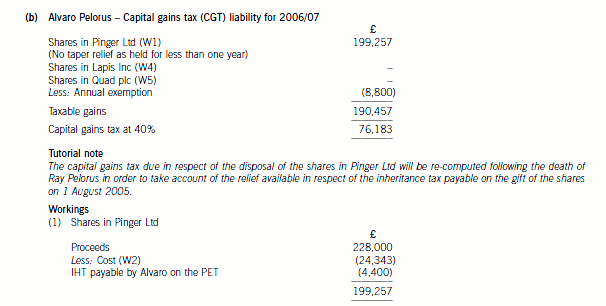

-
第9题:
(b) Explain the corporation tax and value added tax (VAT) implications of the following aspects of the proposed
restructuring of the Rapier Ltd group.
(i) The immediate tax implications of the restructuring. (6 marks)
正确答案:
(b) The tax implications of the proposed restructuring of the Rapier Ltd group
(i) Immediate implications
Corporation tax
Rapier Ltd and its subsidiaries are in a capital gains group as Rapier Ltd owns at least 75% of the ordinary share capital
of each of the subsidiary companies. Any non-exempt items of plant and machinery owned by the subsidiaries will
therefore be transferred to Rapier Ltd at no gain, no loss.
No taxable credit or allowable debit will arise on the transfer of the subsidiaries’ goodwill to Rapier Ltd because the
companies are in a capital gains group.
The trading losses brought forward in Dirk Ltd will be transferred with the trade to Rapier Ltd as the effective ownership
of the three trades will not change (Rapier Ltd owns the subsidiaries which own the trades and, following the
restructuring, will own the three trades directly). The losses will be restricted to being offset against the future trading
profits of the Dirk trade only.
There will be no balancing adjustments in respect of the plant and machinery transferred to Rapier Ltd. Writing down
allowances will be claimed by the subsidiaries in respect of the year ending 30 June 2007 and by Rapier Ltd in respect
of future periods.
Value added tax (VAT)
No VAT should be charged on the sales of the businesses to Rapier Ltd as they are outside the scope of VAT. This is
because the trades are to be transferred as going concerns to a VAT registered person with no significant break in trading.
Switch Ltd must notify HM Revenue and Customs by 30 July 2007 that it has ceased to make taxable supplies. -
第10题:
(b) State the immediate tax implications of the proposed gift of the share portfolio to Avril and identify an
alternative strategy that would achieve Crusoe’s objectives whilst avoiding a possible tax liability in the
future. State any deadline(s) in connection with your proposed strategy. (5 marks)
正确答案:
(b) Gift of the share portfolio to Avril
Inheritance tax
The gift would be a potentially exempt transfer at market value. No inheritance tax would be due at the time of the gift.
Capital gains tax
The gift would be a disposal by Crusoe deemed to be made at market value for the purposes of capital gains tax. No gain
would arise as the deemed proceeds will equal Crusoe’s base cost of probate value.
Stamp duty
There is no stamp duty on a gift of shares for no consideration.
Strategy to avoid a possible tax liability in the future
Crusoe should enter into a deed of variation directing the administrators to transfer the shares to Avril rather than to him. This
will not be regarded as a gift by Crusoe. Instead, provided the deed states that it is intended to be effective for inheritance tax
purposes, it will be as if Noland had left the shares to Avril in a will.
This strategy is more tax efficient than Crusoe gifting the shares to Avril as such a gift would be a potentially exempt transfer
and inheritance tax may be due if Crusoe were to die within seven years.
The deed of variation must be entered into by 1 October 2009, i.e. within two years of the date of Noland’s death. -
第11题:
Which command would correctly set a router‘s date and time?()
A.A
B.B
C.C
D.D
参考答案:C
-
第12题:
问答题Inheritance tax is a tax which many countries levy on the total taxable value of the estate of a deceased person. Inheritance tax is paid by the inheritor of the estate or by the person in charge of its assets. In most cases, if the estate is left to a charitable organization or a surviving spouse, no inheritance tax is due. In China, inheritance tax does not exist. Should inheritance tax be introduced to China? The controversy that has raged over levying inheritance tax in China currently shows little sign of abating. The following are opinions from both sides. Read the excerpt carefully and write your response in about 300 words, in which you should: 1. summarize briefly the opinions from both sides, and then 2. give your comment. Marks will be awarded for content relevance, content sufficiency, organization and language quality. Failure to follow the above instructions may result in a loss of marks. Opponents of inheritance tax typically refer to it as “death tax.” They argue first that concern over burdening their children with this tax may lead elderly to make unwise investment decisions late in life, and that it may also discourage entrepreneurship earlier in life. Opponents also claim that morally it should be only the choice of the person who earned the money what should be done with it, not the government. They see taxing wealth at death as a kind of forced income redistribution that goes against the market economy. Proponents of inheritance tax say that it helps prevent consolidation of wealth in the hands of a few powerful families and is a basic building block of the nation’s system of taxation. They also feel that inheriting large sums without tax undermines people’s motives to work hard in the future and, thus, undercuts the principles of the market economy, encouraging people to become idle and unproductive, which hurts the country overall.正确答案:
【参考范文】
Should Inheritance Tax be Introduced to China? An inheritance tax is a tax paid by a person who inherits money or property or a levy on the estate of a person who has died. Many countries have inheritance tax, while China does not. Whether China should levy inheritance tax has become a hot topic of discussion. Supporters hold that it helps prevent the wealth from being always in the hands of a few powerful families. Inheriting large sums without tax weakens people’s enthusiasm for work, encouraging people to become lazy and unproductive, which is not conducive to the whole country. However, opponents argue that this tax may result in unwise investment decisions late in life, and discourage entrepreneurship earlier in life. It is a kind of forced income redistribution, ignoring the right of people earned the money.
From my points of view, inheritance tax should not be introduced to China. Firstly, it is a violation of human rights. In any country that has recognized the private property rights, a person’s private property can be handled without violating others all a person likes. The inheritance tax violates the rights of the people to dispose of their property. Secondly, inheritance tax will encourage abnormal consumption, conspicuous consumption of rich people, further intensifying contradictions and conflicts among social members. It may stimulate the rich to spend their money excessively before death and lead to hostility to the rich. Thirdly, inheritance tax will reduce the enthusiasm of entrepreneurs, exacerbate capital flight, economic migration and impede investment and capital inflows, inhibiting economic development. It may drive wealthy people to move assets out of the country or emigrate in order to avoid the tax, resulting in capital loss and brain drain.
To summarize, inheritance tax might not be an effective enough tool to narrow income disparity. Therefore, other measures are needed if the government wants to ensure a more equitable distribution of wealth in society.解析:
【审题构思】
本题要求考生围绕是否应该征收遗产税这一话题展开讨论。文章可以支持也可以反对,只要言之有理即可。考生首先要总结材料中的观点,然后明确陈述自己的观点。接下来论证自己的观点,注意要分点列举,这样才能做到内容充实,条理清晰。最后总结全文,重申观点;也可进一步补充观点,深化主题。 -
第13题:
(ii) State, giving reasons, the tax reliefs in relation to inheritance tax (IHT) and capital gains tax (CGT) which
would be available to Alasdair if he acquires the warehouse and leases it to Gallus & Co, rather than to
an unconnected tenant. (4 marks)
正确答案:
(ii) Apart from the fact that Alasdair can keep an eye on his tenant, the main advantages are twofold:
IHT: If the firm are the tenants, the property will be land and buildings used in a business carried on by a partnership
in which the donor is a partner. Thus, Alasdair will be able to claim business property relief (BPR) at a rate of 50%
so long as he remains a partner in the firm. However, this relief would not be available until Alasdair has owned
the property for at least two years from his firm taking up the tenancy.
CGT: As Alasdair is a partner in the firm using the building, it will also be a qualifying asset for the purposes of rollover
relief on any gains arising from the disposal of the property. Assuming that Alasdair acquires a replacement asset
which will be used in the trade, the gain on sale can be deferred against the tax base cost of the replacement asset.
In the event that rollover relief cannot be used, any gains on disposal will be subject to business asset taper relief. -
第14题:
(ii) State when the inheritance tax (IHT) calculated in (i) would be payable and by whom. (2 marks)
正确答案:
(ii) Inheritance tax administration
The tax on Debbie’s estate (personalty and realty) would be paid by the personal representatives, usually an executor.
Inheritance tax is due six months from the end of the month in which death occurred (31 December 2005) or the date
on which probate is obtained (if earlier). However, an instalment option is available for certain assets, which includes
land and buildings i.e. the residence whereby the tax can be paid in 10 equal annual instalments. -
第15题:
(c) (i) Explain the capital gains tax (CGT) implications of a takeover where the consideration is in the form. of
shares (a ‘paper for paper’ transaction) stating any conditions that need to be satisfied. (4 marks)
正确答案:
(c) (i) Paper for paper rules
The proposed transaction broadly falls under the ‘paper for paper’ rules. Where this is the case, chargeable gains do not
arise. Instead, the new holding stands in the shoes (and inherits the base cost) of the original holding.
The company issuing the new shares must:
(i) end up with more than 25% of the ordinary share capital (or a majority of the voting power) of the old company,
OR
(ii) make a general offer to shareholders in the other company with a condition that, if satisfied, would give the
acquiring company control of the other company.
The exchange must be for bona fide commercial reasons and must not have as its main purpose (or one of its main
purposes) the avoidance of CGT or corporation tax. The acquiring company can obtain advance clearance from the
Inland Revenue that the conditions will be met.
If part of the offer consideration is in the form. of cash, a gain must be calculated using the part disposal rules. If the
cash received is not more than the higher of £3,000 or 5% of the total value on takeover, then the amount received in
cash can be deducted from the base cost of the securities under the small distribution rules. -
第16题:
(c) Without changing the advice you have given in (b), or varying the terms of Luke’s will, explain how Mabel
could further reduce her eventual inheritance tax liability and quantify the tax saving that could be made.
(3 marks)
The increase in the retail prices index from April 1984 to April 1998 is 84%.
You should assume that the rates and allowances for the tax year 2005/06 will continue to apply for the
foreseeable future.
正确答案:
(c) Further advice
Mabel should consider delaying one of the gifts until after 1 May 2007 such that it is made more than seven years after the
gift to the discretionary trust. Both PETs would then be covered by the nil rate band resulting in a saving of inheritance tax
of £6,720 (from (b)).
Mabel should ensure that she uses her inheritance tax annual exemption of £3,000 every year by, say, making gifts of £1,500
each year to both Bruce and Padma. The effect of this will be to save inheritance tax of £1,200 (£3,000 x 40%) every year. -
第17题:
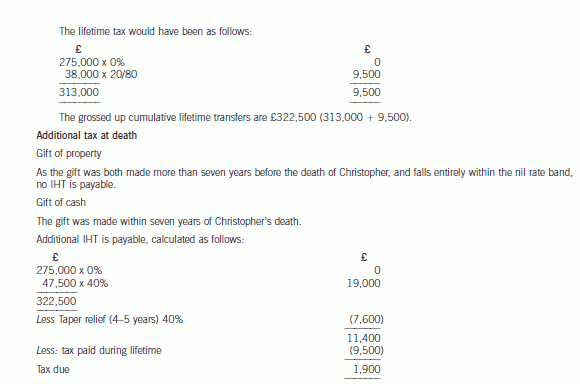
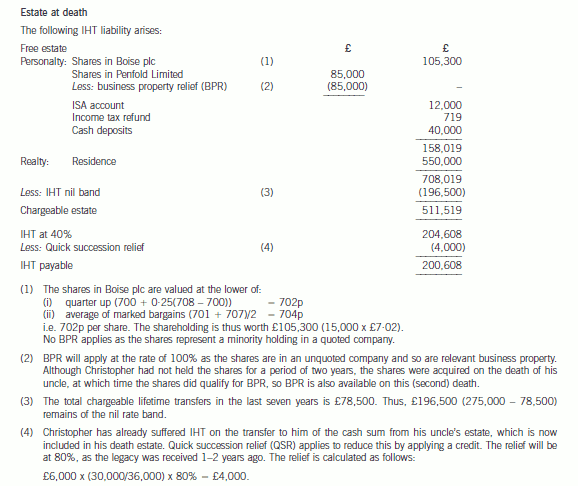
(b) Calculate the inheritance tax (IHT) liability arising as a result of Christopher’s death. (11 marks)
正确答案:
-
第18题:
(c) Explain the capital gains tax (CGT) and income tax (IT) issues Paul and Sharon should consider in deciding
which form. of trust to set up for Gisella and Gavin. You are not required to consider inheritance tax (IHT) or
stamp duty land tax (SDLT) issues. (10 marks)
You should assume that the tax rates and allowances for the tax year 2005/06 apply throughout this question.
正确答案:
(c) As the trust is created in the settlors’ (Paul and Sharon’s) lifetime its creation will constitute a chargeable disposal for capital
gains tax. Also, as the settlors and trustees are connected persons, the disposal will be deemed to be at market value, resulting
in a chargeable gain of £80,000 (160,000 – 80,000). No taper relief will be available as the property is a non-business
asset, and has been held for less than three years, but annual exemptions of £17,000 (2 x £8,500) will be available.
However, in the case of a discretionary trust, gift hold over relief will be available. This is because the gift will constitute a
chargeable lifetime transfer and because there is an immediate charge to inheritance tax (even though no tax is payable due
to the nil rate band) relief is available if a specific accumulation and maintenance trust is used, as in this case the gift will
qualify as a potentially exempt transfer and so gift relief would only be available in respect of business assets. The use of a
basic discretionary trust will thus facilitate the deferral of an immediate capital gains tax charge of £25,200 (63,000 x 40%).
If/when the property is disposed of, however, the trustees will pay capital gains tax on the deferred gain at the trust income
tax rate of 40%, and have an annual exemption of only £4,250 (50% of the normal individual rate) available to them. The
40% rate of tax and lower annual exemption rate also apply to chargeable gains arising in a specific accumulation and
maintenance trust, as well as a basic discretionary trust.
A chargeable disposal between connected persons will also arise for the purposes of capital gains tax if/when the property
vests in a beneficiary, i.e. one or more of the beneficiaries becomes absolutely entitled to all or part of the income or capital
of the trust. Gift hold over relief will again be available on all assets in the case of a discretionary trust, but only on business
assets in the case of an accumulation and maintenance trust, except where a beneficiary becomes entitled to both income
and capital at the same time.
The trust will have taxable property income in the form. of net rents from its creation and in future years is also likely to have
other investment income, probably in the form. of interest, to the extent that monies are retained in the trust. Whichever form
of trust is used, the trustees will pay tax at the standard trust rate of 40% on income other than dividend income (32·5%),
except to the extent of (1) the first £500 of taxable income, which is taxed at the rate that would otherwise apply to such
income (i.e. 22% for non-savings (rental) income, 20% for savings income (interest) and 10% for dividends) but, only to the
extent that it is not distributed; and (2) the legitimate trust management expenses, which are offsettable for the purposes of
the higher trust tax rates against the income with the lowest rate(s) of normal tax and so bear tax only at that rate. The higher
trust tax rate always applies to income that is distributed, other than to the extent that it has been treated as the settlor’s
income, and taxed at that settlor’s marginal tax rate.
As Paul and Sharon intend to create a trust for their unmarried minor (under 18) children, then even if the trust specifically
excludes them from any benefit under the trust, the trust income will be treated as theirs for income tax purposes to the extent
that it constitutes income paid for on behalf (including maintenance payments) of Gisella and Gavin; except where (1) the
total income arising does not exceed £100 gross per annum, and (2) income is held for the benefit of a child under an
accumulation and maintenance settlement, to the extent that it is not paid out. -
第19题:
1 Alvaro Pelorus is 47 years old and married to Maria. The couple have two children, Vito and Sophie, aged 22 and
19 years respectively. Alvaro and Maria have lived in the country of Koruba since 1982. On 1 July 2005 the family
moved to the UK to be near Alvaro’s father, Ray, who was very ill. Alvaro and Maria are UK resident, but not ordinarily
resident in the tax years 2005/06 and 2006/07. They are both domiciled in the country of Koruba.
On 1 February 2007 Ray Pelorus died. He was UK domiciled, having lived in the UK for the whole of his life. For the
purposes of inheritance tax, his death estate consisted of UK assets, valued at £870,000 after deduction of all
available reliefs, and a house in the country of Pacifica valued at £94,000. The executors of Ray’s estate have paid
Pacifican inheritance tax of £1,800 and legal fees of £7,700 in respect of the sale of the Pacifican house. Ray left
the whole of his estate to Alvaro.
Ray had made two gifts during his lifetime:
(i) 1 May 2003: He gave Alvaro 95 acres of farm land situated in the UK. The market value of the land was
£245,000, although its agricultural value was only £120,000. Ray had acquired the land on
1 January 1996 and granted an agricultural tenancy on that date. Alvaro continues to own the
land as at today’s date and it is still subject to the agricultural tenancy.
(ii) 1 August 2005: He gave Alvaro 6,000 shares valued at £183,000 in Pinger Ltd, a UK resident trading
company. Gift relief was claimed in respect of this gift. Ray had acquired 14,000 shares in
Pinger Ltd on 1 April 1997 for £54,600.
You may assume that Alvaro is a higher rate taxpayer for the tax years 2005/06 and 2006/07. In 2006/07 he made
the following disposals of assets:
(i) On 1 July 2006 he sold the 6,000 shares in Pinger Ltd for £228,000.
(ii) On 1 September 2006 he sold 2,350 shares in Lapis Inc, a company resident in Koruba, for £8,270. Alvaro
had purchased 5,500 shares in the company on 1 September 2002 for £25,950.
(iii) On 1 December 2006 he transferred shares with a market value of £74,000 in Quad plc, a UK quoted company,
to a UK resident discretionary trust for the benefit of Vito and Sophie. Alvaro had purchased these shares on
1 January 2006 for £59,500.
Alvaro has not made any other transfers of value for the purposes of UK inheritance tax. He owns the family house
in the UK as well as shares in UK and Koruban companies and commercial rental property in the country of Koruba.
Maria has not made any transfers of value for the purposes of UK inheritance tax. Her only significant asset is the
family home in the country of Koruba.
Alvaro and his family expect to return to their home in the country of Koruba in October 2007 once Ray’s affairs have
been settled. There is no double taxation agreement between the UK and Koruba.
Required:
(a) Calculate the inheritance tax (IHT) payable as a result of the death of Ray Pelorus. Explain the availability
or otherwise of agricultural property relief and business property relief on the two lifetime gifts made by Ray.
(8 marks)
正确答案:

-
第20题:
(b) Draft a report as at today’s date advising Cutlass Inc on its proposed activities. The report should cover the
following issues:
(i) The rate at which the profits of Cutlass Inc will be taxed. This section of the report should explain:
– the company’s residency position and what Ben and Amy would have to do in order for the company
to be regarded as resident in the UK under the double tax treaty;
– the meaning of the term ‘permanent establishment’ and the implications of Cutlass Inc having a
permanent establishment in Sharpenia;
– the rate at which the profits of Cutlass Inc will be taxed on the assumption that it is resident in the
UK under the double tax treaty and either does or does not have a permanent establishment in
Sharpenia. (9 marks)
正确答案:
(b) Report to the management of Razor Ltd
To The management of Razor Ltd
From Tax advisers
Date 6 June 2007
Subject The proposed activities of Cutlass Inc
(i) Rate of tax on profits of Cutlass Inc
When considering the manner in which the profits of Cutlass Inc will be taxed it must be recognised that the system of
corporation tax in Sharpenia is the same as that in the UK.
The profits of Cutlass Inc will be subject to corporation tax in the country in which it is resident or where it has a
permanent establishment. It is desirable for the profits of Cutlass Inc to be taxed in the UK rather than in Sharpenia as
the rate of corporation tax in the UK on annual profits of £120,000 will be 19% whereas in Sharpenia the rate of tax
would be 38%.
Residency of Cutlass Inc
Cutlass Inc will be resident in Sharpenia, because it is incorporated there. However, it will also be resident in the UK if
it is centrally managed and controlled from the UK. For this to be the case, Amy and Ben should hold the company’s
board meetings in the UK.
Under the double tax treaty between the UK and Sharpenia, a company resident in both countries is treated as being
resident in the country where it is effectively managed and controlled. For Cutlass Inc to be treated as UK resident under
the treaty, Amy and Ben would need to ensure that all key management and commercial decisions are made in the UK
and not in Sharpenia.
Permanent establishment
A permanent establishment is a fixed place of business, including an office, factory or workshop, through which the
business of an enterprise is carried on. A permanent establishment will also exist in a country if contracts in the
company’s name are habitually concluded there.
The trading profits of Cutlass Inc will be taxable in Sharpenia if they are derived from a permanent establishment in
Sharpenia even if it can be established that Cutlass Inc is UK resident under the double tax treaty.
Double taxation
If Cutlass Inc is UK resident but has a permanent establishment in Sharpenia, its trading profits will be subject to
corporation tax in both the UK and Sharpenia with double tax relief available in the UK. The double tax relief will be the
lower of the UK tax and the Sharpenian tax on the trading profits. Accordingly, as the rate of tax is higher in Sharpenia
than it is in the UK, there will be no UK tax to pay on the company’s trading profits and the rate of tax on the profits
would be the rate in Sharpenia, i.e. 38%.
If Cutlass Inc is UK resident and does not have a permanent establishment in Sharpenia, its profits will be taxable in
the UK at the rate of 19% and not in Sharpenia. -
第21题:
(b) (i) Explain, by reference to Coral’s residence, ordinary residence and domicile position, how the rental
income arising in respect of the property in the country of Kalania will be taxed in the UK in the tax year
2007/08. State the strategy that Coral should adopt in order to minimise the total income tax suffered
on the rental income. (7 marks)
正确答案:
(b) (i) UK tax on the rental income
Coral is UK resident in 2007/08 because she is present in the UK for more than 182 days. Accordingly, she will be
subject to UK income tax on her Kalanian rental income.
Coral is ordinarily resident in the UK in 2007/08 as she is habitually resident in the UK.
Coral will have acquired a domicile of origin in Kalania from her father. She has not acquired a domicile of choice in the
UK as she has not severed her ties with Kalania and does not intend to make her permanent home in the UK.
Accordingly, the rental income will be taxed in the UK on the remittance basis.
Any rental income remitted to the UK will fall into the basic rate band and will be subject to income tax at 22% on the
gross amount (before deduction of Kalanian tax). Unilateral double tax relief will be available in respect of the 8% tax
suffered in Kalania such that the effective rate of tax suffered by Coral in the UK on the grossed up amount of income
remitted will be 14%.
In order to minimise the total income tax suffered on the rental income Coral should ensure that it is not brought into or
used in the UK such that it will not be subject to income tax in the UK.
Coral should retain evidence, for example bank statements, to show that the rental income has not been removed from
Kalania. Coral can use the money whilst she is on holiday in Kalania with no UK tax implications. -
第22题:
(ii) Explain why Galileo is able to pay the inheritance tax due in instalments, state when the instalments are
due and identify any further issues relevant to Galileo relating to the payments. (3 marks)
正确答案:
(ii) Payment by instalments
The inheritance tax can be paid by instalments because Messier Ltd is an unquoted company controlled by Kepler at
the time of the gift and is still unquoted at the time of his death.
The tax is due in ten equal annual instalments starting on 30 November 2008.
Interest will be charged on any instalments paid late; otherwise the instalments will be interest free because Messier is
a trading company that does not deal in property or financial assets.
All of the outstanding inheritance tax will become payable if Galileo sells the shares in Messier Ltd.
Tutorial note
Candidates were also given credit for stating that payment by instalments is available because the shares represent at
least 10% of the company’s share capital and are valued at £20,000 or more. -
第23题:
James died on 22 January 2015. He had made the following gifts during his lifetime:
(1) On 9 October 2007, a cash gift of £35,000 to a trust. No lifetime inheritance tax was payable in respect of this gift.
(2) On 14 May 2013, a cash gift of £420,000 to his daughter.
(3) On 2 August 2013, a gift of a property valued at £260,000 to a trust. No lifetime inheritance tax was payable in respect of this gift because it was covered by the nil rate band. By the time of James’ death on 22 January 2015, the property had increased in value to £310,000.
On 22 January 2015, James’ estate was valued at £870,000. Under the terms of his will, James left his entire estate to his children.
The nil rate band of James’ wife was fully utilised when she died ten years ago.
The nil rate band for the tax year 2007–08 is £300,000, and for the tax year 2013–14 it is £325,000.
Required:
(a) Calculate the inheritance tax which will be payable as a result of James’ death, and state who will be responsible for paying the tax. (6 marks)
(b) Explain why it might have been beneficial for inheritance tax purposes if James had left a portion of his estate to his grandchildren rather than to his children. (2 marks)
(c) Explain why it might be advantageous for inheritance tax purposes for a person to make lifetime gifts even when such gifts are made within seven years of death.
Notes:
1. Your answer should include a calculation of James’ inheritance tax saving from making the gift of property to the trust on 2 August 2013 rather than retaining the property until his death.
2. You are not expected to consider lifetime exemptions in this part of the question. (2 marks)
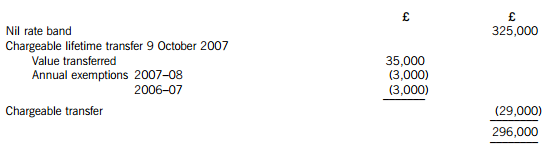
正确答案:(a) James – Inheritance tax arising on death
Lifetime transfers within seven years of death
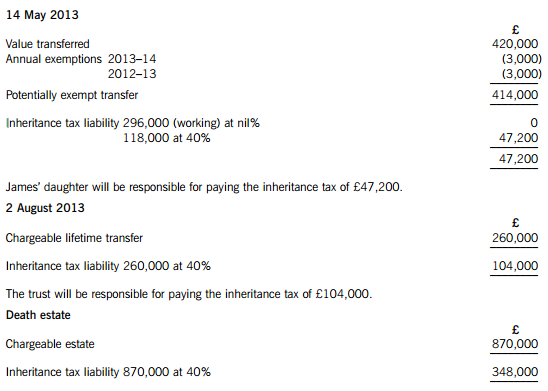
The personal representatives of James’ estate will be responsible for paying the inheritance tax of £348,000.
Working – Available nil rate band
(b) Skipping a generation avoids a further charge to inheritance tax when the children die. Gifts will then only be taxed once before being inherited by the grandchildren, rather than twice.
(c) (1) Even if the donor does not survive for seven years, taper relief will reduce the amount of IHT payable after three years.
(2) The value of potentially exempt transfers and chargeable lifetime transfers are fixed at the time they are made.
(3) James therefore saved inheritance tax of £20,000 ((310,000 – 260,000) at 40%) by making the lifetime gift of property.