(ii) Illustrate the benefit of revising the corporate structure by calculating the corporation tax (CT) payablefor the year ended 31 March 2006, on the assumptions that:(1) no action is taken; and(2) an amended structure as recommended in (i) above is imp
题目
(ii) Illustrate the benefit of revising the corporate structure by calculating the corporation tax (CT) payable
for the year ended 31 March 2006, on the assumptions that:
(1) no action is taken; and
(2) an amended structure as recommended in (i) above is implemented from 1 June 2005. (3 marks)
相似考题
更多“(ii) Illustrate the benefit of revising the corporate structure by calculating the corporation tax (CT) payablefor the year ended 31 March 2006, on the assumptions that:(1) no action is taken; and(2) an amended structure as recommended in (i) above is imp”相关问题
-
第1题:
For this part, assume today’s date is 15 August 2005.
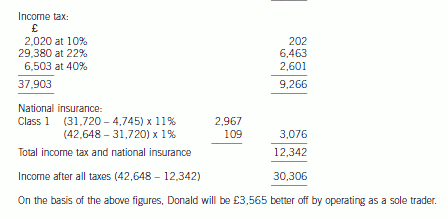
5 (a) Donald is aged 22, single, and about to finish his university education. He has plans to start up a business selling
computer games, and intends to start trading on 1 April 2006, making up accounts to 31 March annually.
He believes that his business will generate cash (equal to taxable profits) of £47,500 in the first year. He
originally intended to operate as a sole trader, but he has recently discovered that as an alternative, he could
operate through a company. He has been advised that if this is the case, he can take a maximum gross salary
of £42,648 out of the company.
Required:
(i) Advise Donald on the income tax (IT), national insurance (NIC) and corporation tax (CT) liabilities he
will incur for the year ended 31 March 2007 trading under each of the two alternative business
structures (sole trade/company). Your advice should be supported by calculations of disposable income
for both alternatives assuming that in the company case, he draws the maximum salary stated.
(7 marks)
正确答案: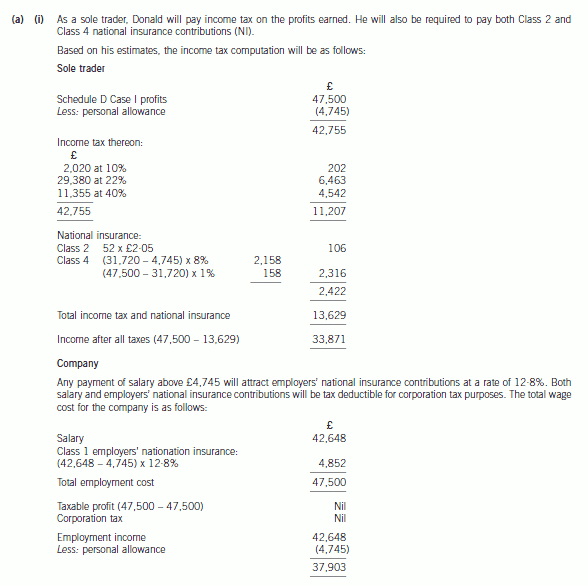
-
第2题:
3 Assume that today’s date is 10 May 2005.
You have recently been approached by Fred Flop. Fred is the managing director and 100% shareholder of Flop
Limited, a UK trading company with one wholly owned subsidiary. Both companies have a 31 March year-end.
Fred informs you that he is experiencing problems in dealing with aspects of his company tax returns. The company
accountant has been unable to keep up to date with matters, and Fred also believes that mistakes have been made
in the past. Fred needs assistance and tells you the following:
Year ended 31 March 2003
The corporation tax return for this period was not submitted until 2 November 2004, and corporation tax of £123,500
was paid at the same time. Profits chargeable to corporation tax were stated as £704,300.
A formal notice (CT203) requiring the company to file a self-assessment corporation tax return (dated 1 February
2004) had been received by the company on 4 February 2004.
A detailed examination of the accounts and tax computation has revealed the following.
– Computer equipment totalling £50,000 had been expensed in the accounts. No adjustment has been made in
the tax computation.
– A provision of £10,000 was made for repairs, but there is no evidence of supporting information.
– Legal and professional fees totalling £46,500 were allowed in full without any explanation. Fred has
subsequently produced the following analysis:
Analysis of legal & professional fees
£
Legal fees on a failed attempt to secure a trading loan 15,000
Debt collection agency fees 12,800
Obtaining planning consent for building extension 15,700
Accountant’s fees for preparing accounts 14,000
Legal fees relating to a trade dispute 19,000
– No enquiry has yet been raised by the Inland Revenue.
– Flop Ltd was a large company in terms of the Companies Act definition for the year in question.
– Flop Ltd had taxable profits of £595,000 in the previous year.
Year ended 31 March 2004
The corporation tax return has not yet been submitted for this year. The accounts are late and nearing completion,
with only one change still to be made. A notice requiring the company to file a self-assessment corporation tax return
(CT203) dated 27 July 2004 was received on 1 August 2004. No corporation tax has yet been paid.
1 – The computation currently shows profits chargeable to corporation tax of £815,000 before accounting
adjustments, and any adjustments for prior years.
– A company owing Flop Ltd £50,000 (excluding VAT) has gone into liquidation, and it is unlikely that any of this
money will be paid. The money has been outstanding since 3 September 2003, and the bad debt will need to
be included in the accounts.
1 Fred also believes there are problems in relation to the company’s VAT administration. The VAT return for the quarter
ended 31 March 2005 was submitted on 5 May 2005, and VAT of £24,000 was paid at the same time. The previous
return to 31 December 2004 was also submitted late. In addition, no account has been made for the VAT on the bad
debt. The VAT return for 30 June 2005 may also be late. Fred estimates the VAT liability for that quarter to be £8,250.
Required:
(a) (i) Calculate the revised corporation tax (CT) payable for the accounting periods ending 31 March 2003
and 2004 respectively. Your answer should include an explanation of the adjustments made as a result
of the information which has now come to light. (7 marks)
(ii) State, giving reasons, the due payment date of the corporation tax (CT) and the filing date of the
corporation tax return for each period, and identify any interest and penalties which may have arisen to
date. (8 marks)
正确答案:(a) Calculation of corporation tax
Year ended 31 March 2003
Corporation tax payable
There are three adjusting items:.
(i) The computers are capital items, as they have an enduring benefit. These need to be added back in the Schedule D
Case I calculation, and capital allowances claimed instead. The company is not small or medium by Companies Act
definitions and therefore no first year allowances are available. Allowances of £12,500 (50,000 x 25%) can be claimed,
leaving a TWDV of £37,500.
(ii) The provision appears to be general in nature. In addition there is insufficient information to justify the provision and it
should be disallowed until such times as it is released or utilised.
(iii) Costs relating to trading loan relationships are allowable, as are costs relating to the trade (debt collection, trade disputes
and accounting work). Costs relating to capital items (£5,700) are not allowable so will have to be added back.
Total profit chargeable to corporation tax is therefore £704,300 + 50,000 – 12,500 + 10,000 + 5,700 = 757,500. There are two associates, and therefore the 30% tax rate starts at £1,500,000/2 = £750,000. Corporation tax payable is 30% x£757,500 = £227,250.
Payment date
Although the rate of tax is 30% and the company ‘large’, quarterly payments will not apply, as the company was not large in the previous year. The due date for payment of tax is therefore nine months and one day after the end of the tax accounting period (31 March 2003) i.e. 1 January 2004.
Filing date
This is the later of:
– 12 months after the end of the period of account: 31 March 2004
– 3 months after the date of the notice requiring the return 1 May 2004
i.e. 1 May 2004.
-
第3题:
3 On 1 January 2007 Dovedale Ltd, a company with no subsidiaries, intends to purchase 65% of the ordinary share
capital of Hira Ltd from Belgrove Ltd. Belgrove Ltd currently owns 100% of the share capital of Hira Ltd and has no
other subsidiaries. All three companies have their head offices in the UK and are UK resident.
Hira Ltd had trading losses brought forward, as at 1 April 2006, of £18,600 and no income or gains against which
to offset losses in the year ended 31 March 2006. In the year ending 31 March 2007 the company expects to make
further tax adjusted trading losses of £55,000 before deduction of capital allowances, and to have no other income
or gains. The tax written down value of Hira Ltd’s plant and machinery as at 31 March 2006 was £96,000 and
there will be no fixed asset additions or disposals in the year ending 31 March 2007. In the year ending 31 March
2008 a small tax adjusted trading loss is anticipated. Hira Ltd will surrender the maximum possible trading losses
to Belgrove Ltd and Dovedale Ltd.
The tax adjusted trading profit of Dovedale Ltd for the year ending 31 March 2007 is expected to be £875,000 and
to continue at this level in the future. The profits chargeable to corporation tax of Belgrove Ltd are expected to be
£38,000 for the year ending 31 March 2007 and to increase in the future.
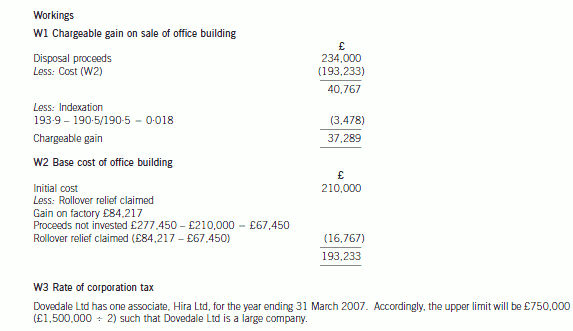
On 1 February 2007 Dovedale Ltd will sell a small office building to Hira Ltd for its market value of £234,000.
Dovedale Ltd purchased the building in March 2005 for £210,000. In October 2004 Dovedale Ltd sold a factory
for £277,450 making a capital gain of £84,217. A claim was made to roll over the gain on the sale of the factory
against the acquisition cost of the office building.
On 1 April 2007 Dovedale Ltd intends to acquire the whole of the ordinary share capital of Atapo Inc, an unquoted
company resident in the country of Morovia. Atapo Inc sells components to Dovedale Ltd as well as to other
companies in Morovia and around the world.
It is estimated that Atapo Inc will make a profit before tax of £160,000 in the year ending 31 March 2008 and will
pay a dividend to Dovedale Ltd of £105,000. It can be assumed that Atapo Inc’s taxable profits are equal to its profit
before tax. The rate of corporation tax in Morovia is 9%. There is a withholding tax of 3% on dividends paid to
non-Morovian resident shareholders. There is no double tax agreement between the UK and Morovia.
Required:
(a) Advise Belgrove Ltd of any capital gains that may arise as a result of the sale of the shares in Hira Ltd. You
are not required to calculate any capital gains in this part of the question. (4 marks)
正确答案:
(a) Capital gains that may arise on the sale by Belgrove Ltd of shares in Hira Ltd
Belgrove Ltd will realise a capital gain on the sale of the shares unless the substantial shareholding exemption applies. The
exemption will be given automatically provided all of the following conditions are satisfied.
– Belgrove Ltd has owned at least 10% of Hira Ltd for a minimum of 12 months during the two years prior to the sale.
– Belgrove Ltd is a trading company or a member of a trading group during that 12-month period and immediately after
the sale.
– Hira Ltd is a trading company or the holding company of a trading group during that 12-month period and immediately
after the sale.
Hira Ltd will no longer be in a capital gains group with Belgrove Ltd after the sale. Accordingly, a capital gain, known as a
degrouping charge, may arise in Hira Ltd. A degrouping charge will arise if, at the time it leaves the Belgrove Ltd group, Hira
Ltd owns any capital assets which were transferred to it at no gain, no loss within the previous six years by a member of the
Belgrove Ltd capital gains group. -
第4题:
(ii) Assuming the new structure is implemented with effect from 1 August 2006, calculate the level of
management charge that should be made by Bold plc to Linden Limited for the year ended 31 July
2007, so as to minimise the group’s overall corporation tax (CT) liability for that year. (2 marks)
正确答案:
(ii) For the year ended 31 July 2007, there will be two associated companies in the group. Bold plc will count as an
associated company as it is not dormant throughout the period in question. As a result, the corporation tax limits will be
divided by two (i.e. the number of associates) giving an upper limit of £750,000 (£1·5 million/2). As Linden Limited
is anticipated to make profits of £1·4 million in the year to 31 July 2007 it will pay corporation tax at the rate of 30%.
Bold plc can earn trading profits up to £150,000 (£300,000/2) and pay tax at the rate of 19%. It will therefore
minimise the group’s corporation tax liability if maximum use is made of this small companies rate band, as it will save
£16,500 (150,000 x (30% – 19%)) of corporation tax for the year to 31 July 2007. Bold plc should therefore make
a management charge of sufficient size to give it profits for that year equal to £150,000.
While the transfer pricing legislation no longer applies to small and medium sized enterprises, Bold plc should
nevertheless ensure that there is evidence to support the actual charge made in terms of the services provided. -
第5题:
(ii) Calculate the corporation tax (CT) payable by Tay Limited for the year ended 31 March 2006, taking
advantage of all available reliefs. (3 marks)
正确答案:
-
第6题:
(b) Explain why making sales of Sabals in North America will have no effect on Nikau Ltd’s ability to recover its
input tax. (3 marks)
Notes: – you should assume that the corporation tax rates and allowances for the financial year to 31 March 2007
will continue to apply for the foreseeable future.
– you should ignore indexation allowance.
正确答案:
(b) Recoverability of input tax
Sales by Nikau Ltd of its existing products are subject to UK VAT at 17·5% because it is selling to domestic customers who
will not be registered for VAT. Accordingly, at present, Nikau Ltd can recover all of its input tax.
Sales to customers in North America will be zero rated because the goods are being exported from the EU. Zero rated supplies
are classified as taxable for the purposes of VAT and therefore Nikau Ltd will continue to be able to recover all of its input tax. -
第7题:
3 You are the manager responsible for the audit of Keffler Co, a private limited company engaged in the manufacture of
plastic products. The draft financial statements for the year ended 31 March 2006 show revenue of $47·4 million
(2005 – $43·9 million), profit before taxation of $2 million (2005 – $2·4 million) and total assets of $33·8 million
(2005 – $25·7 million).
The following issues arising during the final audit have been noted on a schedule of points for your attention:
(a) In April 2005, Keffler bought the right to use a landfill site for a period of 15 years for $1·1 million. Keffler
expects that the amount of waste that it will need to dump will increase annually and that the site will be
completely filled after just ten years. Keffler has charged the following amounts to the income statement for the
year to 31 March 2006:
– $20,000 licence amortisation calculated on a sum-of-digits basis to increase the charge over the useful life
of the site; and
– $100,000 annual provision for restoring the land in 15 years’ time. (9 marks)
Required:
For each of the above issues:
(i) comment on the matters that you should consider; and
(ii) state the audit evidence that you should expect to find,
in undertaking your review of the audit working papers and financial statements of Keffler Co for the year ended
31 March 2006.
NOTE: The mark allocation is shown against each of the three issues.
正确答案:
3 KEFFLER CO
Tutorial note: None of the issues have any bearing on revenue. Therefore any materiality calculations assessed on revenue are
inappropriate and will not be awarded marks.
(a) Landfill site
(i) Matters
■ $1·1m cost of the right represents 3·3% of total assets and is therefore material.
■ The right should be amortised over its useful life, that is just 10 years, rather than the 15-year period for which
the right has been granted.
Tutorial note: Recalculation on the stated basis (see audit evidence) shows that a 10-year amortisation has been
correctly used.
■ The amortisation charge represents 1% of profit before tax (PBT) and is not material.
■ The amortisation method used should reflect the pattern in which the future economic benefits of the right are
expected to be consumed by Keffler. If that pattern cannot be determined reliably, the straight-line method must
be used (IAS 38 ‘Intangible Assets’).
■ Using an increasing sum-of-digits will ‘end-load’ the amortisation charge (i.e. least charge in the first year, highest
charge in the last year). However, according to IAS 38 there is rarely, if ever, persuasive evidence to support an
amortisation method that results in accumulated amortisation lower than that under the straight-line method.
Tutorial note: Over the first half of the asset’s life, depreciation will be lower than under the straight-line basis
(and higher over the second half of the asset’s life).
■ On a straight line basis the annual amortisation charge would be $0·11m, an increase of $90,000. Although this
difference is just below materiality (4·5% PBT) the cumulative effect (of undercharging amortisation) will become
material.
■ Also, when account is taken of the understatement of cost (see below), the undercharging of amortisation will be
material.
■ The sum-of-digits method might be suitable as an approximation to the unit-of-production method if Keffler has
evidence to show that use of the landfill site will increase annually.
■ However, in the absence of such evidence, the audit opinion should be qualified ‘except for’ disagreement with the
amortisation method (resulting in intangible asset overstatement/amortisation expense understatement).
■ The annual restoration provision represents 5% of PBT and 0·3% of total assets. Although this is only borderline
material (in terms of profit), there will be a cumulative impact.
■ Annual provisioning is contrary to IAS 37 ‘Provisions, Contingent Liabilities and Contingent Assets’.
■ The estimate of the future restoration cost is (presumably) $1·5m (i.e. $0·1 × 15). The present value of this
amount should have been provided in full in the current year and included in the cost of the right.
■ Thus the amortisation being charged on the cost of the right (including the restoration cost) is currently understated
(on any basis).
Tutorial note: A 15-year discount factor at 10% (say) is 0·239. $1·5m × 0·239 is approximately $0·36m. The
resulting present value (of the future cost) would be added to the cost of the right. Amortisation over 10 years
on a straight-line basis would then be increased by $36,000, increasing the difference between amortisation
charged and that which should be charged. The lower the discount rate, the greater the understatement of
amortisation expense.
Total amount expensed ($120k) is less than what should have been expensed (say $146k amortisation + $36k
unwinding of discount). However, this is not material.
■ Whether Keffler will wait until the right is about to expire before restoring the land or might restore earlier (if the
site is completely filled in 10 years).
(ii) Audit evidence
■ Written agreement for purchase of right and contractual terms therein (e.g. to make restoration in 15 years’ time).
■ Cash book/bank statement entries in April 2005 for $1·1m payment.
■ Physical inspection of the landfill site to confirm Keffler’s use of it.
■ Annual dump budget/projection over next 10 years and comparison with sum-of-digits proportions.
■ Amount actually dumped in the year (per dump records) compared with budget and as a percentage/proportion of
the total available.
■ Recalculation of current year’s amortisation based on sum-of-digits. That is, $1·1m ÷ 55 = $20,000.
Tutorial note: The sum-of-digits from 1 to 10 may be calculated long-hand or using the formula n(n+1)/2 i.e.
(10 × 11)/2 = 55.
■ The basis of the calculation of the estimated restoration costs and principal assumptions made.
■ If estimated by a quantity surveyor/other expert then a copy of the expert’s report.
■ Written management representation confirming the planned timing of the restoration in 15 years (or sooner). -
第8题:
(c) In April 2006, Keffler was banned by the local government from emptying waste water into a river because the
water did not meet minimum standards of cleanliness. Keffler has made a provision of $0·9 million for the
technological upgrading of its water purifying process and included $45,000 for the penalties imposed in ‘other
provisions’. (5 marks)
Required:
For each of the above issues:
(i) comment on the matters that you should consider; and
(ii) state the audit evidence that you should expect to find,
in undertaking your review of the audit working papers and financial statements of Keffler Co for the year ended
31 March 2006.
NOTE: The mark allocation is shown against each of the three issues.
正确答案:
(c) Ban on emptying waste water
(i) Matter
■ $0·9m provision for upgrading the process represents 45% PBT and is very material. This provision is also
material to the balance sheet (2·7% of total assets).
■ The provision for penalties is immaterial (2·2% PBT and 0·1% total assets).
■ The ban is an adjusting post balance sheet event in respect of the penalties (IAS 10). It provides evidence that at
the balance sheet date Keffler was in contravention of local government standards. Therefore it is correct (in
accordance with IAS 37) that a provision has been made for the penalties. As the matter is not material inclusion
in ‘other provisions’ is appropriate.
■ However, even if Keffler has a legal obligation to meet minimum standards, there is no obligation for upgrading the
purifying process at 31 March 2006 and the $0·9m provision should be written back.
■ If the provision for upgrading is not written back the audit opinion should be qualified ‘except for’ (disagreement).
■ Keffler does not even have a contingent liability for upgrading the process because there is no present obligation to
do so. The obligation is to stop emptying unclean water into the river. Nor is there a possible obligation whose
existence will be confirmed by an uncertain future event not wholly within Keffler’s control.
Tutorial note: Consider that Keffler has alternatives wholly within its control. For example, it could ignore the ban
and incur fines, or relocate/close this particular plant/operation or perhaps dispose of the water by alternative
means.
■ The need for a technological upgrade may be an indicator of impairment. Management should have carried out
an impairment test on the carrying value of the water purifying process and recognised any impairment loss in the
profit for the year to 31 March 2006.
■ Management’s intention to upgrade the process is more appropriate to an environmental responsibility report (if
any).
■ Whether there is any other information in documents containing financial statements.
(ii) Audit evidence
■ Penalty notices of fines received to confirm amounts and period/dates covered.
■ After-date payment of fines agreed to the cash book.
■ A copy of the ban and any supporting report on the local government’s findings.
■ Minutes of board meetings at which the ban was discussed confirming management’s intentions (e.g. to upgrade
the process).
Tutorial note: This may be disclosed in the directors’ report and/or as a non-adjusting post balance sheet event.
■ Any tenders received/costings for upgrading.
Tutorial note: This will be relevant if, for example, capital commitment authorised (by the board) but not
contracted for at the year end are disclosed in the notes to the financial statements.
■ Physical inspection of the emptying point at the river to confirm that Keffler is not still emptying waste water into
it (unless the upgrading has taken place).
Tutorial note: Thereby incurring further penalties. -
第9题:
(c) In November 2006 Seymour announced the recall and discontinuation of a range of petcare products. The
product recall was prompted by the high level of customer returns due to claims of poor quality. For the year to
30 September 2006, the product range represented $8·9 million of consolidated revenue (2005 – $9·6 million)
and $1·3 million loss before tax (2005 – $0·4 million profit before tax). The results of the ‘petcare’ operations
are disclosed separately on the face of the income statement. (6 marks)
Required:
For each of the above issues:
(i) comment on the matters that you should consider; and
(ii) state the audit evidence that you should expect to find,
in undertaking your review of the audit working papers and financial statements of Seymour Co for the year ended
30 September 2006.
NOTE: The mark allocation is shown against each of the three issues.
正确答案:
■ The discontinuation of the product line after the balance sheet date provides additional evidence that, as at the
balance sheet date, it was of poor quality. Therefore, as at the balance sheet date:
– an allowance (‘provision’) may be required for credit notes for returns of products after the year end that were
sold before the year end;
– goods returned to inventory should be written down to net realisable value (may be nil);
– any plant and equipment used exclusively in the production of the petcare range of products should be tested
for impairment;
– any material contingent liabilities arising from legal claims should be disclosed.
(ii) Audit evidence
■ A copy of Seymour’s announcement (external ‘press release’ and any internal memorandum).
■ Credit notes raised/refunds paid after the year end for faulty products returned.
■ Condition of products returned as inspected during physical attendance of inventory count.
■ Correspondence from customers claiming reimbursement/compensation for poor quality.
■ Direct confirmation from legal adviser (solicitor) regarding any claims for customers including estimates of possible
payouts. -
第10题:
(c) Lamont owns a residential apartment above its head office. Until 31 December 2006 it was let for $3,000 a
month. Since 1 January 2007 it has been occupied rent-free by the senior sales executive. (6 marks)
Required:
For each of the above issues:
(i) comment on the matters that you should consider; and
(ii) state the audit evidence that you should expect to find,
in undertaking your review of the audit working papers and financial statements of Lamont Co for the year ended
31 March 2007.
NOTE: The mark allocation is shown against each of the three issues.
正确答案:
(c) Rent-free accommodation
(i) Matters
■ The senior sales executive is a member of Lamont’s key management personnel and is therefore a related party.
■ The occupation of Lamont’s residential apartment by the senior sales executive is therefore a related party
transaction, even though no price is charged (IAS 24 Related Party Disclosures).
■ Related party transactions are material by nature and information about them should be disclosed so that users of
financial statements understand the potential effect of related party relationships on the financial statements.
■ The provision of ‘housing’ is a non-monetary benefit that should be included in the disclosure of key management
personnel compensation (within the category of short-term employee benefits).
■ The financial statements for the year ended 31 March 2007 should disclose the arrangement for providing the
senior sales executive with rent-free accommodation and its fair value (i.e. $3,000 per month).
Tutorial note: Since no price is charged for the transaction, rote-learned disclosures such as ‘the amount of outstanding
balances’ and ‘expense recognised in respect of bad debts’ are irrelevant.
(ii) Audit evidence
■ Physical inspection of the apartment to confirm that it is occupied.
■ Written representation from the senior sales executive that he is occupying the apartment free of charge.
■ Written representation from the management board confirming that there are no related party transactions requiring
disclosure other than those that have been disclosed.
■ Inspection of the lease agreement with (or payments received from) the previous tenant to confirm the $3,000
monthly rental value. -
第11题:
(ii) On 1 July 2006 Petrie introduced a 10-year warranty on all sales of its entire range of stainless steel
cookware. Sales of stainless steel cookware for the year ended 31 March 2007 totalled $18·2 million. The
notes to the financial statements disclose the following:
‘Since 1 July 2006, the company’s stainless steel cookware is guaranteed to be free from defects in
materials and workmanship under normal household use within a 10-year guarantee period. No provision
has been recognised as the amount of the obligation cannot be measured with sufficient reliability.’
(4 marks)
Your auditor’s report on the financial statements for the year ended 31 March 2006 was unmodified.
Required:
Identify and comment on the implications of these two matters for your auditor’s report on the financial
statements of Petrie Co for the year ended 31 March 2007.
NOTE: The mark allocation is shown against each of the matters above.
正确答案:
(ii) 10-year guarantee
$18·2 million stainless steel cookware sales amount to 43·1% of revenue and are therefore material. However, the
guarantee was only introduced three months into the year, say in respect of $13·6 million (3/4 × 18·2 million) i.e.
approximately 32% of revenue.
The draft note disclosure could indicate that Petrie’s management believes that Petrie has a legal obligation in respect
of the guarantee, that is not remote and likely to be material (otherwise no disclosure would have been required).
A best estimate of the obligation amounting to 5% profit before tax (or more) is likely to be considered material, i.e.
$90,000 (or more). Therefore, if it is probable that 0·66% of sales made under guarantee will be returned for refund,
this would require a warranty provision that would be material.
Tutorial note: The return of 2/3% of sales over a 10-year period may well be probable.
Clearly there is a present obligation as a result of a past obligating event for sales made during the nine months to
31 March 2007. Although the likelihood of outflow under the guarantee is likely to be insignificant (even remote) it is
probable that some outflow will be needed to settle the class of such obligations.
The note in the financial statements is disclosing this matter as a contingent liability. This term encompasses liabilities
that do not meet the recognition criteria (e.g. of reliable measurement in accordance with IAS 37 Provisions, Contingent
Liabilities and Contingent Assets).
However, it is extremely rare that no reliable estimate can be made (IAS 37) – the use of estimates being essential to
the preparation of financial statements. Petrie’s management must make a best estimate of the cost of refunds/repairs
under guarantee taking into account, for example:
■ the proportion of sales during the nine months to 31 March 2007 that have been returned under guarantee at the
balance sheet date (and in the post balance sheet event period);
■ the average age of cookware showing a defect;
■ the expected cost of a replacement item (as a refund of replacement is more likely than a repair, say).
If management do not make a provision for the best estimate of the obligation the audit opinion should be qualified
‘except for’ non-compliance with IAS 37 (no provision made). The disclosure made in the note to the financial
statements, however detailed, is not a substitute for making the provision.
Tutorial note: No marks will be awarded for suggesting that an emphasis of matter of paragraph would be appropriate
(drawing attention to the matter more fully explained in the note).
Management’s claim that the obligation cannot be measured with sufficient reliability does not give rise to a limitation
on scope on the audit. The auditor has sufficient evidence of the non-compliance with IAS 37 and disagrees with it. -
第12题:
The ability-to-pay concept is fundamental to the income tax structure. Constructs used to implement this concept include?()I. Deductions.II. Progressive tax rates.III. Exclusions.IV. Business losses.
A、Only statement II is correct
B、Statements I, III, and IV are correct
C、Statements I, II, and IV are correct
D、Statements I and III are correct
E、Statements I, II, III, and IV are correct
答案:C
-
第13题:
(ii) Assuming that Donald operates through a company, advise Donald on the corporation tax (CT) that
would be payable for the year ended 31 March 2007 if he pays himself a gross salary of £31,000, plus
a net dividend of £10,000, instead of a gross salary of £42,648. (4 marks)
正确答案: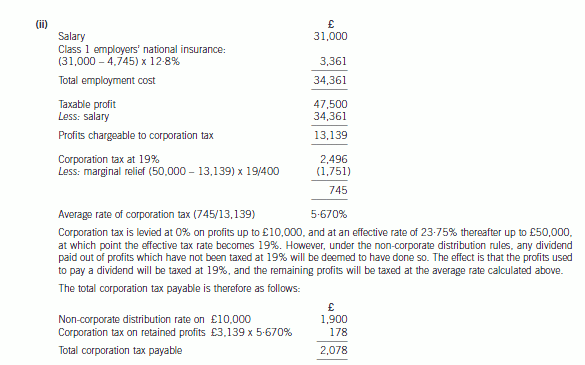
-
第14题:
(b) Calculate the corporation tax (CT) liabilities for Alantech Ltd, Boron Ltd and Bubble Ltd for the year ending
31 December 2004 on the assumption that loss reliefs are taken as early as possible. (9 marks)
正确答案:(b) Schedule D Case I calculation
The three companies form. a group for both group relief and capital gains purposes as all shareholdings pass the 75%
ownership test. The calculation of the corporation tax liabilities is as follows:
-
第15题:
(c) Calculate the expected corporation tax liability of Dovedale Ltd for the year ending 31 March 2007 on the
assumption that all available reliefs are claimed by Dovedale Ltd but that Hira Ltd will not claim any capital
allowances in that year. (4 marks)
正确答案:
-
第16题:
(ii) Following on from your answer to (i), evaluate the two purchase proposals, and advise Bill and Ben
which course of action will result in the highest amount of after tax cash being received by the
shareholders if the disposal takes place on 31 March 2006. (4 marks)
正确答案: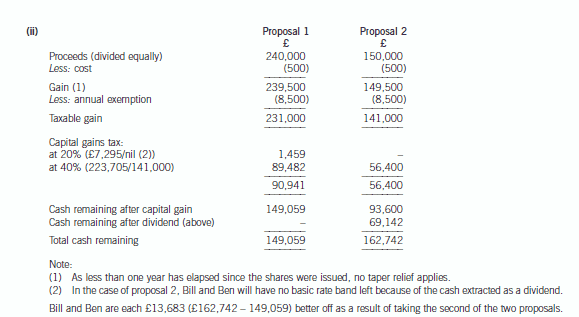
-
第17题:
(b) The tax relief available in respect of the anticipated trading losses, together with supporting calculations and
a recommended structure for the business. (16 marks)
正确答案:

Aral Ltd owned by Banda
The losses would have to be carried forward and deducted from the trading profits of the year ending 30 June 2010.
Aral Ltd cannot offset the loss in the current period or carry it back as it has no other income or gains.
Aral Ltd owned by Flores Ltd
The two companies will form. a group relief group if Flores Ltd owns at least 75% of the ordinary share capital of Aral
Ltd. The trading losses could be surrendered to Flores Ltd in the year ending 30 June 2008 and the year ending
30 June 2009. The total tax saved would be £11,079 ((£38,696 + £19,616) x 19%)
Recommended structure
The Aral business should be established in a company owned by Flores Ltd.
This will maximise the relief available in respect of the trading losses and enable relief to be obtained in the period in
which the losses are incurred.
Tutorial note
The whole of the loss for the period ending 30 June 2008 can be surrendered to Flores Ltd as it is less than that
company’s profit for the corresponding period, i.e. £60,000 (£120,000 x 6/12). -
第18题:
(ii) Explain how the inclusion of rental income in Coral’s UK income tax computation could affect the
income tax due on her dividend income. (2 marks)
You are not required to prepare calculations for part (b) of this question.
Note: you should assume that the tax rates and allowances for the tax year 2006/07 and for the financial year to
31 March 2007 will continue to apply for the foreseeable future.
正确答案:
(ii) The effect of taxable rental income on the tax due on Coral’s dividend income
Remitting rental income to the UK may cause some of Coral’s dividend income currently falling within the basic rate
band to fall within the higher rate band. The effect of this would be to increase the tax on the gross dividend income
from 0% (10% less the 10% tax credit) to 221/2% (321/2% less 10%).
Tutorial note
It would be equally acceptable to state that the effective rate of tax on the dividend income would increase from 0%
to 25%. -
第19题:
(b) A sale of industrial equipment to Deakin Co in May 2005 resulted in a loss on disposal of $0·3 million that has
been separately disclosed on the face of the income statement. The equipment cost $1·2 million when it was
purchased in April 1996 and was being depreciated on a straight-line basis over 20 years. (6 marks)
Required:
For each of the above issues:
(i) comment on the matters that you should consider; and
(ii) state the audit evidence that you should expect to find,
in undertaking your review of the audit working papers and financial statements of Keffler Co for the year ended
31 March 2006.
NOTE: The mark allocation is shown against each of the three issues.
正确答案:
(b) Sale of industrial equipment
(i) Matters
■ The industrial equipment was in use for nine years (from April 1996) and would have had a carrying value of
$660,000 at 31 March 2005 (11/20 × $1·2m – assuming nil residual value and a full year’s depreciation charge
in the year of acquisition and none in the year of disposal). Disposal proceeds were therefore only $360,000.
■ The $0·3m loss represents 15% of PBT (for the year to 31 March 2006) and is therefore material. The equipment
was material to the balance sheet at 31 March 2005 representing 2·6% of total assets ($0·66/$25·7 × 100).
■ Separate disclosure, of a material loss on disposal, on the face of the income statement is in accordance with
IAS 16 ‘Property, Plant and Equipment’. However, in accordance with IAS 1 ‘Presentation of Financial Statements’,
it should not be captioned in any way that might suggest that it is not part of normal operating activities (i.e. not
‘extraordinary’, ‘exceptional’, etc).
Tutorial note: However, note that if there is a prior period error to be accounted for (see later), there would be
no impact on the current period income statement requiring consideration of any disclosure.
■ The reason for the sale. For example, whether the equipment was:
– surplus to operating requirements (i.e. not being replaced); or
– being replaced with newer equipment (thereby contributing to the $8·1m increase (33·8 – 25·7) in total
assets).
■ The reason for the loss on sale. For example, whether:
– the sale was at an under-value (e.g. to a related party);
– the equipment had a bad maintenance history (or was otherwise impaired);
– the useful life of the equipment is less than 20 years;
– there is any deferred consideration not yet recorded;
– any non-cash disposal proceeds have been overlooked (e.g. if another asset was acquired in a part-exchange).
■ If the useful life was less than 20 years, tangible non-current assets may be materially overstated in respect of other
items of equipment that are still in use and being depreciated on the same basis.
■ If the sale was to a related party then additional disclosure should be required in a note to the financial statements
for the year to 31 March 2006 (IAS 24 ‘Related Party Disclosures’).
Tutorial note: Since there are no specific pointers to a related party transaction (RPT), this point is not expanded
on.
■ Whether the sale was identified in the prior year audit’s post balance sheet event review. If so:
– the disclosure made in the prior year’s financial statements (IAS 10 ‘Events After the Balance Sheet Date’);
– whether an impairment loss was recognised at 31 March 2005.
■ If not, and the equipment was impaired at 31 March 2005, a prior period error should be accounted for (IAS 8
‘Accounting Policies, Changes in Accounting Estimates and Errors’). An impairment loss of $0·3m would have
been material to prior year profit (12·5%).
Tutorial note: Unless this was a RPT or the impairment arose after 31 March 2005 a prior period adjustment
should be made.
■ Failure to account for a prior period error (if any) would result in modification of the audit opinion ‘except for’ noncompliance
with IAS 8 (in the current year) and IAS 36 (in the prior period).
(ii) Audit evidence
■ Carrying amount ($0·66m as above) agreed to the non-current asset register balances at 31 March 2005 and
recalculation of the loss on disposal.
■ Cost and accumulated depreciation removed from the asset register in the year to 31 March 2006.
■ Receipt of proceeds per cash book agreed to bank statement.
■ Sales invoice transferring title to Deakin.
■ A review of maintenance expenses and records (e.g. to confirm reason for loss on sale).
■ Post balance sheet event review on prior year audit working papers file.
■ Management representation confirming that Deakin is not a related party (provided that there is no evidence to
suggest otherwise). -
第20题:
(b) You are the audit manager of Johnston Co, a private company. The draft consolidated financial statements for
the year ended 31 March 2006 show profit before taxation of $10·5 million (2005 – $9·4 million) and total
assets of $55·2 million (2005 – $50·7 million).
Your firm was appointed auditor of Tiltman Co when Johnston Co acquired all the shares of Tiltman Co in March
2006. Tiltman’s draft financial statements for the year ended 31 March 2006 show profit before taxation of
$0·7 million (2005 – $1·7 million) and total assets of $16·1 million (2005 – $16·6 million). The auditor’s
report on the financial statements for the year ended 31 March 2005 was unmodified.
You are currently reviewing two matters that have been left for your attention on the audit working paper files for
the year ended 31 March 2006:
(i) In December 2004 Tiltman installed a new computer system that properly quantified an overvaluation of
inventory amounting to $2·7 million. This is being written off over three years.
(ii) In May 2006, Tiltman’s head office was relocated to Johnston’s premises as part of a restructuring.
Provisions for the resulting redundancies and non-cancellable lease payments amounting to $2·3 million
have been made in the financial statements of Tiltman for the year ended 31 March 2006.
Required:
Identify and comment on the implications of these two matters for your auditor’s reports on the financial
statements of Johnston Co and Tiltman Co for the year ended 31 March 2006. (10 marks)
正确答案:
(b) Tiltman Co
Tiltman’s total assets at 31 March 2006 represent 29% (16·1/55·2 × 100) of Johnston’s total assets. The subsidiary is
therefore material to Johnston’s consolidated financial statements.
Tutorial note: Tiltman’s profit for the year is not relevant as the acquisition took place just before the year end and will
therefore have no impact on the consolidated income statement. Calculations of the effect on consolidated profit before
taxation are therefore inappropriate and will not be awarded marks.
(i) Inventory overvaluation
This should have been written off to the income statement in the year to 31 March 2005 and not spread over three
years (contrary to IAS 2 ‘Inventories’).
At 31 March 2006 inventory is overvalued by $0·9m. This represents all Tiltmans’s profit for the year and 5·6% of
total assets and is material. At 31 March 2005 inventory was materially overvalued by $1·8m ($1·7m reported profit
should have been a $0·1m loss).
Tutorial note: 1/3 of the overvaluation was written off in the prior period (i.e. year to 31 March 2005) instead of $2·7m.
That the prior period’s auditor’s report was unmodified means that the previous auditor concurred with an incorrect
accounting treatment (or otherwise gave an inappropriate audit opinion).
As the matter is material a prior period adjustment is required (IAS 8 ‘Accounting Policies, Changes in Accounting
Estimates and Errors’). $1·8m should be written off against opening reserves (i.e. restated as at 1 April 2005).
(ii) Restructuring provision
$2·3m expense has been charged to Tiltman’s profit and loss in arriving at a draft profit of $0·7m. This is very material.
(The provision represents 14·3% of Tiltman’s total assets and is material to the balance sheet date also.)
The provision for redundancies and onerous contracts should not have been made for the year ended 31 March 2006
unless there was a constructive obligation at the balance sheet date (IAS 37 ‘Provisions, Contingent Liabilities and
Contingent Assets’). So, unless the main features of the restructuring plan had been announced to those affected (i.e.
redundancy notifications issued to employees), the provision should be reversed. However, it should then be disclosed
as a non-adjusting post balance sheet event (IAS 10 ‘Events After the Balance Sheet Date’).
Given the short time (less than one month) between acquisition and the balance sheet it is very possible that a
constructive obligation does not arise at the balance sheet date. The relocation in May was only part of a restructuring
(and could be the first evidence that Johnston’s management has started to implement a restructuring plan).
There is a risk that goodwill on consolidation of Tiltman may be overstated in Johnston’s consolidated financial
statements. To avoid the $2·3 expense having a significant effect on post-acquisition profit (which may be negligible
due to the short time between acquisition and year end), Johnston may have recognised it as a liability in the
determination of goodwill on acquisition.
However, the execution of Tiltman’s restructuring plan, though made for the year ended 31 March 2006, was conditional
upon its acquisition by Johnston. It does not therefore represent, immediately before the business combination, a
present obligation of Johnston. Nor is it a contingent liability of Johnston immediately before the combination. Therefore
Johnston cannot recognise a liability for Tiltman’s restructuring plans as part of allocating the cost of the combination
(IFRS 3 ‘Business Combinations’).
Tiltman’s auditor’s report
The following adjustments are required to the financial statements:
■ restructuring provision, $2·3m, eliminated;
■ adequate disclosure of relocation as a non-adjusting post balance sheet event;
■ current period inventory written down by $0·9m;
■ prior period inventory (and reserves) written down by $1·8m.
Profit for the year to 31 March 2006 should be $3·9m ($0·7 + $0·9 + $2·3).
If all these adjustments are made the auditor’s report should be unmodified. Otherwise, the auditor’s report should be
qualified ‘except for’ on grounds of disagreement. If none of the adjustments are made, the qualification should still be
‘except for’ as the matters are not pervasive.
Johnston’s auditor’s report
If Tiltman’s auditor’s report is unmodified (because the required adjustments are made) the auditor’s report of Johnston
should be similarly unmodified. As Tiltman is wholly-owned by Johnston there should be no problem getting the
adjustments made.
If no adjustments were made in Tiltman’s financial statements, adjustments could be made on consolidation, if
necessary, to avoid modification of the auditor’s report on Johnston’s financial statements.
The effect of these adjustments on Tiltman’s net assets is an increase of $1·4m. Goodwill arising on consolidation (if
any) would be reduced by $1·4m. The reduction in consolidated total assets required ($0·9m + $1·4m) is therefore
the same as the reduction in consolidated total liabilities (i.e. $2·3m). $2·3m is material (4·2% consolidated total
assets). If Tiltman’s financial statements are not adjusted and no adjustments are made on consolidation, the
consolidated financial position (balance sheet) should be qualified ‘except for’. The results of operations (i.e. profit for
the period) should be unqualified (if permitted in the jurisdiction in which Johnston reports).
Adjustment in respect of the inventory valuation may not be required as Johnston should have consolidated inventory
at fair value on acquisition. In this case, consolidated total liabilities should be reduced by $2·3m and goodwill arising
on consolidation (if any) reduced by $2·3m.
Tutorial note: The effect of any possible goodwill impairment has been ignored as the subsidiary has only just been
acquired and the balance sheet date is very close to the date of acquisition. -
第21题:
(b) While the refrigeration units were undergoing modernisation Lamont outsourced all its cold storage requirements
to Hogg Warehousing Services. At 31 March 2007 it was not possible to physically inspect Lamont’s inventory
held by Hogg due to health and safety requirements preventing unauthorised access to cold storage areas.
Lamont’s management has provided written representation that inventory held at 31 March 2007 was
$10·1 million (2006 – $6·7 million). This amount has been agreed to a costing of Hogg’s monthly return of
quantities held at 31 March 2007. (7 marks)
Required:
For each of the above issues:
(i) comment on the matters that you should consider; and
(ii) state the audit evidence that you should expect to find,
in undertaking your review of the audit working papers and financial statements of Lamont Co for the year ended
31 March 2007.
NOTE: The mark allocation is shown against each of the three issues.
正确答案:
(b) Outsourced cold storage
(i) Matters
■ Inventory at 31 March 2007 represents 21% of total assets (10·1/48·0) and is therefore a very material item in the
balance sheet.
■ The value of inventory has increased by 50% though revenue has increased by only 7·5%. Inventory may be
overvalued if no allowance has been made for slow-moving/perished items in accordance with IAS 2 Inventories.
■ Inventory turnover has fallen to 6·6 times per annum (2006 – 9·3 times). This may indicate a build up of
unsaleable items.
Tutorial note: In the absence of cost of sales information, this is calculated on revenue. It may also be expressed
as the number of days sales in inventory, having increased from 39 to 55 days.
■ Inability to inspect inventory may amount to a limitation in scope if the auditor cannot obtain sufficient audit
evidence regarding quantity and its condition. This would result in an ‘except for’ opinion.
■ Although Hogg’s monthly return provides third party documentary evidence concerning the quantity of inventory it
does not provide sufficient evidence with regard to its valuation. Inventory will need to be written down if, for
example, it was contaminated by the leakage (before being moved to Hogg’s cold storage) or defrosted during
transfer.
■ Lamont’s written representation does not provide sufficient evidence regarding the valuation of inventory as
presumably Lamont’s management did not have access to physically inspect it either. If this is the case this may
call into question the value of any other representations made by management.
■ Whether, since the balance sheet date, inventory has been moved back from Hogg’s cold storage to Lamont’s
refrigeration units. If so, a physical inspection and roll-back of the most significant fish lines should have been
undertaken.
Tutorial note: Credit will be awarded for other relevant accounting issues. For example a candidate may question
whether, for example, cold storage costs have been capitalised into the cost of inventory. Or whether inventory moves
on a FIFO basis in deep storage (rather than LIFO).
(ii) Audit evidence
■ A copy of the health and safety regulation preventing the auditor from gaining access to Hogg’s cold storage to
inspect Lamont’s inventory.
■ Analysis of Hogg’s monthly returns and agreement of significant movements to purchase/sales invoices.
■ Analytical procedures such as month-on-month comparison of gross profit percentage and inventory turnover to
identify any trend that may account for the increase in inventory valuation (e.g. if Lamont has purchased
replacement inventory but spoiled items have not been written off).
■ Physical inspection of any inventory in Lamont’s refrigeration units after the balance sheet date to confirm its
condition.
■ An aged-inventory analysis and recalculation of any allowance for slow-moving items.
■ A review of after-date sales invoices for large quantities of fish to confirm that fair value (less costs to sell) exceed
carrying amount.
■ A review of after-date credit notes for any returns of contaminated/perished or otherwise substandard fish. -
第22题:
(b) You are the audit manager of Petrie Co, a private company, that retails kitchen utensils. The draft financial
statements for the year ended 31 March 2007 show revenue $42·2 million (2006 – $41·8 million), profit before
taxation of $1·8 million (2006 – $2·2 million) and total assets of $30·7 million (2006 – $23·4 million).
You are currently reviewing two matters that have been left for your attention on Petrie’s audit working paper file
for the year ended 31 March 2007:
(i) Petrie’s management board decided to revalue properties for the year ended 31 March 2007 that had
previously all been measured at depreciated cost. At the balance sheet date three properties had been
revalued by a total of $1·7 million. Another nine properties have since been revalued by $5·4 million. The
remaining three properties are expected to be revalued later in 2007. (5 marks)
Required:
Identify and comment on the implications of these two matters for your auditor’s report on the financial
statements of Petrie Co for the year ended 31 March 2007.
NOTE: The mark allocation is shown against each of the matters above.
正确答案:
(b) Implications for auditor’s report
(i) Selective revaluation of premises
The revaluations are clearly material to the balance sheet as $1·7 million and $5·4 million represent 5·5% and 17·6%
of total assets, respectively (and 23·1% in total). As the effects of the revaluation on line items in the financial statements
are clearly identified (e.g. revalued amount, depreciation, surplus in statement of changes in equity) the matter is not
pervasive.
The valuations of the nine properties after the year end provide additional evidence of conditions existing at the year end
and are therefore adjusting events per IAS 10 Events After the Balance Sheet Date.
Tutorial note: It is ‘now’ still less than three months after the year end so these valuations can reasonably be expected
to reflect year end values.
However, IAS 16 Property, Plant and Equipment does not permit the selective revaluation of assets thus the whole class
of premises would need to have been revalued for the year to 31 March 2007 to change the measurement basis for this
reporting period.
The revaluation exercise is incomplete. Unless the remaining three properties are revalued before the auditor’s report on
the financial statements for the year ended 31 March 2007 is signed off:
(1) the $7·1 revaluation made so far must be reversed to show all premises at depreciated cost as in previous years;
OR
(2) the auditor’s report would be qualified ‘except for’ disagreement regarding non-compliance with IAS 16.
When it is appropriate to adopt the revaluation model (e.g. next year) the change in accounting policy (from a cost model
to a revaluation model) should be accounted for in accordance with IAS 16 (i.e. as a revaluation).
Tutorial note: IAS 8 Accounting Policies, Changes in Accounting Estimates and Errors does not apply to the initial
application of a policy to revalue assets in accordance with IAS 16.
Assuming the revaluation is written back, before giving an unmodified opinion, the auditor should consider why the three
properties were not revalued. In particular if there are any indicators of impairment (e.g. physical dilapidation) there
should be sufficient evidence on the working paper file to show that the carrying amount of these properties is not
materially greater than their recoverable amount (i.e. the higher of value in use and fair value less costs to sell).
If there is insufficient evidence to confirm that the three properties are not impaired (e.g. if the auditor was prevented
from inspecting the properties) the auditor’s report would be qualified ‘except for’ on grounds of limitation on scope.
If there is evidence of material impairment but management fail to write down the carrying amount to recoverable
amount the auditor’s report would be qualified ‘except for’ disagreement regarding non-compliance with IAS 36
Impairment of Assets.
-
第23题:
(ii) Write a letter to Donald advising him on the most tax efficient manner in which he can relieve the loss
incurred in the year to 31 March 2007. Your letter should briefly outline the types of loss relief available
and explain their relative merits in Donald’s situation. Assume that Donald will have no source of income
other than the business in the year of assessment 2006/07 and that any income he earned on a parttime
basis while at university was always less than his annual personal allowance. (9 marks)
Assume that the corporation tax rates and allowances for the financial year 2004 and the income tax rates
and allowances for 2004/05 apply throughout this question.
Relevant retail price index figures are:
January 1998 159·5
April 1998 162·6
正确答案:(ii) [Donald’s address] [Firm’s address]
Dear Donald [Date]
I understand that you have incurred a tax loss in your first year of trading. The following options are available in respect
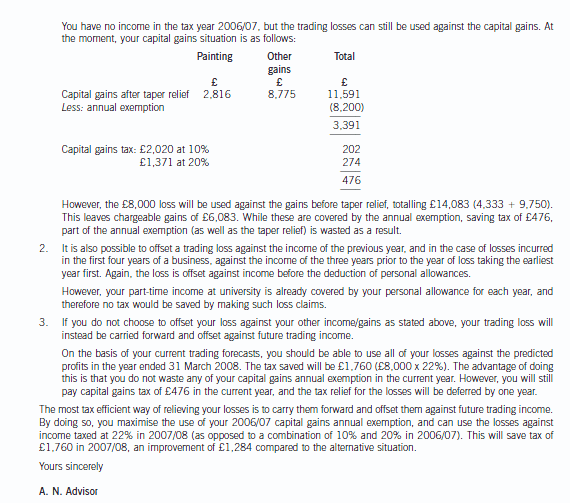
of this loss.
1. The first option is to use the trading loss against other forms of income in the same year. If such a claim is made,
losses are offset against income before personal allowances.
Any excess loss can still be offset against capital gains of the year. However, any offset against capital gains is
before both taper relief and annual exemptions.