
(b) (i) Advise the directors of GWCC on specific actions which may be considered in order to improve theestimated return on their investment of £1,900,000. (8 marks)
题目
(b) (i) Advise the directors of GWCC on specific actions which may be considered in order to improve the
estimated return on their investment of £1,900,000. (8 marks)
相似考题
更多“(b) (i) Advise the directors of GWCC on specific actions which may be considered in order to improve theestimated return on their investment of £1,900,000. (8 marks)”相关问题
-
第1题:
Explain the grounds upon which a person may be disqualified under the Company Directors Disqualification Act 1986.(10 marks)
正确答案:The Company Directors Disqualification Act (CDDA) 1986 was introduced to control individuals who persistently abused the various privileges that accompany incorporation, most particularly the privilege of limited liability. The Act applies to more than just directors and the court may make an order preventing any person (without leave of the court) from being:
(i) a director of a company;
(ii) a liquidator or administrator of a company;
(iii) a receiver or manager of a company’s property; or
(iv) in any way, whether directly or indirectly, concerned with or taking part in the promotion, formation or management of a company.
The CDDA 1986 identifies three distinct categories of conduct, which may, and in some circumstances must, lead the court to disqualify certain persons from being involved in the management of companies.
(a) General misconduct in connection with companies
This first category involves the following:
(i) A conviction for an indictable offence in connection with the promotion, formation, management or liquidation of a company or with the receivership or management of a company’s property (s.2 of the CDDA 1986). The maximum period for disqualification under s.2 is five years where the order is made by a court of summary jurisdiction, and 15 years in any other case.(ii) Persistent breaches of companies legislation in relation to provisions which require any return, account or other document to be filed with, or notice of any matter to be given to, the registrar (s.3 of the CDDA 1986). Section 3 provides that a person is conclusively proved to be persistently in default where it is shown that, in the five years ending with the date of the application, he has been adjudged guilty of three or more defaults (s.3(2) of the CDDA 1986). This is without prejudice to proof of persistent default in any other manner. The maximum period of disqualification under this section is five years.
(iii) Fraud in connection with winding up (s.4 of the CDDA 1986). A court may make a disqualification order if, in the course of the winding up of a company, it appears that a person:
(1) has been guilty of an offence for which he is liable under s.993 of the CA 2006, that is, that he has knowingly been a party to the carrying on of the business of the company either with the intention of defrauding the company’s creditors or any other person or for any other fraudulent purpose; or
(2) has otherwise been guilty, while an officer or liquidator of the company or receiver or manager of the property of the company, of any fraud in relation to the company or of any breach of his duty as such officer, liquidator, receiver or manager (s.4(1)(b) of the CDDA 1986).
The maximum period of disqualification under this category is 15 years.(b) Disqualification for unfitness
The second category covers:
(i) disqualification of directors of companies which have become insolvent, who are found by the court to be unfit to be directors (s.6 of the CDDA 1986). Under s. 6, the minimum period of disqualification is two years, up to a maximum of 15 years;
(ii) disqualification after investigation of a company under Pt XIV of the CA 1985 (it should be noted that this part of the previous Act still sets out the procedures for company investigations) (s.8 of the CDDA 1986). Once again, the maximum period of disqualification is 15 years.
Schedule 1 to the CDDA 1986 sets out certain particulars to which the court is to have regard in deciding whether a person’s conduct as a director makes them unfit to be concerned in the management of a company. In addition, the courts have given indications as to what sort of behaviour will render a person liable to be considered unfit to act as a company director. Thus, in Re Lo-Line Electric Motors Ltd (1988), it was stated that:
‘Ordinary commercial misjudgment is in itself not sufficient to justify disqualification. In the normal case, the conduct complained of must display a lack of commercial probity, although . . . in an extreme case of gross negligence or total incompetence, disqualification could be appropriate.’(c) Other cases for disqualification
This third category relates to:
(i) participation in fraudulent or wrongful trading under s.213 of the Insolvency Act (IA)1986 (s.10 of the CDDA 1986);
(ii) undischarged bankrupts acting as directors (s.11 of the CDDA 1986); and
(iii) failure to pay under a county court administration order (s.12 of the CDDA 1986).
For the purposes of most of the CDDA 1986, the court has discretion to make a disqualification order. Where, however, a person has been found to be an unfit director of an insolvent company, the court has a duty to make a disqualification order (s.6 of the CDDA 1986). Anyone who acts in contravention of a disqualification order is liable:
(i) to imprisonment for up to two years and/or a fine, on conviction on indictment; or
(ii) to imprisonment for up to six months and/or a fine not exceeding the statutory maximum, on conviction summarily (s.13 of the CDDA 1986). -
第2题:
(b) Identify and explain THREE approaches that the directors of Moffat Ltd might apply in assessing the
QUALITATIVE benefits of the proposed investment in a new IT system. (6 marks)
正确答案:
(b) One approach that the directors of Moffat Ltd could adopt would be to ignore the qualitative benefits that may arise on the
basis that there is too much subjectivity involved in their assessment. The problem that this causes is that the investment will
probably look unattractive since all costs will be included in the evaluation whereas significant benefits and savings will have
been ignored. Hence such an approach is lacking in substance and is not recommended.
An alternative approach would involve attempting to attribute values to each of the identified benefits that are qualitative in
nature. Such an approach will necessitate the use of management estimates in order to derive the cash flows to be
incorporated in a cost benefit analysis. The problems inherent in this approach include gaining consensus among interested
parties regarding the footing of the assumptions from which estimated cash flows have been derived. Furthermore, if the
proposed investment does take place then it may well be impossible to prove that the claimed benefits of the new system
have actually been realised.
Perhaps the preferred approach is to acknowledge the existence of qualitative benefits and attempt to assess them in a
reasonable manner acceptable to all parties including the company’s bank. The financial evaluation would then not only
incorporate ‘hard’ facts relating to costs and benefits that are quantitative in nature, but also would include details of
qualitative benefits which management consider exist but have not attempted to assess in financial terms. Such benefits might
include, for example, the average time saved by location managers in analysing information during each operating period.
Alternatively the management of Moffat Ltd could attempt to express qualitative benefits in specific terms linked to a hierarchy
of organisational requirements. For example, qualitative benefits could be categorised as being:
(1) Essential to the business
(2) Very useful attributes
(3) Desirable, but not essential
(4) Possible, if funding is available
(5) Doubtful and difficult to justify. -
第3题:
The IOA Division is also considering whether to undertake an investment in the West of the country (the West Project).
An initial cash outlay investment of £12 million will be required and a net cash inflow amounting to £5 million is
expected to arise in each of the four years of the life of the project.
The activities involved in the West project will cause the local river to become polluted and discoloured due to the
discharge of waste substances from mining operations.
It is estimated that at the end of year four a cash outlay of £2 million would be required to restore the river to its
original colour. This would also clear 90% of the pollution caused as a result of the mining activities of the IOA
Division.
The remaining 10% of the pollution caused as a result of the mining activities of the IOA Division could be cleared
up by a further cash outlay of £2 million.
(c) Evaluate the West project and, stating your reasons, comment on whether the board of directors of NCL plc
should spend the further £2 million in order to eliminate the remaining 10% of pollution. (6 marks)
(Ignore Taxation).
正确答案:(c) The net present value of the West project is dependent upon the level of environmental expenditure that will be incurred by
Division IOA at the conclusion of the project. The potential NPV of the West project can be calculated using a discount rate
of 12% per annum which assumes that the West project has similar characteristics to the North, East and South projects.
Net cash inflows for each of years 1–4 = £5 million
Cumulative discount factor at 12% per annum = 3·037
Therefore the present value of cashflows is £5 million x 3·037 = £15,185 million and the net cash flow after the initial
outlay of £12 million is £3,185,000.
There is now the strategic consideration regarding whether to spend £2 million which will restore the river to its original colour
and also clear 90% of the pollution caused as a result of the mining activities of the IOA Division, or to incur expenditure of
a further £2 million which will completely redress any damage done to the environment by the activities of the IOA Division.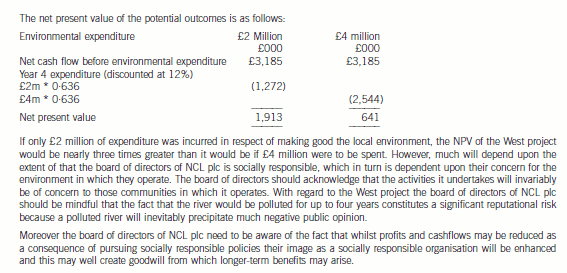
-
第4题:
(ii) Briefly discuss TWO factors which could reduce the rate of return earned by the investment as per the
results in part (a). (4 marks)
正确答案:
(ii) Two factors which might reduce the return earned by the investment are as follows:
(i) Poor product quality
The very nature of the product requires that it is of the highest quality i.e. the cakes are made for human
consumption. Bad publicity via a ‘product recall’ could potentially have a catastrophic effect on the total sales to
Superstores plc over the eighteen month period.
(ii) The popularity of the Mighty Ben character
There is always the risk that the popularity of the character upon which the product is based will diminish with a
resultant impact on sales volumes achieved. In this regard it would be advisable to attempt to negotiate with
Superstores plc in order to minimise potential future losses. -
第5题:
(b) Advise the management of SCC Ltd of THREE strategies that should be considered in order to improve the
future performance of SCC Ltd. (6 marks)
正确答案:
(b) The four quadrants of the Boston-growth share matrix summarise expected profits and resultant cash flows and recommends
an outline strategy to follow which rather simplistically may be summarised as invest in stars, scrutinise the problem children,
milk the cows and divest the dogs.
Value Chain Analysis
It is vital that the management of SCC Ltd undertake a value chain analysis of each of its divisions in order to identify and
eliminate all non-value added activities, thereby improving profitability and cash flow without necessarily increasing turnover
or market share.
Divestment of the Footwear division
Serious consideration should be given to the divestment of the Footwear division. This will enable resources to be redirected
to divisions categorised as problem children i.e. the Industrial and Children’s divisions.
Support the Stars
As far as the Fashion division is concerned, it is obviously in a growth market and currently performing well. It is vital, given
the forecast performance of the other subsidiaries that the management of SCC Ltd do not concentrate on the poor performers
to the detriment of its only star. -
第6题:
(b) Explain how growth may be assessed, and critically discuss the advantages and issues that might arise as a
result of a decision by the directors of CSG to pursue the objective of growth. (8 marks)
正确答案:
(b) Growth may be measured in a number of ways which are as follows:
Cash flow
This is a very important measure of growth as it ultimately determines the amount of funds available for re-investment by any
business.
Sales revenue
Growth in sales revenues generated is only of real value to investors if it precipitates growth in profits.
Profitability
There are many measures relating to profit which include sales margin, earnings before interest, taxation, depreciation and
amortisation (EBITDA) and earnings per share. More sophisticated measures such as return on capital employed and residual
income consider the size of the investment relative to the level of profits earned. In general terms, measures of profitability
are only meaningful if they are used as a basis for comparisons over time or in conjunction with other measures of
performance. Growth rate in profitability are useful when compared with other companies and also with other industries.
Return on investment
A growing return upon invested capital suggests that capital is being used more and more productively. Indicators of a growing
return would be measured by reference to dividend payment and capital growth.
Market share
Growth in market share is generally seen as positive as it can generate economies of scale.
Number of products/service offerings
Growth is only regarded as useful if products and services are profitable.
Number of employees
Measures of productivity such as value added per employee and profit per employee are often used by shareholders in
assessing growth. Very often an increased headcount is a measure of success in circumstances where more people are
needed in order to deliver a service to a required standard. However it is incumbent on management to ensure that all
employees are utilised in an effective manner.
It is a widely held belief that growth requires profits and that growth produces profits. Profits are essential in order to prevent
a company which has achieved growth from becoming a target for a take-over or in a worse case scenario goes into
liquidation. Hence it is fundamental that a business is profitable throughout its existence. Growth accompanied by growth in
profits is also likely to aid the long-term survival of an organisation. CSG operates in Swingland which experiences fluctuations
in its economic climate and in this respect the exploitation of profitable growth opportunities will help CSG to survive at the
expense of its competitors who do not exploit such opportunities.
Note: Alternative relevant discussion and examples would be accepted. -
第7题:
(c) Explain the reasons for the concerns of the government of Happyland with companies such as TMC and
advise the directors of a strategy that might be considered in order to avoid being subject to any forthcoming
legislation concerning the environment. (5 marks)
正确答案:
(c) The government of Happyland will be concerned by the negative impact on the environment. The growth in the number of
children born in Happyland will have raised the demand for disposable nappies as is evidenced from the market size data
contained in the question. In some countries disposable nappies make up around 4% of all household waste and can take
up to five hundred years to decompose! The government will be concerned by the fact that trees are being destroyed in order
to keep babies and infant children in nappies. The disposal costs incurred by the government in terms of landfill etc will be
very high, hence its green paper on the effect of non-biodegradable products in Happyland. The costs of such operations as
the landfill for such products will need to be funded out of increased taxation.
It might be beneficial for the directors of TMC to develop more eco-friendly products such as washable nappies which, by
definition, are recyclable many times over during the life of the ‘product’. Many parents are now changing to ‘real nappies’
because they work out cheaper and better for the environment than disposables. -
第8题:
(b) Donald actually decided to operate as a sole trader. The first year’s results of his business were not as he had
hoped, and he made a trading loss of £8,000 in the year to 31 March 2007. However, trading is now improving,
and Donald has sufficient orders to ensure that the business will make profits of at least £30,000 in the year to
31 March 2008.
In order to raise funds to support his business over the last 15 months, Donald has sold a painting which was
given to him on the death of his grandmother in January 1998. The probate value of the painting was £3,200,
and Donald sold it for £8,084 (after deduction of 6% commission costs) in November 2006.
He also sold other assets in the year of assessment 2006/07, realising further chargeable gains of £8,775 (after
indexation of £249 and taper relief of £975).
Required:
(i) Calculate the chargeable gain on the disposal of the painting in November 2006. (4 marks)
正确答案: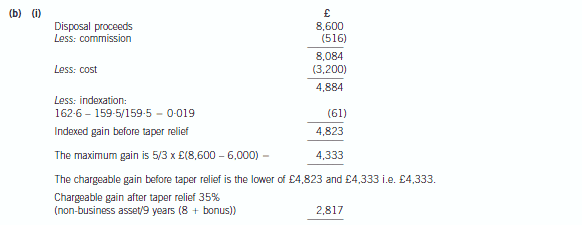
-
第9题:
(ii) Advise Benny of the amount of tax he could save by delaying the sale of the shares by 30 days. For the
purposes of this part, you may assume that the benefit in respect of the furnished flat is £11,800 per
year. (3 marks)
正确答案:
-
第10题:
(b) (i) Advise Andrew of the income tax (IT) and capital gains tax (CGT) reliefs available on his investment in
the ordinary share capital of Scalar Limited, together with any conditions which need to be satisfied.
Your answer should clearly identify any steps that should be taken by Andrew and the other investors
to obtain the maximum relief. (13 marks)
正确答案:
(b) (i) Andrew may be able to take advantage of tax reliefs under the enterprise investment scheme (EIS) provided the
necessary conditions are met. The conditions that have to be satisfied before full relief is available fall into three areas,
and broadly require that a ‘qualifying individual’ subscribes for ‘eligible shares’ in a ‘qualifying company’.
‘Qualifying Individual’
To be a qualifying individual, Andrew must not be connected with the EIS company. This means that he should not be
an employee (or, at the time the shares are issued, a director) or have an interest in (i.e. control) 30% or more of the
capital of the company. These conditions need to be satisfied throughout the period beginning two years before the share
issue and three years after the ‘relevant date’. Where the relevant date is defined as the later of the date the shares were
issued and the date on which the company commenced trading.
Andrew does not intend to become an employee (or director) of Scalar Limited, but he needs to exercise caution as to
how many shares he subscribes for. If only three investors subscribe for 100% of the shares, each will hold 33% of the
share capital. This exceeds the 30% limit and will mean that EIS relief (other than deferral relief) will not be available.
Therefore, Andrew and the other two investors should ensure not only that the potential fourth investor is recruited, but
that s/he subscribes for sufficient shares, such that none of them will hold 30% or more of the issued share capital, as
only then will they all attain qualifying individual status.
‘Eligible shares’
Qualifying shares need to be new ordinary shares which are subscribed for in cash and fully paid up at the time of issue.
The shares must not be redeemable for at least three years from the relevant date, and not carry any preferential rights
to dividends. On the basis of the information provided, the shares of Scalar Limited would qualify as eligible shares.
‘Qualifying Company’
The company must be unquoted, not controlled by another company, and engaged in qualifying business activities. The
latter requires that the company engage in a trading activity, which is carried on wholly or mainly in the UK, throughout
the three years following the relevant date. While certain trading activities, such as dealing in shares or trading in land,
are excluded, the manufacturing trade Scalar Limited proposes to carry on will qualify.
However, it is also necessary for at least 80% of the money raised to be used for the qualifying business activity within
12 months of the relevant date and the remaining 20% to be so used within the following 12 months. Andrew and the
other investors will thus have to ensure that Scalar Limited has not raised more funds than it is able to employ in the
business within the appropriate time periods.
Reliefs available:
Andrew can claim income tax relief at 20% income tax relief on the amount invested up to a maximum of £200,000
in any one tax year. The relief is given in the form. of a tax reducing allowance, which can reduce the investor’s income
tax liability to nil, but cannot be used to generate a tax refund. If the investment is made prior to 6 October in the tax
year, then 50% of the amount invested (up to a maximum of £25,000) can be treated as having been made in the
previous tax year.
Any capital gains arising on the sale of EIS shares will be fully exempt from capital gains tax provided that income tax
relief was given on the investment when made and has not been withdrawn. If the EIS shares are disposed of at a loss,
capital losses are still allowable, but reduced by the amount of any EIS relief attributable to the shares disposed of.
In addition, gains from the disposal of other assets can be deferred against the base cost of EIS shares acquired within
one year before and three years after their disposal. Such gains will, thus, not normally become chargeable until the EIS
shares themselves are disposed of. Further, for deferral relief to be available, it is not necessary for the investment to
qualify for EIS income tax relief, i.e. deferral is available even where the investor is not a qualifying individual. Thus,
Andrew could still defer the gain arising on the disposal of the residential property lease made in order to raise part of
the funds for his EIS investment, even if no fourth investor were to be found and his shareholding were to exceed 30%
of the issued share capital of Scalar Limited. Does not require the existence of income tax relief in order to be claimed.
Withdrawal of relief:
Any EIS relief claimed by Andrew will be withdrawn (partially or fully) if, within three year of the relevant date:
(1) he disposes of the shares;
(2) he receives value from the company;
(3) he ceases to be a qualifying individual; or
(4) Scalar Limited ceases to be a qualifying company.
With regard to receiving value from the company, the definition excludes dividends which do not exceed a normal rate
of return, but does include the repayment of any loans made to the company before the shares were issued, the provision
of benefits and the purchase of assets from the company at an undervalue. In this regard, Andrew and the other
subscribers should ensure that the £50,000 they are to invest in Scalar Limited as loan capital is appropriately timed
and structured relative to the issue of the EIS shares. -
第11题:
PV Co is evaluating an investment proposal to manufacture Product W33, which has performed well in test marketing trials conducted recently by the company’s research and development division. The following information relating to this investment proposal has now been prepared.
Initial investment $2 million
Selling price (current price terms) $20 per unit
Expected selling price inflation 3% per year
Variable operating costs (current price terms) $8 per unit
Fixed operating costs (current price terms) $170,000 per year
Expected operating cost inflation 4% per year
The research and development division has prepared the following demand forecast as a result of its test marketing trials. The forecast reflects expected technological change and its effect on the anticipated life-cycle of Product W33.

It is expected that all units of Product W33 produced will be sold, in line with the company’s policy of keeping no inventory of finished goods. No terminal value or machinery scrap value is expected at the end of four years, when production of Product W33 is planned to end. For investment appraisal purposes, PV Co uses a nominal (money) discount rate of 10% per year and a target return on capital employed of 30% per year. Ignore taxation.
Required:
(a) Identify and explain the key stages in the capital investment decision-making process, and the role of
investment appraisal in this process. (7 marks)
(b) Calculate the following values for the investment proposal:
(i) net present value;
(ii) internal rate of return;
(iii) return on capital employed (accounting rate of return) based on average investment; and
(iv) discounted payback period. (13 marks)
(c) Discuss your findings in each section of (b) above and advise whether the investment proposal is financially acceptable. (5 marks)
正确答案:
(a)Thekeystagesinthecapitalinvestmentdecision-makingprocessareidentifyinginvestmentopportunities,screeninginvestmentproposals,analysingandevaluatinginvestmentproposals,approvinginvestmentproposals,andimplementing,monitoringandreviewinginvestments.IdentifyinginvestmentopportunitiesInvestmentopportunitiesorproposalscouldarisefromanalysisofstrategicchoices,analysisofthebusinessenvironment,researchanddevelopment,orlegalrequirements.Thekeyrequirementisthatinvestmentproposalsshouldsupporttheachievementoforganisationalobjectives.ScreeninginvestmentproposalsIntherealworld,capitalmarketsareimperfect,soitisusualforcompaniestoberestrictedintheamountoffinanceavailableforcapitalinvestment.Companiesthereforeneedtochoosebetweencompetinginvestmentproposalsandselectthosewiththebeststrategicfitandthemostappropriateuseofeconomicresources.AnalysingandevaluatinginvestmentproposalsCandidateinvestmentproposalsneedtobeanalysedindepthandevaluatedtodeterminewhichofferthemostattractiveopportunitiestoachieveorganisationalobjectives,forexampletoincreaseshareholderwealth.Thisisthestagewhereinvestmentappraisalplaysakeyrole,indicatingforexamplewhichinvestmentproposalshavethehighestnetpresentvalue.ApprovinginvestmentproposalsThemostsuitableinvestmentproposalsarepassedtotherelevantlevelofauthorityforconsiderationandapproval.Verylargeproposalsmayrequireapprovalbytheboardofdirectors,whilesmallerproposalsmaybeapprovedatdivisionallevel,andsoon.Onceapprovalhasbeengiven,implementationcanbegin.Implementing,monitoringandreviewinginvestmentsThetimerequiredtoimplementtheinvestmentproposalorprojectwilldependonitssizeandcomplexity,andislikelytobeseveralmonths.Followingimplementation,theinvestmentprojectmustbemonitoredtoensurethattheexpectedresultsarebeingachievedandtheperformanceisasexpected.Thewholeoftheinvestmentdecision-makingprocessshouldalsobereviewedinordertofacilitateorganisationallearningandtoimprovefutureinvestmentdecisions. -
第12题:
Which three best describe the customer benefits of the Cisco Lifecycle Services approach?()
- A、improve the skill sets of its staff members
- B、increase the value of and return on investment for its networks
- C、increase network staff productivity
- D、increase the amount of server room rack space
- E、improve network availability, resiliency, security, and scalability
- F、increase the amount of time required to integrate network changes
正确答案:B,C,E -
第13题:
(iv) Tyre recently undertook a sales campaign whereby customers can obtain free car accessories, by presenting a
coupon, which has been included in an advertisement in a national newspaper, on the purchase of a vehicle.
The offer is valid for a limited time period from 1 January 2006 until 31 July 2006. The management are unsure
as to how to treat this offer in the financial statements for the year ended 31 May 2006.
(5 marks)
Required:
Advise the directors of Tyre on how to treat the above items in the financial statements for the year ended
31 May 2006.
(The mark allocation is shown against each of the above items)
正确答案:
(iv) Car accessories
An obligation should not be recognised for the coupons and no provision created under IAS37 ‘Provisions, Contingent
Liabilities and Contingent Assets’. A provision should only be recognised where there is an obligating event. There has to be
a present obligation (legal or constructive), the probability of an outflow of resources and the ability to make a reliable estimate
of the amount of the obligation. These conditions do not seem to have been met. Until the vehicle is purchased the
accessories cannot be obtained. That is the point at which the present obligation arises, the outflow of resources occurs and
an estimate of the amount of the obligation can be made. When the car is purchased, the accessories become part of the
cost of the sale. The revenue recognised will be the amount received from the customer (the sales price). The revenue will
not be grossed up to include the value of the accessories. -
第14题:
(b) Discuss the relevance of each of the following actions as steps in trying to remedy performance measurement
problems relating to the ‘365 Sports Complex’ and suggest examples of specific problem classifications that
may be reduced or eliminated by each action:
(i) Focusing on and improving the measurement of customer satisfaction
(ii) Involving staff at all levels in the development and implementation of performance measures
(iii) Being flexible in the extent to which formal performance measures are relied on
(iv) Giving consideration to the auditing of the performance measurement system. (8 marks)
正确答案:
(b) Trying to focus on and improve the measurement of customer satisfaction.
This is a vital goal. Without monitoring and improvement of levels of customer satisfaction, an organisation will tend to
underachieve and is likely to have problems with its future effectiveness. Positive signals from performance measures made
earlier in the value chain are only relevant if they contribute to the ultimate requirement of customer satisfaction. Tunnel vision
and sub-optimisation are examples of measurement problems that may be reduced through recognition of the need for a
management focus on customer satisfaction. For example undue focus on the importance of maximising opening hours may
lead to lack of focus on other quality issues seen as important by customers.
Involving staff at all levels in the development and implementation of performance measures.
People are involved in the achievement of performance measures at all levels and in all aspects of an organisation. It is
important that all staff are willing to accept and work towards any performance measures that are developed to monitor their
part in the operation of the organisation and in the achievement of its objectives. This should help, for example, to reduce
gaming. At the sports complex an example of gaming might be, a deliberate attempt to understate the potential benefits of
maintaining the buildings in order to ensure that funds would be used for other purposes such as an increased advertising
budget. The directors of Astrodome Sports Ltd must recognise that leisure facilities that appear dated and in a poor state of
repair will cause customers to look for more aesthetically appealing alternatives.
Being flexible in the extent to which formal performance measures are relied on.
It is best to acknowledge that measures should not be relied on exclusively for control. A performance measure may give a
short-term signal that does not relate directly to actions that are taking place to improve the level of performance in the longer
term. To some extent, improved performance may be achieved through the informal interaction between individuals and
groups. This flexibility should help to reduce measure fixation and misrepresentation. For example the percentage increase in
the quantity of bowling equipment purchased is seen as necessarily implying increased demand for use of the bowling greens.
Giving consideration to the audit of the performance measurement system.
Actions that may be taken may include:
– Seeking expert interpretation of the performance measures in place. It is important that any audit is ‘free from bias’ and
conducted independently on an ‘arm’s length’ basis. Thus it is essential that such audits should be ‘free from the
influence’ of those personnel involved in the operation of the system.
– Maintaining a careful audit of the data used. Any assessment scheme is only as good as the data on which it is founded
and how this data is analysed and interpreted.
The above actions should help, in particular, to reduce the incidence and impact of measure fixation, misinterpretation and
gaming.
For example, an audit may show that the directors of Astrodome Sports Ltd are fixated on equipment availability and
misinterpret this as being the key to customer volume and high profitability. The audit may also provide evidence of gaming
such as a deliberate attempt to underplay the benefits of one course of action in order to release funds for use on some
alternative.
-
第15题:
1 The Great Western Cake Company (GWCC) is a well-established manufacturer of specialist flour confectionery
products, including cakes. GWCC sells its products to national supermarket chains. The company’s success during
recent years is largely attributable to its ability to develop innovative products which appeal to the food selectors within
national supermarket chains.
The marketing department of Superstores plc, a national supermarket chain has asked GWCC to manufacture a cake
known as the ‘Mighty Ben’. Mighty Ben is a character who has recently appeared in a film which was broadcast
around the world. The cake is expected to have a minimum market life of one year although the marketing department
consider that this might extend to eighteen months.
The management accountant of GWCC has collated the following estimated information in respect of the Mighty Ben
cake:
(1) Superstores plc has decided on a launch price of £20·25 for the Mighty Ben cake and it is expected that this
price will be maintained for the duration of the product’s life. Superstores plc will apply a 35% mark-up on the
purchase price of each cake from GWCC.
(2) Sales of the Mighty Ben cake are expected to be 100,000 units per month during the first twelve months.
Thereafter sales of the Mighty Ben cake are expected to decrease by 10,000 units in each subsequent month.
(3) Due to the relatively short shelf-life of the Mighty Ben cake, management has decided to manufacture the cakes
on a ‘just-in-time’ basis for delivery in accordance with agreed schedules. The cakes will be manufactured in
batches of 1,000. Direct materials input into the baking process will cost £7,000 per batch for each of the first
three months’ production. The material cost of the next three months’ production is expected to be 95% of the
cost of the first three months’ production. All batches manufactured thereafter will cost 90% of the cost of the
second three months’ production.
(4) Packaging costs will amount to £0·75 per cake. The original costs of the artwork and design of the packaging
will amount to £24,000. Superstores plc will reimburse GWCC £8,000 in the event that the product is
withdrawn from sale after twelve months.
(5) The design of the Mighty Ben cake is such that it is required to be hand-finished. A 75% learning curve will
apply to the total labour time requirement until the end of month five. Thereafter a steady state will apply with
labour time required per batch stabilising at that of the final batch in month five. The labour requirement for the
first batch of Mighty Ben cakes to be manufactured is expected to be 6,000 hours at £10 per hour.
(6) A royalty of 5% of sales revenue (subject to a maximum royalty of £1·1 million) will be payable by GWCC to the
owners of the Mighty Ben copyright.
(7) Variable overheads are estimated at £3·50 per direct labour hour.
(8) The manufacture of the Mighty Ben cake will increase fixed overheads by £75,000 per month.
(9) In order to provide a production facility dedicated to the Mighty Ben cake, an investment of £1,900,000 will be
required and this will be fully depreciated over twelve months.
(10) The directors of GWCC require an average annual return of 35% on their investment over 12 months and
18 months.
(11) Ignore taxation and the present value of cash flows.
Note: Learning curve formula:
y = axb
where y = average cost per batch
a = the cost of the initial batch
x = the total number of batches
b = learning index (= –0·415 for 75% learning rate)
Required:
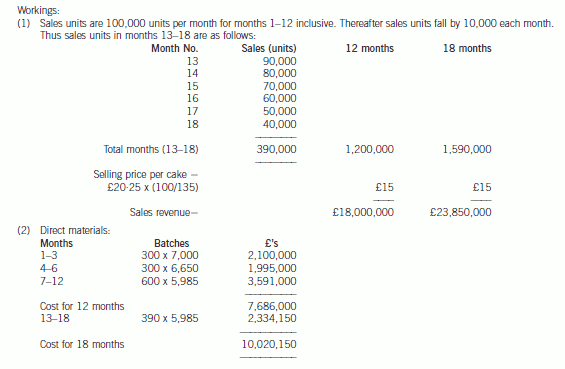
(a) Prepare detailed calculations to show whether the manufacture of Mighty Ben cakes will provide the required
rate of return for GWCC over periods of twelve months and eighteen months. (20 marks)
正确答案: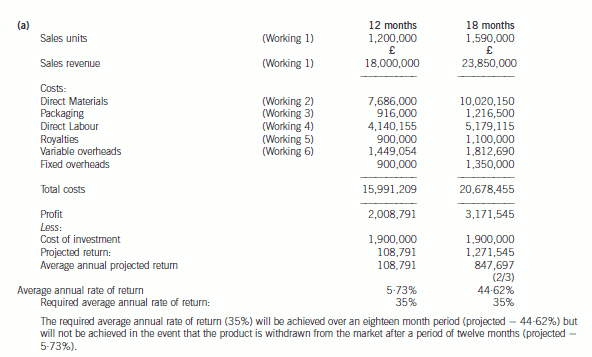

-
第16题:
(c) Explain the term ‘target costing’ and how it may be applied by GWCC. Briefly discuss any potential
limitations in its application. (8 marks)
正确答案:
(c) Target costing should be viewed as an integral part of a strategic profit management system. The initial consideration in target
costing is the determination of an estimate of the selling price for a new product which will enable a firm to capture its required
share of the market. In this particular example, Superstores plc, which on the face of it looks a powerful commercial
organisation, wishes to apply a 35% mark-up on the purchase price of each cake from GWCC. Since Superstores plc has
already decided on a launch price of £20·25 then it follows that the maximum selling price that can be charged by GWCC
is (100/135) x £20·25 which is £15·00.
This is clearly a situation which lends itself to the application of target costing/pricing techniques as in essence GWCC can
see the extent to which they fall short of the required level of return with regard to a contract with Superstores plc which ends
after twelve months. Thus it is necessary to reduce the total costs by £556,029 to this figure in order to achieve the desired
level of profit, having regard to the rate of return required on new capital investment. The deduction of required profit from
the proposed selling price will produce a target price that must be met in order to ensure that the desired rate of return is
obtained. Thus the main theme that underpins target costing can be seen to be ‘what should a product cost in order to achieve
the desired level of return’.
Target costing will necessitate comparison of current estimated cost levels against the target level which must be achieved if
the desired levels of profitability, and hence return on investment, are to be achieved. Thus where a gap exists between the
current estimated cost levels and the target cost, it is essential that this gap be closed.
The Directors of GWCC plc should be aware of the fact that it is far easier to ‘design out’ cost during the pre-production phase
than to ‘control out’ cost during the production phase. Thus cost reduction at this stage of a product’s life cycle is of critical
significance to business success.
A number of techniques may be employed in order to help in the achievement and maintenance of the desired level of target
cost. Attention should be focussed upon the identification of value added and non-value added activities with the aim of the
elimination of the latter. The product should be developed in an atmosphere of ‘continuous improvement’. In this regard, total
quality techniques such as the use of Quality circles may be used in attempting to find ways of achieving reductions in product
cost.
Value engineering techniques can be used to evaluate necessary product features such as the quality of materials used. It is
essential that a collaborative approach is taken by the management of GWCC and that all interested parties such as suppliers
and customers are closely involved in order to engineer product enhancements at reduced cost.
The degree of success that will be achieved by GWCC via the application of target costing principles will be very much
dependent on the extent of ‘flexibility’ in variable costs. Also the accuracy of information gathered by GWCC will assume
critical importance because the use of inaccurate information will produce calculated ‘cost gaps’ which are meaningless and
render the application of target costing principles of little value. -
第17题:
2 Ice-Time Ltd (ITL) manufactures a range of sports equipment used in a variety of winter-sports in Snowland.
Development engineers within ITL have recently developed a prototype of a small engine-propelled bobsleigh named
the ‘Snowballer’, which has been designed for use by young children. The directors of ITL recently spent £200,000
on market research, the findings of which led them to believe that a market exists for the Snowballer.
The marketing director has suggested that ITL should use the ‘Olympic’ brand in order to market the Snowballer.
The finance director of ITL has gathered relevant information and prepared the following evaluation relating to the
proposed manufacture and sale of the Snowballer.
(1) Sales are expected to be 3,200 units per annum at a selling price of £2,500 per unit.
(2) Variable material, labour, and overhead costs are estimated at £1,490 per unit.
(3) In addition, a royalty of £150 per unit would be payable to Olympic plc, for the use of their brand name.
(4) Fixed overheads are estimated at £900,000 per annum. These overheads cannot be avoided until the end of the
year in which the Snowballer is withdrawn from the market.
(5) An initial investment of £5 million would be required. A government grant equal to 50% of the initial investment
would be received on the date the investment is made. However, because the Snowballer would be classified as
a luxury good, no tax allowances would be available on this initial investment. The estimated life cycle of the
Snowballer is six years.
(6) Corporation tax at the rate of 30% per annum is payable in the year in which profit occurs.
(7) All cash flows are stated in current prices and, with the exception of the initial investment and the government
grant, will occur at the end of each year.
(8) The nominal cost of capital is 15·44%. Annual inflation during the period is expected to amount to 4%.
Required:
(a) Calculate the net present value (NPV) of the Snowballer proposal and recommend whether it should be
undertaken by the directors of ITL. (4 marks)
正确答案: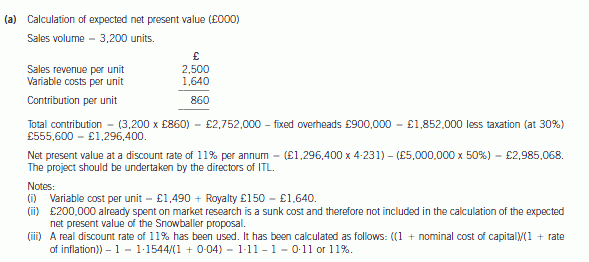
-
第18题:
(d) Suggest a set of SIX performance measures which the directors of SSH could use in order to assess the
quality of service provided to its clients. (3 marks)
正确答案:
(d) The following performance measures which could be used to assess the quality of service provided to its clients:
– The reliability of staff in keeping to scheduled appointment times with clients
– The responsiveness of staff to client enquiries or requests for assistance
– The quality of communications between SSH and its clients
– The competence of its staff in providing training to its clients
– The access times to staff upon the request of clients
– The availability of staff to meet emergency needs of clients
– The security of the data of its client base.
Notes: (i) Only six performance measures were required
(ii) Other relevant performance measures would be acceptable.
-
第19题:
(ii) Assuming that Donald operates through a company, advise Donald on the corporation tax (CT) that
would be payable for the year ended 31 March 2007 if he pays himself a gross salary of £31,000, plus
a net dividend of £10,000, instead of a gross salary of £42,648. (4 marks)
正确答案: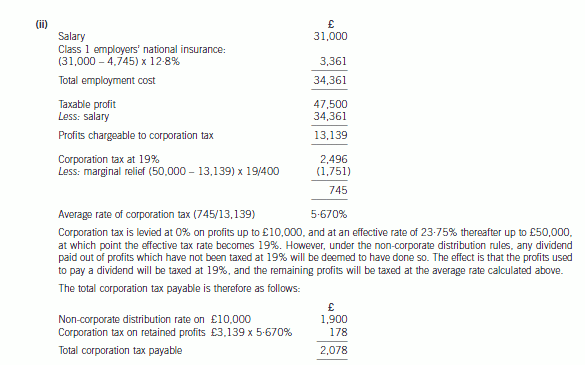
-
第20题:
(b) (i) Advise Alasdair of the tax implications and relative financial risks attached to the following property
investments:
(1) buy to let residential property;
(2) commercial property; and
(3) shares in a property investment company/unit trust. (9 marks)
正确答案:
(b) (i) Income tax:
Direct investment in residential or commercial property
The income will be taxed under Schedule A for both residential and commercial property investment. Expenses can be
offset against income under the normal trading rules. These will include interest charges incurred in borrowing funds to
acquire the properties. Schedule A losses are restricted to use against future Schedule A profits, with the earliest profits
being relieved first.
When acquiring commercial properties, it may be possible to claim capital allowances on the fixtures and plant held in
the building. In addition, industrial buildings allowances (IBA) may also be available if the property qualifies as an
industrial building.
Capital allowances are not normally available for fixtures and fittings included in a residential property. Instead, a wear
and tear allowance can be claimed if the property is furnished. This is equal to 10% of the rental income after any
tenants cost (for example, council tax) paid by the landlord.
Income tax is levied at the normal tax rates (10/22/40%) as appropriate.
Collective investment (shares in a property investment company/unit trust)
With collective investments, the investor either buys shares (in an investment company) or units (in an equity unit trust).
The income tax treatment of both is the same in that the investor receives dividends. These are taxed at 10% and 32·5%
respectively (for basic and higher rate taxpayers).
Investors are not able to claim income tax relief on either interest costs (of borrowing) or any other expenses.
Capital gains tax (CGT):
The normal rules apply for CGT purposes in all situations. Property investments do not normally qualify for business
rates of taper relief unless they are furnished holiday lets or in certain circumstances, commercial property. Investments
in unit trusts or property investment companies will never qualify for business taper rates.
It is possible to use an individual savings account (ISA) to make collective investments. If this is done, income and
capital gains will be exempt from tax.
Other taxes:
New commercial property is subject to value added tax (VAT) at the standard rate, but new residential property is subject
to VAT at the zero rate. If a commercial building is acquired second hand as an investment, VAT may be payable if a
previous owner has opted to tax the property. If this is the case, VAT at the standard rate will be payable on the purchase
price, and rental charges to tenants will also be subject to VAT, again at the standard rate.
The acquisition of shares is not subject ot VAT.
Stamp duty land tax (SDLT) will be payable broadly on the direct acquisition of any property. The rates vary from 0 to
4% depending on the value of the land and building and its nature (whether residential or non-residential). Stamp duty
is payable at a rate of 0·5% on the acquisition of shares.
Investment risks/benefits
Direct investment
Investing directly in property represents a long term investment, and unless this is the case, investment risks are high.
Substantial initial costs (such as SDLT, VAT and transactions costs) are incurred, and ongoing running costs (such as
letting agents’ fees and vacant periods) can be significant. The investments are illiquid, particularly commercial
properties which can take months to sell.
All types of properties are dependent on a cyclical market, and the values of property investments can vary significantly
as a result. However, residential property has (on a long term basis) proven to be a good hedge against inflation.
Collective investments
The nature of collective investments is that the investor’s risk is reduced by the investment being spread over a large
portfolio as opposed to one or a few properties. In addition, investors can take advantage of the higher levels of liquidity
afforded by such vehicles. -
第21题:
6 Andrew is aged 38 and is single. He is employed as a consultant by Bestadvice & Co and pays income tax at the
higher rate.
Andrew is considering investing in a new business, and to provide funds for this investment he has recently disposed
of the following assets:
(1) A short leasehold interest in a residential property. Andrew originally paid £50,000 for a 47 year lease of the
property in May 1995, and assigned the lease in May 2006 for £90,000.
(2) His holding of £10,000 7% Government Stock, on which interest is payable half-yearly on 20 April and
20 October. Andrew originally purchased this holding on 1 June 1999 for £9,980 and he sold it for £11,250
on 14 March 2005.
Andrew intends to subscribe for ordinary shares in a new company, Scalar Limited, which will be a UK based
manufacturing company. Three investors (including Andrew) have been identified, but a fourth investor may also be
invited to subscribe for shares. The investors are all unconnected, and would subscribe for shares in equal measure.
The intention is to raise £450,000 in this manner. The company will also raise a further £50,000 from the investors
in the form. of loans. Andrew has been told that he can take advantage of some tax reliefs on his investment in Scalar
Limited, but does not know anything about the details of these reliefs
Andrew’s employer, Bestadvice & Co, is proposing to change the staff pension scheme from a defined benefit scheme
to which the firm and the employees each contribute 6% of their annual salary, to a defined contribution scheme, to
which the employees will continue to contribute 6%, but the firm will contribute 8% of their annual salary. The
majority of Andrew’s colleagues are opposed to this move, but, given the increase in the firm’s contribution rate
Andrew himself is less sure that the proposal is without merit.
Required:
(a) (i) Calculate the chargeable gain arising on the assignment of the residential property lease in May 2006.
(2 marks)
正确答案:
-
第22题:
(b) Advise Maureen on deregistration for the purposes of value added tax (VAT) and any possible alternative
strategy. (8 marks)
An additional mark will be awarded for the effectiveness with which the information is communicated.
(1 mark)
正确答案:
(b) Advice on Maureen’s VAT position
Deregistration
In order to voluntarily deregister for VAT you must satisfy HMRC that the value of your taxable supplies in the next twelve
months will not exceed £62,000. You will then be deregistered with effect from the date of your request or a later date as
agreed with HMRC.
On deregistering you are regarded as making a supply of all stocks and equipment in respect of which input tax has been
claimed. However, the VAT on this deemed supply need only be paid to HMRC if it exceeds £1,000.
Once you have deregistered, you must no longer charge VAT on your sales. You will also be unable to recover the input tax
on the costs incurred by your business. Instead, the VAT you pay on your costs will be allowable when computing your taxable
profits.
You should monitor your sales on a monthly basis; if your sales in a twelve-month period exceed £64,000 you must notify
HMRC within the 30 days following the end of the twelve-month period. You will be registered from the end of the month
following the end of the twelve-month period.
Flat rate scheme
Rather than deregistering you may wish to consider operating the flat rate scheme. This would reduce the amount of
administration as you would no longer need to record and claim input tax in respect of the costs incurred by your business.
Under the flat rate scheme you would continue to charge your customers VAT in the way that you do at the moment. You
would then pay HMRC a fixed percentage of your VAT inclusive turnover each quarter rather than calculating output tax less
input tax. This may be financially advantageous as compared with deregistering; I would be happy to prepare calculations for
you if you wish. -
第23题:
Which factor must be considered when determining the order of loading of dissimilar products through the same piping system aboard a tanker?
A.Contamination of the cargo
B.Flash points
C.Reid vapor pressures
D.Specific gravities
正确答案:A