
5 Gagarin wishes to persuade a number of wealthy individuals who are business contacts to invest in his company,Vostok Ltd. He also requires advice on the recoverability of input tax relating to the purchase of new premises.The following information has b
题目
5 Gagarin wishes to persuade a number of wealthy individuals who are business contacts to invest in his company,
Vostok Ltd. He also requires advice on the recoverability of input tax relating to the purchase of new premises.
The following information has been obtained from a meeting with Gagarin.
Vostok Ltd:
– An unquoted UK resident company.
– Gagarin owns 100% of the company’s ordinary share capital.
– Has 18 employees.
– Provides computer based services to commercial companies.
– Requires additional funds to finance its expansion.
Funds required by Vostok Ltd:
– Vostok Ltd needs to raise £420,000.
– Vostok Ltd will issue 20,000 shares at £21 per share on 31 August 2008.
– The new shareholder(s) will own 40% of the company.
– Part of the money raised will contribute towards the purchase of new premises for use by Vostok Ltd.
Gagarin’s initial thoughts:
– The minimum investment will be 5,000 shares and payment will be made in full on subscription.
– Gagarin has a number of wealthy business contacts who may be interested in investing.
– Gagarin has heard that it may be possible to obtain tax relief for up to 60% of the investment via the enterprise
investment scheme.
Wealthy business contacts:
– Are all UK resident higher rate taxpayers.
– May wish to borrow the funds to invest in Vostok Ltd if there is a tax incentive to do so.
New premises:
– Will cost £446,500 including value added tax (VAT).
– Will be used in connection with all aspects of Vostok Ltd’s business.
– Will be sold for £600,000 plus VAT in six years time.
– Vostok Ltd will waive the VAT exemption on the sale of the building.
The VAT position of Vostok Ltd:
– In the year ending 31 March 2009, 28% of Vostok Ltd’s supplies will be exempt for the purposes of VAT.
– This percentage is expected to reduce over the next few years.
– Irrecoverable input tax due to the company’s partially exempt status exceeds the de minimis limits.
Required:
(a) Prepare notes for Gagarin to use when speaking to potential investors. The notes should include:
(i) The tax incentives immediately available in respect of the amount invested in shares issued in
accordance with the enterprise investment scheme; (5 marks)
相似考题
更多“5 Gagarin wishes to persuade a number of wealthy individuals who are business contacts to invest in his company,Vostok Ltd. He also requires advice on the recoverability of input tax relating to the purchase of new premises.The following information has b”相关问题
-
第1题:
3 Assume that today’s date is 10 May 2005.
You have recently been approached by Fred Flop. Fred is the managing director and 100% shareholder of Flop
Limited, a UK trading company with one wholly owned subsidiary. Both companies have a 31 March year-end.
Fred informs you that he is experiencing problems in dealing with aspects of his company tax returns. The company
accountant has been unable to keep up to date with matters, and Fred also believes that mistakes have been made
in the past. Fred needs assistance and tells you the following:
Year ended 31 March 2003
The corporation tax return for this period was not submitted until 2 November 2004, and corporation tax of £123,500
was paid at the same time. Profits chargeable to corporation tax were stated as £704,300.
A formal notice (CT203) requiring the company to file a self-assessment corporation tax return (dated 1 February
2004) had been received by the company on 4 February 2004.
A detailed examination of the accounts and tax computation has revealed the following.
– Computer equipment totalling £50,000 had been expensed in the accounts. No adjustment has been made in
the tax computation.
– A provision of £10,000 was made for repairs, but there is no evidence of supporting information.
– Legal and professional fees totalling £46,500 were allowed in full without any explanation. Fred has
subsequently produced the following analysis:
Analysis of legal & professional fees
£
Legal fees on a failed attempt to secure a trading loan 15,000
Debt collection agency fees 12,800
Obtaining planning consent for building extension 15,700
Accountant’s fees for preparing accounts 14,000
Legal fees relating to a trade dispute 19,000
– No enquiry has yet been raised by the Inland Revenue.
– Flop Ltd was a large company in terms of the Companies Act definition for the year in question.
– Flop Ltd had taxable profits of £595,000 in the previous year.
Year ended 31 March 2004
The corporation tax return has not yet been submitted for this year. The accounts are late and nearing completion,
with only one change still to be made. A notice requiring the company to file a self-assessment corporation tax return
(CT203) dated 27 July 2004 was received on 1 August 2004. No corporation tax has yet been paid.
1 – The computation currently shows profits chargeable to corporation tax of £815,000 before accounting
adjustments, and any adjustments for prior years.
– A company owing Flop Ltd £50,000 (excluding VAT) has gone into liquidation, and it is unlikely that any of this
money will be paid. The money has been outstanding since 3 September 2003, and the bad debt will need to
be included in the accounts.
1 Fred also believes there are problems in relation to the company’s VAT administration. The VAT return for the quarter
ended 31 March 2005 was submitted on 5 May 2005, and VAT of £24,000 was paid at the same time. The previous
return to 31 December 2004 was also submitted late. In addition, no account has been made for the VAT on the bad
debt. The VAT return for 30 June 2005 may also be late. Fred estimates the VAT liability for that quarter to be £8,250.
Required:
(a) (i) Calculate the revised corporation tax (CT) payable for the accounting periods ending 31 March 2003
and 2004 respectively. Your answer should include an explanation of the adjustments made as a result
of the information which has now come to light. (7 marks)
(ii) State, giving reasons, the due payment date of the corporation tax (CT) and the filing date of the
corporation tax return for each period, and identify any interest and penalties which may have arisen to
date. (8 marks)
正确答案:(a) Calculation of corporation tax
Year ended 31 March 2003
Corporation tax payable
There are three adjusting items:.
(i) The computers are capital items, as they have an enduring benefit. These need to be added back in the Schedule D
Case I calculation, and capital allowances claimed instead. The company is not small or medium by Companies Act
definitions and therefore no first year allowances are available. Allowances of £12,500 (50,000 x 25%) can be claimed,
leaving a TWDV of £37,500.
(ii) The provision appears to be general in nature. In addition there is insufficient information to justify the provision and it
should be disallowed until such times as it is released or utilised.
(iii) Costs relating to trading loan relationships are allowable, as are costs relating to the trade (debt collection, trade disputes
and accounting work). Costs relating to capital items (£5,700) are not allowable so will have to be added back.
Total profit chargeable to corporation tax is therefore £704,300 + 50,000 – 12,500 + 10,000 + 5,700 = 757,500. There are two associates, and therefore the 30% tax rate starts at £1,500,000/2 = £750,000. Corporation tax payable is 30% x£757,500 = £227,250.
Payment date
Although the rate of tax is 30% and the company ‘large’, quarterly payments will not apply, as the company was not large in the previous year. The due date for payment of tax is therefore nine months and one day after the end of the tax accounting period (31 March 2003) i.e. 1 January 2004.
Filing date
This is the later of:
– 12 months after the end of the period of account: 31 March 2004
– 3 months after the date of the notice requiring the return 1 May 2004
i.e. 1 May 2004.
-
第2题:
2 Benny Korere has been employed as the sales director of Golden Tan plc since 1994. He earns an annual salary of
£32,000 and is provided with a petrol-driven company car which has a CO2 emission rate of 187g/km and had a
list price when new of £22,360. In August 2003, when he was first provided with the car, Benny paid the company
£6,100 towards the capital cost of the car. Golden Tan plc does not pay for any of Benny’s private petrol and he is
also required to pay his employer £18 per month as a condition of being able to use the car for private purposes.
On 1 December 2006 Golden Tan plc notified Benny that he would be made redundant on 28 February 2007. On
that day the company will pay him his final month’s salary together with a payment of £8,000 in lieu of the three
remaining months of his six-month notice period in accordance with his employment contract. In addition the
company will pay him £17,500 in return for agreeing not to work for any of its competitors for the six-month period
ending 31 August 2007.
On receiving notification of his redundancy, Benny immediately contacted Joe Egmont, the managing director of
Summer Glow plc, who offered him a senior management position leading the company’s expansion into Eastern
Europe. Summer Glow plc is one of Golden Tan plc’s competitors and one of the most innovative companies in the
industry, although not all of its strategies have been successful.
Benny has agreed to join Summer Glow plc on 1 September 2007 for an annual salary of £39,000. On the day he
joins the company, Summer Glow plc will grant him an option to purchase 10,000 ordinary shares in the company
for £2·20 per share under an unapproved share option scheme. Benny can exercise the option once he has been
employed for six months but must hold the shares for at least a year before he sells them.
The new job will require Benny to spend a considerable amount of time in London. Summer Glow plc has offered
Benny the exclusive use of a flat that the company purchased on 1 June 2003 for £165,000; the flat is currently
rented out. The flat will be made available from 1 September 2007. The company will pay all of the utility bills
relating to the flat as well as furnishing and maintaining it. Summer Glow plc has also suggested that if Benny would
rather live in a more central part of the city, the company could sell the existing flat and buy a more centrally located
one, of the same value, with the proceeds.
On 15 March 2007 Benny intends to sell 5,800 shares in Mahana plc, a quoted company, for £24,608. His
transactions in the company’s shares have been as follows:
£
June 1988 Purchased 8,400 shares 6,744
February 1996 Sale of rights nil paid 610
January 2005 Purchased 1,300 shares 2,281
The sale of rights, nil paid, was not treated as a part disposal of Benny’s holding in Mahana plc.
Benny’s shareholding in Mahana plc represents less than 1% of the company’s issued ordinary share capital. He will
not make any other capital disposals in 2006/07.
In addition to his employment income, Benny receives rental income of £4,000 (net of deductible expenses) each
year. He normally submits his tax return in August but he has not yet prepared his return for 2005/06. He expects
to be very busy in December and January and is planning to prepare his tax return in late February 2007.
Required:
(a) Calculate Benny’s employment income for 2006/07. (4 marks)
正确答案: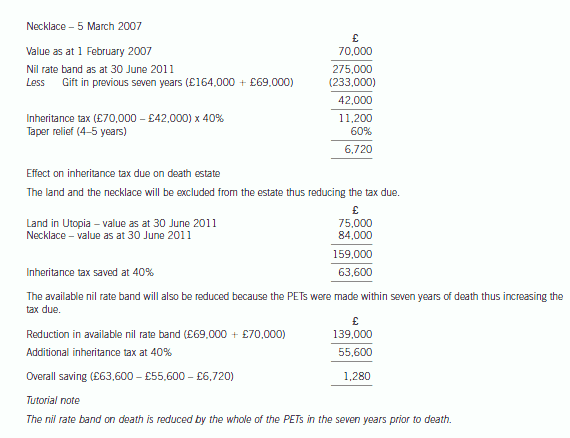
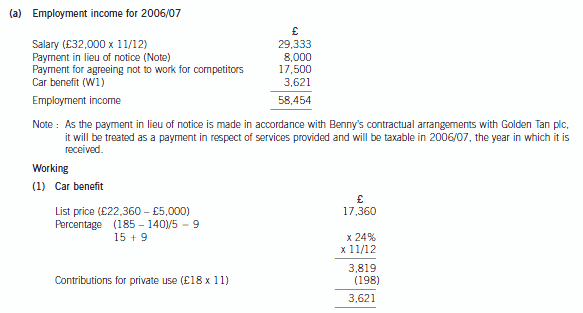
-
第3题:
4 (a) For this part, assume today’s date is 1 March 2006.
Bill and Ben each own 50% of the ordinary share capital in Flower Limited, an unquoted UK trading company
that makes electronic toys. Flower Limited was incorporated on 1 August 2005 with 1,000 £1 ordinary shares,
and commenced trading on the same day. The business has been successful, and the company has accumulated
a large cash balance of £180,000, which is to be used to purchase a new factory. However, Bill and Ben have
received an offer from a rival company, which they are considering. The offer provides Bill and Ben with two
alternative methods of payment for the purchase of their shares:
(i) £480,000 for the company, inclusive of the £180,000 cash balance.
(ii) £300,000 for the company assuming the cash available for the factory purchase is extracted prior to sale.
Bill and Ben each currently receive a gross salary of £3,750 per month from Flower Limited. Part of the offer
terms is that Bill and Ben would be retained as employees of the company on the same salary.
Neither Bill nor Ben has used any of their capital gains tax annual exemption for the tax year 2005/06.
Required:
(i) Calculate which of the following means of extracting the £180,000 from Flower Limited on 31 March
2006 will result in the highest after tax cash amount for Bill and Ben:
(1) payment of a dividend, or
(2) payment of a salary bonus.
You are not required to consider the corporation tax (CT) implications for Flower Limited in your
answer. (5 marks)
正确答案: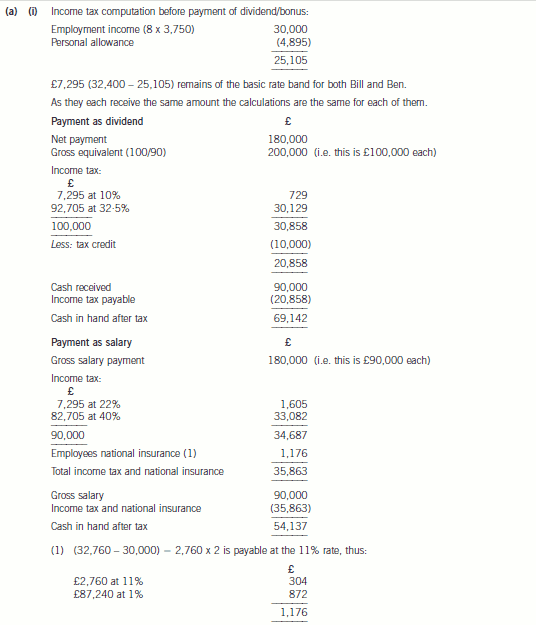
As a result, Bill and Ben would each be better off by £15,005 (69,142 – 54,137). If the cash were extracted by way
of dividend.
Tutorial note: In this answer the employers’ national insurance liability on the salary has been ignored. Credit would be
given to a candidate who recognised this issue. -
第4题:
5 Crusoe has contacted you following the death of his father, Noland. Crusoe has inherited the whole of his father’s
estate and is seeking advice on his father’s capital gains tax position and the payment of inheritance tax following his
death.
The following information has been extracted from client files and from telephone conversations with Crusoe.
Noland – personal information:
– Divorcee whose only other relatives are his sister, Avril, and two grandchildren.
– Died suddenly on 1 October 2007 without having made a will.
– Under the laws of intestacy, the whole of his estate passes to Crusoe.
Noland – income tax and capital gains tax:
– Has been a basic rate taxpayer since the tax year 2000/01.
– Sales of quoted shares resulted in:
– Chargeable gains of £7,100 and allowable losses of £17,800 in the tax year 2007/08.
– Chargeable gains of approximately £14,000 each tax year from 2000/01 to 2006/07.
– None of the shares were held for long enough to qualify for taper relief.
Noland – gifts made during lifetime:
– On 1 December 1999 Noland gave his house to Crusoe.
– Crusoe has allowed Noland to continue living in the house and has charged him rent of £120 per month
since 1 December 1999. The market rent for the house would be £740 per month.
– The house was worth £240,000 at the time of the gift and £310,000 on 1 October 2007.
– On 1 November 2004 Noland transferred quoted shares worth £232,000 to a discretionary trust for the benefit
of his grandchildren.
Noland – probate values of assets held at death: £
– Portfolio of quoted shares 370,000
Shares in Kurb Ltd 38,400
Chattels and cash 22,300
Domestic liabilities including income tax payable (1,900)
– It should be assumed that these values will not change for the foreseeable future.
Kurb Ltd:
– Unquoted trading company
– Noland purchased the shares on 1 December 2005.
Crusoe:
– Long-standing personal tax client of your firm.
– Married with two young children.
– Successful investment banker with very high net worth.
– Intends to gift the portfolio of quoted shares inherited from Noland to his aunt, Avril, who has very little personal
wealth.
Required:
(a) Prepare explanatory notes together with relevant supporting calculations in order to quantify the tax relief
potentially available in respect of Noland’s capital losses realised in 2007/08. (4 marks)
正确答案: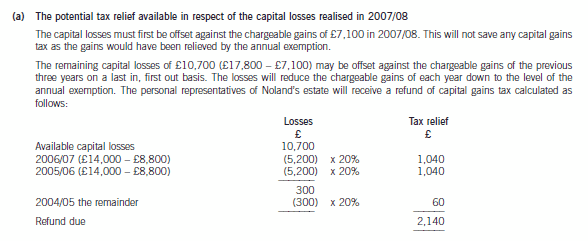
-
第5题:
(b) Calculate the amount of input tax that will be recovered by Vostok Ltd in respect of the new premises in the
year ending 31 March 2009 and explain, using illustrative calculations, how any additional recoverable input
tax will be calculated in future years. (5 marks)
正确答案:
(b) Recoverable input tax in respect of new premises
Vostok Ltd will recover £47,880 (£446,500 x 7/47 x 72%) in the year ending 31 March 2009.
The capital goods scheme will apply to the purchase of the building because it is to cost more than £250,000. Under the
scheme, the total amount of input tax recovered reflects the use of the building over the period of ownership, up to a maximum
of ten years, rather than merely the year of purchase.
Further input tax will be recovered in future years as the percentage of exempt supplies falls. (If the percentage of exempt
supplies were to rise, Vostok Ltd would have to repay input tax to HMRC.)
The additional recoverable input tax will be computed by reference to the percentage of taxable supplies in each year including
the year of sale. For example, if the percentage of taxable supplies in a particular subsequent year were to be 80%, the
additional recoverable input tax would be computed as follows.
£446,500 x 7/47 x 1/10 x (80% – 72%) = £532.
Further input tax will be recovered in the year of sale as if Vostok Ltd’s supplies in the remaining years of the ten-year period
are fully vatable. For example, if the building is sold in year seven, the additional recoverable amount for the remaining three
years will be calculated as follows.
£446,500 x 7/47 x 1/10 x (100% – 72%) x 3 = £5,586. -
第6题:
Dear Mr. Brown,
Thank you for your letter of 6 September regarding Mr. John Green who has been employed by this company for the past 10 years.
Mr. Green served his apprenticeship (学徒) with Vickers Tools Ltd. in Manchester, followed by a three-year course of engineering for Production Engineers. He is technically well—qualified and for the past five years has been our Assistant Works Manager responsible for production and related business in our Sheffield factory. In all his job duties he has shown himself to be hard-working, responsible and in every way a very dependable employee.
I can strongly recommend Mr. Green as I feel sure that if he were to be chosen to manage your factory in Nairobi he would bring to his work a true atmosphere of teamwork, which would be found necessary and helpful by all who would work with him.
Sincerely yours,
Tom Smith
1. How long has Mr. Green been employed by the writer's company?
For ().
2. What kind of course did Mr. Green take?
A three-year course in engineering for ().
3. What job position has Mr. Green held in the past five years?
4.What does the writer think of Mr. Green as an employee?
He is hard-working, () and dependable.
5.What is the purpose of this letter?
To () Mr. Green to manage a factory in Nairobi.
答案:1.10years,2.Production Engineersl,3.Assistant Words Manger,4.responsible,5.strongly recommed
-
第7题:
根据以下内容,回答202-206题。
The Daily Inquirer
October 8
Book Review of Anne Narazaki's
New Century, New Business
Reviewed by John Gilliam
Anne Narazaki's recent book, New Century, New Business, seeks to examine the new tech-nologies that are critical for global business and how they affect today's corporate transactions. Ms.Narazaki argues that while economic transactions of one kind or another have taken place for thou-sands of years, the impact of changing technology on business has become obvious only recently. In fact, as new technologies have grown more prevalent, Ms. Narazaki observes, international busi-nesses have increased in size and number. At the same time, the time required to conduct each business transaction has decreased.
Mr. Narazaki illustrates her observations with detailed examples of recent business transac-tions. Citing the merger of Poynter Technologies and Carce Company, which created the largest fi-nancial services company in the world, Ms. Narazaki explains the effect technology has on the val-uation of a company, on communication between the managements of different companies, and on stock and funds trading.
Those of us who take an interest in the interaction between business and technology will find Ms. Narazaki's ideas persuasive. The view that business cannot survive without keep~ing up with new technology has become today's corporate reality.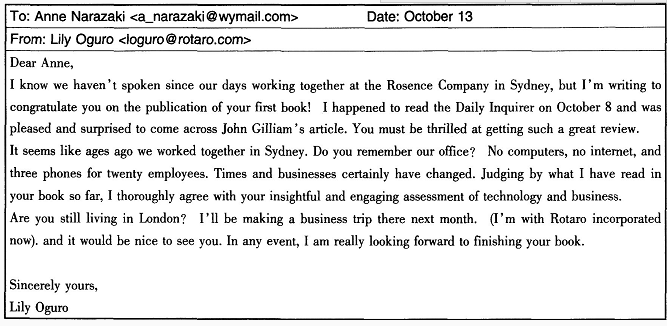
In the article, the word "critical" in paragraph 1 is closest in meaning to ( )。A.growing
B.sensitive
C.disapproving
D.important答案:D解析:“critical”一词出现在“examine the new technologies that are critical for global business”这句话中,结合整句加以理解,是说:新的科技技术对全球商业的重要性。所以,该题的正确答案应为D。 -
第8题:
共用题干
A Success Story
At 19,Ben Way is already a millionaire,and one of a growing number of teenagers who have ______(51)their fortune through the Internet.______(52)makes Ben's story all the more remarkable is that he is dyslexic,and was______(53)by teachers at his junior school that he would never be able to read or write______(54).“I wanted to prove them______(55)”, says Ben,creator and director of Waysearch,a net search engine which can be used ______(56)find goods in online shopping malls.
When he was eight,his local authorities provided him with a PC to help with school work.
Although he was______(57)to read the manuals,he had a natural ability with the computer, and______(58)by his father,he soon began______(59)people£10 an hour for his
knowledge and skills.At the age of 15 he______(60)up his own computer consultancy, Quad Computer,which he ran from his bedroom,and two years later he left school to ______(61)all his time to business.
“By this time the company had grown and I needed to take on a______(62)of employees to help me”,says Ben.“That enabled me to start doing business with______(63)companies.”It was his ability to consistently______(64)difficult challenges that led him to win the Young Entrepreneur of the Year award in the same year that he formed Waysearch,and he has re-cently signed a deal______(65)£25 million with a private investment company,which will finance his search engine.64._________
A: overcome
B: overlook
C: overtake
D: overdo答案:A解析:固定搭配make fortune,意为“制造财富,发财”,因此选B。其他三项均不合适。
这里应该是一个由what引导的从句为主语的句子,表示“使得 Ben的故事更引人注意的是……”,其他三项均无法引导该从句。
根据句意,是Ben被告知,因此选项told为正确答案。said意为“被说”,suggested 意为“被建议”,reported意为“被报道”,均不合句意。
联系上下文,了解到本句表达的是Ben曾被他的初中教师告知他将永远不能正确读写,而不是完全无法读写,因此properly才符合句意。absolutely表示“完全地,绝对地”,totally表示“完全地”,thoroughly表示“彻底地,完全地”,均不合句意。
根据句意,很容易了解Ben是要证明他们对他的判断错了,而不是说他们的判断是假的、不真实的,或者不公平的,所以wrong是正确答案。
固定搭配。be used to意为“被用来做”。因此A项正确。
根据句意,易知文中要表达的是“虽然他不能阅读使用指南”,因此unable为正确答案。impossible表示“不可能的”,incapable表示“无能力的”,一般形容不能胜任的; disabled表示“有残缺的”。
根据句意,易知文中要表达的是在爸爸的鼓励下。若用promised则表示在爸爸的承诺下,invited则是在爸爸的邀请下,animated表示“有生气的”,均不符合句意,因此 encouraged为正确答案。
根据句意,“ Ben很快就开始以自己的知识和能力收费——每小时10英镑”,只有 charge符合句意。
联系上下文,根据句意, Ben创建了自己的公司——Quad Computer,固定搭配set up 表示“创建”,其他三项均不合适,所以选D。
根据句意,Ben把所有的精力投入到公司经营当中,根据后面的介词to可知,只有 devote是正确答案。
词组搭配。a couple of表示“一些”, few一般形容只需少量的几个,little形容不可数名词,文中要表达的是公司已经发展壮大,Ben需要雇用一些员工,因此只有couple符合句意。
文中要表达的是雇用一些员工,使公司发展壮大。因此B项正确。
固定搭配。overcome challenge,表示“克服困难,克服挑战”,因此选A。 overlook表示“不注意,忽视”, overtake表示“赶上”,overdo表示“把……做得过分”。
根据句意,“价值2500万英镑的交易”,显然worth是正确答案。valuable表示“珍贵的,值钱的”, estimated表示“估计,预算”,priced表示“给……定价,附有定价的”。 -
第9题:
A global container shipping company has a new application that they are going to deploy on a p5-570 at their corporate data center. The Chief Information Officer indicates that, if the application is down for more than 36 hours, the cost of downtime is very high. For the initial 36 hours of downtime, the company has a manual process they can execute without significant additional cost. Which of the following products best mitigates the major business risk to the company?()
- A、IBM Business Continuity Services
- B、HACMP and a second p5-570 for the data center
- C、ServiceSuite Supportline with Account Advocate
- D、ServiceSuite 9x5 next day Hardware Maintenance
正确答案:A -
第10题:
问答题Practice 5 ● Your company has decided to invest some of this year’s exceptionally high profits in one of the following areas: ● New company buses ● Culture comparative Courses ● Special bonus payments. ● You have been asked to write a report recommending how the profits should be invested and what benefits they would bring respectively. ● Write 200-250 words on your Answer Sheet.正确答案: 【参考范文】
Introduction
The purpose of this report is to analyze how the company should reinvest its profits this year. Options under consideration include purchasing new company buses, providing language training courses and paying special bonuses.
Findings
Options under consideration
New company buses
Despite that the motorcade of company buses are aged, they are still good enough to use. They are equipped with comfortable sofa seats, air-conditioning system and even karaoke. Therefore, their hardware is definitely not out of date. In addition, engines of these vehicles were only replaced last year, and they all came from Bolvo which run very smoothly. As a result, new company buses would be out of the question.
Culture comparative courses
Since the company is planning to increase its international market shares, especially in China and Japan, attending culture comparative courses would be very help for employees to deal with business partners and customers in those regions. Furthermore, courses would also increase cohesion, that is to say, staff members would get on with each other as classmates. They would certainly keep in memory this special period of happy time for many years to come. Therefore, the idea of investing in culture comparative courses is not bad.
Special bonus payments
As is known to all, special bonus payments would stimulate motivations. However, they would not have immediate improvement on the company’s overall performances. In addition, there’s also a potential hazard regarding the resentment of stall ineligible for the payments. If a precedent for future payments is set, think about what we shall do then to boost the morale in a rainy day. Therefore, it would be unwise to invest in bonus payments.
Recommendations
To conclude, investing in culture comparative courses will achieve a win-win situation for both the company and staff. It is recommended that the company arrange courses in Chinese and Japanese for employees who have contact with partners and customers in the above regions. As for other members of staff who are interested, they should also be encouraged to participate in.解析: 暂无解析 -
第11题:
问答题Practice 1 Some people call him “Guidone”—big Guido. Large in both physical stature and reputation, Guido Rossi, who took over as Telecom Italia's chairman on September 15th following the surprise resignation of Marco Tronchetti Provera, has stood out from the Italian business crowd for more than three decades. Mr. Rossi, who attended Harvard law school in the 1950s and wrote a book on American bankruptcy law, made his name as a corporate lawyer keen on market rules and their enforcement. He has since worked in both private and public sectors, including stints in the Italian Senate and as one of the European Commission's group of company-law experts. As well as running a busy legal practice, he also has a reputation as a corporate troubleshooter and all-round Mr Fix-It, and is often called upon to clean up organisations in crisis. His role at Telecom Italia marks a return to the company he headed for ten months in 1997, during its politically tricky and legally complex privatisation. Before that, Mr Rossi had been sent in to sort out Ferruzzi-Montedison, an agri-business and chemicals group, which had collapsed after magistrates uncovered tangentopoli (“bribesville”).正确答案: 【参考译文】
有的人叫他“吉多尼”——也就是“大”吉多。吉多·罗西身材高大,名气也很大。9月15日,在马可·特龙切蒂·普罗费拉突然辞职之后,三十多年来在意大利商圈一直声名显赫的罗西接任意大利电信公司总裁一职。上世纪五十年代,罗西在哈佛法学院学习,曾写过一部关于美国破产法的著作,后来成为一名公司代理律师,因热衷于市场规则及其执行相关的案例而名噪一时。他在私有和国有单位都谋过事,其中包括在意大利参议院干过一段时间,当过欧盟委员会公司法律处专家。除了忙于法律业务外,他还是赫赫有名的排解公司纠纷高手,人称全能的“处理先生”,经常有危机缠身的公司请他帮助排忧解难。
他在意大利电信公司所扮演的角色标志着他的回归,因为1997年他在该公司主持过十个月的工作,其时公司正处于勾心斗角的政治斗争和涉及复杂法律问题的私有化过程中。之前罗西曾受命调查了Ferruzzi-Montedison的问题。Ferruzzi-Montedison是一家农业与化工集团,在被地方法官查出存在贿赂问题后倒闭。解析: 暂无解析 -
第12题:
单选题Federal tax evasion is a serious crime that places an unfair tax burden on those members of society who pay their fair share. To reduce the incidence of tax evasion, the government needs to prosecute a few high• profile individuals whose cases will receive substantial media attention.The argument above relies on which of the following assumptions?AThe tax system is so complicated that even people who try to comply with it may inadvertently not pay some of their taxes.
BThe average citizen will be less likely to evade taxes after he or she sees a high-profile individual prosecuted for tax evasion.
CTax revenues collected from high-profile tax evaders will help to alleviate the unfair tax burden on honest citizens.
DAlthough it is difficult to secure a conviction on a charge of tax evasion, if the government focuses its efforts on a small number of high-profile individuals, the odds of obtaining a conviction will increase.
EWhile there is no universal measure for determining whether a taxation system is “fair” or “unfair,” the current system was constructed by Congress to represent the societal priorities and values of the American people.
正确答案: A解析:
因为对少数逃税的人员的诉讼并不能直接改善逃税情况,但是可以通过扩大宣传使得普通民众对逃税行为的惩罚感到害怕,进而改变逃税情况,由此可知B项是正确的。 -
第13题:
6 Assume today’s date is 16 April 2005.
Henry, aged 48, is the managing director of Happy Home Ltd, an unquoted UK company specialising in interior
design. He is wealthy in his own right and is married to Helen, who is 45 years old. They have two children – Stephen,
who is 19, and Sally who is 17.
As part of his salary, Henry was given 3,000 shares in Happy Home Ltd with an option to acquire a further 10,000
shares. The options were granted on 15 July 2003, shortly after the company started trading, and were not part of
an approved share option scheme. The free shares were given to Henry on the same day.
The exercise price of the share options was set at the then market value of £1·00 per share. The options are not
capable of being exercised after 10 years from the date of grant. The company has been successful, and the current
value of the shares is now £14·00 per share. Another shareholder has offered to buy the shares at their market value,
so Henry exercised his share options on 14 April 2005 and will sell the shares next week, on 20 April 2005.
With the company growing in size, Henry wishes to recruit high quality staff, but the company lacks the funds to pay
them in cash. Henry believes that giving new employees the chance to buy shares in the company would help recruit
staff, as they could share in the growth in value of Happy Home Ltd. Henry has heard that there is a particular share
scheme that is suitable for small, fast growing companies. He would like to obtain further information on how such
a scheme would work.
Henry has accumulated substantial assets over the years. The family house is owned jointly with Helen, and is worth
£650,000. Henry has a £250,000 mortgage on the house. In addition, Henry has liquid assets worth £340,000
and Helen has shares in quoted companies currently worth £125,000. Henry has no forms of insurance, and believes
he should make sure that his wealth and family are protected. He is keen to find out what options he should be
considering.
Required:
(a) (i) State how the gift of the 3,000 shares in Happy Home Ltd was taxed. (1 mark)
正确答案:
(a) (i) Gift of shares
Shares, which are given free or sold at less than market value, are charged to income tax on the difference between the
market value and the amount paid (if any) for the shares. Henry was given 3,000 shares with a market value of £1 at
the time of gift, so he was assessed to income tax on £3,000, in the tax year 2003/04. -
第14题:
(b) Peter, one of Linden Limited’s non-executive directors, having lived and worked in the UK for most of his adult
life, sold his home near London on 22 March 2006 and, together with his wife (a French citizen), moved to live
in a villa which she owns in the south of France. Peter is now demanding that the tax deducted from his director’s
fees, for the board meetings held on 18 April and 16 May 2006, be refunded, on the grounds that, as he is no
longer resident in the UK, he is no longer liable to UK income tax. All of the company’s board meetings are held
at its offices in Cambridge.
Despite Peter’s assurance that none of the other companies of which he is a director has disputed his change of
tax status, Damian is uncertain whether he should make the refunds requested. However, as Peter is a friend of
the company’s founder, Linden Limited’s managing director is urging him to do so, stating that if the tax does
have to be paid, then Linden Limited could always bear the cost.
Required:
Advise Damian whether Peter is correct in his assertion regarding his tax position and in the case that there
is a UK tax liability the implications of the managing director’s suggestion. You are not required to consider
national insurance (NIC) issues. (4 marks)
正确答案:
(b) Peter will have been resident and ordinarily resident in the UK. When such individuals leave the UK for a purpose other than
to take up full time employment abroad, they normally continue to still be so regarded unless their absence spans a complete
tax year. But, where someone intends to live permanently abroad or to do so for a period of at least three tax years, they may
be treated as non-resident and non-ordinarily resident from the day after the date of their departure, if they can provide
evidence to HMRC of that intention. Selling a residence in the UK and setting up home abroad will normally constitute such
evidence. However to retain non-resident status the intention must actually be fulfilled, and visits to the UK must not exceed
182 days in any tax year or average more than 90 days per year over a period of four tax years. Given that Peter would appear
to have several company directorships in the UK, it is possible that he might fail to satisfy the 90 day average ‘substantial
visits’ rule.
Even if Peter is classed as non-resident, any remuneration earned in the UK will still be liable to UK income tax, and subject
to PAYE, unless it is for duties incidental to an overseas employment, which is unlikely to be the case for fees paid to a nonexecutive
director for attending board meetings. Thus, income tax should still be deducted from the fees under PAYE. Where
PAYE should have been deducted from a director’s emoluments and it has not been, but the tax is nevertheless accounted
for by the company to HMRC, then to the extent that the tax is not reimbursed by the director, he will be treated as receiving
a benefit equivalent to the amount of tax. -
第15题:
2 Clifford and Amanda, currently aged 54 and 45 respectively, were married on 1 February 1998. Clifford is a higher
rate taxpayer who has realised taxable capital gains in 2007/08 in excess of his capital gains tax annual exemption.
Clifford moved into Amanda’s house in London on the day they were married. Clifford’s own house in Oxford, where
he had lived since acquiring it for £129,400 on 1 August 1996, has been empty since that date although he and
Amanda have used it when visiting friends. Clifford has been offered £284,950 for the Oxford house and has decided
that it is time to sell it. The house has a large garden such that Clifford is also considering an offer for the house and
a part only of the garden. He would then sell the remainder of the garden at a later date as a building plot. His total
sales proceeds will be higher if he sells the property in this way.
Amanda received the following income from quoted investments in 2006/07:
£
Dividends in respect of quoted trading company shares 1,395
Dividends paid by a Real Estate Investment Trust out of tax exempt property income 485
On 1 May 2006, Amanda was granted a 22 year lease of a commercial investment property. She paid the landlord
a premium of £6,900 and also pays rent of £2,100 per month. On 1 June 2006 Amanda granted a nine year
sub-lease of the property. She received a premium of £14,700 and receives rent of £2,100 per month.
On 1 September 2006 Amanda gave quoted shares with a value of £2,200 to a registered charity. She paid broker’s
fees of £115 in respect of the gift.
Amanda began working for Shearer plc, a quoted company, on 1 June 2006 having had a two year break from her
career. She earns an annual salary of £38,600 and was paid a bonus of £5,750 in August 2006 for agreeing to
come and work for the company. On 1 August 2006 Amanda was provided with a fully expensed company car,
including the provision of private petrol, which had a list price when new of £23,400 and a CO2 emissions rate of
187 grams per kilometre. Amanda is required to pay Shearer plc £22 per month in respect of the private use of the
car. In June and July 2006 Amanda used her own car whilst on company business. She drove 720 business miles
during this two month period and was paid 34 pence per mile. Amanda had PAYE of £6,785 deducted from her gross
salary in the tax year 2006/07.
After working for Shearer plc for a full year, Amanda becomes entitled to the following additional benefits:
– The opportunity to purchase a large number of shares in Shearer plc on 1 July 2007 for £3·30 per share. It is
anticipated that the share price on that day will be at least £7·50 per share. The company will make an interestfree
loan to Amanda equal to the cost of the shares to be repaid in two years.
– Exclusive free use of the company sailing boat for one week in August 2007. The sailing boat was purchased by
Shearer plc in January 2005 for use by its senior employees and costs the company £1,400 a week in respect
of its crew and other running expenses.
Required:
(a) (i) Calculate Clifford’s capital gains tax liability for the tax year 2007/08 on the assumption that the Oxford
house together with its entire garden is sold on 31 July 2007 for £284,950. Comment on the relevance
to your calculations of the size of the garden; (5 marks)
正确答案: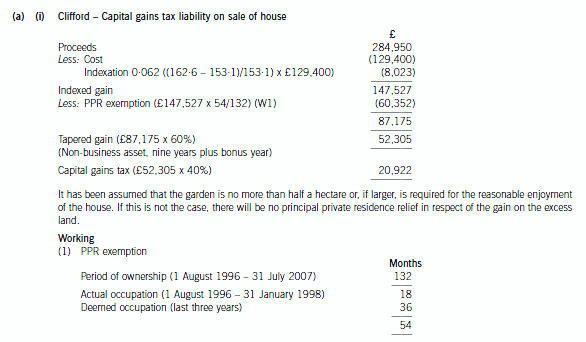
-
第16题:
3 Spica, one of the director shareholders of Acrux Ltd, has been in dispute with the other shareholders over plans to
expand the company’s activities overseas. In order to resolve the position it has been agreed that Spica will sell her
shares back to the company. Once the purchase of her shares has taken place, the company intends to establish a
number of branches overseas and acquire a shareholding in a number of companies that are resident and trade in
overseas countries.
The following information has been obtained from client files and meetings with the parties involved.
Acrux Ltd:
– An unquoted UK resident company.
– Share capital consists of 50,000 ordinary shares issued at £1·90 per share in July 2000.
– None of the other shareholders has any connection with Spica.
The purchase of own shares:
– The company will purchase all of Spica’s shares for £8 per share.
– The transaction will take place by the end of 2008.
Spica:
– Purchased 8,000 shares in Acrux Ltd for £2 per share on 30 September 2003.
– Has no income in the tax year 2008/09.
– Has chargeable capital gains in the tax year 2008/09 of £3,800.
– Has houses in the UK and the country of Solaris and divides her time between them.
Investment in non-UK resident companies:
– Acrux Ltd will acquire between 15% and 20% of each of the non-UK resident companies.
– The companies will not be controlled foreign companies as the rates of tax in the overseas countries will be
between 23% and 42%.
– There may or may not be a double tax treaty between the UK and the overseas countries in which the companies
are resident. Where there is a treaty, it will be based on the OECD model treaty.
– None of the countries concerned levy withholding tax on dividends paid to UK companies.
– The directors of Acrux Ltd are concerned that the rate of tax suffered on the profits of the overseas companies
will be very high as they will be taxed in both the overseas country and in the UK.
Required:
(a) (i) Prepare detailed calculations to determine the most beneficial tax treatment of the payment Spica will
receive for her shares; (7 marks)
正确答案:
-
第17题:
3 The Stiletto Partnership consisted of three partners, Clint, Ben and Amy, who shared the profits of the business
equally. On 28 February 2007 the partners sold the business to Razor Ltd, in exchange for shares in Razor Ltd, with
each former partner owning one third of the new company.
The recent, tax adjusted, trading profits of the Stiletto Partnership have been as follows:
£
Year ended 30 June 2006 92,124
1 July 2006 to 28 February 2007 81,795
Clint, who was 65 on 5 October 2006, retired when the business was sold to Razor Ltd. He is now suggesting that
if the sale of the partnership, and his retirement, had been delayed until 30 April 2007, his total tax liability would
have been reduced. Clint’s only other income is gross pension income of £6,100 per year, which he began receiving
in the tax year 2005/06. Clint did not receive any salary or dividends from Razor Ltd. It is estimated that the
partnership’s tax adjusted trading profits for the period from 1 March 2007 to 30 April 2007 would have been
£20,760. Clint has overlap profits of £14,250 brought forward from when the partnership began trading.
Razor Ltd manufactures industrial cutting tools. On 1 July 2007, Razor Ltd will subscribe for the whole of the ordinary
share capital of Cutlass Inc, a company newly incorporated in the country of Sharpenia. It is intended that Cutlass
Inc will purchase partly finished tools from Razor Ltd and customise them in Sharpenia. It is anticipated that Cutlass
Inc’s annual profits chargeable to corporation tax will be approximately £120,000.
Ben and Amy will be the directors of Cutlass Inc, although Ben will not be involved in the company’s business on a
day-to-day basis. Amy intends to spend one or two weeks each month in the country of Sharpenia looking after the
company’s affairs. The remainder of her time will be spent in the UK. Amy has employment contracts with both Razor
Ltd and Cutlass Inc and her duties for Cutlass Inc will be carried out wholly in Sharpenia. Cutlass Inc will pay for
Amy’s flights to and from Sharpenia and for her husband and baby to visit her there twice a year. Amy is currently
UK resident and ordinarily resident.
The system of income tax and corporation tax in the country of Sharpenia is broadly similar to that in the UK although
the rate of corporation tax is 38% regardless of the level of profits. There is a double tax treaty between the UK and
Sharpenia based on the OECD model treaty. The clause in the treaty dealing with company residency states that a
company resident in both countries under domestic law will be regarded under the treaty as being resident only in the
country where it is effectively managed and controlled. Sharpenia is not a member of the European Union.
Required:
(a) (i) Calculate Clint’s taxable trading profits for the tax years 2006/07 and 2007/08 for both of the
alternative retirement dates (28 February 2007 and 30 April 2007). (3 marks)
正确答案: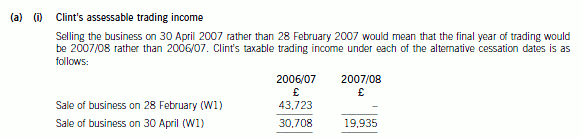
-
第18题:
How often one hears children wishing they were grown up,and old people wishing they were young again. Each age has its pleasures and its pains,and the happiest person is the one who enjoys what each age gives him without wasting his time in useless regrets.
Childhood is a time when there are few responsibilities. If a child has good parents,he is well fed,looked after and loved. It is unlikely that he will ever again in his life be given so much without having to do anything in return. In addition,life is always presenting new things to the child-things that have lost their,interest for older people because they are too well known. A child finds pleasure in playing in the rain,or in the snow. His first,visit to the seaside is a marvelous adventure. But a child has his pains:he is not so free to do as he wishes as he thinks older people are;he is continually being told what to do and what not to do. Therefore,a child is not happy as he wishes to be.
When the young man starts to earn his own living,he becomes free from the discipline of school and parents;but at the same time he is forced to accept responsibilities. With no one to pay for his food,his clothes,or his room,he has to work if he wants to live comfortably. If he spends most of his time playing about in the way that he used to as a child,he will go hungry. And if he breaks the laws of society as he used to break the laws of his parents,he may get himself into trouble. If,however,he works hard,goes by the law and has good health,he may feel satisfied in seeing himself make steady progress in his job and in building up for himself his own position in society.
Old age has always been thought of as the worst age to be;but it is not necessary for the old to be unhappy. With old age comes wisdom and the ability to help others with advice wisely given. The old can have the joy of seeing their children making progress in life;they can watch their grandchildren growing up around them;and,perhaps best of all,they can,if their life has been a useful one,feel the happiness of having come through the battle of life safely and of having reached a time when they can lie back and rest,leaving everything to others.
The happiest people should be those who______.
A.face up to difficulties in life
B.hope to be young again
C.enjoy life in different ages
D.wish to be grown up
正确答案:C
解析:见第一段,每一个年龄段有快乐和烦恼,最快乐的人不会浪费他的时间去后悔,而是享受每个午龄段所带给他的。 -
第19题:
共用题干
A Success Story
At 19,Ben Way is already a millionaire,and one of a growing number of teenagers who have ______(51)their fortune through the Internet.______(52)makes Ben's story all the more remarkable is that he is dyslexic,and was______(53)by teachers at his junior school that he would never be able to read or write______(54).“I wanted to prove them______(55)”, says Ben,creator and director of Waysearch,a net search engine which can be used ______(56)find goods in online shopping malls.
When he was eight,his local authorities provided him with a PC to help with school work.
Although he was______(57)to read the manuals,he had a natural ability with the computer, and______(58)by his father,he soon began______(59)people£10 an hour for his
knowledge and skills.At the age of 15 he______(60)up his own computer consultancy, Quad Computer,which he ran from his bedroom,and two years later he left school to ______(61)all his time to business.
“By this time the company had grown and I needed to take on a______(62)of employees to help me”,says Ben.“That enabled me to start doing business with______(63)companies.”It was his ability to consistently______(64)difficult challenges that led him to win the Young Entrepreneur of the Year award in the same year that he formed Waysearch,and he has re-cently signed a deal______(65)£25 million with a private investment company,which will finance his search engine.61._________
A: pay
B: spend
C: devote
D: invest答案:C解析:固定搭配make fortune,意为“制造财富,发财”,因此选B。其他三项均不合适。
这里应该是一个由what引导的从句为主语的句子,表示“使得 Ben的故事更引人注意的是……”,其他三项均无法引导该从句。
根据句意,是Ben被告知,因此选项told为正确答案。said意为“被说”,suggested 意为“被建议”,reported意为“被报道”,均不合句意。
联系上下文,了解到本句表达的是Ben曾被他的初中教师告知他将永远不能正确读写,而不是完全无法读写,因此properly才符合句意。absolutely表示“完全地,绝对地”,totally表示“完全地”,thoroughly表示“彻底地,完全地”,均不合句意。
根据句意,很容易了解Ben是要证明他们对他的判断错了,而不是说他们的判断是假的、不真实的,或者不公平的,所以wrong是正确答案。
固定搭配。be used to意为“被用来做”。因此A项正确。
根据句意,易知文中要表达的是“虽然他不能阅读使用指南”,因此unable为正确答案。impossible表示“不可能的”,incapable表示“无能力的”,一般形容不能胜任的; disabled表示“有残缺的”。
根据句意,易知文中要表达的是在爸爸的鼓励下。若用promised则表示在爸爸的承诺下,invited则是在爸爸的邀请下,animated表示“有生气的”,均不符合句意,因此 encouraged为正确答案。
根据句意,“ Ben很快就开始以自己的知识和能力收费——每小时10英镑”,只有 charge符合句意。
联系上下文,根据句意, Ben创建了自己的公司——Quad Computer,固定搭配set up 表示“创建”,其他三项均不合适,所以选D。
根据句意,Ben把所有的精力投入到公司经营当中,根据后面的介词to可知,只有 devote是正确答案。
词组搭配。a couple of表示“一些”, few一般形容只需少量的几个,little形容不可数名词,文中要表达的是公司已经发展壮大,Ben需要雇用一些员工,因此只有couple符合句意。
文中要表达的是雇用一些员工,使公司发展壮大。因此B项正确。
固定搭配。overcome challenge,表示“克服困难,克服挑战”,因此选A。 overlook表示“不注意,忽视”, overtake表示“赶上”,overdo表示“把……做得过分”。
根据句意,“价值2500万英镑的交易”,显然worth是正确答案。valuable表示“珍贵的,值钱的”, estimated表示“估计,预算”,priced表示“给……定价,附有定价的”。 -
第20题:
Companycom is about to purchase a POWER5 Enterprise server which requires two Ethernet ports and two disks for each of the four LPARs. It has been configured and validated using the IBM eConfig tool. Which of the following is very important to verify in addition to the eConfig validation?()
- A、Total number of SCSI adapters
- B、Total number of Ethernet adapters
- C、Total number of Ethernet adapters and number of SCSI paths per LPAR
- D、Total number of SCSI paths available and total number of SCSI adapters
正确答案:C -
第21题:
问答题Passage 2 A land free from destruction, wealth, natural resources, and labor supply--all these were important 1 in helping England to become the center for the Industrial Revolution. 2 they were not enough. Something 3 was needed to start the industrial process. That "something special", was men-- creative individuals who could invent machines, find new sources of power, and 4 business organizations to reshape the society. The men who created the machines of the Industrial Revolution 5 from many backgrounds and many occupations. Many of them were 6 inventors than scientists. A man who is a pure scientist is primarily interested in doing his research accurately. He is not necessarily working 7 that his findings can be used. An inventor or one interested in applied science is usually trying to make something 8 has a concrete use. He tries to solve a problem by following the theories of science or by experimenting 9 trial and error. Regardless 10 his method, he is working to obtain a specific result: the construction of a harvesting machine, the burning of a light bulb, or one of many other objectives. Most of the people who developed the machines of the Industrial Revolution were 11 . A 12 were both scientists and inventors. Even those who had little or no training 13 science might have made their inventions, 14 a groundwork had been laid by scientists years 15 .正确答案: 1. factors 根据句意,没有破坏的土地、财富、自然资源和劳动力都是英国成为工业革命中心的重要因素。因此填入factors。
2. But 通过后面的not enough可知,空格处应该填入表示转折的But。注意首字母大写。
3. else 文章一开始就提到一系列因素,接着说这些因素还不够,由此可知,此处填入else,修饰something表示其他事物。
4. establish/found/start 空格部分需填入动词与business organizations搭配。
5. came/were 句意:工业革命中发明各种机器的人有着各种背景,从事各种职业。come from/ be from来自。注意此处需使用过去时态。
6. more more...than...后跟形容词、副词、动词、名词等,且more后部分和than后部分词类相同,表示“与其说……不如说、是……不是、是……更是、有……无……”等。
7. so so that表示结果。这里指科学家的工作不一定是要让他的发现能够被使用。
8. that 空格部分填入that引导定语从句修饰不定代词something。
9. through trial and error反复试验;不断摸索。这里填入through,意思为“通过,凭借”。
10. of regardless of不顾,不管。
11. inventors 通过上文介绍可知,发明家更倾向于发明实用的东西,而科学家的研究不一定能够被使用。因此该句应该填入inventors。
12. few 此处填入few。a few“一些”,与上一句中的most of the people形成对比。
13. in training in sth.关于……的培训。
14. because 逗号后面的句子为前面的句子的原因,因此填入because。
15. before 句意:甚至那些很少甚至没有接受科学培训的人也可能会发明东西,因为科学家数年前就已经奠定好了基础。years before数年前。解析: 暂无解析 -
第22题:
单选题His company went()after he failed in the business.Adecent
Bnegative
Cbankrupt
Dacute
正确答案: D解析: 暂无解析 -
第23题:
问答题Practice 3 ● Your manager is considering whether to purchase or to rent a new company premise. He has asked you to write a report concerning this. ● Write a report for your manager, including the following information: ● what you know about the premise, ● why it is good for you to take the relevant action, ● how your company would benefit from it. ● Write 200-250 words.正确答案: 【参考范文】
To: Manager
From: Will Smith
Date: Oct.23, 2012
Subject: New Premise
Introduction
The Health, Safety, and Environmental team and the Admin Team jointly inspected our targeted premise-16th floor of the Fortune Building. It is an upscale office building with very good facilities such as parking lot, and A/C. The top floor of the building is what we are looking at. It is quoted 100 per square meters per month.
Recommendation
We, the working team, suggest that we would like to take this premise. We made this decision after inspecting a dozen of office buildings in the three month’s. The judgment is made in terms of the cost, fame and accessibility. The schedule of its availability can also satisfy our schedule of moving.
Conclusion
In the downtown area, this is the ONLY new office building. Locating in the downtown area means that we get much closer to all our suppliers and customers. This will make us more appealing and bring us convenience, and also save our people time, cost and energy to travel from what we are now to the downtown area. The building has really very good fame that matches us as a Multi-National Company better than before. With respect to cost, our planned budget is enough to cover the cost, and according to the agency the offer is negotiable.解析: 暂无解析