
(ii) An evaluation of the environmental and sustainability implications of the Giant Dam Project; (8 marks)
题目
(ii) An evaluation of the environmental and sustainability implications of the Giant Dam Project; (8 marks)
相似考题
参考答案和解析
(ii) Environmental and sustainability implications of the Giant Dam Project
In our preparation for the bid to act as principal contractor for the Giant Dam Project, we established that there were
two prominent negative implications of the project but these are, in our view, more than offset by two major
environmental positives.
The environmental arguments against the Giant Dam Project both concern the flooding of the valley behind the dam.
Regrettably, it seems that there will be some loss of important habitats. This, in turn, may mean the removal of balanced
environmental conditions for certain animal and plant species. In addition, the flooding of the valley will result in the
loss of productive farmland. This will mean reduced capacity for the host country to grow food and thus support citizens
such as the members of First Nation. From our point of view, as the board of R&M, however, we would remind
shareholders and other observers that the decisions involving the size and positioning of the Giant Dam were taken by
the client, the government. It is R&M’s job, having won the contract as principal contractor, to now carry out the plans,
regardless of our own views.
Happily, however, there are two very powerful environmental arguments in favour of the Giant Dam Project. It will create
a large source of clean energy for economic development that will be sustainable, as it will create no carbon emissions
nor will it consume any non-renewable resources as it does so (compared to, for example, fossil fuels).
At a time when people are becoming very concerned about greenhouse gases produced from conventional power
generation, the Giant Dam Project will contribute to the East Asian country’s internationally agreed carbon reduction
targets. This, in turn, will contribute to the reduction of greenhouse gases in the environment.
It is clear that the construction of the Giant Dam Project is an environmental conundrum with strong arguments on both
sides. The deciding factor may be the opinion that we each have of the desirability of economic growth in the East Asian
country (which the energy from the dam is intended to support). It seems that Stop-the-dam values the preservation of
the original environment more than the economic growth that the energy from the dam would support. The client does
not agree with this assessment and we are happy to be involved with a project that will create such a useful source of
renewable and non-polluting energy.
更多“(ii) An evaluation of the environmental and sustainability implications of the Giant Dam Project; (8 marks)”相关问题
-
第1题:
(b) Using relevant evaluation criteria, assess how achievable and compatible these three strategic goals are over
the next five years. (20 marks)
正确答案:
(b) The three strategic goals are to become the leading premium ice cream brand in the UK; to increase sales to £25 million;
and to achieve a significant entry into the supermarket sector. On the basis of performance to date these goals will certainly
be stretching. All three strategies will involve significant growth in the company. Johnson and Scholes list three success criteria
against which the strategies can be assessed, namely suitability, acceptability and feasibility. Suitability is a test of whether a
strategy addresses the situation in which a company is operating. In Johnson and Scholes’ terms it is the firm’s ‘strategic
position’, an understanding of which comes from the analysis done in the answer to the question above. Acceptability is
concerned with the likely performance outcomes of the strategy and in particular whether the return and risk are in line with
the expectations of the stakeholders. Feasibility is the extent to which the strategy can be made to work and is determined
by the strategic capability of the company reflecting the resources available to implement the strategy. It is interesting to see
that the three growth related goals are compatible in that becoming the leading premium brand will involve increased market
penetration, product development and market development. If achieved it will increase sales and necessitate a successful
entry into the supermarket sector. Time will be an important influence on the success or otherwise of these growth goals –
five years seems to be a reasonable length of time to achieve these ambitious targets.
Suitability – Churchill is currently a small but significant player at the premium end of the market. This segment is becoming
more significant and is attractive because of the high prices and high margins attainable. This is leading to more intense
competition with global companies. One immediate question that springs to mind is what precisely does ‘leading brand’
mean? The most obvious test is that of market share and unless Churchill achieve the access to the supermarkets looked for
in the third strategic goal, seems difficult to achieve. If ‘leading brand’ implies brand recognition this again looks very
ambitious. On the positive side this segment of the ice cream market is showing significant growth and Churchill’s success
in gaining sponsorship rights to major sporting events is a step in the right direction. The combination of high price and high
quality should position the company where it wants to be. Achieving sales of £25 million represents a quantum shift in
performance in a company that has to date only achieved modest levels of sales growth.
Acceptability – as a family owned business the balance between risk and return is an important one. The family to date has
been ‘happy’ with a modest rate of growth and modest return in terms of profits. The other significant stakeholder group is
the professional managers headed up by Richard Smith. They seem much more growth orientated and may be happier with
the risks that the growth strategy entails. The family members seem more interested in the manufacturing side than the
retailing side of the business and their bad previous experiences with growing the business through international market
development may mean they are risk averse and less willing to invest the necessary resources.
Feasibility – again this is linked to how ‘leading brand’ is defined. If as seems likely the brand becomes more widely known
through increasing the number of company owned ice cream stores then a significant investment in retail outlets will be
necessary. Increasing the number of franchised outlets will reduce the financial resources required but may be at the expense
of the brand’s reputation. Certainly there would seem to be a need for increased levels of advertising and promotion –
particularly to gain access to the ice cream cabinets in the supermarket chains. This is likely to mean an increase in the
number of sales and marketing staff. Equally important will be the ability to develop and launch new products in a luxury
market shaped by impulse buying and customers looking to indulge themselves.
Overall, becoming the leading brand of premium ice cream may well be the key to achieving the desired presence in the
supermarket ice cream cabinets, which in turn is a pre-requisite for increasing company sales to £25 million. So the three
strategic goals may be regarded as consistent and compatible with one another. However each strategic goal will have to be
broken down into its key elements. For example in achieving sales of £25 million what proportion of sales will come from its
own ice cream stores and what proportion from other outlets including the supermarkets? Sales to date of Churchill ice cream
are dominated by impulse purchases but in achieving sales of £25 million penetrating the take home market will be essential.
Finally, what proportion of these take home sales will be under the supermarkets own label brands? Over reliance on own
label sales will seriously weaken Churchill’s desire to become the leading national brand of premium ice cream. It looks to
be an ambitious but attainable strategy but will require a significant planning effort to develop the necessary resources andcapabilities vital to successful implementation of the strategy. -
第2题:
(b) Describe to the Beth Group the possible advantages of producing a separate environmental report.
(8 marks)
正确答案:
(b) An environmental report allows an organisation to communicate with different stakeholders. The benefits of an environmental
report include:
(i) evaluating environmental performance can highlight inefficiencies in operations and help to improve management
systems. Beth could identify opportunities to reduce resource use, waste and operating costs.
(ii) communicating the efforts being made to improve social and environmental performance can foster community support
for a business and can also contribute towards its reputation as a good corporate citizen. At present Beth has a poor
reputation in this regard.
(iii) reporting efforts to improve the organisation’s environmental, social and economic performance can lead to increased
consumer confidence in its products and services.
(iv) commitment to reporting on current impacts and identifying ways to improve environmental performance can improve
relationships with regulators, and could reduce the potential threat of litigation which is hanging over Beth.
(v) investors, financial analysts and brokers increasingly ask about the sustainability aspects of operations. A high quality
report shows the measures the organisation is taking to reduce risks, and will make Beth more attractive to investors.
(vi) disclosing the organisation’s environmental, social and economic best practices can give a competitive market edge.
Currently Beth’s corporate image is poor and this has partly contributed to its poor stock market performance.
(vii) the international trend towards improved corporate sustainability is growing and access to international markets will
require increasing transparency, and this will help Beth’s corporate image.
(viii) large organisations are increasingly requiring material and service suppliers and contractors to submit performance
information to satisfy the expectations of their own shareholders. Disclosing such information can make the company a
more attractive supplier than their competitors, and increase Beth’s market share.
It is important to ensure that the policies are robust and effective and not just compliance based. -
第3题:
(b) Describe a framework to assess the risks to the progress of the Giant Dam Project. Your answer should
include a diagram to represent the framework. (6 marks)
正确答案:(b) Framework for assessing risk
Risk is assessed by considering each identified risk in terms of two variables:
– its hazard (or consequences or impact) and,
– its probability of happening (or being realised or ‘crystallising’).
The most material risks are those identified as having high impact/hazard and the highest probability of happening. Risks
with low hazard and low probability will have low priority whilst between these two extremes are situations where judgement
is required on how to manage the risk.
In practice, it is difficult to measure both variables with any degree of certainty and so if is often sufficient to consider each
in terms of relative crude metrics such as ‘high/medium/low’ or even ‘high/low’. The framework can be represented as a ‘map’
of two intersecting continuums with each variable being plotted along a continuum.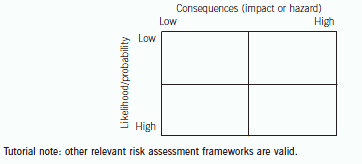
-
第4题:
(e) Internal controls are very important in a complex civil engineering project such as the Giant Dam Project.
Required:
Describe the difficulties of maintaining sound internal controls in the Giant Dam Project created by working
through sub-contractors. (4 marks)
正确答案:
(e) Control and sub-contractors
Specifically in regard to the maintenance of internal controls when working with sub-contractors, the prominent difficulties
are likely to be in the following areas:
Configuring and co-ordinating the many activities of sub-contractors so as to keep progress on track. This may involve taking
the different cultures of sub-contractor organisations into account.
Loss of direct control over activities as tasks are performed by people outside R&M’s direct employment and hence its
management structure.
Monitoring the quality of work produced by the sub-contractors. Monitoring costs will be incurred and any quality problems
will be potentially costly.
Budget ‘creep’ and cost control. Keeping control of budgets can be a problem in any large civil engineering project (such the
construction of the new Wembley Stadium in the UK) and problems are likely to be made worse when the principal contractor
does not have direct control over all activities.
Time limit over-runs. Many projects (again, such as the new Wembley Stadium, but others also) over-run significantly on time.
Tutorial note: only four difficulties need to be described. -
第5题:
(b) Discuss the statements of the operational manager of Bonlandia and assess their implications for SSH.
(4 marks)
正确答案:
(b) In a market place such as that in which SSH competes, product and service quality assumes critical significance. Quality is
a key determinant of the financial results and the level of competitiveness achieved by SSH. This will always be the case and
therefore quality may be viewed as a strategic necessity if SSH is to prosper in the future. Therefore, the statements of the
manager of Bonlandia operations are myopic at best and unethical at worst! Businesses use software in a variety of different
ways but poor quality software can do serious harm to businesses. Much will depend on the extent to which a business uses
its information for strategic reasons as opposed to meeting operational needs. The more a business uses its information
systems for strategic reasons then the greater the potential damage suffered as a consequence of poor quality software. It is
wrong for the manager of Bonlandia operations to knowingly promote the installation of poor quality business software in
clients’ businesses. The effects can be costly to clients in terms of poor planning, control and decision-making with potential
losses of client goodwill and reputation. -
第6题:
(ii) Advise Andrew of the tax implications arising from the disposal of the 7% Government Stock, clearly
identifying the tax year in which any liability will arise and how it will be paid. (3 marks)
正确答案:
(ii) Government stock is an exempt asset for the purposes of capital gains tax, however, as Andrew’s holding has a nominal
value in excess of £5,000, a charge to income tax will arise under the accrued income scheme. This charge to income
tax will arise in 2005/06, being the tax year in which the next interest payment following disposal falls due (20 April
2005) and it will relate to the income accrued for the period 21 October 2004 to 14 March 2005 of £279 (145/182
x £350). As interest on Government Stock is paid gross (unless the holder applies to receive it net), the tax due of £112
(£279 x 40%) will be collected via the self-assessment system and as the interest was an ongoing source of income
will be included within Andrew’s half yearly payments on account payable on 31 January and 31 July 2006. -
第7题:
(ii) Advise Clifford of the capital gains tax implications of the alternative of selling the Oxford house and
garden by means of two separate disposals as proposed. Calculations are not required for this part of
the question. (3 marks)
正确答案:
(ii) The implications of selling the Oxford house and garden in two separate disposals
The additional sales proceeds would result in an increase in Clifford’s capital gains and consequently his tax liability.
When computing the gain on the sale of the house together with a small part of the garden, the allowable cost would
be a proportion of the original cost. That proportion would be A/A + B where A is the value of the house and garden
that has been sold and B is the value of the part of the garden that has been retained. Principal private residence relief
and taper relief would be available in the same way as that set out in (i) above.
When computing the gain on the sale of the remainder of the garden, the cost would be the original cost of the property
less the amount used in computing the gain on the earlier disposal. Principal private residence relief would not be
available as the land sold is not a dwelling house or part of one. -
第8题:
(ii) Advise Mr Fencer of the income tax implications of the proposed financing arrangements. (2 marks)
正确答案:
(ii) The income tax implications of the proposed financing arrangements
Mr Fencer has borrowed money from a UK bank in order to make a loan to Rapier Ltd, a close company. The interest
paid by Mr Fencer to the bank will be an allowable charge on income as long as he continues to hold more than 5% of
Rapier Ltd. Charges on income are deductible in arriving at an individual’s statutory total income.
Mr Fencer will receive interest from Rapier Ltd net of 20% income tax. The gross amount of interest will be subject to
income tax at either 10%, 20% or 40% depending on whether the income falls into Mr Fencer’s starting rate, basic rate
or higher rate tax band. Mr Fencer will obtain a tax credit for the 20% income tax suffered at source. -
第9题:
(ii) The answers to any questions that the potential investors may raise in connection with the maximum
possible investment, borrowing to finance the subscription and the implications of selling the shares.
(7 marks)
Note: you should assume that Vostok Ltd and its trade qualify for the purposes of the enterprise investment
scheme and you are not required to list the conditions that need to be satisfied by the company, its
shares or its business activities.
正确答案:
(ii) Answers to questions from potential investors
Maximum investment
– For the relief to be available, a shareholder (together with spouse and children) cannot own more than 30% of the
company. Accordingly, the maximum investment by a single subscriber will be £315,000 (15,000 x £21).
Borrowing to finance the purchase
– There would normally be tax relief for the interest paid on a loan taken out to acquire shares in a close company
such as Vostok Ltd. However, this relief is not available when the shares qualify for relief under the enterprise
investment scheme.
Implications of a subscriber selling the shares in Vostok Ltd
– The income tax relief will be withdrawn if the shares in Vostok Ltd are sold within three years of subscription.
– Any profit arising on the sale of the shares in Vostok Ltd on which income tax relief has been given will be exempt
from capital gains tax provided the shares have been held for three years.
– Any capital loss arising on the sale of the shares will be allowable regardless of how long the shares have been
held. However, the loss will be reduced by the amount of income tax relief obtained in respect of the investment.
The loss may be used to reduce the investor’s taxable income, and hence his income tax liability, for the tax year
of loss and/or the preceding tax year.
– Any gain deferred at the time of subscription will become chargeable in the year in which the shares in Vostok Ltd
are sold. -
第10题:
(ii) Briefly explain the implications of Parr & Co’s audit opinion for your audit opinion on the consolidated
financial statements of Cleeves Co for the year ended 30 September 2006. (3 marks)
正确答案:
(ii) Implications for audit opinion on consolidated financial statements of Cleeves
■ If the potential adjustments to non-current asset carrying amounts and loss are not material to the consolidated
financial statements there will be no implication. However, as Howard is material to Cleeves and the modification
appears to be ‘so material’ (giving rise to adverse opinion) this seems unlikely.
Tutorial note: The question clearly states that Howard is material to Cleeves, thus there is no call for speculation
on this.
■ As Howard is wholly-owned the management of Cleeves must be able to request that Howard’s financial statements
are adjusted to reflect the impairment of the assets. The auditor’s report on Cleeves will then be unmodified
(assuming that any impairment of the investment in Howard is properly accounted for in the separate financial
statements of Cleeves).
■ If the impairment losses are not recognised in Howard’s financial statements they can nevertheless be adjusted on
consolidation of Cleeves and its subsidiaries (by writing down assets to recoverable amounts). The audit opinion
on Cleeves should then be unmodified in this respect.
■ If there is no adjustment of Howard’s asset values (either in Howard’s financial statements or on consolidation) it
is most likely that the audit opinion on Cleeves’s consolidated financial statements would be ‘except for’. (It should
not be adverse as it is doubtful whether even the opinion on Howard’s financial statements should be adverse.)
Tutorial note: There is currently no requirement in ISA 600 to disclose that components have been audited by another
auditor unless the principal auditor is permitted to base their opinion solely upon the report of another auditor. -
第11题:
() is not the advantage of GERT (Graphical evaluation and review techniques)as compared with PERT (project evaluation and review techniques).A.Allowing looping
B.Allowing for dummy tasks
C.Allowing branching
D.Allowing multiple project end results答案:B解析:与PERT(计划评审法)相比()不是GERT(图表评审法)的优势。A、允许循环B、允许虚活动C、允许分支D、允许多个项目的最终结果 -
第12题:
问答题Practice 4 Few creations of big technology capture the imagination like giant dams. Perhaps it is humankind’s long suffering at the mercy of flood and drought that makes the ideal of forcing the waters to do our bidding so fascinating. But to be fascinated is also, sometimes, to be blind. Several giant dam projects threaten to do more harm than good. The lesson from dams is that big is not always beautiful. It doesn’t help that building a big, powerful dam has become a symbol of achievement for nations and people striving to assert themselves. Egypt’s leadership in the Arab world was cemented by the Aswan High Dam. Turkey’s bid for First World status includes the giant Ataturk Dam.正确答案:
【参考译文】
重大技术的创造中,几乎没有哪个比巨型大坝更令人心驰神往。也许正是由于人类长期遭受旱涝之灾才使得让洪水听从人的调遣这种理想如此令人痴迷。但使人痴迷有时也就使人盲目。有几个巨型大坝项目可能弊大于利。
从堤坝中获得的教训是,大的并不总是美的。对于那些在努力显示自身力量的国家和人民,建一个功能强大的大水坝标志着他们取得了成就,然而修建大坝并没有什么实际作用。埃及的阿拉伯世界的领导地位因阿斯旺大坝得以巩固和加强,土耳其在其争取跻身于第一世界的努力中也包括建造阿搭特克大坝。解析: 暂无解析 -
第13题:
(c) the deferred tax implications (with suitable calculations) for the company which arise from the recognition
of a remuneration expense for the directors’ share options. (7 marks)
正确答案:
-
第14题:
1 Rowlands & Medeleev (R&M), a major listed European civil engineering company, was successful in its bid to become
principal (lead) contractor to build the Giant Dam Project in an East Asian country. The board of R&M prided itself in
observing the highest standards of corporate governance. R&M’s client, the government of the East Asian country, had
taken into account several factors in appointing the principal contractor including each bidder’s track record in large
civil engineering projects, the value of the bid and a statement, required from each bidder, on how it would deal with
the ‘sensitive issues’ and publicity that might arise as a result of the project.
The Giant Dam Project was seen as vital to the East Asian country’s economic development as it would provide a
large amount of hydroelectric power. This was seen as a ‘clean energy’ driver of future economic growth. The
government was keen to point out that because hydroelectric power did not involve the burning of fossil fuels, the
power would be environmentally clean and would contribute to the East Asian country’s ability to meet its
internationally agreed carbon emission targets. This, in turn, would contribute to the reduction of greenhouse gases
in the environment. Critics, such as the environmental pressure group ‘Stop-the-dam’, however, argued that the
project was far too large and the cost to the local environment would be unacceptable. Stop-the-dam was highly
organised and, according to press reports in Europe, was capable of disrupting progress on the dam by measures such
as creating ‘human barriers’ to the site and hiding people in tunnels who would have to be physically removed before
proceeding. A spokesman for Stop-the-dam said it would definitely be attempting to resist the Giant Dam Project when
construction started.
The project was intended to dam one of the region’s largest rivers, thus creating a massive lake behind it. The lake
would, the critics claimed, not only displace an estimated 100,000 people from their homes, but would also flood
productive farmland and destroy several rare plant and animal habitats. A number of important archaeological sites
would also be lost. The largest community to be relocated was the indigenous First Nation people who had lived on
and farmed the land for an estimated thousand years. A spokesman for the First Nation community said that the ‘true
price’ of hydroelectric power was ‘misery and cruelty’. A press report said that whilst the First Nation would be unlikely
to disrupt the building of the dam, it was highly likely that they would protest and also attempt to mobilise opinion in
other parts of the world against the Giant Dam Project.
The board of R&M was fully aware of the controversy when it submitted its tender to build the dam. The finance
director, Sally Grignard, had insisted on putting an amount into the tender for the management of ‘local risks’. Sally
was also responsible for the financing of the project for R&M. Although the client was expected to release money in
several ‘interim payments’ as the various parts of the project were completed to strict time deadlines, she anticipated
a number of working capital challenges for R&M, especially near the beginning where a number of early stage costs
would need to be incurred. There would, she explained, also be financing issues in managing the cash flows to R&M’s
many subcontractors. Although the major banks financed the client through a lending syndicate, R&M’s usual bank
said it was wary of lending directly to R&M for the Giant Dam Project because of the potential negative publicity that
might result. Another bank said it would provide R&M with its early stage working capital needs on the understanding
that its involvement in financing R&M to undertake the Giant Dam Project was not disclosed. A press statement from
Stop-the-dam said that it would do all it could to discover R&M’s financial lenders and publicly expose them. Sally
told the R&M board that some debt financing would be essential until the first interim payments from the client
became available.
When it was announced that R&M had won the contract to build the Giant Dam Project, some of its institutional
shareholders contacted Richard Markovnikoff, the chairman. They wanted reassurance that the company had fully
taken the environmental issues and other risks into account. One fund manager asked if Mr Markovnikoff could
explain the sustainability implications of the project to assess whether R&M shares were still suitable for his
environmentally sensitive clients. Mr Markovnikoff said, through the company’s investor relations department, that he
intended to give a statement at the next annual general meeting (AGM) that he hoped would address these
environmental concerns. He would also, he said, make a statement on the importance of confidentiality in the
financing of the early stage working capital needs.
(a) Any large project such as the Giant Dam Project has a number of stakeholders.
Required:
(i) Define the terms ‘stakeholder’ and ‘stakeholder claim’, and identify from the case FOUR of R&M’s
external stakeholders as it carries out the Giant Dam Project; (6 marks)
正确答案:
(a) (i) Stakeholders
A stakeholder can be defined as any person or group that can affect or be affected by an entity. In this case, stakeholders
are those that can affect or be affected by the building of the Giant Dam Project. Stakeholding is thus bi-directional.
Stakeholders can be those (voluntarily or involuntarily) affected by the activities of an organisation or the stakeholder
may be seeking to influence the organisation in some way.
All stakeholding is characterised by the making of ‘claims’ upon an organisation. Put simply, stakeholders ‘want
something’ although in some cases, the ‘want’ may not be known by the stakeholder (such as future generations). It is
the task of management to decide on the strengths of each stakeholder’s claim in formulating strategy and in making
decisions. In most situations it is likely that some stakeholder claims will be privileged over others.
R&M’s external stakeholders include:
– The client (the government of the East Asian country)
– Stop-the-dam pressure group
– First Nation (the indigenous people group)
– The banks that will be financing R&M’s initial working capital
– Shareholders -
第15题:
(c) Using information from the case, assess THREE risks to the Giant Dam Project. (9 marks)
正确答案:
(c) Assessment of three risks
Disruption and resistance by Stop-the-dam. Stop-the-dam seems very determined to delay and disrupt progress as much as
possible. The impact of its activity can be seen on two levels. It is likely that the tunnelling and other ‘human’ disruption will
cause a short-term delay but the more significant impact is that of exposing the lenders. In terms of probability, the case says
that it ‘would definitely be attempting to resist the Giant Dam Project when it started’ but the probability of exposing the
lenders is a much lower probability event if the syndicate membership is not disclosed.
Impact/hazard: low
Probability/likelihood: high
The risk to progress offered by First Nation can probably be considered to be low impact/hazard but high probability. The case
says that it ‘would be unlikely to disrupt the building of the dam’, meaning low impact/hazard, but that ‘it was highly likely
that they would protest’, meaning a high level of probability that the risk event would occur.
Impact: low
Probability: high
There are financing risks as banks seems to be hesitant when it comes to lending to R&M for the project. Such a risk event,
if realised, would have a high potential for disruption to progress as it may leave R&M with working capital financing
difficulties. The impact would be high because the bank may refuse to grant or extend loans if exposed (subject to existing
contractual terms). It is difficult to estimate the probability. Perhaps there will be a range of attitudes by the lending banks
with some more reticent than others (perhaps making it a ‘medium’ probability event).
Impact: medium to high (depending on the reaction of the bank)
Probability: low to medium (depending on how easy it would be to discover the lender) -
第16题:
(d) Explain the term ‘environmental management accounting’ and the benefits that may accrue to organisations
which adopt it. (4 marks)
正确答案:
(d) Environmental management accounting (EMA) involves the generation and analysis of both financial and non-financial
information in order to support internal environmental management processes. It is complementary to the conventional
management accounting approach, with the aim to develop appropriate mechanisms that assist the management of
organisations in the identification and allocation of environmentally related costs.
Organisations that alter their management accounting practices to incorporate environmental concerns will have greater
awareness of the impact of environment-related activities on their profit and loss accounts and balance sheets. This is because
conventional management accounting systems tend to attribute many environmental costs to general overhead accounts with
the result that they are ‘hidden’ from management. It follows that organisations which adopt EMA are more likely to identify
and take advantage of cost reduction and other improvement opportunities. A concern with environmental costs will also
reduce the chances of employing incorrect pricing of products and services and taking the wrong options in terms of mix and
development decisions. This in turn may lead to enhanced customer value whilst reducing the risk profile attaching to
investments and other decisions which have long term consequences.
Reputational risk will also be reduced as a consequence of adopting (EMA) since management will be seen to be acting in
an environmentally responsible manner. Organisations can learn from the Shell Oil Company whose experience in the much
publicised Brent Spar incident cost the firm millions in terms of lost revenues as a result of a consumer boycott. -
第17题:
(ii) Explain the income tax (IT), national insurance (NIC) and capital gains tax (CGT) implications arising on
the grant to and exercise by an employee of an option to buy shares in an unapproved share option
scheme and on the subsequent sale of these shares. State clearly how these would apply in Henry’s
case. (8 marks)
正确答案:
(ii) Exercising of share options
The share option is not part of an approved scheme, and will not therefore enjoy the benefits of such a scheme. There
are three events with tax consequences – grant, exercise and sale.
Grant. If shares or options over shares are sold or granted at less than market value, an income tax charge can arise on
the difference between the price paid and the market value. [Weight v Salmon]. In addition, if options can be exercised
more than 10 years after the date of the grant, an employment income charge can arise. This is based on the market
value at the date of grant less the grant and exercise priced.
In Henry’s case, the options were issued with an exercise price equal to the then market value, and cannot be exercised
more than 10 years from the grant. No income tax charge therefore arises on grant.
Exercise. On exercise, the individual pays the agreed amount in return for a number of shares in the company. The price
paid is compared with the open market value at that time, and if less, the difference is charged to income tax. National
insurance also applies, and the company has to pay Class 1 NIC. If the company and shareholder agree, the national
insurance can be passed onto the individual, and the liability becomes a deductible expense in calculating the income
tax charge.
In Henry’s case on exercise, the difference between market value (£14) and the price paid (£1) per share will be taxed
as income. Therefore, £130,000 (10,000 x (£14 – £1)) will be taxed as income. In addition, national insurance will
be chargeable on the company at 12·8% (£16,640) and on Henry at the rate of 1% (£1,300).
Sale. The base cost of the shares is taken to be the market value at the time of exercise. On the sale of the shares, any
gain or loss arising falls under the capital gains tax rules, and CGT will be payable on any gain. Business asset taper
relief will be available as the company is an unquoted trading company, but the relief will only run from the time that
the share options are exercised – i.e. from the time when the shares were acquired.
In Henry’s case, the sale of the shares will immediately follow the exercise of the option (6 days later). The sale proceeds
and the market value at the time of exercise are likely to be similar; thus little to no gain is likely to arise. -
第18题:
(ii) State the taxation implications of both equity and loan finance from the point of view of a company.
(3 marks)
正确答案:
(ii) A company needs to be aware of the following issues:
Equity
(1) Costs incurred in issuing share capital are not allowed as a trading deduction.
(2) Distributions to investors are not allowed as a trading deduction.
(3) The cost of making distributions to shareholders are disallowable.
(4) Where profits are taxed at an effective rate of less than 19%, any profits used to make a distribution to noncorporate
shareholders will themselves be taxed at the full 19% rate.
Loan finance/debt
(1) The incidental costs of obtaining/raising loan finance are broadly deductible as a trading expense.
(2) Capital costs of raising loan finance (for example, loans issued at a discount) are not deductible for tax purposes.
(3) Interest incurred on a loan to finance a business is deductible from trading income. -
第19题:
(ii) The UK value added tax (VAT) implications for Razor Ltd of selling tools to and purchasing tools from
Cutlass Inc; (2 marks)
正确答案:
(ii) Value added tax (VAT)
Goods exported are zero-rated. Razor Ltd must retain appropriate documentary evidence that the export has taken place.
Razor Ltd must account for VAT on the value of the goods purchased from Cutlass Inc at the time the goods are brought
into the UK. The VAT payable should be included as deductible input tax on the company’s VAT return. -
第20题:
(b) Explain the corporation tax and value added tax (VAT) implications of the following aspects of the proposed
restructuring of the Rapier Ltd group.
(i) The immediate tax implications of the restructuring. (6 marks)
正确答案:
(b) The tax implications of the proposed restructuring of the Rapier Ltd group
(i) Immediate implications
Corporation tax
Rapier Ltd and its subsidiaries are in a capital gains group as Rapier Ltd owns at least 75% of the ordinary share capital
of each of the subsidiary companies. Any non-exempt items of plant and machinery owned by the subsidiaries will
therefore be transferred to Rapier Ltd at no gain, no loss.
No taxable credit or allowable debit will arise on the transfer of the subsidiaries’ goodwill to Rapier Ltd because the
companies are in a capital gains group.
The trading losses brought forward in Dirk Ltd will be transferred with the trade to Rapier Ltd as the effective ownership
of the three trades will not change (Rapier Ltd owns the subsidiaries which own the trades and, following the
restructuring, will own the three trades directly). The losses will be restricted to being offset against the future trading
profits of the Dirk trade only.
There will be no balancing adjustments in respect of the plant and machinery transferred to Rapier Ltd. Writing down
allowances will be claimed by the subsidiaries in respect of the year ending 30 June 2007 and by Rapier Ltd in respect
of future periods.
Value added tax (VAT)
No VAT should be charged on the sales of the businesses to Rapier Ltd as they are outside the scope of VAT. This is
because the trades are to be transferred as going concerns to a VAT registered person with no significant break in trading.
Switch Ltd must notify HM Revenue and Customs by 30 July 2007 that it has ceased to make taxable supplies. -
第21题:
What does the author mainly discuss in the text?
A. Technology. B. Sustainability.
C. Ethanol energy. D. Environmental protection.
正确答案:B
-
第22题:
(c) Identify and discuss the implications for the audit report if:
(i) the directors refuse to disclose the note; (4 marks)
正确答案:
(c) (i) Audit report implications
Audit procedures have shown that there is a significant level of doubt over Dexter Co’s going concern status. IAS 1
requires that disclosure is made in the financial statements regarding material uncertainties which may cast significant
doubt on the ability of the entity to continue as a going concern. If the directors refuse to disclose the note to the financial
statements, there is a clear breach of financial reporting standards.
In this case the significant uncertainty is caused by not knowing the extent of the future availability of finance needed
to fund operating activities. If the note describing this uncertainty is not provided, the financial statements are not fairly
presented.
The audit report should contain a qualified or an adverse opinion due to the disagreement. The auditors need to make
a decision as to the significance of the non-disclosure. If it is decided that without the note the financial statements are
not fairly presented, and could be considered misleading, an adverse opinion should be expressed. Alternatively, it could
be decided that the lack of the note is material, but not pervasive to the financial statements; then a qualified ‘except
for’ opinion should be expressed.
ISA 570 Going Concern and ISA 701 Modifications to the Independent Auditor’s Report provide guidance on the
presentation of the audit report in the case of a modification. The audit report should include a paragraph which contains
specific reference to the fact that there is a material uncertainty that may cast significant doubt about the entity’s ability
to continue as a going concern. The paragraph should include a clear description of the uncertainties and would
normally be presented immediately before the opinion paragraph. -
第23题:
( )is not the advantage of GERT (Graphical evaluation and review techniques)as compared with PERT (project evaluation and review techniques).
- A、Allowing looping
- B、Allowing for dummy tasks
- C、Allowing branching
- D、Allowing multiple project end results
正确答案:B