
(b) Donald actually decided to operate as a sole trader. The first year’s results of his business were not as he hadhoped, and he made a trading loss of £8,000 in the year to 31 March 2007. However, trading is now improving,and Donald has sufficient order
题目
(b) Donald actually decided to operate as a sole trader. The first year’s results of his business were not as he had
hoped, and he made a trading loss of £8,000 in the year to 31 March 2007. However, trading is now improving,
and Donald has sufficient orders to ensure that the business will make profits of at least £30,000 in the year to
31 March 2008.
In order to raise funds to support his business over the last 15 months, Donald has sold a painting which was
given to him on the death of his grandmother in January 1998. The probate value of the painting was £3,200,
and Donald sold it for £8,084 (after deduction of 6% commission costs) in November 2006.
He also sold other assets in the year of assessment 2006/07, realising further chargeable gains of £8,775 (after
indexation of £249 and taper relief of £975).
Required:
(i) Calculate the chargeable gain on the disposal of the painting in November 2006. (4 marks)
相似考题
更多“(b) Donald actually decided to operate as a sole trader. The first year’s results of his business were not as he hadhoped, and he made a trading loss of £8,000 in the year to 31 March 2007. However, trading is now improving,and Donald has sufficient order”相关问题
-
第1题:
6 Alasdair, aged 42, is single. He is considering investing in property, as he has heard that this represents a good
investment. In order to raise the funds to buy the property, he wants to extract cash from his personal company, Beezer
Limited, whose year end is 31 December.
Beezer Limited was formed on 1 May 1998 with £1,000 of capital issued as 1,000 £1 ordinary shares, and traded
until 1 January 2005 when Alasdair sold the trade and related assets. The company’s only asset is cash of
£120,000. Alasdair wants to extract this cash from the company with the minimum amount of tax payable. He is
considering either, paying himself a dividend of £120,000, on 31 March 2006, after which the company would have
no assets and be wound up or, leaving the cash in the company and then liquidating the company. Costs of liquidation
of £5,000 would then be incurred.
Since Beezer Limited ceased trading, Alasdair has been taken on as a partner at a marketing firm, Gallus & Co. He
estimates his profit share for the year of assessment 2005/06 will be £30,000. He has not made any capital disposals
in the current tax year.
Alasdair wishes to reinvest the cash extracted from Beezer Limited in property but is not sure whether he should invest
directly in residential or commercial property, or do so via some form. of collective investment. He is aware that Gallus
& Co are looking to rent a new warehouse which could be bought for £200,000. Alasdair thinks that he may be able
to buy the warehouse himself and lease it to his firm, but only if he can borrow the additional money to buy the
property.
Alasdair has a 25% shareholding in another company, Glaikit Limited, whose year end is 31 March. The remaining
shares in this company are held by his friend, Gill. Alasdair is considering borrowing £15,000 from Glaikit Limited
on 1 January 2006. He does not intend to pay any interest on the loan, which is likely to be written off some time
in 2007. Alasdair does not have any connection with Glaikit Limited other than his shareholding.
Required:
(a) Advise Alasdair whether or not a dividend payment will result in a higher after-tax cash sum than the
liquidation of Beezer Limited. Assume that either the dividend would be paid on 31 March 2006 or the
liquidation would take place on 31 March 2006. (9 marks)
Assume that Beezer Limited has always paid corporation tax at or above the small companies rate of 19%
and that the tax rates and allowances for 2004/05 apply throughout this part.
正确答案: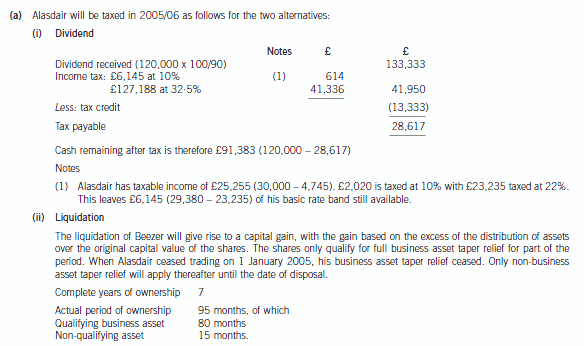
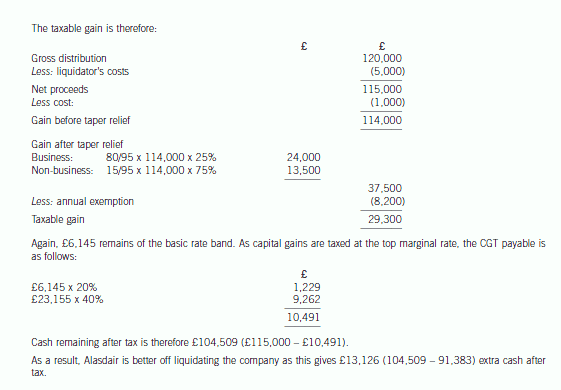
-
第2题:
4 Assume today’s date is 15 May 2005.
In March 1999, Bob was made redundant from his job as a furniture salesman. He decided to travel round the world,
and did so, returning to the UK in May 2001. Bob then decided to set up his own business selling furniture. He
started trading on 1 October 2001. After some initial success, the business made losses as Bob tried to win more
customers. However, he was eventually successful, and the business subsequently made profits.
The results for Bob’s business were as follows:
Period Schedule D Case I
Trading Profits/(losses)
£
1 October 2001 – 30 April 2002 13,500
1 May 2002 – 30 April 2003 (18,000)
1 May 2003 – 30 April 2004 28,000
Bob required funds to help start his business, so he raised money in three ways:
(1) Bob is a keen cricket fan, and in the 1990s, he collected many books on cricket players. To raise money, Bob
started selling books from his collection. These had risen considerably in value and sold for between £150 and
£300 per book. None of the books forms part of a set. Bob created an internet website to advertise the books.
Bob has not declared this income, as he believes that the proceeds from selling the books are non-taxable.
(2) He disposed of two paintings and an antique silver coffee set at auction on 1 December 2004, realising
chargeable gains totalling £23,720.
(3) Bob took a part time job in a furniture store on 1 January 2003. His annual salary has remained at £12,600
per year since he started this employment.
Bob has 5,000 shares in Willis Ltd, an unquoted trading company based in the UK. He subscribed for these shares
in August 2000, paying £3 per share. On 1 December 2004, Bob received a letter informing him that the company
had gone into receivership. As a result, his shares were almost worthless. The receivers dealing with the company
estimated that on the liquidation of the company, he would receive no more than 10p per share for his shareholding.
He has not yet received any money.
Required:
(a) Write a letter to Bob advising him on whether or not he is correct in believing that his book sales are nontaxable.
Your advice should include reference to the badges of trade and their application to this case.
(9 marks)
正确答案:
(a) Evidence of trading
[Client address]
[Own address]
[Date]
Dear Bob,
I note that you have been selling some books in order to raise some extra income. While you believe that the sums are not
taxable, I believe that there may be a risk of the book sales being treated as a trade, and therefore taxable under Schedule D
Case I. We need to refer to guidance in the form. of a set of principles known as the ‘badges of trade’. These help determine
whether or not a trade exists, and need to be looked at in their entirety. The badges are as follows.
1. The subject matter
Some assets can be enjoyed by themselves as an investment, while others (such as large amounts of aircraft linen) are
clearly not. It is likely that such assets are acquired as trading stock, and are therefore a sign of trading. Sporting books
can be an investment, and so this test is not conclusive.
2. Frequency of transactions
Where transactions are frequent (not one-offs), this suggests trading. You have sold several books, which might suggest
trading, although you have only done this for a short period - between one and two years.
3. Length of ownership
Where items are bought and sold soon afterwards, this indicates trading. You bought your books in the 1990s, and the
length of time between acquisition and sale would not suggest trading.
4. Supplementary work and marketing
You are actively marketing the books on your internet website, which is an indication of trading.
5. Profit motive
A motive to make profit suggests trading activity. You sold the books to raise funds for your property business, and not
to make a profit as such, which suggests that your motive was to raise cash, and not make profits.
6. The way in which the asset sold was acquired.
Selling assets which were acquired unintentionally (such as a gift) is not usually seen as trading. You acquired the books
for your collection over a period of time, and while these were intentional acquisitions, the reasons for doing so were for
your personal pleasure.
By applying all of these tests, it should be possible to argue that you were not trading, merely selling some assets in
order to generate short-term cash for your business.
The asset disposals will be taxed under the capital gain tax rules, but as the books are chattels and do not form. part of
a set, they will be exempt from capital gains tax.
Yours sincerely
A N. Accountant -
第3题:
3 On 1 January 2007 Dovedale Ltd, a company with no subsidiaries, intends to purchase 65% of the ordinary share
capital of Hira Ltd from Belgrove Ltd. Belgrove Ltd currently owns 100% of the share capital of Hira Ltd and has no
other subsidiaries. All three companies have their head offices in the UK and are UK resident.
Hira Ltd had trading losses brought forward, as at 1 April 2006, of £18,600 and no income or gains against which
to offset losses in the year ended 31 March 2006. In the year ending 31 March 2007 the company expects to make
further tax adjusted trading losses of £55,000 before deduction of capital allowances, and to have no other income
or gains. The tax written down value of Hira Ltd’s plant and machinery as at 31 March 2006 was £96,000 and
there will be no fixed asset additions or disposals in the year ending 31 March 2007. In the year ending 31 March
2008 a small tax adjusted trading loss is anticipated. Hira Ltd will surrender the maximum possible trading losses
to Belgrove Ltd and Dovedale Ltd.
The tax adjusted trading profit of Dovedale Ltd for the year ending 31 March 2007 is expected to be £875,000 and
to continue at this level in the future. The profits chargeable to corporation tax of Belgrove Ltd are expected to be
£38,000 for the year ending 31 March 2007 and to increase in the future.
On 1 February 2007 Dovedale Ltd will sell a small office building to Hira Ltd for its market value of £234,000.
Dovedale Ltd purchased the building in March 2005 for £210,000. In October 2004 Dovedale Ltd sold a factory
for £277,450 making a capital gain of £84,217. A claim was made to roll over the gain on the sale of the factory
against the acquisition cost of the office building.
On 1 April 2007 Dovedale Ltd intends to acquire the whole of the ordinary share capital of Atapo Inc, an unquoted
company resident in the country of Morovia. Atapo Inc sells components to Dovedale Ltd as well as to other
companies in Morovia and around the world.
It is estimated that Atapo Inc will make a profit before tax of £160,000 in the year ending 31 March 2008 and will
pay a dividend to Dovedale Ltd of £105,000. It can be assumed that Atapo Inc’s taxable profits are equal to its profit
before tax. The rate of corporation tax in Morovia is 9%. There is a withholding tax of 3% on dividends paid to
non-Morovian resident shareholders. There is no double tax agreement between the UK and Morovia.
Required:
(a) Advise Belgrove Ltd of any capital gains that may arise as a result of the sale of the shares in Hira Ltd. You
are not required to calculate any capital gains in this part of the question. (4 marks)
正确答案:
(a) Capital gains that may arise on the sale by Belgrove Ltd of shares in Hira Ltd
Belgrove Ltd will realise a capital gain on the sale of the shares unless the substantial shareholding exemption applies. The
exemption will be given automatically provided all of the following conditions are satisfied.
– Belgrove Ltd has owned at least 10% of Hira Ltd for a minimum of 12 months during the two years prior to the sale.
– Belgrove Ltd is a trading company or a member of a trading group during that 12-month period and immediately after
the sale.
– Hira Ltd is a trading company or the holding company of a trading group during that 12-month period and immediately
after the sale.
Hira Ltd will no longer be in a capital gains group with Belgrove Ltd after the sale. Accordingly, a capital gain, known as a
degrouping charge, may arise in Hira Ltd. A degrouping charge will arise if, at the time it leaves the Belgrove Ltd group, Hira
Ltd owns any capital assets which were transferred to it at no gain, no loss within the previous six years by a member of the
Belgrove Ltd capital gains group. -
第4题:
4 (a) For this part, assume today’s date is 1 March 2006.
Bill and Ben each own 50% of the ordinary share capital in Flower Limited, an unquoted UK trading company
that makes electronic toys. Flower Limited was incorporated on 1 August 2005 with 1,000 £1 ordinary shares,
and commenced trading on the same day. The business has been successful, and the company has accumulated
a large cash balance of £180,000, which is to be used to purchase a new factory. However, Bill and Ben have
received an offer from a rival company, which they are considering. The offer provides Bill and Ben with two
alternative methods of payment for the purchase of their shares:
(i) £480,000 for the company, inclusive of the £180,000 cash balance.
(ii) £300,000 for the company assuming the cash available for the factory purchase is extracted prior to sale.
Bill and Ben each currently receive a gross salary of £3,750 per month from Flower Limited. Part of the offer
terms is that Bill and Ben would be retained as employees of the company on the same salary.
Neither Bill nor Ben has used any of their capital gains tax annual exemption for the tax year 2005/06.
Required:
(i) Calculate which of the following means of extracting the £180,000 from Flower Limited on 31 March
2006 will result in the highest after tax cash amount for Bill and Ben:
(1) payment of a dividend, or
(2) payment of a salary bonus.
You are not required to consider the corporation tax (CT) implications for Flower Limited in your
answer. (5 marks)
正确答案: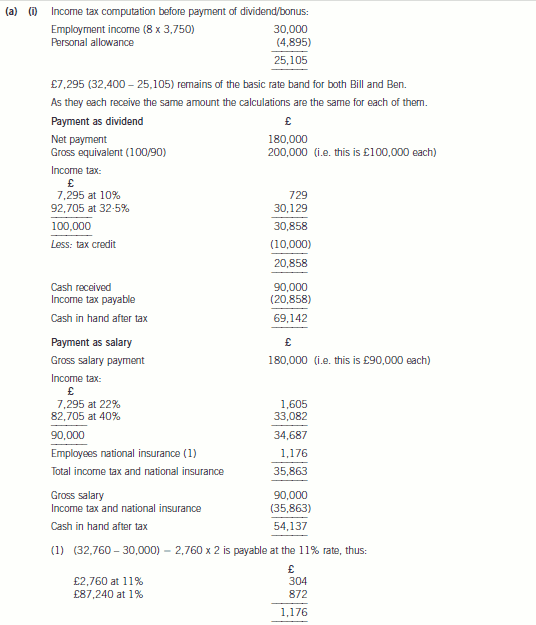
As a result, Bill and Ben would each be better off by £15,005 (69,142 – 54,137). If the cash were extracted by way
of dividend.
Tutorial note: In this answer the employers’ national insurance liability on the salary has been ignored. Credit would be
given to a candidate who recognised this issue. -
第5题:
6 Sergio and Gerard each inherited a half interest in a property, ‘Hilltop’, in October 2005. ‘Hilltop’ had a probate value
of £124,000, but in November 2005 it was badly damaged by fire. In January 2006 the insurance company made
a payment of £81,700 each to Sergio and Gerard. In February 2006 Sergio and Gerard each spent £55,500 of the
insurance proceeds on restoring the property. ‘Hilltop’ was worth £269,000 following the restoration work. In July
2006, Sergio and Gerard sold ‘Hilltop’ for £310,000.
Sergio is 69 years old and a widower with three adult children and seven grandchildren. His annual income consists
of a pension of £9,900 and interest of £300 on savings of £7,600 in a bank deposit account. Sergio owns his home
but no other significant assets. He plans to buy a domestic rental property with the proceeds from the sale of ‘Hilltop’,
such that on his death he will have a significant asset which can be sold and divided between the members of his
family.
Gerard is 34 years old. He is employed by Fizz plc on a salary of £66,500 per year together with a performance
related bonus. Gerard estimates that he will receive a bonus in December 2007 of £4,500, in line with previous
years, and that his taxable benefits in the tax year 2007/08 will amount to £7,140. He also expects to receive
dividends from UK companies of £1,935 and bank interest of £648 in the tax year 2007/08. Gerard intends to set
up a personal pension plan in August 2007. He has not made any pension contributions in the past and proposes to
use part of the proceeds from the sale of ‘Hilltop’ to make the maximum possible tax allowable contribution.
Fizz plc has announced that it intends to replace the performance related bonus scheme with a share incentive plan,
also linked to performance, with effect from 6 April 2008. Gerard estimates that Fizz plc will award him free shares
worth £2,100 each year. He will also purchase partnership shares worth £700 each year and, as a result, will be
awarded matching shares (further free shares) worth £1,400.
Required:
(a) Calculate the chargeable gains arising on the receipt of the insurance proceeds in January 2006 and the sale
of ‘Hilltop’ in July 2006. You should assume that any elections necessary to minimise the gain on the receipt
of the insurance proceeds have been submitted. (4 marks)
正确答案: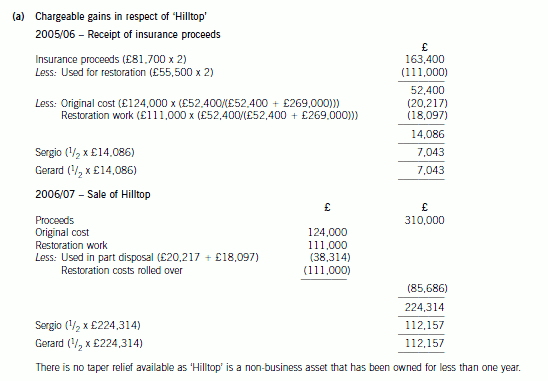
-
第6题:
5 Crusoe has contacted you following the death of his father, Noland. Crusoe has inherited the whole of his father’s
estate and is seeking advice on his father’s capital gains tax position and the payment of inheritance tax following his
death.
The following information has been extracted from client files and from telephone conversations with Crusoe.
Noland – personal information:
– Divorcee whose only other relatives are his sister, Avril, and two grandchildren.
– Died suddenly on 1 October 2007 without having made a will.
– Under the laws of intestacy, the whole of his estate passes to Crusoe.
Noland – income tax and capital gains tax:
– Has been a basic rate taxpayer since the tax year 2000/01.
– Sales of quoted shares resulted in:
– Chargeable gains of £7,100 and allowable losses of £17,800 in the tax year 2007/08.
– Chargeable gains of approximately £14,000 each tax year from 2000/01 to 2006/07.
– None of the shares were held for long enough to qualify for taper relief.
Noland – gifts made during lifetime:
– On 1 December 1999 Noland gave his house to Crusoe.
– Crusoe has allowed Noland to continue living in the house and has charged him rent of £120 per month
since 1 December 1999. The market rent for the house would be £740 per month.
– The house was worth £240,000 at the time of the gift and £310,000 on 1 October 2007.
– On 1 November 2004 Noland transferred quoted shares worth £232,000 to a discretionary trust for the benefit
of his grandchildren.
Noland – probate values of assets held at death: £
– Portfolio of quoted shares 370,000
Shares in Kurb Ltd 38,400
Chattels and cash 22,300
Domestic liabilities including income tax payable (1,900)
– It should be assumed that these values will not change for the foreseeable future.
Kurb Ltd:
– Unquoted trading company
– Noland purchased the shares on 1 December 2005.
Crusoe:
– Long-standing personal tax client of your firm.
– Married with two young children.
– Successful investment banker with very high net worth.
– Intends to gift the portfolio of quoted shares inherited from Noland to his aunt, Avril, who has very little personal
wealth.
Required:
(a) Prepare explanatory notes together with relevant supporting calculations in order to quantify the tax relief
potentially available in respect of Noland’s capital losses realised in 2007/08. (4 marks)
正确答案: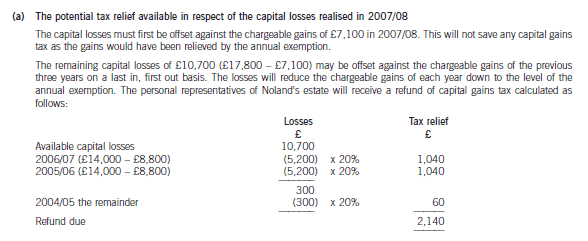
-
第7题:
(ii) Write a letter to Donald advising him on the most tax efficient manner in which he can relieve the loss
incurred in the year to 31 March 2007. Your letter should briefly outline the types of loss relief available
and explain their relative merits in Donald’s situation. Assume that Donald will have no source of income
other than the business in the year of assessment 2006/07 and that any income he earned on a parttime
basis while at university was always less than his annual personal allowance. (9 marks)
Assume that the corporation tax rates and allowances for the financial year 2004 and the income tax rates
and allowances for 2004/05 apply throughout this question.
Relevant retail price index figures are:
January 1998 159·5
April 1998 162·6
正确答案:(ii) [Donald’s address] [Firm’s address]
Dear Donald [Date]
I understand that you have incurred a tax loss in your first year of trading. The following options are available in respect
of this loss.
1. The first option is to use the trading loss against other forms of income in the same year. If such a claim is made,
losses are offset against income before personal allowances.
Any excess loss can still be offset against capital gains of the year. However, any offset against capital gains is
before both taper relief and annual exemptions.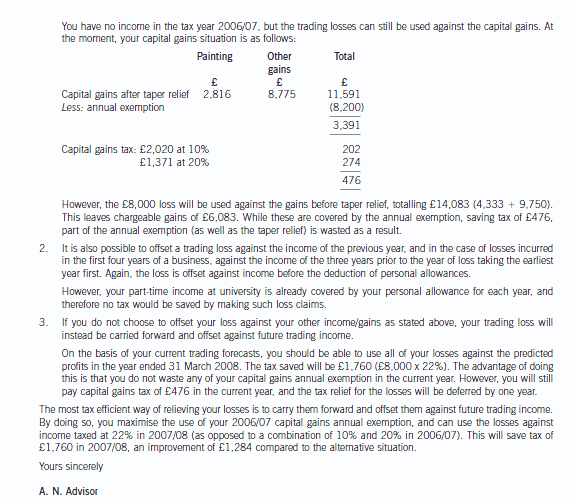
-
第8题:
3 The Stiletto Partnership consisted of three partners, Clint, Ben and Amy, who shared the profits of the business
equally. On 28 February 2007 the partners sold the business to Razor Ltd, in exchange for shares in Razor Ltd, with
each former partner owning one third of the new company.
The recent, tax adjusted, trading profits of the Stiletto Partnership have been as follows:
£
Year ended 30 June 2006 92,124
1 July 2006 to 28 February 2007 81,795
Clint, who was 65 on 5 October 2006, retired when the business was sold to Razor Ltd. He is now suggesting that
if the sale of the partnership, and his retirement, had been delayed until 30 April 2007, his total tax liability would
have been reduced. Clint’s only other income is gross pension income of £6,100 per year, which he began receiving
in the tax year 2005/06. Clint did not receive any salary or dividends from Razor Ltd. It is estimated that the
partnership’s tax adjusted trading profits for the period from 1 March 2007 to 30 April 2007 would have been
£20,760. Clint has overlap profits of £14,250 brought forward from when the partnership began trading.
Razor Ltd manufactures industrial cutting tools. On 1 July 2007, Razor Ltd will subscribe for the whole of the ordinary
share capital of Cutlass Inc, a company newly incorporated in the country of Sharpenia. It is intended that Cutlass
Inc will purchase partly finished tools from Razor Ltd and customise them in Sharpenia. It is anticipated that Cutlass
Inc’s annual profits chargeable to corporation tax will be approximately £120,000.
Ben and Amy will be the directors of Cutlass Inc, although Ben will not be involved in the company’s business on a
day-to-day basis. Amy intends to spend one or two weeks each month in the country of Sharpenia looking after the
company’s affairs. The remainder of her time will be spent in the UK. Amy has employment contracts with both Razor
Ltd and Cutlass Inc and her duties for Cutlass Inc will be carried out wholly in Sharpenia. Cutlass Inc will pay for
Amy’s flights to and from Sharpenia and for her husband and baby to visit her there twice a year. Amy is currently
UK resident and ordinarily resident.
The system of income tax and corporation tax in the country of Sharpenia is broadly similar to that in the UK although
the rate of corporation tax is 38% regardless of the level of profits. There is a double tax treaty between the UK and
Sharpenia based on the OECD model treaty. The clause in the treaty dealing with company residency states that a
company resident in both countries under domestic law will be regarded under the treaty as being resident only in the
country where it is effectively managed and controlled. Sharpenia is not a member of the European Union.
Required:
(a) (i) Calculate Clint’s taxable trading profits for the tax years 2006/07 and 2007/08 for both of the
alternative retirement dates (28 February 2007 and 30 April 2007). (3 marks)
正确答案: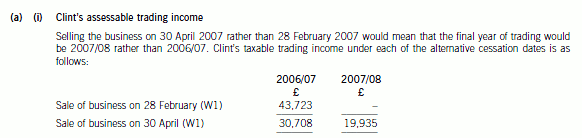
-
第9题:
John Smith is a student in his first year at university, so he is _____.A.freshman
B.sophomore
C.junior
D.senior
答案:A
解析:句意为:John Smith是一名大一新生,所以他是()。freshman意为“新生”,sophomore意为“大学二年级生”,junior意为“大学三年级生”,senior意为“大学四年级生,毕业班生”,所以答案选A。
-
第10题:
共用题干
A Success Story
At 19,Ben Way is already a millionaire,and one of a growing number of teenagers who have ______(51)their fortune through the Internet.______(52)makes Ben's story all the more remarkable is that he is dyslexic,and was______(53)by teachers at his junior school that he would never be able to read or write______(54).“I wanted to prove them______(55)”, says Ben,creator and director of Waysearch,a net search engine which can be used ______(56)find goods in online shopping malls.
When he was eight,his local authorities provided him with a PC to help with school work.
Although he was______(57)to read the manuals,he had a natural ability with the computer, and______(58)by his father,he soon began______(59)people£10 an hour for his
knowledge and skills.At the age of 15 he______(60)up his own computer consultancy, Quad Computer,which he ran from his bedroom,and two years later he left school to ______(61)all his time to business.
“By this time the company had grown and I needed to take on a______(62)of employees to help me”,says Ben.“That enabled me to start doing business with______(63)companies.”It was his ability to consistently______(64)difficult challenges that led him to win the Young Entrepreneur of the Year award in the same year that he formed Waysearch,and he has re-cently signed a deal______(65)£25 million with a private investment company,which will finance his search engine.61._________
A: pay
B: spend
C: devote
D: invest答案:C解析:固定搭配make fortune,意为“制造财富,发财”,因此选B。其他三项均不合适。
这里应该是一个由what引导的从句为主语的句子,表示“使得 Ben的故事更引人注意的是……”,其他三项均无法引导该从句。
根据句意,是Ben被告知,因此选项told为正确答案。said意为“被说”,suggested 意为“被建议”,reported意为“被报道”,均不合句意。
联系上下文,了解到本句表达的是Ben曾被他的初中教师告知他将永远不能正确读写,而不是完全无法读写,因此properly才符合句意。absolutely表示“完全地,绝对地”,totally表示“完全地”,thoroughly表示“彻底地,完全地”,均不合句意。
根据句意,很容易了解Ben是要证明他们对他的判断错了,而不是说他们的判断是假的、不真实的,或者不公平的,所以wrong是正确答案。
固定搭配。be used to意为“被用来做”。因此A项正确。
根据句意,易知文中要表达的是“虽然他不能阅读使用指南”,因此unable为正确答案。impossible表示“不可能的”,incapable表示“无能力的”,一般形容不能胜任的; disabled表示“有残缺的”。
根据句意,易知文中要表达的是在爸爸的鼓励下。若用promised则表示在爸爸的承诺下,invited则是在爸爸的邀请下,animated表示“有生气的”,均不符合句意,因此 encouraged为正确答案。
根据句意,“ Ben很快就开始以自己的知识和能力收费——每小时10英镑”,只有 charge符合句意。
联系上下文,根据句意, Ben创建了自己的公司——Quad Computer,固定搭配set up 表示“创建”,其他三项均不合适,所以选D。
根据句意,Ben把所有的精力投入到公司经营当中,根据后面的介词to可知,只有 devote是正确答案。
词组搭配。a couple of表示“一些”, few一般形容只需少量的几个,little形容不可数名词,文中要表达的是公司已经发展壮大,Ben需要雇用一些员工,因此只有couple符合句意。
文中要表达的是雇用一些员工,使公司发展壮大。因此B项正确。
固定搭配。overcome challenge,表示“克服困难,克服挑战”,因此选A。 overlook表示“不注意,忽视”, overtake表示“赶上”,overdo表示“把……做得过分”。
根据句意,“价值2500万英镑的交易”,显然worth是正确答案。valuable表示“珍贵的,值钱的”, estimated表示“估计,预算”,priced表示“给……定价,附有定价的”。 -
第11题:
He has made up his mind to give up smoking.A:tried
B:attempted
C:agreed
D:decided答案:D解析:make up one's mind:打定主意,决心。decide:决定。例如:Susan has made up her mind that , come what may , she will stay with John.苏珊决心已下,不管发生什么,她都将跟约翰在一起。He decided not to do that.他决定不干那件事。try:设法,例如:We are all trying to improve our English.我们都在设法提高我们的英语水平。attempt:试图,例如:We attempted to quit smoking , but failed.我们试图戒烟,但没有成功。agree:同意,例如:They might not agree with her opinion.他们可能不同意她的意见。故答案为D。 -
第12题:
问答题When David is twice as old as he is now he will be four times as old as his daughter Jane will be in five years time. If in 1990, four years ago, he was four times as old as his daughter, in what year was she born?正确答案: In 1983解析:
(由题目可知,四年前为1990年,则今年为1994年。可以设David的女儿今年为X岁,David为Y岁,根据题目条件可以列出一个两元一次方程组:4(X+5)=2Y; 4(X-4)=Y-4。解方程组可得:X=11,Y=32,即Jane今年11岁,又知今年为1994年,则1994-11=1983,即她出生于1983年。) -
第13题:
3 Assume that today’s date is 10 May 2005.
You have recently been approached by Fred Flop. Fred is the managing director and 100% shareholder of Flop
Limited, a UK trading company with one wholly owned subsidiary. Both companies have a 31 March year-end.
Fred informs you that he is experiencing problems in dealing with aspects of his company tax returns. The company
accountant has been unable to keep up to date with matters, and Fred also believes that mistakes have been made
in the past. Fred needs assistance and tells you the following:
Year ended 31 March 2003
The corporation tax return for this period was not submitted until 2 November 2004, and corporation tax of £123,500
was paid at the same time. Profits chargeable to corporation tax were stated as £704,300.
A formal notice (CT203) requiring the company to file a self-assessment corporation tax return (dated 1 February
2004) had been received by the company on 4 February 2004.
A detailed examination of the accounts and tax computation has revealed the following.
– Computer equipment totalling £50,000 had been expensed in the accounts. No adjustment has been made in
the tax computation.
– A provision of £10,000 was made for repairs, but there is no evidence of supporting information.
– Legal and professional fees totalling £46,500 were allowed in full without any explanation. Fred has
subsequently produced the following analysis:
Analysis of legal & professional fees
£
Legal fees on a failed attempt to secure a trading loan 15,000
Debt collection agency fees 12,800
Obtaining planning consent for building extension 15,700
Accountant’s fees for preparing accounts 14,000
Legal fees relating to a trade dispute 19,000
– No enquiry has yet been raised by the Inland Revenue.
– Flop Ltd was a large company in terms of the Companies Act definition for the year in question.
– Flop Ltd had taxable profits of £595,000 in the previous year.
Year ended 31 March 2004
The corporation tax return has not yet been submitted for this year. The accounts are late and nearing completion,
with only one change still to be made. A notice requiring the company to file a self-assessment corporation tax return
(CT203) dated 27 July 2004 was received on 1 August 2004. No corporation tax has yet been paid.
1 – The computation currently shows profits chargeable to corporation tax of £815,000 before accounting
adjustments, and any adjustments for prior years.
– A company owing Flop Ltd £50,000 (excluding VAT) has gone into liquidation, and it is unlikely that any of this
money will be paid. The money has been outstanding since 3 September 2003, and the bad debt will need to
be included in the accounts.
1 Fred also believes there are problems in relation to the company’s VAT administration. The VAT return for the quarter
ended 31 March 2005 was submitted on 5 May 2005, and VAT of £24,000 was paid at the same time. The previous
return to 31 December 2004 was also submitted late. In addition, no account has been made for the VAT on the bad
debt. The VAT return for 30 June 2005 may also be late. Fred estimates the VAT liability for that quarter to be £8,250.
Required:
(a) (i) Calculate the revised corporation tax (CT) payable for the accounting periods ending 31 March 2003
and 2004 respectively. Your answer should include an explanation of the adjustments made as a result
of the information which has now come to light. (7 marks)
(ii) State, giving reasons, the due payment date of the corporation tax (CT) and the filing date of the
corporation tax return for each period, and identify any interest and penalties which may have arisen to
date. (8 marks)
正确答案:(a) Calculation of corporation tax
Year ended 31 March 2003
Corporation tax payable
There are three adjusting items:.
(i) The computers are capital items, as they have an enduring benefit. These need to be added back in the Schedule D
Case I calculation, and capital allowances claimed instead. The company is not small or medium by Companies Act
definitions and therefore no first year allowances are available. Allowances of £12,500 (50,000 x 25%) can be claimed,
leaving a TWDV of £37,500.
(ii) The provision appears to be general in nature. In addition there is insufficient information to justify the provision and it
should be disallowed until such times as it is released or utilised.
(iii) Costs relating to trading loan relationships are allowable, as are costs relating to the trade (debt collection, trade disputes
and accounting work). Costs relating to capital items (£5,700) are not allowable so will have to be added back.
Total profit chargeable to corporation tax is therefore £704,300 + 50,000 – 12,500 + 10,000 + 5,700 = 757,500. There are two associates, and therefore the 30% tax rate starts at £1,500,000/2 = £750,000. Corporation tax payable is 30% x£757,500 = £227,250.
Payment date
Although the rate of tax is 30% and the company ‘large’, quarterly payments will not apply, as the company was not large in the previous year. The due date for payment of tax is therefore nine months and one day after the end of the tax accounting period (31 March 2003) i.e. 1 January 2004.
Filing date
This is the later of:
– 12 months after the end of the period of account: 31 March 2004
– 3 months after the date of the notice requiring the return 1 May 2004
i.e. 1 May 2004.
-
第14题:
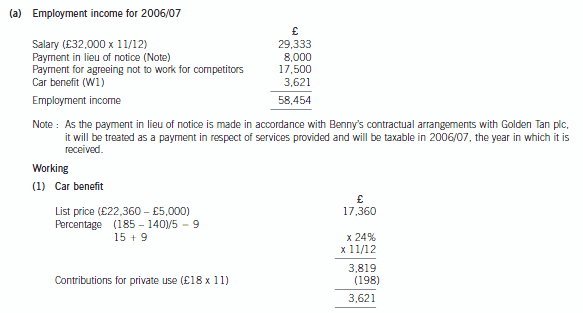
2 Benny Korere has been employed as the sales director of Golden Tan plc since 1994. He earns an annual salary of
£32,000 and is provided with a petrol-driven company car which has a CO2 emission rate of 187g/km and had a
list price when new of £22,360. In August 2003, when he was first provided with the car, Benny paid the company
£6,100 towards the capital cost of the car. Golden Tan plc does not pay for any of Benny’s private petrol and he is
also required to pay his employer £18 per month as a condition of being able to use the car for private purposes.
On 1 December 2006 Golden Tan plc notified Benny that he would be made redundant on 28 February 2007. On
that day the company will pay him his final month’s salary together with a payment of £8,000 in lieu of the three
remaining months of his six-month notice period in accordance with his employment contract. In addition the
company will pay him £17,500 in return for agreeing not to work for any of its competitors for the six-month period
ending 31 August 2007.
On receiving notification of his redundancy, Benny immediately contacted Joe Egmont, the managing director of
Summer Glow plc, who offered him a senior management position leading the company’s expansion into Eastern
Europe. Summer Glow plc is one of Golden Tan plc’s competitors and one of the most innovative companies in the
industry, although not all of its strategies have been successful.
Benny has agreed to join Summer Glow plc on 1 September 2007 for an annual salary of £39,000. On the day he
joins the company, Summer Glow plc will grant him an option to purchase 10,000 ordinary shares in the company
for £2·20 per share under an unapproved share option scheme. Benny can exercise the option once he has been
employed for six months but must hold the shares for at least a year before he sells them.
The new job will require Benny to spend a considerable amount of time in London. Summer Glow plc has offered
Benny the exclusive use of a flat that the company purchased on 1 June 2003 for £165,000; the flat is currently
rented out. The flat will be made available from 1 September 2007. The company will pay all of the utility bills
relating to the flat as well as furnishing and maintaining it. Summer Glow plc has also suggested that if Benny would
rather live in a more central part of the city, the company could sell the existing flat and buy a more centrally located
one, of the same value, with the proceeds.
On 15 March 2007 Benny intends to sell 5,800 shares in Mahana plc, a quoted company, for £24,608. His
transactions in the company’s shares have been as follows:
£
June 1988 Purchased 8,400 shares 6,744
February 1996 Sale of rights nil paid 610
January 2005 Purchased 1,300 shares 2,281
The sale of rights, nil paid, was not treated as a part disposal of Benny’s holding in Mahana plc.
Benny’s shareholding in Mahana plc represents less than 1% of the company’s issued ordinary share capital. He will
not make any other capital disposals in 2006/07.
In addition to his employment income, Benny receives rental income of £4,000 (net of deductible expenses) each
year. He normally submits his tax return in August but he has not yet prepared his return for 2005/06. He expects
to be very busy in December and January and is planning to prepare his tax return in late February 2007.
Required:
(a) Calculate Benny’s employment income for 2006/07. (4 marks)
正确答案:
-
第15题:
(b) Explain by reference to Hira Ltd’s loss position why it may be beneficial for it not to claim any capital
allowances for the year ending 31 March 2007. Support your explanation with relevant calculations.
(6 marks)
正确答案:
(b) The advantage of Hira Ltd not claiming any capital allowances
In the year ending 31 March 2007 Hira Ltd expects to make a tax adjusted trading loss, before deduction of capital
allowances, of £55,000 and to surrender the maximum amount possible of trading losses to Belgrove Ltd and Dovedale Ltd.
For the first nine months of the year from 1 April 2006 to 31 December 2006 Hira Ltd is in a loss relief group with Belgrove
Ltd. The maximum surrender to Belgrove Ltd for this period is the lower of:
– the available loss of £41,250 (£55,000 x 9/12); and
– the profits chargeable to corporation tax of Belgrove of £28,500 (£38,000 x 9/12).
i.e. £28,500. This leaves losses of £12,750 (£41,250 – £28,500) unrelieved.
For the remaining three months from 1 January 2007 to 31 March 2007 Hira Ltd is a consortium company because at least
75% of its share capital is owned by companies, each of which own at least 5%. It can surrender £8,938 (£55,000 x 3/12
x 65%) to Dovedale Ltd and £4,812 (£55,000 x 3/12 x 35%) to Belgrove Ltd as both companies have sufficient taxable
profits to offset the losses. Accordingly, there are no losses remaining from the three-month period.
The unrelieved losses from the first nine months must be carried forward as Hira Ltd has no income or gains in that year or
the previous year. However, the losses cannot be carried forward beyond 1 January 2007 (the date of the change of
ownership of Hira Ltd) if there is a major change in the nature or conduct of the trade of Hira Ltd. Even if the losses can be
carried forward, the earliest year in which they can be relieved is the year ending 31 March 2009 as Hira Ltd is expected to
make a trading loss in the year ending 31 March 2008.
Any capital allowances claimed by Hira Ltd in the year ending 31 March 2007 would increase the tax adjusted trading loss
for that year and consequently the unrelieved losses arising in the first nine months.
If the capital allowances are not claimed, the whole of the tax written down value brought forward of £96,000 would be
carried forward to the year ending 31 March 2008 thus increasing the capital allowances and the tax adjusted trading loss,
for that year. By not claiming any capital allowances, Hira Ltd can effectively transfer a current period trading loss, which
would be created by capital allowances, of £24,000 (25% x £96,000) from the year ending 31 March 2007 to the following
year where it can be surrendered to the two consortium members. -
第16题:
5 (a) Carver Ltd was incorporated and began trading in August 2002. It is a close company with no associated
companies. It has always prepared accounts to 31 December and will continue to do so in the future.
It has been decided that Carver Ltd will sell its business as a going concern to Blade Ltd, an unconnected
company, on 31 July 2007. Its premises and goodwill will be sold for £2,135,000 and £290,000 respectively
and its machinery and equipment for £187,000. The premises, which do not constitute an industrial building,
were acquired on 1 August 2002 for £1,808,000 and the goodwill has been generated internally by the
company. The machinery and equipment cost £294,000; no one item will be sold for more than its original cost.
The tax adjusted trading profit of Carver Ltd in 2007, before taking account of both capital allowances and the
sale of the business assets, is expected to be £81,000. The balance on the plant and machinery pool for the
purposes of capital allowances as at 31 December 2006 was £231,500. Machinery costing £38,000 was
purchased on 1 March 2007. Carver Ltd is classified as a small company for the purposes of capital allowances.
On 1 August 2007, the proceeds from the sale of the business will be invested in either an office building or a
portfolio of UK quoted company shares, as follows:
Office building
The office building would be acquired for £3,100,000; the vendor is not registered for value added tax (VAT).
Carver Ltd would borrow the additional funds required from a UK bank. The building is let to a number of
commercial tenants who are not connected with Carver Ltd and will pay rent, in total, of £54,000 per calendar
quarter, in advance, commencing on 1 August 2007. The company’s expenditure for the period from 1 August
2007 to 31 December 2007 is expected to be:
£
Loan interest payable to UK bank 16,000
Building maintenance costs 7,500
Share portfolio
Shares would be purchased for the amount of the proceeds from the sale of the business with no need for further
loan finance. It is estimated that the share portfolio would generate dividends of £36,000 and capital gains, after
indexation allowance, of £10,000 in the period from 1 August 2007 to 31 December 2007.
All figures are stated exclusive of value added tax (VAT).
Required:
(i) Taking account of the proposed sale of the business on 31 July 2007, state with reasons the date(s) on
which Carver Ltd must submit its corporation tax return(s) for the year ending 31 December 2007.
(2 marks)
正确答案:
(a) (i) Due date for submission of corporation tax return
Carver Ltd intends to cease trading on 31 July 2007. This will bring to an end the accounting period that began on
1 January 2007. A new accounting period will commence on 1 August 2007 and end on the company’s accounting
reference date on 31 December 2007.
Carver Ltd is required to submit its corporation tax return by the later of:
– one year after the end of its accounting period; and
– one year after the end of the period of account in which the last day of the accounting period falls.
Accordingly, the company must submit its corporation tax returns for both accounting periods by 31 December 2008. -
第17题:
3 Palm plc recently acquired 100% of the ordinary share capital of Nikau Ltd from Facet Ltd. Palm plc intends to use
Nikau Ltd to develop a new product range, under the name ‘Project Sabal’. Nikau Ltd owns shares in a non-UK
resident company, Date Inc.
The following information has been extracted from client files and from a meeting with the Finance Director of Palm
plc.
Palm plc:
– Has more than 40 wholly owned subsidiaries such that all group companies pay corporation tax at 30%.
– All group companies prepare accounts to 31 March.
– Acquired Nikau Ltd on 1 November 2007 from Facet Ltd, an unrelated company.
Nikau Ltd:
– UK resident company that manufactures domestic electronic appliances for sale in the European Union (EU).
– Large enterprise for the purposes of the enhanced relief available for research and development expenditure.
– Trading losses brought forward as at 1 April 2007 of £195,700.
– Budgeted taxable trading profit of £360,000 for the year ending 31 March 2008 before taking account of ‘Project
Sabal’.
– Dividend income of £38,200 will be received in the year ending 31 March 2008 in respect of the shares in Date
Inc.
‘Project Sabal’:
– Development of a range of electronic appliances, for sale in North America.
– Project Sabal will represent a significant advance in the technology of domestic appliances.
– Nikau Ltd will spend £70,000 on staffing costs and consumables researching and developing the necessary
technology between now and 31 March 2008. Further costs will be incurred in the following year.
– Sales to North America will commence in 2009 and are expected to generate significant profits from that year.
Shares in Date Inc:
– Nikau Ltd owns 35% of the ordinary share capital of Date Inc.
– The shares were purchased from Facet Ltd on 1 June 2003 for their market value of £338,000.
– The sale was a no gain, no loss transfer for the purposes of corporation tax.
– Facet Ltd purchased the shares in Date Inc on 1 March 1994 for £137,000.
Date Inc:
– A controlled foreign company resident in the country of Palladia.
– Annual chargeable profits arising out of property investment activities are approximately £120,000, of which
approximately £115,000 is distributed to its shareholders each year.
The tax system in Palladia:
– No taxes on income or capital profits.
– 4% withholding tax on dividends paid to shareholders resident outside Palladia.
Required:
(a) Prepare detailed explanatory notes, including relevant supporting calculations, on the effect of the following
issues on the amount of corporation tax payable by Nikau Ltd for the year ending 31 March 2008.
(i) The costs of developing ‘Project Sabal’ and the significant commercial changes to the company’s
activities arising out of its implementation. (8 marks)
正确答案:
(a) Nikau Ltd – Effect on corporation tax payable for the year ending 31 March 2008
(i) Project Sabal
Research and development expenditure
The expenditure incurred in respect of research and development will give rise to an enhanced deduction for the
purposes of computing the taxable trading profits of Nikau Ltd. The enhanced deduction is 125% of the qualifying
expenditure as Nikau Ltd is a large enterprise for this purpose.
The expenditure will reduce the profits chargeable to corporation tax of Nikau Ltd by £87,500 (£70,000 x 1·25) and
its corporation tax liability by £26,250 (£87,500 x 30%).
The budgeted expenditure will qualify for the enhanced deduction because it appears to satisfy the following conditions.
– It is likely to qualify as research and development expenditure within generally accepted accounting principles as
it will result in new technical knowledge and the production of a substantially improved device for use in the
industry.
– It exceeds £10,000 in Nikau Ltd’s accounting period.
– It relates to staff costs, consumable items or other qualifying expenditure as opposed to capital items.
– It will result in further trading activities for Nikau Ltd.
Use of brought forward trading losses
The development of products for the North American market is likely to represent a major change in the nature and
conduct of the trade of Nikau Ltd. This is because the company is developing new products and intends to sell them in
a new market. It is a major change as sales to North America are expected to generate significant additional profits.
Because this change will occur within three years of the change in the ownership of Nikau Ltd on 1 November 2007,
any trading losses arising prior to that date cannot be carried forward beyond that date.
Accordingly, the trading losses brought forward may only be offset against £158,958 ((£360,000 – £87,500) x 7/12)
of the company’s trading profits for the year. The remainder of the trading losses £36,742 (£195,700 – £158,958) will
be lost resulting in lost tax relief of £11,023 (£36,742 x 30%).
Tutorial note
The profits for the year ending 31 March 2008 will be apportioned to the periods pre and post 1 November 2007 on
either a time basis or some other basis that is just and reasonable. -
第18题:
(ii) The use of the trading loss of Tethys Ltd for the year ending 31 December 2008; (6 marks)
正确答案:
(ii) Tethys Ltd – Use of trading loss
– The two companies will not be in a group relief group as Saturn Ltd will not own 75% of Tethys Ltd.
– For a consortium to exist, 75% of the ordinary share capital of Tethys Ltd must be held by companies which each
hold at least 5%. Accordingly, Tethys Ltd will be a consortium company if the balance of its share capital is owned
by Clangers Ltd but not if it is owned by Edith Clanger.
– If Tethys Ltd qualifies as a consortium company: 65% of its trading losses in the period from 1 August 2008 to
31 December 2008 can be surrendered to Saturn Ltd, i.e. £21,667 (£80,000 x 5/12 x 65%).
– If Tethys Ltd does not qualify as a consortium company: none of its loss can be surrendered to Saturn Ltd.
– The acquisition of 65% of Tethys Ltd is a change in ownership of the company. If there is a major change in the
nature or conduct of the trade of Tethys Ltd within three years of 1 August 2008, the loss arising prior to that date
cannot be carried forward for relief in the future.
Further information required:
– Ownership of the balance of the share capital of Tethys Ltd. -
第19题:
6 Charles and Jane Miro, aged 31 and 34 years respectively, have been married for ten years and have two children
aged six and eight years. Charles is a teacher but for the last five years he has stayed at home to look after their
children. Jane works as a translator for Speak Write Ltd.
Speak Write Ltd was formed and began trading on 6 April 2006. It provides translation services to universities. Jane,
who ceased employment with Barnham University to found the company, owns 100% of its ordinary share capital
and is its only employee.
Speak Write Ltd has translated documents for four different universities since it began trading. Its biggest client is
Barnham University which represents 70% of the company’s gross income. It is estimated that the company’s gross
fee income for its first 12 months of trading will be £110,000. Speak Write Ltd usually agrees fixed fees in advance
with its clients although it charges for some projects by reference to the number of days taken to do the work. None
of the universities makes any payment to Speak Write Ltd in respect of Jane being on holiday or sick.
All of the universities insist that Jane does the work herself. Jane carries out the work for three of the universities in
her office at home using a computer and specialised software owned by Speak Write Ltd. The work she does for
Barnham University is done in the university’s library on one of its computers as the documents concerned are too
delicate to move.
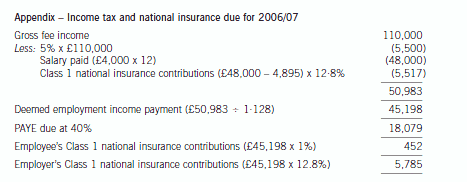
The first set of accounts for Speak Write Ltd will be drawn up for the year ending 5 April 2007. It is estimated that
the company’s tax adjusted trading profit for this period will be £52,500. This figure is after deducting Jane’s salary
of £4,000 per month and the related national insurance contributions but before any adjustments required by the
application of the personal service companies (IR 35) legislation. The company has no other sources of income or
capital gains.
Jane has not entered into any communication with HM Revenue and Customs (HMRC) with respect to the company
and wants to know:
– When the corporation tax computation should be submitted and when the tax is due.
– When the corporation tax computation can be regarded as having been agreed by HMRC.
Charles and Jane have requested a meeting to discuss the family’s finances. In particular, they wish to consider the
shortfall in the family’s annual income and any other related issues if Jane were to die. Their mortgage is covered
by a term assurance policy but neither of them have made any pension contributions or carried out any other long
term financial planning.
Jane has estimated that her annual after tax income from Speak Write Ltd, on the assumption that she extracts all of
the company’s profits, will be £58,000. Charles owns two investment properties that together generate after tax
income of £8,500. He estimates that he could earn £28,000 after tax if he were to return to work.
The couple’s annual surplus income, after payment of all household expenditure including mortgage payments of
£900 per month, is £21,000. Charles and Jane have no other sources of income.
Required:
(a) Write a letter to Jane setting out:
(i) the arguments that HMRC could put forward, based only on the facts set out above, in support of
applying the IR 35 legislation to Speak Write Ltd; and
(ii) the additional income tax and national insurance contributions that would be payable, together with
their due date of payment, if HMRC applied the IR 35 legislation to all of the company’s income in
2006/07. (11 marks)
正确答案: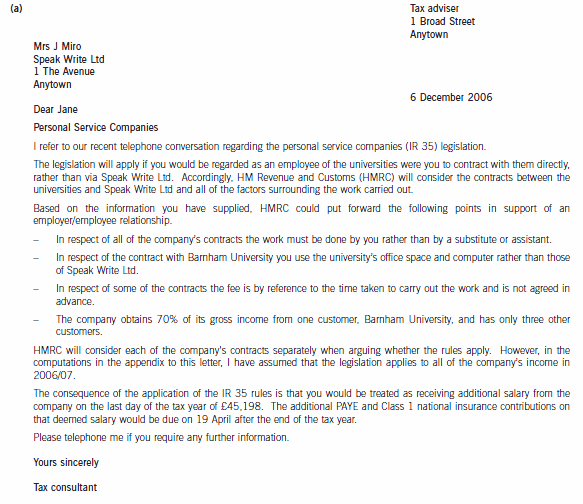
-
第20题:
A CAR STOPPED JUST IN THE MIDDLE OF THE STREET Joan has been charged with a misdemeanor by asking her 13-year-old son to drive, putting her child in a dangerous situation. It was Joan's 32ndbirthday, so she decided to go out for dinner with her 35-year-old boyfriend, Donald, as well as her 13-year-old son, Mike. Joan was so happy that she drank two bottles of wine with her boyfriend.When it was time to go home, both Joan and Donald were too drunk to drive.They knew it clearly that both of them couldn't drive home safely after that much wine, so they sat in the back seat and asked Mike, Joan's 13-year-old son, to drive the 2008 Land Rover. Being a driver for the first time in his life, Mike could receive no help from his mom or Donald.They were too drunk to tell him clearly what to do. He started the car nervously, but when he realized he couldn't control the car at all, he was scared and depressed. He decided to stop the car and refuse to drive any further. He called the police for help. When the police arrived, they found the car was stopped right in the middle of the street.
1. Joan has been charged with driving after drinking.()
2. Mike was 35 years old.()
3. Joan and Donald were both too drunk to drive.()
4. It was the first time for Mike to drive.()
5. The police stopped Mike in the middle of the street.()
参考答案:1:F; 2:F; 3:T; 4:T; 5:F
-
第21题:
By the end of his senior year, he was earning two hundred dollars a week writing science fiction, and his parents were reconciled to his pursuit of the literary life.
正确答案:译文:到大四结束的时候,他每星期写科幻小说已经可以赚两百美元了,而他的双亲也接受了他对于文学生涯的追求。
本题考核知识点:顺译法和分词的翻译。
该句是and连接的并列句,其主干是he was earning... and his parents were...,可采用顺译的方法翻译。前一分句中,分词结构writing science fiction作方式状语,翻译时应置于谓语前面,译为“(通过)写科幻小说”。
词汇:be reconciled to意为“将就,妥协,接受”。
-
第22题:
Time to Stop Traveling by Air
Twenty-five years ago a young British man called Mark Ellingham decided that he wanted a change of scenery. So he went to Australia, stopping off in many countries between. He also decided to write about the experience and produced a guide for other travelers making similar journeys.
In 1970, British airports were used by 32million people. In 2004, the figure was 216 million. In 2030, according to government forecasts, it will be around 500 million. It's a growth driven by the emergence of low cost airlines, offering access to all parts of the world for less than £100.
This has made a huge contribution to global warming. One return flight from Britain to the US produces the same carbon dioxide(二氧化碳)as a year's motoring(驾车). A return flight to Australia equals the emissions(排放)of three average cars for a year. And the pollution is released at a height where its effect on climate change is more than double that on the ground.
Mark Ellingham built his business on helping people travel. Now he wants to help people stop – at least by air.
He is calling for a £100 green tax on all flights to Europe and Africa, and £250 on flights to the rest of the world. He also wants investment to create a low-carbon economy, as well as a halt to airport expansion.
Mark Ellingham's commitment is important because his readers aren't just the sort of young and adventurous people who would happily jump on a plane to spend a weekend exploring a foreign culture. They are also the sort of people who say they care about the environment. It's a debate that splits people down the middle.
The tourist industry has responded by offering offsetting(补偿)schemes. A small increase in the price of a ticket is used to plant trees.
But critics say that it is not enough to just be carbon neutral. We should be actively cutting back on putting green house gases into the atmosphere. And for the average person, making a plane journey will be his or her largest contribution to global warming. It maybe good to repair the damage we do. But surely it is better not to do the damage in the first place.
文章(1~7)
Mark Ellingham spent quite a few days in China on his way to Australia 25 years ago.A.Right
B.Wrong
C.Not mentioned答案:C解析: -
第23题:
单选题Having made his first film earlier this year, he is ______ starting in a new musical.Aactually
Brecently
Ccurrently
Dlately
正确答案: C解析:
句意:他年初刚完成自己制作的第一部电影,现在又着手制作一个新的音乐片。currently现在,目前,最近。actually事实上。recently近来一段时间,多用于现在完成时。lately最近,近来,强调时间点时多用过去时,表示时间长度时多用完成时。