
(ii) Briefly discuss FOUR non-financial factors which might influence the above decision. (4 marks)
题目
(ii) Briefly discuss FOUR non-financial factors which might influence the above decision. (4 marks)
相似考题
更多“(ii) Briefly discuss FOUR non-financial factors which might influence the above decision. (4 marks)”相关问题
-
第1题:
(b) Discuss the limitations of the above estimates. (6 marks)
正确答案:(b) The estimates are based upon unrealistic assumptions and are subject to a considerable margin of error. Possible limitations
include:
(i) Sales, operating costs, replacement investments, and dividends are unlikely to increase by the same amount.
(ii) Forecasts of future growth rates may not be accurate. Paxis is unlikely to have access to enough internal information
about the activities of Wragger to make accurate projections.
(iii) The expected reduction in operating costs might not be achieved.
(iv) The estimates are based upon present values to infinity of expected free cash flows. A shorter time horizon might be
more realistic.
(v) The cost of capital for the combined company could differ from that estimated, depending how the market evaluates the
risk of the combined entity.
(vi) The analysis is based upon the assumption that the initial offer price is accepted.
(vii) There is no information about the fees and other costs associated with the proposed acquisition. In many cases these
are substantial, and must be included in the analysis.
(viii) The post acquisition integration of organisations often involves unforeseen costs which would reduce the benefit of any
potential synergy. -
第2题:
(b) Ratio analysis in general can be useful in comparing the performance of two companies, but it has its limitations.
Required:
State and briefly explain three factors which can cause accounting ratios to be misleading when used for
such comparison. (6 marks)
正确答案:
(b) (i) One company may have revalued its assets while the other has not.
(ii) Accounting policies and estimation techniques may differ. For example, one company may use higher depreciation rates
than the other.
(iii) The use of historical cost accounting may distort the capital and profit of the two companies in different ways.
Other answers considered on their merits. -
第3题:
(ii) Describe the claim of each of the four identified stakeholders. (4 marks)
正确答案:
(ii) Stakeholder claims
Four external stakeholders in the case and their claims are as follows.
The client, i.e. the government of the East Asian country. This stakeholder wants the project completed to budget and
on time. It may also be concerned to minimise negative publicity in respect of the construction of the dam and the
possible negative environmental consequences.
Stop-the-dam, the vocal and well organised pressure group. This stakeholder wants the project stopped completely,
seemingly and slightly paradoxically, for environmental and social footprint reasons.
First Nation, the indigenous people group currently resident on the land behind the dam that would be flooded after its
construction. This stakeholder also wants the project stopped so they can continue to live on and farm the land.
The banks (identified as a single group). These seem happy to lend to the project and will want it to proceed so they
make a return on their loans commensurate with the risk of the loan. They do not want to be publicly identified as being
associated with the Giant Dam Project.
Shareholders. The shareholders have the right to have their investment in the company managed in such a way as to
maximise the value of their shareholding. The shareholders seek projects providing positive NPVs within the normal
constraints of sound risk management.
Tutorial note: only four stakeholders need to be identified. Marks will be given for up to four relevant stakeholders
only. -
第4题:
(b) Discuss FOUR factors that distinguish service from manufacturing organisations and explain how each of
these factors relates to the services provided by the Dental Health Partnership. (5 marks)
正确答案:
(b) The major characteristics of services which distinguish services from manufacturing are as follows:
– Intangibility.
When a dentist provides a service to a client there are many intangible factors involved such as for example the
appearance of the surgery, the personality of the dentist, the manner and efficiency of the dental assistant. The output
of the service is ‘performance’ by the dentist as opposed to tangible goods.
– Simultaneity.
The service provided by the dentist to the patient is created by the dentist at the same time as the patient consumed it
thus preventing any advance verification of quality.
– Heterogeneity.
Many service organisations face the problem of achieving consistency in the quality of its output. Whilst each of the
dentists within the Dental Health Partnership will have similar professional qualifications there will be differences in the
manner they provide services to clients.
– Perishability.
Many services are perishable. The services of a dentist are purchased only for the duration of an appointment. -
第5题:
(ii) Comment briefly on how divisional managers might respond to the results achieved and ONE potential
problem that might be experienced by Our Timbers Ltd. (2 marks)
正确答案: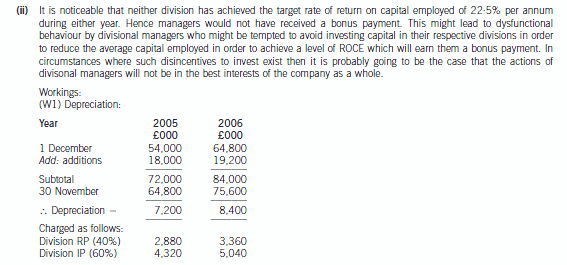
-
第6题:
(ii) Briefly discuss TWO factors which could reduce the rate of return earned by the investment as per the
results in part (a). (4 marks)
正确答案:
(ii) Two factors which might reduce the return earned by the investment are as follows:
(i) Poor product quality
The very nature of the product requires that it is of the highest quality i.e. the cakes are made for human
consumption. Bad publicity via a ‘product recall’ could potentially have a catastrophic effect on the total sales to
Superstores plc over the eighteen month period.
(ii) The popularity of the Mighty Ben character
There is always the risk that the popularity of the character upon which the product is based will diminish with a
resultant impact on sales volumes achieved. In this regard it would be advisable to attempt to negotiate with
Superstores plc in order to minimise potential future losses. -
第7题:
(ii) Briefly explain the extent to which the application of sensitivity analysis might be useful in deciding
which refrigeration system to purchase and discuss the limitations inherent in its use. (3 marks)
正确答案:
(ii) Sensitivity analysis could be used to assess how responsive the NPV calculated in part (a) in respect of each decision
option change is to changes in the variables used to calculate it. The application of sensitivity analysis requires that the
net present values are calculated under alternative assumptions in order to determine how sensitive they are to changing
conditions. In this particular example then a relatively small change in the forecast cash flows might lead to a change
in the investment decision. The application of sensitivity analysis can indicate those variables to which the NPV is most
sensitive and the extent to which these variables may change before an investment results in a negative NPV. Thus the
application of sensitivity analysis may provide management with an indication of why a particular project might fail. The
directors of Stay Cool Ltd should give consideration to the potential variations in the independent variables which feature
in the decision-making process such as:
– estimated revenues
– estimated operating costs
– estimated working lives
– estimated repair costs
– the estimated discount rate i.e. cost of capital of each alternative investment.
Sensitivity analysis has some serious limitations. The use of the method requires changes in each variable under
consideration are isolated. However management may be focused on what happens if changes occur in two or more
critical variables. Another problem relating to the use of sensitivity analysis to forecast outcomes lies in the fact that it
provides no indication of the likelihood of the occurrence of changes in critical variables. -
第8题:
(b) Briefly discuss how stakeholder groups (other than management and employees) may be rewarded for ‘good’
performance. (4 marks)
正确答案:
(b) Good performance should result in improved profitability and therefore other stakeholder groups may be rewarded for ‘good
performance’ as follows:
– Shareholders may receive increased returns on equity in the form. of increased dividends and /or capital growth.
– Customers may benefit from improved quality of products and services, and possibly lower prices.
– Suppliers may benefit from increased volumes of purchases.
– Government will benefit from increased amounts of taxation. -
第9题:
(ii) Suggest THREE other performance measures (not applied in (i)) which might be used to assess the
customer perspective of the balanced scorecard of GER. (3 marks)
正确答案:
(ii) Performance measures that may be used to assess the customer perspective of the balanced scorecard of GER include
the following:
Lost or damaged luggage per 1,000 passengers
Train cancellation rate
Denied boarding rate
Number of passenger complaints.
Note: Only three measures were required.
-
第10题:
JOL Co was the market leader with a share of 30% three years ago. The managing director of JOL Co stated at a
recent meeting of the board of directors that: ‘our loss of market share during the last three years might lead to the
end of JOL Co as an organisation and therefore we must address this issue immediately’.
Required:
(b) Discuss the statement of the managing director of JOL Co and discuss six performance indicators, other than
decreasing market share, which might indicate that JOL Co might fail as a corporate entity. (10 marks)
正确答案:
(b) It would appear that JOL’s market share has declined from 30% to (80 – 26)/3 = 18% during the last three years. A 12%
fall in market share is probably very significant with a knock-on effect on profits and resultant cash flows. Obviously such a
declining trend needs to be arrested immediately and this will require a detailed investigation to be undertaken by the directors
of JOL. Consequently loss of market share can be seen to be an indicator of potential corporate failure. Other indicators of
corporate failure are as follows:
Six performance indicators that an organisation might fail are as follows:
Poor cash flow
Poor cash flow might render an organisation unable to pay its debts as and when they fall due for payment. This might mean,
for example, that providers of finance might be able to invoke the terms of a loan covenant and commence legal action against
an organisation which might eventually lead to its winding-up.
Lack of new production/service introduction
Innovation can often be seen to be the difference between ‘life and death’ as new products and services provide continuity
of income streams in an ever-changing business environment. A lack of new product/service introduction may arise from a
shortage of funds available for re-investment. This can lead to organisations attempting to compete with their competitors with
an out of date range of products and services, the consequences of which will invariably turn out to be disastrous.
General economic conditions
Falling demand and increasing interest rates can precipitate the demise of organisations. Highly geared organisations will
suffer as demand falls and the weight of the interest burden increases. Organisations can find themselves in a vicious circle
as increasing amounts of interest payable are paid from diminishing gross margins leading to falling profits/increasing losses
and negative cash flows. This leads to the need for further loan finance and even higher interest burden, further diminution
in margins and so on.
Lack of financial controls
The absence of sound financial controls has proven costly to many organisations. In extreme circumstances it can lead to
outright fraud (e.g. Enron and WorldCom).
Internal rivalry
The extent of internal rivalry that exists within an organisation can prove to be of critical significance to an organisation as
managerial effort is effectively channeled into increasing the amount of internal conflict that exists to the detriment of the
organisation as a whole. Unfortunately the adverse consequences of internal rivalry remain latent until it is too late to redress
them.
Loss of key personnel
In certain types of organisation the loss of key personnel can ‘spell the beginning of the end’ for an organisation. This is
particularly the case when individuals possess knowledge which can be exploited by direct competitors, e.g. sales contacts,
product specifications, product recipes, etc.
-
第11题:
(iii) Identify and discuss an alternative strategy that may assist in improving the performance of CTC with
effect from 1 May 2009 (where only the products in (a) and (b) above are available for manufacture).
(4 marks)
正确答案:
(iii) If no new products are available then CTC must look to boost revenues obtained from its existing product portolio whilst
seeking to reduce product specific fixed overheads and the company’s other fixed overheads. In order to do this attention
should be focused on the marketing activities currently undertaken.
CTC should consider selling all of its products in ‘multi product’ packages as it might well be the case that the increased
contribution achieved from increased sales volumes would outweigh the diminution in contribution arising from
reductions in the selling price per unit of each product.
CTC could also apply target costing principles in order to reduce costs and thereby increase the margins on each of its
products. Value analysis should be undertaken in order to evaluate the value-added features of each product. For
example, the use of non-combustible materials in manufacture would be a valued added feature of such products
whereas the use of pins and metal fastenings which are potentially harmful to children would obviously not comprise
value added features. CTC should focus on delivering ‘value’ to the customer and in attempting to do so should seek to
identify all non-value activities in order that they may be eliminated and hence margins improved. -
第12题:
(ii) From the information provided above, recommend the matters which should be included as ‘findings
from the audit’ in your report to those charged with governance, and explain the reason for their
inclusion. (7 marks)
正确答案:
(ii) Control weakness
ISA 260 contains guidance on the type of issues that should be communicated. One of the matters identified is a control
weakness in the capital expenditure transaction cycle. The assets for which no authorisation was obtained amount to
0·3% of total assets (225,000/78 million x 100%), which is clearly immaterial. However, regardless of materiality, the
auditor should ensure that the weakness is brought to the attention of the management, with a clear indication of the
implication of the weakness, and recommendations as to how the control weakness should be eliminated.
The auditor is providing information to help those charged with governance improve the internal systems and controls
and ultimately reduce business risk. In this case there is a high risk of fraud, as the lack of authorisation for purchase
of office equipment could allow expenditure on assets not used for bona fide business purposes.
Disagreement with accounting treatment of brand
Audit procedures have revealed a breach of IAS 38 Intangible Assets, in which internally generated brand names are
specifically prohibited from being recognised. Blod Co has recognised an internally generated brand name which is
material to the statement of financial position (balance sheet) as it represents 12·8% of total assets (10/78 x 100%).
The statement of financial position (balance sheet) therefore contains a material misstatement.
The report to those charged with governance should clearly explain the rules on recognition of internally generated brand
names, to ensure that the management has all relevant technical facts available. In the report the auditors should
request that the financial statements be corrected, and clarify that if the brand is not derecognised, then the audit opinion
will be qualified on the grounds of a material disagreement – an ‘except for’ opinion would be provided. Once the breach
of IAS 38 is made clear to the management in the report, they then have the opportunity to discuss the matter and
decide whether to amend the financial statements, thereby avoiding a qualified audit opinion.
Audit inefficiencies
Documentation relating to inventories was not always made readily available to the auditors. This seems to be due to
poor administration by the client rather than a deliberate attempt to conceal information. The report should contain a
brief description of the problems encountered by the audit team. The management should be made aware that
significant delay to the receipt of necessary paperwork can cause inefficiencies in the audit process. This may seem a
relatively trivial issue, but it could lead to an increase in audit fee. Management should react to these comments by
ensuring as far as possible that all requested documentation is made available to the auditors in a timely fashion. -
第13题:
(c) Discuss the factors that might influence whether the initial bid is likely to be accepted by the shareholders of Wragger plc.
正确答案:(c) The type of payment might influence the success of the bid. Paxis is proposing a share for share exchange which offers a continuation in ownership of the entity, albeit as part of the successful bidder. However, relative share prices will change during the period of the bid, and the owner of shares in the potential victim company will not know the precise postacquisition value of the bid. An alternative might be cash payments which provides a known, precise sum, and might be favoured for this reason. However, in some countries payment in cash might lead to an immediate capital gains tax liability for the investor.
The effective price offered would of course be a major influence. Paxis would need to offer a premium over the existing share price, but the size of the premium that would be acceptable is unknown. Informal discussions with major shareholders of Wragger might assist in determining this (subject to such discussions being permitted by the regulatory authorities).
-
第14题:
(d) Draft a letter for Tim Blake to send to WM’s investors to include the following:
(i) why you believe robust internal controls to be important; and
(ii) proposals on how internal systems might be improved in the light of the overestimation of mallerite at
WM.
Note: four professional marks are available within the marks allocated to requirement (d) for the structure,
content, style. and layout of the letter.
(16 marks)
正确答案:
You will be aware of the importance of accurate resource valuation to Worldwide Minerals (WM). Unfortunately, I have to
inform. you that the reserve of mallerite, one of our key minerals in a new area of exploration, was found to have been
overestimated after the purchase of a mine. It has been suggested that this information may have an effect on shareholder
value and so I thought it appropriate to write to inform. you of how the board intends to respond to the situation.
In particular, I would like to address two issues. It has been suggested that the overestimation arose because of issues with
the internal control systems at WM. I would firstly like to reassure you of the importance that your board places on sound
internal control systems and then I would like to highlight improvements to internal controls that we shall be implementing
to ensure that the problem should not recur.
(i) Importance of internal control
Internal control systems are essential in all public companies and Worldwide Minerals (WM) is no exception. If anything,
WM’s strategic position makes internal control even more important, operating as it does in many international situations
and dealing with minerals that must be guaranteed in terms of volume, grade and quality. Accordingly, your board
recognises that internal control underpins investor confidence. Investors have traditionally trusted WM’s management
because they have assumed it capable of managing its internal operations. This has, specifically, meant becoming aware
of and controlling known risks. Risks would not be known about and managed without adequate internal control
systems. Internal control, furthermore, helps to manage quality throughout the organisation and it provides
management with information on internal operations and compliance. These features are important in ensuring quality
at all stages in the WM value chain from the extraction of minerals to the delivery of product to our customers. Linked
to this is the importance of internal control in helping to expose and improve underperforming internal operations.
Finally, internal control systems are essential in providing information for internal and external reporting upon which, in
turn, investor confidence rests.
(ii) Proposals to improve internal systems at WM
As you may be aware, mineral estimation and measurement can be problematic, particularly in some regions. Indeed,
there are several factors that can lead to under or overestimation of reserves valuations as a result of geological survey
techniques and regional cultural/social factors. In the case of mallerite, however, the issues that have been brought to
the board’s attention are matters of internal control and it is to these that I would now like to turn.
In first instance, it is clear from the fact that the overestimate was made that we will need to audit geological reports at
an appropriate (and probably lower) level in the organisation in future.
Once a claim has been made about a given mineral resource level, especially one upon which investor returns might
depend, appropriate systems will be instituted to ask for and obtain evidence that such reserves have been correctly and
accurately quantified.
We will recognise that single and verbal source reports of reserve quantities may not necessarily be accurate. This was
one of the apparent causes of the overestimation of mallerite. A system of auditing actual reserves rather than relying
on verbal evidence will rectify this.
The purchase of any going concern business, such as the mallerite mine, is subject to due diligence. WM will be
examining its procedures in this area to ensure that they are fit for purpose in the way that they may not have been in
respect of the purchase of the mallerite mine. I will be taking all appropriate steps to ensure that all of these internal
control issues can be addressed in future.
Thank you for your continued support of Worldwide Minerals and I hope the foregoing goes some way to reassure you
that the company places the highest value on its investors and their loyalty.
Yours faithfully,
Tim Blake
Chairman -
第15题:
(b) Discuss ways in which the traditional budgeting process may be seen as a barrier to the achievement of the
aims of EACH of the following models for the implementation of strategic change:
(i) benchmarking;
(ii) balanced scorecard; and
(iii) activity-based models. (12 marks)
正确答案:
(b) Benchmarking
Benchmarks enable goals to be set that may be based on either external measures of ‘best practice’ organisations or internal
cross-functional comparisons which exhibit ‘best practice’. A primary aim of the traditional budgeting process is the setting of
realistic targets that can be achieved within the budget period. The setting of realistic targets means that the extent of
underperformance against ‘best practice’ standards loses visibility, and thus short-term financial targets remain the
predominant focus of the traditional budgeting process. It is arguable that because the budgetary reporting system purports
to give managers ‘control’, there is very little real incentive to seek out benchmarks which may be used to raise budgeted
performance targets. Much depends upon the prevailing organisational culture since benchmarking may be viewed as an
attempt by top management to impose impossible targets upon operational managers. The situation is further exacerbated
where organisations do not measure their success relative to their competition.
Balanced scorecard
The Balanced scorecard is often misunderstood as a consequence of the failure by top management to ensure that it is
implemented effectively within the organisation. Thus it may be viewed as the addition of a few non-financial measures to
the conventional budget. In an attempt to overcome this misperception many management teams now establish a
performance-rewards linkage based upon the achievement of Scorecard targets for the forthcoming budget period.
Unfortunately this can precipitate dysfunctional behaviour at every level within the organisation.
Even in situations where the Scorecard has been well-designed and well-implemented it is difficult for it to gain widespread
acceptance. This is because all too often there exists a culture which places a very high value upon the achievement of the
fixed annual targets in order to avoid the loss of status, recognition and rewards.
A well-constructed Scorecard contains a mix of long-term and short-term measures and therefore drives the company in the
direction of medium-term strategic goals which are supported by cross-functional initiatives. On the other hand, the budgeting
process focuses the organisation on the achievement of short-term financial goals supported by the initiatives of individual
departments. Budgets can also act as an impediment to the acceptance of responsibility by local managers for the
achievement of the Scorecard targets. This is often the case in situations where a continued emphasis exists on meeting shortterm
e.g. quarterly targets.
Activity-based models
Traditional budgets show the costs of functions and departments (e.g. staff costs and establishment costs) instead of the costs
of those activities that are performed by people (e.g. receipt of goods inwards, processing and dispatch of orders etc). Thus
managers have no visibility of the real ‘cost drivers’ of their business. In addition, it is probable that a traditional budget
contains a significant amount of non-value-added costs that are not visible to the managers. The annual budget also tends
to fix capacity for the forthcoming budget period thereby undermining the potential of Activity-based management (ABM)
analysis to determine required capacity from a customer demand perspective. Those experienced in the use of ABM
techniques are used to dealing with such problems, however their tasks would be much easier to perform. and their results
made more reliable if these problems were removed. -
第16题:
(e) Briefly discuss FOUR initiatives that management might consider in order to further enhance profitability.
(4 marks)
正确答案:
(e) In order to enhance profitability management might take the following actions:
(i) Increase the maximum capacity of the circus.
(ii) Undertake a detailed review of operating costs which are budgeted at £239,200,000. Such a review might identify nonvalue
added costs which may be eliminated thereby increasing profitability.
(iii) Enter into a strategic arrangement with large hotels and travel agencies to offer travel and accommodation inclusive
arrangements for visitors to Cinola Island. This might help to increase the number of visitors to the zoo thereby increasing
profits.
(iv) Change the price structure and entitlement of tickets so that purchasers might visit Cinola Island on two separate days
in order to attend the zoo and circus. Additional revenues would arise as a consequence of the increased number of
visitors to the zoo, thereby increasing profitability.
(v) Hold prize draws for free tickets to the zoo for families on an ‘all-inclusive basis’, including restaurants, photographs,
souvenirs etc.
N.B. Only four initiatives were required to be discussed. -
第17题:
(ii) Comment briefly on the use of its own tree plantations as a source of raw materials by Our Timbers Ltd.
(3 marks)
正确答案:
(ii) The use of its own tree plantations as a source of raw materials not only ensures available supplies of timber but may
also demonstrate that the directors of Our Timbers Ltd are mindful of the need for careful planning in the consumption
of natural resources. This concern with the need to protect the environment will enhance the reputation of Our Timbers
Ltd as an environmentally-conscious organisation which in turn may translate into a source of competitive advantage
since contemporary thought is very much focused on the environmental responsibilities of organisations with particular
regard to the use of natural resources such as timber.
-
第18题:
(c) Explain the term ‘target costing’ and how it may be applied by GWCC. Briefly discuss any potential
limitations in its application. (8 marks)
正确答案:
(c) Target costing should be viewed as an integral part of a strategic profit management system. The initial consideration in target
costing is the determination of an estimate of the selling price for a new product which will enable a firm to capture its required
share of the market. In this particular example, Superstores plc, which on the face of it looks a powerful commercial
organisation, wishes to apply a 35% mark-up on the purchase price of each cake from GWCC. Since Superstores plc has
already decided on a launch price of £20·25 then it follows that the maximum selling price that can be charged by GWCC
is (100/135) x £20·25 which is £15·00.
This is clearly a situation which lends itself to the application of target costing/pricing techniques as in essence GWCC can
see the extent to which they fall short of the required level of return with regard to a contract with Superstores plc which ends
after twelve months. Thus it is necessary to reduce the total costs by £556,029 to this figure in order to achieve the desired
level of profit, having regard to the rate of return required on new capital investment. The deduction of required profit from
the proposed selling price will produce a target price that must be met in order to ensure that the desired rate of return is
obtained. Thus the main theme that underpins target costing can be seen to be ‘what should a product cost in order to achieve
the desired level of return’.
Target costing will necessitate comparison of current estimated cost levels against the target level which must be achieved if
the desired levels of profitability, and hence return on investment, are to be achieved. Thus where a gap exists between the
current estimated cost levels and the target cost, it is essential that this gap be closed.
The Directors of GWCC plc should be aware of the fact that it is far easier to ‘design out’ cost during the pre-production phase
than to ‘control out’ cost during the production phase. Thus cost reduction at this stage of a product’s life cycle is of critical
significance to business success.
A number of techniques may be employed in order to help in the achievement and maintenance of the desired level of target
cost. Attention should be focussed upon the identification of value added and non-value added activities with the aim of the
elimination of the latter. The product should be developed in an atmosphere of ‘continuous improvement’. In this regard, total
quality techniques such as the use of Quality circles may be used in attempting to find ways of achieving reductions in product
cost.
Value engineering techniques can be used to evaluate necessary product features such as the quality of materials used. It is
essential that a collaborative approach is taken by the management of GWCC and that all interested parties such as suppliers
and customers are closely involved in order to engineer product enhancements at reduced cost.
The degree of success that will be achieved by GWCC via the application of target costing principles will be very much
dependent on the extent of ‘flexibility’ in variable costs. Also the accuracy of information gathered by GWCC will assume
critical importance because the use of inaccurate information will produce calculated ‘cost gaps’ which are meaningless and
render the application of target costing principles of little value. -
第19题:
(ii) the factors that should be considered in the design of a reward scheme for BGL; (7 marks)
正确答案:
(ii) The factors that should be considered in the design of a reward scheme for BGL.
– Whether performance targets should be set with regard to results or effort. It is more difficult to set targets for
administrative and support staff since in many instances the results of their efforts are not easily quantifiable. For
example, sales administrators will improve levels of customer satisfaction but quantifying this is extremely difficult.
– Whether rewards should be monetary or non-monetary. Money means different things to different people. In many
instances people will prefer increased job security which results from improved organisational performance and
adopt a longer term-perspective. Thus the attractiveness of employee share option schemes will appeal to such
individuals. Well designed schemes will correlate the prosperity of the organisation with that of the individuals it
employs.
– Whether the reward promise should be implicit or explicit. Explicit reward promises are easy to understand but in
many respects management will have their hands tied. Implicit reward promises such as the ‘promise’ of promotion
for good performance is also problematic since not all organisations are large enough to offer a structured career
progression. Thus in situations where not everyone can be promoted there needs to be a range of alternative reward
systems in place to acknowledge good performance and encourage commitment from the workforce.
– The size and time span of the reward. This can be difficult to determine especially in businesses such as BGL
which are subject to seasonal variations. i.e. summerhouses will invariably be purchased prior to the summer
season! Hence activity levels may vary and there remains the potential problem of assessing performance when
an organisation operates with surplus capacity.
– Whether the reward should be individual or group based. This is potentially problematic for BGL since the assembly
operatives comprise some individuals who are responsible for their own output and others who work in groups.
Similarly with regard to the sales force then the setting of individual performance targets is problematic since sales
territories will vary in terms of geographical spread and customer concentration.
– Whether the reward scheme should involve equity participation? Such schemes invariably appeal to directors and
senior managers but should arguably be open to all individuals if ‘perceptions of inequity’ are to be avoided.
– Tax considerations need to be taken into account when designing a reward scheme. -
第20题:
(c) Briefly discuss why the directors of HFL might choose contract D irrespective of whether or not contract D
would have been selected using expected values as per part (a). (2 marks)
正确答案:
(c) The directors might select Contract D under which 360,000 kilograms of organic mushrooms would be supplied to HFL for
each outlet. This is the entire capacity of HFL which would ensure that competitors would not be able to supply the same
product and hence the competitive advantage held by HFL might be preserved. -
第21题:
(ii) Briefly discuss THREE disadvantages of using EVA? in the measurement of financial performance.
(3 marks)
正确答案:
(ii) Disadvantages of an EVA approach to the measurement of financial performance include:
(i) The calculation of EVA may be complicated due to the number of adjustments required.
(ii) It is difficult to use EVA for inter-firm and inter-divisional comparisons because it is not a ratio measure.
(iii) Economic depreciation is difficult to estimate and conflicts with generally accepted accounting principles.
Note: Other relevant discussion would be acceptable. -
第22题:
(ii) Comment on the figures in the statement prepared in (a)(i) above. (4 marks)
正确答案:
(ii) The statement of product profitability shows that CTC is forecast to achieve a profit of $2·185 million in 2008 giving a
profit:sales ratio of 11·9%. However, the forecast profit in 2009 is only $22,000 which would give a profit:sales ratio
of just 0·19%! Total sales volume in 2008 is 390,000 units which represent 97·5% utilisation of total annual capacity.
In stark contrast, the total sales volume in 2009 is forecast to be 240,000 units which represents 60% utilisation of
total annual capacity and shows the expected rapid decline in sales volumes of Bruno and Kong products. The rapid
decline in the sales of these two products is only offset to a relatively small extent by increased sales volume from the
Leo product. It is vital that a new product or products with healthy contribution to sales ratios are introduced.
Management should also undertake cost/benefit analyses in order to assess the potential of extending the life of Bruno
and Kong products. -
第23题:
(ii) Discuss TWO problems that may be faced in implementing quality control procedures in a small firm of
Chartered Certified Accountants, and recommend how these problems may be overcome. (4 marks)
正确答案:
(ii) Consultation – it may not be possible to hold extensive consultations on specialist issues within a small firm, due to a
lack of specialist professionals. There may be a lack of suitably experienced peers to discuss issues arising on client
engagements. Arrangements with other practices for consultation may be necessary.
Training/Continuing Professional Development (CPD) – resources may not be available, and it is expensive to establish
an in-house training function. External training consortia can be used to provide training/CPD for qualified staff, and
training on non-exam related issues for non-qualified staff.
Review procedures – it may not be possible to hold an independent review of an engagement within the firm due to the
small number of senior and experienced auditors. In this case an external review service may be purchased.
Lack of specialist experience – where special skills are needed within an engagement; the skills may be bought in, for
example, by seconding staff from another practice. Alternatively if work is too specialised for the firm, the work could be
sub-contracted to another practice.
Working papers – the firm may lack resources to establish an in-house set of audit manuals or standard working papers.
In this case documentation can be provided by external firms or professional bodies.