
Passage TwoQuestions 26 to 30 are based on the following passage.The electromagnet was invented in England by William Sturgeon,who took an iron rod and bent it into the shape of a horseshoe. This “horseshoe” was coated with varnish and a layer of copper w
题目
Passage Two
Questions 26 to 30 are based on the following passage.
The electromagnet was invented in England by William Sturgeon,who took an iron rod and bent it into the shape of a horseshoe. This “horseshoe” was coated with varnish and a layer of copper wire was wrapped around it. An electric current was passed through the wire,thus making the rod magnetic. The rod was now,because of magnetic attraction,able to support nine pounds of iron. In the US,a scientist named Joseph Henry improved on Sturgeon's electromagnet by insulating the copper wine with silk. He was able to wrap many turns of wire around an iron core without danger of short circuits between the turns. His magnet could hold 2,300 pounds. This experiment prompted Henry to try his hand at converting magnetism into electricity. First he coiled some insulated wire around an iron bar. connecting both ends of the wire to a galvanometer(电流表). The iron bar was placed across the poles of the electromagnet. Then the coil of the electromagnet was connected to a battery. The galvanometer indicated a voltage,then dropped to zero. Henry signaled his assistant to disconnect the coil. The galvanometer showed that once again a voltage had been produced,although this time in the opposite direction. The principle of electromagnetic induction had thus been discovered. Unfortunately for Joseph Henry he did not publish his findings and someone else(Faraday)got the credit for the discovery.
The principle of electromagnetic was discovered by______.
A. William Sturgeon
B. Joseph Henry
C. Faraday
D. someone else
相似考题
更多“Passage TwoQuestions 26 to 30 are based on the following passage. The electromagnet was in ”相关问题
-
第1题:
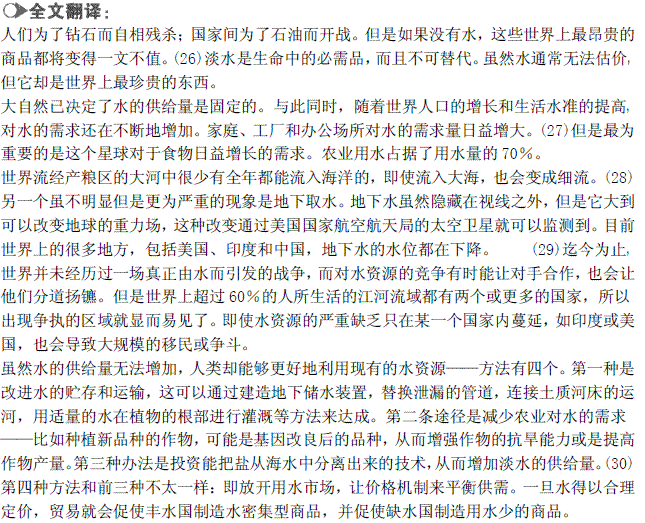
According to the last paragraph, the fourth way is "of a different kind" because( )
[A] the first three ways can increase the water supply, while the fourth one can't
[B] the first three ways can make a better use of water, while the fourth one can't
[C] the first three ways is technology-based, while the fourth one is market-based
[D] the first three ways can't balance the supply and demand of water, while the fourth one can
正确答案:C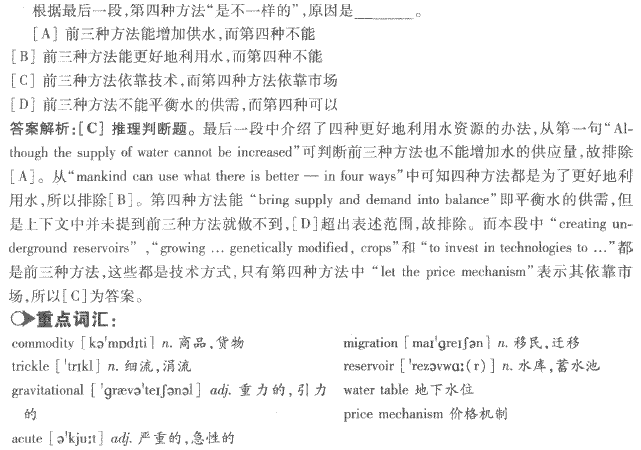
-
第2题:
2、Q-learning属于哪种算法
A.On-policy算法
B.Off-policy 算法
C.Model-based 算法
D.Value-based 算法
B -
第3题:
不需要建模环境,等待真实反馈再进行接下来的动作,这是哪种强化学习算法
A.Model-free方法
B.Model-based 方法
C.Policy-based 方法
D.Value-based 方法
错误 -
第4题:
3、Q-learning属于哪种算法
A.On-policy算法
B.Off-policy 算法
C.Model-based 算法
D.Value-based 算法
B -
第5题:
在实际的工作计划制定过程中,主要采用三种方法:“基于项目(Project-based)”,“基于流程(Process-based)”和基于时间(Time-based)。
以上都是 -
第6题:
17、不需要建模环境,等待真实反馈再进行接下来的动作,这是哪种强化学习算法
A.Model-free方法
B.Model-based 方法
C.Policy-based 方法
D.Value-based 方法
D