
根据下面资料,回答题 One of my children is spinning in a circle, creating a narrative about a princess as she twirls.?The other is building a rocket ship out of a discarded box, attaching propellers made of cardboard?and jumping in and out of her makeshift launcher
题目
One of my children is spinning in a circle, creating a narrative about a princess as she twirls.?The other is building a rocket ship out of a discarded box, attaching propellers made of cardboard?and jumping in and out of her makeshift launcher. It is a snow day, and I've decided to let them?design their own activities as I dean up and prepare a meal. My toddler becomes the spinning?princess, imagining her character's feelings and reactions. What seems like a simple story involves?sequencing, character development, and empathy for the brave princess stuck in her tower. The?rocket ship my first grader is working on needs a pilot and someone to devise the dimensions and?scale of its frame; it also needs a story to go with it. She switches between roles and perspectives,?between modes of thinking and tinkering.?
This kind of experiential learning, in which children acquire knowledge by doing and via?reflection on their experiences, is full of movement, imagination, and self-directed play. Yet such?learning is increasingly rare in early-childhood classrooms in the U.S, where many young children?spend their days sitting at tables and completing worksheets. Kindergarten and preschool in the U.S.?have become more and more academic, rigorously structuring kids' time, emphasizing assessment,?drawing a firm line between "work" and "play"--and restricting kids' physical movement. A study?from the University of Virginia released earlier this year found that, compared to 1998, children?today are spending far less time on self-directed learning--moving freely and doing activities that?they themselves chose--and measurably more time in a passive learning environment.?
With so few years under their belts, my 3- and 6-year-old daughters are still learning to inhabit?their bodies. They are learning how to maneuver themselves physically, how to orient themselves in?space. As Vanessa Durand, a pediatrician at St. Christopher' s Hospital for Children in Philadelphia,?says, freedom of movement is necessary for children to meet their developmental milestones:?"Children learn by experiencing their world using all of their senses. The restriction of movement,?especially at a young age, impedes the experiential learning process."?
Movement allows children to connect concepts to action and to learn through trial and error. "If?you walk into a good kindergarten class, everyone is moving. The teacher is moving. There are?structured activities, but generally it is about" purposeful movement," comments Nancy?Carlsson-Paige, a professor emerita of early-childhood education at Lesley University and the author?of Taking Back Childhood, describing the ideal classroom setup. In the classroom culture she?advocates for,"[Kids] are getting materials for an activity, they are going back and deciding what?else they need for what they want to create, seeing how the shape of a block in relation to another?block works, whether they need more, does it balance, does it need to be higher, is it symmetrical.?All of these math concepts are unfolding while kids are actively building and moving."?
Research has shown time and again that children need opportunities-to move in class. Memory?and movement are linked, and the body is a tool of learning, not a roadblock to or a detour away?from it. Any parent who has brought home a kindergartener after school, bursting with untapped?energy yet often carrying homework to complete after a seven-hour day, can reasonably deduce why?children today have trouble keeping still in their seats. Many children are getting 20-minute breaks,?or none at all On Florida, parents whose children have no recess have been campaigning to legislate?recess into the curriculum.) Recess, now a more frequent topic of research studies, has been found to?have "important educational and developmental implications." Schools that have sought to integrate?more movement and free play, such as short 15-minute recess periods throughout the day, have seen?gains in student attention span and instructional time. As Carlsson-Paige points out, "Recess is not a?separate thing in early-childhood education."?
Ben Mardell, a professor of early-childhood education at Lesley University and the project?director of the Pedagogy of Play initiative at Harvard's Project Zero observes that even when adults?do incorporate play into learning, they often do so in a way that restricts free movement and agency.?"The idea that there should be formal instruction makes it no longer play," says Mardell. ?"In play?the player is choosing to participate, choosing a goal, and directing and formulating the rules. When?there is an adult telling the kids, ?'This is what we are supposed to do,' many of the important?developmental benefits of play get lost."?
The role of play has been established not just as a part of learning, but as a foundation for?healthy social and emotional function. The National Association for the Education of Young?Children has published widely circulated position papers on the need for developmentally?appropriate teaching practices and for reversing the "unacceptable trends in kindergarten entry and?placement" that have been prompted largely by policy makers' demand for more stringent?educational standards and more testing. Some teachers are enacting changes, seeking ways to bring?movement back into the classroom. Lani Rosen-Gallagher, a former first-grade teacher for New?York City public schools and now a children's yoga instructor, explains the shift in thinking: "I?would have [my students] get out of their seats every 15 minutes and take a Warrior Pose or Lion' s?Breath, and then I could get 15 more minutes of work out of them." This kind of movement, she?said, also gives children space to develop self-awareness and self-regulation, to get to know?themselves as thinking individuals by connecting with the body.?
Play-based preschools and progressive schools (often with open room plans, mixed-age groups,?and an emphasis on creativity and independence) are seeing increased popularity. Enrichment programs engaging children in movement with intention (yoga, meditation, martial arts) are also gaining traction.?
These kinds of methods seek to give children back some of the agency their young minds and bodies crave, as less play and mobility lead to an uptick in anxiety in ever-younger students and even, according to Durand, a growing number of cases of children who need to see occupational therapists. Mindfulness practices such as guided breath and yoga can help mitigate the core symptoms of ADHD in children, ?(an increasingly common diagnosis), while the arts encourage?self-expression and motor-skill development.?
Emily Cross, a professor in the School of Psychology at the United Kingdom's Bangor?University, explains the impact of movement on memory and learning: New neuroscience research,?she said in an email, shows that active leaming--"where the learner is doing, moving, acting, and?interacting"--can change the way the brain works and can accelerate kids' learning process. While?passive learning may be easier to administer, she added, it doesn't favor brain activity. Cross, whose?research focuses on pre-teens and young adults, said she's found ?"very clear evidence that when?learners are actively engaged with moving their own bodies to music, in time with avatars on the?screen, their performance is vastly superior to when they're asked to engage in passive learning ...?[There are] striking changes in brain activity when we combine dance and music in the learning?context." In other words, people absorb a newly acquired skill-set better while doing, engaging their?bodies rather than simply observing.?
These research findings echo the observations and methodologies of educators who promote?active learning. As Sara Gannon, the director and teacher at Bethesda Nursery School, a highly?regarded play-based preschool in New Haven, Connecticut, that favors experiential learning over?direct instruction, in an email notes: ?"Unfortunately, there has been so much focus on forcing the?academics, and young children are being asked to do what they are just not ready to do ... of course,?we do teach letters and sounds, numbers and quantities--but through experiences and within a?context. That means, hands-on: counting the number of acorns a child found on the playground,?building with unit blocks, sounding out a child's name as they learn to write it, looking at traffic?signs on a walk." Yet while such developmentally oriented programs may benefit children, for now?they're unlikely to become widespread given the current focus on assessment and school readiness,?particularly in underserved communities.?
As my girls continued creating their own activity stations and imaginary worlds, the contrast?between how children operate versus what is often expected of them was apparent. It would be?unwise and impractical to pretend that children do not need any structure, or that academic skills are?unimportant in school. Yet it is necessary to recognize that the early-childhood classroom has been?significantly altered by increasingly rigorous academic standards in ways that rarely align with how?young children learn.?
?
??What′ s the author′ s altitude towards the importance of academic skills?查看材料
B..Objective.
C.Critical.
D.Tolerant
相似考题
更多“根据下面资料,回答题 ”相关问题
-
第1题:
下面哪个不是T31网管上单板通讯测试类型?()A.主备通讯环回
B.NCP业务处理环回
C.H口环回
D.NCPS口环回
参考答案:C
-
第2题:
根据下面资料,作答题。
【资料】教师在板书生字时,常把形近字的相同部分与相异部分分别用白色和红色的粉笔写出来。
你认为教师这种做法是否正确?( ) 查看材料
A.√
B.×
正确答案:A
。 -
第3题:
关于可转债的回售条款,下面说法正确的是( )。A.股票下跌时可转债持有人可以行使回售条款
B.回售条款由发行人行使
C.回售条款由可转债持有人行使
D.回售价格根据回售时标的股票市价确定答案:C解析:回售条款是指可转债持有者有权在约定的条件触发时按照事先约定的价格将可转债卖回给发行企业的规定。一般在股票价格下跌超过转换价格一定幅度时生效。 -
第4题:
根据除氧器压力大小,除氧器的分类下面不正确的是()。
- A、真空式
- B、大气式
- C、高压式
- D、回热式
正确答案:D -
第5题:
下面哪个不是T31网管上单板通讯测试类型?()
- A、主备通讯环回
- B、NCP业务处理环回
- C、H口环回
- D、NCPS口环回
正确答案:C -
第6题:
下面哪个油滤具有旁通功能()。
- A、“A”系统壳体回油滤
- B、“B”系统壳体回油滤
- C、主液压系统回油滤
- D、备用系统壳体回油滤
正确答案:C -
第7题:
问答题本人已经办理了东莞异地就医,现在深圳住院,不知道回东莞报销起付线标准是多少?需提供哪些资料?正确答案: 根据规定东莞医保市外三级医院起付标准2000元,市外二级医院起付标准1500元,市外一级医院起付标准1000元。办理报销手续需提供如下资料:
1、疾病诊断证明原件;
2、医疗收费收据/发票原件;
3、费用明细汇总清单原件;
4、住院病历/称入院记录复印件;
5、出院小结/称出院记录复印件;
6、身份证、社保卡原件及复印件;
7、《转院证明》原件(限转院者);
8、本人银行存折复印件(限所持社会保障卡不具备金融功能的参保人提供);
9、代办人身份证(他人代办)。解析: 暂无解析 -
第8题:
单选题下面哪个不是T31网管上单板通讯测试类型?()A主备通讯环回
BNCP业务处理环回
CH口环回
DNCPS口环回
正确答案: B解析: 暂无解析 -
第9题:
单选题关于可转债的回售条款,下面说法正确的是( )。A股票下跌时可转债持有人可以行使回售条款
B回售条款由可转债持有人行使
C回售条款由发行人行使
D回售价格根据回售时标的股票市价确定
正确答案: D解析: -
第10题:
问答题根据资料一至资料三,编制甲公司与该项投资相关的会计分录。正确答案:解析: -
第11题:
问答题作文提示: 根据下面的提示各写一封信,全文不少于350字。 你收到一封初中同学的来信,现在请给他回一封信,谈谈你最近的学习情况和生活情况,以及对不久的将来的打算。正确答案:
亲爱的小奇:
你好!
昨天收到你的信了。你最近过得怎么样?我们已经开学一个星期了。因为是学初,我很忙。不过收到你的信我很高兴,所以马上给你回信。
我们班换了一个新的语文老师,他30多岁,性格很好,很少批评我们,上课的时候还常常说笑话。他平时喜欢体育运动,身体很健康,看起来很年轻,下课以后有时带我们一块去操场踢球,大家都很喜欢他。我们班的好多女生都叫他帅哥呢。看来我这个帅哥的地位有点儿下降了。哈哈,跟你开个玩笑。说真的,我也很喜欢他,因为他教得好,我对语文比以前更感兴趣了,连写作文也不害怕了。我写的一篇作文还作为范文在课上念了呢。
这几天天气比较暖和,大概冬天很快就要过去了。今年冬天我们这儿一场雪也没下。你那边怎么样?我正在忙着准备考大学,很多事妈妈都不让我做,感觉好像失去了自由。不过她答应我,如果考上理想的大学的话,这个暑假就让我去云南旅游。你暑假有什么计划?如果方便的话,跟我一起去吧。
就写到这儿,等你的回信。
祝你
学习进步,心情愉快!
大明2008年3月5日解析: 暂无解析 -
第12题:
问答题根据资料(一)和资料(二)分析先诚公司采取的公司战略,并说明资料(一)中所采用战略的优缺点。正确答案:解析: -
第13题:
根据下面资料,回答第 82~86 题。
已知某商店三种商品销售量及价格资料,如表6—3所示。

第 82 题 宜采用的指数体系为( )。
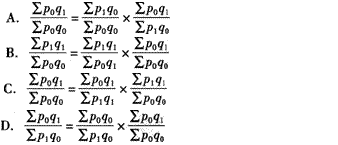 正确答案:B
-
第14题:
根据下面资料,作答题。
【资料】教师在检查学生知识掌握的情况时,通常其试卷不单纯选用选择题和判断题,而常常借助于填空题、简答题和论述题等。
教师采用的这种方法符合学生的记忆规律。( ) 查看材料
A.√
B.×
正确答案:A
。 -
第15题:
根据下面资料,回答94-96题
下面是某求助者的MMPl的测验结果:
轻躁狂量表的K校正分应当是( )。A.19
B.28
C.34
D.38答案:C解析:轻躁狂量表为Ma量表,其K校正分数的求法为原始分数加上一定比例的K分:Ma+0.2K,即31+0.2×14=33.8,约为34。 -
第16题:
下面哪种暂估方式不是存货核算的暂估方式?()
- A、月初回冲
- B、月末回冲
- C、单到补差
- D、单到回冲
正确答案:B -
第17题:
下面哪一项不是污水回用的途径()。
- A、回用于农业
- B、回用于工业
- C、回用于城市杂用
- D、回用于生活
正确答案:D -
第18题:
问答题我在东莞这边辞工了,准备回湖南邵阳老家,想把养老保险转回老家,请问需要什么资料?正确答案: 请在离职后凭身份证原件打印参保凭证带到新参保地即可。解析: 暂无解析 -
第19题:
单选题下面哪一项不是污水回用的途径()。A回用于农业
B回用于工业
C回用于城市杂用
D回用于生活
正确答案: C解析: 暂无解析 -
第20题:
问答题著名的京剧传统剧目《捉放曹》是根据《三国演义》的情节改编的。下面是京剧中陈宫唱词:“我先前自道他(曹操)宽宏量大,却原来是个无义的冤家,马行在狭道内我难以回马。”陈宫为何骂曹操“无义”?“狭道内难以回马”又为何事?请简要叙述《三国演义》相关的情节。(4回)正确答案: 曹操谋刺董卓未成,逃出京城,在中牟县被县令陈宫捉住,后陈宫钦佩他的忠义,弃了官职与他同逃。逃到成皋,多疑的曹操错杀吕伯奢家人,又杀死好心的吕伯奢以绝后患,所以陈宫骂曹操“无义”。从曹操杀死吕伯奢一家人中,陈宫看出曹操心狠手辣,想杀他,但又念及自己为国家跟他到此,杀之不义,于是弃曹操而他往。这就是他所说的“狭道内难以回马”。解析: 暂无解析 -
第21题:
问答题根据表面张力理论,回缩和缩孔是怎样产生的,如何克服?正确答案: 回缩:涂料施工时的机械作用力能把表面张力高的涂料涂覆于表面张力较低的底材上,但涂料并不能润湿底材表面,湿漆膜就倾向于收缩成球状,而溶剂挥发造成湿漆膜黏度增大,在被拉成球之前,黏度已高到使流动基本停止,这样就形成厚度不均的漆膜。
为消除漆膜回缩,得到厚度均匀一致的漆膜,涂料涂布前通常需要对工件进行预处理。金属等材料的表面张力大,需要清除其表面的有机污物,这称为除油。塑料等材料本身的表面张力小需要在它们的表面上引进极性大的基团,以增加其表面张力。
缩孔:缩孔是由低表面张力的小颗粒或小液滴产生的。这些低表面张力物质存在于底材上,涂料中或飞落在刚涂布好的湿膜上,就产生表面张力梯度,低表面张力的部分流动试图去覆盖周围高表面张力的部分,而溶剂的挥发增大黏度,阻碍流动,最终低表面张力处形成凹缩孔,外观是小圆形,像火山口。在缩孔的中心一般可看到杂质颗粒。
(1)增加湿漆膜厚度
(2)增大湿漆膜的黏度
(3)低表面张力的涂料较少形成缩孔,因为比这种涂料更低表面张力的杂物少
(4)涂料配方要合理。不能出现涂料中各个组分相互溶解性能不好,干燥过程中因溶剂挥发造成某些树脂溶解性不良而析出的现象。解析: 暂无解析 -
第22题:
问答题根据背景资料,简述对塌方段的处理措施。正确答案:解析: -
第23题:
问答题根据资料(1),计算A公司的合并商誉。正确答案:
A公司的合并商誉=9000-9100×90%=810(万元)。解析: 暂无解析 -
第24题:
问答题根据上述资料逐笔编制会计分录。正确答案:解析: