Corn originated in the New World and thus was not known in Europe until Columbus found it ______ in Cuba. A) being cultivated B) been cultivated C) having cultivated D) cultivating

题目

Corn originated in the New World and thus was not known in Europe until Columbus  

    found it ______ in Cuba.

    A) being cultivated     B) been cultivated  C) having cultivated  D) cultivating


相似考题

1.Most people have no idea of the hard work and worry in the collecting of those fascinating birds and animals that they pay to see in the zoo. One of the questions that is always asked of me is 1 I became an animal collector in the first 2 .The answer is that I have always been interested in animals and zoos. According to my parents, the first word I was able to say with any 3 was not the conventional"mamma"or"daddy", 4 the word "zoo", which I would 5 over and over again with a shrill 6 until someone 7 me up, would take me to the zoo. When I 8 a little older, we lived in Greece and I had a great 9 of pets, ranging from owls to seahorses, and I spent all my spare time 10 the countryside in search of fresh specimens to 11 to my collection of pets. 12 on I went for a year to the City Zoo, as a student 13 , to get experience of the large animals, such as lions, bears, bison and ostriches, 14 were not easy to keep at home. When I left, I 15 had enough money of my own to be able to 16 my first trip and I have been going 17 ever since then. Though a collector's job is not an easy one and is full of 18 , it is certainly a job which will appeal 19 all those who love animals and 20 .1. A. how B. where C. when D. whether2. A. region B. field C. place D. case3. A. clarity B. emotion C. sentiment D. affection4. A. except B. but C. except for D. but for5. A. recite B. recognize C. read D. repeat6. A. volume B. noise C. voice D. pitch7. A. close B. shut C. stop D. comfort8. A. grew B. was growing C. grow D. grown9. A. many B. amount C. number D. supply10. A. living B. cultivating C. reclaiming D. exploring11. A. increase B. include C. add D. enrich12. A.Later B.Further C.Then D.Subsequently13. A. attendant B. keeper C. member D. aide14. A. who B. they C. of which D. which15. A. luckily B. gladly C. nearly D. successfully16. A. pay B. provide C. allow D. finance17. A. normally B. regularly C. usually D. often18. A. expectations B. sorrows C. excitement D. disappointments19. A. for B. with C. to D. from20. A. excursion B. travel C. journey D. Trip

3.When you're promoted to a new job,chere are a lot of relationships that need recalibrating.You have a new boss,new direct reports,and,important.ly,a new set of peers.How can you show you have what it takes to be their equal wilhout appearing arrogant?How do you break out of the mentee/mentor dynamic?And what should you do abouL that one colleague who doesn't take you seriously?1.Congratulations on your promotion-now you need to prove you're worthy of it in the eyes of those who have known you as an underling."Any time you change your role or you get promoted,there's a change in the rules of engagement,"says Amy Jen Su,managing part.ner of Paravis Partners and coauthor of own the Room.She recommends staying focused on the long term.Your peer group"represents a potentially powerful coalition,"she says."They are your sounding boards and sources of support."Michael Watkins,the chairman of Genesis Advisers,a professor at IMD says"You need to fundamentally reset how people see you."2."It's understandable that you may feel vulnerable and insecure,"around your new peers-especially at first,says Watkins."You are stepping up to the big leagues."You may even suffer from a touch of imposter syndrome.But you mustn't let self-doubc get the better of you.And don't assume the worst.It's highly likely that these people"weighed in on your promotion"and believe you are up to the task,adds Jen Su."They see you as qualified and capable and ready for the job."Try not to get consumed by actively"tiying to prove yourself"to your new peer group,she says.3.Be confident-but not overconfident.Othewise you risk being seen as"too big for your boots,"says Watkins.Think about"how you want to be.perceived"by your peers,and"how they will form opinions"of you,says Wackins.Go in with a collaborative mindset."You want to be viewed as a person can work with,"he says.Your goal is to demonstrace that"you're someone with a depth of knowledge but who also wants to learn and help."Project competence."Show conviction;"but be humble about it."Don't,be deferential;be appropriately respectful."4.When you're the new kid on the block,it's"incumbent on you"to reach out to your colleagues and try to get to know them,says Watkins.Upon starting the job,he recommends scheduling"a series of one-on-ones"with your new peers and talk abouc how you will best work together going fonvard."These conversations needn't be confined to conference rooms or cubicles,adds Jen Su.She suggests inviting them out for coffee or lunch-"there's huge value to spending informal time with your colleagues batting ideas around."Your objective is to become a"good thought partner"to your peers."Seek to understand their perspectives,"she says."Ask for their input-not because you need t.heir permission,but because you appreciate their counsel."5.Recasting your professional persona takes time and your colleagues'opinions of you may not shift ovemight.Be preparecl,too,that cerlain Tough cookies on your team might try to test your mettle.whaTever you do,"don't take it personally,"says Jen Su."The more you let this person get under your skin,the more they will poke you."Watkins recommends"cultivating a Thick skin and setting boundaries"of what are you and aren't willing to do."Otherwise you risk getting run over."It's also important that you not lose sight of the relationships that matter most."What your peers think about you is important,but what your boss thinks about you is very important." 4选?A.Be patient B.Build bridges. C.Project professionalism. D.Think positively. E.Tread lightly at first. F.Understand team dynamics. G.What the experts say.

4.(D)The latest research suggests a more prosaic, democratic, even puritanical view of the world. The key factor separating geniuses from the merely accomplished is not a divine spark. It’s not I.Q., a generally bad predictor of success, even in realms like chess. Instead, it’s deliberate practice. Top performers spend more hours (many more hours) rigorously practicing their craft. If you wanted to picture how a typical genius might develop, you’d take a girl who possessed a slightly above average verbal ability. It wouldn’t have to be a big talent, just enough so that she might gain some sense of distinction. Then you would want her to meet, say, a novelist, who coincidentally shared some similar biographical traits. Maybe the writer was from the same town, had the same ethnic background, or, shared the same birthday.This contact would give the girl a vision of her future self. It would give her some idea of a fascinating circle she might someday join. It would also help if one of her parents died when she was 12, giving her a strong sense of insecurity and fueling a desperate need for success. Armed with this ambition, she would read novels and life stories of writers without end. This would give her a primary knowledge of her field. She’d be able to see new writing in deeper ways and quickly perceive its inner workings.Then she would practice writing. Her practice would be slow, painstaking and error-focused. By practicing in this way, she delays the automatizing process. Her mind wants to turn conscious, newly learned skills into unconscious, automatically performed skills. By practicing slowly, by breaking skills down into tiny parts and repeating, she forces the brain to internalize a better pattern of performance. Then she would find an adviser who would provide a constant stream of feedback, viewing her performance from the outside, correcting the smallest errors, pushing her to take on tougher challenges. By now she is redoing problems—how do I get characters into a room—dozens and dozens of times. She is establishing habits of thought she can call upon in order to understand or solve future problems.The primary trait she possesses is not some mysterious genius. It’s the ability to develop a purposeful, laborious and boring practice routine. The latest research takes some of the magic out of great achievement. But it underlines a fact that is often neglected. Public discussion is affected by genetics and what we’re “hard-wired” to do. And it’s true that genes play a role in our capabilities. But the brain is also very plastic. We construct ourselves through behavior.76. The passage mainly deals with _____.A. the function of I.Q. in cultivating a writer B. the relationship between genius and successC. the decisive factor in making a genius D. the way of gaining some sense of distinction

参考答案和解析

A

being cultivated
首先,使用被动形式
其次,find sth doing搭配。
因此,选A

更多“CornoriginatedintheNewWorldandthuswasnotknowninEuropeuntilColumbusfoundit______inCuba.A)beingcultivatedB)beencultivatedC)havingcultivatedD)cultivating”相关问题
  • 第1题:


    二、考题解析
    【教案】
    Teaching aims:
    Knowledge aim:
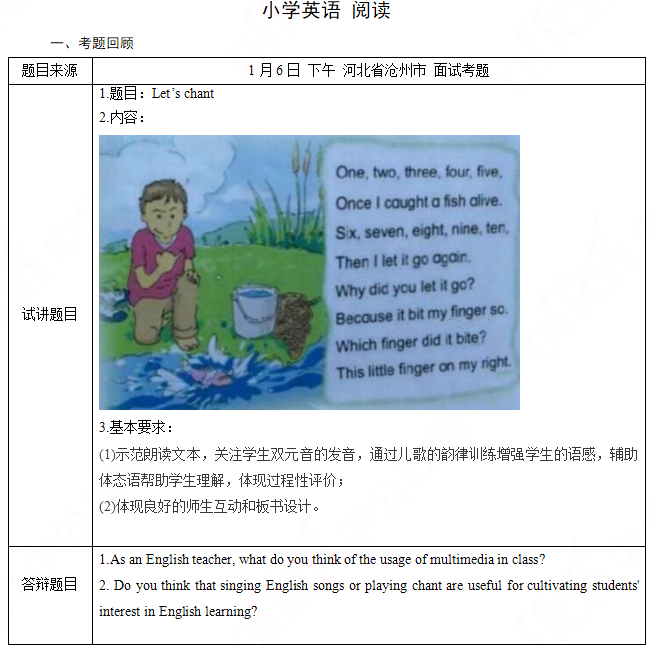
    Students will master the sound /ai/ in the words “five”, “alive” and so on.
    Ability aim:
    Students will apply the sound correctly in real communication.
    Emotional aim:
    Students will be more interest in speaking English.
    Key and difficult point:
    Key Point: Students will master the sound /ai/ in the words “five”, “alive” and so on.
    Difficult Point: Students will apply the sound correctly in real communication.
    Teaching procedure:
    Step 1: Warming-up
    1. Greetings.
    2.Play a chant they have learned “tomato, tomato, wash, wash, wash” and lead them to learn another chant this class..
    Step 2: Presentation
    1. Students watch the picture and tell the teacher what they can see in the picture, and the teacher guide them to present the first part of the chant. Then students watch the picture carefully and predict what’s wrong with the boy, then the teacher guide them to present the last part of the chant.
    2. Students observe the sentences and find out what common letters they can find.
    3. The teacher teaches them correct pronunciation of the letter “i” in “five”, “right” and so on.
    Step 3: Practice
    1. Read the pronunciation /ai/ and the words that includes “i” repeatedly.
    2. Listen to the tape and follow the tape, paying attention to the intonation of the chant.
    3. Students work in pairs to make a chant in 5 minutes.
    Step4: Production
    1. The teacher writes more words that includes the sound /ai/and students try to read them.
    2. Students work in groups to make a story using the picture and the words with the sound /ai/ on the blackboard.
    Step5: Summary and Homework
    Summary: ask a student to conclude the content of the lesson and summarize with the whole class.
    Homework: ask students to search other pronunciation of the letter “i” and list those words accordingly.
    Blackboard design:


    1. As an English teacher, what do you think of the usage of multimedia in class?
    2. Do you think that singing English songs or playing chant are useful for cultivating students' interest in English learning?


    答案:
    解析:
    1.
    Multimedia help students to understand our class more smoothly and vividly and enhance their thinking ability. With images, audios and videos, knowledge that is difficult to understand in English is well presented. The students can more truly feel the content of the text, which is helpful to solve difficulties. In the environment of multimedia students can also develop abstract thinking and divergent thinking.
    2.
    As far as the activity such as singing or chant itself is concerned, it is very interesting and can attract students' attention. The time for students to keep concentrating is limited. If you add such activities as some songs and chants that students like, you can not only attract students' attention, but also cultivate their interest in learning. Therefore, combining knowledge and activities in the classroom allows students to learn while playing and even achieve better effects.

  • 第2题:

    单选题
    These observations indicates the extreme difficulty in cultivating this precious thing called democracy.
    A

    elaborate      

    B

    treasonable    

    C

    valuable  

    D

    deliberate


    正确答案: D
    解析: precious宝贵的。valuable与之同义。elaborate精心制作的。treasonable背叛的。deliberate审慎的。故意的。

  • 第3题:

    He's spent years cultivating a knowledge of art.

    A:using
    B:denying
    C:sharing
    D:developing

    答案:D
    解析:
    这句话的意思是:他用了数年的时间学习艺术知识。句中“cultivate”意为“培养”。四个 选项中A项意为“使用”;B项意为“否认”;C项意为“分享”;D项意为“发展,培养”。因此只有 D项最为合适。

  • 第4题:

    单选题
    What does “methods that focused on taking advantage of students interests” (line 3) mean?
    A

    Teaching methods that take advantages of students’ interests.

    B

    Teaching methods that aim at finding and cultivating students’ interests in academic courses.

    C

    Teaching methods that use students’ interests to earn money.

    D

    Heavy systematization of school education.


    正确答案: B
    解析:
    本题主要考查的是短语focus on和take advantage of,尤其是后一短语,意为“利用,从中得利”,在本题中它指的是从学生的兴趣角度出发。参见文章第一段第二句话:直到四五十年代,改革运动对繁重的系统化教学提出反对,而又提出了从学生兴趣的角度出发的教学方法。