
假设有定义: int d[3]={10,20,30}; struct sp { int a; int *b; }t[3]={70,&d[0],80,&d[1],90,&d[2]},*p=t; 则表达式++(p->a)+*++p->b的值为();
题目
假设有定义: int d[3]={10,20,30}; struct sp { int a; int *b; }t[3]={70,&d[0],80,&d[1],90,&d[2]},*p=t; 则表达式++(p->a)+*++p->b的值为();
相似考题
更多“假设有定义: int d[3]={10,20,30}; struct sp { int a; int *b; }t[3]={70,&d[0],80,&d[1],90,&d[2]},*p=t; 则表达式++(p->a)+*++p->b的值为();”相关问题
-
第1题:
有以下程序includestruct STU{char name[10];int num;};void f(char*name, intnum){s 有以下程序 #include <string.h> struct STU { char name[10]; int num; }; void f(char *name, int num) { struct STU s[2]={{"SunDan",20044},{"Penghua",20045}}; num=s[0].num; strcpy(name,s[0].name); } main() { struct STU s[2]={{"YangSan",20041},{"LiSiGuo",20042}},*p; p=&s[1]; f(p->name,p->num); printf("%s %d\n",p->name,p->num); } 程序运行后的输出结果是
A.SunDan 20042
B.SunDan 20044
C.LiSiGuo 20042
D.YangSan 20041
正确答案:A
解析:题目中定义的函数f()包含两个参数,一个字符指针,—个整型变量。当修改参数指针所指向的内容的时候,实参所指的内容也被修改,即传址调用;但只是修改参数变量的内容,则实奉不受影响,即传值调用。因此,主函数调用f()函数后,第1个参数被修改成函数中s[0]的name成员,第2个参数不受影响,还是主函数中s[1]的num成员。故最终输出SunDan20042。应该选择A。 -
第2题:
阅读下列说明和C代码,将应填入(n)处的字句写在对应栏内。
【说明】
本题给出四个函数,它们的功能分别是:
1.int push(PNODE*top,int e)是进栈函数,形参top是栈顶指针的指针,形参e是入栈元素。
2.int pop(PNODE*top,int*e)是出栈函数,形参top是栈顶指针的指针,形参e作为返回出栈元素使用。
3.int enQueue(PNODE*tail,int e)是入队函数,形参tail是队尾指针的指针,形参e是入队元素。
4.int deQueue(PNODE*tail,int*e)是出队函数,形参tail是队尾指针的指针,形参e作为返回出队元素使用。
以上四个函数中,返回值为。表示操作成功,返回值为-1表示操作失败。
栈是用链表实现的;队是用带有辅助结点(头结点)的单向循环链表实现的。两种链表的结点类型均为:
typedef struct node {
int value;
struct node * next;
} NODE, * PNODE;
【函数1】
int push(PNOOE * top,int e)
{
PNODE p = (PNODE) malloc (sizeof (NODE));
if (! p) return-1;
p->value=e;
(1);
*top=p;
return 0;
}
【函数2】
int pop (PNODE * top,int * e)
{
PNODE p = * top;
if(p == NULL) return-1;
* e = p->value;
(2);
free(p);
return 0;
}
【函数3】
int enQueue (PNODE * tail,int e)
{ PNODE p,t;
t= *tail;
p = (PNODE) malloc(sizeof(NODE));
if(!p) return-1;
p->value=e;
p->next=t->next;
(3);
* tail = p;
return 0;
}
【函数4】
int deQueue(PNODE * tail,int * e)
{ PNODE p,q;
if(( * tail)->next == * tail) return-1;
p= (* tail)->next;
q = p ->next;
* e =q ->value;
(4)=q->next;
if(,tail==q) (5);
free(q);
return 0;
}
正确答案:(1)p->next=*top (2)*top=p->next或* top=(*top)->next (3)t->next=p或(*tail)->next=p (4)p->next或(*tail)->next->next (5)*tail=p或*tail=(*tail)->next
(1)p->next=*top (2)*top=p->next或* top=(*top)->next (3)t->next=p或(*tail)->next=p (4)p->next或(*tail)->next->next (5)*tail=p或*tail=(*tail)->next 解析:(1)插入结点p后,p应当指向插入前头结点,所以填入p ->next=*top。(2)出栈后,头指针应指向它的下一结点,所以填入 *top=p->next或*top=(*top)->next。(3)入队时,需要将结点插入队尾,所以应当填入(*tail)->next=p或t->next=p(t也指向尾结点)。(4)出队时,需要删除队头结点,通过(*tail)->next可以得到对队头结点的引用。(4)处是正常删除队头结点的情况,空格处应填入头结点指向下一结点的指针,即p->next或(*tail)->next->next。(5)处是需要考虑的特殊情况,即队列中最后一个元素出队后,要更新队尾指针,即填入*tail=p或*tail=(*tail)->next。 -
第3题:
有以下程序: inCludestructNODE{ int num; structNODE*next; }; main() {StructN00E 有以下程序:
#inClude <stdlib.h>
struct NODE{
int num;
struct NODE *next;
};
main()
{ Struct N00E *p,*q,*r;
int sum;0;
p=(struct NODE *)malloc(sizeof(struct NODE));
q=(struct NODE *)malloc(sizeof(struct NODE));
r=(struct NODE *)malloc(Sizeof(struct NODE));
p->num=1;q->num=2;r->num=3;
p->next=q;q->next=r;r->next=NULL;
sum+=q->next->num;sum+=p->num;
printf("%d\n",sum);
}
执行后的输出结果是
A.3
B.4
C.5
D.6
正确答案:B
解析:本题中定义了一个结点structNODE,在主函数中定义了三个结点变量指针p、q和r,接着通过malloc函数分配了三个结点并让p、q和r分别指向他们,再接着给p、q和r所指向的结点的hum域赋值为1、2、3,然后让结点p指向q,让q指向r,r指向NULL。显然q->next->num的值为指针r所指向结点的num域的值为3,p->num的值为指针p所指向结点的num域的值为1,故最后输出s的值为3+1=4。所以,4个选项中选项B符合题意。 -
第4题:
有以下程序: includestruct STU (char name[10]; int num; }; 有以下程序: #include <string.h> struct STU (char name[10]; int num; }; void f(char *name, int num) {struct STU s[2]={{"SunDan",20044}.{"Penghua",20045}}; num=s[0].num; strcpy(name,s[0].name); } main() {struct STU s[2]={{"YangSall",20041},{"LiSiGao",20042}},*p;p=&s[1]; f(p->name,p->num); printf("%s%d\n",p->name,p->num); } 程序运行后的输出结果是 ______。
A.SunDan 20042
B.SunDan 20044
C.LiSiGuo 20042
D.YangSan 20041
正确答案:A
解析:本题主函数中定义了结构体类型的指针变量p,并使其指向了结构体类型的数组s[1],并通过调用函数f改变了指针变量p所指向的结构体中成员变量name的值,但并未改变其num的值。这是因为函数f中的形参name是一个字符型指针变量,它指向了主函数中指针变量p所指向的结构体的成员变量name,所以对函数f中的形参*name的改变也就是刘主函数中p->name的改变,而函数f中对形参num的改变并不会影响主函数中p->num的值,因为此时传递给num的是一个值,而不是地址。 -
第5题:
以下程序的输出结果是( )。 {int x;int*y;}*p; int dt[4]={1,2,3,4}; struct st aa[4]={2,&dt[0],3,&dt[0],4,&dt[0],5,&dt[0],}; {p=aa; pfintf("%d\n",++(p->x)); }
A.1
B.2
C.3
D.4
正确答案:C
解析:程序首先将指针p指向结构体数组aa的首地址,通过p->x引用了结构体数组aa[0]的第一个成员2;++(p->x)是将p->x的值加1,所以输出结果为3。 -
第6题:
有以下程序includestruct ord{ int x,y;} dt[2]={1,2,3,4};mare(){struct ord*p=dt; p 有以下程序 #include<stdio.h> struct ord { int x,y;} dt[2]={1,2,3,4}; mare() { struct ord*p=dt; printf("%d,",++p->x); printf("%d\n",++p->y); } 程序的运行结果是______。
A.1,2
B.2,3
C.3,4
D.4,1
正确答案:B
解析:本题主要考查了结构体变量成员的引用,有三种形式来引用结构体变量中的成员:(1)结构体变量名.成员名:(2)指针变量名->成员名;(3)(*指针变量名).成员名。其中点号“.”称为成员运算符;箭头“->”称为结构指向运算符。由于p->x指向了结构体的的成员x,而结构体中x的值为1,因此自增后变为2,p->y指向了结构体的成员y,而结构体中y的值为2,因此自增后变为3,因此,选项B是正确的。 -
第7题:
有以下程序: includestruct NODE{ int num; struct NODE*next; } main() {structNOD 有以下程序:
#include<stdlib.h>
struct NODE{
int num;
struct NODE *next;
}
main()
{ struct NODE *p,*q,*r;
int sum=0;
p=(struct NODE *)malloc(sizeof(struct NODE));
q=(Struct NODE *)malloc(sizeof(struct NODE));
r=(Struct NODE *)malloc(sizeof(struct NODE));
p->num=1; q->num=2; r->num=3;
p->next=q; q->next=r; r->next=NULL;
sum+=q->next->num;sum+=p->num;
printf("%d\n",sum);
}
执行后的输出结果是( )。
A.3
B.4
C.5
D.6
正确答案:B
解析:本题中定义了一个结点结构stmct NODE,在主函数中定义了3个结点指针p、q和r,接着通过malloc函数分配了3个结点并让p、q和r分别指向他们,再接着给p、q和r所指向的结点的num域赋值为1、2、3,然后让结点p指向q,让q指向r, r指向NULL。显然q->next->num的值为指针r所指向结点的hum域的值为3,p->hum的值为指针p所指向结点的num域的值为1,故最后输出s的值为3+1=4。所以,4个选项中选项B符合题意。 -
第8题:
下面程序的输出结果为( )。 struct st {int x;int *y;}*p; int dt[4]={10,20,30,40); struct st aa[4]={50,&dt[0],60,&dt[1],70,&dt[2],80,&dt[3]}; main() { p=aa; printf("%d\n",++p->x); printf("%d|n",(++p)->x); printf("%d\n",++(*p->y)); }
A.10 20 20
B.50 60 21
C.51 60 21
D.60 70 31
正确答案:C
解析:第1个输出语句中由于->的优先级高于++,因此先取结构体的分量x,再对x的值加1,再输出。p的初值为结构体数组aa的首地址即a[0]的地址,a[0]的x分量值为50,加1后输出51。第2个输出语句中++p被括号括起来,括号的优先级与->相同,自左至右结合,因此先对p加1,再取p所指向的元素的x分量的值。p加1后p指向数组元素a[1],a[1]的x分量的值为60,输出60。第3个输出语句中括号的优先级高于++,因此先求括号中表达式的值,又由于->的优先级高于*,所以先取p所指向的数组元素的y分量的值,p所指向的元素为a[1],y分量的值为&dt[1]。&dt[1]是一个存储单元的地址,是数组dt第2个元素的地址值,再取该存储单元中的值为20,最后对20加1,输出21。选项C为所选。 -
第9题:
有以下程序:struct S{int n;int a[20];};void f(struct S*P){int i,j,t;for(i=0;in-1;i++)fo 有以下程序: struct S{int n;int a[20];}; void f(struct S*P) { int i,j,t; for(i=0;i<P->n-1;i++) for(j=j+1;j<P->n-1;j++) if(p->a[i]>p->a[j]) {t=P->a[i];p->a[i]=P->a[j];p->a[j]=t} } main() {int i;struct S s{10,{2,3,1,6,8,7,5,4,10,9}}; f(&s); for(i=0;i<s.n;i++)printf("%d",s.a[i]);} 程序运行后的输出结果是( )。
A.3
B.4
C.5
D.6
正确答案:A
解析:在主函数main()中定义了一个整型变量i和一个结构体变量s。f()函数中,定义了一个结构体指针类型的指针p,外层循环变量i表示数组的第i个元素,内层循环j表示数组的第i+1个元素,调用f()函数,通过指针变量p来引用结构体成员,并把它们进行从小到大排序,最后输出。 -
第10题:
设有以下C语言说明语句,则值为210的表达式是(33)。 struct s { int a;int *b;}; Int x0[]={110,120},x1[]={210,220}; struct s x[]={{100},{200}},*p=x; x[0].b=x0;x[1].b=x1;
A.(++p)->a
B.*p->b
C.*(p++)->b
D.*(++p)->b
正确答案:D
解析:注意到本试题中x为结构体数组,则数组名x代表数组首地址。x[0]、x[1]代表结构体数组元素。对于指向结构体数组的指针变量p,每次“+1”则指向下一个结构体数组元素。本题中++p后,由x[0]改指向x[1]。结构体数组x在定义时赋初值,但未对结构体成员b赋初值。语句“x[0].b=x0;x[1].b=x1;”的作用是对结构体数组x的成员b赋初值。对于选项A,(++p)->a等价于x[1].a==200。选项B,*p->b等价于*(x->b)==*x0==110。选项C,*(p++)->b等价于*(x[0].b)==110=x0[0]。选项D,*(++p)->b等价于*(x[1].b)==210=x1[0]。注意,在测试以上1个选项的输出值时,不能放在同一个printf函数中进行输出。因为函数中的参数运算顺序在C语言中是自右向左进行的,而p的值又是不断变化的,所以相互之间会产生影响。 -
第11题:
有以下程序 inGludestruct NODE { int num; struct NODE *next; } main() {struct N 有以下程序
#inGlude<stdlib.h>
struct NODE {
int num;
struct NODE *next;
}
main()
{ struct NODE *p,*q,*r;
int sum=0;
p=(struct NODE*)malloc(sizeof(struct NODE));
q=(struct NODE*)malloc(sizeof(struct NODE));
r=(stnlct NODE*)malloc(sizeof(struct NODE));
p->num=1;q->num=2;r->num=3;
p->next=q;q->next;r;r->next=NULL;
sum+=q->next->Num,sum+=p->num;
printf("%d\n",sum);
}
执行后输出结果是
A.3
B.4
C.5
D.6
正确答案:B
解析:本题中定义了一个结点struct NODE,在主函数中定义了三个结点变量指针p、q和r,接着通过malloc函数分配了三个结点并让p、q和r分别指向他们,再接着给p、q和r所指向的结点的num域赋值为1、2、3,然后让结点p指向q,让q指向r,r指向NULL。显然q->next->num的值为指针r所指向结点的num域的值为3,p->hum的值为指针P所指向结点的num域的值为1,故最后输出s的值为3+1=4。 -
第12题:
若已定义 struct num{ int a; int b; float f; } n={1,3,5.0}; struct num *p=&n; 则表达式p->b/n.a*++p->b的值是 ① ,表达式(*p).a+p->f的值是 ② 。
正确答案: ①12
②6.0 -
第13题:
阅读以下说明和C++程序,将应填入(n)处的字句写在对应栏内。
[说明]
下面程序实现十进制向其它进制的转换。
[C++程序]
include"ioStream.h"
include"math.h"
include
typedef struct node {
int data;
node*next;
}Node;
Class Transform.
{
DUDlic:
void Trans(int d,int i); //d为数字;i为进制
void print();
private:
Node*top;
};
void Transform.:Trans(int d,int i)
{
int m,n=0;
Node*P;
while(d>0)
{
(1);
d=d/i;
p=new Node;
if(!n){
p->data=m;
(2);
(3);
n++;
}
else{
p->data=m;
(4);
(5);
}
}
}
void Transform.:print()
{
Node*P;
while(top!=NULL)
{
p=top;
if(p->data>9)
cout<<data+55;
else
cout<<data;
top=p->next;
delete p;
}
}
正确答案:(1) m=d%i (2) top=p (3) top->next=NULL (4) p->next=top (5) top=p
(1) m=d%i (2) top=p (3) top->next=NULL (4) p->next=top (5) top=p 解析:本题考查C++编程,主要考查了链表的使用。
所有的问题只出在函数Trans中,它的功能是完成将十进制数d转换为任意进制i的数,并存在数组中。函数中首先定义了一个指向链表结点的指针,然后开始进行转换,进制转换应该是一个很常见的问题,就是不断的求模运算,所以(1)处应填入“m=d%i”。然后,我们要把求模的结果保存到链表结点中,并使链表首指针指向该结点,结点中指向下一个结点”的指针设为空,所以(2)处应填入“top=p”,(3)处应填入“top->next=NULL”。由于求模运算是从低位到高位逐位求出的,所以在我们在进行完第二次求模运算后,应该将第二次运算的结果放到链表首位,所以(4)处应填入“P->next=top”,(5)处应填入“top=p”。 -
第14题:
以下程序的输出是( )。 struct st { int x;int *y; } *p; int dt[4]={10,20,30,40}; struct st aa[4]= {50,&dt[0],60,&dt[1],70,&dt[2],80,&dt[3]}; main() { p=aa; cout<<++p->x; cout<<(++p)->x; cout<<++(*p->y); }
A.10 20 20
B.50 60 21
C.51 60 21
D.60 70 31
正确答案:C
-
第15题:
以下程序的输出是______。 struct st {int x;int*y; }*p; int dt[4]={10,20,30,40}; struct st aa[4]={50,&dt[0],60,&dt[1],60,&dt[2],60,&dt[3]}; main() { p=aa; printf("%d\n",++(p->X)); }
A.51
B.11
C.50
D.60
正确答案:A
解析:p是指向结构aa的结构指针,++(p->x)是对p的x成员的值进行加1。p=aa使得p指向aa的首地址,p->x的值为50,那么++(p->X)就等于51。 -
第16题:
有以下程序 includestruct tt { int x; struct tt *y; } *p; s 有以下程序 #include <stdio.h> struct tt { int x; struct tt *y; } *p; struct tt a[4]= {20,a+ 1,15,a+2,30,a+3,17,a}; main() { int i; p=a; for(i=1; i<-2; i++) { printf("%d,", p->x ); p=p->y; }
A.20,30,
B.30,17
C.15,30,
D.20,15,
正确答案:D
解析:题目中定义了一个全局结构体数组a,结构体中包含两个成员:一个int型变量x和一个自身类型指针y。所以,结构体数组a的初始化列表中每两个初始化一个结构体元素。主函数通过一个for循环,连续调用了两次输出函数printf(),每次输出p所指元素的x成员值。p初始化时指向数组 a的首地址,即a[0]的位置,所以第1次输出的值为20。然后又将a[0]的成员y的值赋给p,y在初始化时是a+1,所以p在第2次输出时指向的元素是a[1],故第2次输出的值为15。所以本题最终输出结果是“20,15,”,应该选择D。 -
第17题:
以下程序运行后的输出结果是【 】。
struct NODE
{int num;struct NODE *next;
};
main()
{struct NODE s[3]={{1,'\0'},{2,'\0'},{3,'0'}},*p,*q,*r;
int sum=0;
s[0].next=s+1;s[1].next=s+2;s[2].next=s;
p=s; q=p->next; r=q->next;
sum+=q->next->num; sum+=r->next->next->num;
printf("%d\n",sum);
}
正确答案:5
5 解析:程序通过语句“s[0].next=s+1;s[1].next=s+2;s[2].next=s;”将结构体变量s中各结点链接成了一个循环链表,即最后一个结点的指针域指向了头结点(s[2].next=s;),整个链表形成一个环,并通过语句“p=s;q=p->next;r=q->next;”将结构体指针变量p、q、r指向了各结点,具体结构如下图: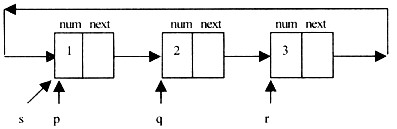
故本题输出的sum=3+2=5。 -
第18题:
对于下述说明,不能使变量p->b的值增1的表达式是______。 struct exm { int a; int b; float c }*p;
A.++p->b
B.++(p++)->b
C.p->b++
D.(++p)->b++
正确答案:D
解析:p->b应作为一个整体看待,++p->b和p->b++都使变量b增1, ++(p++)->b先使b增1,再使p后移,D中表达式的含义是使p+1所指结构体变量中的成员 b的值增1。 -
第19题:
有以下程序 includestruct NODE{ int num; struct NODE *next;}; main( ) 有以下程序
#include <stdlib.h>
struct NODE{
int num;
struct NODE *next;};
main( )
{ struct NODE *p,*q,*r;
int sum=0;
p=(struct NODE *)malloc(sizeof(struct NODE));
q=(struct NODE *)malloc(sizeof(struct NODE));
r=(struct NODE *)malloc(sizeof(struct NODE));
p->num=1;q->num=2;r->num=3;
p->next=q;q->next=r;r->next=NULL;
sum+=q->next->num;sum+=p->num;
printf(“%d\n”,sum);}
执行后的输出结果是
A.3
B.4
C.5
D.6
正确答案:B
解析:q—>next—>num=3,p—>num=1,所以结果为4。 -
第20题:
下而程序实现十进制向其他进制的转换。
[C++程序]
include"ioStream.h"
include"math.h"
include <conio.h>
typedef struct node{
int data;
node *next;
}Node;
class Transform
{
public:
void Trans(int d,int i); //d为数字;i为进制
void print();
private:
Node *top;
};
void Transform.:Trans(int d,int i)
{
int m,n=0;
Node *P;
while(d>0)
{
(1) ;
d=d/i;
p=new Node;
if(!n){
P->data=m;
(2) j
(3) ;
n++;
}
else{
p->data=m;
(4) ;
(5) ;
}
}
}
void Transform.:print()
{
Node *P;
while(top!=NULL)
{
p=top;
if(P->data>9)
cout<<data+55:
else
cout<<data;
top=p->next;
delete P;
}
}
正确答案:(1)m=d%i (2) top=p (3) top->next=NULL (4) p->next=top (5) top=p
(1)m=d%i (2) top=p (3) top->next=NULL (4) p->next=top (5) top=p 解析:本题考查C++编程,主要考查了链表的使用。
所有的问题只出在函数Trans中,它的功能是完成将十进制数d转换为任意进制i的数,并存在数组中。函数中首先定义了一个指向链表节点的指针,然后开始进行转换,进制转换应该是一个很常见的问题,就是不断地求模运算,所以(1)处应填入“m=d%i”。然后,我们要把求模的结果保存到链表节点中,并使链表首指针指向该节点,节点中指向下一个节点的指针设为空,所以(2)处应填入top=p,(3)处应填入top->next=NULL。由于求模运算是从低位到高位逐位求出的,所以在进行完第二次求模运算后,应该将第二次运算的结果放到链表首位,所以(4)处应填入p->next=top,(5)处应填入top=p。 -
第21题:
以下程序的输出是( )。 struct st { int x;int *y; } *p; int dt[4]={10,20,30,40}; struct st aa[4]={50,&dt[0],60,&dt[0],60,&dt[0],60,&dt[0],}; main() { p=aa; cout<+<+(p->x); }
A.10
B.11
C.51
D.60
正确答案:C
-
第22题:
设有以下C语言说明语句。 struct { int x,y;} s[2]={{1,2),{3,4}),*p=s,*q=s; 则表达式++p->x和表达式(++q)->x的值分别为(34)。
A.1、1
B.1、3
C.2、3
D.3、3
正确答案:C
解析:表达式++p->x中->(指向运算符)优先级高于++(自增运算符),所以先求出p->x中的值1。由于结构体数组元素(或结构体变量)中的成员是有存储单元的,可以像普通变量一样使用,因此++运算是针对s[0].x成员的,即该成员中的值自增后由1变为2。对于表达式(++q)->x,则是q先自增,q指向s[1],输出s[1].x成员中的值3。 -
第23题:
有以下程序: includestruct NODE{int nurn;struct NODE *next; }; main() { struct 有以下程序:
#include <stdlib.h>
struct NODE{
int nurn;
struct NODE *next;
};
main()
{ struct NODE *p,*q,*r;
int sum=0;
P=(struct NODE*)malloc(sizeof(struct NODE));
q=(struct NODE*)malloc(sizeof(struct NODE));
r=(struct NODE*)malloc(sizeof(struct NODE));
p->num=1;q->num=2;r->num=3;
p->next=q;q->next=r;r->next=NULL;
sum+=q->next->num;sum+=p->num;
Printf("%d\n",sum);
}
执行后的输出结果是( )。
A.3
B.4
C.5
D.6
正确答案:B
解析:本题中定义了一个结点structNODE,在主函数中定义了三个结点变量指针p、q和r,接着通过malloc函数分配了三个结点并让p、q和r分别指向他们,再接着给p、q和r所指向的结点的num域赋值为1、2、3,然后让结点p指向小让q指向r,r指向NULL。显然q->next->num的值为指针r所指向结点的num域的值为3,p->num的值为指针p所指向结点的num域的值为1,故最后输出s的值为3+1=4。所以,4个选项中选项B符合题意。 -
第24题:
问答题若已定义 struct num{ int a; int b; float f; } n={1,3,5.0}; struct num *p=&n; 则表达式p->b/n.a*++p->b的值是 ① ,表达式(*p).a+p->f的值是 ② 。正确答案: ①12
②6.0解析: 暂无解析