
Reading ComprehensionDirections:There are two passages in this part.Each passage is followed by some questions or unfinished statements. For each of them there are four choices marked A,B,C and D. Youshould decide on the best choice.Questions 56- 60 are b
题目
Reading Comprehension
Directions:There are two passages in this part.Each passage is followed by some questions or unfinished statements. For each of them there are four choices marked A,B,C and D. Youshould decide on the best choice.
Questions 56- 60 are based on Passage One:
Passage One
The largest earthquake (magnitude里氏9.5)of the 20th century happened on May 22,1960 0ff the coast of South Central Chile.
It generated(生成) one of the most destructive Pacific-wide tsunami(海啸). Near the generating area, both the earthquake and the tsunami were very much destructive, particularly in the coastal area from Concepcion to the south end of Isla Chiloe.The largest tsunami damage occurred at Isla Chiloe-the coastal area closest to the epicenter(震中).Huge tsuna- mi waves measuring as high as 25 meters arrived within l0 to 15 minutes after the earthquake, killing at least two hundred people, sinking all the boats, and flooding half a kilometer inland.
There was large damage and loss of life at Concepcion, Chile's top industrial city.Near the city of Valdivia, the earthquake and following aftershocks generated landslides which killed 18 people. At the port city of Valparaiso, a city of 200,000, many buildings collapsed. A total of 130,000 houses were destroyed-one in every three in the earthquake zone and nearly 2,000,000 people were left homeless.
Total damage losses, including agriculture and industry, were estimated(估计) to be over a half billion dollars. The total number of deaths related with both the tsunami and the earthquake was never found accurately for the region. Estimates of deaths reached between 490 and 57,002 with no distinction(差别) as to how many deaths were caused by the earthquake and how many were caused by the tsunami. However, it is believed that most of the deaths in Chile were caused by the tsunami.
Where did the largest tsunami damage occur? ( )
A. Concepcion
B. Isia Chiloe
C. Valdivia
D. Valparaiso
相似考题
更多“Reading ComprehensionDirections:There are two passages in this part.Each passage is follow ”相关问题
-
第1题:
Reading Comprehension
Directions:There are two passages iⅡthis part. Each passage is followed by some questions or unfinished statements. For each of them there are four choices marked A,B,C and D.You should decide on the best choice.
Questions 56- 60 are based on Passage One:
Passage One
The law says that women should have the chance of doing the same jobs as men and earn the same as them.
The reality is very different.Women lose because, 25 years after the Equal Pay Act,many of them still get paid less than men.
They lose because they do lower-paid jobs which men just won't consider.And they lose because they are the ones who interrupt a career to have children.
All this is reported in an independent study ordered by the Government's Women's Unite.
The biggest problem isn't equal pay in workplaces such as factories.It is a sort of work women do.Make a list of the low-paid jobs, then consider who do them.
Try nurses, secretaries, cleaners, clerks, teachers in primary schools, dinner ladies,and child care helpers. Not a lot of men among that group, are there?
Yet some of those jobs are really important.Surely no one would deny that about nurses and teachers, for a start.
So why do we reward the people who do them so poorly? There can be only one answer—because they are women.
This is not going to be put right overnight. But the Government which employs a lot of them, and other bosses have to make a start.
It is disgraceful(可耻的) that we have gone into the 21st century but still treat women as second-class citizens.
Women should have the chance of doing the same jobs and be paid equally as Men( ).
A. after 25 years
B. according to the law
C. as a result of the Equal Pay Act
D. because women are as strong as men
正确答案:B
B[解析]根据the Equal Pay Act应该做到男女平等,C选项错在并不是因为the Equal Pay Act的结果。所以答案选B。 -
第2题:
Organizing students to anticipate the general content of the reading passages should be in the step of_____.A.post-reading
B.while-reading
C.pre-reading
D.test答案:C解析:考查阅读技能教学。
C选项,题干的意思是组织学生预测文章的内容应该是在哪个环节?四个选项分别为
读后、读中、读前和测试环节。根据PWP教学模式,该活动应该在读前环节。
故此题的正确答案为C。 -
第3题:
Teachers believing in the _______model in a general sense usually follow the sequence of teaching new words, sentences and then the whole passage in the ,reading class.A.interactive
B.bottom-up
C.top-down
D.interactional答案:B解析:考查阅读教学模式。阅读课的教学模式通常包括boaom-up(自下而上),top-bouom(自上而下).intelactive(交互补偿模式)。自下而上的模式是遵循从小的语言单位开始进行教学,直到最大的教学单位.即单词、句子和篇章,这也正是题目中说到的模式,故选B。 -
第4题:
小学英语?阅读
一、考题回顾
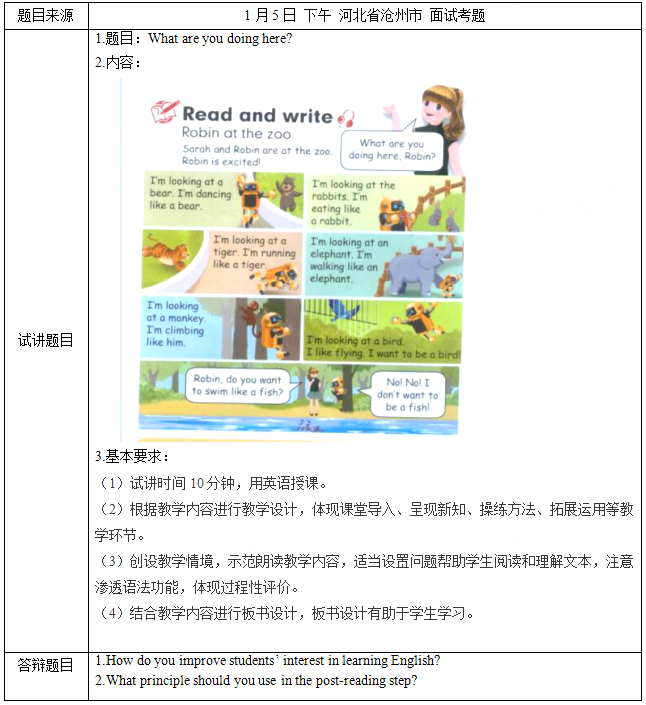
二、考题解析
【教学设计】
Teaching aims:
Knowledge aim:
Students will master the meaning and usage of the structure “be doing” through reading the passage.
Ability aim:
Students will apply the “be doing” to communicate with each other in real situation.
Emotional aim:
Students will be more interest in learning English.
Key and difficult point:
Key Point: Students will master how to improve reading abilities through finding main idea and details.
Difficult Point: Students will apply the “be doing” to communicate with each other in real situation.
Teaching procedure:
Step 1: Warming-up
1. Greetings.
2. Play a riddle and students guess the animals, such as “long nose, big ears and strong body——elephant”, then lead to the topic of “let’s go to the zoo to see what animals are doing”.
Step 2: Pre-reading
1. According to the title, students have a prediction about what kinds of animals are mentioned in the passage.
Step 3: While-reading
1. Fast reading: students read the passage fast and figure out what kinds of animals are mentioned in the passage then make a list.
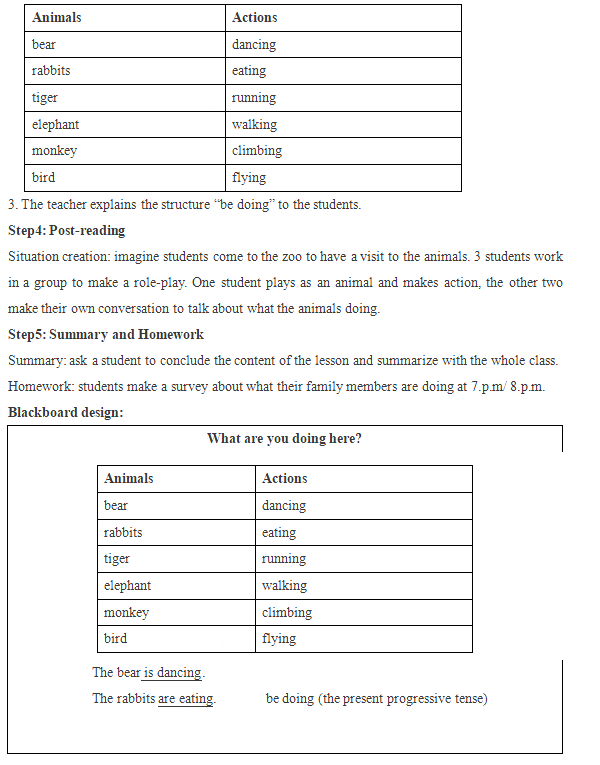
2. Careful reading: students read the passage carefully and answer the question: what are the animals doing? Then fill in the blanks.
1. How do you improve students’ interest in learning English?
2. What principle should you use in the post-reading step?答案:解析:1.
In the process of English teaching, teachers should enrich the teaching approaches, not only teach students through "listening, speaking, reading", but also integrate situational teaching, so that students can feel the diversity of teaching and learning.
Besides, teachers can make use of the form of cooperative study and organize various practice activities in the classroom to create an atmosphere of mutual assistance and cooperation, so that students have positive sense of learning.
2.
First, we should persist in the communicative principle. In the production step of reading
class, students should be organized in groups to cultivate their speaking ability and communicative ability. In this way, we can reach the New Curriculum Standard.
Then, we should insist on the truth principle. That means we should provide more real materials that are closet to students’ real life, such as situation creation like what I did in this class. In this way, students’ interest can be aroused and they can apply what they’ve learned in real communication. -
第5题:
The teacher can help the students to read a text by reading it aloud while they follow in their books.()
A对
B错
错
略 -
第6题:
单选题Which of the following most accurately states the role of the first paragraph in relation to the passage as a whole?AIt summarizes two theories. the relative merits of which are debated in the passage.
BIt puts forth an argument that the rest of the passage is devoted to refuting.
CIt introduces a new concept that the rest of the passage expands upon.
DIt frames the background and relevance of the material to follow.
EIt outlines the majorthemes of each of the four paragraphs to follow.
正确答案: D解析:
推断题。第一段讲述了科学家们在了解疟疾方面所做的努力:“It took scientists centuries to deconstruct”,然后将疟疾与人类的健康联系“has contributed to the difficulty of devishag effective public health measures to combat the disease”,故D项的表述正确。 -
第7题:
单选题Which best characterizes how the impact of science on chimpanzees is treated in these two passages?AThe author of Passage 1 lauds the benefits science has produced, while the author of Passage 2 speaks hopefully of possible future benefits.
BBoth of the passages react with distrust to the idea of using science to assess chimpanzees.
CThe first passage lists the studies that showed positive chimp interactions, while the author of Passage 2 refutes their claims,
DThe first passage suggests that science can have a positive impact on perceptions about chimps, whereas the second passage views science as almost universally negative.
EThe author of the first passage is more apt to justify using chimps in science than the author of Passage 2.
正确答案: E解析:
两篇文章对于科学的态度是不同的。第一篇文章列举一些关于黑猩猩的科学发现,体现了科学的正面作用。而第二篇文章提到黑猩猩被滥用为科学实验的对象,故选D项。 -
第8题:
单选题A swift current occurring in a narrow passage connecting two large bodies of water which is produced by the continuously changing difference in height of tide at the two ends of the passage is called a(n)().Ahydraulic current
Brectilinear current
Crotary current
Dharmonic current
正确答案: A解析: 暂无解析 -
第9题:
单选题The two passages differ in their perspectives on the debate between industrialists and environmentalists mainly in that Passage 1 emphasizes ______.Amathematics, while Passage 2 emphasizes psychology
Bdeficiencies in the debate, while Passage 2 emphasizes progress in the debate
Cthe irrelevance of externalities, while Passage 2 emphasizes their importance
Dthe impact on taxpayers, while Passage 2 emphasizes the views of politicians
Epollution, while Passage 2 emphasizes recycling
正确答案: C解析:
第一篇文章主要是关于环境保护论争论的缺陷,提到取得的进步很少,妖魔化成分太多,并提议进行更广范围的分析。第二段表明Costanza的作品认为实业家和环境保护主义者没有明显差别,论辩因此取得了进步。 -
第10题:
判断题The teacher can help the students to read a text by reading it aloud while they follow in their books.()A对
B错
正确答案: 对解析: 暂无解析 -
第11题:
单选题Which of the following best describes the relationship between the two passages?APassage 2 describes a significant. and discovery that contradicts the argument of Passage 1.
BPassage 2 offers a theory that supports the main point in Passage 1.
CPassage I provides a possible reason for the scientific inquiry presented in Passage 2.
DPassage 1 relates an anecdote that explains the popular misconception in Passage 2.
EPassage 2 provides a historical context for the discovery described in Passage 1.
正确答案: D解析:
第一篇文章主要讲到工具的创造是人类发展史上很重要的一步。第二篇文章主要描述了一项重大发现,即人类什么时候开始创造工具的的。C项最好地将两篇文章的关系表现出来了,第一篇文章提到工具创造对人类进化有很大的影响,第二篇文章继而对第一篇文章提出的问题作进一步研究,故选C项。 -
第12题:
单选题Which statement most accurately describes the difference between the two passages?APassage 1 deals less directly with the exportation of chimpanzees than does Passage 2.
BPassage 1 is less concerned with the interaction between man and the land than is Passage 2.
CPassage I pertains to a species in its indigenous habitat while Passage 2 addresses the same animal in nonnative settings.
DPassage I ends with an expression of optimism and Passage 2 does not.
EPassage I introduces a species and describes its status worldwide, while Passage 2 limits its discussion of that species to its activities in the Northern Hemisphere.
正确答案: A解析:
第一篇文章主要是关于黑猩猩在自然栖息地生存的情况。第二篇文章主要是关于黑猩猩在非自然栖息地生存的情况。故选C项。 -
第13题:
We can learn from the passage that______.
A. Reading is just a way of knowing new words
B. A good reader must learn more new words
C. A good reader can think before, while and after reading
D. Reading takes a lot of time
正确答案:C35.答案为C 通过短文得知好的阅读者懂得在读前、读中、读后思考。A、B与短文内容冲突,D选项未提到。
-
第14题:
Which of the following can' NOT be used as a pre-reading task?__________A.Predicting what a passage is about.
B.Creating a word web related to a topic.
C.Listening to the recording of a passage.
D.Sharing what is already known about a topic.答案:C解析:考查阅读教学。在读前这一环节教师需要向学生介绍主题.引起学生的兴趣.向学生讲授关键的词句,介绍背景知识,帮助学生消除文化障碍,以便更好地理解文章。A项是预测文章内容,B项对应呈现新单词,D项则是分享关于主题已知的知识。故选C。 -
第15题:
Teachers’believing in the_____model in a general sense usually follow the sequence of teaching new words,sentences and then the whole passage in the reading class.A.interactive
B.bottom-up
C.top-down
D.interactional答案:B解析:考查阅读技能。
B选项,the bottom-up approach,自下而上模式。是一种从单词,短语,句型,最后到对整篇文章理解的一种模式。符合题意,故此题的正确选项为B。
A选项,互动,不合题意,故排除。
C选项,自上而下模式,和B正好相反,从文章到句型,短语,单词,不合题意,故排除。
D选项,相互作用的,不合题意,故排除。
故此题的正确选项为B。 -
第16题:
初中英语?阅读
一、考题回顾

二、考题解析
【教案】
Teaching aims:
Knowledge aim:
Students will grasp and understand the main and detailed information of the passage.
Ability aim:
Students will improve their reading and speaking skills.
Emotional aim:
Students will foster the interest and desire of learning English and take part in speaking activities actively.
Key and difficult point:
Key Point: Students will totally understand the content of the passage.
Difficult Point: Students will foster the interest of learning English, and take part in speaking activities.
Teaching procedure:
Step 1: Warming-up
1. Greetings.
2. Show students pictures about different types of transportation and naturally lead to today’s topic.
Step 2: Pre-reading
1. Ask students two questions and some volunteers will be invited to share their answers.
Q1: How do you come to school?
Q2: How do your parents go to work?
2. Ask students to predict the main idea of the passage based on the above discussion and pictures on the screen.
Step 3: While-reading
1st reading: Ask students to read the passage for the first time and check their prediction. Besides, they need to find out which countries are mentioned in the passage and circle them.
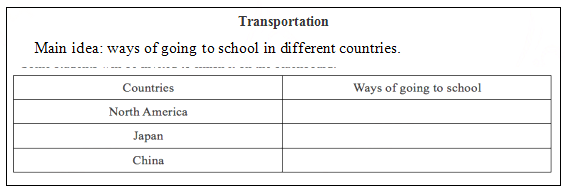
2nd reading: Ask students to read the passage for the second time and complete the following chart. Some students will be invited to finish it on the blackboard.

Step4: Post-reading
Discussion: ask students to discuss the advantages and disadvantages of different modes of transportation. Four students in a group, after five minutes, some groups are supposed to show their results.
Step5: Summary and Homework
Summary: ask a student to conclude the content of the lesson and summarize with the whole class.
Homework: ask students to investigate their friends’ way of going to school and find some interesting ways of transportation on the Internet.
Blackboard design:
1. How to improve students’ reading and speaking ability in your class?
2. How did you evaluate the performance of students in the class?答案:解析:1.
It is very important to improve students’ reading and speaking abilities. In my class, I take three specific steps to improve their reading and speaking abilities. Firstly, before reading the article, I ask the students to guess the main idea of the article according to my questions and pictures on the screen. As you heard, this can not only exercise students’ guessing ability, but also help them read the passage with questions. In the while-reading part, I set two times of reading, namely extensive reading and intensive reading. Obviously, students’ scanning ability and the ability to grasp detailed information can be improved. It also helps them form good reading habits. As for speaking ability, I organize a discussion activity without standard answers. Students can express their views freely in groups. In this way, their reading and speaking abilities can be improved a lot.
2.
Students are under a stage of growing and developing. They are eager to be evaluated and encouraged by their teachers. At the same time, students are different, and their acceptance and abilities of learning are different. Therefore, in my class, I have adopted a variety of different evaluations. For the students who answered correctly, I would praise them directly, such as “excellent”, “you can find the answer so fast”. For those students who dare not answer questions or did not find out the answers, I just encouraged them and guided them to say the answers, and gave some encouraging comments, like “nice try!”, “you’ve made a great progress”. Also, some students made mistakes. In my class, instead of directly blaming the student for being wrong, I asked other students to help him/her and give them a proper evaluation. -
第17题:
The teacher can help the students to read a text by reading it aloud while they follow in their books.()
正确答案:错误 -
第18题:
单选题The passage is mainly about _____.Aa better way to download an Ebook
Ba new kind of book-the Ebooks
Cthe new version of Ebooks
Dthe fun of reading Ebooks
正确答案: A解析:
主旨题。本文主要是围绕电子书展开的,包括电子书如何阅读、阅读器的功能、电子书的便捷之处、电子书的订阅以及电子书的下载。B项更具有概括性。其他选项都只是论述的一个方面,不能起到概括全文的作用。 -
第19题:
单选题A swift current occurring in a narrow passage connecting two large bodies of water,which is produced by the continuously changing difference in height of tide at the two ends of the passage,is called a().Ahydraulic current
Brectilinear current
Crotary current
Dharmonic current
正确答案: C解析: 暂无解析 -
第20题:
单选题Which of the following is the best title for the passage?AMain Characters ofPopular Books
BThe #1000BlackGirlBooks Campaign
CWhitewashing in the Publishing Industry
DFurther Reading for Kids and Teenagers
正确答案: B解析: -
第21题:
单选题The most important information to be obtained from a barometer is the().Adifference between the reading of the two pointers,which shows wind direction
Blast two figures of the reading of the pointer,such as 87,76,or 92
Cpresent reading of the pressure,combined with the changes in pressure observed in the recent past
Dweather indications printed on the dial (such as cold,wet,etc.) under the pointer
正确答案: D解析: 暂无解析 -
第22题:
单选题____ stage for teaching writing includes discussion or debate on relevant topic, picture telling, free talk, reading short passages, and audio-visual activities.APre-writing
BWhile-writing
CPost-writing
DIntensive-wntmg
正确答案: B解析: -
第23题:
单选题According to the passage, a “pacing” device ______.Ais used to time a student’s reading speed
Bis not used in most speed reading courses
Cis used as an aid to vocabulary learning
Dshould be used whenever we read alone
正确答案: D解析:
本题答案可由文章第一句话破折号后面的句子“some timing device which lets the student know how many words a minutes he is reading”得出。A项的意思与句意相符。故选A。